Another fallen bird. This time a mourning dove.
~
Meanwhile, at night I sometimes still can hear the shirring of wings as flocks head south. And the owls converse.
Another fallen bird. This time a mourning dove.
~
Meanwhile, at night I sometimes still can hear the shirring of wings as flocks head south. And the owls converse.
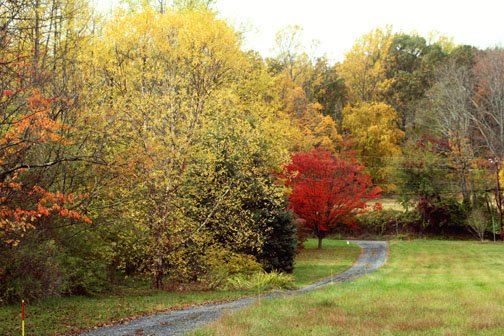
October. I’ve put my vegetable garden to bed, deadheaded and pruned the perennials. The leaves are yellow and red and orange and brown, and the white pines are dropping their old needles. Quieter days, quieter nights: fewer insects, amphibians, and birds making their noises.
Well–there are the danged woodpeckers…
I expect to keep this blog less frequently this month, or to make the posts shorter, because I am taking part in what is for me a new endeavor: an online poetry workshop. I am taking a month-long class with Daisy Fried through Providence’s Fine Arts Center, 24 Pearl Street.
Daisy Fried lives in Philadelphia, 24 Pearl St. is in Rhode Island, and my fellow workshop participant-peers live in NH, MA, IN, MC, ME, NY, VA, NJ, VT, CA, AL and IL. Oh, the amazing connectivity of the world-wide web!
I’m somewhat tech-savvy but only to a limited degree, and reading online is still cumbersome for me. Nonetheless, I am curious to see how the virtual critique will work, given that we are not face-to-face as we comment, enthuse, and suggest. Interpretation takes on multiple meanings in an environment such as this one. And whether I can keep on top of the comments and reading! That’s another type of challenge during the academic year for me.
I feel thrilled to be back in the position of student, though. I’m the sort of person who might stay in school perpetually if I could manage it. Even autodidacts sometimes enjoy the camaraderie of peers.
If you are interested in the process, and how it goes for me…I shall eventually report back on these “pages”!
Gardening has been a dismal endeavor this past summer; I just did not devote my usual energies to the landscape, the perennials, or even to the vegetable patch. For a number of reasons I will not enumerate here, I did not even get to the weeding. I wish I could say I spent my energy on writing, revising, and submitting my poems–alas, no.
After a weekend of trying to catch up (in two days) on two months of garden neglect, I caught up on my reading a bit and found this delightful and appropriate post on Lesley Wheeler’s blog: “Restlessly pruning the overstuffed closet of a poetry manuscript.” Her analogy is to a closet and wardrobe, but the underlying concept of assessing and culling works for perennial beds and poetry manuscripts (and attics, and basements, and garages, and…)
This post appeals to me because, in addition to rallying myself to the cause of deadheading and pruning and weeding in the great outdoors, I have also been working on cleaning up two manuscripts. Wheeler asks of her work:
Wise questions to ask of a book of poems; also see Jeffrey Levine’s Tupelo Press blog for his exhaustive take on the process.
Clearly, reorganizing and evaluating my collections are not the kind of work I could accomplish in two days.
In that way, weeding and pruning the gardens offers more immediate satisfaction, though it left me with some scratches, rashes, and a sore back!
Sanskrit for circle. Symbolic of completeness, unifying principles. The container that holds the center. The cosmic center and the spiritual center, including the void (being able to recognize that the “self” is also a void, a construct).
This deep practice–the emptying of self and the entering into completeness and unity with everything (becoming One)–intrigues me but seems very far beyond my grasp. If consciousness can be envisioned as a set of experiential layerings that the mind braids into a narrating self, illusory but convincing, I can imagine feeling One with them. But that’s theory, not genuine practice.
“You and I are all as much continuous with the physical universe as a wave is continuous with the ocean.” ~Alan Watts
I am a physical being in the universe; this, too, I understand. Somehow, that doesn’t make meditation easier for me–even though I have always been a highly reflective person.
Trying too hard to empty the mind defeats the purpose, of course. The practice of compassion as meditation (see Thich Nhat Hanh and Pema Chödrön) seems a more effective way for me to enter into a sense of oneness and completeness. I am definitely experiencing beginner’s mind, perhaps complicated by my interests in philosophy, psychology, neurology, and art.
So I turn, constantly, to nature for an immersion in something other than the human self: completion of the cycle evident in every plant and creature. See the mandala of the sunflower above. Contemplate the circle–what it contains, in this case, pollen, seeds, a tiny bee; what encircles the circle: the petals that fade so rapidly, the sun, the air.
And then I turn to my reading again. Hungry mind (appetite). But I found this wonderful column by Kate Murphy in the recent New York Times: “No Time to Think.” Quite fitting, given these recent ruminations!
~
~
From J. M. Barrie’s Peter Pan: “Fairies have to be one thing or the other, because being so small they unfortunately have room for one feeling only at a time.”
~
From W. H. Auden: “…poetry might be defined as the clear expression of mixed feelings.” For Auden, this communication of mixed feelings didn’t mean ambiguity; it referred to double focus–seeing or feeling or otherwise knowing two conflicting feelings simultaneously. Something that, according to Barrie, fairies could not do.
~
The mixed-ness of life presents many of its irritants, but also many of its joys. Think about the amazing complexity of a human being, a consciousness, a sentience: the mish-mash of experiences filtered through a mish-mash of other experiences and through unique neurological channels. I relish the fringes and edges of things such as meadows, rivers, horizons, roads, neighborhoods, and cultures. Combinations are more interesting than homogeneity. Paradoxes are more exciting than indelible rules.
I appreciate the design of formal gardens, or swaths of tulips; but a cottage garden interests me for longer, as do bogs and wetlands and the borders of woodlands. Most of the poems I love best, those that resonate the deepest and longest, express multiple and mixed possibilities. I enjoy poetry that can be interpreted several ways, or that twists back on itself and points out a paradox or a different focus, poetry that opens up perspectives and challenges expectations and perceptions. Mixed media, mixed expression, mixed feelings, mixed perennial borders, mixed forests, mixed neighborhoods…these juicy collages of experience keep the brain lively and interested.
They also pose good challenges for meditation. One can concentrate or focus on the unity of the disparities, for example. Lose yourself in a meadow.
This summer, it seems the birds have fledged a bit later than usual–not by much, but enough for me to notice. And this crop of birds seems to be a reckless bunch of adolescents. At least twice a day I hear a soft, feathered body thud against a windowpane.
~
We have taken a few of the actions recommended by the Humane Society (see page here if you want some advice), but some of our windows are quite high off the ground and we haven’t been able to bird-proof all of them. Most summers we hear just a few thuds, find the occasional body of a casualty or rescue a stunned survivor before a neighborhood cat gets it.
This year? I think I’ve heard two dozen thuds during the past 10 days. I am surprised at how many of the injured simply recover from their brief concussion, sit dazed for a few seconds, or continue to fly; but youth is resilient.
~
This woodpecker, for example, was more dazed than most. But it gradually calmed itself into a recuperated state and hopped off my hand and into the hedgerow.
~
~
I always come away amazed at such encounters with “wild animals.” There is so much I don’t know about them. They are gorgeous. I find myself spending long minutes just examining the details of a feather, a toenail (claw-nail?), a tongue, an eye.
It seems a privilege to hold one, and a privilege to let it go.
Even though this bird will no doubt repay me by tearing more holes in the wooden siding of our house.
Well, the birds were here first.
~
Not as lucky, this poor beauty was, alas, “maximally bent and broken.” Like the language of poetry.
“…Let us admit that reading with us is just a drug we cannot do without–who of this band does not know the restlessness that attacks him when he has been severed from reading too long, the apprehension and irritability, and the sigh of relief which the sight of a printed page extracts from him?–and so let us be no more vainglorious than the poor slaves of the hypodermic needle or the pint-pot.” ~ W. Somerset Maugham, “The Book-Bag”
In June and July, my situation lets up enough that I am not in my office 40 hours a week and can, for a time, attend to the garden or the hiking trail or avail myself of more time to read. Yesterday, I browsed through the campus library and came away with seven or eight books. How I loved that feeling when I was a child: walking through the stacks, thumbing through card catalogues, picking and choosing, now with deliberation, now with impulse, until I had reached the borrowing limit!
It is, in a way, a kind of addiction, though for the past three decades I have been a bit more studied and less compulsive in my reading habits. A bit. Plants and animals, and the workings and seasons of the garden, are my alternate texts when the printed page is unavailable or my eyes feel tired. Certainly I read on-screen quite often, but that process is not nearly as fulfilling. I have downloaded a book by Deleuze (Difference and Repetition) as a kind of experiment; I’m not at all sure that philosophy will be comfortable to read on screen, but I suspect I might prefer reading philosophy on a computer than reading a novel on a computer.
For me, the worst thing about onscreen reading, as I possess neither laptop nor tablet computer, is the inability to stretch on a lounge chair or curl up on a sofa (or, best of all, in a hammock) while reading. And the pleasant experience of leaf-shadows gently caressing the off-white pages of a paper book, the tone of the paper shifting ever slightly as the light changes, the sensation of dozing off with a book over one’s face when the sun gets hot…book addicts find these aspects as enjoyable as the intellectual response to the material, the words themselves.
Several significant events & celebrations appear on this summer’s horizon, but with any luck I can employ my library cards to good purpose a few more times before the fall semester arrives.
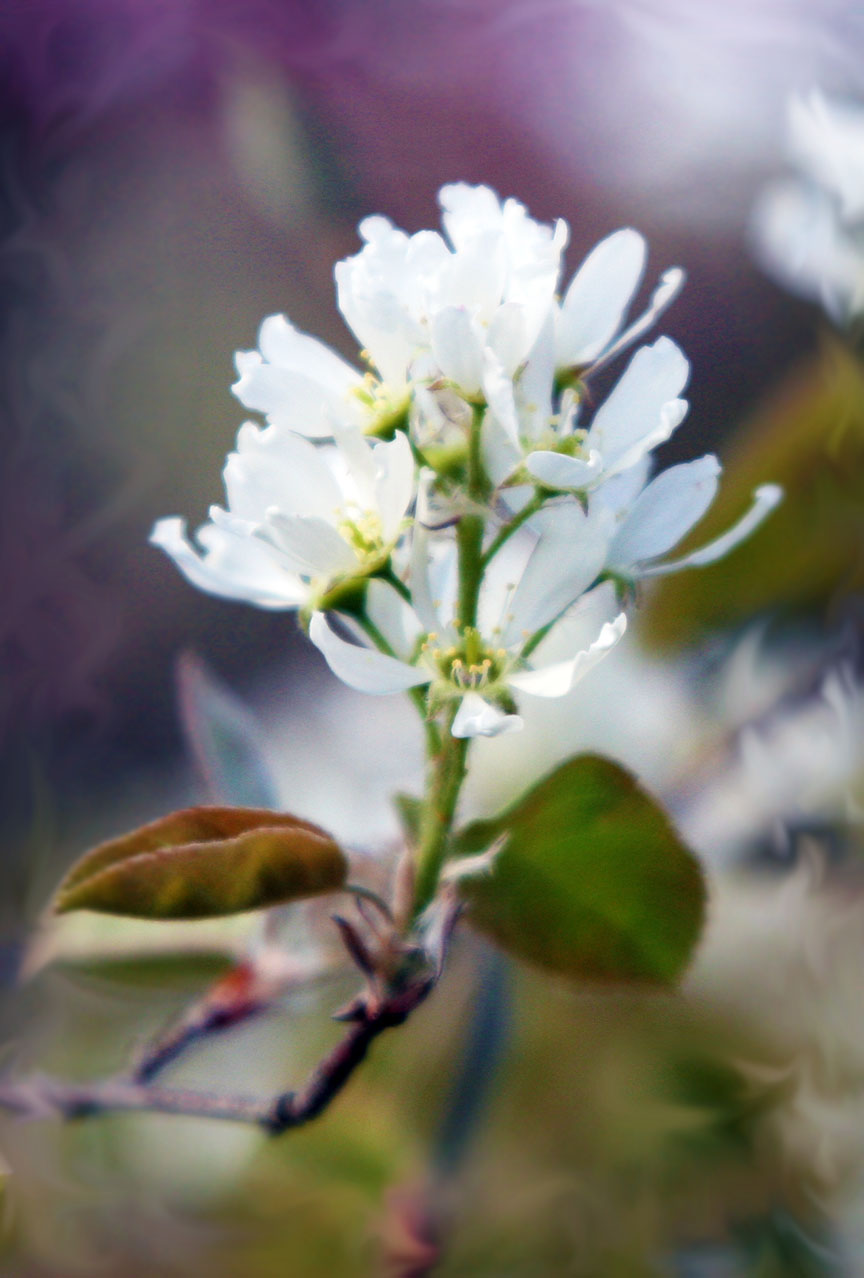
…I had one this year. By which I mean I had a fever caused by a viral infection that hit me at the peak of blossom time, and as a result, I spent a warm spring week mostly indoors.
I could have been out in the garden, weeding and prepping soil and planting beans, had I been hale and well. Instead–well, this year the vegetables will get a late start, and the perennial beds may not be particularly well-groomed, and the pears are unlikely to be pruned.
Laid low for over a week, I have regained enough wherewithal to return, gradually, to work and to managing short walks around the yard. Often, I take my camera. I wonder why I feel compelled to photograph the plants. I see them year after year. I enjoy looking at far better photographs by far better photographers than I, yet I prostrate myself before the gallium (mayflowers) and try to capture some feeling of their delicacy. I have pondered whether this desire stems from some Western-Romantic cultural hand-me-down, echoes of Wordsworth et al…but then I remember how Asian poetry revels in the blossom and the budding leaf and the moon’s reflection on water, and how ancient poems compare a man’s curly hair to hyacinths or a woman’s blush to the rose.
The aesthetic appeal of springtime–and all the seasons–of landscape, and of animal grace and strength–has been around for eons.
Because my brain has felt fried, I have not expended much effort on words lately.
So I will let the images speak for me
…and for themselves.
~◊~
~~
I left the budding springtime in eastern Pennsylvania to visit Glasgow, Scotland for six days. Springtime along the north Atlantic was full of gorse blooms, primroses, daffodils beginning to fade (though there were several hillside hosts of golden daffodils worthy of Wordsworthian apostrophe), early tulips, and wildflowers alongside lakes, streams, and rivers, even in the city.
The days are longer than they are at my latitude, and the diurnal length has an effect on many of the bloom times. I saw few saucer magnolias–too windy, too chilly–but there were stellata magnolias and, to my surprise, camellias apparently thrive in Glasgow as long as they are planted in a sheltered area.
I spent a fine Saturday afternoon at the Glasgow Botanic Gardens, which are lovely. The greenhouses there have an excellent collection of carnivorous plants: sundews from South Africa, pitcher plants from North America.
The entire span of days I visited, the weather was sunny. Glaswegians took advantage of the unusual break in the weather and were out in droves, picnicking at the Botanic Gardens Saturday and–on Easter Sunday–wandering Loch Lomond’s shores.
Like many of the rivers, canals, and lakes in the region, Loch Lomond is frequented by swans. It is nesting season, and I was thrilled to find cobs patrolling the waters and the female swans draped elegantly over their large nests. I didn’t see any cygnets, though I saw some ducks and ducklings.
Many years ago, my first book of poetry was a collaborative chapbook with my dear friend David Dunn. The book is listed on my Books page, but it is out of print. The title is The Swan King.
I returned home Monday, where my yard is resplendent with daffodils, hyacinths, grape hyacinths, magnolia, forsythia, and a zillion tufts of wild garlic (onion grass, we used to call it) punctuating the green grass of the lawn.
But lovely as my view was this morning, I wish I could have spent longer at Loch Lomond and the Trossachs…