Subtle spring

Today, inspired by an apparent and, I hope, lasting thaw, I ventured out into my yard to hunt for any signs of spring. Most years, the first week of March is when we mow the meadow, cut back the buddleia, and prepare the vegetable patch for sowing peas and spinach. The snowdrops are in bloom, as well as the early crocuses, and the trees are budding.

Not so this year. I don’t think our tractor can handle mowing this just yet:

IMG_0551

~

If I look closely, though, the signs are here. For example, the budding catkins on the silver birch:

birch1

                        …and the pool of green beside the river birch:

IMG_0543

A little purpling along the thorny blackberry canes indicates some liveliness has begun.

IMG_0550

At the foot of the downspout–water! Instead of ice!

IMG_0547

~~

Then, the faint fuzz at the branch-tips of the staghorn sumac, a little hard to see,
but easy to sense if you touch them.

IMG_0553
Unsightly, but still a sign of spring: litter by the road as the piles of dirty snow melt off. This brush of some kind has been twisted into an “M” by forces like plows and ice.

trash

But the most cheering photograph, for me, is this one–taken by poet and publisher Michael Czarnecki, whose photos are available here. The photo below is of the first tapping of maple sap from his trees in New York state.

photo Michael Czarnecki, http://foothillspublishing.com

photo Michael Czarnecki,
http://foothillspublishing.com

Steel roots: Flower Show

Steel Roots series, Steve Tobin, at the Philadelphia Flower Show 2014

Steel Roots series, Steve Tobin, at the Philadelphia Flower Show 2014

Terrific place for Steve Tobin’s steel roots sculptures: this year’s annual Philadelphia Flower Show. Usually, I attend–and this year’s theme is art!--but circumstances prevent it this time. But the PHS (Philadelphia Horticultural Society) has an up-to-date website, and the Flower Show has its own Facebook page; so I can attend virtually without braving the icy roads and the crowds. I will, however, miss the marvelous olfactory thrill of walking into the main hall and getting stunned by the scent of fresh flowers.

Spring is a long time coming this year. I still can’t see anything but snow in my garden. Here’s hoping for thaw and the charming sight of snowdrops blooming…

Negotiating the storm

I have lived and driven vehicles in regions that receive a great deal of snow, but it has been awhile–and I am not as spry as I once was–and I don’t even own a pair of cross-country skis anymore (a favorite winter activity). Being responsible for keeping a house and property and cars and pets maintained while the ice comes down and the snow piles up and the heat stops working and the power goes off has also somewhat dampened my enthusiasm for snowy winters. Plowing and shoveling are no substitute for XC skiing, and harder on the back. Worries about possible frozen pipes or whether the oil truck can get down the driveway (which resembles a bobsled run) shove more leisurely, more inspired thinking out of mind.

iceimage~

Nonetheless, I cannot ignore the beauty of fields and trees in snow or branches rimmed with ice or–as tonight–the cold, bright moon above the cold, white earth. I remind myself that snow is the best mulch. I think of the crocus and narcissus bulbs snug and dormant below the deep drifts. The house we built does its job of upholding us and protecting us. The house, wearing its white hat…

~

A poem from 2007, an experiment in sapphics, that seems appropriate.

Negotiating the Storm

Dawn. I curl away from the ice storm toward you,
your breath cools my face and my hair, the warm room;
Love, we’ve had too few of these moments lately—
other storms plague us.

Ice assaults the windows with droves of needles,
gusts shove over pines and flatten the birches.
I am glad for the weather’s impersonal aspect:
nothing to blame there.

Sleep. The sleet does not suffer indecision.
You don’t have to touch me, just breathing is plenty.
Walls and roof are stolidly doing their jobs,
power is on yet.

Let’s recuse ourselves from the task of judging
guilt or merits the past twelve moths have garnered,
forge a drowsy peace between us and also the
guileless brute outside.

~

© 2007 Ann E. Michael

Sublime beauty

In his book Survival of the Beautiful, David Rothenberg says perhaps it was the evolution of an abstract aesthetics in art (abstract work as beautiful) that enabled human beings to begin to see natural things as beautiful in themselves–as opposed to the Romantic view that human yearning and elevated sensibility could best be encountered while experiencing Nature or Classicist ideas that found natural things corrupt and irregular, in need of perfection into better-proportioned objectification. In History of Beauty, Eco allows the Romantics their view of the sublime but says that in the late 17th c “the Sublime established itself in an entirely original way, because it concerns the way we feel about nature, and not art.” His text offers the paintings of Caspar David Friedrich as an excellent example, paintings that depict people as observers of the Sublime:

The people are portrayed from behind, in such a way that we must not look at them, but through them, putting ourselves in their place, seeing what they see and sharing their feeling of being negligible elements in the great spectacle of nature…more than portraying nature in a moment of sublimity, the painter has tried to portray (with our collaboration) what we feel on experiencing the Sublime.

I love the idea Eco parenthetically notes here: with the viewer’s collaboration. These paintings permit us to enter into the experience as the great preponderance of the artistic canon did not. Some critics suggest the environmental “movement” (in the USA, at least) owes its lineage to Leopold via Thoreau through Darwin, Wordsworth, and the German Romantics.

Friedrich’s work tends a bit over the top for my personal tastes, but I do think some of his best work (notably The Wanderer above the Mists, Woman on the Beach of Rugen, Moonrise by the Sea) does exemplify a sense I have experienced myself in natural surroundings when I feel myself a “negligible element” amid the remarkable scope of the cosmos and the world.

In the USA, at about the same time as the German Romantics, the paintings of the Hudson River school evoke some of the same sense of nature-as-sublime. (Frankly, I prefer Thomas Cole to Friedrich.)

~

This, too:

“The sense of the Sublime is a mixed emotion. It is composed of a sense of sorrow whose extreme expression is manifested as a shudder, and a feeling of joy that can mount to rapturous enthusiasm…while it is not actually pleasure…”   Friedrich von Schiller, On the Sublime (tr. Alastair McEwen)

~

“Poetry might be defined as the clear expression of mixed feelings.” I am pretty sure W.H. Auden said that. Which, by the way, gets us into the territory of the Sublime as described by Schiller.

~

In Japan, in the 17th century, Matsuo Basho composed haiku, some of which demonstrate the sense of the Sublime (without being Romantic at all)–i.e. that sense of rapture tinged with the shudder of grief or the feeling of awareness of one’s negligibility:

A wild sea-
in the distance over Sado
the Milky Way.

~

paintdaub
I stand on my back porch; I am small and negligible, the sky is large and Sublime.

Abstraction, evolution, & sky-beauty

I awakened this morning to a sunrise of surpassing beauty. As I drove to work, I remembered that the first poems I recall ever writing were about the wind and about dawn–perhaps I wrote other poems as a child, but these two are the only ones I remember: poems that celebrated something I found lovely in nature.

After the vivid morning sky, we had a day of rain; and on my commute home, a compelling sunset bookended the working day. I call these skies “beautiful” and would definitely regard my experience of looking at them as aesthetic.

And yet, it’s only the sky, some clouds, the sun, phenomena that science has explained. What makes it beautiful?

photo: Beejay Grob

photo: Beejay Grob (North Carolina coastal sky)

David Rothenberg’s 2011 book Survival of the Beautiful: Art, Science, and Evolution has accompanied me for the past week; I have been reading it when I can find time to read and to cogitate. Rothenberg speaks directly to the question of what makes us experience beauty, whether beauty is a human-only construct, and from where the qualities of aesthetic experience arise. He explores among other things whether beauty (especially in the form of art) evolved along with us, what makes it timeless (if it is indeed timeless), and whether our grounding in nature as earthly beings formed the grounding for what we deem beautiful.

And he considers symmetry and biology and abstract art and math and music. There’s quite a good deal of synthesis and speculation going on in this book.

~

Rothenberg writes that he is interested in whether humans’ developing education in abstractions–concepts and abstract arts–might produce an outcome that increases our appreciation of things in nature and the cosmos. He writes:

It might seem this century has freed us from interest in any kind of constricting form or function in art, but I want to test out a different theory: that abstraction in the arts has made us find more possible beauty in the natural world…as art exalts pure form and shape, the laws of symmetry and chaos found in mathematics and science seem ever more directly inspirational. Aesthetically, we become more prepared to see beauty where before we saw only the clues of beauty, its glimmers or possibilities…our minds are more attentive to an abstract kind of beauty that we can discover but not necessarily build or create.

It takes him several chapters to braid together the many strings of his interdisciplinary inquiries; but the upshot is that while I feel he does not answer the questions he begins with, he does deepen the reader’s thought process about art, beauty, and the evolution of ideas as well as of organisms. He says the interesting discussion lies not with what is or is not art, nor how to evaluate the individual merit of works, but rather “how artistic expression changes how we think in ways only art can accomplish.”

~

In light of Rothenberg’s musings on how natural-feeling abstract art can be, here are some examples: Barlow, Ellis, (contemporary) and Klee (modern).

Rothenberg concludes with some ambiguity about aesthetics and evolution, which suits his book-length and life-long explorations on the interweavings of these ideas; but he adds with certainty that “[b]iology is not here to explain away all that we love in terms of the practical and rational. That is not how nature works. Nor should we shrink from our natural astonishment at the magnificence evolution has produced.”

~

He mentions John Cage’s work and approach to composing, and I think Cage’s main point in so much of his work is getting us to listen, to see, getting us to be attentive. Viz Rothenberg’s words quoted above, maybe an integration of abstraction does open us to be more attentive to the beauty that exists in the world without any artist making it. We could not, in the past, have appreciated the fractal values of river deltas viewed from airplanes; and perhaps only natural (or trained) artists noticed how the twigs of a tree reiterate the shapes, angles, and curves of the branches, boughs, sometimes even bark. Now we know about Mandelbrot sets and fractal geometry, and those abstractions can generate beautiful patterns. Now we know the Fibonacci sequence of numbers–an abstraction–appears in snail shells and sunflower seed-heads.

We do not have to be mathematicians, chemists, art critics, environmental scientists, physicists, sculptors, violinists, composers, dancers, college professors or biologists to recognize patterns and symmetries, or to find that slight variations in the pattern enhance the experience through the kind of surprise and delight that I discover in great poems.

We just have to be attentive.

~

sunset1

Trees & tombs

On a brisk and clear autumn day, I visited Brooklyn’s magnificent and park-like Green-Wood Cemetery. Established in 1838, the burial grounds were planned as a gently-rolling landscape of hills, winding paths, ponds, and specimen trees in what was then rural Long Island. The “History” tab of the National Historic Site’s webpage says:

By 1860, Green-Wood was attracting 500,000 visitors a year, rivaling Niagara Falls as the country’s greatest tourist attraction. Crowds flocked to Green-Wood to enjoy family outings, carriage rides and sculpture viewing in the finest of first generation American landscapes. Green-Wood’s popularity helped inspire the creation of public parks, including New York City’s Central and Prospect Parks.

These days, US citizens feel far less connected to death, and the concept of picnicking among gravesites may seem creepy. The organization devoted to keeping up the cemetery as a historic site (it is, by the way, still an active cemetery) offers tours: visitors can tour the catacombs, visit graves of famous people, take an architectural monument & mausoleum tour, and see the sculptural highlights of the cemetery.

The sculptures are largely figural pieces and tend toward the Gothic sentimentality of the late 19th century: draped urns, weeping maidens wearing Greek chitons, triumphant angels, busts and full-length portraiture, columns and more columns (Corinthian being far and away the favorite). If such monuments appeal to you, Green-Wood is decidedly worth a visit; it is also a favorite among history buffs. A Revolutionary battle was fought on those grounds, and there are some early graves from the Dutch pre-Revolutionary era, not to mention the inherent historical interest of a major city mortuary established in the 1830s.

Here’s a flickr site devoted to images of Green-Wood.

~

While history and art interest me a great deal, what most arrested my attention at Green-Wood were the trees. Seldom do I get to see dozens of 170-year-old oaks, 100-year-old weeping beeches draping their boughs over paths and tombstones, large female gingko trees that drop their smelly orange fruits on the ground, old elms that survived Dutch elm disease, enormous cedars and firs of every description, majestic walnut trees (the woodlot at my house sports only some weedy black walnuts). Three tall, long-armed people embraced the circumference of one of these old oaks…

GreenwoodTree2-26Oct2013

Loving up the trees at Green-Wood.

~

There are hundreds of species of trees at Green-Wood, aptly named; and in fall the colors are handsome. I can imagine the pastel colors of the flowering trees there in spring!

So I think of the place of the dead as a fantastic terrarium of living things encased in city streets, a bubble of micro-environment–470+ acres–wherein thrive trees, a wide variety of birds, ornamental grasses and flowers, shrubs (too many hydrangeas, perhaps), squirrels and, judging by the dug-up divots evident in grassy areas, skunks, opossums, and possibly raccoons.

And yes, I recognize that cemeteries have a reputation for good soil because the plants are “fertilized” by human remains–undeserved reputation in modern times due to sanitation requirements and at Green-Wood, where many of the interred are not even in the ground. Even if and when human decay complements the soil nutrients, the idea doesn’t bother me. I am enough of a scientist, and enough of a Buddhist, to appreciate the biocycle.

Autumn, time transfixed

IMG_0127

When we were initially landscaping our property, I chose to plant a particular species of zelkova known for its lovely fall foliage color. I cannot recall the variety now, although I am sure I recorded it in my garden journal 16 years ago. The leaf color is challenging to capture in a photograph. If only I were a painter, then I might manage. Of course, the color varies depending upon time of day, cloudiness, and atmospheric changes.

It is a lovely tree that announces the equinox quite articulately.

~

Equinox, autumnal: a slowing of crickets, the brief visits of migratory birds, quieter dawns, fewer bats at dusk, longer shadows. Time is far from transfixed.

~

I visited the Museum of Modern Art, New York City, on a warm October day to see the René Magritte exhibit. Magritte’s work is so easy to parody, so graphically amusing, that my brother–who was not all that familiar with the artist–at first said, “This reminds me of mediocre high school art.” After viewing the entire gallery, however, he had changed his mind about Magritte.

Magritte did a great deal of commercial art and, like Warhol years later, felt comfortable with the kind of graphic representation to which wide audiences respond. And then he played with that audience’s expectations, sometimes more effectively than others. One painting which certainly upends expectations and which I was glad to see again is La Durée poignardée, on loan from the Art Institute of Chicago; it was a favorite of my late friend David Dunn.

La Durée poignardée (1938)

time-transfixed-1938(1).jpg!BlogThis image of the painting appears at http://www.wikipaintings.org/en/rene-magritte#supersized-featured-211652

~

Here’s some playfulness concerning the title. The French word poignarder means to stab, and the implication is to stab with something pointed, ie, a dagger, since the verb is transitive. It interests me that the accepted English translation for this painting is “Time Transfixed.” The meaning I associate with transfixed in terms of, say, holding in one place (pointedly?) is that of pinning insects to a board as in lepidoptery displays. In this painting, the “stabbing” seems to be reversed: the pointy end emerges rather menacingly from the static, domesticated mantelpiece. If this image depicts the verso side of the display, it could be time itself that has been killed, spread open, and pinned, invisible from this aspect. Or perhaps the translation should be “Time Stabbed through Its Continual Duration,” stabbed with a poniard in the shape of something almost as ongoing, the contemporary barreling locomotive engine.

As it is a genuine surrealist painting, no particular meaning can be assumed. The images are random; make of them what you will. Magritte came up with wonderful, mysterious titles for his work–his paintings and their titles have inspired quite a few poets over the years. David Dunn was among them.

No wonder, really; this artist was quoted as saying, “The function of painting is to make poetry visible.”

~

Meanwhile, since I am not a painter, I will let the zelkova tree make poetry visible to me for a few days…and then get back to writing some myself.

Equinox: autumnal

ann e. michael poet

I do like early autumn. The bright flowers of late summer possess almost tropical coloration: tithonia, goldenrod, zinnias, dahlias, canna lilies, cosmos, salvia, marigolds…meanwhile, the leaves begin to turn. Where I live, the euonymus alatus (spindle-tree/burning bush), sassafras, and sumac are the first leaves to redden, along with the five-leaved Virginia creeper vines.

My reading in Bloomsburg was a great experience. There was a full house, the sound and lighting systems worked, and the Moose Exchange is a delightful building, similar in purpose to many arts-venue collectives in other small US cities as they attempt to revitalize their downtown regions. The building was once the home of the Moose Lodge, one of many community associations that once worked to keep small cities and neighborhoods vibrant in the days before flight to the suburbs. My reading, part of the Big Dog reading series, took place in the third-floor ballroom! Afterwards, we had dinner in a terrific little Italian restaurant just off Main Street. Portobello mushroom ravioli in sage-butter, delicious.

The drive home was quiet–mostly highway, late crickets still making noise along the road, full moon in a perfectly cloudless sky.

I recognized that I can work on my writing practice more diligently and less anxiously than I have been. There are ways to make space in my life for creativity again. My recent readings on consciousness and the nature of being lead back to the poetics of space somehow.

first day of Autumn
my heart is pounding wild
Ah! The full moon

     ~Basho

Introspection interregnum: on being ticklish

I woke at five this morning to the sound of birdsong followed by a heavy downpour. The rain will bring another onset of green beans even though the vines are a bit “tired” by now.

I couldn’t get back to sleep, and at seven I rose and took a cup of tea out to the back porch. It’s a good place to muse. [For delightful porch musings, see Dave Bonta’s blog morningporch.]

A sizable daddy-long-legs swayed elegantly across the decking. During my childhood and adolescence, I was afraid of spiders, and the daddy-long-legs was the first “spider” I learned not to run from. Actually, the creature to which I refer here is neither a spider nor, officially, a daddy-long-legs; it’s a harvestman (phalangium opilio), which is an arachnid but not a spider. But it resembles a spider closely enough that the arachnophobe is unlikely to stick around for a closer look. My father taught me not to be afraid of them: “They don’t bite, and they eat pest insects. They just tickle when they walk on your skin.”

Ticklishness arises from tension. I found that I could withstand the ticklish feel of an insect on my skin once the initial startle reflex calmed, just as I adjusted myself to my dog’s licking–a sensation I liked. Probably what I learned was how to manage “self-calming.” Breathing slowly and deeply helped me to get over the fears I had, and with time I learned to be unafraid of real spiders, too (as a gardener, I now bless the spiders and welcome them!). Breath and loosing of tension alleviated nervousness and ticklish sensations.

With a certain glee, I realized I could control being ticklish. I hated being tickled, the helplessness of it–even though other people love to tickle and be tickled (my sister among them). Mostly to spite my sister, who liked to tickle me into submission, I taught myself how to un-tense when someone tickled me. When the ticklee doesn’t laugh, the tickler has no fun…and stops.

These musings drifted through my mind while I idly watched the delicate creature make its morning ambit along the porch. And I thought: how interesting that when I was a child, I taught myself about relaxation and the importance of breath control for the purposes of overcoming ticklishness and fears. I wonder if my interest in philosophy and psychology has a basis in my peculiar self-education? And maybe it is no wonder that Zen and other “Eastern” philosophical-meditative-religious practices appeal to me as an adult.

meditative

meditative

Untermyer Park

~

My enthusiasm for gardens of all kinds seems inextinguishable, and my tastes are wide-ranging. I love cottage gardens, wilderness-style native gardens, garden rooms, rooftop gardens and multi-acre gardens (ah, the Biltmore Estate...), sculpture gardens, vegetable gardens, potager and herb knots and medicinal plots, historic gardens (Monticello, Bartram’s...) and my grandma’s truck patch, may my grandma rest in peace. Also Asian gardens, European gardens, alpine gardens, undersea gardens (I have yet to visit one, but I would love to do so)–and I’m intrigued by trick gardens like the one at Hellbrunn in Salzburg and themed gardens and miniature railway gardens (there’s a fun one near me at Morris Arboretum). Oh, and I adore arboretums. Or should that be arboreta?

Gardens, like art and literature, reflect unique visions and aesthetics. And they are completely process-oriented: the results, if you can call them that, are fleeting and changeable. Maybe that’s one reason they appeal to me.

~

Recently, I had a garden adventure that was part nostalgia, part history, part aesthetic–and a lovely day out with my sister, as well. We decided to return to a park that had been important to us when we were very young, for the three years we lived in Yonkers, NY (see my post on the Grinton Will Public Library).

My family lived in houses that had almost non-existent backyards, which is not uncommon in Yonkers–a city built on hills and cliffsides, dwellings crowded practically on top of one another in some parts of town. Our parents took us to nearby Untermyer Park for picnics, exploration, and play. Situated above the Hudson River, the park was like The Secret Garden, Alice in Wonderland, ancient Greece, and Narnia, all rolled up into one mysterious and lovely, part-wild, part-formal place. The walled garden and the grotto beneath the Temple of Love were favorite places.

When we lived there, the park was reasonably well-kept, though not planted with many blooming flowers: lawns mowed, shrubs and trees somewhat pruned, no graffiti, a few paths cleared. The park belongs to the City of Yonkers, deeded to the public by Samuel Untermyer–a civic-minded gentleman who for some reason did not also endow the place. As a result, maintenance of the original 150 acres quickly became untenable and the city sold off much of the land. The 1862 mansion was razed, a hospital began to expand on some of the property, and the former glory rapidly decayed, overgrown by trees and weeds.

Which made it all the more exciting to people who are very young. It was entirely possible to believe there might be lions or mountain goats or fairies in the fringes of the woodland. The columns evoked stories and myths. The long reflecting pools, though not entirely full of water, were exotic canals or dangerous rivers or chasms. There were stairs and doors in surprising places, and overhanging vines, and grand old trees.

My sister and I share happy memories of the park. We had heard that it went through ups and downs depending upon the economy, the health of the city, grants, taxes, etc. Apparently the early 70s saw considerable graffiti on the walls we loved and on the grotto rocks. We heard indigent young people liked to hang out there and get stoned. We heard the woods had become littered and full of vermin. In the 1980s, some clean-up occurred; the park had made it onto the federal Historic Register. The walled garden was kept clean, and most of the graffiti tags erased. Deer roamed the place, eating everything but the mugwort, phragmites, and Japanese knotweed. The city still had trouble funding maintenance on the park, let alone restoration.

My sister went searching for Untermyer recently and learned that the city of Yonkers has hired two full-time gardeners and has partnered with a non-profit organization in an attempt to get more serious about restoration of this special place. And last weekend, she and I went on a tour with the enthusiastic gardeners and their young and enthusiastic apprentices.

And fell in love with the park all over again.

Even in its partially-wild, partially-decayed state, Untermyer Park compels the visitor. People genuinely gasp as they enter the walled Persian-style garden through the Artemis gate (the walled garden has been largely restored and looks pretty fabulous). The website offers an overview of the amazing history behind the place and includes some photos from the Roaring 20s, when Greystone Estate was the place to attend a party.

The “Persian” garden symbolizes Eden; indeed, the word “Paradise” has its etymological roots in Persia (Iran) as a compound of the word pairi- “around” and the word diz “to make, as in a wall.” Here’s a photo I took with my sister’s phone. The snapshot doesn’t do the place justice, of course; nor can it capture the thrill we felt at returning to find an old, old friend in the full bloom of health.
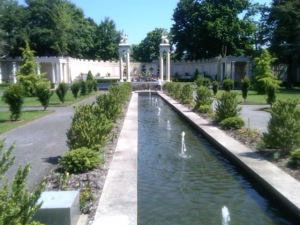
Inside the walled garden, looking north at the amphitheater

Inside the walled garden, looking north at the amphitheater

Click here for Untermyer website.