Equinox: autumnal

ann e. michael poet

I do like early autumn. The bright flowers of late summer possess almost tropical coloration: tithonia, goldenrod, zinnias, dahlias, canna lilies, cosmos, salvia, marigolds…meanwhile, the leaves begin to turn. Where I live, the euonymus alatus (spindle-tree/burning bush), sassafras, and sumac are the first leaves to redden, along with the five-leaved Virginia creeper vines.

My reading in Bloomsburg was a great experience. There was a full house, the sound and lighting systems worked, and the Moose Exchange is a delightful building, similar in purpose to many arts-venue collectives in other small US cities as they attempt to revitalize their downtown regions. The building was once the home of the Moose Lodge, one of many community associations that once worked to keep small cities and neighborhoods vibrant in the days before flight to the suburbs. My reading, part of the Big Dog reading series, took place in the third-floor ballroom! Afterwards, we had dinner in a terrific little Italian restaurant just off Main Street. Portobello mushroom ravioli in sage-butter, delicious.

The drive home was quiet–mostly highway, late crickets still making noise along the road, full moon in a perfectly cloudless sky.

I recognized that I can work on my writing practice more diligently and less anxiously than I have been. There are ways to make space in my life for creativity again. My recent readings on consciousness and the nature of being lead back to the poetics of space somehow.

first day of Autumn
my heart is pounding wild
Ah! The full moon

     ~Basho

Introspection interregnum: on being ticklish

I woke at five this morning to the sound of birdsong followed by a heavy downpour. The rain will bring another onset of green beans even though the vines are a bit “tired” by now.

I couldn’t get back to sleep, and at seven I rose and took a cup of tea out to the back porch. It’s a good place to muse. [For delightful porch musings, see Dave Bonta’s blog morningporch.]

A sizable daddy-long-legs swayed elegantly across the decking. During my childhood and adolescence, I was afraid of spiders, and the daddy-long-legs was the first “spider” I learned not to run from. Actually, the creature to which I refer here is neither a spider nor, officially, a daddy-long-legs; it’s a harvestman (phalangium opilio), which is an arachnid but not a spider. But it resembles a spider closely enough that the arachnophobe is unlikely to stick around for a closer look. My father taught me not to be afraid of them: “They don’t bite, and they eat pest insects. They just tickle when they walk on your skin.”

Ticklishness arises from tension. I found that I could withstand the ticklish feel of an insect on my skin once the initial startle reflex calmed, just as I adjusted myself to my dog’s licking–a sensation I liked. Probably what I learned was how to manage “self-calming.” Breathing slowly and deeply helped me to get over the fears I had, and with time I learned to be unafraid of real spiders, too (as a gardener, I now bless the spiders and welcome them!). Breath and loosing of tension alleviated nervousness and ticklish sensations.

With a certain glee, I realized I could control being ticklish. I hated being tickled, the helplessness of it–even though other people love to tickle and be tickled (my sister among them). Mostly to spite my sister, who liked to tickle me into submission, I taught myself how to un-tense when someone tickled me. When the ticklee doesn’t laugh, the tickler has no fun…and stops.

These musings drifted through my mind while I idly watched the delicate creature make its morning ambit along the porch. And I thought: how interesting that when I was a child, I taught myself about relaxation and the importance of breath control for the purposes of overcoming ticklishness and fears. I wonder if my interest in philosophy and psychology has a basis in my peculiar self-education? And maybe it is no wonder that Zen and other “Eastern” philosophical-meditative-religious practices appeal to me as an adult.

meditative

meditative

Untermyer Park

~

My enthusiasm for gardens of all kinds seems inextinguishable, and my tastes are wide-ranging. I love cottage gardens, wilderness-style native gardens, garden rooms, rooftop gardens and multi-acre gardens (ah, the Biltmore Estate...), sculpture gardens, vegetable gardens, potager and herb knots and medicinal plots, historic gardens (Monticello, Bartram’s...) and my grandma’s truck patch, may my grandma rest in peace. Also Asian gardens, European gardens, alpine gardens, undersea gardens (I have yet to visit one, but I would love to do so)–and I’m intrigued by trick gardens like the one at Hellbrunn in Salzburg and themed gardens and miniature railway gardens (there’s a fun one near me at Morris Arboretum). Oh, and I adore arboretums. Or should that be arboreta?

Gardens, like art and literature, reflect unique visions and aesthetics. And they are completely process-oriented: the results, if you can call them that, are fleeting and changeable. Maybe that’s one reason they appeal to me.

~

Recently, I had a garden adventure that was part nostalgia, part history, part aesthetic–and a lovely day out with my sister, as well. We decided to return to a park that had been important to us when we were very young, for the three years we lived in Yonkers, NY (see my post on the Grinton Will Public Library).

My family lived in houses that had almost non-existent backyards, which is not uncommon in Yonkers–a city built on hills and cliffsides, dwellings crowded practically on top of one another in some parts of town. Our parents took us to nearby Untermyer Park for picnics, exploration, and play. Situated above the Hudson River, the park was like The Secret Garden, Alice in Wonderland, ancient Greece, and Narnia, all rolled up into one mysterious and lovely, part-wild, part-formal place. The walled garden and the grotto beneath the Temple of Love were favorite places.

When we lived there, the park was reasonably well-kept, though not planted with many blooming flowers: lawns mowed, shrubs and trees somewhat pruned, no graffiti, a few paths cleared. The park belongs to the City of Yonkers, deeded to the public by Samuel Untermyer–a civic-minded gentleman who for some reason did not also endow the place. As a result, maintenance of the original 150 acres quickly became untenable and the city sold off much of the land. The 1862 mansion was razed, a hospital began to expand on some of the property, and the former glory rapidly decayed, overgrown by trees and weeds.

Which made it all the more exciting to people who are very young. It was entirely possible to believe there might be lions or mountain goats or fairies in the fringes of the woodland. The columns evoked stories and myths. The long reflecting pools, though not entirely full of water, were exotic canals or dangerous rivers or chasms. There were stairs and doors in surprising places, and overhanging vines, and grand old trees.

My sister and I share happy memories of the park. We had heard that it went through ups and downs depending upon the economy, the health of the city, grants, taxes, etc. Apparently the early 70s saw considerable graffiti on the walls we loved and on the grotto rocks. We heard indigent young people liked to hang out there and get stoned. We heard the woods had become littered and full of vermin. In the 1980s, some clean-up occurred; the park had made it onto the federal Historic Register. The walled garden was kept clean, and most of the graffiti tags erased. Deer roamed the place, eating everything but the mugwort, phragmites, and Japanese knotweed. The city still had trouble funding maintenance on the park, let alone restoration.

My sister went searching for Untermyer recently and learned that the city of Yonkers has hired two full-time gardeners and has partnered with a non-profit organization in an attempt to get more serious about restoration of this special place. And last weekend, she and I went on a tour with the enthusiastic gardeners and their young and enthusiastic apprentices.

And fell in love with the park all over again.

Even in its partially-wild, partially-decayed state, Untermyer Park compels the visitor. People genuinely gasp as they enter the walled Persian-style garden through the Artemis gate (the walled garden has been largely restored and looks pretty fabulous). The website offers an overview of the amazing history behind the place and includes some photos from the Roaring 20s, when Greystone Estate was the place to attend a party.

The “Persian” garden symbolizes Eden; indeed, the word “Paradise” has its etymological roots in Persia (Iran) as a compound of the word pairi- “around” and the word diz “to make, as in a wall.” Here’s a photo I took with my sister’s phone. The snapshot doesn’t do the place justice, of course; nor can it capture the thrill we felt at returning to find an old, old friend in the full bloom of health.
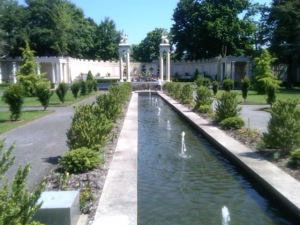
Inside the walled garden, looking north at the amphitheater

Inside the walled garden, looking north at the amphitheater

Click here for Untermyer website.

Beauty & awe–briefly

I have been reading lately (currently Leonard Shlain’s Art & Physics and Donald Revell’s The Art of Attention: A Poet’s Eye), but not much inspired to write. Instead, I work in the garden or sit on the porch and listen to birdsong.

I muse upon beauty. Partly such musing falls under the pursuit of aesthetics: the world of my garden becomes especially beautiful in spring. The sounds birds make seem beautiful to my ears. Water droplets on emerging leaves appear beautiful in the morning light.

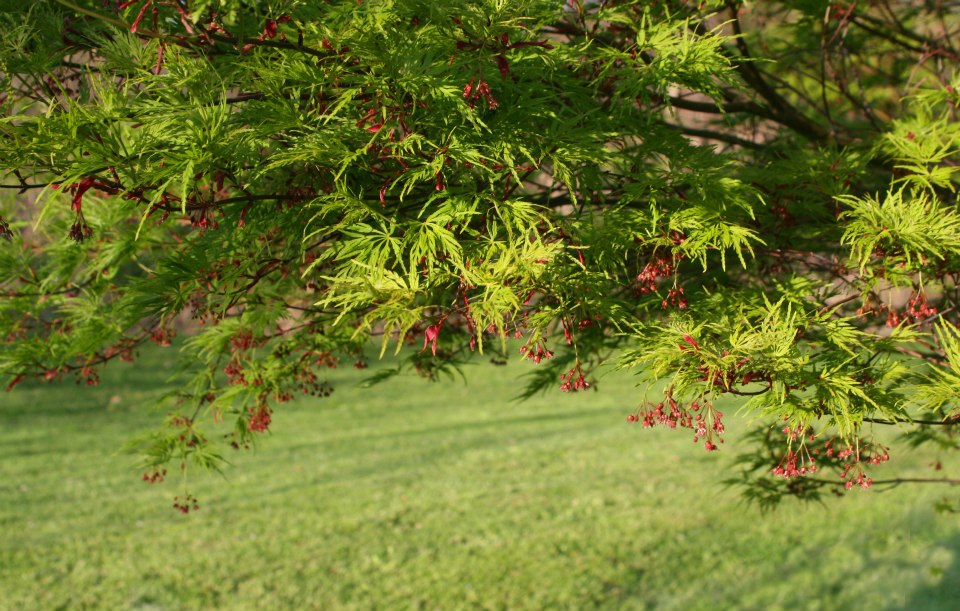
japanese mapleThese are phenomena. The world of things I can take in with my senses, process through my body and brain, and create–out of whatever “mind” may be–a concept of the beautiful. The phenomena are not physically affected by my categorization. It is I who am changed, I suppose, by virtue of my aesthetic appreciation of the beautiful.

I am reminded of Kierkegaard:

“Love does not alter the beloved, it alters itself.”

Aesthetic appreciation does not alter the thing-in-itself, it alters the person who finds beauty in the thing-in-itself. If this is so, I am altered by my love of what I deem beautiful.

~

While I was searching the web to find the quote above–I couldn’t quite recall it exactly–I found the Kierkegaard quote on the blog of pastor Jonathan Martin, whose theology I can’t completely get my mind around but whose words (below) reminded me of the Bhagavad Gita:

The most beautiful thing a person will ever see may well also be the most terrifying.

Is this not the nature of true beauty? To not just be soft and delicate, but to be so powerful, so overwhelming, so altogether other from ourselves as to threaten? Beauty does not intimidate, but it can overpower. Beauty is a coup to our senses. It holds an unruly power over us. Beauty can move us, haunt us, carry us, compel us. To feel ourselves beholden to the raw power of something beautiful is to be upended, not just inspired but assaulted.

On the lines of such thinking, we might find beauty in a tsunami, hurricane, earthquake, meteor strike the same way Arjuna feels paralyzed by the awesome beauty of the revealed godhead Krishna.

Perhaps that is why we often find ourselves fascinated by photos of natural disasters. Having lived for a couple of years along the northern end of Tornado Alley in the USA, I fear tornadoes. But they possess a kind of beauty in their awesomeness, if we can remove ourselves from the anguish we feel for people whose livelihoods, homes, and lives are destroyed by the big winds.

I wonder if human beings can ever bear that kind of awe; Martin says it transfigures us, Kierkegaard implies something similar, the Mahabharata and other sacred literature suggest that our bodies and our minds can withstand such revelation but cannot describe or truly comprehend it. It seems to me a kind of spiritual post-traumatic stress disorder! This is the “fear and trembling” of the psyche, whether the mind decides the experience is physical, mental, spiritual, or religious.

And that manner of beauty is not aesthetic.

Martin later writes, “Objectively speaking, the beauty of God is already present in our beloved, whether we recognize it or not. Rather, when we encounter beauty in another person, we are changed–we are transfigured…[those we love] do not become beautiful because we recognize their beauty; rather their beauty makes us beautiful.”

Is this experience awesome or aesthetic? Does the beauty of the azalea, the lilac, make me beautiful because I recognize it as such? Am I altered, fundamentally, in my admiration for an artist’s work, a poet’s words?

~

“The Visionaries” [a poem by a friend]

"Diana" by Augustus Saint-Gaudens; photo by Pete Finneran 2000. Image courtesy of Brookgreen Museum.  www.brookgreen.org

“Diana” by Augustus Saint-Gaudens; photo by Pete Finneran 2000. Image courtesy of Brookgreen Museum.
http://www.brookgreen.org

A poem by Beejay Grob © 2013

The Visionaries

We too had seen the gardens
sculpted by every season now.
A significant collective ‘we’–
myself, and practically anyone
I could target; one-by-one,
rain, autumn, winter night.

The family album holds each
posing sandwiched on a tailgate
flocked outside the aviary;
all standing straight as statues,
shot by the granite Pegasus.
Everyone except you, Muse.

Beneath a hospitality of waving
palmettos, feathering Carolina skies
from here to Charleston,
the stone-silent Visionaries
lean in from their perch,
reflecting in their secret oracle.

I took a stab at it when Orion
hung low over midnight oaks,
a carved moon enlightening Anna:
Why so many huntresses?
I determined her quivering gifts
sighted monumental occasions.

Walk among the springtime
blooms, the lubbers mating openly,
or in summer’s dead heat–
count the times she made a point
to cast herself as Diana,
the female Archer.

~ ~ ~

National Poetry Month, 2013. Many thanks to Beejay Grob, who wrote the poem and who introduced me to the beauty of Brookgreen Gardens in spring.

Brookgreen Plantation and Sculpture Gardens, Myrtle Beach SC

Endemophilia

This poem is sort of my version of endemophilia, describing (as Albrecht defines it) “the particular love of the locally and regionally distinctive in the people of that place. It is similar to what Relph … called “existential insideness” or the deep, satisfying feeling of being truly at home with one’s place and culture.” You might want to check out Glenn Albrecht’s site for more detailed definitions and philosophical/psychological reasons for inventing names for such concepts.

My long-poem in Water-Rites, “The Valley, the Whitetail: A History,” probably fits the term endemophilia more closely than the poem I’ve posted below–which may one day appear in print if I can find a publisher for my next manuscript. But the long-poem is a little too long for a blog post.

[I have an idea: buy a copy of Water-Rites from Brick Road Poetry Press, and read it there!]

~

Suburban Georgic

A mild day in February. Good chance
there’ll be more snow or ice. Walk slowly,

note the footprint of a hosta, dormant, or
the arrow-shaped deer hoof in hardened soil.

Look more closely for the ravages and burrows
of rodentia—woodchucks, voles and mice.

You may discover where squirrels have
hidden seeds or laid waste to crocus corms—

try to restrain your wrath. Decide
how best to counter such yearly looting;

strategy keeps the mind sharp. Grubs,
for instance, in your lawn—a different tack,

and this year you may succeed, and keep
the skunks from rooting through the grass.

Weigh, in your mind and pocketbook,
the relative costs of pesticide and herbicide.

It might be the year to go organic,
though there’s even odds the dandelions will thrive.

Ease your troubled breast from lawn woes.
Raise your eyes to forsythia, to witch-hazel,

observe critically the shrubs’ bare bones,
decide what needs the kindest cut,

find your saw and pruners, time to oil
and sharpen—your fingers itch—

but it’s a little soon. To assuage your
yearning, cut back the redtwig osier

so its new growth will flush crimson.
Consider forcing blooms indoors—

aren’t there soft, small swellings on
the slim wands of pussywillow?

When the next storm hits, dream of columbine
and narcissus. Get out your Horace, and wait.

ann e michael

quince blossoms

~

© 2008 Ann E. Michael

~

Waiting, in the place I call home, for spring.

Toponesia and poem

Here is a poem by Virginia Hamilton Adair that demonstrates, perhaps, the idea of “toponesia”–loss of connection with place. The speaker recalls the beloved beach in its decay and in its beauty; she also recognizes that the tide erases all–talk about amnesia!

Buckroe, After the Season, 1942

Past the fourth cloverleaf, by dwindling roads
At last we came into the unleashed wind;
The Chesapeake rose to meet us at a dead end
Beyond the carnival wheels and gingerbread.
Forsaken by summer, the wharf. The oil-green waves
Flung yellow foam and sucked at disheveled sand.
Small fish stank in the sun, and nervous droves
Of cloud hastened their shadows over bay and land.
Beyond the NO DUMPING sign in its surf of cans
And the rotting boat with nettles to the rails,
The horse dung garlanded with jeweling flies
And papers blown like a fleet of shipless sails,
We pushed into an overworld of wind and light
Where sky unfettered ran wild from earth to noon,
And the tethered heart broke loose and rose like a kite
From sands that borrowed diamonds from the sun.
We were empty and pure as shells that air-drenched hour,
Heedless as waves that swell at the shore and fall,
Pliant as sea-grass, the rapt inheritors
Of a land without memory, where tide erases all.

from Ants on the Melon. Copyright © 1996 by Virginia Hamilton Adair

Homescape poems: Solastalgia

Note–The poems below are used only as illustrations and used by virtue of the Creative Commons theory; the copyrights belong to the authors or their executors.

~

I’m thinking about the nostalgic overtones of the “changed” homescape here, or the notion of solastalgia as coined by Glenn Albrecht (see earlier post). At first I planned to use a poem with overt environmental themes (as of the home that has been denuded, altered, destroyed–many good poems exist on that theme). Then I thought to look more obliquely at the idea of solastalgia as an emotional state, for home is deeply freighted with psyche.

One form of “solastalgia” is represented here, I think, in Philip Larkin’s “Home Is So Sad”:

Home Is So Sad

Home is so sad. It stays as it was left,
Shaped to the comfort of the last to go
As if to win them back. Instead, bereft
Of anyone to please, it withers so,
Having no heart to put aside the theft

And turns again to what it started as,
A joyous shot at how things ought to be,
Long fallen wide. You can see how it was:
Look at the pictures and the cutlery.
The music in the piano stool. That vase.

~

Another aspect of solastalgia, in this section of Gary Snyder’s “Four Poems for Robin,” relates to the homeplace in the form of a relationship, one bound up with the excitement of youth, college, the orchard with its tall dry grasses and love’s “grave, awed intensity.” Yase village is located near Kyoto; the speaker of the poem identifies where (and when: December) he resides while reflecting on an autumn day in his past.

December at Yase

You said, that October,
In the tall dry grass by the orchard
When you chose to be free,
“Again someday, maybe ten years.”

After college I saw you
One time. You were strange.
And I was obsessed with a plan.

Now ten years and more have
Gone by: I’ve always known

where you were–

I might have gone to you
Hoping to win your love back.
You still are single.

I didn’t.
I thought I must make it alone. I
Have done that.

Only in dream, like this dawn,
Does the grave, awed intensity
Of our young love
Return to my mind, to my flesh.

We had what the others
All crave and seek for;
We left it behind at nineteen.

I feel ancient, as though I had
Lived many lives.
And may never now know
If I am a fool
Or have done what my

karma demands.
~
I’d be interested in finding out which poems you consider solastalgic. Meanwhile, I am going to browse my collection for poems that are endomophilic…

Endemophilia, toponesia, psychoterric states

Thanks to poet Annie Finch, I came across a thoughtful essay in Aeon magazine–an exercise in synthesis and interdisciplinary thinking that connects with Naess and his notion of ecosophy; and with Bachelard and others whose work I have lately been reading and thinking about. Liam Heneghan combines ecology, botany and topography with Winnie-the-Pooh and explores transience and trans-placement from several viewpoints. He looks at how so many of us are transplants, foreign “invaders,” culturally and biologically, and asks us to think about how we feel about place–home-place, in particular.

Not all of us connect with the concept of a home-dwelling anymore; but if we do so, that place is generally closely associated with childhood, observes Heneghan. He cites environmental philosopher Glenn Albrecht and says:

…we do not yet have an adequate vocabulary to address our ‘psychoterric’ states — or how the state of the Earth relates to our states of mind. To balance the negative psychological state of ‘nostalgia’, a couple of years ago Albrecht proposed ‘endemophilia’ (the sense of being truly at home within one’s place and culture — or ‘homewellness’). To balance the term ‘topophilia’, a love of place, Albrecht opposes ‘solastalgia’ — the desolate feeling associated with the chronic decline of a homescape. Solastalgia names the emotions we have at the loss of species and habitats through climate change and other environmental changes. We should all expect a lot more of it.

I do know those feelings, and I feel happy to have terms for them! Yet I argue that we do have an adequate vocabulary for how the state of the Earth relates to our states of mind, and that vocabulary is artistic. I believe the finest expression of these kinds of emotional-memory sensations can be found mainly through art. My task for myself in the coming weeks is to gather a few examples of endemophilia, solastalgia, and other “psychoterric states” in poetry. I’ve already got a few in mind.

Please read Heneghan’s essay if ecopoetics or the notion of homescape appeals to you.

Exhaustion & bloom

Isak Dinesen: “I write a little every day, without hope and without despair.”

~

Some days, the little is…quite little. I am not exactly taking a break from reading and writing, but a great deal of my reading these days is student-written work; and the writing tends to be corrective.

There are also events in one’s life that tend to push back against the time needed to dwell on creative things.

Kurt Vonnegut: “So it goes.”

~

I’m re-reading Descartes. The best part of his philosophical writing, in my opinion, deals with his conscious desire to remove all prejudicial thinking from his mind. I have my doubts as to his success in that regard, but I love the splendidness of trying to attain the mental tabula rasa. Open-mindedness, a virtue more human beings should strive to embrace.

~

And there is also exhaustion, pure and simple. Some days, I need my rest.

February: awaiting the snowdrops’ blooms. (They’re nearing…the white tips are visible, enclosed in the deep green spathes.) Meanwhile, fragrant yellow winterhazel.

corylopsis

winter hazel