On Tolerance

Tolerance, as defined in the OED, means endurance, as of pain or treatments; it is also the tiny allowance of imperfection in coining or machinery, the acceptable out-of-round. But the term has become popular recently under its third definition, “freedom of bigotry or undue judgment upon the actions or behaviors of others.” It has indirectly become the target of people who complain about over-use of “politically-correct language.”

Tolerance is not one of the Virtues, but it tends to have a slightly virtuous connotation, sometimes with an irritating hint of self-righteousness. An acquaintance of mine said once, “Quakers! They’re so damned tolerant,” as if it were an attribute to be avoided by sparkling, sexy people who are analytical and quick to judge. I have known some mightily opinionated Quakers in my time and will attest that tolerant folks can hold strong opinions. The connotation of tolerance to mean somehow wishy-washy or evasive is an unfortunate one. And it’s wrong.

My parents taught tolerance. This was a necessary trait in a family full of passionate, witty, highly-opinionated and creative people. I learned that I could disagree with my sister completely and still love her and accept her point of view, even if I could never in a million years adopt her perspective. My father marched on Birmingham and Washington in the 1960s, and we learned that people who do not look like us are no less like us than our neighbors—and we learned to be polite to our neighbors, some of whose values and opinions we didn’t particularly care for, but whom we tolerated as members of the community. Tolerance is a component of empathy in two directions: empathy inspires in us the ability to practice tolerance of others, and the practice of tolerance itself enables us to feel empathy with others.

Without empathy, no altruism; without altruism, no society. Tolerance has an important place in human nature. The simplistic slogan “Teach tolerance” has value only if we can remove the negative slap-dash judgment of tolerance as some sort of liberal-PC value rather than as what it is, a practical behavior necessary for social interaction. Good manners, for one thing. And yes, that means that sometimes we must endure the psychic pain of listening to a person we desperately want to judge negatively, or bear with the person who is slightly “out of round.”

Practicing tolerance doesn’t mean giving up our own values, it merely forces us to withhold judgment a little longer than usual and to endeavor to discern, and acknowledge, another person’s perspective. Can we argue? Can we disagree? Certainly. Will we respect that perspective? Maybe not. But we can learn a great deal from the exercise.

Here is a poem from my collection The Capable Heart. Tolerance and an attempt to understand another perspective are not just for human beings. This poem looks at my daughter’s point of view, my own, and the horse’s. More broadly, the piece is about all of the things I’ve mentioned in this post—if that’s how my reader would like to interpret it. (Of course, I am ready to acknowledge other interpretations and perspectives!)

WAYS WE ARE ALIKE

I wanted a way to embrace
my daughter’s fascination.

To overcome my own fear, with carrots,
with a lead rope and a soft brush.

I touched the withers and the
warm, broad chest;

I held the lead. Let pulsing lips
explore my hands, my jacket.

The narrow nose stretched
under my fingers and

I rubbed the strong, shallow bone
above curious, sensing nostrils.

My daughter tells me the many ways
horses and I are alike.

They are beautiful, and
they understand fear.

Orri. Photo by Ann E. Michael

The seed of disorder

“I am the seed of disorder.” –Paul Eluard

From an essay by Ezra Pound (published in The Exile):
“The principle of good is enunciated by Confucius. It consists in establishing order within oneself. This order or harmony spreads by a sort of contagion without specific effort.”

As Lewis Hyde, who excerpts the above passage in The Gift notes, Pound offers an implicit paradox here that he apparently could neither acknowledge nor accept. If “good” is order, how can it spread by “a sort of contagion”—surely a chaotic method of disseminating something supposedly well-structured?

Hmm. I turn now to Wallace Stevens—or rather, to Helen Vendler on Wallace Stevens—to examine further this “idea of order.” Vendler’s interpretation of the order in Stevens’ “The Idea of Order at Key West” includes several approaches. There is order as in organization: the singer in Stevens’ poem creates and hence organizes her physical world. There is order as in command: she orders her world into being by singing, by language. Then there is order as magnitude: “The two Wordsworthian orders of mind and world…exquisitely fitted and yet subtly uneasy with each other,” notes Vendler. The tension Hyde finds and explicates in Pound’s Cantos also exists in Vendler’s examination of Stevens.

Eluard, a poet completely different in style, sensibility, and background from Pound and Stevens, identifies in his poem the workings of that tension, the DNA carrier, the seed of disorder which, it can be plausibly speculated, might well spread its own form of harmony without specific effort, traveling as seeds do through a myriad of dispersal mechanisms such as wind, burrs, digestion and expulsion, burial by mammals, flotation, and the like. (As a gardener, I am constantly amazed at these marvelous mechanisms.)

Well-fitted but uneasy together, disorder through its contagion moves harmony and order to grounds on which what inheres in the seed can survive, even thrive, as it organizes itself into maturity. The seed “follows orders” nature has imposed through genetics. Mind and world, order and self, establish themselves as “good.”

Without that seed of disorder, all is stasis. No art, nor mind nor world, can be produced unless the rebellious seed slips from stem, twig, womb, sac, or lamellae to sing its own idea of order into the world.

For some fabulous photographs of lamellae, see:

Hive Mind on FlickR

Affirmation

larch cones by Ann E. Michael

I am almost finished reading Parfit’s Reasons and Persons, and I think his conclusions about the self (person) in society and as individual are valid; I have long questioned the self-interest theory of philosophy but only on an intuitive basis as I am no philosopher, merely a student of the discipline.

What strikes me after having read this lengthy and rationally-argued book is that there are so many ways philosophical reasoning does actually intersect with that “most irrational” of impulses, art.

Here is a lovely excerpt from poet David Ignatow, from an essay he wrote in 1971:
“There is no contravening another person’s sense of himself and his world. We must accept it on his terms, though we need not accept it for ourselves…men and women have discovered themselves as individuals, and that this sense of individuality is something among them…In affirming themselves, they affirm all others.”

He later adds that poetry “is formed by the terms with which the person sees himself.”

It seems to me that Ignatow possessed an excellent understanding of the psychological and emotional as well as the rhetorical aspects of poetry–indeed, of any art.

Reasons and felines

“Like my cat, I often simply do what I want to do.”

This sentence begins Derek Parfit’s book Reasons and Persons, a lengthy series of philosophical arguments examining the validity of the self-interest theory, examinations of hedonistic and altruistic behavior, among others,  as rational responses to life, and why people choose to do what is against their own or their community’s best interests (i.e., behave “irrationally”)–as well as whether irrational behavior is ever justified and why.

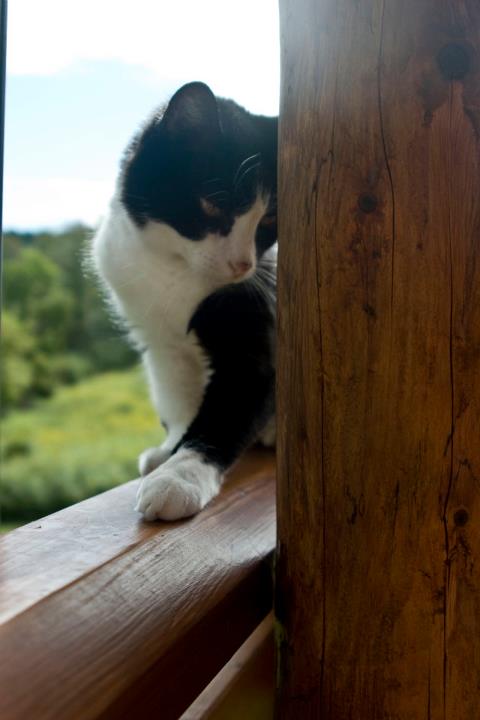
At right, my favorite cat, Topsy. He does what he wants to do.

Parfit’s book has been a good refresher course for me in how philosophers actually work, devise their analogies, create and endeavor to solve dilemmas, clarify and limit their claims, etc.

But frankly, my brain hurts. (See Monty Python skit, below).

There are times one simply wants to think less about the things that matter, and that desire may not be rational but is certainly human. So while humans do have the opportunity to be reasoning creatures, they also have the opportunity to be like cats: to do what they want to do.

Or not to do, as the case may be.

At present, I’m assessing student work for final grades. This work is rational and should be carried out as objectively as possible against specific criteria. This work is one of the jobs teachers do, besides the job of endeavoring to impart information and to encourage critical thinking on the part of the students. It’s my job, I get paid to do it, and I take it seriously. Nevertheless, today I find myself tired of being the reasoning person.

And so, because I cannot slink over to the sofa and curl up on a pile of blankets, I am posting this:


Lewis, Buber, Dickinson

“Meeting with God does not come to man in order that he may concern himself with God, but in order that he may confirm that there is meaning in the world. All revelation is summons and sending.”   –Martin Buber, I and Thou

I suppose I ought to know this, but I cannot recall reading about whether C.S. Lewis was influenced by Martin Buber’s work, specifically I and Thou. Some of Lewis’ writing seems to suggest that he agrees with the concept of relation: as Buber describes it, the stepping out to meet Thou as Thou, and the insistence that “Man’s [sic] desire to possess God” keeps said man from true relation with God (a point described in The Great Divorce through the allegorical character of the Episcopal Ghost). God has become an “It” rather than a Thou for the Bishop, though he feels he is a true believer, an error made in lesser ways by other characters such as the Big Man.

Many of the students I tutor are writing their final papers for a Theology class that uses Lewis’ texts as a foundation for the course, which is why I’m feeling a bit conversant with Lewis lately, many long years after reading his fiction and his theological writings. And a random quote (above) that I read on a colleague’s email put me in mind of Buber, whose I and Thou reads, often, like poetry….which got me thinking about Emily Dickinson.

How’s that for a train of thought? Perhaps I need to examine the concatenation step by step.

1) Buber, I and Thou, a work deeply influenced by the author’s immersion in non-Western and Cabbalistic “mysteries” (the idea of the radii and the Centre closely parallels the Hindi conceptualization of Indra’s Net, just to name one example). Buber returns to the Western religious traditions throughout, though he mentions the way of Buddha and others as he examines the ever-present confrontation with the Thou of relational experience.

2) Lewis, The Great Divorce. Students interpret this work as one in which the author outlines his agreements and differences with, among other things, ideas about free will stemming from Socratic/Platonic through Augustinian and more modern concepts of Heaven/Hell. They tend to miss the concepts of what makes union/relation significant in the choice to unite with God, but they “get” the gist of the allegory.

3) Emily Dickinson, who more informally and more frequently uses “you” and “I” to explore these depths, but whose contrarian views on soul and spirituality knit the religious with the genuine in complex and exciting ways through the art of language.

An example, in which she does employ the King James Bible diction:

725

Where Thou art—that—is Home—
Cashmere—or Calvary—the same—
Degree—or Shame—
I scarce esteem Location’s Name—
So I may Come—

What Thou dost—is Delight—
Bondage as Play—be sweet—
Imprisonment—Content—
And Sentence—Sacrament—
Just We two—meet—

Where Thou art not—is Woe—
Tho’ Bands of Spices—row—
What Thou dost not—Despair—
Tho’ Gabriel—praise me—Sire—

How similar to Buber, those lines “And Sentence—Sacrament—/Just We two—meet—”

and the idea that “Where Thou art not—is Woe—”

Poetry precedes philosophy more often than not, though philosophy may object.

On ignorance, mostly

Now I am reading Derek Parfit’s Reasons and Persons, a series of philosophical arguments, dilemmas, extensions and inquiries in small dense type. It requires more concentration than I’ve had to expend on a book in quite some time. So much so that I began to wonder if the reading would ever yield anything valuable enough to have been worth the effort—but I think it is worth the effort. Granted, I am not yet much more than a quarter of the way through its 543 pages (ok, 454 if you don’t include notes, appendices, index); but I’ve reached some discussion about happiness and what can be defined as “good,” and Parfit gets there by means of examining theories of happiness that are directly or indirectly self-defeating. Among other things.

Although Parfit does not mention ignorance, at this section of the book I found myself musing on it, specifically “ignorance is bliss” (a phrase which seems to refute the Socratic statement about the examined life while allowing Socrates his insistence on his own ignorance and, I suppose, his happiness). And having recently read Emma Donoghue’s novel Room, which confronts how much reality is valuable for happiness, under extenuating circumstances, the concept of ignorance as a not-necessarily-negative state of being intrigues me…I, who have tried all my life to avoid ignorance. Though this book is doing a fair job of making me feel pretty ignorant, I don’t feel bad about it.

Am I suggesting ignorance is good? No…but it may be value-neutral, or it may be relative, operating along a sort of continuum that cannot be categorized as “good” or “bad.” I return to my last post, on malclichés. It is possible, even likely, that an instructor who encounters one of these mis-hearings/mis-writings in a student essay will assume the student is ignorant. The student may indeed be ignorant of the conventions of spelling or the usual turns of overused phrases. Such mistakes, however, may indicate a lack of education, simple laziness or disinclination or haste, an over-reliance on AutoCorrect, or perhaps a disability in the areas of vision-hearing-neural processing: not necessarily ignorance.

Then what is ignorance? (This is why so many people get irritated with philosophy: you have to define everything!)

One thing ignorance is not is a lack of conventional education, even though that definition may be the easiest to assume. Again, it’s kind of a continuum, isn’t it? If I miss an allusion to a line in a Yeats poem, am I ignorant? And am I more, or less, ignorant than if I miss an allusion to a Shakespeare play or, perhaps, an allusion to the Kardashian sisters?

(That sentence makes me really want to write a poem that contains references to Yeats, Macbeth, and the Kardashians; but I probably ought to leave that to Billy Collins.)

Anyway, Parfit’s book is really more about what is rationality and what is morality and how individuals may or may not be rational or moral, both as individuals and as persons within communities and societies. Which inquiry and argument, by the way, would encompass Yeats, Shakespeare, and the Kardashians.

Perhaps after I finish reading it, I will be better educated on rationality and morality. I may be just as ignorant, but I’ll try not to be too judgmental about being so.

Here’s one from Philip Larkin, titled (appropriately) “Ignorance”:

Strange to know nothing, never to be sure
Of what is right, or true, or real
But forced to qualify: Or so I feel
Or: Well, it does seem so,
Someone must know

Strange to be ignorant of the way things work
Their skill at finding what they need,
Their sense of shape, and punctual spread of seed
And willingness to change
Yes, it is strange

Even to wear such knowledge—for our flesh
surrounds us with its own decisions—
and yet spend all our lives on imprecisions,
that when we start to die
have no idea why.

~~~

OWS: Trust and the need to revel in difficulties

Why I support the Occupy movement

First, I need to explain who the Occupy supporters and protesters are. These people are my friends. I respect the values of my friends; my friends are well-educated, experienced, thoughtful, and often wise. If they support an action or a cause, I don’t necessarily jump on the ol’ bandwagon just because I like them; but I do take a good look at their claims. The description that follows is based upon my own experience and may not be statistically accurate.

There is no way to generalize my friends and colleagues who support the protests. They range in age from 18 to 86, and they are of both sexes and numerous “races,” a term to which I object on scientific grounds but which serves a purpose here. Sexual orientation among these friends varies, but the vast majority of them are heterosexual people involved in long-term committed relationships. Many attend religious services regularly. While I may be acquainted with a few more radical liberals than the average citizen is, I do not know any Communists involved with Occupy and most of the people I know who support the movement are moderate, middle-class or formerly-middle-class taxpayers. None of them are homeless. Although one or two are “underwater” with their mortgages, most of them are managing to pay their loans and make ends meet; they are all employed or under-employed (a term I shall define below).

The vast majority of my Occupier colleagues have college degrees, but not all of them are employed in white-collar jobs. Many, many, many of my friends and colleagues who support OWS are working part-time, or working at jobs for which they are over-qualified, or working free-lance on a less-than-regular basis; or they own and run small businesses such as consulting practices that don’t always generate income when the economy is stale. They are educators and artists and even young lawyers right out of grad school. These are the under-employed, and there are so many of us out there that the government statistics are bound to under-count us. They are recent college grads who have mountains of debt to pay off and who now realize the career for which they’ve trained has, at present, no place for them…so they pick up some retail work or start a part-time small business or try to earn a living however they can, often swinging two or more jobs just to pay the bills. They are not lazy lay-abouts who want a government handout for free.

The majority of these people support capitalism, yet they feel our nation’s government has not quite lived up to its role of protector and defender of the people. Most of these folks feel that a government “safety net” or a more equitable method of taxation is not the same as a socialist agenda and that a moderate level of social support is not incompatible with democracy. They are willing to pay taxes for the kinds of support they request, but they want fair taxation and fair wages and a chance to serve the world through diligent and profitable work. The lack of fairness is what irks them; they want to live in a nation that is “just.” The idea of justice is not only something that pertains to the judicial branch of government but to the idea of fairness across the board, in all endeavors, including economic endeavors.

I have friends and colleagues who are atheists, Buddhists, Jews, Wiccans, Muslims, and agnostics; but the majority of the people I know personally who are involved in OWS identify themselves as Christians. I think this is relevant on many levels: it messes with stereotypes of Christians as “right-wingers,” for one thing. Jesus’ teachings tend to focus on caring for the least among us— Jesus was not a supporter of oligarchy. He did remind us that we need to be grateful for whatever we have, to love the world that God gave us; the implicit and explicit reminder is that each human being is part of that world.

There’s a slogan with which we are all familiar: “In God we trust.” Some Americans have chosen to focus on the Big G-word of this slogan. Some citizens think it should not appear on the legal tender of a nation where there is separation of church and state. Others claim that God is what the country should be all about and that we need to rewrite or re-interpret our laws to reflect that idea.

Suppose, however, we were to focus on the T-word instead? Trust. My diagnosis—and I admit, I am basing it only on the people I know personally (and I know quite a few) among the loose collective movement that is OWS—is that people feel a loss of trust. Protesters often use the word “betrayed” when they are interviewed about why they are sleeping in Zuccotti park. For many years, Americans have been naively but wonderfully trusting:

–why didn’t you read the fine print, Grandma?

–because the banker was trustworthy on my last two mortgages; why would the bank want to take all my money now?

Does this country really want to move from “In God we trust” to “caveat emptor”? That would mark a huge change in the collective character of the US citizen. I hope that legislators and politicians will pay attention to the people of the Occupy movement and hear how vital trust is. We cannot move forward until there is trust on all sides of the discussion.

The press has made much of the OWS movement as being vague or aimless, and it is true that the anti-war protests of the 60s and 70s seemed to have more purpose. Still, “End the War” was not the only demand of those protesters, and some of the protests were both obscure and misdirected. The protests that made up the War on Poverty were composed of a cacophony of different and often dissenting voices, too. Certainly, there was little agreement on the specific ultimate aims of the Civil Rights movement or on how to attain those rights. In retrospect, it’s always easier to say what the purposes were.

I’m not out on the streets with a sign and a sleeping bag. I have classes to teach and I desperately need to keep my day job. But being silent doesn’t show support or argue for trust and fairness in a nation founded on rational goodness which, idealistic as that is, was one of the aims of Thomas Jefferson. My sense is that specific aims will be synthesized from all this discontent. People are brainstorming. This is what I tell my students to do when they have to write a paper: revel in difficulties for awhile. Figure out what your purpose is going to be.

Then go for it.

Here’s another take on OWS, with some quite reasonable analogies:

Lemony Snicket on OWS

Poetry Break.

I took a break from difficult reading to read Eluard’s “Last Love Poems” as translated by Marilyn Kallet. Alas that I am mono-lingual and cannot read poetry in any language other than English. I have to take the translator’s word for it (literally and figuratively) that the beauty in the lines can be nearly portrayed in English. The struggle translators must have to go through to transform such a studied thing of language as a poem is into a different tongue amazes me. Inevitably there is some loss of connotation, wordplay, music, rhythm, cultural freight; the careful reader understands that there may be lacunae of some kind, and a mono-lingual reader recognizes that she will not be able to track down where those subtle gaps occur. A good translation, however, manages to maintain the beauty.

“Beauty”—now, there’s a moving target. Quine devotes a few pages to the discussion of the concept in his “intermittently philosophical dictionary.” He writes: “The aesthetic pole is the focus of belle lettres, music, art for art’s sake. But it is a matter of emphasis, not boundaries. Scientists in pursuing truth also seek beauty of an austere kind in the elegance of a theory, and happily some of them seek literary grace in their expository writing.” Quine ends his brief entry on Beauty by suggesting that truth and beauty are not a binary system, that we need not see them as poles apart; yet he does not quite agree with Keats’ conflation of the two. We need ethics and rhetoric in addition to truth and beauty, says the philosopher.

Peter de Bolla, writing two decades or so later, inclines toward a less binary way of looking at beauty and truth when he writes that, since the art of music is  an “articulation of the temporal,” there is a “philosophical argument music makes about relationships between time and being.”  And that argument results in beauty, when it is a well-composed argument, I suppose.

Suddenly the welcome earth
Was a rose of luck
Visible with fair mirrors
Where everything sang to open rose

(“Seasons,” Paul Eluard, tr. Marilyn Kallet)

de Bolla asks: What does the poem know? This poem knows music, and beauty “in the gentle desert of the street” and “beneath life overpowering and good.”

Ah.

ann e. michael, waterfall, poetry

Why read difficult books?

Poetry can be difficult, but I love to read it. Poetry is not the only form of ‘hard reading’ I do, though. Reading a text that’s challenging takes more time and more effort on my part, and for a person who is often pressed for time the question presents itself:

Why do I read hard books?

Bachelard. de Bolla. Girard. Kuhn. I’m immersed in Quiddities by W. V. Quine at the moment. Slow going, though I enjoy his sense of humor, because I’m not as comfortable with philosophical terms as I once was. Next up: Derek Parfit.

Philosophy, poetics, aesthetics…not as easy nor, I suppose, as entertaining as popular fiction. I admit I enjoy how novels erase the boundaries between my life and the characters’ lives, their times and places (historical? imaginary? far from Emmaus, Pennsylvania?); it is easy to feel wrapped up in a novel, and I appreciate being taken elsewhere.  I’m a fan of short fiction, too. It’s easy to love fiction.

That’s not always the effect I seek from reading, however. I read non-fiction to become informed, and I especially treasure information that is delivered in a beautiful, literary fashion. John McPhee, James Prosek, Annie Dillard, Phillip Lopate, Terry Tempest Williams, to name a few. Writers such as these make reading science and politics and biology and culture and other informational material a joy.

I read difficult texts such as philosophy and physics because I love to think. Thinking deeply has always resulted—for me—in new forms of perspective, in inspiration, and in poetry.

Poetry is sometimes difficult to read, as well. Think of the many ways the word “difficult” can mean in this poetic context: Marie Howe is difficult in a different way than Jorie Graham, or Lyn Hejinian, or Ezra Pound, Gray Jacobik, or Gregory Orr’s early collection Gathering the Bones Together.

Stuff that is hard to read can be extremely rewarding. And, when I am puzzled (which I often am), I feel inspired to question and to observe…which leads to writing. Much of what we call “art” is a response to difficulty.

Oh, how I relish the difficult!