& more difficult books…

Difficult books” ends up being one of my most-blogged-about topics. I like to challenge my brain with concepts that rattle the typical, with texts that force me to slow down and puzzle through my tangled thoughts. Right now, I am slowly reading two difficult but extremely rewarding books: Ann Lauterbach‘s The Night Sky: Writings on the Poetics of Experience and Elaine Scarry‘s The Body in Pain.

Both of these writers use plenty of source material that synthesizes (or sometimes argues with) their concepts and explorations. In many cases, these are books new to me, but Lauterbach also quotes from and is inspired by some of my own favorites: Whitman, Emerson, Dickinson, William James. Lauterbach combines what my students would call a geeky interest in theory (literary and social) with anecdote, musings, and a collaged or transgressive approach to the argument or critique. This is to say I admit I do not always know where she is going with her essays, even at the close of them. And yet–her interweavings fascinate, her choices surprise. She’s a master of the pithy definition (“Poetry is…”), but she allows for many perspectives, many definitions.

brad-hammonds-flikr-books

Brad Hammonds/Flickr Creative Commons

Scarry’s text covers a different domain, though theory certainly has a place in her book. The Body in Pain examines what pain is–semiotically, physically, its interiority, its defining characteristics, the portrayal of pain in art and literature and what that tells us about the body, the Self, and the shared understanding but individual experience of pain. I have not gotten much beyond the second chapter of her book, but I already feel myself inquisitive about aspects of human pain that I had never even considered before; who thinks about pain except when feeling, or anticipating feeling, pain? Of course we know what pain is–until we try to describe our experience of it to another person.

I’ve had that frustrating experience numerous times (here’s Ally Brosch of Hyperbole & a Half with the best solution to pain charts), but I have not devoted much time to exploring why pain is so individual despite our universal recognition of its existence; also, it had not occurred to me why we so often doubt others’ pain. Scarry says we have developed no particular understanding of the phenomenon, one reason she undertook the writing of this book.

Meanwhile, the semester continues apace and my students are interested in argument after all, it appears; and the bounty of late tomatoes has arrived with much processing to do before they all rot. My time spent blogging will be brief in the coming weeks. 🙂


Surely compelled

Ann Lauterbach from her book The Night Sky: Writings on the Poetic Experience

We make music, painting, sculpture, films, novels in order to mediate our mortal visiting rights: a specifically human wish to intercede, to punctuate the ongoingness of time and the seemingly random distributions of nature. This punctuation is called history or, more precisely, culture, or, more precisely still, history of culture…

The phrase “to mediate our mortal visiting rights” feels particularly resonant these days, as some of my elderly best-beloveds appear to be navigating that region–mediating it–at present; [to mediate: “divide in two equal parts,” probably a back-formation from mediation or mediator, or else from Latin mediatus, past participle of mediare “to halve,” later, “be in the middle,” from Latin medius “middle”).  –thank you Online Etymology Dictionary]. The two halves, between one world of what we call the living and another which is the end of life, there is really more of a continuum, however. The “gray area” can be quite enriching and lively. Or not. These are ways we create, or punctuate, our personal histories: the year grandmother broke her hip, the year Susan entered school, the year the Twin Towers were destroyed. These, among other “random distributions of nature.”

I think it is true that the arts help us with the wish to intercede somehow, and also–a different sort of wish, it seems to me–the wish to mediate. Lauterbach seems to conflate these wishes. I see her point, but I am not sure I agree wholly.

~~~

Intercession. Isn’t that also a form of prayer?

[“intercessory prayer, a pleading on behalf of oneself or another,” from Latin intercessionem (nominative intercessio) “a going between, coming between, mediation,” noun of action from past participle stem of intercedere “intervene, come between, be between” (in Medieval Latin “to interpose on someone’s behalf;”]

~~~

…the way words make sentences and sentences paragraphs is also a kind of constellating, where imagined structures are drawn from an apparently infinite fund: words, stars….these acts of narrative and imagistic invention were surely compelled by the inexhaustible human desire to transfigure the incomprehensible into intelligible form.

Lovely–and here, I agree completely: “surely compelled.”

~~~

Writing for me is associative, meditative, and digressive.  ~ Ann Lauterbach

images                                        pompeiian woman-writer


Thanks to art critic and blogger Sigrun of sub rosa for alerting me to the existence of this book.

As to what matters

What matters, at this moment, are compassion and communication–and recalling that communication requires listening, especially when we assume we know what the Other will say. [The Other may be black, or white, or a parent, or a politician, or of a different culture, etc.]

http://blacklivesmatter.com/

To people of color in the United States of America, in particular to African-Americans: Ask your questions. Speak up. I understand that some of you are prepared for argument and rhetoric, others for fear, anger, and defensiveness. You are tired, perhaps, of speaking up. Tired of the resulting outcry and pushback and character assassination and judgment and stereotyping. Tired of the pain. I get what you are feeling, even though it isn’t my personal experience, even though my social experience differs from your social experience.

Speak up nonetheless. Many of us finally recognize the need to listen. It matters because once someone signals readiness, true perspective begins. Because connections must occur before listening can occur. Where do we begin?

“Why don’t you listen?” is a good question, though it tends to put the Other on the defensive. If, however, people can hear genuine curiosity behind the interlocutor, there may be a moment of pausing to reflect: “I thought I was listening. Why do you think I am not?” Both parties need to ease the borders a bit (not a popular thing to do, I know).

So often, perspectives vary so widely that each of us carries into the discussion a host of unspoken assumptions based upon the only experience each of us has–our own. No one can ask the child-like, curious questions without being accused of hidden or not-so-hidden agendas.

I am reminded of an old saw one of my high school teachers wrote on the chalkboard:

Screen shot 2016-07-12 at 12.18.21 PM

Learning to listen and to accept and to formulate questions reminds me of the process of raising children. Really. My perspective as an adult in the world–my assumptions–so often trumped what my children were experiencing as small people with totally unexpected and intriguing perspectives on life. I had to learn to listen to their points of view at least some of the time, and I was always rewarded with insights I would not have discovered on my own. (I referred often to the Faber & Mazlish book How to Talk So Kids Will Listen and Listen So Kids Will Talk when my children were at home.) We have to make ourselves more aware, and much much much more patient than usually comes naturally, as parents and as members of a wider community than human societies have ever encountered before.

Yes, we yearn for answers. We do. That yearning may be part of the human genome. But just like our brains, and our conscious sense of self or selves, it’s complicated.

It would be helpful for all of us to recognize that listening to questions, and forming more inquiries–rather than answers or arguments–supplies the basics of Socratic inquiry. For the methods application in contemporary society, check out books by Christopher Phillips. Despite my occasional ramblings and speculations on rational thought (see many of my previous posts on argument, pedagogy, philosophy), argument may not be our best human tool at all times. The best human tool is compassion.

What matters is that human beings, whatever our color or culture, enter into relationships with one another and with our environments. That we admit to complexities and to questions; that we remain curious, which opens us to connections and enables us to see how vital all kinds of relationships are. Do people need to be reminded that #BlackLivesMatter? Yes, alas, people do. While a few of the social majority of human beings in the USA are more cognizant than usual, grab the moment. And people? Listen.

Because there actually is but one species of human being. Let us be homo sapiens–wise, judicious, sensible.
 

On absence

I have experienced a felt absence lately, a sense of missing.

Maybe the world is too much with me. I have responses to the Stanford rape case, responses to the Syrian refugee crisis, to the US presidential campaign, to the mass murder at a gay nightclub in Orlando; responses to some personal challenges, as well–health: my own and loved ones’, among other concerns.

Responding represents the equal and opposite reaction to any action, in a Newtonian metaphor. And what my body and my mind these days are saying to me is “step back, reflect.”

Humans love immediacy–the rapid Twitter argument, the comments on opinion posts, the punch in the gut. Animals need rapid responses in order to negotiate a world of predator and prey; humans, however, (and, more than most of us realize, many other animals) also possess the ability to reflect on what the feelings are. What they may mean. How that meaning may alter our responding mechanisms. We can–if we pause to do so–put ourselves in the place of the Other, imagine different perspectives that may color our responses.

Sometimes, we may need to absent ourselves awhile. To put some distance between our feelings and the conflicts we engage in. We need feelings and we need thoughts, we need responses and we need observation from other viewpoints.

~

It occurs to me that poetry is the conversation between the rational, languaged mind and the mind of feeling and imagery. This effort involves the same mind at work on two or more fronts, the human brain constructed as it is to handle multiple levels of feedback, feedforward, and association.

Poetry isn’t “about emotions.” It’s an art that employs language to represent the tension between the rational and the feeling, the mind’s mighty efforts to engage with the difficult and the heart-stirring.

This is how reading about neuroscience enhances my interpretation and understanding of what poets do. I read difficult books and eschew spending time on the internet. I sit on my back porch and ponder. A buzzard swings to and fro above, gliding on the updrafts. I try to heal myself. I cannot heal the world.


IMG_2288


Jargon

Having just spent some time in Scotland, encountering Scots accents and language, and having read Kathleen Jamie’s book Findings while on my trip, and having visited castles and a distillery (even though malt whisky is not something I drink), I find myself thinking again about words. In particular, specialized words–those used by the ancient crafts such as beer-making, by vintners and distillers, weavers, farmers, and builders of defenses, ships, and of cathedrals, architectural terms and words specific to a trade: jargon.

921168_10209085893448781_6452269178661505510_o

Barley. Glengoyne Distillery, not far from Glasgow.

Jargon, the word itself, comes from the French. As per the Online Etymology Dictionary:

jargon (n.) Look up jargon at Dictionary.commid-14c., “unintelligible talk, gibberish; chattering, jabbering,” from Old French jargon “a chattering” (of birds), also “language, speech,” especially “idle talk; thieves’ Latin” (12c.). Ultimately of echoic origin (compare Latin garrire “to chatter”).

From 1640s as “mixed speech, pigin;” 1650s as “phraseology peculiar to a sect or profession,” hence “mode of speech full of unfamiliar terms.” Middle English also had it as a verb, jargounen “to chatter” (late 14c.), from French.

One of the things I like best about taking tours of and reading books about distilleries or castles and the like is the chance to savor those unusual and often strangely lovely-sounding special terms. The lyne arm. The tun. The potstill, the draff, the spirit safe. Wort and wormtub.

And there’s the donjon, the voussoir, the queen-post, the feretory…in addition to all those buttresses and gargoyles and portcullises. Not to mention the terms, many of them archaic, associated with the making of tapestries and the cooking of meals and the husbandry of sheep or falcons or cattle.

905668_10209085939849941_7289218723455836950_o

Or the laying of stones for roads or masonry walls, for the engineering of moats and the design of crenellated defenses. So many words, and only highly specialized historians know them today; whereas once, the mostly illiterate men and women who did the work used the language of their trades.

It’s still true today–perhaps more than ever–that jargon is used among the people in a given industry, computer tech or realty or politics. I suppose those words will as surely fall out of use, or evolve in their meanings, and perhaps more rapidly than the jargon of yore.

Obscure terms, highly specialized in their function as means of communication. Sometimes, quite beautiful to know.


The skill of grieving

In a recent post, Sigrun of the blog sub rosa pointed me to Poetry Society of America’s page on Natalie Diaz; I’m even going to post the same paragraph she does, in which Diaz states:

When I write, I bring all of my truths, even the Judas-truths that make me feel like the betrayer whose dirty hands are resting on the table for everyone to see, including God. For me, writing is less a declaration of those truths than it is my interrogation of them. Uncovering the darkness in me that led to some of the poems about my brother also lights up the hard, bright way in which I love him and the small wars I wage to win him back…the truths that have built in me a strength and compassion that help me to survive this world. Truth is that little animal we chase and chase until we suddenly glance over our shoulder and realize it has been chasing us all along.

This passage about “uncovering the darkness” and the hard ways in which we sometimes love–maybe with some people, there is no other way to love–interestingly coincides with my recent reading of Stephen Jenkinson’s Die Wise, a manifesto on how we die and how we might die better (wiser) if we carried our darkness better, as Diaz suggests in the passage above. While I am reading Jenkinson for specific reasons around end-of-life concerns, there’s no doubt that there is often poetry in his philosophy that we need to learn the skill of how to grieve and to learn all that such a skill contains, including its “Judas-truths” and its unflinching confrontation with the ways in which death is a gift to us collectively and individually.

Most of us do not see death as any kind of gift, and Jenkinson admits it can be a challenging perspective; he endeavors to persuade the mostly-American or European reader that each of us and each of our societies or cultures would benefit by reclaiming death as a natural sequence in our being in the world.

Claiming or reclaiming death (you might read here: darkness), says Jenkinson, requires us to face the fact that we have no language for dying, not really. He says “we are taught almost nothing about what language to use or why when we are trained for the job [of tending to the dying].” The Dying, he writes, are “them,” meaning they are “not us.” Which makes them outsiders and invisible and yet all of us die; we are all of us dying–and we work so hard to distance ourselves from the fact.

Poetry is a language that, I think, sometimes guides us toward the hard truths, when poetry is well-made and conflicting and sundered with surprise. Poetry isn’t the language that gets us to dying, exactly; but it can do some of the hard work of teaching us how to grieve.

This is not to say that poets or artists are any better at dying than the rest of us. Sometimes the darkness uncovered in the fiction or poem or painting is true and authentic and deep, but the artist does the grief-working well in art and not so well in life’s physical dying process. Artists who choose suicide may be people who suffer pain and can express it artistically without actually learning the work of grief, which differs from suffering. If we learn that anything that does not last forever is meaningless (an idea drummed into many of us through the concept of “eternal life”), we are apt to feel bereft at every loss and may embrace a kind of horrible existentialism. Sometimes our artists strive to overcome the meaningless through lasting works of art, but their personal desire to be somehow immortal may bog them down as death nears.

We admire this artistic striving, but it is a kind of working against our darkness rather than confronting it with the love Diaz mentions. Jenkinson writes: “Dying isn’t the end of true things…It is one of the true things, that is all.” [My italics.]

However, I do believe that art–particularly the storytelling arts–can offer much in the way of teaching us the physical, on-the-level, hard work of grieving. Really good novels and plays can help teach us if no one in our “real lives” does. Even if we weep at the end of the book and wish the author had chosen a different way of ending it. Good poetry that leaves us excited and confused by complexity or blasted with gut-level sorrowing might be teaching us the ways of grief we aren’t learning from our culture.

When a loved one dies, we often get lost, pushed away from grief through the signing of papers and the bland condolences of marginal friends and the plea to move on with our lives. Good poems can keep us dangling in the now of real grief and force us to figure our way through the losses we incur–losses which do not exclude even our selves. Because “death waters the living.” And so does poetry.

http://www.philamuseum.org/collections/permanent/82820.html

Rain [La Pluie] Vincent van Gogh, 1889. Thanks to the Philadephia Museum of Art


Epiphany

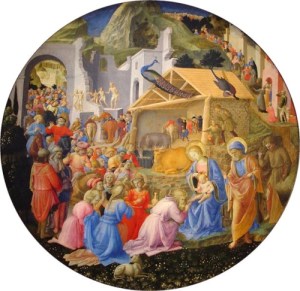
This week includes the date of the Epiphany, January 6th, the close of the Christmas celebration. Christian tradition confers religious importance to the day because it commemorates the visitation of the magi, the “Wise Men” or “Three Kings,” to the infant Jesus; more metaphorically, the Epiphany hallows “the manifestation of Christ to the Gentiles as represented by the Magi (Matthew 2:1–12),” as Google’s dictionary puts it.

12-01-05MagiFraAngelicoGoogle’s dictionary offers a little graph at the close of its definition, if the reader scrolls down far enough. The use of the word epiphany has risen considerably from the 1800s; I suspect the reason for that is that the term has migrated toward its other meaning as a revelation, particularly a creative revelation: “a moment of insight.”

Epiphany is a word encountered when reading about artists, inventors, philosophers, writers. It has become something to treasure–the AHA! moment, the reveal, the serendipitous appearance of a solution or concept–which is a meaning closely derived from its etymology: epiphainein, ancient Greek for “reveal.” The challenge for the artist or writer is to make manifest that revelation, if one is lucky enough to encounter it. The true epiphany must be acted upon, or lost.

~

And, of course, the other challenge is to continue to write day by day by day, when revelations seem few and far between or totally unforthcoming. That is a different order of activity, one which I’m currently engaged in, without epiphanies to help me along.


To endure

I have been contemplating the word endure, particularly in relation to my continuing curiosity about consciousness and in relation to physical enduring when the body is in pain.

Reading an excerpt from Husserl (the first proponent of transcendental phenomenology) that–admittedly, taken out of context–places consciousness in relation to time, I realize endure implies the concept of time itself even though time doesn’t make an appearance in its etymology (see below). Husserl writes:

Every temporal object has a duration…but in the type that is duration we have a distinction between the expanding, flowing duration and the momentary durations.

He suggests that there are “filling-in” types of duration, or time-phases, that arise to create “a continuous consciousness of unity whose correlate is an unbroken unity,” giving us the impression of sensuous unity in time. I wonder if our sensations of  physical pain operate in the synapses of the brain in somewhat the same way: momentary (acute), and filling in over time or flowing (chronic).

When we suffer, we call upon endurance to sustain ourselves. The verb form connotes the negative more commonly, such as to endure oppression, abuse, harassment, pain, humiliation. It is an active verb.

etymology: late 14c., “to undergo or suffer” (especially without breaking); also “to continue in existence,” from Old French endurer (12c.) “make hard, harden; bear, tolerate; keep up, maintain,” from Latin indurare “make hard,” in Late Latin “harden (the heart) against,” from in- (see in- (2)) + durare “to harden,” from durus “hard,” from PIE *dru-ro-, from root *deru- “be firm, solid, steadfast”

Nonetheless, strength is also implied, a resilient firmness that people tend to value. What is the current perspective on being steadfast? Is it to harden (become stubborn and inflexible) or to be solid? Don’t we admire the person who has endured much and yet, one way or another, lived life as it presented itself however hard the circumstances? And are those positive or negative traits, as our culture views them? Customs endure. Prejudices endure. When we call someone a “hard person,” it is seldom a compliment. Yet being steadfast is generally considered a virtue.

It’s interesting to note that the adjective form of endure has a more positive connotation–

enduring (adj.) Look up enduring at Dictionary.com

“lasting,” 1530s, present participle adjective from endure.

An enduring work of art; an enduring love. Something that defies time by lasting through those temporary durations and through the fillings-in. We human beings wonder whether our consciousness, what many have called our souls, are enduring in the sense of expanding over time and past the demise of our corporeal selves. But great literature, great music, great art suggests there are many ways to endure.

In the New Year, my hope is to become attentive to what endures; to extend compassion and love more widely and more deeply; to read good books and take in good works of art; to be good at what I do reasonably well, tending to myself and to others with as much grace as I can muster. Some years challenge us more than other years. Let us choose to endure.

Love is all you need


Resilience & interpretation

I know many of the readers who follow this blog are not citizens of the United States. Perhaps you have been hearing about the contenders for our upcoming presidential election and feeling some dismay. Perhaps you are particularly concerned about calls for identifying citizens based upon their ethnic background and religious choice.

If so, I assure you that there is push-back here from people who recognize that persons such as Mr. Trump embarrass the nation. It appalls us to see a person who feels he can ignore the U.S. Constitution running for the presidential office simply because he has money and recognition…although the free and open laws of the country permit him to proceed.

Trump’s proposal to identify some of our citizens by creed or heritage violates the Constitution in several ways. It violates Amendment One’s provisions for freedom of religious expression, and Amendment Four, the right to privacy; and the section of Amendment Five that relates to being held answerable to a crime and deprived of liberties without due process of law; also, Amendment Fourteen Section 1. Many, many U.S. citizens know that such proposals are merely rabble-rousing slander and could not be enacted without completely controverting the Constitution. These people are not wealthy entertainers, and they do not make the news, but they exist and–with any luck–they will vote.

A person running for the highest office in his country should know its laws thoroughly, but nothing in our Constitution says he (or she) must. We citizens are to blame, as clearly many of us are not terribly familiar with the laws of the United States of America, either. U.S. citizens should become more aware of our responsibility to learn about the Constitution, the importance of the vote, and the need to be rational thinkers when we go to the polls. Our democracy’s founding documents were drafted by people who earnestly, if perhaps idealistically, believed that human beings are capable of rational decision-making.

Granted, they also thought they were granting voting rights to property-owning men. The Constitution has been altered over time; it is a resilient, flexible, and enduring piece of prose that’s been the source of frequent interpretation.USConstitution From a literary standpoint, resilience and interpretation are what keep “classics” alive and relevant as works of art, though close readers can also use context, history, and speculation about original intent to examine a piece of writing they love and respect.

I have no idea of how I will vote next November. But I do know I will consider, more than personal values, the values of the nation under whose laws I currently reside. I’m reminded of the wisdom-teachings of Jesus in the Gospel of Matthew–

He said to them, “Then render to Caesar the things that are Caesar’s; and to God the things that are God’s.” Matt. 22:21

The people listening to Jesus went away “amazed” (Matt. 22:22). There is something ambiguous in that response that speaks to me today, something worth meditating upon, something worth interpreting.

~

Clouds & trees

One benefit to living where I do is the way the sky looks in early autumn. Another is the brilliancy of leaves as they change color.

This time of year, even my commute to and from work offers moments of beauty. There are sunrises as I get ready for work, sunsets as I drive home each evening. The skies have been so glorious lately that a friend of mine posts photos on his social media account every day. Autumn arrives, and I wish I were a painter.

Cloud textures: yesterday morning, stippled so densely I could easily imagine ice crystals clustering together in the atmosphere a thousand feet above me. Bouncy puffs, striations, streaks. Today, a more consistent palette of repeated half-rounds. A stream of grey, white, and slate blue overhead, highlighted with thin bands of yellow.

Meanwhile, the trees–first the hickories going golden, then other tints. Today, I noticed the scarlet of a tupelo aflame at the edge of a field and the first big sugar maple shifting to orange. Many of the smaller ornamental trees take on burgundy hues. I can’t describe these landscapes in words! I want words to be pigments. I feel stalled. Maybe I am just making excuses for why I have not been writing poetry lately–(I don’t want to confess to writer’s block, as obviously I am writing!)

10934149_10208044582216651_8508294618826705064_o

Here’s a nice video from Slate that speculates, based on recent science, about why there are more red colors in North American trees than in European trees. Click here!