The skill of grieving

In a recent post, Sigrun of the blog sub rosa pointed me to Poetry Society of America’s page on Natalie Diaz; I’m even going to post the same paragraph she does, in which Diaz states:

When I write, I bring all of my truths, even the Judas-truths that make me feel like the betrayer whose dirty hands are resting on the table for everyone to see, including God. For me, writing is less a declaration of those truths than it is my interrogation of them. Uncovering the darkness in me that led to some of the poems about my brother also lights up the hard, bright way in which I love him and the small wars I wage to win him back…the truths that have built in me a strength and compassion that help me to survive this world. Truth is that little animal we chase and chase until we suddenly glance over our shoulder and realize it has been chasing us all along.

This passage about “uncovering the darkness” and the hard ways in which we sometimes love–maybe with some people, there is no other way to love–interestingly coincides with my recent reading of Stephen Jenkinson’s Die Wise, a manifesto on how we die and how we might die better (wiser) if we carried our darkness better, as Diaz suggests in the passage above. While I am reading Jenkinson for specific reasons around end-of-life concerns, there’s no doubt that there is often poetry in his philosophy that we need to learn the skill of how to grieve and to learn all that such a skill contains, including its “Judas-truths” and its unflinching confrontation with the ways in which death is a gift to us collectively and individually.

Most of us do not see death as any kind of gift, and Jenkinson admits it can be a challenging perspective; he endeavors to persuade the mostly-American or European reader that each of us and each of our societies or cultures would benefit by reclaiming death as a natural sequence in our being in the world.

Claiming or reclaiming death (you might read here: darkness), says Jenkinson, requires us to face the fact that we have no language for dying, not really. He says “we are taught almost nothing about what language to use or why when we are trained for the job [of tending to the dying].” The Dying, he writes, are “them,” meaning they are “not us.” Which makes them outsiders and invisible and yet all of us die; we are all of us dying–and we work so hard to distance ourselves from the fact.

Poetry is a language that, I think, sometimes guides us toward the hard truths, when poetry is well-made and conflicting and sundered with surprise. Poetry isn’t the language that gets us to dying, exactly; but it can do some of the hard work of teaching us how to grieve.

This is not to say that poets or artists are any better at dying than the rest of us. Sometimes the darkness uncovered in the fiction or poem or painting is true and authentic and deep, but the artist does the grief-working well in art and not so well in life’s physical dying process. Artists who choose suicide may be people who suffer pain and can express it artistically without actually learning the work of grief, which differs from suffering. If we learn that anything that does not last forever is meaningless (an idea drummed into many of us through the concept of “eternal life”), we are apt to feel bereft at every loss and may embrace a kind of horrible existentialism. Sometimes our artists strive to overcome the meaningless through lasting works of art, but their personal desire to be somehow immortal may bog them down as death nears.

We admire this artistic striving, but it is a kind of working against our darkness rather than confronting it with the love Diaz mentions. Jenkinson writes: “Dying isn’t the end of true things…It is one of the true things, that is all.” [My italics.]

However, I do believe that art–particularly the storytelling arts–can offer much in the way of teaching us the physical, on-the-level, hard work of grieving. Really good novels and plays can help teach us if no one in our “real lives” does. Even if we weep at the end of the book and wish the author had chosen a different way of ending it. Good poetry that leaves us excited and confused by complexity or blasted with gut-level sorrowing might be teaching us the ways of grief we aren’t learning from our culture.

When a loved one dies, we often get lost, pushed away from grief through the signing of papers and the bland condolences of marginal friends and the plea to move on with our lives. Good poems can keep us dangling in the now of real grief and force us to figure our way through the losses we incur–losses which do not exclude even our selves. Because “death waters the living.” And so does poetry.

http://www.philamuseum.org/collections/permanent/82820.html

Rain [La Pluie] Vincent van Gogh, 1889. Thanks to the Philadephia Museum of Art


Epiphany

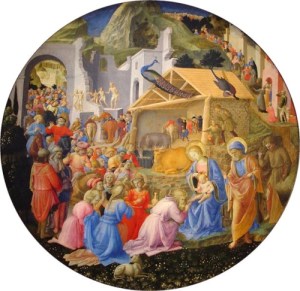
This week includes the date of the Epiphany, January 6th, the close of the Christmas celebration. Christian tradition confers religious importance to the day because it commemorates the visitation of the magi, the “Wise Men” or “Three Kings,” to the infant Jesus; more metaphorically, the Epiphany hallows “the manifestation of Christ to the Gentiles as represented by the Magi (Matthew 2:1–12),” as Google’s dictionary puts it.

12-01-05MagiFraAngelicoGoogle’s dictionary offers a little graph at the close of its definition, if the reader scrolls down far enough. The use of the word epiphany has risen considerably from the 1800s; I suspect the reason for that is that the term has migrated toward its other meaning as a revelation, particularly a creative revelation: “a moment of insight.”

Epiphany is a word encountered when reading about artists, inventors, philosophers, writers. It has become something to treasure–the AHA! moment, the reveal, the serendipitous appearance of a solution or concept–which is a meaning closely derived from its etymology: epiphainein, ancient Greek for “reveal.” The challenge for the artist or writer is to make manifest that revelation, if one is lucky enough to encounter it. The true epiphany must be acted upon, or lost.

~

And, of course, the other challenge is to continue to write day by day by day, when revelations seem few and far between or totally unforthcoming. That is a different order of activity, one which I’m currently engaged in, without epiphanies to help me along.


To endure

I have been contemplating the word endure, particularly in relation to my continuing curiosity about consciousness and in relation to physical enduring when the body is in pain.

Reading an excerpt from Husserl (the first proponent of transcendental phenomenology) that–admittedly, taken out of context–places consciousness in relation to time, I realize endure implies the concept of time itself even though time doesn’t make an appearance in its etymology (see below). Husserl writes:

Every temporal object has a duration…but in the type that is duration we have a distinction between the expanding, flowing duration and the momentary durations.

He suggests that there are “filling-in” types of duration, or time-phases, that arise to create “a continuous consciousness of unity whose correlate is an unbroken unity,” giving us the impression of sensuous unity in time. I wonder if our sensations of  physical pain operate in the synapses of the brain in somewhat the same way: momentary (acute), and filling in over time or flowing (chronic).

When we suffer, we call upon endurance to sustain ourselves. The verb form connotes the negative more commonly, such as to endure oppression, abuse, harassment, pain, humiliation. It is an active verb.

etymology: late 14c., “to undergo or suffer” (especially without breaking); also “to continue in existence,” from Old French endurer (12c.) “make hard, harden; bear, tolerate; keep up, maintain,” from Latin indurare “make hard,” in Late Latin “harden (the heart) against,” from in- (see in- (2)) + durare “to harden,” from durus “hard,” from PIE *dru-ro-, from root *deru- “be firm, solid, steadfast”

Nonetheless, strength is also implied, a resilient firmness that people tend to value. What is the current perspective on being steadfast? Is it to harden (become stubborn and inflexible) or to be solid? Don’t we admire the person who has endured much and yet, one way or another, lived life as it presented itself however hard the circumstances? And are those positive or negative traits, as our culture views them? Customs endure. Prejudices endure. When we call someone a “hard person,” it is seldom a compliment. Yet being steadfast is generally considered a virtue.

It’s interesting to note that the adjective form of endure has a more positive connotation–

enduring (adj.) Look up enduring at Dictionary.com

“lasting,” 1530s, present participle adjective from endure.

An enduring work of art; an enduring love. Something that defies time by lasting through those temporary durations and through the fillings-in. We human beings wonder whether our consciousness, what many have called our souls, are enduring in the sense of expanding over time and past the demise of our corporeal selves. But great literature, great music, great art suggests there are many ways to endure.

In the New Year, my hope is to become attentive to what endures; to extend compassion and love more widely and more deeply; to read good books and take in good works of art; to be good at what I do reasonably well, tending to myself and to others with as much grace as I can muster. Some years challenge us more than other years. Let us choose to endure.

Love is all you need


Resilience & interpretation

I know many of the readers who follow this blog are not citizens of the United States. Perhaps you have been hearing about the contenders for our upcoming presidential election and feeling some dismay. Perhaps you are particularly concerned about calls for identifying citizens based upon their ethnic background and religious choice.

If so, I assure you that there is push-back here from people who recognize that persons such as Mr. Trump embarrass the nation. It appalls us to see a person who feels he can ignore the U.S. Constitution running for the presidential office simply because he has money and recognition…although the free and open laws of the country permit him to proceed.

Trump’s proposal to identify some of our citizens by creed or heritage violates the Constitution in several ways. It violates Amendment One’s provisions for freedom of religious expression, and Amendment Four, the right to privacy; and the section of Amendment Five that relates to being held answerable to a crime and deprived of liberties without due process of law; also, Amendment Fourteen Section 1. Many, many U.S. citizens know that such proposals are merely rabble-rousing slander and could not be enacted without completely controverting the Constitution. These people are not wealthy entertainers, and they do not make the news, but they exist and–with any luck–they will vote.

A person running for the highest office in his country should know its laws thoroughly, but nothing in our Constitution says he (or she) must. We citizens are to blame, as clearly many of us are not terribly familiar with the laws of the United States of America, either. U.S. citizens should become more aware of our responsibility to learn about the Constitution, the importance of the vote, and the need to be rational thinkers when we go to the polls. Our democracy’s founding documents were drafted by people who earnestly, if perhaps idealistically, believed that human beings are capable of rational decision-making.

Granted, they also thought they were granting voting rights to property-owning men. The Constitution has been altered over time; it is a resilient, flexible, and enduring piece of prose that’s been the source of frequent interpretation.USConstitution From a literary standpoint, resilience and interpretation are what keep “classics” alive and relevant as works of art, though close readers can also use context, history, and speculation about original intent to examine a piece of writing they love and respect.

I have no idea of how I will vote next November. But I do know I will consider, more than personal values, the values of the nation under whose laws I currently reside. I’m reminded of the wisdom-teachings of Jesus in the Gospel of Matthew–

He said to them, “Then render to Caesar the things that are Caesar’s; and to God the things that are God’s.” Matt. 22:21

The people listening to Jesus went away “amazed” (Matt. 22:22). There is something ambiguous in that response that speaks to me today, something worth meditating upon, something worth interpreting.

~

Clouds & trees

One benefit to living where I do is the way the sky looks in early autumn. Another is the brilliancy of leaves as they change color.

This time of year, even my commute to and from work offers moments of beauty. There are sunrises as I get ready for work, sunsets as I drive home each evening. The skies have been so glorious lately that a friend of mine posts photos on his social media account every day. Autumn arrives, and I wish I were a painter.

Cloud textures: yesterday morning, stippled so densely I could easily imagine ice crystals clustering together in the atmosphere a thousand feet above me. Bouncy puffs, striations, streaks. Today, a more consistent palette of repeated half-rounds. A stream of grey, white, and slate blue overhead, highlighted with thin bands of yellow.

Meanwhile, the trees–first the hickories going golden, then other tints. Today, I noticed the scarlet of a tupelo aflame at the edge of a field and the first big sugar maple shifting to orange. Many of the smaller ornamental trees take on burgundy hues. I can’t describe these landscapes in words! I want words to be pigments. I feel stalled. Maybe I am just making excuses for why I have not been writing poetry lately–(I don’t want to confess to writer’s block, as obviously I am writing!)

10934149_10208044582216651_8508294618826705064_o

Here’s a nice video from Slate that speculates, based on recent science, about why there are more red colors in North American trees than in European trees. Click here!


Empathy & compassion

quanyin
Quan Yin, bodhisattva or goddess of compassion; the Chinese interpretation of Avalokiteśvara

Sensitive. Or: oversensitive.

These are terms I hear bandied about to describe people who react deeply to anything from wool clothing or sock seams to sarcasm or “charged language.” When I was a child, people told me I was sensitive; initially, I thought that was a kind of compliment, and sometimes that was the intention. The teenager I once was believed that sensitivity made me empathetic and compassionate.

As I matured, however, the term sensitivity took on more negative connotations of the “can’t you take a joke?” sort. Worse yet, the charge of sensitivity came loaded with accusations of narcissism, as in “you take everything personally.” In today’s phraseology, “It’s not all about you.” Under those terms, sensitivity does not resemble empathy.

Empathy is a feeling-response, true. It appears to have a like-kind relationship to sensitivity–but a person must be sensitive to others’ experiences in order to feel empathy; so the similarity’s not as swappable as it first seems. I thought that my feeling-response signaled that I was a compassionate person. Indeed, fiction elicits empathy in me. A lifelong bookworm and early addict to novels, I definitely feel along with the characters of the stories I read. Is it really the experience of others that makes me weep or feel joy as the characters forge through lives such as I will never be able to encounter? Or is it a feeling response to damned good writing?

I ask myself these questions because, given my inquiries into what consciousness is and what poetry does, it seems I have not made clear to myself the differences between sensitivity, empathy, and compassion.

~

My current thoughts on the differences have evolved through reading and writing poetry, not fiction, and through getting older. Nothing like life experience to knock a person’s youthful errors into strong relief.

Here goes:

Sensitivity is the strength of a person’s reaction. That reaction may be physical or emotional and will vary widely from one individual to another.

Empathy always means that one “feels within” another person (from Greek empatheia em- ‘in’ & pathos ‘feeling’); it is an inward response to external stimuli. As Daniel Goleman notes, there are several types of empathy psychologists have identified–here’s a brief article on that topic.

Compassion, while a noun, must be active. I think of it as behavior, as action, as verb in noun form. It is a response or reaction to suffering in others (empathy) that is accompanied by an urgent desire–the word desire isn’t strong enough to convey the feeling–to help alleviate the suffering.

That’s where the activity comes in. Until I feel a desire to act, I am “merely” empathetic and sensitive.

~

Recently, I have begun to recognize that my desire to write poetry is partly compassion-based. Art of any kind is process as well as result, and process is action. Additionally, my career as an educator has compassionate action structured into the job description. There are other ways we–I–can be compassionate in the world. This matters to me.

We can learn from the practice of tonglen: “Breathe in for all of us and breathe out for all of us. Use what seems like poison as medicine. Use your personal suffering as the path to compassion for all beings.” ~Pema Chödrön

And we can live in the world and begin to use our sensitivity to pain, and our sense of empathy, to activate compassion–as a verb.


Perspective & aesthetics

Officially autumn now–and my lawn litter consists mostly of oak leaves, though other leaves will shortly follow. The showy blossoms of late summer, such as zinnia and tithonia, have begun to fade. Even the tall, bright-yellow, wild goldenrod’s going to seed, turning the meadow into a mass of beige and fading green. Asters and chrysanthemums take their places, drawing the garden visitor’s eyes a bit closer to the ground.

We move toward yin, the earth…which is where I happened to notice that just above the sprawling petunias–still blossoming, though getting a bit peaked–an iris is in bloom, too. This particular iris would not be all that commendable a flower in late spring or early summer when most irises are efflorescing. Its stature is medium, its color a rather wan yellow, its petals unremarkable.

autumn iris

Nonetheless, it’s an iris. In autumn! Apparently, my perspective on flowers changes once the days get shorter. My aesthetic expectations evolve: any rose becomes a wonder, any iris an almost magical surprise amid the mums and ornamental kale. That’s an important observation I try to keep in mind for myself and to teach to my students: perspective alters everything.

~

There are nice hybridization developments on late-blooming or, more accurately, re-blooming irises (this link from the Brooklyn Botanic Garden offers some useful information). I transplanted my rebloomer from an older garden that a long-ago homeowner planted; so I don’t know its heritage, though it somewhat resembles the cultivar “Baby Blessed.”

In the process of trying to track down the variety, I learned a new botanical word: remontant. Remontancy is that quality in a plant that makes it capable of blooming more than once in a season or year. There’s something generous and buoyant in that word, from the French “coming up again.” If hope does not spring eternal, may it at least be remontant. And may my perspective be flexible enough to appreciate seasonal transitions and small, un-flashy irises in autumn.

~

Another sign of autumn: the gleaners in the fields.

Altercation, alliteration, & assonance

Recently, while driving to a restaurant just at rush hour, we witnessed a near-accident. The offending vehicles were blocking an intersection but had just managed to avoid collision, and the driver of one car was shouting from his rolled-down window–shouting words that it is a good thing my 90-year-old mother-in-law was too deaf to hear, I might add.

After scooting around to the shoulder and proceeding along our route, my son commented on the driver’s use of the epithet “douche canoe.” It’s one I was not familiar with. “What does that even mean?” I asked, unable to process it either literally or by metaphor; yet I grant there is something appealing about the phrase, for sound reasons (I am making a pun! I admit it!).

Not the insult variety of canoe

~

Poets tend to be enamored of the way language sounds, even those who “write for the page.” We can imagine the sounds, “see” them, as we write. Performative poems rely on sound and continue the ancient oral foundations of poetry in song and chant. Many American students encounter the Beowulf saga in high school; kenning appears on the curriculum, and it is the one aspect of the saga my students always seem to recall.

Dictionary.com says of “kenning”:

a conventional poetic phrase used for or in addition to the usual name of a person or thing, especially in Icelandic and Anglo-Saxon verse, as ‘a wave traveler’ for ‘a boat.’

Poets deepened these modifiers, using kenning to evoke allusions to well-known myths, for example, or doing tricky wordplay such as puns and alliteration…or all of the above.

Moving away from kenning and into the general field of poetic wordplay, poets and others who are facile with language can move with ease to the sarcastic, the suggestive, and the downright vile (a classic example is Catullus–here’s a link to a biography from the Poetry Foundation that includes commentary on some of his well-known insult poems). A quick Google search on Shakespearean insults yields dozens of results from the bard of Avon. One of my favorite strings of poetic invective is from King Lear: “lily-liver’d, action-taking, whoreson, glass-gazing, superserviceable, finical rogue.” Note the alliteration and the meter. Touché.

Closer to “douche canoe” in terms of era is playing the dozens, exemplified for boxing fans through the boasts and challenges of Muhammed Ali–here, crowing over a bout with Sonny Liston:

“The crowd did not dream when they laid down their money
that they would see a total eclipse of the Sonny.”

Elijah Wald has a scholarly book on the tradition of playing the dozens. These rhymes are intended to challenge, provoke, and amuse. The evolution into rap is easy to credit.

~

Despite the aural appeal of “douche canoe” with its long, repeated vowels, I doubt the phrase will enter my personal lexicon. It did remind me, however, of an alliterative insult I heard fairly frequently from my uncles when one of us kids was acting particularly balky:

“Don’t be such a horse’s hind end!”

hindend

What does a woman want?

In the medieval poem “The Marriage of Sir Gawain,” the knight gallantly agrees to marry a hag-like witch who has helped King Arthur by giving him the answer to his enemy’s riddle, which is “What does a woman want?” One of several ballad-like story poems of the Arthurian legend, this one appears in Eleven Romances of Sir Gawain (an online scholarly edition is here).

For contemporary intellectual types, however, the person who famously posed that question is Sigmund Freud. He spent many years refining the theory we now refer to as “penis envy” and arguing the displacement theory was at work subconsciously. Far too many casual references to Freud have simplified this idea as suggesting that women want to be anatomically arranged like men.

Um, not exactly…nope.

But back to Sir Gawain, agreeing to marry the hag in order to free his king from the evil baron’s grip. According to the poem, Arthur gives Gawain the secret he has learned from the witch herself. Depending upon the version or translation, the answer is: what a woman wants is her way (or her will, or to have her own way). She wants to be free to decide things that affect her and to make her own choices. Because Gawain is not only gallant and loyal and noble but also no dummy, he remembers Arthur’s secret. When the witch reveals herself as a gorgeous woman and asks him whether he’d prefer to see her lovely by day (when others can see her) or lovely by night (when her husband is abed with her), he defers to her. He says she should choose.

Delighted, she chooses to be lovely all the time (she now knows he will never forget that she has a will of her own).

So, if the medieval hag is correct, Freud was right, at least symbolically. Freud dwelt in a culture where men had authority, power, and self-agency, probably also true of medieval European culture, though I’d argue the Victorians were even more constrained. Anyway, women want those things, too–if possessing a penis as part of one’s anatomy could get you those things, one can understand envying the man, if not the organ itself. Indeed, Freud uses a bunch of lengthy theorizing to offer intellectual ballast to what he initially mentioned was an issue of power. Penis=power, in a male-dominated culture. It is almost too simple an idea, and almost too obvious, so he probably felt he had to pack it with a lot of other ideas. Transference and displacement theory have proven useful in other ways, but penis envy just suggests that females too often lack power to make personal choices within a social milieu.

As a feminist who yearns for balance and equality among human beings, I think it is crucial to point out that, despite the stories with which I’ve framed this post, wanting one’s way is not just what women want. It is also what men want.

People, no matter the gender, want to be able to say “No” and to be listened to and heeded. People want to direct their own lives, make their own decisions–and their own mistakes. I work with college students who are 17-22 years old, and I can assure you that they desperately want to make their own choices. Though they often also desperately want to blame someone else for the unfortunate consequences of certain ill-considered choices, they mature once they realize that sort of behavior limits them to the role of the naughty child–a dependent–not a responsible, independent person. If you want to be respected as an adult, I tell my students, you have to be willing to own up to your own poor decisions. And that’s just for starters.

Each young person I teach, tutor, or counsel wants some control over his or her life. Some try to get it by seeking to control other people, others by trying to control their environment, others by endeavoring to control the social situation they find themselves in…the list goes on. Human beings cannot really control as much as we think we can. But we can exert our will and speak up for our way. We can offer respect and seek respect. We ought to be able to make our own decisions as long as we are mature enough to deal with the results for good or ill. That goes for people of any sex.

Yet when a woman asserts that she wants her way, our society tends to judge her as a whiner or a bitch, a ball-breaker or a manipulator. Even now, many years into politically-correct language and Title IX and women as Supreme Court justices, I hear this sort of language bandied about, often “in jest.” Sure, it can be jesting; but it’s also pretty close to jousting–with words. Be a little more careful, my friends. Or as the terminology goes these days, more mindful. Perhaps, given the freedom to exercise our will, more of us will choose to be lovely all the time.

Noesis

noesis~

  1. Cognition; perception.
    2. The exercise of reason.

Interesting that definition number two is dependent upon definition number one. Lately I have been thinking about the difference between consciousness and conscience; the latter seems to me to be specifically human, I guess, because isn’t conscience a sort of cultural or judgmental entity based upon rules? Yes, I am talking about morality, a term I tend not to use much when I consider cognition, consciousness, narrative, being.

I recently perused Patricia Churchland’s Braintrust and found myself intrigued about where and in what ways morality and consciousness or sentience mesh. Churchland is a moral philosopher, but this book relies largely on arguments premised on neurology, biology, evolution, and animal studies. Her critics pose interesting rebuttals, too. I found her book readable and often convincing–and it’s the kind of book that leads me to other writers and scientists; I love that in a book!

braintrust~

The phenomenology of consciousness–the carbon body brain-based “real world” idea of the word–involves intentionality, sentience, qualia, and first-person perspective. We can identify qualities based upon our first-person consciousness and respond to them. This process has led Western thinkers toward the concept of reason or rational thinking. The exercise of reason derives from perception.

This does not mean that phenomenology is the sole form of consciousness or even that it is necessarily human-only, but it seems to me to be the easiest one for human beings to wrap their minds around. Yet the earlier philosophers were not phenomenologists. Their speculations about what consciousness originated in and what morality inhered in were quite abstract.

For a good sum-up of how contemporary scholars define and discuss consciousness, go to Stanford’s site here.

~

Being cognizant or conscious does not necessarily lead to moral behavior or reason…or does it? Here we have an idea that has been debated for centuries. In her book, Churchland often returns to Hume, who wrote about morality from what, eventually, became known as the utilitarian stance (though I would argue Hume is not really utilitarian). Stanford offers an overview of morality as defined by philosophers over the years; The Internet Encyclopedia of Philosophy says this of Hume:

In epistemology, he questioned common notions of personal identity, and argued that there is no permanent “self” that continues over time. He dismissed standard accounts of causality and argued that our conceptions of cause-effect relations are grounded in habits of thinking, rather than in the perception of causal forces in the external world itself. He defended the skeptical position that human reason is inherently contradictory, and it is only through naturally-instilled beliefs that we can navigate our way through common life.

These concepts should feel modern to most of us thanks to cultural anthropology, sociology, and psychology, among other disciplines. Hume’s position conflicts with much religious dogma, but his ideas were not out of line with many of his fellow Enlightenment-Era thinkers. During the Enlightenment, intellectuals were enamored of the exercise of reason (noesis).

~

So: consciousness and conscience. First we have the one–however it arises within us*–and the other develops (or evolves?) thanks to the need for social beings to navigate common life. And thanks, perhaps, to brain evolution adapting to social common life (see Churchland for more on this).

Much to mull over during my brief summer break.

~

Jiminy Cricket copyright Walt Disney Co.

Jiminy Cricket copyright Walt Disney Co.

*See my numerous previous posts on consciousness!

⇐ “And always let your conscience be your guide!”