Composition

Forgive me, readers–whoever you are–this weekend I am composing poems instead of a blog post, revising the work (see this post) and creating new stuff from dribs, drabs, sketches, notes, and the windy day outside with its sky full of variable, intermittent, strangely-colored clouds.


Neglecting the work

It seemed to me to have been a long time since I devoted serious focus to my creative work–I mean in terms of organizing, keeping track, revising, submitting to journals, compiling a draft manuscript of newer work…the so-called business of poetry. I resolved therefore to spend a weekend at the task. Alas. The weekend revealed to me the extent of my benign neglect: ten years of not-really-being-on-the-ball.

inflating-clipart-beach-ball-6

I do not consider myself a particularly prolific poet, but I found myself faced with well over a ream of poetry pages, many poems only in their second or third draft and far from “finished.” Maybe an average of 70 poems a year for ten years. Do the math: this is not a weekend’s work. [le sigh]

Where to begin? There is no beginning. After an hour or so of trying to prioritize the various components of the job, I gave up and just started at whatever had become the top of the pile. Analysis: which drafts had any glimmer of possibility? Some erstwhile poems could easily be culled into the “dead poems file” I keep under the cabinet with the dust bunnies. Others required considerable revision.

Fascinating process, despite aspects of tedium. I encountered poems I forgot I’d composed. I looked at the dates I began and revised them, tried to discern where my thoughts and feelings were at the time. Somehow, going through poems in no way resembles looking at old photographs–it’s not that sort of memory jog. Indeed, the poems are not involved with the memory part of my brain but with the creative part.

And that is exactly what I have been neglecting: the creative, imaginative, intuitively analytical side of myself.

In the process, I found a chapbook manuscript to submit–I had completely neglected it–and several worthwhile poems. I have no idea yet how much further I can get into the pages of past poems, and whether I might fashion another manuscript from the lot. But I’ve decided the work should not be neglected.

And I have a lot of catching up to do!


Vocation, avocation

Somewhere recently–was it the Sunday New York Times?–I read an opinion essay about how recent surveys of US citizens indicate that we have fewer hobbies than we have had in years past. The columnist wondered whether that lack is due to a zeal to be the best at whatever we engage in–the best jogger we can be, the most avid cyclist, the best collector, knitter, paper-crafter, woodworker, violinist, what-have-you. She suggested we’ve somehow lost the joys of being hobbyists: amateurs who do or create something because it is fun or relaxing, or because trying to learn a new skill makes us feel good. A true hobby is something we don’t have to be perfect at, because that is not the point.

As my students wrestle with the tasks of college and their concerns about their futures, the concept of vocation arises often. What to do with a life? Earn enough money to live reasonably comfortably, even if the job is not a passion? What if it’s not even satisfying? Should people choose a bearable career and find enjoyment in avocations? Or persist at what they love even if society doesn’t always reward the path they’ve chosen? Or–the options are legion.

~

I believe in vocation as passion, and I also practice hobbies. My career is in higher education, and I enjoy and learn from my job. My vocation is writing, particularly writing poetry; my passion lies in that direction more than any other, but poetry has not been a career path in my case.

~

My hobbies have evolved over the years. For decades, gardening has kept me happily occupied out of doors–but I have no need to become a Master Gardener, and my gardens are often minor failures in one respect or another. The garden, however, soothes me, distracts me from anxieties, helps me to become a better observer, teaches me much. When learning about plants, I got interested in botany and wild flower identification, so I am a more informed hiker and nature-saunterer than I used to be.

IMG_5633

garden photo: pepper, sassafras leaf © 2018 by Ann E. Michael


Photography’s also a hobby I pursue, an interest of mine since my late teen years (back before digital). The view through the frame has always intrigued me, as well as the opportunities that different lens lengths offer the photographer as to framing and focus. I especially enjoy macro lenses. It’s fun to zoom in closely on insects, flowers, and small areas of everyday objects. Photography encourages different types of observation.

The earliest interest I can recall having is art: painting and drawing in particular. From the time I was tiny, even before I entered kindergarten, I loved to draw and paint and to look at art in books and museums. During my teen years, I studied art at Fleisher Art Memorial in Philadelphia and headed to college thinking I would minor in the fine arts. My talent did not match my aspirations, and a thorough self-analysis at around age 20 led me to recognize I could be creative more successfully in other ways…by that time, I was writing more seriously than I was painting.

But now? I have taken up painting in acrylics. Mostly sketches of clouds. There’s no pressure on me to do well; I can paint many mediocre pictures of clouds and feel relaxed in the process, meditative, observant, a casual learner.

cloudsketch

mediocre acrylic sketch of clouds, by Ann E. Michael

~

As I wrap up this post, I realize that my career and my hobbies have encouraged observation from multiple and new perspectives. And my vocation? Poetry practically relies upon the writer’s ability to switch into creative and imagined points of view, as well as to have the opportunity for closely-observed objects and experiences.

Vocation, avocation, passion, career. I count myself lucky.

…Some rain must fall

Longfellow wrote that “Into each life some rain must fall” (“The Rainy Day“). The poem is an extended metaphor; here in my valley, the rain has been actual, physical, moist, sopping, wringing, drizzly, humid, soaking, and all the rest.

The metaphorical hasn’t been absent, either.

So this week, my post consists of other writers’ posts. Explore, please. All of these links offer much to enlighten the reader.

https://www.daletrumbore.com/unthinkable

Now Hold On There; or Slowing the Revision Process

On first looking into Shenandoah’s submissions

Barberous

http://www.writerintheworld.com/2018/09/03/cathedrals-and-yurts-a-reprint/

Grammar


Steven Pinker‘s early book, The Language Instinct (1994)–controversial among linguists, psychologists, social anthropologists and probably semiotics philosophers–is nonetheless relatively easy for the interested non-scholarly layperson to read. Pinker has since become well-known for his best-selling books, TED talks, and willingness to engage in lively debates on controversial topics such as violence in society and his claims for the embodied brain, scientifically-supported atheism, and rational culture. [Totally off topic, but I’m a great fan of his current wife’s novels and philosophy books–Rebecca Goldstein–what an amazing mind she has! Not that Steve Pinker is a slouch in that department, either…an intellectual power couple indeed. But I digress.]

The Language Instinct got me thinking more broadly about grammar, especially as the semester is about to begin and I’m once again wrestling with how to teach conventional writing skills to under-prepared, newly-minted college freshmen. I harbor no intentions of talking to them about linguistic theories. But I do want them to understand that they can already express themselves perfectly well verbally, with the help of body language (even students who are still learning English; even students who have told me that they have learning disabilities). The tool they need to succeed at the college level is the skill of writing that employs enough agreed-upon conventions–prescriptive grammar–to convey clear ideas to the standard reader.

Lots of assumed definitions there: who is the ‘standard’ reader? How many and which ‘conventions’ are enough, and who is it that agrees upon them? I have to let the students know that the answer is: “It depends.” They are seldom very pleased to hear it, but human beings are nothing if not adaptable.

~

After defending slang, split infinitives, the ‘verbing’ of nouns, and other shibboleths, Pinker–in a chapter denigrating language mavens (hence his Jeremiah example toward the end of this excerpt)–writes:

The aspect of language most worth changing is the clarity and style of written prose. Expository writing requires language to express far more complex trains of thought than it was biologically designed to do. Inconsistencies caused by limitations of short-term memory and planning, unnoticed in conversation, are not as tolerable when preserved on a page that is to be perused more leisurely. Also…a reader will rarely share enough background assumptions to interpolate all the missing premises that make language comprehensible. Overcoming one’s natural egocentrism and trying to anticipate the knowledge state of a generic reader at every stage of the exposition is one of the most important tasks in writing well. All this makes writing a difficult craft that must be mastered through practice, instruction, feedback, and–probably most important–intensive exposure to good examples…a banal but universally acknowledged key to good writing is to revise extensively…Anyone who does not appreciate this necessity is going to be a bad writer. Imagine a Jeremiah exclaiming, “Our language today is threatened by an insidious enemy: the youth are not revising their drafts enough times!”

Indeed, I agree with him here. Taking the time to read good writing frequently, and taking the time to revise carefully when writing pretty much anything (even a Twitter post) would go a long way toward improving anyone’s writing.

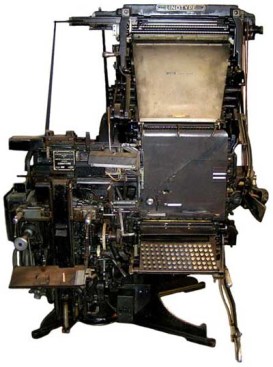
linotype

Mergenthaler’s Linotype machine

We do need concise, standardized, well-revised written texts, especially when we are relaying new information, instructing others how to do something, or convincing our professors that we comprehend the fundamental theories of the coursework. That’s not “grammar,” the magical tool that my students think they somehow missed learning in grades K-12, it’s craft, attention, and revision–with a few prescriptive rules, enough to level the ground on which the we lay our communicative foundations.  The rest is work.


Process

William Stafford:

A writer is a person who enters into sustained relations with the language for experiment and experience not available in any other way…A writer is not so much someone who has something to say as he is someone who has found a process that will bring about new things he would not have thought of if he had not started to say them.

Writing is a process that elicits consciousness in the individual writer, often as the writing unfolds. Flannery O’Connor: “I write because I don’t know what I think until I read what I say.” Joan Didion: “I don’t know what I think until I write it down.”

imagestafford

Perhaps oddly–perhaps not–Stafford’s definition that what a writer is comes down to what a writer does bears a certain resemblance to Gerald Edelman‘s “neural Darwinism” theory (ca. 1989 in Bright Air, Brilliant Fire, a more reader-friendly version of models developed in his neural topology trilogy*). Edelman basically says consciousness isn’t a “thing in itself” so much as it is a process that the embodied brain does. The brain’s processing capabilities are individual and endlessly myriad and they operate, claims Edelman, through the re-entry of information in intricately complicated links and physiological systems.  Thus, through evolution’s incremental layering of human beings’ brains, what we call higher-order consciousness makes its appearance.

And then on to gesture, semantics, lexicon, syntax, language, culture, &c.

~

Gerald Edelman:

What is daunting about consciousness is that it does not seem to be a matter of behavior. It just is–winking on with the light, multiple and simultaneous in its modes and objects, ineluctably ours. It is a process and one that is hard to score. We know what it is for ourselves but can only judge its existence in others by inference.

…Once a self is developed through social and linguistic interactions on a base of primary consciousness, a world develops that requires naming and intending. This world reflects inner events that are recalled, and imagined events, as well as outside events that are perceptually experienced. Tragedy becomes possible–the loss of the self by death or mental disorder, the remembrance of unassuageable pain. By the same token, a high drama of creation and endless imagination emerges…The wish to go beyond these limits [of embodiment] creates contradiction, fantasy, and a mystique that makes the study of the mind especially challenging; for after a certain point, in its individual creations at least, the mind lies beyond scientific reach…the reason for the limit is straightforward: The forms of embodiment that lead to consciousness are unique in each individual, unique to his or her body and individual history. [italics mine]

To me, this passage–in a book about neural mapping and brain physiology–feels “poetic.” But what do I mean when I say the concept of embodied consciousness, and consciousness as a series of intricate, synthesized processes, coincides with being a writer? Or in my case specifically, a poet?

It has something to do with taking in the world–through the senses, which is all my body’s really got–and synthesizing all those years of experiences, memories, books I’ve read, poems and plays I’ve loved, people I’ve known, relationships with the environment and with human beings and with other creatures, the whole of my personal cosmos. Referents and reentrants. Relationships actual and imagined. “The remembrance of unassuageable pain.” The process of loafing through the world.

Writing, where much of my so-called consciousness dwells. Not in the outcome, the resulting poems or essays, but in the doing.

~

More about writing-related processes and politics here: Poet Bloggers


* Neural Darwinism: The Theory of Neuronal Group Selection; Topobiology: An Introduction to Molecular Embryology; The Remembered Present: A Biological Theory of Consciousness.

Berrying

Each year, dill starts going to seed as the beans plump out almost overnight. It’s time to make dilly beans, if you can stand to work in the kitchen, canning–as my grandmothers always did, without the assistance of air conditioning.

No, thanks. I prefer beans fresh. I rise as early as I can and harvest them before the sun gets too high. This morning, I remembered to look for blackberries, too.

IMG_5460

Turns out this is a good year for blackberries. The canes are loaded with fruit and weighted with vining wild grapes and honeysuckle. The latter bloomed rather late this year and are still putting forth fragrant flowers. The marvelous scent made berry-picking quite soothing.

Soon, the catbirds and orioles and everyone else will be harvesting these berries. Despite their thorns (which didn’t deter me, either).

~

It has been far too hot to work in the garden, however; so I have been writing, and submitting work to literary journals, and even painting a little–something I have not done in years. Finding ways to be both creative and relaxed. Much needed.

Linkage

Thanks to a student who pointed out how many of the links to the right (on this blog page) were inoperable, I have finally updated them. Well, most of them; I have limited time for tweaking around on my WordPress settings page.

Links appeal to me because they mean connection. The interconnectedness of the web parallels the many relationships among human beings, societies, and environmental entities from forest to desert, as well as infrastructural connections from town to city and across waters and the physiological connections that make life in a carbon-based embodiment possible. And neuro-connections that maintain our pulses and our consciousness–without such linkages, what would we be?

linkage-5 University of Utah

see link in para. 3

Our genetic linkage influences what we look like, what forms of illness or robustness our bodies possess, and the likelihood of carrying those traits to our offspring.

When we link ideas or concepts or theories, the resulting concatenation can be innovative, revelatory, novel–even if the result is a failure, there’s much to learn from trying to solve the puzzles we encounter when putting together unlike things.

Writing a poem, for example, involves such a combinatory effort. Combinatory logic is a mathematical concept but an intriguing metaphor for what poets do when we mash together observations with ideas and emotions and whatever values each writer operates under.

Linkage permits us to steer things, too, and to integrate systems elegantly:

baesystems-parallelhybridrives_OEMoff highway

[thanks to OEM Off-Highway]

So, please check out the links to my work and to the interesting sites on the right of the page on this post. And likewise, links below (yes, I am still taking part in reading blogs on the Blog Tour!)

On capital letters in poems and making craft choices in poetry, an interesting blog post by Marly Youmans.

And Leslie Wheeler on whether a poem can be a monument.

~

May you remain always connected, one way or another.

Whelmed

The other day, I mentioned to a friend that I anticipate a busy May, what with sundry beloveds graduating and having birthdays, and visitors from far places, and the end of the academic year at my place of employ, and prime planting-out-the-vegetable-garden season upon me…

She said perhaps I am overwhelmed.

All of the above events are wonderful things. And I have considerable help in accomplishing them, so there are no great burdens on my shoulders. Overwhelmed sounds, well, overstated. That got me thinking about the words overwhelmed and its opposite, underwhelmed–is there a “whelmed,” just on its own?

Turns out there is (archaic, notes Merriam-Webster):

WHELM transitive verb
1. to turn (something, such as a dish or vessel) upside down usually to cover something; cover or engulf completely with usually disastrous effect
2. to overcome in thought or feeling
intransitive verb to pass or go over something so as to bury or submerge it

And its source is Middle English (thank you, Online Etymology Dictionary):

early 14c., Middle English whelmen “to turn upside down”… Figurative sense of overwhelm as “to bring to ruin” is attested from 1520s.

Maybe I am whelmed, then, as per definition 2 above; the feeling I have doesn’t jive with the connotation of “to bring ruin.”

At any rate, I herewith offer some diversions by writers of other blogs and sites instead of my own work–with the exception of the first link on “Say It Today.” Read and explore and allow what’s delightful to wash over you without disastrous effect.  🙂

GTJ75603_2

From Haverfordwest Library, accessed through Casgliad y Werin Cymru

~

Brothers & Storytellers, a brief essay of gratitude at Say It Today

~

Lesley Wheeler’s delightful, on-the-spur-of-the-moment, Day 29 of National Poetry Month poem should amuse those who write poetry and those who meditate and…well, just fun.

~

Donna Vorreyer on writing “a whole lotta poems.

~

Kelli Russell Agodon on writing a poem a day (and forgetting about quality).

~

Finally, Theodora Goss on love, home, and work–priorities that feel pretty “right” to me.

Friendships

April: a busy time. During my busy times at work or on the home front, I often spend less time with my friends.

The best thing about that is: my friends understand. They will still be there when I crawl out from under whatever has me crushed for time, whether it’s illness, job stress, time-consuming family-related challenges, home maintenance, garden or lawn work, travel, or depression.

[insert here, me, waving to my friends!]

Social media is no substitute, although I confess to using it to keep connections with those I care about. Social media, for example, has been significant in helping me to stay in touch with poetry colleagues; but much as I admire and learn from other writers, they play different roles in my life than friends do. Also, even from the beginning of my Facebook use, I knew the platform essentially was a “me and those like me” social bubble.

The specter of “us vs. them” has raised its snarling head on social media sites ever since the early days of chat rooms. There’s a reason for that, and Natalie Angier of The New York Times reports on some recent findings in this article:


~

Meanwhile, on the “unalloyed good” side of friendship–The real friend listens, gets busy herself, drops a line now and then if I’ve been absent for awhile, and drops everything if I find myself in difficulties and ask for help.

She or he also shares my brainwaves, apparently–and not just metaphorically! The studies Angier writes about in the article below offer some really intriguing possibilities about human beings as social animals and how our brains work. PubMed.gov lists a large number of research articles that examine the topic of health, neuroscience, and sociability; the interconnectedness strikes me as relevant and fascinating.


~

Boy, do I love neuroscience! This work synthesizes physical actuality with metaphorical possibilities in ways that inspire me.

Probably, there will be poems. Meanwhile, if you want to watch some brain functions in action, some cool animations: http://www.neuroplastix.com/styled-99/therapeuticanimations.html