Filling the world with poems

Taking part in the blogging tour means trying to keep up with what other poets have been posting, and in the process raising my own writing frequency. Recently I’ve read several writers’ insights about, fears of, and approaches to the process of submitting work for publication. I have also had several in-person and by-email discussions about the perceived or genuine value of publication of one’s work, and some advice on how fervently to pursue publication (and in which venue).

A perennial topic among literary types:

http://ofkells.blogspot.co.uk/2018/02/on-rejection-and-some-advice-from-drag.html

http://webbish6.com/what-ive-learned-from-my-millennial-friends-as-a-gen-x-writer-or-how-to-submit-like-a-millennial/

https://uniambic.com/2018/01/24/poetry-submission-strategy-whatever-works-for-you/

http://webbish6.com/the-importance-of-resilience-in-the-poetry-game-and-in-life/

https://lissaclouser.com/2018/01/26/accepted/

https://lissaclouser.com/2018/01/30/scared-to-submit-yer-poems/

~

I’ve also read articles urging poets to consider submitting on a “tier” basis. First-tier journals are the long-standing literary magazines such as Poetry, The Paris Review, APR, and the better-known university-affiliated literary journals. The tiers move down from there, and it gets complicated deciding whether a lively, well-visited online site is a “higher tier” than a lesser-known print venue.

A friend advised me not to post drafts or unpublished poems online, as they are then ineligible to appear in most literary venues, online or in print–generally, these journals want first-rights for publication. These concerns once mattered to me; I no longer care.

Why the change?

My outlook has moved on. I’m not seeking an academic appointment or a job teaching creative writing at the college or graduate level. I’m no longer starting out–I’ve had my poems published in literary venues of many types since 1981! If I haven’t made the “top tier,” maybe I never will; I still submit to those journals now and then, but I set no store by their rejections, though I would be happy if I had a poem accepted by–say–Poetry. [I miss the days when I’d get a little slip of paper with the formatted rejection emblazoned with what a friend calls Thurber’s “Evil Pegasus.”]
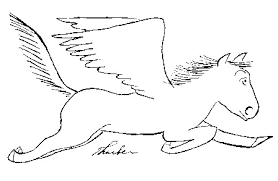
 

pegasus

This image by James Thurber belongs to The Poetry Foundation


My intention in this decade of my life is just to keep writing and to get the poems out into the world in whatever form, venue, media, or technological method may exist. I do recognize that many other poets are either just starting out or trying to secure a career in the writing field–or trying to advance in the university–and for those poets, a concern for the cachet of the journal or venue and the extent of its reach for the correct audience matters considerably. I’m not suggesting anyone take a cavalier approach to publishing; it is serious work (those curious about publishing, see the blogger links above).

Tedious work, for me.

Nonetheless, I do occasionally submit to journals, as the listing to the right with links that sometimes but not always work discloses. Most recently, I am glad to report that I have two poems in Antiphon #22. < The link will take you to the journal in .pdf format. This time, I did not provide an audio file; but some of the authors have, and these are always worth a listen.

Yet another new way of filling the world with poems. Psalms. Antiphons. Moving poems. Texts. Podcasts. Anthologies. Journals. Websites. And more.


Writers, letters

26 January 1983

AnN aNn ann ANN!!

…it seems like all i do is work…i’m feeling abit friendless of late. working weekends didn’t help my social life either. anyway there are still some bugs in the system.i’ve got to get used to working again and i’ve got to learn how to right again, right. i mean write. i’ve been away from my muse too long or at least not on speaking terms with her.

things to do

  1. make friends (with others and with myself)
  2. write!
  3. work.
  4. get out of here!!!
  5. write some more

(aside:)

i don’t think that i ever knew how to write…it was (is) something that i just did (do) akin to breathing or my heart beating

been away so long i hardly knew the place.

number 6 from the things to do list

6. get back into shape!!!

ddunn1983002


anyway ANYWAY anyWay anyWAY aNYWay anYway ANyway anyway–

here’s to you my dear. (this is a toast…i’m drinking apple juice) for sticking by me.

and here’s to SWAN KING

and here’s to poetry and learning how to walk again. and here’s to jazz and here’s to you again and here’s to life and here’s to love and here’s to all that we hold dear and here’s to everything else and here’s to me: my return to the ball game.

much love. david.

~~


L’enigma

“What is especially needed is great sensitivity: to look upon everything in the world as enigma….To live in the world as in an immense museum of strange things.”

This quote is attributed to Giorgio de Chirico, favorite artist of my poetry mentor & best pal, the late David Dunn. I like the way this idea is phrased (it may be the translator, it may be de Chirico): to live as in a museum; for a museum’s purpose–behind its collection, curation, and presentation–is simply to offer up items for the community to observe.

Paolo Baldacci makes an argument for de Chirico as “the first conceptual artist” that I find intriguing if ultimately unconvincing. There is merit, however, in considering the artist’s “surrealist era” paintings as conceptual in the sense that experiencing the work unsettles the viewer, distorts her sense of the real and requires her to enter the world of the painting with its enigmatic strangeness. And to observe without knowing, exactly, what it is she can see.

Artist Deborah Barlow, on her blog Slow Muse, has some words worth reading on the subject of “not knowing” that visitors to museums and galleries, and those who can view the world as an immense museum of strange things, may recognize. Barlow suggests that there may be an “essential incomprehensibility” in the acts of art-making and path-making as the human being moves from the known to the not-known. The enigma, as de Chirico terms it. The ambiguous and uncertain, the experiment, the unanswered question.

David Dunn often wrote letters to me in which he expressed his occasional discomfort with words, with sentences and language; he wished he could paint or play a musical instrument–felt that jazz might have enabled him to enter the enigma more fearlessly, as his jazz heroes did when they jammed and improvised.

WEB_sized_De_Chirico_-_LEnigma_dell_Ora_1910_HR-p

“L’enigma della Oro” (1910)

We wrote about writing, often. Poetry–and the problem of saying the unsayable. Lately, I feel almost ready to retrieve his letters from the box where I’ve kept them for 20 years. My personal museum, those old letters. My immense museum, this strange, strange world.

A poem that offers entrance into a potentially uncomfortable world–by Luisa Igloria on Dave Bonta’s via negativa site: click here.


Drafting

Sun on snow. I turn off the radio during my drive to work, concentrate on the slippery road conditions, try not to get too distracted by the pines’ elegant white drapery or the bird silhouetted above–hawk? Crow?

This activity acts as a form of drafting poems.

Walk to the mailbox on a Saturday morning. Watch clouds. Listen to the sounds of vehicles in the distance. Observe shadows. (Also drafting.)

Lunch break walk, also drafting. Sitting indoors with a cup of tea–drafting, but only if I’m alone and watching the birds at the feeder outside.

Drafting takes more time than any other part of the poetry-writing process.

200px-Cirrus_clouds2

Edges & outcomes

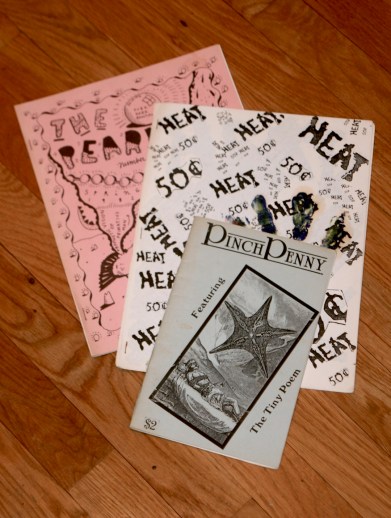
One outcome of participating in a “blog tour” is the opportunity to listen in on what writers younger than I–or newer to the act of being-a-poet–experience in the literary environment of the 21st century. In some ways that has become quite a changed adventure from the early 1980s when the alternatives to major presses and established print journals were little fly-by-night xerox-zines, copied and stapled in runs of under 100. But perhaps not so different from free blogs with just a few dedicated followers; those miniature publications gave me my first print credentials as a poet. Today, I read Lissa Clouser writing of “all the things I’m not” and recalled my own early and uncertain forays at the edges of the literary world.

IMG_5106

xerox-zines, ca. 1982-ish

I now enjoy being outside, observing the edges. It’s more interesting than I realized when I was in my 20s–when edginess was cool, but one might wish to belong with the edgy newcomers. [The paradox of being in the tribe of outsiders.]

Also, I found the garden and the woods and meadows intriguing, and also child-raising, teaching, neuroscience, philosophy. I became a nominal member of many tribes. Including, more recently, the tribe of the aging person and the tribe of the chronically ill–communities that range widely, encompass much, and are fraught with delicious and difficult complexity.

It took me 20 years to get to Arthur W. Frank’s book The Wounded Storyteller, and I might not have found it so useful and illuminating if I’d read it twenty years ago. Now, however, the book’s insights are relevant to my life and to the current moment. Frank powerfully reminds us that as members of the human collective, we need to listen to people; that in time, all of us become wounded storytellers; and, therefore, each of us benefits by learning how to bear human living with a kind of “intransitive hope.” By intransitive hope, Frank means finding a way to be with our suffering in life, recognize that suffering happens, but also to recognize that there are ways to be human that do not end in miraculous cures–that may (and will, eventually) end in death.

And that’s okay. He suggests that healing is a project, not an outcome.

Kind of like writing, you know?

~

“As far as I’m concerned, poetry is the best thing that exists in the universe.”             –-Kaveh Akbar

~

~
~

Curation

Recently, I spent awhile browsing the Walter Kerr collection of books in the library of the college that employs me. Kerr and his wife Jean were writers in New York in the 1950s, 60s, and 70s; he was best known as a theater critic and she as a playwright and essayist. His family donated his books to the school, and it occurred to me during my perusal that this section of the stacks seems more personal than the collection as a whole. Here are Kerr’s quirky book choices, his favored influences, his academic interests with a place among the trendier tomes on movies and Broadway.

A personal library acts as a unit, books that are kept together rather than disbursed upon the death (or before-death donation) of the book collector. It therefore parallels–and predates, of course–the social media concept of the curated self:

Through the ongoing process of organizing content and media elements which create personal profiles for specific audiences, social media users inadvertently curate versions of themselves. Social media turns users into curators as they create distinct incarnations that are separate, yet become the objectified digital presentation of one’s physical self. [definition from socialcurators at weebly]

“Curating” seems to be a trending concept these days, so I naturally checked the etymology:

derives from cure: c. 1300, “care, heed,” from Latin cura “care, concern, trouble,” with many figurative extensions, such as “study; administration; a mistress,” and also “means of healing, remedy,” from Old Latin coira, a noun of unknown origin. Meaning “medical care” is late 14c. (https://www.etymonline.com)

Among those “many figurative extensions” is the curator in the sense of library science or museum administration. Now we can add social media users to the extension metaphors.

Perhaps curating oneself is more natural than I initially thought. My library probably offers a means of knowing who I am, or at any rate what I choose to value given what I have learned in my past; what we leave behind–as in Mr. Kerr’s library collection–becomes who we may be to others.

If they study, if they speculate, if they care.

While I was at the library, I borrowed a few books (of course). I will write about Arthur Frank’s classic book The Wounded Storyteller soon, I hope, in conjunction with some poems I’ve been working on. I also borrowed poetry collections by Matthea Harvey, Rachel Hadas, and Larry Levis.

Am I curating my life?

~~

~~


Poetry on chilly days

The region in which I live has been experiencing a lengthy spate of below-freezing weather, many a chilly day. When I do not feel like concentrating too much, I browse seed catalogues. But I am also reading poetry.

Today, I’ve begun reading a 2011 collection of poems by Rachel Hadas, The Golden Road, poems that are dense and beautiful and often elegiac in tone. I took a workshop with Hadas quite a few years ago and had enjoyed her work since long before the class; it was a pleasure to have her as a reader/instructor. And it is, so far, an excellent book. I’ve been keeping her poem “The Study” in my mind for hours now.

Good news, though–I have commenced the year with new poems of my own. I have three drafts as of January 7, which is a good start.

But for today–yet another chilly day–I’m posting this little verse by William Carlos Williams.

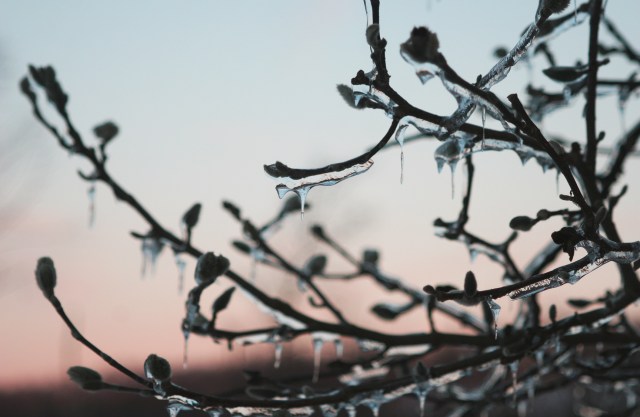
Winter Trees

All the complicated details
of the attiring and
the disattiring are completed!
A liquid moon
moves gently among
the long branches.
Thus having prepared their buds
against a sure winter
the wise trees
stand sleeping in the cold.
                              –William Carlos Williams
~
IMG_0516
~~
~~

Poetry & paradox

~
“Language is a profoundly mysterious technology, so constitutive of the human mind that we can only get glimpses, from inside the fishbowl of consciousness, of how it works.”
sea inside Charnine

 The Sea Inside. Charnine.com features information on surrealist artist Charnine and Surrealism – copyright © 1994 – 2011 Samy Charnine – All rights reserved

~
How do we get from language to poetry? However we do that, consciously or not, it must be as fluid and natural as it is damned difficult! I sometimes wonder whether paradox may be the basis of art. At least, if there exists a “something” that inspires me to compose a poem, paradox–and the way it requires effort to explore contradictions and ambiguities–could stand in as my motivating flame.
~

Paradox, randomness, juxtapositions and contradictions evoke imagery, dream, the realms beyond the rational consciousness we humans claim to possess. Poet and fellow poetry blogger Susan Rich recently posted about the surrealist painter Remedios Varo, an artist whose name and art I had never before encountered; and I felt an urgent pull to introduce her work to my friend David Dunn–he loved surrealism and appreciated it more than I ever have, and such paintings (particularly early de Chirico) exerted a large influence on his poems.

David, however, died in 1999. I share my memory of him here, by writing it on a blog, the same as I share the names of Varo and de Chirico and of the many poets and philosophers I have mentioned during my years of posting to this forum. It’s a form of immortality, if only a temporary immortality (another paradox…)
~
Here is Menand again, who wrote poetry in his youth but moved into journalism and critical reviews in prose later on: “… I got the same painful pleasure out of writing prose that I did out of writing poetry—the pleasure of trying to put the right words in the right order.” Painful pleasure. That mysterious technology, language, rises to the occasion of inherent contradiction.


“And I took away from my experience with poetry something else. I understood that the reason people write poems is the reason people write. They have something to say.”
~
Do you know what you have to say before you write a poem? Or does what you have to say appear in the process of writing? Or after the poem seems complete? Or once someone else has read it and decided what it is you had to say?

About time

It is the last day of the calendar year, and tomorrow evening a full moon will shine over our snow-dressed meadow. End-of-year events have left me thoughtful about time, memory, fear, love, and other such. Which brought to mind this poem I wrote quite a few years back. It’s part of The Red Queen Hypothesis manuscript.

Let 2018 be a time to press against the dam and swell into your next adventure.

~


Counsel

Wait for that wisest of all counselors, Time. —Pericles, Plutarch’s Lives

Always, you have hated the wait,
fidgeting at the desk, the queue, your bed.
You suffer the malaise of the young
whose imaginations collide
with the world’s dull and repetitive ways,

for whom responsibility is a petty bureaucrat
in a cheap gray suit
watching the clock you punch, counting
irretrievable minutes you spend
doing work you cannot love.

Do not despair.
After you’ve done some time
in the slow slog of nickel and dime
your passions, silvery as fishes,
will gather in schools that swell and press
against the dam—

that damn ordinariness
dulling your heart—
and spill themselves brilliant into
the crooked creek of your next adventure,
each carrying in its small body
the germ of an idea, yours
to pursue.

~

waterfall

Poetry as a value

If individual consciousness exists among human beings, and I believe it does, it is however the collective consciousness that has the longest-ranging impact. We are social mammals. We crave some object or objective with which we can connect and form relationships around in order to create community. Humans cannot survive without communities.

Those communities can be centered around almost anything as long as the focus keeps social members busy with the process of group-forming, skill-sharing, skill-teaching, communication and, ultimately, the development of a shared history. Hence family, tribe, language, or religion–among many other social magnets–keep us cohesive. Until we bicker and subdivide. Society works in ways analogous to the brain and body: through complex systems and nearly-random relationships and long, twisty networks.

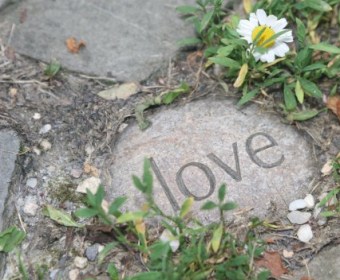
I’ve been thinking about the things we “worship”–things we value and therefore believe are inherent among good human beings–and how such perspectives affect the consciousness of entire civilizations. Simon A. May, in Love: A History, suggests that in the early 21st century, “Western” societies have been elevating the idea of love to that socializing focus. An interesting premise, and I suppose there are worse rallying concepts than love, though May points out ways in which even love can be transformed into an ideology rather than an emotion.ann e. michael

In a large society are many sub-societies, each with its own locus of organizing a human collective; these may often overlap or coexist with the vast variety of human interests. Reflecting on this, I consider myself as part of the society of educators, and of book-readers and book-learners, and of art lovers; and also a member of those people who feel that poetry assists in the lifelong endeavor to engage meaningfully and attentively to life.

Here is a list of people like me who subscribe to the necessity of poetry and who write about it on their blogs. Donna Vorreyer has compiled a listing of poetry-related blogs to follow. I will be following some of them, too.

https://djvorreyer.wordpress.com/2017/12/26/it-feels-just-like-starting-over/