Alien

Last week I attended a local book festival that offered a day of independent and small press books (Easton Book Festival) and came away with Lanternfly August by Robin Gow. The poems fascinate me on a number of levels, especially as I love poetry that interconnects with science–biology in particular–and with the diverse experiences that make up a human life.

But first, some context or references. Gow hails from eastern PA, from a rural area north of me, and now lives in Allentown. This region of Pennsylvania was port-of-entry for the spotted lanternfly, a recent scourge for gardeners and landscapers, that made its way from Asia–where it feeds on Ailanthus altissima (tree of heaven). Well, in fact, it did not “make its way” here; it was brought here, inadvertently I assume, through global trade and human intervention. It isn’t the lanternfly’s fault that it is an invasive species. It is human beings’ fault. What if we were to view the lanternfly from other perspectives? What metaphors might it offer us, particularly about being alien, the Other? This is one way to read Gow’s collection.

Gow, who is not yet 30, identifies as an “autistic bisexual genderqueer person” but says they didn’t come out until college. Life in rural Pennsylvania as a person with autism and a sense of being different in terms of mind and gender? There have to be feelings of alienation, or of feeling like an alien. Gow also writes for YA readers, where compassionate understanding of how it feels to be part of, or left out of, peer groups matters; in the lanternfly poems, readers get a sense of empathy even for this damaging leafhopper. That amazes me, and I appreciate it deeply.

When the bugs first appeared, I read as much as I could about how to discourage them from our trees, how to trap them and what their various stages (egg masses, instars) looked like. Mostly I was bent on eradication, with a bit of resignation in the mix–see this post from 2018. After we got them reasonably under control here, they began to move north and west, just as the brown marmorated stinkbugs did shortly after their arrival in 1998. Both insects feed on sap or fruit. They are foreign to our shores but find much to suck upon here and have damaged fruit crops and trees. Although some people find them beautiful–they are much prettier in flight than at rest, brightly translucent red with the sun behind their wings, and their second instar stage resembles ladybugs–they have gained the reputation of being a Bad Bug. Gow writes:

When I called you “host” I meant,
“I love you in a ruinous way.”

That’s from the poem “Third Instar.” In the poem “First Instar,” the speaker wonders how long before “this becomes wreckage? I don’t even know yet what I am.” The creature could be some type of cryptid, developing into something no one can explain or understand. Society offers solutions that don’t necessarily work–ways to eradicate the insect demonstrated on TikTok, laid out on government websites, posted on Pennsylvania Department of Agriculture’s pages. Also the inquiry, in “Home Remedies,” of totally re-imagining one’s body: “Have you tried becoming a different species? Have you really given mammals a try yet?” Wry humor, of a bleak but wildly intelligent sort, pervades many of these pieces. In “Stop the Spread” (pandemic/plague allusion definitely intended):

...I cannot stop myself
from lanterflying: verb meaning to exist ardently
despite not belonging. How did I become so contagious?
Spores, like fireworks, floated from my gills.

I’m not really writing a review here, just sharing my enthusiasm; otherwise I’d have written about the varieties of form/text/layout Gow employs and the structure of the collection, and much more. Anyway, this is the reason I love going to conferences, seminars, readings, small press, and literary events–always something new to me to explore and learn from. Gow’s poems have helped me to develop a kind of compassion for “alien invasives.” The parallels to how society treats its Others–those aliens and distraught foreigners (not colonizers) arrive almost inescapably from the collection. That those who do not fit in nonetheless have value and need appreciation and respect comes through as given. There’s deep heart in these poems.

A bit of awe from me to this poet. (I happen to be reading about awe right now, which may figure in my next post). To find out more about Robin Gow: They have a website with a daily poetry blog at https://robingow.com/dailypoetry/, definitely worth checking out, and their books are listed there.

Once again, ambition

Dave Bonta, he of the Poetry Blog Digest, Moving Poems, via negativa, Dave Bonta blog, and more, recently posted a thoughtful essay about personal poetic ambitions vs. careers in the poetry field (see https://davebonta.com/2023/10/ambition-without-careerism/). The link’s here because I encourage you to read it! It is a topic many of us poets return to occasionally, especially when we find ourselves wondering things like why bother and who cares whether we write or not or whether we ever get any good at writing poetry…and whether poets should be paid better, or at all…and whether or not poets benefit by being attached to universities.

In fact, when I read Dave’s post I immediately recalled having written similar ideas, though from a different perspective, on this very blog some years back–and probably more than once. The concept of ambition in poetry, and how one defines that word in relation to poetry, is something I first encountered in Donald Hall’s 1988 book Poetry and Ambition–still in print from University of Michigan. I read this book of essays in 1991, in between changing diapers and coordinating naptimes for two children under the age of four. It was difficult to feel ambition about career at that time, and a career in poetry was ever a pipe dream; but the notion that a writer could feel ambitious about the work she might be doing in learning about and endeavoring to craft really good poems, even should she fail most of the time, felt encouraging to me. I recommend this book, as there’s also a good deal one can find to disagree with in it, and debate is useful for thinking.

Fast-forward to today (time does seem to move in fast-forward), and I find myself retired from a career on the fringes of academia, where I taught composition to students less-prepared for college and ran the writing center at a university. But I did not teach poetry or creative writing and was staff, not professorial/tenured; so the need to be career-ambitious through poetry was null. That suited my personality well. Maybe too well. Yet somehow I managed to get a reasonable amount of my work published (see the sidebar of this page) and to get several chapbooks and books into print (see the My Books tab here). I had my own form of ambition.

What now, I wonder? I have so much work to revise! Recently, I submitted an experimental, historically-based chapbook to a publisher, and I’m working on getting a new book of older work, though not as old as The Red Queen Hypothesis‘ poems, into print. Will I spend the next few years just catching up? Possibly. Is that “ambitious”? Nah, just means I wasn’t ambitious enough to get to it earlier!

Poets, horses

My local public library’s poetry section is on the sparse side. However, after renewing my card today, I felt determined to borrow a poetry book. I considered taking out one of Louise Glück’s collections, but I already own copies of the two on the library’s shelves (Wild Iris and Meadowlands). I chose Maxine Kumin’s 1992 book Looking for Luck instead. When I returned home, I learned that Glück has died (age 80). There will be time to return to her books and to seek out her most recent collection, which I have not read; but hers is a voice readers of poetry will miss.

One thing that her poems do is to face, without shying away from, sorrow or grief. They seldom offer sociably-conventional consolations. The consolation is in the spare beauty of her observation, her control of language. That is difficult to do. When I write from despair or deep grief, I find I want to bring some kind of–call it hope?–into the last few lines. I wonder whether I’ve a tendency to want to comfort; maybe my readers, maybe myself.

I haven’t gotten very far into the Kumin book yet, but it’s clear that this collection includes numerous poems featuring horses, one of Kumin’s lifelong joys (she and her husband raised quarterhorses in New Hampshire). Her poems have taken me back in time, so to speak, to when my daughter was learning to ride. I have had a sensible regard for horses’ size, prey instincts, teeth, and hooves from early childhood–not quite a fear of horses, but pretty close–so when my then-tiny nine-year-old expressed an unwavering and stubborn interest in riding lessons, I held off until persuaded to let her “just try it.” Of course she knew what she was interested in, and of course she loved riding, despite frustrations and beasts who didn’t want to cooperate and being pitched off and stepped on while I watched and encouraged and soothed, swallowing my fears for her safety.

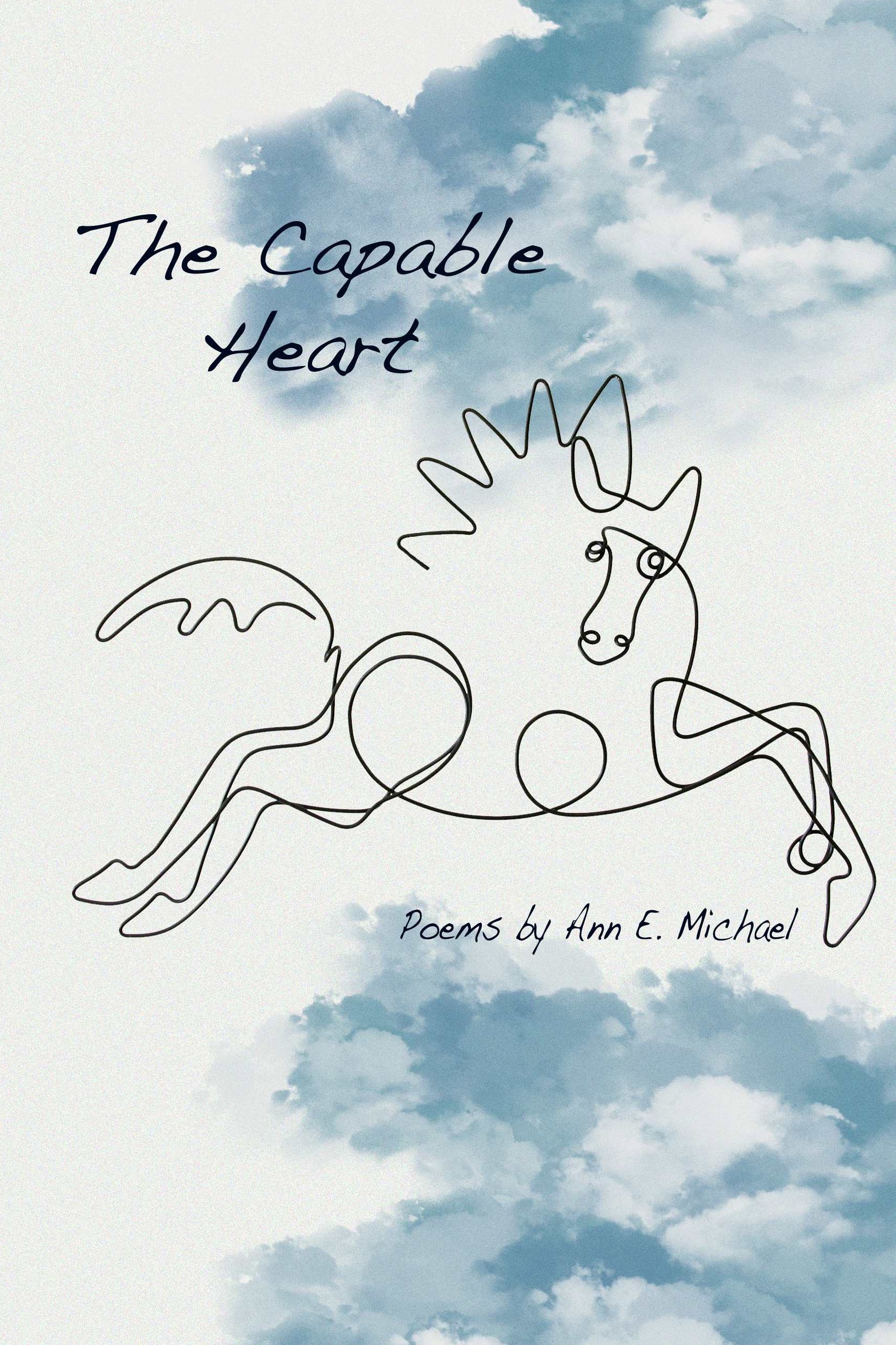
Equine grace, strength, personality did not quite win me over; I’ll never be much of a rider myself. But contending with horses and learning to love and commune with them was good for my child, and reading Kumin’s poems brings back how human animals can have relationships with other animals. I never quite got over horses being an “Other” for me, but observing how my daughter loved being with them inspired me to write quite a few poems of my own [see my chapbook The Capable Heart]. Reading Kumin’s work takes me to a familiar and important place in my own life.

There & back again, with weeding

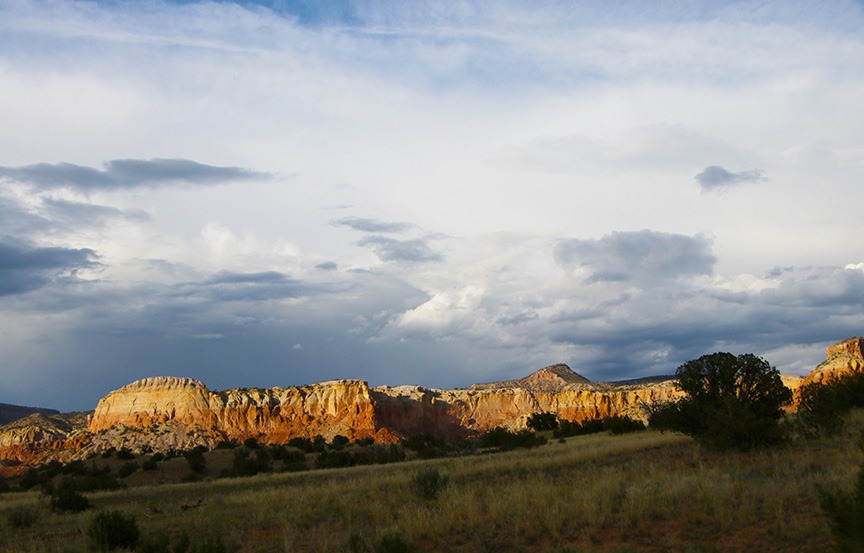
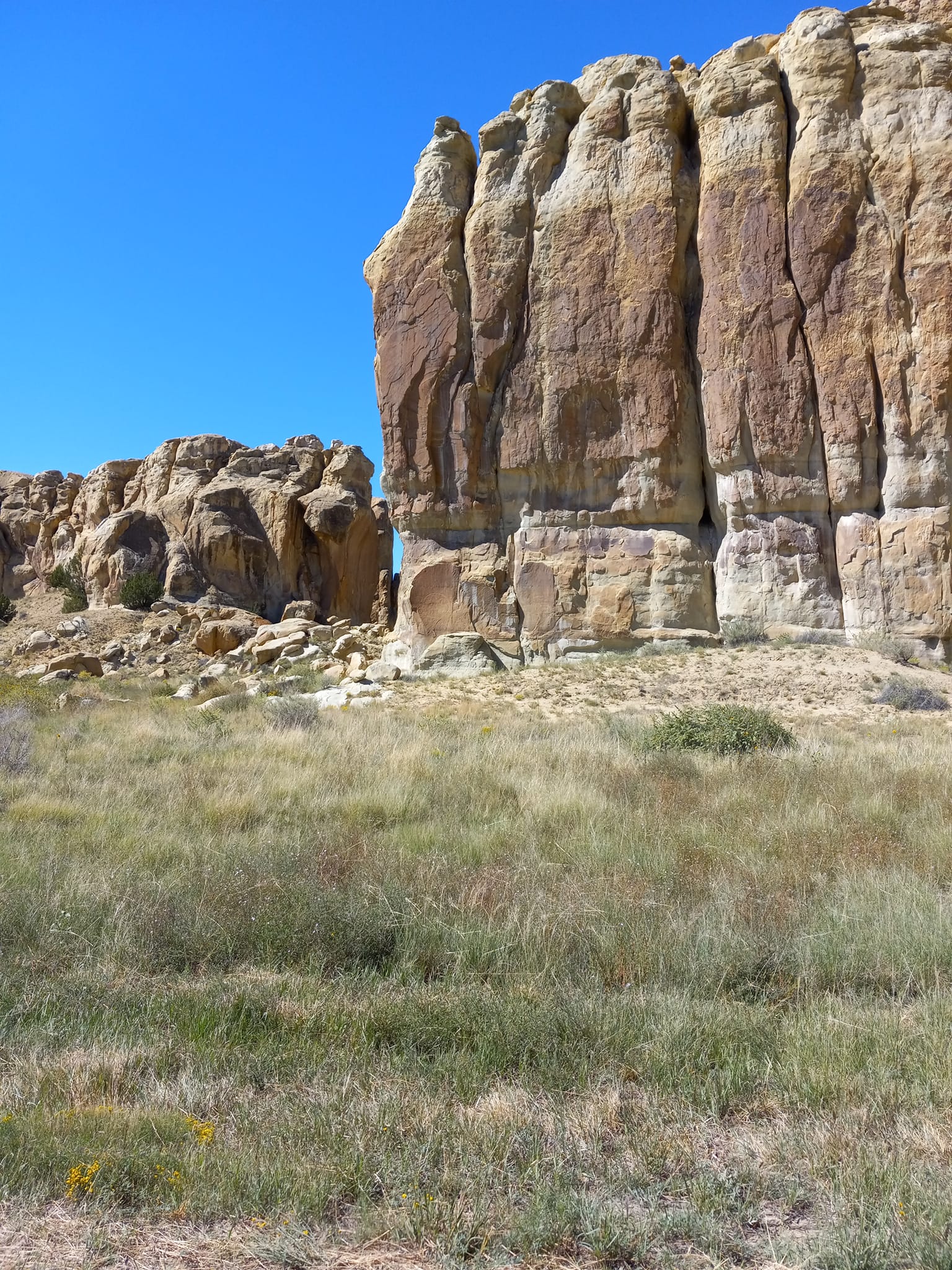
I have traveled to the American Southwest and back again, over a fortnight away from the humid valley where my gardens languished toward autumn, pounded by rain, while we were gone. For two weeks, we lived among the terpene-scented (pinene, not cannabis…though we did notice cannabis when in downtown Albuquerque…) environment of the Sandia Mountains, where humidity is “not a thing.” I embraced my beloved family members, not quite often enough to make up for the distance between us, but enough to feel contented for awhile. And we explored some of the northwestern/north-central parts of the state that we haven’t seen before and were awed. I have not yet tired of the geology there. It’s easy to imagine New Mexico as the benthic floor of an ancient sea!

En route home, we encountered flight cancellations and re-routing, which is practically to be expected (our checked bag arrived 20 hours after our arrival in Albuquerque, also not an unsurprising development). I hear many complaints about air travel these days. I may even have added to said complaints. While it may feel almost as inconvenient, unreliable, and uncomfortable as traveling by Conestoga wagon, you must admit it’s much faster–even if it doesn’t seem that way while you’re waiting for the bus to the economy long-term parking lot at 11 pm. If my beloveds had taken Horace Greeley’s advice in the 1850s, I might never have seen them again. So, I am grateful. Even to American Airlines.

~

Upon a (slightly delayed) return, I found that the valley in which we live had experienced considerable rain but mild temperatures; as I expected, the garden weeds were thriving. Some of that is fine with me: annual weeds can go crazy in October and I don’t mind. But the perennial vines, little shrubs, and weedy biennials and perennials? I dig those out in fall, along with the tomato vines, sunflower and corn stalks, and amaranth plants. That has been my job upon my return; and the cooler weather, with soil moist from all the rain, has been a boon. I have to admit that adjusting to the lower elevation and the higher humidity has put some strain on my ol’ body. But we did a good bit of hiking and walking in the Sandias and Bandolier and Jemez, so I was somewhat prepared for the workout.

My beloved doesn’t understand my enthusiasm for “putting the gardens to bed for winter.” It seems like boring, hard work. Yet I don’t clean everything up–I always leave cover for bees and other creatures that need leaf litter and old stems in order to winter over. However, taking down the stalks and cutting back the peonies (etc) feels satisfying to me. I work in the cooler weather and sense the difference in the air. I recognize the annuals are dying and the perennials are going dormant, the trees let go of their coloring leaves; walnuts, oaks, and hickories seem to fling their mast upon the earth with every gust of wind. There’s nothing sad or somber about the changing of seasons. Winter must arrive in order for spring to do its thing. I like to think of daffodils, muscari, and irises huddled quietly in soil and taking much-required rest before the warmth unthaws the earth. I feel the same.

Lists

There can be beauty in a list: its specificity, also the rhythm and sound–which order does the poet choose for each word? That matters. Chronology perhaps; category, like the scientist; or else sound, such as alliteration; or possibly by the thread of some concatenation that gradually creates associations. The logic of a list poem differs from other forms of lists.

I always think of Whitman as an early and consummate “list poet,” though a great many of his poems do not rely on the strategy. There are list poems that employ anaphora and those that build through phrases. Others rely on modifiers that escalate or change tone to surprise the reader. In my own process it has been useful to begin drafting poems through listing, though often I abandon the list when I revise.

Also, I teach myself about the world and its people, environs, and ideas through lists.

For example, having strayed temporarily from my home region, I’m getting acquainted with a “new” place by making lists of birds, trees, flowers–yeah, the naming-things approach so basic to human beings, like when my children were just learning to talk and conversation with them consisted largely of naming objects or actions.

This is not a poem:

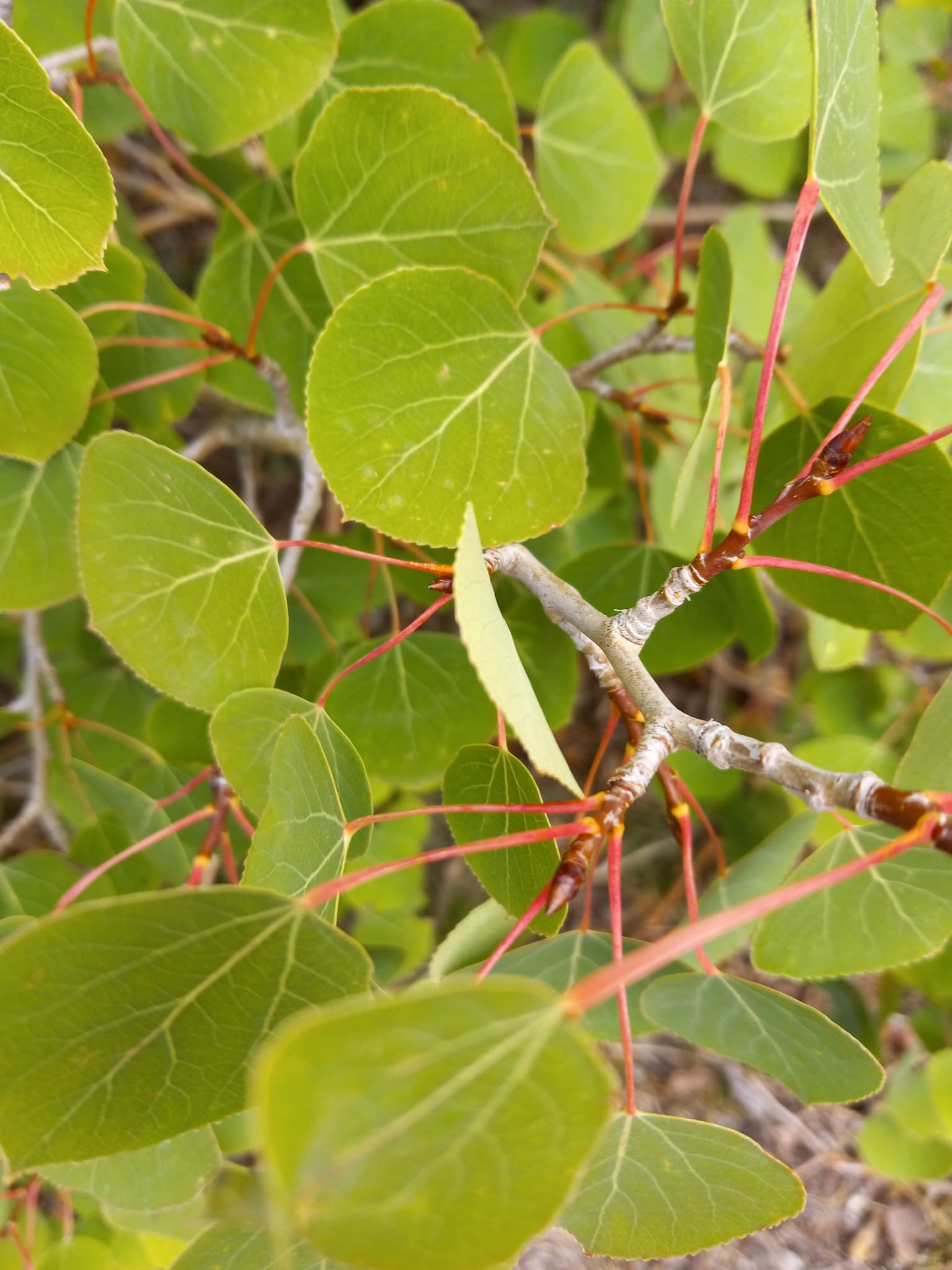
Pygmy nuthatch, juniper titmouse, pinyon jay. Gambel oak, Abert’s squirrel, pinacate stink beetle, skink. Quaking aspen, limber pine. Common raven, Woodhouse’s scrub-jay, fireweed, globemallow, bear corn, oak gall, crow. Pinyon, cholla, Ponderosa pine, alligator juniper, Apache plume, sandwort, groundsel. Gneiss, granite, gray oak, spotted towhee, rabbitbrush, bajada, arroyo, muttongrass, mesa, schist.

~

However, these words now evoke images, sounds, memories, senses that–who knows?–may end up in poems eventually. Because poetry is about and in the world.

Restorative

I often start a post with a mini-weather report; I guess that’s one way I prepare myself to write, centering myself in the environment I inhabit. Our region received much-needed rain this weekend, but I was out of town–and the weather in Chicago was glorious: cloudless, crisp, mild, a light breeze. Odd, though, how weather conditions can evoke strong memories for me. The amazing clarity of the sky and air reminded me vividly of September 11, 2001, and the two days following it when we had a run of glorious weather and a mood of intense disturbance all around us…and no plane traffic at all. It took a few moments for that recall to settle in, and a few minutes more to let the memory go so I could enjoy the present moment.

~

I was in the Chicago area–Highland Park– for the book launch of The Red Queen Hypothesis. Many thanks to my publisher, Julie Dotson, and the welcoming and supportive group of poets and audience; the reading went well, and we sold some books (always a satisfying thing). I met quite a few interesting people and learned a bit about the city of Highland Park, its relatively long history, its parks, architecture, the storied Ravinia Festival, and how the city’s been coping since the July 4 tragedy last year. Travel always offers perspective. In this case, travel offered community as well: a lively community of people who support the literary arts.

~

I even got to be recorded, with Jennifer Dotson as the interviewer–a first for me. Here’s the link:

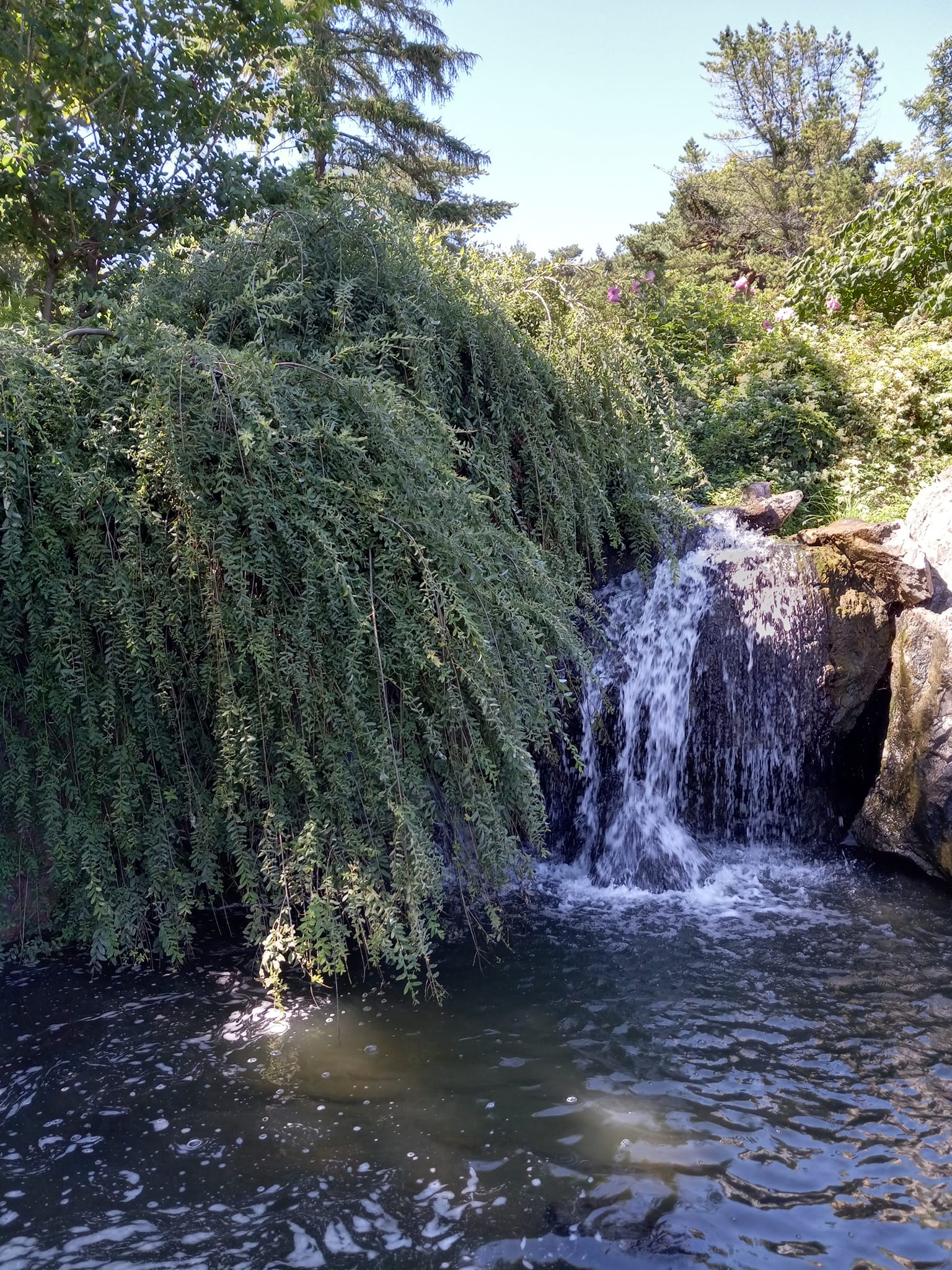
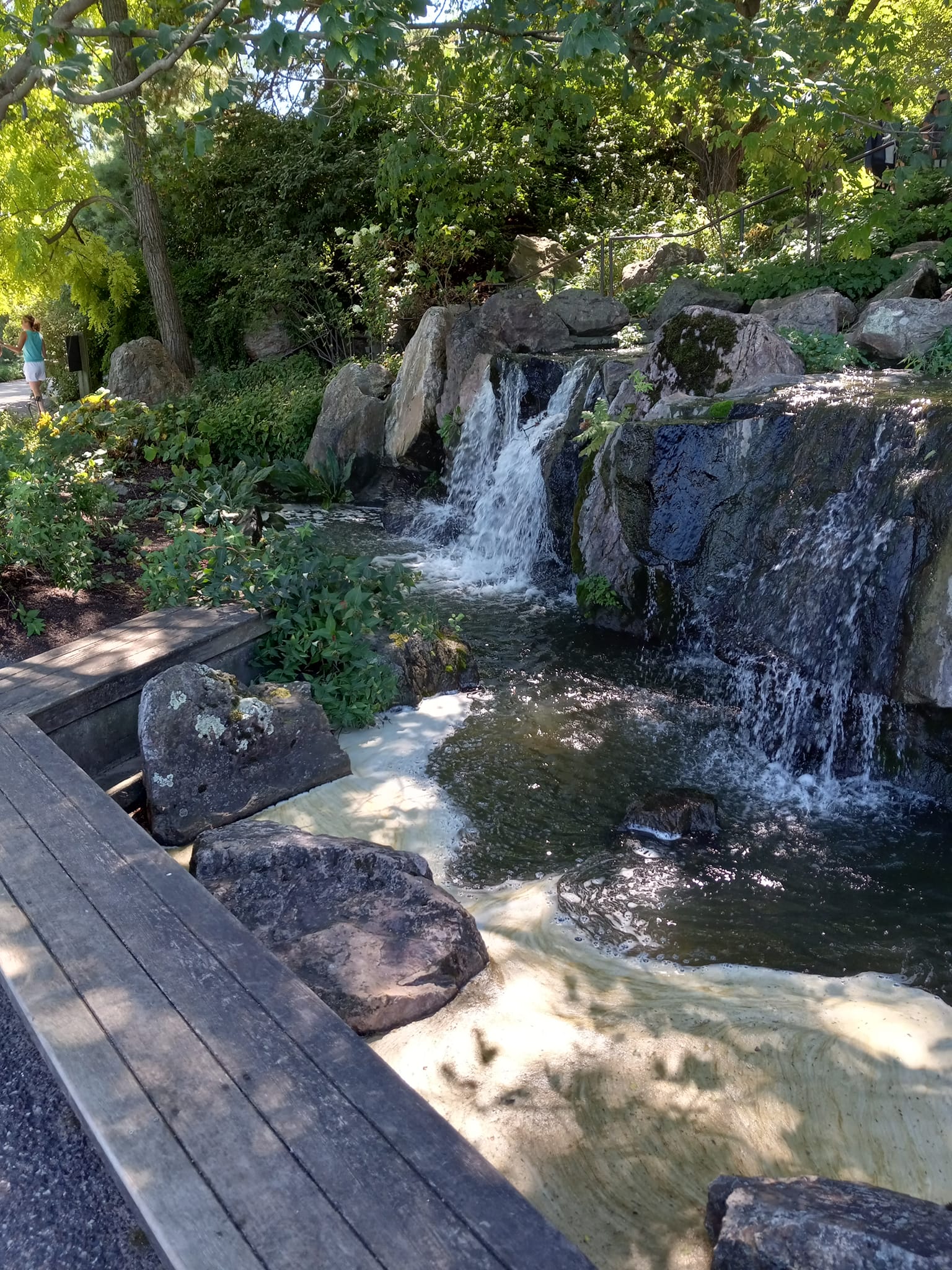
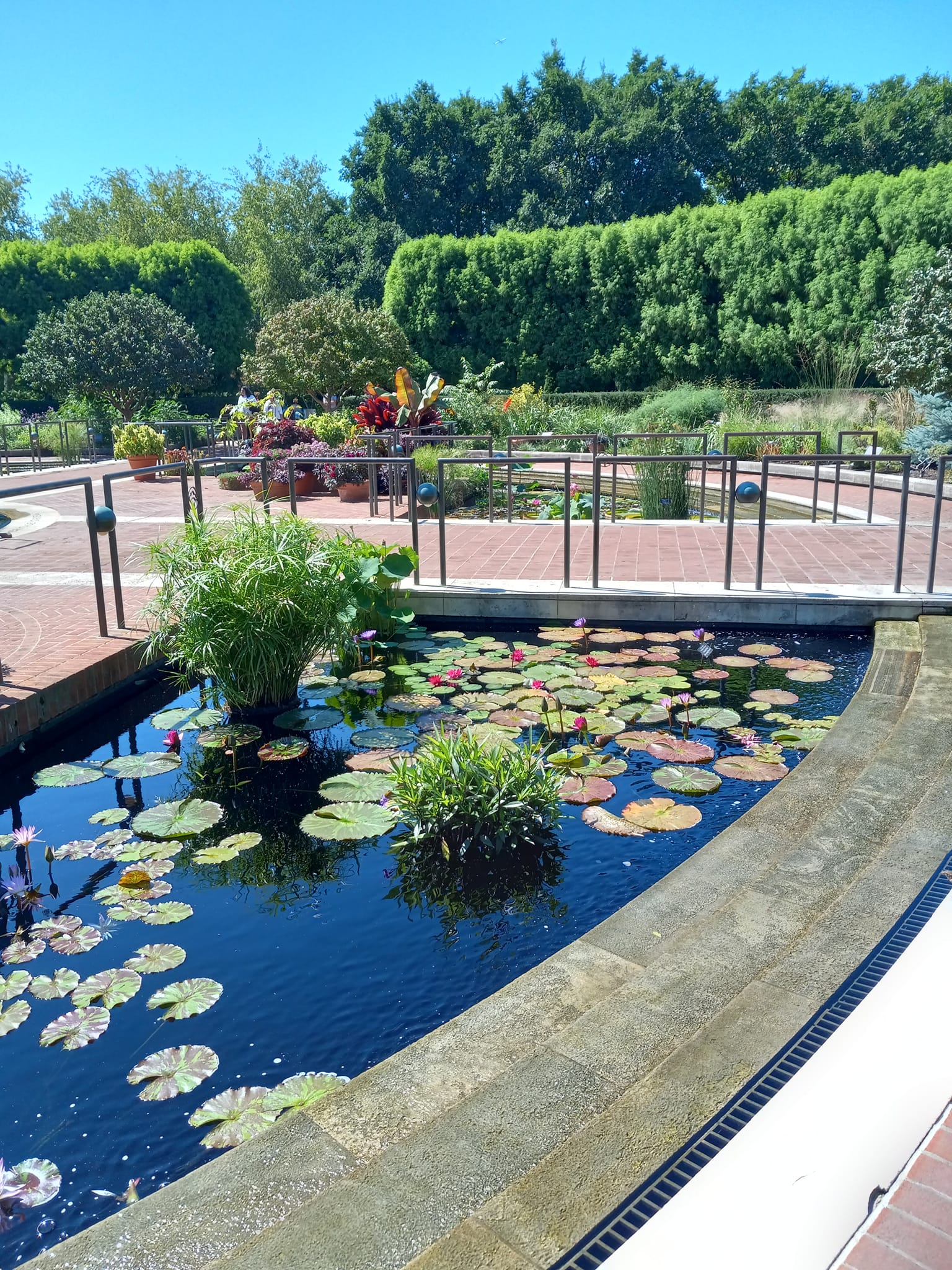
My generous poet-host, Julie Isaacson, knew from my writing and my biography that I would enjoy a walk around the Chicago Botanic Gardens–and she was so right! The gardens offered just the respite I needed after airplane travel. We hadn’t the time to stroll all 280+ acres, but the chance to walk amid trees and beside water in the middle of an urban expanse was genuinely restorative.

Now I am pulling weeds and pruning for the approaching autumn, activities that allow me to settle into myself internally and which sometimes result in poem drafts. Please wish me luck on both endeavors!

Language power

In advance of my reading this weekend, Jennifer Dotson of Highland Park Poetry asked a few questions and created the flyer below. I especially like the last question and have more to say about it below.

~

The graffiti on the NJ and NY Palisades sent a thrill through my childish mind and body. I first recall seeing words spray-painted on the cliffs when I was under age five and barely cognizant of letter forms. The view puzzled and frightened me, partly because of the heights (I was acrophobic from a very early age) and partly because I had no idea what those huge, high-up letters signified. When I got to kindergarten and began deciphering letters, the graffiti confused me because it contained signs that weren’t in the alphabet I was learning at school: Ω, Φ, the scary-looking Ψ; θ, Δ, and Σ, which resembled a capital E but clearly wasn’t. Once I could read and still could not understand them, I asked my father what those letters were and why they were up there on the rocks. They reminded me of the embroidered on some of the altar cloths in church, but I didn’t know what that stood for, either.

Frat boys from the colleges painted their Greek symbols on the rocks long before spray paint was invented, my dad said, possibly as part of hazing rituals. By the time I was a child, the 50s-era “greasers” had begun announcing their love for Nancy or Tina through daring feats of rock and bridge painting; then the graffiti era came into full swing after the mid-sixties, and the process got colorful–the Greek symbols vanished, replaced by “tags.” All of which just reinforces the importance of words in the world.

I will never climb up high to write or declaim my own words, as heights continue to terrify me. But I continue to push ideas, words, arguments, pleas, elegies, and gratitude into the world. Writing is the only way I know how to do that. It’ll have to be enough.

Script, postscript

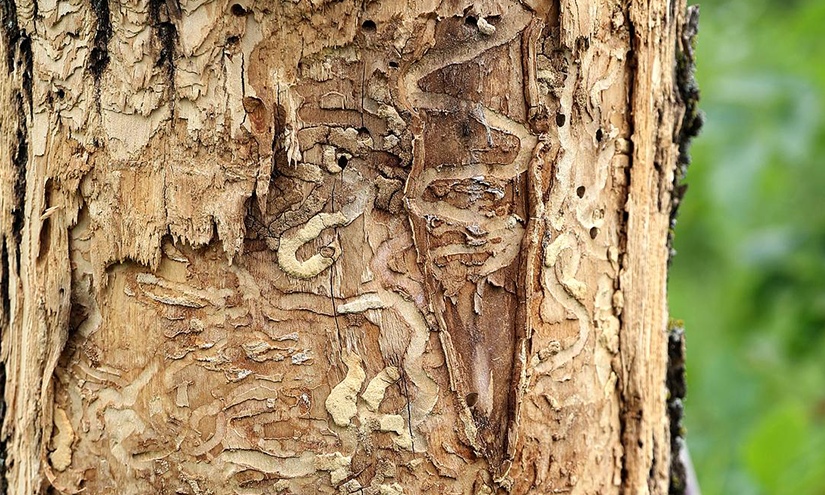
The weather has been glorious lately, which has the downside of getting rather droughty. No rain in the forecast, either, so it is time for supplemental watering if I want to keep harvesting from the vegetable garden. There’s not much left there, though; I may just wait things out and save the water. Meanwhile, some of our days have recently been punctuated by the sound of green ash limbs crashing in the nearby woods. When I investigate the trees, there are the telltale scribbles of ash borer on the trunks. The marks look like script.

I learned, while teaching college freshmen the past few years, that many younger adults do not know how to write or even to read script. Many children never get the lessons in handwriting in the second through fourth grades the way I did. Instead, they learn keyboarding–a skill I got to in my junior year of high school but never really have mastered (yes, even now I use a self-developed version that’s sort of an advanced hunt-and-peck method). It’s hard to believe that reading script is a task that will be relegated to specialists in years to come, but I shouldn’t be surprised if that’s what happens. To many of my college age students, handwritten script in English is almost indistinguishable from the marks of ash borers. They don’t see the need for that particular skill. Handwriting is going the way of letter-writing.

Perhaps we live in a post-script world?

I have been thinking about the handwritten word recently because of a recent incident while visiting my mother. She received a small refund check from an insurer, and though she understood what it was and that she no longer uses her checking account–we siblings take care of that through power of attorney–she was confused about what to do with it. “Sign it, Mom,” I told her, offering her a pen. “We’ll deposit it for you.” I turned the check over and pointed to the line for signature on the back.

She wavered, pen in the air. “I don’t…I don’t,” she said (her aphasia has advanced past the point of expressing full sentences). It took me a moment to realize that she could not recall how to sign her name. I placed my hand around hers and helped her start with the capital B.

I didn’t cry, but the experience hasn’t left me alone. I suppose there may be a poem in this incident, but if so, it’s a sorrowful one.

Book launch, travel, PR

Highland Park Poetry press has set up a book launch/poetry reading for The Red Queen Hypothesis (and me) with poet Rene Parks and an open mic to follow. This event takes place Saturday, September 9th at 5 pm, at Madame ZuZu’s, 1876 First Street, Highland Park IL. Here’s a link, and here’s another link. It’s a ways to travel from eastern Pennsylvania but a good reason for yours truly to visit a new place, meet new people–including the book’s publisher–and listen to other poets.

Too often, perhaps, I stay around the home front, indulge in my introversion by gardening and reading, and shy away from promoting my work. Lately, it’s been months since I did any submitting. There was my participation in the annual Goschenhoppen Festival, then a short but lovely week in North Carolina, camping and seeing friends. Now, the veggie season is starting to wind down–tomato sauce simmers on the burner–and I will have fewer excuses for why I am not sending out poems.

But my travel for the year is not quite done. In September there’s one more trip away from PA, and after that we can settle into autumn. I have writing plans, so once we return, I need to create a schedule that is flexible enough I can stick to it but framed clearly enough that it feels necessary and not difficult to integrate into my days and weeks. Every one of my writer friends knows how challenging that can be. Wish me luck. There’s a chapbook that’s been languishing in my desk area for quite a long time, but to which I’ve recently returned; there’s a ream of poems under 21 lines that might make up a collection, too. Then there’s the next manuscript, rather grief-heavy at present, that I need to re-think and revise.

Oh, and all those poem drafts I have not looked at in awhile…

Then there will be the next round of promotion, not just for RQH but for a collection for which I just signed a publishing contract! That book may be released as soon as April or May of 2024. We shall see. After the drawn-out publication wait for this last book, I will not be holding my breath. Still–it’s heartening news on the poetry front.

Above, Blue Ridge Mountains in August.

Aft a-gley

Today marked the first day of the Fall semester at the college, but I had no reason to be there. Instead, I enjoyed the surprisingly fine August weather, harvested tomatoes and basil, and began the much-delayed task of weeding our numerous perennial beds. At 4 pm, I rested in the hammock after a walk and spent a few minutes reveling in retirement; though generally I’ve been too busy to find myself in reflective or relaxation mode, it was nice to pretend for awhile.

Yes–I wanted to read books in that hammock, and get to the community pool, and hang out with friends on the patio until the bats came out and the last fireflies gleamed over the meadow. Ah, but Robert Burns nailed it: “The best laid schemes o’ mice an’ men / Gang aft a-gley.” There were so many other things to do.

That said, while I did not do the Sealey Challenge this August, I managed to read several really terrific poetry books–and the month’s not over yet! To keep this post brief, I’ll just mention the book I’m reading now, Jennifer Franklin’s stellar new collection If Some God Shakes Your House. Lots of (mostly) non-rhyming sonnets, a series of memento mori poems, and lyrically linked poems titled “As Antigone–” connect anger, grief, and suggest that anti-authoritarian acts are often more about love than bravery. The speaker keeps denying that bravery’s behind her disobedience, but these poems are brave. I found many of them utterly heart-breaking, so it may not be an “easy read” if you want something cheerful to uplift a low mood. Nonetheless, Franklin’s poems secure hope to love so intensely I could not look away and keep returning to them even before I have finished the book.

I grew up confusing opinion
with oracle. She reminded me
all men are dangerous, each time
I left the house alone….

Jennifer Franklin

It can be difficult to avoid comparing such strong poetry with…well, with what I write. I think that most writers do this occasionally, some more than others. If one is a competitive or ambitious person, analysis and comparisons may be second nature; I have known poets who feel dismayed by their own inadequacy compared to the “greats,” and poets who felt bitterly overlooked because they didn’t get the attention or lauding other writers garnered. Either way is a trap, though. In general, I look to admirable literature as something to enjoy, learn from, admire, and to analyze to figure out how it can be done. If I have ambition, it is the ambition to learn. Oh yeah, the autodidact in me again!

And speaking of ambition, or lack thereof, I am far behind in promoting my book. Next post should contain details of the book launch in the Chicago area (September 9), and perhaps other writing-related newsiness.