Solo endeavor?

It was great fun to be back in person, in Philadelphia, reading poetry aloud. Prepping for the performance made me aware, though, that I have no current obsession to mull upon; that may be why I have not been writing many poems of late. However, I recently felt inspired by Lesley Wheeler’s blog post including some prompts from poets. Prompts! Of course. Those are ways into writing when writing has not supplied the writer with her own ways into writing.

Therefore, I’ll close another year of my blog with a piece I drafted using Lesley’s conjunctions prompt. What resulted from the free-write surprised me, which is a good thing (it’s fun when I surprise myself, though this gets a bit dark toward the close–but dark contains interesting objects). And many thanks to Lesley and to the other poets whose prompts she shared. It’s likely I will keep working with them until my next poetic preoccupation.

~

So I’m tired of hearing people start their sentences with “So” on podcasts and the radio and TV, “so” a verbal tic, a word instead of “um,” which serves the same purpose but admits, more humbly, of uncertainty, which says I am pausing to gather my thoughts before speaking; whereas “So” sets up an explanation leading to opinion or argument, or so it seems to me.

So I’m sitting on my back porch even though it is late December, clouds gathering over bare trees. I hear woodpeckers deepening holes in trees, a rat-a-tat drill, and white-breasted nuthatches loud along the woodlot, and I ponder emerald ash borers and climate change and how to handle human aging in a capitalist society.

So what I wonder is “Am I afraid?” Some questions possess a looming quality, I guess this is one such. In my wicker chair, in my own backyard, no. Not afraid. The mood’s serene, no tightness in my chest no racing heart, not even facing death–as we all must do, though most of us refuse. Where are you going with this, Writer?

So all I’m saying is, I have fears about the future yes but not about dying, because dying I will face alone. Even when loved ones can be beside us, we are not an us when death comes. Each dies to their ego alone, interior to the world, most alone at death no matter who surrounds us.

So why, then, do I volunteer for hospice work, where the goal is not only to alleviate some of the pain but also to keep people from dying unaccompanied? My reasons are complicated, people are complicated. So let me just say that having been present when human beings die, that passage may not necessarily be a lonely one. But it is accomplished alone.

Readings in person

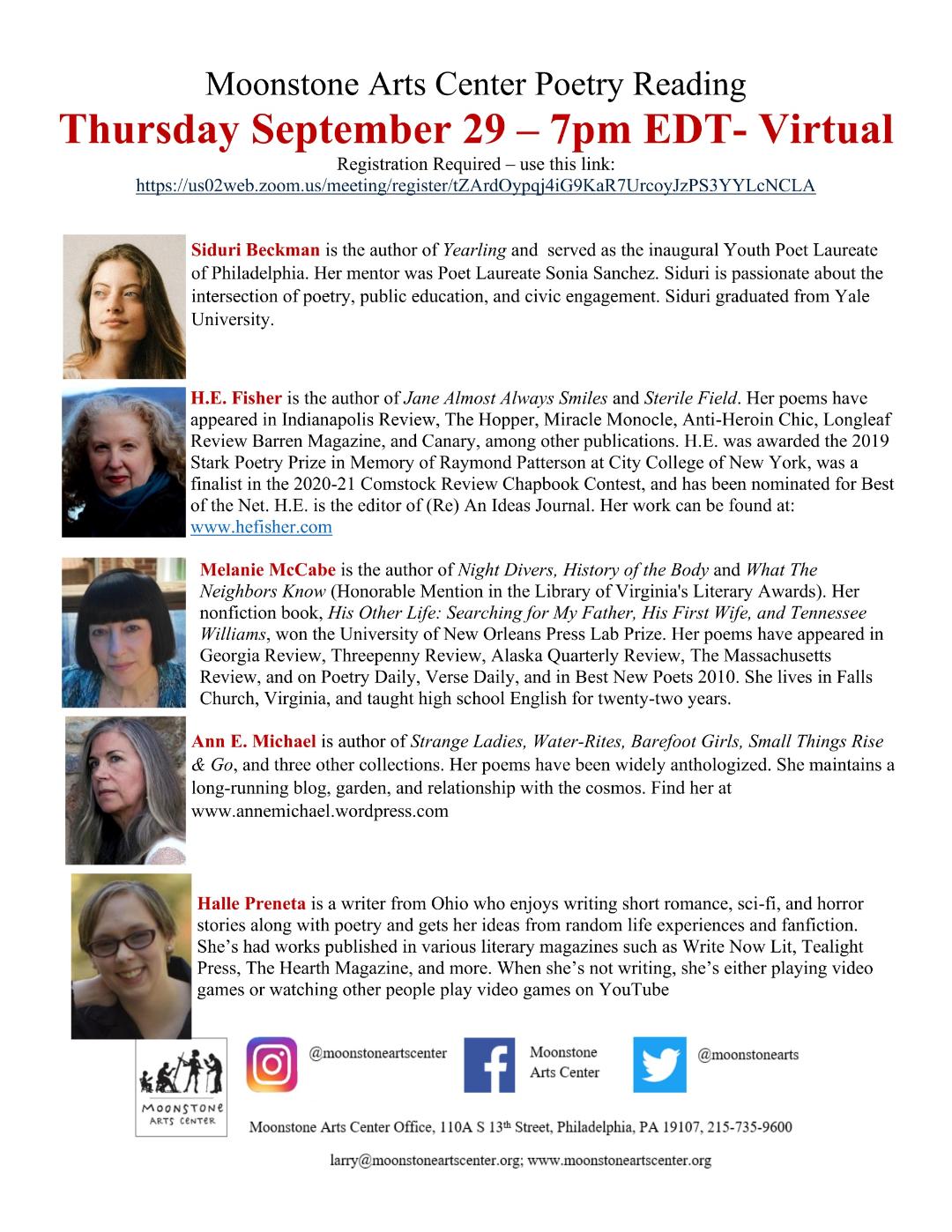
I have not done any in-person readings in awhile (thanks to covid and fibromyalgia); but I will be returning to Philly’s jawn environs on the 28th of December at the lovely Irish pub, Fergie’s, 1214 Sansom St., and well worth a visit if you can. Moonstone Arts Center hosts readings at Fergie’s fairly regularly. Moonstone’s Larry Robin published my latest chapbook, Strange Ladies.

I’m not at all sure I am ready to present in public again after so long a time away; yes, I teach–but it is not quite the same experience as reading poetry to a beer-consuming adult audience. Nonetheless, I’m excited about a post-holiday reading in the City of Brotherly Love! Philadelphia hosted me early in my poetry “career,” and fond memories surround the city.

Wednesday December 28, 2022
7PM – LIVE
Live at Fergie’s Pub, 1214 Sansom Street, Philadelphia PA
And on Zoom – Registration Required. Register Below!
Register Here
https://us02web.zoom.us/meeting/register/tZctceCppz8iE9HhItlupBaoL-TCdkVXAuhL

Also, January 9 at 4 pm, if you are local enough to the Lehigh Valley of PA to attend an event at the Parkland Library (Allentown) at 4pm, please consider coming to my book talk and reading!

In May of 2023, I’ll once again be reading in Reading (PA). So–time to practice my reading skills and choose poems I can sensibly present effectively at readings. Whew–work ahead. Meanwhile, just getting through the holidays, and the vicissitudes of contemporary long-distance travel (read: travails), have been challenge enough for this particular writer. And this particular winter.

~~

Noel, folks.

Alone not lonely

Recent read: Party of One: A Loner’s Manifesto by Anneli Rufus, a book that I would have found enlightening if it had only been around when I was 18 years old. But many things were as yet unwritten 45 years ago, and even if this book had been–I might not have discovered it. Rufus celebrates social loners, decrying the myth that people who prefer time by themselves to socializing are by nature dangerous and threatening. That knowledge would have been a great relief to me when I was young; but I eventually learned on my own that the “loner myth” is, indeed, a mistaken idea perpetrated by too many so-called experts in our society. Through my lifelong bookworm habit, I learned a great deal about people who chose to be alone, chose small circles of friends, or chose to keep friendships going by letter rather than through visits.

All of which options seemed perfectly reasonable to me. I like people and deeply need my friends and family, but I’ve always found a different form of comfort in–and need for–being by myself. I joined Girl Scouts mostly because my two best friends were Scouts, but I was the kid who dawdled on hikes, slowing down to look at the plants and mosses, and I pretended to be asleep when camping so that others would stop chatting to me. When I found my old Girl Scout sash some years back, it was festooned with badges earned for loner-type skills: literature, sewing, whittling, embroidery, and other crafts or pursuits I could accomplish on my own. Selling cookies? Nah. I managed to be the worst cookie salesperson in the troop for several years running.

In high school, I joined the marching band. It was required duty for every student in the concert band, where I played flute. My sister protested against that requirement and succeeded in getting out of marching band, but the self-advocacy did not seem worth it to me-at-15. Besides, band provided me with a few close friends and some sense of high-school camaraderie which, as a sensitive nerd who was never much for teams or competition, gave me a veneer of normalcy in a very team-oriented time and place. I was not a rebellious loner but a stealth loner.

Despite often feeling a bit like an outlier among my peers, I had no burning need to belong or be accepted, and that need (and lack of acceptance) in a person is what leads to “pseudo-loners” (Rufus’ term). Those are the people most likely to get angry, resentful, hostile, or suicidal, she claims: the ones who want to fit in but are ostracized or blocked. The rest of us just want to be left alone when it suits us. It’s not the same thing.

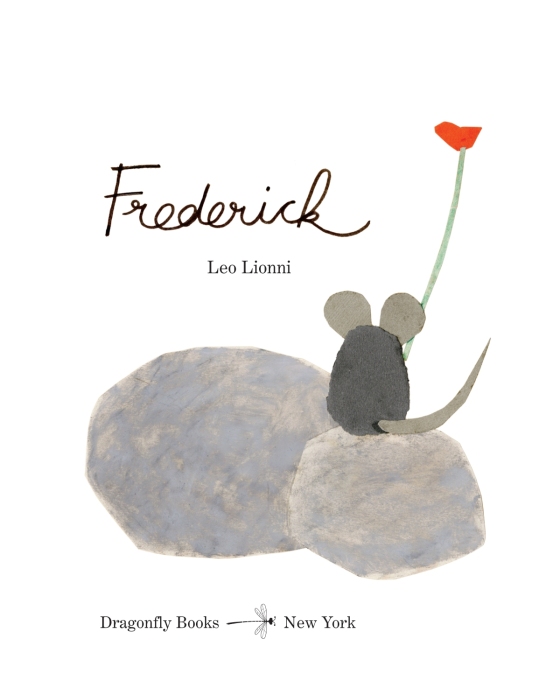
Loner, introvert, eccentric, moody, artistic, creative, sensitive, weird–at my age, I don’t need a manifesto. Experience demonstrates a person can be friendly and funny and easily-tired and sometimes withdrawn and able to speak in public and irritated by too much noise or novelty and can dance at parties and laugh too loudly and a thousand other things that are contradictory and not simple to pin down. (And capable of polysyndeton!) But if you know a child who is content being by themselves and who may feel pressured by well-intentioned adults, I recommend Leo Lionni‘s Caldecott-winning book Frederick. It is a story I loved as a child, and now I realize why. The quiet mouse who is off on his own while his busy community harvests food for winter proves valuable to his mouse-society by offering them poems and stories that ease their discomfort when they are cold and hungry.

In some ways, that has been my lifelong dream.

In deepest fog

Autumn here was a bit dry, but as we approach the winter solstice–mild temperatures, rain, and many days of fog. Fog seems apropos. My mind has been fuzzy lately, clarity of intent and expression lacking. It’s one reason I have not been blogging.

When the air temperature gets up to 45° or 50° F, stinkbugs come out of their torpor and slowly climb up the window screens where they have been hiding or buzz noisily about the rooms, acting as sleepy and undirected as I feel. True, the daylight’s dwindling, and that makes many of us go into a sort of hibernating mode, mentally if not physically (likely a bit of both). True, the Fall semester at the university is in its last week or two and, as usual, is wearing on me.

Also true, it’s hunting season until the 10th, and the deer may be grateful for the fog…at any rate, taking advantage of it. It’s not all negative. Water molecules in the air can be good for plants, hydrating them after a dry autumn. Fog means less dry skin for those of us who wander around outside.

But let’s face it: fog encourages molds and increases the chance of traffic accidents and tends to head people into a low-barometer frame of mind. Foggy-headed. Brain fog. Here’s an informative breakdown of fog’s kinds and outcomes (yes! of course there are categories of fog!) https://mrcc.purdue.edu/living_wx/fog/index.html Some of my readers may find poetry in these categories.

Just before dusk this afternoon, I stood at my window and marveled at the dense cloudiness of the valley, at the stark bare trees snaking their way up through the pale damp air. I felt a twinge of European Romanticism: Caspar Friedrich’s “Wanderer above the Sea of Fog” and all that. The view was analogous to my fusty mind. All sorts of possibilities out there in the mist, nothing to strike toward, no path, potential risk. But beautiful in its way. I thought to myself, “There is something hidden in all this, and among the hidden-ness, things that are dear and familiar to me, not just fearful unknowns.”

The garden is there. The deer. The beech tree, some of its leaves still clinging. The bank voles and the red squirrels, the holly bush, the daffodils underground that will emerge in April. My fog will clear.

Then darkness overtook fog, and the coyotes called their carols in the moist air.

Break-taking

It is a particularly lovely autumn in the region, colorful, clear, dry and mild. This evening at 5 pm: 70 degrees F, crickets and frogs singing. My mood has, however, been unsettled–and I have not been writing much. Indeed, this feels like a good time for a hiatus on a number of fronts and in a number of ways. I recently read Katherine May’s Wintering, which was not terribly memorable but which offers the reader support for, well, resting. Resting one’s bones, mind, endeavors…seasonally apropos.

Mostly I’ve been on a Murakami kick, reading three books that a recently-departed friend had with him in his hospice room. Novels take the place of doing my own creative thinking. I get wrapped up in their worlds and can rest from my own. Thus reading is a form of wintering. (May agrees.)

My poetry output has been minimal recently, and I have hardly sent out any work; mostly, I feel tired and eager for the semester to come to a close (one month or so hence). There are reasons for this it is not necessary to go into. But I miss the writing.

I will return to the “best words in the best order” in my own time. So if you follow this blog, don’t think that I have fallen off a cliff–I have merely oriented differently, for a time.

Meanwhile, please remember that there are books for sale you can find on my ‘My Books’ tab. Support the small-business publishers of poetry now, for poetry is as necessary as ever, and not a luxury.

Autumnal

I have been re-reading Allen Lacy’s charming and informative book The Garden in Autumn. I first read it years ago and enjoyed his writing as much as I appreciated his useful ideas about landscaping with autumn in mind. I treasure books that offer more than information–well-written and inspirational texts which in this case includes attractive photographs, as well. I am outside in the clear, cool weekend days and doing some garden cleanup, but I don’t tidy things up as neatly as I used to: many insects and other small animals need some vegetative cover, and incautious hoeing can disturb nesting bees. I was almost 40 years old before I learned that most bees don’t live in hives and that our precious pollinators of many varieties need winter shelter.

Meanwhile, haiku drafts. Meant to kick myself back into creative writing gear. Practice/Zen practice.

~

So hot!
drinking the last of my morning coffee
with ice...


cicadas whirring.
under my bare feet
	dry grass.


Fall semester
remember to practice 
resting Buddha face


Jays and chickadees call—
louder but not as constant as
crickets in the dew


four cantaloupes
on the vine
I didn’t plant!

~

In the profusion 
of morning glories:
		one gold leaf


good morning, cicadas!
	at least some of us
feel wide awake

~

in the tulip poplar
red squirrel scolds 
a Carolina wren


dew
on crabgrass is 
still dew


farm stand:
fresh eggs for
a dying friend


late summer
six young sparrows—
empty birdfeeder


Three bats flit
at dusk the doe huffs, sneezes—
bedtime for fawns.

I don’t need
the word September
I see the spider’s orb

Poetry mentor: Chris Peditto

I moved to Philadelphia’s suburbs in 1982 because I needed a place to live, and my folks had a spare room. I was job-hunting and did not know anyone locally, so I sought out poetry events in the city–and there were more than I expected to find. Chris Peditto was one of the first people I met, and he was unfailingly generous about introducing me to reading venues and even driving me around sometimes when, as often happened in Philadelphia, public transportation did not exist between where I was and where things were happening.

Chris was natured like that, helpful in a mentoring way. He’d open up a few doors, drop the name of a literary journal I might want to look into or a poet I might want to read, and then leave the rest up to me. Sometimes, I needed a little more motivation–especially in those days, when I was pretty dragged down by depression. Chris nudged me into involvement with the Open Mouth Poetry Series of readings, which had aspects of critique, editorial decisions, publicity (for poetry events) and which eventually branched out to a xerox-zine and a paperback anthology. He liked my work and was happy to get me to rub elbows with the artistic, musical, literary folks in Center City and beyond. His encouragement meant more than I think I realized at the time.

It was Chris who introduced me to Rosemary Cappello and to too many poets, artists, and musicians to name in a blog post. Suffice it to say I remain grateful. He may not have thought of himself as a poetry mentor; but much of the confidence I now have in my ability to analyze my own work and the work of others, and much of my confidence in public performance, stems from those days in my early 20s–and he played a significant role.

But then, Chris understood poetry mentorship. He actively looked for it! I enjoyed his tales about leaving South Jersey for New York City as often as possible, even when he was only 16 or 17, and hanging about the haunts of Beat Poets until he finally managed to meet the last of the stragglers who hadn’t died or moved to California and beyond. He had some great Gregory Corso stories, Etheridge Knight stories, among others–and some rather alarming ones as well; I just loved that as a boy he had so much persistence. He emulated the Beat genre in poetry even when he didn’t completely embrace the Beat lifestyle (there may have been a bit of emulation there, as well…but Chris didn’t end up on Skid Row). I know he omitted a few incidents to keep conversations more tightly focused on writing and less on the lives of writers. To him, it is the writing that matters.

Though his prose ultimately received more notice and publication–reviews, literary analysis, short fiction, academic work on Italian-American authors, even a piece or two on pedagogy–Chris wrote poems and, more than that, loved to read poetry of practically all kinds. He was also an excellent educator and earned achievements for his work once he moved to North LA in the early 1990s. I am certain he became a mentor to many other people–not just writers. I was honored to be his friend and snail-mail correspondent for many years and felt the loss of his kind and encouraging presence keenly when he died in 2013.

~

Three mentors–none of them “famous,” all of them crucial to my development as a poet: they took my work, and my person, seriously. They listened critically and spoke to me encouragingly and listened. I think that’s what makes a person mentor material.

In later years, there have certainly been others who have been guides, coaches, teachers, mentors, friends-in-poetry…some of them better-known than Ariel, David, or Chris. But these three, all of whom are no longer walking about on the earthly plane, gave me so much more than I ever thanked them for. Which is why I’m doing so now.

Poetry mentor: david dunn

Where do I start? With a winter solstice poetry reading in Brooklyn, in a dark room on a dark night; his poem evoking a Di Chirico painting made my head explode, the work was so much more interesting than anyone else’s. But we didn’t speak that night. I met David before the equinox the following year, at a critique workshop run by the people who had set up the solstice reading: Merle Molofsky and Les von Losberg.

David didn’t have a presence; he was a presence. He read in a growl, with a slight lisp and a Brooklyn accent, and he could quiet a room. The poems were not lyrical or narrative, nor formal, nor confessional–they were jazz-like, full of strange images that sounded like surrealism and yet were not. He wrote prose poems and free verse and tiny little aphoristic pieces that sometimes made me laugh and sometimes broke my heart. He was not famous. He had not studied with well-known poets. But he had much to teach me, I thought, from the first time we sat around a table and read our work to one another.

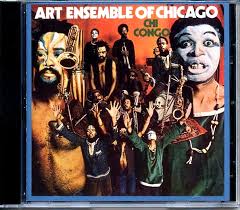
I found I listened more closely to David’s responses to my work than I did to other participants’, though as a fairly novice writer, I valued any critique. I liked that he often mentioned the work of poets he’d been reading, talked about their approaches and influences on his work. We started going to Gotham Book Mart together, searching the poetry stacks to score exciting contemporary writers and out-of-print classic collections. He told me to read Stanley Kunitz and James Lowell, Faye Kicknosway, Denise Levertov, Gerard Manley Hopkins. He had me listening to avant garde jazz, which I’d been introduced to in college thanks to a friend who was into Anthony Braxton and Dave Holland, and expanded my listening to include Don Cherry, the Chicago Art Ensemble, Albert Ayler, and many others.

His analysis of what was working in my poems, and what could work better, helped me to learn how to revise and rethink my work on my own. I gained a bit of confidence in my ability to figure out what sounded clunky, or wordy, or slightly “off.” He taught me not to be so hard on myself and to feel okay with putting a poem away for awhile–or forever–and letting the piece settle down so that, later, I could read it again and review its problematic areas less emotionally. He made me believe that my writing was worth reading, and that I was really a writer. Really. Not just faking it. In so many ways, he mentored me and my poetry. David encouraged me to submit to magazines and to let the rejections happen without feeling doubt about the value of the work. Although the value of that early work was…probably questionable, we’d look at the rejected pieces again and decide whether further revision might be needed or just a different reviewing editor!

As we got to know one another better, I learned about the challenges of his growing-up years, when he lived with his mother behind his grandmother’s millinery shop while his father was in prison for treason, in the US–following two years in a Chinese prison in Korea as a POW. Gradually, I heard about his dad’s release and inability to re-enter society, his parents’ divorce, his mom’s remarriage to a decent man who loved music but whose son, David’s step-brother, struggled with mental illness and died in a suspicious fire when David was about 20 years old. David’s outlier personality, his temper, his size–he was a large man who had been a fat boy, teased and bullied–found release and love through music, poetry, and dogs.

Also baseball, boxing, Star Trek…but we talked about those less often

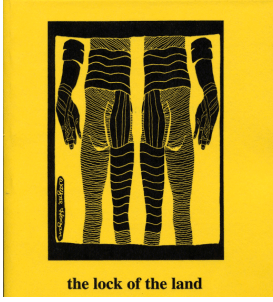
posthumous poetry collection by david dunn

The other thing we conversed about frequently was frame of mind, particularly depression. Both of us were visited by depression frequently when we were in our 20s and 30s, and it was such a boon to have someone I loved and trusted who understood the “mood” and what a toll it could take on everyday life. When I married and had children, the need to feel less depressed got me to more reliable psych care–and I had better health insurance than David did. Sometimes he was chronically short of income, laid off, on unemployment, taking jobs in record stores, borrowing from his folks. He went a couple of years without health insurance or reliable health care, even though he was diabetic. So getting good therapeutic assistance for his chronic depression fell to a low priority, unfortunately. I tried to be there to listen to him, however, and he was always there to listen to me. We gave one another comfort during the doldrums, lassitude, and weird loneliness depression inflicts. And we reminded one another to write!

I miss him almost every day, though he died back in 1999. My book Water-Rites contains a section devoted to him and tries to convey the devastation I felt at losing him.

But you never really lose a mentor, right? They are always with us/in us.

Poetry mentor: Ariel Dawson

Adrian Owles. That was her anagrammed alias. She used that name for things like electric and phone company bills when her real name set off “overdue payment” notices, resulting in her inability to get services. She did, in her youth, have a conniver’s sense of how to skive and get away with it. To some degree. She learned the skills from her father, a brilliant alcoholic from a once-wealthy family. From her mother, she learned poetry and an idealistic, romantic outlook on life…but also that she should be independent and never rely on men to take care of her or keep their promises.

Well, maybe she learned that last part from her father. Her parents never divorced, but her father was an absentee dad. That’s the picture she supplied to me. I suspect it was true, but I know only a tiny part of her story. Ariel Dawson, my poetry mentor, was a year younger than I but so well-read, aware of the “poetry scene,” reading craft essays and books before I knew such things existed–and taking reasoned issue with some of the writers, too, in ways it never would have occurred to me to do. Question such recognized authority? I would not have dared.

What is a mentor? A kind of teacher or model of behavior? Ariel’s behavior was far from conventional, which did appeal to me. We hitchhiked from Michigan to NYC and back. We stayed up almost until dawn and drank wine and talked about poetry. We ganged up on the poor man teaching a creative writing class at our college by questioning his pronouncements and asking about poets and poetry he had not specialized in. We sneaked into bars without paying the cover charge or having our IDs checked (Michigan had a liquor law that permitted 18-year-olds to drink, but Ariel was only 17). I kept wondering quietly to myself: Is this how poets behave? Is unconventionality necessary to the craft?

Well, yes and no. A certain aspect of the unconventional probably helps writers of any kind, but risky antics are not required. An individual perspective on heartbreak or trauma can be useful. Some of Ariel’s stories made me fear for her, feel heartbreak for her; if I never knew how factually true they were, I sensed a fundamental truth in what she told me. One example is her “love affair” when she was 13. She believed she was having an affair with a man in his early 30s who was from Pittsburgh, which she thought was an eastern seaboard town (so much for Detroit’s 1970s educational system as far as American geography goes). He disappeared one day, and she set off by herself to find him in Pittsburgh, where the police eventually located her. They sent her home to her mother. Now I look at this story as grooming by a pederast, but at the time she considered it oddly romantic of her. What makes trauma, if the victim doesn’t feel traumatized? If she can imagine the experience into something naive and…sort of like love?

Ariel’s poems appeared mostly in the early 1980s in print magazines; she taught creative writing at a couple of universities, but eventually her love of dreams and the mythic led her to pursue Jungian scholarship. Last I heard, she was working as an analyst in New York state. Perhaps unfortunately, she remains best known for a letter she wrote to the Writer’s Chronicle/AWP Newsletter in which she took a stance against New Formalism. She always did love a controversy.

My book Strange Ladies is dedicated to her memory. For a whole bunch of reasons and for a number of Ariel stories I can’t even begin to relate here. But most of all, because she urged me to write. And to revise. And to read as many poets and as many craft books as I possibly could. And never stop learning, and keep on writing. She got me to give poetry readings aloud to an audience. She kept me laughing. She was wild and lovely, and I am sorry she is no longer among us.

Meanwhile, here is the link to register for an upcoming Zoom reading by some strange ladies, including yours truly:

https://us02web.zoom.us/meeting/register/tZArdOypqj4iG9KaR7UrcoyJzPS3YYLcNCLA

~

Poetry mentors

Rosemary loved red roses

I learned, this week, that Rosemary Cappello has died. She was among the first people to encourage my writing and was an advocate for poetry and the arts in Philadelphia, where she lived for most of her life. I would not call her a mentor of mine; but she has been mentor to many other people as well as instrumental in setting up poetry reading series, poetry events, and other gatherings. All while also editing and publishing Philadelphia Poets Journal, a literary magazine that started as an 8-page photocopied zine and became a 100+ page annual journal…what energy, what devotion! And such kindness–when I first met her in the early 1980s, we saw each other often at poetry readings and open mikes. Then I moved away, first to Connecticut and then to the Lehigh Valley. Yet whenever I returned to Philadelphia for a poetry event, it seemed Rosemary was there. She always remembered me, too! In recent years, I’ve encountered her on Zoom readings and events. And I knew she had health struggles and trouble with mobility, but she never flagged in her enthusiasm for the arts.

~

If Rosemary, bless her heart, was not one of my poetry mentors, helpful and kind as she was, who were my mentors–and what exactly is a mentor? A teacher, a guide, a supportive expert in one’s field? Someone who advises, offers a network, feeds the soul, provides a model? Yes–but more than that, perhaps.

At my university, there are several programs or projects that purport to offer mentorship, but I get different answers when I ask people who qualifies as a mentor. It has made me think about my own mentors, most of whom have been in the creative writing field. I mean, I could count my dad or mother, but parents generally aren’t considered mentors—they’re doing another job, that of parenting.

This concept came up recently not only from my workplace, where we are launching programs to have our students be mentors to incoming freshmen, but also from a recent interview with Ocean Vuong that has been making the writing-related social media rounds. [link is here]

This video kind of floored me. I am aware that Vuong is young—but 33? He’s my son’s age! Much as I love my intelligent and funny son, he doesn’t possess the insightful earnestness that comes through in Vuong’s presentations, interviews, and writing. Not to mention his teaching! I am not so sure, at twice Vuong’s age, that I possess those qualities, either; yet I know I have been a mentor to some friends and students, mostly by accident. What defines mentorship?

I have not formulated a definition for poetry mentor or life mentor yet, but considering the possibilities may help me recognize what mentorship is and what it means. Therefore, I think I will devote the next few blog posts to beloved and talented friends and colleagues whom I consider to be my mentors. Alas, some of them have departed this earth, but that doesn’t mean their influence has vanished. I hope that writing and posting about them will keep the memory of them alive in that way that human beings have of recalling and integrating the compassionate and useful persons we’ve known and loved into the present moment.

Next time I post, I’ll have things to say about Ariel Dawson, to whose memory my most recent chapbook collection is dedicated.