Language acquisition & its opposite

When my children were learning to talk, I developed a fascination with language  acquisition. The process of learning to communicate with other human beings in the lingua franca of the culture (speaking US English to adults) was taking place in front of me. I felt awed by the intelligence required to decipher language and delighted by the myriad ways the process and behavior unfolded. For about a year, I seriously considered enrolling in university to pursue a Master’s degree in some sort of language/linguistics-related discipline.

But I had two toddlers and lacked the energy, time, and money to devote to diligent scholarship of that sort. Instead, I took my usual autodidactic approach: reading and observing. One thing of vivid interest to me at the time was how differently my children each approached “learning to talk.” In retrospect, I recognize that their differences in personality and their differing cognitive strengths made significant impacts upon language acquisition, implementation, expression, and use.
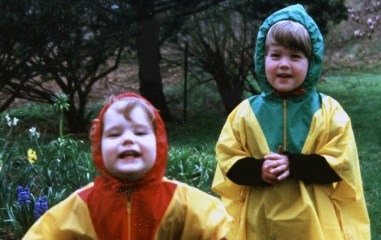
ponchos~


At present, my interests in language revolve about the other end of the lifespan of human communication–the loss of language abilities as people age. The elderly Beloveds in my life are displaying markedly differing changes in how they experience, and express, cognitive gaps. Often the expression of such gaps appears in the way they speak.

This would be the opposite of language acquisition. Memory losses, or slower memory retrieval functions, are common to most adults over age 70; but those issues do not necessarily affect sentence structure, vocabulary, pronunciation, descriptive abilities, and emotive communication through language. Strokes, neurovascular constriction, and Alzheimer’s disease, among other physiological alterations, can exert marked effects on verbal and written communication, however. Hearing loss and diminished vision exacerbate these problems.

All too often, the human being seems “lost” beneath the symptoms or becomes isolated as a result of the immense challenges to human relationships we have taken for granted for decades of being relatively “non-impaired.”

The loss of language skills intrigues me as much as the acquisition; my readings in neuropsychology and neurobiology have taught me that there is so much yet to learn about the brain and how it processes–well, almost everything (but my special interest is communication).

And my experience with people who are aging, or in some cases–my hospice volunteer work–dying, demonstrates on a personal or anecdotal level how uniquely individual each one of us is. How we communicate, how we express ourselves, our neurological processes, our physiology, temperament, environment, genetic makeup…so gloriously complex, random, fascinating.
Maga

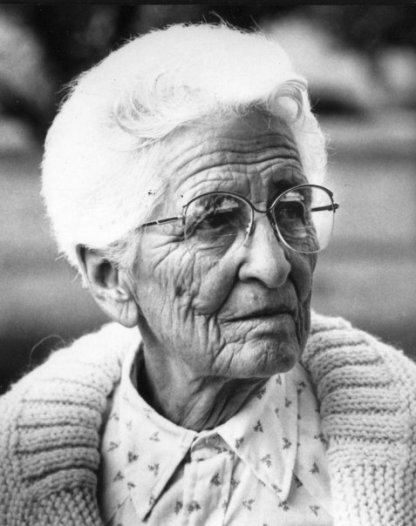
The late Edna Smith Michael in 1990. Her language skills stayed quite intact until her last hospitalization.

~

Some recent reading–

Into the Silent Land: Travels in Neuropsychology (Paul Broks); Cure: A Journey into the Science of Mind over Body (Jo Marchant); The Language Instinct (Steven Pinker)

A post I put up awhile back contains my poem “Age as a Foreign Language.” Apropos here, I think.

~

And no, I am not tempted to enroll in further formal study on this topic. But reading suggestions will be gratefully accepted!


Back to metaphor

I recently read James Geary’s entertaining book I Is an Other–The Secret Life of Metaphor and How It Shapes the Way We See the World. Geary takes his title from one of Rimbaud‘s letters, calling this phrase metaphor’s “principal equation”:

Metaphor systematically disorganizes the common sense of things–jumbling together the abstract with the concrete, the physical with the psychological, the like with the unlike–and reorganizes it into uncommon combinations.

I like this definition because it feels more complete than the typical definition of metaphor as a comparison without the use of the adverbial comparative (i.e., no “like” or “as”). Indeed, metaphor probably forms the basis of language itself; while that conclusion’s much debated in semiotics, linguistics, and other scholarly disciplines, common sense and common usage strongly suggest that even thought itself–in terms of how we think internally about the world–employs metaphor as an underpinning.

Maybe I believe so because I’m a poet. Geary, as it turns out, has written some poetry, though he’s best known for his books about words, word origins, wordplay, aphorisms, witticisms, and the like. (He’s also got a TED talk…everybody’s got a TED talk…)

As to poetry, and how metaphor behaves in the poem’s context, I like what Geary says here (although in this excerpt it’s not actually poetry he’s discussing, but rhetoric):

Readers actively retrieve a metaphor’s meaning, just as a punch line requires listeners to resolve a joke’s incongruities for themselves…though the speaker may make the metaphor, the hearer makes its meaning. Hearer and speaker are accomplices; the one unpacks what the other presents. In terms of creativity, producing a metaphor and penetrating one are almost the same act.

I think the above lines go far to explaining why I love to read poetry and also provide implications as to why poems can be so damned difficult to compose. The poet endeavors to create a context and container for an often-unknown audience who will nonetheless need to invest, one hopes willingly, in the process of reorganizing the surprising (metaphor) into the recognizable.

And what a fine task that is!

2011A-rainbow

Berrying

Each year, dill starts going to seed as the beans plump out almost overnight. It’s time to make dilly beans, if you can stand to work in the kitchen, canning–as my grandmothers always did, without the assistance of air conditioning.

No, thanks. I prefer beans fresh. I rise as early as I can and harvest them before the sun gets too high. This morning, I remembered to look for blackberries, too.

IMG_5460

Turns out this is a good year for blackberries. The canes are loaded with fruit and weighted with vining wild grapes and honeysuckle. The latter bloomed rather late this year and are still putting forth fragrant flowers. The marvelous scent made berry-picking quite soothing.

Soon, the catbirds and orioles and everyone else will be harvesting these berries. Despite their thorns (which didn’t deter me, either).

~

It has been far too hot to work in the garden, however; so I have been writing, and submitting work to literary journals, and even painting a little–something I have not done in years. Finding ways to be both creative and relaxed. Much needed.

Seemingly small stuff

Things to view, things to think about.

Sub Rosa’s post on floral aesthetica here.

IMG_4663

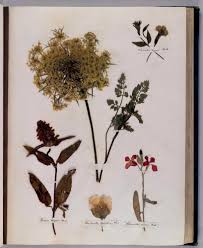
Emily Dickinson’s herbarium, thanks to Harvard (it takes a few seconds to load) here.

qalace ed

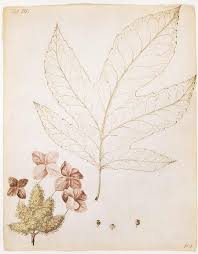
William Bartram‘s 18th-century drawings of American flora.

bartramx

~

Lovely words from Lesley Wheeler, and so true for me, too: “…reading and writing puts me in an honest place. Plus, while poems contain struggle of all kinds, they also constitute separate worlds it can be a great relief to enter, because good poems are not unjust or disruptive of bodily integrity.”

Conditioning

In regards to my last post: I’ve conferred with some people who knew Jack Fisher, and I may have mis-remembered parts of the story. Although those who knew him agree it sounds like something he would do, no one else can place the painting that I recall. His daughter says it’s possible I saw a sketch or preliminary painting that Jack never completed. (She definitely recalls how much he abhorred the water tower!) If so, perhaps his talking about the possibilities of the composition made an impact on me, even if the work itself was a watercolor sketch that never made it to canvas. Entirely possible.

The point of my post remains the same, however–that “ugly” things can be understood in ways that may offer new perspectives on what we consider beautiful.

I guess what I am trying to get to qualifies as a kind of conditioning. That’s now a therapeutic approach to teaching people how to overcome, say, a phobia of airplanes or elevators. You put your toe in the water, so to speak, or learn about the thing that causes fear. And knowledge can overcome fear. Not always, but often.

Inadvertently, I discovered conditioning on my own, when I was about twelve. I decided to study some things I was afraid of–spiders, bees, darkness–and managed to unlearn the fear. It does not work with everything: I’m still acrophobic.

famous photo construction workers

‘Lunchtime Atop A Skyscraper’ Charles Ebbets, 1932

My biggest fear was one most human beings acknowledge–the fear of death. From the time I was quite small, I worried and feared and had trouble getting to sleep because my mind raced around the Big Unknown of what it would be like to die. Many years into my adult life, I decided to explore that fear through my usual method: self-education. I read novels and medical texts and philosophy and religious works in the process. Finally, after visiting an ICU many times during the serious illness of a best-beloved, I decided to sign up as a hospice volunteer.

It’s one way to face death–one sees a great deal of it in hospice care. But the education I received from other caregivers, from the program instructors, and from the patients and their families, has proven immensely valuable to me. Am I afraid of death? Well, sure; but fear of death (thanatophobia) no longer keeps me up nights. I possess a set of skills that helps me recognize how individual each death is–just as each life is. More important still? I treasure and value the small stuff more and am less anxious about the Big Unknown. It’s going to happen, so why agonize over it? This is conditioning. For me, anyway.

Conditioning does not have the same meaning as habituation, because conditioning requires learning and is more “mindful” than habituation. Habituation occurs when we just get accustomed to something and carry on; perhaps we repress our emotions or our values in order to do that carrying on. People can habituate to war, poverty, all kinds of pain, and can make not caring into a habit. We are amazing in our capacity to carry on, but it isn’t necessarily healthy. Getting into the habit of warfare, hatred, ignorance, hiding our feelings, or other hurtful behaviors is often easier than getting into more helpful habits like daily walks. I do not know why that is.

I am, however, endeavoring to condition myself to stay awake to new perspectives, to stay inquisitive, to plumb the world to find, if not beauty, at least understanding and compassion and gratitude. Maybe one day I will even manage to get that perspective from somewhere very, very high up…    [yikes!]


Aesthetic “therapy”

I have been musing on Rebecca Solnit’s text in which she writes about the Romantics’ “new” appreciation of Nature. I was particularly struck by her research about how in Europe, and among the Eurocentric American colonizers, pre-Romantic era society considered mountains not only dangerous but also “ugly” (in Wanderlust: A History of Walking). Aesthetics began to change in the late 18th and the 19th centuries. Walking the natural world for something other than pure transportation from place to place altered our social ideas about what’s “beautiful.”

~

“The first question I ask myself when something doesn’t seem to be beautiful is why do I think it’s not beautiful. And very shortly you discover that there is no reason.”  —John Cage


~

This train of thought reminded me of Jack Fisher’s water tower. Jack was a friend and extended-family member who who lived in Bucks County, Pennsylvania from the 1940s until his death in 1999. He was an architect, engineer, teacher, builder of many things, and an artist.

Often when we were visiting, Jack would show us a painting he was working on. On this occasion, he told us how annoyed he had felt at a new condo development; the big, aqua-colored water tower rising from the housing campus especially irked him. “It’s so ugly!” he said. “So ugly, and I was feeling so mad, I decided to do a landscape painting of the damned thing. And here’s what’s funny–I kind of like the composition here, and the colors. What do you think?” He was right. It may have been an ugly water tower, but it was a lovely painting.

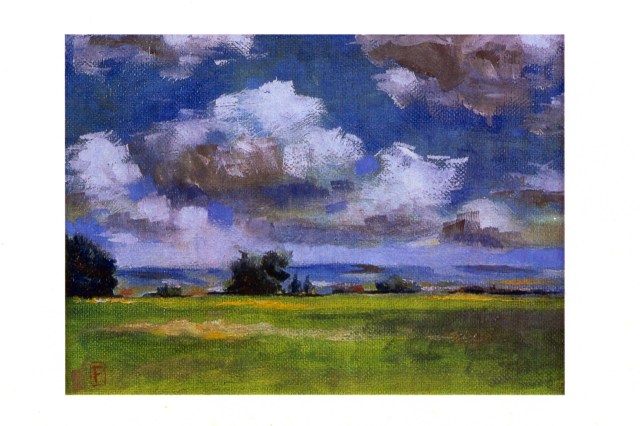
Unfortunately, I do not have an image of that painting except in my memory; here, however, is a painting of Jack’s that depicts the fields in Bucks County, PA, which he considered beautiful.

jackpainting004

Suber’s Field with Clouds, Jack Fisher, oil, 1998

Imagine a water tower here, and a sea of peak-roofed condominiums. And a balanced composition, and a deft use of colors.

~

Looking closely enough at something to find that you no longer see it as ugly requires an almost meditative change in perspective. It’s been an approach useful to me as a poetry prompt and as a means of more closely appreciating the world and everything in it. I don’t mean that I identify with the 19th-c Romantics, though I eagerly trod where Wordsworth trod when I visited the Lakes District a few years back; I don’t. My view of nature is really with a small ‘n’ and is pragmatic and scientific, among other things.

But: John Cage’s question to himself is a reminder to be compassionate, to observe with openness, information, education, perspective, and loving-kindness…while walking through the world.


Beach reading

Mock orange and honeysuckle scents pervade the evening air. It’s the season of lightning bugs in the meadow and fireworks on Fridays at the local AAA baseball stadium over the hill. While I was preparing for the reading (this evening, in New Jersey!), I sat on my back porch surrounded by my own poems.

It’s interesting to look at one’s work and find “old friends” among the poems. Even among work I wrote thirty years ago, there are a few poems that I’m happy to meet up with again.

poster


Now to garner the stamina to do what needs to be done!

Resting

Taking a breather. Pausing along the path.

sit-up-poetry-art


This poem is thanks to Michael McClintock.

Courting, sparking*

Early June. Honeysuckle on the breeze. New graduates on the move to wherever they are fortunate enough to get jobs. Blessings & good luck!

Many local songbird species fledged during the last week or two, and now the courting has begun for the second brood of spring.

IMG_5396

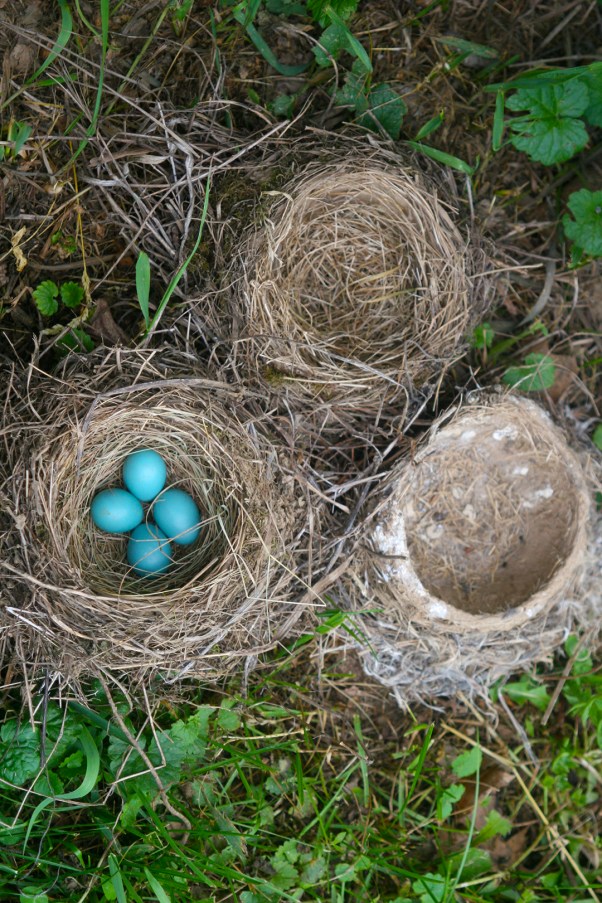
Robins’ nests: one never completed; one abandoned; one used, the fledglings flown.

~~~

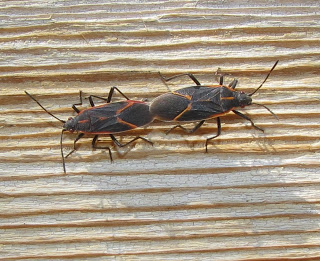
Meanwhile, among those bearing exoskeletons, pheromones also drift upon the air. I saw quite a bit of this activity during my lunch break. I was sitting by the library, next to ash and maple trees, prime feeding and hatching spots for boxelder beetles.

boxelderPairCO1a

Boxelder bugs mate in June here. This photo by bug-master Eric Eaton, co-author of the Kaufman Field Guide to Insects of North America

This is a good place for me to make a plug for one of my favorite bloggers, the anonymous author/photographer/entomology geek known as standingoutinmyfield.

~~

Meanwhile, I have been contending with some minor but niggling health issues and hope to get those sorted out soon, because I will be reading poetry at the beach on Monday, June 18–Cape May, New Jersey [hooray!]. Info appears on my Readings & Events page.

~

* Yes, Joni Mitchell fans, yes.

Haiku, moon, peony

During busy times, we may need a few moments of solitary reflection.

~

381-1233891708GdW7.jpg

Full moon moonlight
Sony Cyber-shot DSC-V1
10/800s, f 2.8, ISO 100, 7 mm

253142_2101392498695_2412222_n


~
flower moon
fireflies enlighten
the pear tree
~

I’m currently reading David Bayles’ and Ted Orland’s encouraging little book, Art & Fear. Nice reading to tuck around the edges of a few full weeks.