Dozens of views

No one has ever found the traces of memory in a brain cell. Nor are your imagination, your desires, your intentions in a brain cell. Nothing that makes us human is there.

Deeprak Chopra

Chopra is not my favorite writer on consciousness, but he does an adequate job of explaining complicated concepts to people who are just getting accustomed to questioning experience and who are beginning to be open-minded about the mind, the body, and beyond. So often, we have been raised not to doubt, told what God is and is not, and trained into beliefs about the truth. This, in spite of the common human trait of curiosity that asks: who and where are we in the world? What makes me me? What happens when I die? Chopra, with his medical background and his experience spanning several major cultures, can offer both a great deal of information and pose provocative questions to his readers.

In our technologically-obsessed culture, it is easy to turn to science as foremost authority; I happen to be fascinated by neurology and neuropsychology when it comes to consciousness, for example, but I never rule out so-called spiritual insights. Chopra’s writing often falls into the fallacy of stating “there are two views,” when in fact there are dozens of views, even among scientists. My guess (it is but a guess) is that the either/or form of presenting perspective is simpler for the “average reader”–as defined by his editor–to understand. Yet it seems to me a slight to the average reader to narrow these big questions down to “two views.”

Here’s an example, just one of many in his writing:

There are two views about consciousness in science today. One is that consciousness is an emergent property of the brain and. therefore, also an emergent property of evolution. That’s the materialist, reductionist view. There’s another view…[that] holds that consciousness is not an emergent property but inherent in the universe.

Now, I genuinely prefer what Chopra calls the “mind first” argument in which consciousness is a kind of field effect. I would not, however, suggest that matter first and mind first are the only two views today’s scientists hold; and neither would anyone else who has read a number of the elegantly-argued, well-researched, thoughtful, passionate blogs of today’s science researchers. The majority of them are atheists, but some are agnostics and some are inclined toward non-theist teachings such as Zen. Even among the ranks of non-believers (in terms of an anchoring eternal presence or god), the question of consciousness leads to intriguing inquiries.

The philosophers of today cannot ignore scientific advances any more than Maimonides could in the 12th century. Physics is a thing! as my students might put it. For the ways in which this relates to the science of neurology, I return to the framework on consciousness proposed by Douglas Hofstadter in his book I Am a Strange Loop.

What is the world but consciousness? Or illusion, in Hindu and Buddhist teachings (Maya) and, in a slightly different but related way, in Plato. And how many perspectives are there on that consciousness?

Chopra would probably say that each of us has to experience a state of awareness and interaction with whatever deep potential “god” or the creating principle offers for us. Which basically admits of not merely dozens but billions of unique interactions or perspectives…if we even agree to the schema.

goldenrod (solidago) going to seed

goldenrod (solidago) going to seed

Work vs. work

Untitled-writerOutside Academia: The Writer…


Lately, I have felt overly-occupied with my so-called day job. The work I do at the college is personally rewarding and pays my bills; I love the challenges it offers and the people with whom I work, but I am not what one would term career-driven. Even though I am employed by a university, and even though I teach (just one class a semester), in many ways–as far as scholarship, research, and poetry go–I remain “outside academia.” An interesting paradox. But if I over-extend at my office, I find less to say at my writing desk at home.

Poets Mary Oliver and Kay Ryan also spent most of their careers working at colleges without climbing the spiral stairway of academia’s ivory tower. Well-received, excellent writers–and Oliver even sells quite well for a poet–they aren’t “academics.” It is heartening to know that such poetry luminaries are, like me, not academics. I often wonder how they managed to balance teaching with writing poetry.

~

What I do “at work” where I earn a salary, and what I do when I “work” on poetry, seem quite separate to me, and I question whether one informs the other. I feel that being a poet does influence, though subtly, the way I approach teaching and tutoring. (It does not seem to have any influence on the way I do record-keeping, spreadsheets, or paperwork.)

By contrast, my day job at the college seems not to have much sway over my poetry; I write prose about teaching and tutoring, but my career work does not often appear as topic or substance in my poems. I notice, too, that Oliver and Ryan do not often write poems about their day jobs (both of them have retired by now–but still). In fact, I would venture that the way my day job affects my poetry is mostly as a time and energy drain.

~

I have challenged myself to write at least two poems a month that in some respect relate to my work with students. That prompt forces me to remember that I am not two separate beings, one at the college desk and one, pen in hand, on the back porch at home. I remain my whole self, and I place my whole self into both endeavors. I can work with that.

Clouds & trees

One benefit to living where I do is the way the sky looks in early autumn. Another is the brilliancy of leaves as they change color.

This time of year, even my commute to and from work offers moments of beauty. There are sunrises as I get ready for work, sunsets as I drive home each evening. The skies have been so glorious lately that a friend of mine posts photos on his social media account every day. Autumn arrives, and I wish I were a painter.

Cloud textures: yesterday morning, stippled so densely I could easily imagine ice crystals clustering together in the atmosphere a thousand feet above me. Bouncy puffs, striations, streaks. Today, a more consistent palette of repeated half-rounds. A stream of grey, white, and slate blue overhead, highlighted with thin bands of yellow.

Meanwhile, the trees–first the hickories going golden, then other tints. Today, I noticed the scarlet of a tupelo aflame at the edge of a field and the first big sugar maple shifting to orange. Many of the smaller ornamental trees take on burgundy hues. I can’t describe these landscapes in words! I want words to be pigments. I feel stalled. Maybe I am just making excuses for why I have not been writing poetry lately–(I don’t want to confess to writer’s block, as obviously I am writing!)

10934149_10208044582216651_8508294618826705064_o

Here’s a nice video from Slate that speculates, based on recent science, about why there are more red colors in North American trees than in European trees. Click here!


Focus

On what do I focus when I write a poem?

This question has occurred to me before, usually under the guise of someone asking the ever-vague “What inspires you to write?” Focus differs from inspiration. For me, focus seems to derive from observation and is a process of discovering meaning.

Focus helps me understand what it is I’m experiencing and to decide how to express it. I focus when I need to make decisions; in the case of writing a poem, the decision might be one of craft approach or of imagery, or a realization that the poem needs a turn to create tension or resolution. What is the hub of the poem, the real kernel at its core? To make a poem “work,” I have to have a sense of what that might be.

This type of emphasis is a form of concentration. I think we learn from focusing; it teaches the value of close study, a skill needed for analysis. It can also be a reminder of what is outside the area of attention. Focus needs context, or it ends up as navel-gazing.

For a visual example, consider Andy Goldsworthy‘s “Rain Shadows,” which are among the most transitory of his ephemeral works.

The opposite of making a snow angel, in these conceptual art pieces–and he would object to me calling them by that term–the artist lies on a sidewalk and waits until a light rain falls just enough to leave his figure on the ground. Of course, in no time, the rain fills in the figure, so he documents the “shadow” with a photograph.

Goldsworthy talks about the process, in a recent interview with Terry Gross (see link below).

I just concentrate on the rain. I’ve learned so much about rain — the different kinds of rains, the rhythms of rains. And people will say, “Oh, why don’t you just use a hose pipe?” That would be totally pointless. The point is not just to make the shadow, it’s to understand the rain that falls and the relationship with rain and the different rhythms of different rainfalls.

The “art” in Goldsworthy’s rain shadows–he also does this with snowfall–consists in a focus, a learning, a process that the viewer cannot participate in. Which is kind of weird. Unless, of course, seeing his rain shadows prompts other people to try making them, during which they will learn about rain’s rhythms and varieties.

In this way, Goldsworthy encourages focus and close attention to the world in which we live. I think I will file that under “inspiration.”


Empathy & compassion

quanyin
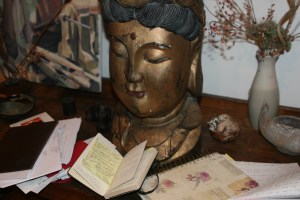
Quan Yin, bodhisattva or goddess of compassion; the Chinese interpretation of Avalokiteśvara

Sensitive. Or: oversensitive.

These are terms I hear bandied about to describe people who react deeply to anything from wool clothing or sock seams to sarcasm or “charged language.” When I was a child, people told me I was sensitive; initially, I thought that was a kind of compliment, and sometimes that was the intention. The teenager I once was believed that sensitivity made me empathetic and compassionate.

As I matured, however, the term sensitivity took on more negative connotations of the “can’t you take a joke?” sort. Worse yet, the charge of sensitivity came loaded with accusations of narcissism, as in “you take everything personally.” In today’s phraseology, “It’s not all about you.” Under those terms, sensitivity does not resemble empathy.

Empathy is a feeling-response, true. It appears to have a like-kind relationship to sensitivity–but a person must be sensitive to others’ experiences in order to feel empathy; so the similarity’s not as swappable as it first seems. I thought that my feeling-response signaled that I was a compassionate person. Indeed, fiction elicits empathy in me. A lifelong bookworm and early addict to novels, I definitely feel along with the characters of the stories I read. Is it really the experience of others that makes me weep or feel joy as the characters forge through lives such as I will never be able to encounter? Or is it a feeling response to damned good writing?

I ask myself these questions because, given my inquiries into what consciousness is and what poetry does, it seems I have not made clear to myself the differences between sensitivity, empathy, and compassion.

~

My current thoughts on the differences have evolved through reading and writing poetry, not fiction, and through getting older. Nothing like life experience to knock a person’s youthful errors into strong relief.

Here goes:

Sensitivity is the strength of a person’s reaction. That reaction may be physical or emotional and will vary widely from one individual to another.

Empathy always means that one “feels within” another person (from Greek empatheia em- ‘in’ & pathos ‘feeling’); it is an inward response to external stimuli. As Daniel Goleman notes, there are several types of empathy psychologists have identified–here’s a brief article on that topic.

Compassion, while a noun, must be active. I think of it as behavior, as action, as verb in noun form. It is a response or reaction to suffering in others (empathy) that is accompanied by an urgent desire–the word desire isn’t strong enough to convey the feeling–to help alleviate the suffering.

That’s where the activity comes in. Until I feel a desire to act, I am “merely” empathetic and sensitive.

~

Recently, I have begun to recognize that my desire to write poetry is partly compassion-based. Art of any kind is process as well as result, and process is action. Additionally, my career as an educator has compassionate action structured into the job description. There are other ways we–I–can be compassionate in the world. This matters to me.

We can learn from the practice of tonglen: “Breathe in for all of us and breathe out for all of us. Use what seems like poison as medicine. Use your personal suffering as the path to compassion for all beings.” ~Pema Chödrön

And we can live in the world and begin to use our sensitivity to pain, and our sense of empathy, to activate compassion–as a verb.


Safety

I work, and sometimes teach, at a college campus–a small, quiet, safe university surrounded by cornfields and lightly-wooded slopes. The institution has a manual of protocols to ensure the safety of staff and students: lockdown procedures, early alerts, advising on harassment, threat, and signs of various types of needs along with preventive measures, communication protocol, background screening, and referrals. The administration has taken pains to assure the safety of students, faculty, and staff.

It seems that one of the most urgent desires of U.S. citizens is to be safe. We spend millions of hours and dollars on the quest to protect ourselves and our communities. We argue over whose responsibility that should be, though most of us recognize the responsibility–as in any social group–must be a shared one. After last week’s mass shooting tragedy, one Oregon college professor posted an open letter to her legislators (click here for story). Her situation parallels my own except that I have been at my college for many years and am aware of the protocols. But those procedures would be just as useless in my classroom as she envisions they would be in hers.

From a June 2015 New York Times article reporting on the Texas campus-carry legislation: “Opponents say the notion that armed students would make a campus safer is an illusion that will have a chilling effect on campus life. Professors said they worry about inviting a student into their offices to talk about a failing grade if they think that student is armed.” Most lawmakers have never been teachers. I think it unlikely they are aware of the stress and apprehension most of us feel in addition to our interest, concern, and compassion when dealing with a “difficult,” angry, or excessively anxious student. Yet we do not let our fears keep us from doing the jobs we love, disseminating what we have learned through study and experience to others and (usually) actively seeking their engagement in the discipline. That means taking intellectual risks. Occasionally, it means making oneself vulnerable to physical risks as well.

I am not suggesting there is something wrong-headed about wanting to feel secure; certainly that need is basic among human beings, keeping us in groups banded together for safety. But I do wonder whether the craving for safety distracts people from exploring and implementing other, perhaps more helpful, methods of operating as a society. To do so would require rejecting the norm, stepping away from the way we generally tend to do things (the way they’ve “always been done”) and endeavoring to create new approaches to our social maladies.

What might that look like, from the professor’s point of view? Or from the politician’s perspective, or a parental viewpoint? And are we, collectively, ready to take those risks?

photo by Patrick Target

photo, Patrick Target. Mary Mother of God statue above the campus.

Interpretation & finesse

A few months back, I heard from an editor who rejected a poem I had submitted. He said that the editors really liked the work, but that the journal generally did not publish “poems about poetry.” The critique was especially surprising to me because I didn’t realize that my poem was about poetry; the editors’ interpretation of my text was different from my own!

It is interesting to re-read one’s own work from the viewpoint of a reader who is not oneself. Actually, that’s an impossible task, but I tried. My interpretation of my poem is that it is a somewhat speculative, perhaps philosophical piece concerning the re-envisioning of the commonplace. Nonetheless, it is not an abstract poem on the surface. My poetry inclines toward physical imagery, often nature-based (no surprise to readers of this blog…). When I distanced myself a bit and tried to imagine what another reader might make of the poem, I could see that there would be a way to interpret the piece metaphorically as a reflection on the writing process.

That’s not what I thought I was writing, but the interpretation works just fine. Who knows, maybe I was kind of writing about writing, and it took a thoughtful critique by some editors to figure that out!

~

Which brings me to the whole topic of interpretation. I am not teaching poetry class this semester, but that does not mean I am not trying to impart to my students an understanding of what it means to interpret a text. The aim of any composition & rhetoric course is to assist students in learning how to express their original thoughts about a topic–any topic–and to ground those thoughts in evidence: in other words, to validate the student’s interpretation.

That process involves analysis, argument, inference, sometimes research, and composition whether the text the student responds to is literary, persuasive, commercial, visual, auditory, performatory, or digital. Critical thinking requires inference and metacognition. These tasks are harder than they seem; most students do not develop those abilities overnight and need a bit of coaching.

Then there are students who are capable of thinking analytical thoughts but are at a loss for how to express them on paper (or on word-processing software). That ability also requires a bit of coaching.

It can be difficult to ascertain whether a student I am tutoring needs help with the thinking or help with the expressing. Too often, early in my career as a writing tutor, I have inferred incorrectly about a student’s difficulties with the written word. Coaching takes finesse. Finesse takes awhile to develop.

Come to think of it, interpretation requires finesse as well. When a critic bludgeons a poem to pieces, the interpretation gets lost in the analysis (and critics can even bludgeon poems that they love).

I am glad that the above-mentioned editor read my poem with considerable care and finesse. He may have decided not to publish it, and he may have interpreted it differently that I would have myself, but he took the time to interpret. It is encouraging to know that my work has been read with such care.


Perspective & aesthetics

Officially autumn now–and my lawn litter consists mostly of oak leaves, though other leaves will shortly follow. The showy blossoms of late summer, such as zinnia and tithonia, have begun to fade. Even the tall, bright-yellow, wild goldenrod’s going to seed, turning the meadow into a mass of beige and fading green. Asters and chrysanthemums take their places, drawing the garden visitor’s eyes a bit closer to the ground.

We move toward yin, the earth…which is where I happened to notice that just above the sprawling petunias–still blossoming, though getting a bit peaked–an iris is in bloom, too. This particular iris would not be all that commendable a flower in late spring or early summer when most irises are efflorescing. Its stature is medium, its color a rather wan yellow, its petals unremarkable.

autumn iris

Nonetheless, it’s an iris. In autumn! Apparently, my perspective on flowers changes once the days get shorter. My aesthetic expectations evolve: any rose becomes a wonder, any iris an almost magical surprise amid the mums and ornamental kale. That’s an important observation I try to keep in mind for myself and to teach to my students: perspective alters everything.

~

There are nice hybridization developments on late-blooming or, more accurately, re-blooming irises (this link from the Brooklyn Botanic Garden offers some useful information). I transplanted my rebloomer from an older garden that a long-ago homeowner planted; so I don’t know its heritage, though it somewhat resembles the cultivar “Baby Blessed.”

In the process of trying to track down the variety, I learned a new botanical word: remontant. Remontancy is that quality in a plant that makes it capable of blooming more than once in a season or year. There’s something generous and buoyant in that word, from the French “coming up again.” If hope does not spring eternal, may it at least be remontant. And may my perspective be flexible enough to appreciate seasonal transitions and small, un-flashy irises in autumn.

~

Another sign of autumn: the gleaners in the fields.

A break

I took a break from weeding and lay in the hammock awhile. Cloudless, breezy, equinoctial day–in no time, acorns and oak leaves hastened down to join me (nothing quite like having a large acorn ping on the forehead to remind one of the force of gravity and the inevitability of seasonal change). Hammock time is being pared away by the longer nights.

When I can be out of doors, I keep an eye out for migratory dragonflies, monarchs, flocks of robins, assemblages of chipping sparrows. Yesterday, I spied a kestrel in flight, zooming pointedly, clearly on the hunt. Today, we heard the weirdly rasping, short-stopped honks of herons, a stately pair of whom were being followed by an oddly-silent flock of crows.

smallcornsThis brief post is likewise a break for me. Post-weeding and post-hammock, I have student papers to grade and a busy work week ahead. Well, that’s what happens in the fall! I may as well be ready for it.

In the meantime, specific observations from the hammock or the back porch may act as feeder streams for future poems.

Painfully conscious

I’ve just finished reading Melanie Thernstrom’s 2011 book The Pain Chronicles, a journalist’s inquiry into the concepts that “define” pain and the medical discoveries concerning chronic pain, in addition to a bit of memoir as a narrative device. Although I have experience with chronic pain myself, the part of the text that most interested me comes in her concluding chapters, in which she gathers the variously-disciplined evidence of her enterprise to suggest that pain is the ultimate test of the mind-body problem (thank you, René Descartes). The experts Thernstrom interviews disagree on how much we do know or can know about the human brain and how it processes anything, let alone such a complicated psycho-physiological event as pain. Some of them believe human beings will make enormous technological discoveries to unlock our brains’ workings, but the majority seem to have learned from research that each “a-ha!” leads only to further complications. Discussing the outlook for future fMRI scanning in brain research, Dr. John Keltner tells the author:

[N]obody has come up with a rich and complicated enough model to analyze the complexity of the distributed patterns of neural  networks and deduce anything like underlying rules…We’re literally grappling with the fundamental aspects of human beings. We naively believed that pain is simple–it hurts or it doesn’t hurt–so there should be a single brain state we could see every time someone is in pain. But what we’ve stumbled into is the discovery that there’s a relative universe of hurt–that hurting is an immense, rich, and varied human experience associated with an unknown number of possible brain states.

I find some of these analogies, and some of this language, appealing–I can think of poems that express “a universe of hurt.” I embrace the idea that hurting is immense, rich, varied, and human–we are aware (conscious) that we hurt, that others hurt, that hurt can be painful even when it is not caused by a toothache but through loss of a friend or lover…the beloved other, the pain in ourselves. Isn’t compassion born of this awareness? Does art have a place here, too? I wonder.

Thernstrom concludes with the agreement of several expert researchers: “pain and suffering are properties of the mind” [my italics]. That means pain is, at least in part, a property of that elusive thing we generally call consciousness. Scott Fishman of UC Davis explains that “[t]he mind is like a virtual organ–it doesn’t  have a physical address that we know of.” Consciousness, these researchers imply, is not merely the sum of firing neurons, a process that can be considered on some level mechanical. Thernstrom asks, “Do we need to understand consciousness itself in order to understand pain?”

If so, that is a tall order, one the author posits is analogous to understanding aesthetics (what is beauty?). But though the task appears daunting, the discoveries en route make the trek valuable.

Even if we never understand the answer.

neural matrix fiber topography, Johns Hopkins University

neural matrix fiber topography, Johns Hopkins University