Adventuring

The weather here has been hot and somewhat humid, though it continues to be dry–much drier than autumns used to be. Drought extending past August into October is becoming a more usual thing, according to my garden journal. One plant that thrives this time of year is tithonia (Mexican sunflower), and it attracts monarch butterflies like crazy. These are the monarchs that go adventuring: the super-generation of these insects that makes the 3,000-mile trip to Mexico. Here’s a brief blog from the Xerxes Society that has some quick facts. The monarchs I see in my garden may, if they are lucky enough to survive the trip, live up to 9 months, which is well past the life span of spring and early summer generations.

They are not even returning to a place they know or have ever been. Human science has never yet determined how monarch butterflies of the last summer generation find their way to Mexico. They just go adventuring, floating on air currents, supping on flowers as they travel.

I’m about to go adventuring, as well, traveling further east than I’ve ever been, in the company of one of my favorite persons in the world–my daughter. She and I had long talked about taking a mother-daughter trip together once I retired, and sooner is better than later! She found an environmentally-conscious adventure tour business that offers some really intriguing historical/archeological/environmental hike-and-bus options. We’ll find out whether the company is worth recommending & I’ll report back here, meanwhile keeping our destination unrevealed for now. A little mystery is fun.

While I am taking this trip for reasons beyond writing inspiration, I can’t help hoping it will act as a prompt and opportunity for drafting new poems. I’ve been working on new drafts, and revising older ones; but I have to admit that for awhile my creative mojo has been a bit off. Yes, this happens to any so-called “creative” occasionally, but it never feels terrific. One prefers the juicy, challenging urgency of creative flow. Wish me luck (and traveling mercies).

Re-assessing

Another clear day; we finally got an inch or so of rain on Friday, which was much needed, and since then the temperature has cooled a little. This late in November, it finally feels like autumn. On my morning walk today, I was happy to see this handsome creature airing its wings in the sunshine. Our local turkey buzzards have been active lately. I’m fairly certain that the snag this one’s perched on is a green ash tree, clearly well-visited by woodpeckers.

My low mood seems to have abated, at least temporarily, and I wrote a few poems and revised a few others during the past three days. I’m trying to accept the fact that this year, we will see neither our son nor our daughter for the Thanksgiving and Christmas holidays. So I’m trying to get creative about things to do that we might not have done if we were preparing for family celebrations. Yet we miss the concept of family celebrations. I guess that’s a socio-cultural thing, right? I may need to reassess what value “the holidays” have for me these days.

~

I have also kept myself busy re-assessing a chapbook manuscript I’ve worked on forever (it seems) and am now looking for the sort of small, independent publisher that might consider a hybrid poetry-journalistic/historical work influenced by Muriel Rukeyser‘s long-poem The Book of the Dead. My poem is about a Korean War veteran tried as a traitor upon his return to the USA, a man who was my friend David Dunn’s father. It has been a real creative challenge to figure out how to tell his story, and the resulting text is definitely “hybrid,” with footnotes, magazine articles, military court proceedings, letters, and poems. People who believe that poems simply flow from some internal inspiration would probably take issue with a poem-ish thing like this, but I keep feeling compelled to find a way to tell this man’s story. The unfairness of it, the long-term damage, the people who used him as a scapegoat, his short life (he died at his mother’s, age 39, discouraged and unwell from physical wounds that never healed, divorced, unable to overcome the dishonorable discharge that kept him from gainful employment). David kept losing his father over and over: to prison, to PTSD, to divorce, to death. It’s an all-too-common narrative, but each tale is also deeply and profoundly individual. Hence the need to write it.

Two falls

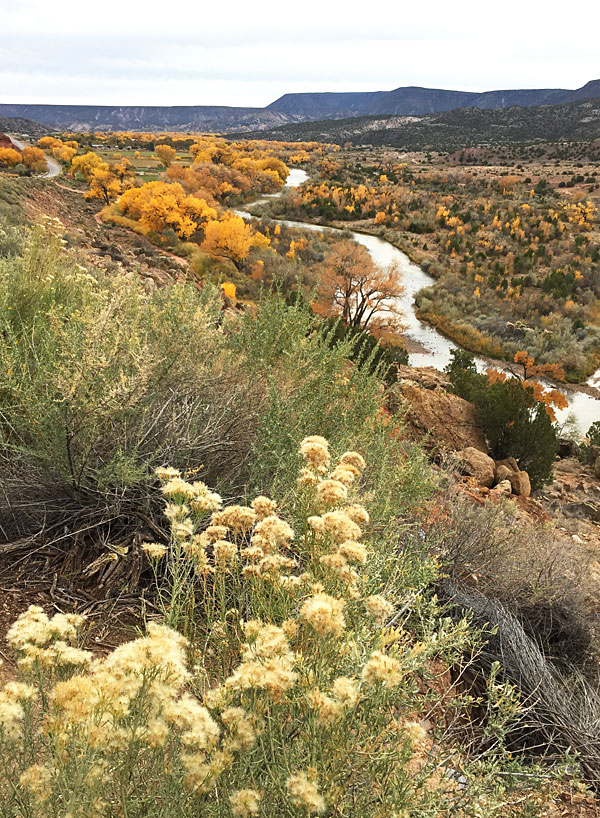
I have experienced two autumns this October: one in New Mexico, one in Pennsylvania. In the American Southwest, high up in the world, the cottonwood trees that hug every available water source were going a brilliant gold while I was there. Any view above a creek or river revealed a winding path of yellow–along the Chama, along the Rio Grande. The tiny-leaved oaks were turning brown-leaved and dropping scads of acorns along the paths. The oranges and reds are mostly there year-round, on the mesas and in the canyons.

It was wonderful to experience a poetry workshop with Anita Skeen and Cindy Hunter Morgan and to learn how books are made by hand, wonderful to draft some poems using color imagery and ekphrasis, wonderful to meet some fascinating people with whom I enjoyed pushing past my/our comfort zones and into art forms we may have been a bit less comfortable with. These are reasons to attend an instructor-led workshop, seminar, or residency. I spent part of last September in New Mexico, but it wasn’t the most spectacular time for autumn coloration–whereas October certainly gleams in northern NM!

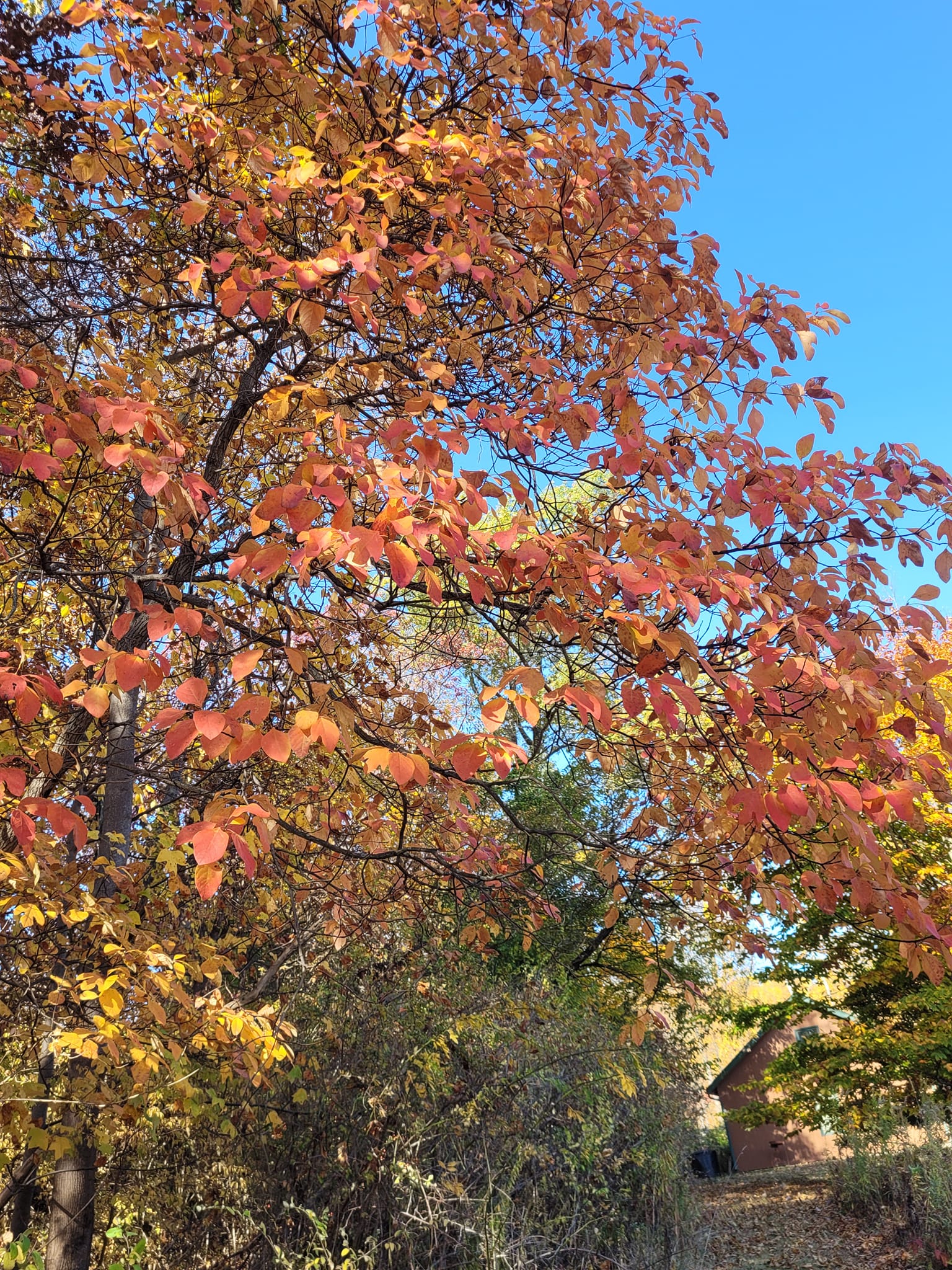
When I returned home, I had missed “peak season” for color in Pennsylvania; my husband said that came a bit early this year because of drought. But it’s still very bright here. The maple leaves haven’t all fallen, most of the tulip trees are still yellow, the hickories haven’t reached peak gold yet, and many of the sassafras are that warm coral color I love so well. The burning bushes? Ours hasn’t dropped its bright fuchsia-maroon leaves. It’s a vivid presence at the corner of the house.

~

Therefore, I have two autumns this year, one sea-level Mid-Altlantic East, and one high-altitude Southwest.

Which strikes me as an abundance of beauty and color. So I am continuing the theme of last week’s workshop. Here’s a new draft of a new poem just for the joy of it. [This fall, those of us in the USA could use a bit of joy.]


I don’t have a title for it yet. Maybe you can help me think of one.

~


The difference between orange leaf color
and orange rock color.
Between the greens of grass and juniper,
the pale dun of meadow’s die-back
and beige sand stretching westward
to the mountains.
Even the clear sky’s blueness
on fair, mild mornings
differs by an almost measurable degree.
Something to do with altitude
and aridity, the science of which
I don’t really understand.
Life’s variations and hues—
striated like cliffs, buttes, mesas,
like hills of maple and hickory in fall—
beautiful and strange.
Even when I close my eyes, color-
memories, all those shades
I can’t define, sift through my skin.
Into blood. Into bone.

Crabgrass

I have been at work in the vegetable garden during the past few dry, sunny, late-summer days–it has been rather droughty here–and pulling up weeds in an effort to get an early start on putting the patch to bed for autumn. I have decided not to do any late-season sowing this year, and therefore I can pretty much tear up everything if I feel like it. Today I was thinking about my mother-in-law, who died in 2017, but who was sometimes my partner in the garden, or I in hers, when we were younger. I learned a great deal about ornamentals from her.

At her property, crabgrass was a particular scourge. I remember us weeding flower beds together while she muttered, “Crabgrass! Always crabgrass, how I hate it!” It struck me odd at the time that she pronounced it “crebgrass,” with the first “a” like a short “e”, because she said the word “crab” and similar words with an open short “a.” It was almost as though she reserved that pronunciation to express her ire at this particular weed. She liked weeding at my house partly because I had so little crabgrass. Plenty of other weeds, but not much crabgrass.

Our weeding together took place over 15 years ago, when my gardens were on the new side, maybe a decade old. Today, however, I find my vegetable patch very much colonized by digitaria sanguinalis…one of the finger grasses, a very successful weed that can produce 150,000 seeds per plant. My garden now hosts both smooth and large crabgrass; the former is much easier to pull, though it can set seed even when it is mowed to under an inch in height! Large crabgrass, when it gets going, can grow over a foot tall and have a base rosette of 10″ with a star-like (or crab-like) set of leaves and quite tenacious roots, for an annual.

While I worked (too late, I really should have gotten to the weeds long before they began to set seed), I heard my mother-in-law in my mind: “Crebgrass! How I hate it.” Well, dearest Gene, I have finally encountered the Eurasian colonizer in my own gardens. And I miss having you around to sympathize with my plight.

 Maudib | Credit: Getty Images

There’s a metaphor here, I know there is. Maybe there’s a poem in this experience, too? For the time being, pulling weeds reminds me of someone I loved–and takes my mind off of another person I love, whose dwindling and decline (her “diminishing”) stay uneasily in the background of everything I do these days.

In the between-season time, with autumn almost upon us, I want to remind myself of the joys that come along with the crabgrass. Such as the brown crickets and the morning glories and the goldenrod…and memories of people for whom I have cared a great deal.

~

báilù

白露 báilù is the section of the lunisolar calendar that refers to the two weeks before the autumnal equinox; the translation is “white dew.” Misty mornings here and there, damp grass, dew spangling the tent spider webs in the meadow, draping the grasses and goldenrod with white gauze. Brown crickets sing, but the cicadas have left off. Nuthatches return. Squirrels knock walnuts off the branches daily, so there’s a regular thump-thump sound along the treeline. My summer-loving acquaintances bemoan the cooler days and insist summer’s not over until the 21st. My fall-loving acquaintances are picking apples and celebrating the return of pumpkin-spice flavoring to their favorite beverages.

I like the in-between times, the verging of seasons, aspects of change. Change means life, even though the onset of autumn traditionally signals the dying of the year. On my walk this morning, I took photos and made a mental list of changes that are flags of the coming season: acorns on the bough; morning glory still open at noon (in Japanese literature, the morning glory is a signal of autumn’s approach); burning bush shrub going pink; pennants of yellow walnut leaves; ripe wild grapes–deep navy blue, quite sour, and full of seeds; sweet autumn clematis (terniflora) in its whirly seed state, swarming over the hedges; oak leaves, five-leaf vines, and sassafras starting to color; winterberries already red; acorn detritus on the tractor path; pin oak galls (probably thanks to the wasp Callirhytis furva) on a leaf. All of these are mid-September features in eastern PA.

If I were feeling more poetically creative, I might try writing haiku using each of these as the image word. But my current state is fretful. Pulling weeds and taking walks ease my mind a bit. Sitting down to write, not so much. However, reader, I encourage you to try the exercise.

~

There & back again, with weeding

I have traveled to the American Southwest and back again, over a fortnight away from the humid valley where my gardens languished toward autumn, pounded by rain, while we were gone. For two weeks, we lived among the terpene-scented (pinene, not cannabis…though we did notice cannabis when in downtown Albuquerque…) environment of the Sandia Mountains, where humidity is “not a thing.” I embraced my beloved family members, not quite often enough to make up for the distance between us, but enough to feel contented for awhile. And we explored some of the northwestern/north-central parts of the state that we haven’t seen before and were awed. I have not yet tired of the geology there. It’s easy to imagine New Mexico as the benthic floor of an ancient sea!

En route home, we encountered flight cancellations and re-routing, which is practically to be expected (our checked bag arrived 20 hours after our arrival in Albuquerque, also not an unsurprising development). I hear many complaints about air travel these days. I may even have added to said complaints. While it may feel almost as inconvenient, unreliable, and uncomfortable as traveling by Conestoga wagon, you must admit it’s much faster–even if it doesn’t seem that way while you’re waiting for the bus to the economy long-term parking lot at 11 pm. If my beloveds had taken Horace Greeley’s advice in the 1850s, I might never have seen them again. So, I am grateful. Even to American Airlines.

~

Upon a (slightly delayed) return, I found that the valley in which we live had experienced considerable rain but mild temperatures; as I expected, the garden weeds were thriving. Some of that is fine with me: annual weeds can go crazy in October and I don’t mind. But the perennial vines, little shrubs, and weedy biennials and perennials? I dig those out in fall, along with the tomato vines, sunflower and corn stalks, and amaranth plants. That has been my job upon my return; and the cooler weather, with soil moist from all the rain, has been a boon. I have to admit that adjusting to the lower elevation and the higher humidity has put some strain on my ol’ body. But we did a good bit of hiking and walking in the Sandias and Bandolier and Jemez, so I was somewhat prepared for the workout.

My beloved doesn’t understand my enthusiasm for “putting the gardens to bed for winter.” It seems like boring, hard work. Yet I don’t clean everything up–I always leave cover for bees and other creatures that need leaf litter and old stems in order to winter over. However, taking down the stalks and cutting back the peonies (etc) feels satisfying to me. I work in the cooler weather and sense the difference in the air. I recognize the annuals are dying and the perennials are going dormant, the trees let go of their coloring leaves; walnuts, oaks, and hickories seem to fling their mast upon the earth with every gust of wind. There’s nothing sad or somber about the changing of seasons. Winter must arrive in order for spring to do its thing. I like to think of daffodils, muscari, and irises huddled quietly in soil and taking much-required rest before the warmth unthaws the earth. I feel the same.

Autumnal

I have been re-reading Allen Lacy’s charming and informative book The Garden in Autumn. I first read it years ago and enjoyed his writing as much as I appreciated his useful ideas about landscaping with autumn in mind. I treasure books that offer more than information–well-written and inspirational texts which in this case includes attractive photographs, as well. I am outside in the clear, cool weekend days and doing some garden cleanup, but I don’t tidy things up as neatly as I used to: many insects and other small animals need some vegetative cover, and incautious hoeing can disturb nesting bees. I was almost 40 years old before I learned that most bees don’t live in hives and that our precious pollinators of many varieties need winter shelter.

Meanwhile, haiku drafts. Meant to kick myself back into creative writing gear. Practice/Zen practice.

~

So hot!
drinking the last of my morning coffee
with ice...


cicadas whirring.
under my bare feet
	dry grass.


Fall semester
remember to practice 
resting Buddha face


Jays and chickadees call—
louder but not as constant as
crickets in the dew


four cantaloupes
on the vine
I didn’t plant!

~

In the profusion 
of morning glories:
		one gold leaf


good morning, cicadas!
	at least some of us
feel wide awake

~

in the tulip poplar
red squirrel scolds 
a Carolina wren


dew
on crabgrass is 
still dew


farm stand:
fresh eggs for
a dying friend


late summer
six young sparrows—
empty birdfeeder


Three bats flit
at dusk the doe huffs, sneezes—
bedtime for fawns.

I don’t need
the word September
I see the spider’s orb

Collecting & creativity

Somehow or another, I completed a chapbook manuscript. The longer collection is coming together, as well. Yet it feels to me as though I have not spent nearly enough time on my creative work. And when I find myself awake at 3 in the morning, it’s not poetry that runs through my mind. Usually those wee-hour thoughts are work-related. I guess that makes me normal.

The next step, once a writer has completed a manuscript, is to have another writer or two review it; I’ve done that, too. So now? I guess I submit the work and find out whether a publisher agrees the poem collection does the job of poetry.

And I get prepared for rejection. Comes with the territory.

Upon reflection, the reason I feel I haven’t been doing creative work is that I am not generating many new poems right now. Some, but not many. But let’s re-think the process of revision: it’s a process of deciding upon the order poems should appear in a book, and which of the poems ought to be there to speak to one another, to resonate with one another (and with the imagined future reader). Hey, I am using my imagination here, and I am doing creative work. If all I ever do is generate new poems, those poems won’t have a chance to go out into the world and endeavor to speak to other humans.

Figuring out how to make that happen is the creative work of revising, editing, rethinking. Imagining the reader. Striking the tone of each individual poem to see whether it adds harmony, or works with a fugue-like trope, or changes the mood to minor, or unleashes a surprise. The book of poems can have an arc or act as a chorale or zigzag about to keep the reader on her toes.

The collection of poetry, when it is not yet a book, presents problems the writer and editor must solve. Problem-solving requires creative thinking–I tell my students this almost every time I see them in class!

Will the manuscripts find homes? That’s a different “problem.” Meanwhile, more new poems, more revisions, maybe more manuscripts ahead…while I await the first frost, while the leaves turn and fall. All part of the cycle.

Evolution

Evolution

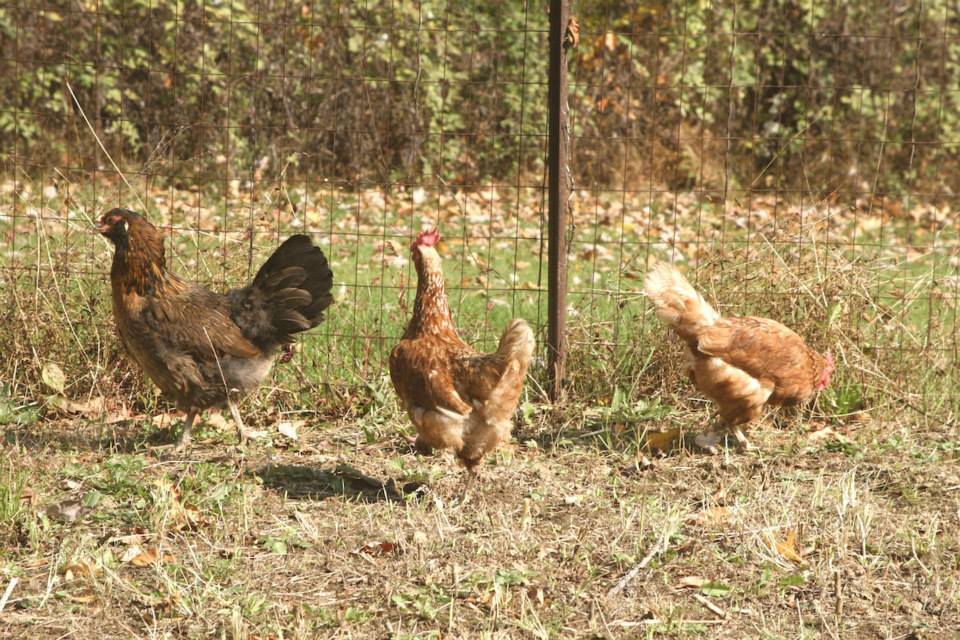
The chickens mill and scratch;
what do they know of their theropod ancestry,
how many millennia it took
to evolve a brain, without neocortex,
capable of amodal completion
immediately upon hatching, a brain
that supplies all they need for survival
until the hatchet, predatory snag, parasite, virus?
Hens in the garden stride through scythed weeds,
make an unhurried ambit of the dead
and dying remainders—
Stumps of stalks, twisted beige grasses
the color of birds’ tail and breast feathers,
brown-speckled hens, rumps dun, red combs.
They cluster in a fence corner,
step on each other’s heads,
snap up bees and beetles during autumn’s
short-limbed days. The clawed foot
extends, grasps, clings to roost.
A Jurassic hinge, rusting, its vitality immured
in the muttered musing of hens.
Dry leaves, blooms gone to seed.
How the mighty have fallen.

~

This is an older poem, going back at least ten years. It seemed suitable for the end of autumn and the looming solstice today. I love that I could use the terms amodal and neocortex in a poem. That kind of poetic vocabulary isn’t everybody’s “jam,” but the thwarted scientist in me enjoys playing around with this sort of fact-meets-art interdisciplinary terminology. And yes, there’s an opportunity for metaphor here, in the virus and in the chances evolution randomly develops as to who’s on top or who thinks they are on top. A lesson for us all.

First frost

autumn
when so much dies
or moves on

toads burrow deeper
after dark covers 
sedge and clover

fallen hickory leaves
ice-rimmed gold
at sunrise

I wake too chilly
at my usual hour
forsake my habit of rising

listen to the nuthatch
and house sparrow
mourning dove croon

give me another minute
beside you in bed
shivering yet shimmering