Jisei

I have been re-reading a lovely anthology called Japanese Death Poems, edited by Yoel Hoffman. I purchased this book years ago when I was immersed in the study of haiku, haibun, and the early Chinese poetry forms and approaches that influenced many Japanese poets. Hoffman’s book offers excellent examples of jisei (poems composed near the moment of death) and his informational text places the poems in the context of various cultural, economic, power, and belief structures.

For a person raised in a contemporary western culture, the concept of death as a constant partner in our consciousness seems–while perhaps obvious–rather uncomfortable. We are not likely to approach our deaths with a sense of acceptance, let alone friendly understanding: “This is how it is.” But the death poems, as I read them, suggest that while death is universal, each person’s awareness of it is unique, even among people in the same culture who may hold similar beliefs.

Jisei intrigue curious folk, because death is A Big Thing to Be Curious About. Digital photographer Hank Frentz, a young artist who’s been inspired by Hoffman’s collection of jisei, has posted a series of mysterious and beautiful photos paired with the death poems, a sample of which can be viewed here. Please follow the link, as his photographs seem to me to be aesthetically and “spiritually” close to the poems he chooses, creating a kind of haiga (俳画) effect.

~~


I have also been revisiting Earl Miner’s translation of Shiki’s brief verse diary, “The Verse Record of My Peonies.” Written in 1899, when Shiki was suffering agonizing pain from spinal tuberculosis (he died in 1902 at the age of 35), the haiku and the prose of the diary recommend the reader to an understanding of physical pain, uncertainty–will I live, or die?–and humor, friendship, grieving. The diary is as layered as a peony blossom; each time I read it, I find something new to contemplate in its few pages: joy, aesthetics, nature, the human body, the solace of friendship and the isolation of illness, the nearness of death, the challenge of uncertainty, the many ways poetry can supply a place or grounding for a person struggling with ambiguities.

Two flakes fall
and the shape of the peonies
is wholly changed.

[tr. Earl Miner]


Composer Libby Larson has used Shiki’s verse diary as a text basis for a 7-minute composition for voice available here.


The skill of grieving

In a recent post, Sigrun of the blog sub rosa pointed me to Poetry Society of America’s page on Natalie Diaz; I’m even going to post the same paragraph she does, in which Diaz states:

When I write, I bring all of my truths, even the Judas-truths that make me feel like the betrayer whose dirty hands are resting on the table for everyone to see, including God. For me, writing is less a declaration of those truths than it is my interrogation of them. Uncovering the darkness in me that led to some of the poems about my brother also lights up the hard, bright way in which I love him and the small wars I wage to win him back…the truths that have built in me a strength and compassion that help me to survive this world. Truth is that little animal we chase and chase until we suddenly glance over our shoulder and realize it has been chasing us all along.

This passage about “uncovering the darkness” and the hard ways in which we sometimes love–maybe with some people, there is no other way to love–interestingly coincides with my recent reading of Stephen Jenkinson’s Die Wise, a manifesto on how we die and how we might die better (wiser) if we carried our darkness better, as Diaz suggests in the passage above. While I am reading Jenkinson for specific reasons around end-of-life concerns, there’s no doubt that there is often poetry in his philosophy that we need to learn the skill of how to grieve and to learn all that such a skill contains, including its “Judas-truths” and its unflinching confrontation with the ways in which death is a gift to us collectively and individually.

Most of us do not see death as any kind of gift, and Jenkinson admits it can be a challenging perspective; he endeavors to persuade the mostly-American or European reader that each of us and each of our societies or cultures would benefit by reclaiming death as a natural sequence in our being in the world.

Claiming or reclaiming death (you might read here: darkness), says Jenkinson, requires us to face the fact that we have no language for dying, not really. He says “we are taught almost nothing about what language to use or why when we are trained for the job [of tending to the dying].” The Dying, he writes, are “them,” meaning they are “not us.” Which makes them outsiders and invisible and yet all of us die; we are all of us dying–and we work so hard to distance ourselves from the fact.

Poetry is a language that, I think, sometimes guides us toward the hard truths, when poetry is well-made and conflicting and sundered with surprise. Poetry isn’t the language that gets us to dying, exactly; but it can do some of the hard work of teaching us how to grieve.

This is not to say that poets or artists are any better at dying than the rest of us. Sometimes the darkness uncovered in the fiction or poem or painting is true and authentic and deep, but the artist does the grief-working well in art and not so well in life’s physical dying process. Artists who choose suicide may be people who suffer pain and can express it artistically without actually learning the work of grief, which differs from suffering. If we learn that anything that does not last forever is meaningless (an idea drummed into many of us through the concept of “eternal life”), we are apt to feel bereft at every loss and may embrace a kind of horrible existentialism. Sometimes our artists strive to overcome the meaningless through lasting works of art, but their personal desire to be somehow immortal may bog them down as death nears.

We admire this artistic striving, but it is a kind of working against our darkness rather than confronting it with the love Diaz mentions. Jenkinson writes: “Dying isn’t the end of true things…It is one of the true things, that is all.” [My italics.]

However, I do believe that art–particularly the storytelling arts–can offer much in the way of teaching us the physical, on-the-level, hard work of grieving. Really good novels and plays can help teach us if no one in our “real lives” does. Even if we weep at the end of the book and wish the author had chosen a different way of ending it. Good poetry that leaves us excited and confused by complexity or blasted with gut-level sorrowing might be teaching us the ways of grief we aren’t learning from our culture.

When a loved one dies, we often get lost, pushed away from grief through the signing of papers and the bland condolences of marginal friends and the plea to move on with our lives. Good poems can keep us dangling in the now of real grief and force us to figure our way through the losses we incur–losses which do not exclude even our selves. Because “death waters the living.” And so does poetry.

http://www.philamuseum.org/collections/permanent/82820.html

Rain [La Pluie] Vincent van Gogh, 1889. Thanks to the Philadephia Museum of Art


In memoriam

Ariel Dawson, 1959-2013

I recently learned that a friend who was hugely significant in my life once, but with whom I had lost touch for 15 years, no longer walks the same earth that I do; in fact, Ariel Dawson died in 2013, unbeknownst to  me.

Ariel Verlaine Dawson

Ariel Verlaine Dawson

It is hard to lose friends, but losing the friends of one’s youth–those intense, passionate friendships that teach human beings how to navigate the world of human relationships–that loss cuts in a different way. For Ariel is perhaps the reason I am a writer. No–I would have become a writer. She is the reason I decided it was possible to be a poet. She amazed me with her vocabulary, her insights, her evaluative reading, her positively voracious and precocious reading, her charm, her gentle goofiness, her forthrightness, her neurosis; she seemed to fear nothing (but that wasn’t true); she had published poetry in real journals before she was 17 years old; she read Rilke and Yeats; had affairs with well-known poets; spent years fathoming Jung. In 1994, she wrote an opinion piece for what is now AWP’s Writer’s Chronicle responding indignantly to Dana Gioia’s article “Can Poetry Matter?”–a piece that started quite a dust-up among defenders of what has been termed “new formalism.”

Ariel had always been the sort of person who chose to disappear and then to reappear, to my joy, months or years later to take up the friendship without pause–and often without explanation for her absence. She had her reasons, and I respected that; but I missed her.

Ariel, 1977 or 78

Ariel, 1977 or 78

~

In the early 1980s, my (also late) friend David Dunn and I were publishing chapbooks under the small-press name LiMbo bar&grill Books. We approached Ariel for our second-ever chapbook: Poems for the Kazan Astrologer. She was, at the time, teaching creative writing at Old Dominion University. We were very happy with the outcome, but we had no good method of distributing the books. I may still have a box of 25 or so of these books somewhere in my attic.

Then Ariel became more intensely interested in Jungian psychology, though it had long been a passion of hers.

In subsequent years, she wrote less and less poetry and stopped submitting her work for publication. The response to her Writer’s Chronicle opinion was, I think, a bit shocking to her, though I know she stood by her opinion. She just decided, perhaps, that she felt more at home in the world of Jung and his followers.

During the past decade I have often tried tracking her down, imagining the internet would find her. My job at the college has made me a rather adept online researcher, but all that ever showed up was a listing for her psychotherapy practice in New York City. The number was incorrect.

Then, my father became very ill and other issues crowded my mind. Searching for a friend who clearly wanted to remain anonymous in an electronic era was not a priority.

Besides, I always assumed that Ariel would suddenly re-emerge, call me–my phone number remains the same as it was last time I saw her–and mention she was going to be in the area, and could she stop by? That’s how it had been before. And I’d be thrilled to see her, and we’d talk about poetry and art, and politics and pets, cheese, philosophy, psychology, parents, wine…

I assumed incorrectly. That’s what happens with assumptions. Just this past week, when I finally found myself with some spare time, I tried an internet search again. And found her “electronic obit” online, and the fact that she’d died in February of 2013.

~

I have no words to express how this information feels to me.

And also–

~

Arthur Cadieux, 1943-2015

Arthur Cadieux in 1978, a photo taken by Jim Terkeurst.

Arthur Cadieux in 1978, a photo taken by Jim Terkeurst.


279519_2290955317647_6522544_o

Arthur 2011, Eastport, Main

Arthur in 2015. Photo Elizabeth Ostrander.

Arthur in 2015. Photo Elizabeth Ostrander.


~

Arthur Cadieux was my art teacher at Thomas Jefferson College in the late 1970s. He and his wife, Helene, were exceptionally kind to young adults who had an interest in art and in observing the world around them. We had dinner at their house in Michigan and at their loft apartment in New York City. Years later, after Helene’s tragically early death, and after Arthur had moved back to Maine, he let me stay at their cottage on Leighton Point (he lived in a smaller house in town) so that I could have a personal “writing retreat.” He deeply understood the creative person’s need for reflection, evaluation, thought, imagination, boredom, and occasional moments of lively talk.  The universe needs people like Arthur Cadieux, talented and generous, who are constantly pushing their own boundaries. Many of us who benefited from his friendship will miss him. Arthur’s paintings can be found at his website, arthurcadieux.org.

~

May they be free from suffering and causes of suffering.
May they never be separated from the happiness that is free from suffering.

About that death/writing thing

Driving the road that clings to the south side of our hill I notice the round bright moon over newly-gleaned cornfields and find myself thinking about the last essay in Margaret Atwood‘s book Negotiating with the Dead. I finished reading the book some days back, but the title essay worries at me somehow; I can’t let it go. Maybe it is because I perceive connections between her ideas on the ontology of story-making and Boyd’s evolutionary premise for narrative, or between conscious mind and story-making arising from the cthonic, the deeps, the under-earth “hells” to which our myth-makers and shamans, goddesses, musicians, poets and heroes journeyed in order to bring back–if nothing else–the story of the trek and the resulting wisdom. Maybe it is because “negotiating” with the dead raises the problem of consciousness in peculiar and challenging ways as well as the problem of communicating with people of the past and of the future. Or maybe because of that bogeyman that awaits us all: Death.

When I was quite a young child, age seven or perhaps earlier, I was seized with an insomnia-inducing fear of death that kept me in agonies as soon as darkness fell. I wonder if that had anything to do with my later need to “be a writer.”

Atwood suggests that all writers truck with the dead. We read the work of our ancestors-in-the-craft; they are often our first teachers. That important aspect of craft so many of us struggle to attain–the ever-illusive quality of “voice”–is what we notice in many of our beloved writers. Voice, perfect example of metonymy. It stands in for the departed body, the dispersed consciousness.

Here is Atwood holding forth at a dinner party of fellow writers:

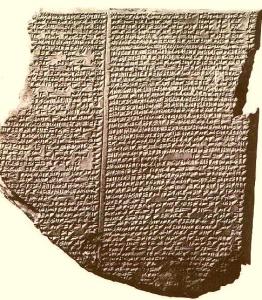
Gilgamesh was the first writer…He wants the secret of life and death, he goes through hell, he comes back, but he hasn’t got immortality, all he’s got is two stories–the one about his trip, and the other, extra one about the flood. So the only thing he really brings back with him is a couple of stories…and then he writes the whole thing down on a stone.

She adds that going “into the narrative process–is a dark road. The poets know this too.” So inspiration is not so much a clearing in the clouds but a kind of rappelling into a cave. At any rate, darkness, even with a full moon to light the road, seems as likely as a bolt of lightning to produce emotionally-resonant work. Maybe more so, because it’s harder work and more ambiguous (Lord knows, writing is both of those!). Darkness requires more interpretation. The audience has to listen, not simply see; the darker path gets traversed by both writer and reader.

The Flood

The Flood

Atwood also makes note of the threshold concept, that edge or invisible boundary line between the realms, any pair of realms. Life/death, yin/yang, heaven/earth, day/night. The one who seeks knowledge or magic or treasure (or lost love, viz Orpheus) at some point crosses the threshold, and then nothing is certain. He or she may not be able to return, for example. Edges are the interesting places, where all manner of things mesh and overlap–good spots for inspiration even if one opts not to take the stairway to the underworld; but they also pose danger. We humans, with our need for communities, invent parallel communities for our dead, not just physical cemeteries but supernatural abodes, and create all manner of “rules and procedures…for ensuring that the dead stay in their place and the living in theirs, and that communication between the two spheres will take place only when we want it to,” says Atwood.

I wonder if that is one reason I felt so unsettled by the idea of death when I was seven. I did not personally know anyone who had died (yet), but I knew the stories; certainly, I’d been taught about Jesus, though I was told he had defeated death. So why the early-onset angst? Did I fear that edge between the realms, being too inexperienced either to navigate it or to allow communication on my own terms? And maybe the fear is precisely what has led me to my ongoing inquiries into philosophy, consciousness, art, and mind.

Or was I precociously aware that I would have to venture into the darkness, into the coffin-holes and the caves and the seas’ depths, if I wanted to come back with a story to tell?


Quiet earthiness

The beloved life partner of a long-time friend was interred in a green burial today, a glorious May morning full of flowers (she loved gardening…); and I find myself with little to say.

It’s been that way for the past two weeks. Not exactly writer’s block, as I have in fact drafted several poems, but an extreme sense of turning-inward. My nature is reflective–I’ve always fallen into the introvert category (INFP for those who are familiar with the Myers-Briggs assessment)–but my job requires pretty constant interaction with other people, students and colleagues for the most part, and quite a bit of listening and talking. I enjoy my job and find it rewarding; but the stressful weeks just before exams, when term papers are due, can be challenging for a person whose inclination is to read books and putter in the dirt.

I planted seeds in the earth, and picked flowers. And then placed flowers on a coffin woven of reeds which was lowered into the earth.

Returning home the quiet overcame me. I’ve been reading poetry today instead of the Sunday New York Times.

Also, I’ve been reading books on “good death” and “mindful dying,” and the guidance of some sensitive and experienced authors seems appropriate and grounded.

But grief is hard. It’s probably one reason we invented philosophy, religion, and poetry.

Shadblow, also known as serviceberry.

Shadblow, also known as serviceberry.

One of my go-to anthologies for sorrow is Pinsky’s The Handbook of Heartbreak, which I’ve mentioned in a previous post. In addition, I opened Christian Wiman’s book Every Riven Thing at random and came upon his poem “From a Window“–

Incurable and unbelieving
in any truth but the truth of grieving…


The poem comforted me (and I read other poems today, by other poets, that also comforted me). This one ends with the following stanzas:


Of course that old tree stood
exactly as it had and would


(but why should it seem fuller now?)
and though a man’s mind might endow


even a tree with some excess
of life to which a man seems witness,


that life is not the life of men.
And that is where the joy came in.


~
The joy comes in, somehow, through the quiet and the dirt and the trees.

Roadkill

As the spring equinox approaches and creatures rouse from dormancy, the number of roadkill incidents spikes. Yesterday as I made a left turn into my driveway, I noticed a groundhog carcass lying in the middle of the street. I was stopped to retrieve my mail anyway, so I figured I should move the body off.

And then it moved–bloodied mouth opening and shutting, one heavily-clawed forepaw shuddering slightly. It wasn’t quite dead.

Poems about road kills sprang to mind. I thought immediately of Stafford’s “Traveling through the Dark” and that moment of swerving, replete with caesuras, in the last couplet; Billy Collins’ “Ave Atque Valealso skittered into my thoughts, that bloated woodchuck waving “hail, Caesar” to the passing vehicles.  As I pulled a plastic bag from my car, one of my own poems resonated–“Burials,” which is in my collection Water-Rites (available through this link and posted below).

I made a glove of the bag and grasped the poor beast by its tail, a precaution: it might have been lively enough to snap at me. Not the case this time. A car running over the body would have put the groundhog more quickly out of its misery, but by daylight drivers tend to avoid road kill; it gets smashed during the night hours. So I left it on the embankment to gasp out its last breath with the birds larking about above it and some damp wintry weeds under its dark body.

This sort of experience feels oddly metaphorical…obviously, not only for me but for people like Stafford and Collins. I am sure one could put together an anthology of very lovely roadkill poems.

~groundhog-day-groundhog

BURIALS

1.
Last week the neighbors’ dogs eviscerated a woodchuck,
left it, stinking, at the perimeter of our woods

which is how we found it, by the smell—
body bloated, partly hairless:

a scientific demonstration on the rapidity
and absoluteness of decay, the brief time it takes;

but today my daughter cannot bear the stray cat’s
road-killed stillness, the soft, domestic body,

the pet, which isn’t hers—she begs to bury it.
The schoolbus arrives with my promise

to give the cat some cover. Under mulberry I scrape
a shallow grave, in thin and gravelly roadside soil,

cover it with fallen leaves, an autumn prayer—
nothing more, because I know burial does not forestall

death’s swell, its stink, desiccation,
absoluteness; I do what I promised,

disguising the body’s inevitable progression
from the eyes of my grieving child.

2.
Shall I cover my gray hairs
with dry leaves, shall I layer
my wrinkled hands beneath clay,
hide my own departure—

or shall I teach my children
to understand the truth of maggots,
which consume equally
the treasured and the stray—

which arrive unasked,
fulfill their contract with the earth,
never seeking recognition
or time, more time?

~

© 2012 Ann E. Michael


In which I discuss the theme of death in literature

~

Victor Brombert offers an octogenarian’s reflections on death, literature, and the creative process (storytelling, history-creating, poetry-inspiring) in a recent Chronicle of Higher Education. I found his musings of interest partly because I have best beloveds who are octogenarians and partly because Brombert is a dyed-in-the-wool humanities professor (professor emeritus of Romance and comparative literatures at Princeton) whose thoughts on mortality cannot help but have been shaped by his long associations with such texts, as well as by his long life and his experiences. “After Omaha Beach, where I discovered that I decidedly did not have a heroic vocation, I also discovered between the hedgerows of Normandy how repellent the smell of dead cows and dead men can be, how repulsive the sight of half-burned tank drivers finished off by machine-gun bullets, their bodies folded over the turrets, or of gunmen and mechanics who had tried in vain to crawl out of escape hatches,” Brombert recalls; then, he reminds himself that he had considerable warnings about war’s savagery–through literature–citing Montaigne and The Iliad. In fact, he says that “the theme of death stood for me in a special relation to literature.”

About death’s “special relationship with literature,” my education agrees with his. Before I ever had much experience with death in the immediate small circle of my own life, I had encountered it in the books I read voraciously. I knew death could be gruesome, sentimental, slow, quick, painful, transformative, pointless. But I was very young, and I did not, could not, fully understand with what I was engaging: the very question of being and non-being, of what comes “after” and if there is an “after,” and if those words as we know them (temporally) mean anything at all.

Brombert says: “I began to understand that all art and the love of art allow us, according to André Malraux’s famous pronouncement, ‘to negate our nothingness.'” His reading, his studies of art and humanist thinking, “elated” him. He felt drawn to Montaigne, whose essays he calls “flexible and meandering” and whose reflections on mortality seemed affirming in that death itself was “subject to laws of transition, passage, natural progression, or process.”

~

Brombert recognized his job as a teacher of literature was a kind of giving voice to the dead. Here, I think of Hofstadter’s conclusion about human consciousness: that it is shared, carried on–in part–by living human beings after the bodily death. Is that troubling, or comforting? Some excerpts:

[W]riting itself was implicitly suffused with the theme of mortality, especially narratives and storytelling in general (the example of Scheherazade of One Thousand and One Nights came to mind) as ways of eluding or delaying the inevitable.

Plato set the tone in the Phaedo when he had Socrates tell his disciples, before drinking the poison hemlock, that true philosophers concern themselves with nothing but dying and death, that philosophy is in fact the study of death. This seemed to me rather excessive.

Though never losing sight of his mortal condition, Montaigne is primarily intrigued by the processes of life, the mutations from day to day, as he watches his own decline and feels, as he puts it, that he is dissolving and slipping away from himself (“Je fons et eschape a moy“). His concern is not with essence or being but rather with transition: “I do not portray being, I portray passing” (“Je peints le passage“). Throughout, his Essays affirm the need to live to the fullest. Yet, in a deep sense, his thought seems prompted by the recurrent sense of the transitory and the perishable.

Kind of dovetails with the concept of impermanence, no?

~

On a closing note, and back to my favorite topic of poetry….Billy Collins has claimed that “the theme of poetry is death.” Like Brombert’s assessment of Socrates’ claim, I’m inclined to think this statement is a bit exaggerated. There’s merit to it, however. Worth thinking about.

Collins’ poem “The Dead” offers one way of thinking about death in a poem; this link will take you to a clever animated version of this poem.

And there’s a nice example of paronomasia: animating the dead!