Mud & connections

My region’s been unusually low on rainfall the past 18 months, but this year April showers seem almost to be compensating…my veg patch is mud. Weeding and more sowing will just have to wait. I walk around the neighborhood and my yard and the woods, squelching through muck and stopping now and again to upend a rock or rotten log and see who’s active now. Lots of worms and arthropods, the occasional spider, many ants.

In such moist circumstances, we get fungi; I’ve been enjoying Lesley Wheeler’s new book, Mycocosmic, which I’ve read twice now–once for content and sound, once to learn more from the poems’ craft structures, all the while fascinated by the science of fungus, which she incorporates into many of these poems. It’s a richly rewarding book, sometimes sorrowful, always intelligent, full of insightful poetry. The collection includes some poems that feel like spells, chants, divinations that suggest there are always imaginative methods for coping with anger, unfairness, and loss. Exploring the vein of how interconnected the natural world is, and the human world (with other humans and with the Earth) feels so vital to me, and Wheeler’s book pivots on this vitality. Look at the way Harry Humes threaded through my life, for example, in small but meaningful ways. The same goes for Lesley and for so many other people with whom I’ve shared intersections, interweavings, and connections over the years. That butterfly effect of influence. (Now that I think of it–Harry Humes has a book with that title: The Butterfly Effect). Or are those networks mycelial, as Lesley Wheeler suggests?

~

More connections: grad school was long ago now, but I’ve maintained a few colleagues from those days and will always treasure the fact that earning an MFA led to meeting fascinating people. For example, the recent issue of The Bookends Review features an interview my fellow Goddard alum Ian Haight conducted with me last summer. He asked me about teaching humanities, about higher ed in these fraught times, about AI and creative work, about my residency at Joya, and about poetry in general…https://thebookendsreview.com/2025/04/09/poetry-the-humanities-and-aesthetics-an-interview-with-ann-e-michael/. Some thought-provoking questions–thanks, Ian! And thanks to The Bookends Review for curating the interview into the journal.

Au revoir, institution

It was not a huge surprise–the proverbial writing has been on the metaphorical wall for some time–but the college I attended for graduate studies has announced that it is folding.

In January 2001, shortly after I won a grant in poetry from the PA Council on the Arts, I rallied myself and my work, packed a bag, and took the family car by myself to Vermont for two weeks. In a burst of confidence and enthusiasm post-grant, I’d applied to creative writing graduate programs. There were none nearby enough to commute to, and Goddard’s low-residency model seemed my only choice. Well, I could have abandoned my husband and young children and moved to another area, but that seemed untenable and unkind.

But Goddard was perfect. I met new people and made (so far) lifelong friends-in-writing and friends-in-feeling. The work challenged me; the reading was intense! When I look at the bibliography at the back of my thesis, I admit I wonder how I managed. Hard work, intellectually demanding work, constant revision. Well, I needed less sleep in those days. Many times I read and annotated while waiting for my kids while they took piano lessons or riding lessons or whatever they were doing in middle school.

Sometimes my parents or spouse spent a Saturday or Sunday with the children so Mama could study and write. It is kind of a blur, but the community of fellow students seemed so supportive at the time. It’s not that I was without supportive people in my life–but the folks at Goddard, students and faculty, deeply understood my passion for writing. I found I could spend hours talking about things that matter to writers (which is kind of everything, but also, WRITING), which wasn’t easy to do in other areas of my middle-aged, middle-class, mom-life existence.

The iconic Goddard College Clocktower

Goddard often has been termed an “experimental” college. That term covers a whole host of meanings in the world of education. No point in trying to define it, since one thing that experimental institutions tend to do is change and evolve. The program I attended in 2000-2003 differed from the programs of 1985 or 2015. Which is as it should be–education should not be a static set of activities even when some exploration of canonical texts is necessary. One reason I chose to pursue my education at experimental colleges (The New School, Thomas Jefferson College, Goddard) is that I am a slightly odd bird, an autodidact who did well enough in standard subjects but who got the most benefit from deep study of things I felt passionate about–literature, history, botany, poems, dance, philosophy, feminism, visual art. Experimental colleges offered mentors who could guide me in self-directed learning, recommend books and authors, feed my often-changing interests, offer personal, one-to-one advising and critique. I am 100% sure I would not have excelled in universities that followed more standard educational subjects and protocols, and I’m glad I received good guidance (usually) and a well-rounded, if eclectic, education.

Many of the poems in my book Water-Rites are from my time at Goddard, since Water-Rites in an earlier form was part of my graduate thesis. And a fair number of the poems in The Red Queen Hypothesis were first drafted during my years there, when I was experimenting with forms. So, having just learned for certain that Goddard will cease to function as an offbeat, transformative, self-directed institution of higher education–thus joining my undergraduate school, Thomas Jefferson College of Michigan, as defunct institutions–I will post a poem that I know for certain I drafted just before I graduated. It’s a response to the events of 9/11 and was not quite ready, nor suited, for inclusion in my first collection; it appears in The Red Queen Hypothesis and Other Poems.

~

Shreds
for Judith

We ran, leaves before a bitter wind,
& some ran headlong & some in circles,
we did not know what to do with ourselves,

& watched, pressed to our windows & could
do nothing: streets erupted with people
like clustered beetles wakened from dormancy.

We walked, in all directions but mostly north,
& we were silent and our mouths were dry.
Things like shoes and hats made us human.

We wept and it was not sufficient,
& swept, then, for months & recalled
mostly paper, the ways we occupy ourselves,
the mild wind carrying what lingered. Scraps.


(after “Exhibit 13,” Blue Man Group, 2002)


~

Goals, sort of

Our regional drought continues. I sometimes entertain the idea that the universe is telling me I might as well consider moving to the Southwest–where my children now reside–since the Mid-Atlantic area currently has less rainfall, higher temperatures, and lower humidity than where they are. Granted, this is likely to be a temporary situation; but for the present, I get the chance to walk on crunchy grass and hard soil daily and see how I like it. And to see blue skies for days on end, and see how I like that. What next?

Speculating on “what next” comes rather naturally to me, a reflective sort of human being; but making goals and ambitions toward accomplishment–not so much. Lately, though, the years-ahead thinking has been moved the forefront of my thoughts. It’s all those dang Medicare and Social Security and AARP mailings, in part, and my peers and I heading into the so-called retirement years. Inescapable: the conversations crop up around the dinner party table, while having coffee with a pal, or on a phone call with siblings. People keep asking me what my new goals are. I suppose, having reached the age Social Security (used to) kick in, I was expected to come up with new goals? Must have missed that memo.

Goal: the word is of uncertain origin, says Etymology Online, but appears in the 14th c “with an apparent sense of ‘boundary, limit.’ Perhaps from Old English *gal ‘obstacle, barrier,’ a word implied by gælan ‘to hinder’ and also found in compounds (singal, widgal). That would make it a variant or figurative use of Middle English gale ‘a way, course’…” And there’s the further meaning of a stake that signals the end point of a game. Interesting that goal can be an obstacle, a limitation, an end-point, or a pathway.

If I think of it as a pathway, the question is, what do I want to do? After many years as an educator…do I throw all that experience away and take up something else? My guess is that I’ll find myself imparting information of some kind, one way or another, regardless of employment status. So no major change of course, just a change of scenery, situation, or audience. After all, I will still be writing.

Or are we talking aspirations? What is it I would like to plan for…self care? travel? conferences and retreats? Time to do–what, exactly, and with whom? Here there are perhaps barriers and limitations: can we ever stop worrying about how much will it cost and how much time it will take to achieve the specified goals? And obstacles–you cannot plan for them. Maybe I go blind or get cancer or get hit by a bus. Maybe the apocalypse occurs in my lifetime. That would certainly be the stake that signifies “game over!”

Then again, what if my plans are to get into the woods more, sit under trees more, take more walks, read more books, tend to plants and animals, hang out with my beloveds, write poems? Those things, I want to do in future. But it isn’t as though I am not already doing them now.

Photo by Michael Heinrich on Pexels.com

Top ten, discourse, power

Last week’s New York Times Book Review listed, as always, the ten best-selling books. It’s rather heartening to note that this past week, in the non-fiction category, nine of the ten top selling books deal with systemic racism, historic racism, personal experiences as a person of color, and anti-racism in the United States. Granted, the NYT Bestsellers list projects the interests of only a small percentage of citizens and reflects the interests of a well-educated readership. These readers, however, tend to be people who have money and influence, who make hiring decisions and corporate policy protocols, and who are responsible for educating Americans. They may not think of themselves as people with power, for many of the Times readers are under 40 and middle-class.* But they seem to be showing an interest in learning more about privilege, power, and racism.

I have never considered myself a person who had any power; and yet I now recognize that just as I have privilege I never earned, I have power I never earned–and that I have indeed been using that power (as I have unwittingly benefited from privilege) and can do more with it. For educators possess power.

So do poets.

The past three months, as spring has bloomed into summer, poems of protest and poems that inform society have likewise bloomed. Poets of color, marginalized poets, poets who are disabled or queer or immigrant or for other reasons yearning to be heard are all over social media–which is not unusual in itself (the voices, the poems, have been online for decades)–but the difference lately comes through retweets and viral videos and shared posts at a higher rate than previously. These poems, and the prose and interviews that often accompany them, create discourse. Badly needed discussions. Confrontations that cannot be shoved away as easily as they were. I’ve been reading and observing, hoping a change is gonna come.

True, maybe change will not come. At any rate, it’s unlikely to come readily or rapidly; we have been at this pass many times before in the USA. One person at a time may make incremental changes, though, as my father did in the 1960s: a tiny addition to the marches, one person speaking to a small and largely indifferent congregation. One person at a time can be me, as I instruct my students in how to discuss and how to write about controversial subjects using genuine evidence while being respectful of other perspectives. Demonstrate to them how to notice that there are other perspectives. Teach them that they can read and listen in order to teach themselves.

That is power, and it is power to change. Incrementally, a drop in the ocean, a butterfly effect…why not? We have a dream.

monarch.ann e michael

~~

* I’ve gleaned demographic information from NYT’s published statistics and those from several media-advertisement websites.

Just speak

Much has been going on in the blogger’s back-of-the-blog life, compounded with news of the nation. And frankly, I have been mulling for well over a week on how to say what I want to say; or how to say anything, for that matter. There are times in the life of a writer when said writer recognizes the limitations of words.

Also: words can be dangerous–inflammatory, distracting, powerful, persuasive, false, painful, hurtful. People get defensive at words they feel are “aimed” at them. Aimed, a weaponized word. I have had people (okay, white people) tell me they are tired of hearing about their privilege, because they and their families worked hard for their place in the world and because many, many white people are underprivileged and suffering, just as people of color are suffering.

While this is true, it is also fails to address the argument. Defensiveness is a diversion tactic used when people are too uncomfortable to address hard discussions. A student at my university recently exhorted us–“us” being mostly the uncomfortable white people who teach or take classes here–to speak up. “Even if you’re afraid you’ll say something the wrong way,” she said, “if you let me know you are uncertain but that you really want to have a discussion, speak up anyway. Because then at least I know that you’re reaching out to me, and I’ll dial it back a bit.”

It’s easy to understand why people would want to avoid the topics of privilege and of systemic racism. We are taught to be polite; one of the social contracts I was urged to respect was to keep conversation friendly, to avoid religion, politics, and other hot topics in order to get along with my neighbors and coworkers–to maintain friendships with people whose perspectives are different from my own. This approach does work, to a degree. Politeness, though, is not the same as compassionate interest and doesn’t always encourage listening and reflecting.

So it stops the conversation just when the conversation might be getting interesting. Or difficult. I have seen this play out in the course I teach time and again. Some students try to mediate as soon as a disagreement starts. Some tune out; some get embarrassed; some shut it down. Some talk to me after class, individually. Only a few times are my freshmen confident and mature enough to speak up assertively but in a way that admits of, and permits, other points of view.

That behavior is what I try to teach and to encourage. We need to admit of other perspectives rather than keep comparing this with that or bring up side arguments or shut people down with ad hominem attacks. That means ideologically “liberal” people also have to listen and to allow opposition, by the way. I teach in a fairly conservative university; and as a rather unconventional thinker in that environment, it can be a challenge for me to let students express views with which I disagree. But that’s the point: to listen and try to understand, and then to show where the argument goes awry–if it does–and acknowledge the validity of the stance, as there often is some.

I am not defensive about my privilege because I can admit to it. I acknowledge that things I have little control over–the society into which I was born, the family that raised me, the historical structures of the social contract norms, the assumption that I would be educated–have randomly assigned me to accepted norms of privilege. In simplest terms, I’m lucky, randomly fortunate.

Which had little to do with how hard my ancestors worked. They scraped and toiled and suffered, they may have been run out of Europe for their beliefs, or out of poverty or risk of prison, they may have arrived with nothing and been poorly treated by the elite in the early USA. All true. They worked their butts off for generations and never became wealthy or politically powerful.

They were permitted to attend school, however. They were permitted to own land. They were permitted to vote.

These foundational opportunities for equity were denied–often by the laws of this democratic nation–to black slaves, who were brought here completely unwillingly and indeed by main force under even worse conditions than any poverty-stricken European on a ship headed to this continent. These opportunities were denied to the Chinese who labored on our railroads. They were denied to the original residents of this continent, whose own nations and norms were largely and purposely erased by the European immigrants. The historical barriers became legitimized into social norms.

Do I have privilege? Yes. Do I value my privilege? Yes. Do I think I’ve earned my privilege? Absolutely not.

I am for equity. I have no idea how we can possibly achieve it in the United States, and I cannot say I have a lot of hope. My dad was working for civil rights back in 1965;  55 years later, there are more female than male students at my college, and more students of color or of diverse national, linguistic, and religious backgrounds…so some things have changed, though mostly due to “leg up” approaches rather than “barriers down” actions. It is a start.

Equity means that no mother residing in this nation would have to worry about the safety of her young adult son while he is driving to work, walking down the street, taking a jog or a bike ride, or going to a pool or a beach. That’s been one of my privileges. Of all the concerns I may have had as my son grew up (he’s past 30 now), I never needed to think about the danger of “walking while black.”

Because he isn’t black.

And that’s not equitable.

~

Untitled-writer

What is American?

I have been setting up new training for the students I hire as writing tutors. My tutors are terrific students who understand coaching, modeling academic writing behaviors, and conventional essay structure better, often, than correct use of commas. Anyone can eventually figure out commas, though–that’s not the best use of a student’s time in a tutoring session. Writing tutoring works best when the tutor and student engage in understanding the assignment and the reading and then, mutually, figure out the most appropriate means of expressing the student’s stance and response. Only the final draft needs a bit of window-dressing for academic correctness, though that certainly is important…more important to some instructors than it is to others, and more important to some students than it is to others!

What I’ve lately come to recognize is that my tutors need a little more guidance in how to assist non-native-English-speakers. The need is not merely pedagogical–such as how to coach someone in the correct use of articles or of adjective-noun word order or verb agreement. The need is also cultural: my tutors should possess an awareness of cultural and ethnic variations in background that make content-reading, prompt-interpretation, and the structure of essay-writing far more complex than they may realize.

The college at which I work is small, religious-based, suburban, regional, and only recently multi-ethnic. My tutors tend to be from fairly privileged high schools and are, after all, quite young (undergraduate sophomores, juniors, and seniors, the oldest among them is only 22). I’m continually impressed by their willingness to expand their horizons–many of them have taken semesters or mission trips abroad, for example. Several of them have asked me for advice on how to conduct tutoring sessions with “ESL” students. Hence, some training is in order.

~

I encounter this new generation of students in my office, as well; and recently, one of them asked me what she could do to “become American more quickly.” She has been in the US for two years, and she does not know what to read or what to watch to guide her more rapidly into American culture other than self-help books, popular TV, and internet sites, which she finds unfathomable and uninteresting: Everyone speaks too quickly. She misses all the allusions. The material seems shallow and risqué.

Reasonable conclusions on her part. She is bright and observant.

My feeling is that cultural appropriation is American culture, and vice versa, but that notion is a bit theoretical for the writing center. One has to start somewhere, so what path can I show her? She is so eager, yearning written all over her face and her posture–and so full of questions that in her naivete she believes I can answer.

My tutors and I need to recognize ourselves as cultural informants§, and to proceed to assist students to write as clearly in US/American-English as possible while respecting the diverse knowledge and cultural differences we are liable to encounter more frequently as our institution becomes more open and diverse–a welcome diversity that will change and enhance the college mission.

My tutee’s earnest question has primed my thinking–what is “American”? Every time we converse with a student, we are inadvertently cultural ambassadors; we represent the culture that we unwittingly just are. So now, as we help at the sentence level, we ought also to think about who it is we are and what we can do to help newcomers to acclimate.

How? I believe the students we tutor will offer the best and brightest assistance in that direction.

~

§ See Staben & Nordhaus, “Looking at the Whole Text”

Transcendence & education

I am in the thick of midterm madness and have temporarily abandoned my post as speculative philosophical muser, gardening enthusiast and poet.

However, I maintain my efforts to stay in mindfulness whenever I can. In the car, on my way to work. In the phlebotomist’s chair, waiting for a blood test. At a staff meeting, or with a student–trying to be aware of what I say, and who the person in front of me is, rather than zone out and get anxious about the next thing I have to accomplish before bedtime. The practice, however badly I manage it, rewards me with moments of clarity and observation that help get me through a day and complement the practice of writing poetry.

waterfall

Mindfulness does not come naturally to me; I am a daydreamer by temperament, a tuner-outer. It is far too easy for me to get carried out of the now by thoughts of “what if” or “what’s next,” and if I function in that way, I am not living my life in the present moment. Poets may start out as daydreamers, but if imagining never turns to the practice of writing and revising and reading the work–the daydreamer stays a dreamer, and does not mature into poetry-writing.

~

Among many other things, I am a teacher. I tell my students that English and Philosophy are “friends,” that they share many concepts, and that philosophy and English classes should educate people about The Big Picture. About life. I did not come to mindfulness or a consciousness of the value of the present moment in church or in school or on my own, though. People taught me. I came upon these concepts through philosophy–first, Western philosophy and later, Eastern philosophy.

Here are professors John Kaag and Clancy Martin presenting some of philosophy’s timeless questions (under the lens of Faust, for starters):

Faust knows everything worth knowing. And still, after all his careful bookwork, he arrives at the unsettling realization that none of it has really mattered. His scholarship has done pitifully little to unlock the mystery of human life.

Are we and our students in that same situation? Are we teaching them everything without teaching them anything regarding the big questions that matter most? Is there a curriculum that addresses why we are here? And why we live only to suffer and die?

Good questions.

In their article, Kaag and Martin take the question of life in the present, with its present meaning–if there is one–and propose an even deeper inquiry, one that I sometimes discuss with my colleagues in The Morbid Book Group. The authors write that

[w]hen dying finally delivers us to our inevitable end, we would like to think that we’ve endured this arduous trial for a reason. But that reason cannot, unfortunately, be articulated by many of the academic disciplines that have gained ascendance in our modern colleges. Why not? Why shouldn’t an undergraduate education prepare students not only for a rich life but for a meaningful death?

Then they compose a nice thumbnail sketch outlining some major definitions and explorations in Western thought and then suggest that higher education’s typical intellectual approach to The Big Questions has, to our students’ loss, lacked fullness of the lived experience as a part of its inquiries.

The need to have authentically lived and also to know what to do about dying are knotted together in a way that none of our usual intellectual approaches can adequately untangle. It is related to the strange way that experience is both wholly one’s own and never fully in one’s possession. Experience is, by its very nature, transcendent — it points beyond itself, and it is had and undergone with others.

The authors write, “Who needs transcendence? We suspect that human beings do.” I am certainly in agreement there; exactly how to convey transcendence to students is probably beyond the scope of most college professors, but we can encourage them toward inquisitiveness. We can be mindful about where they are now, and where we are now:

The meaning of life and death is not something we will ever know. They are rather places we are willing or unwilling to go. To feel them, moment by moment, to the end, authentically, thoughtfully, passionately — that is an answer in itself. And for us as educators, to show our students the importance of trying to go to those places — that may be one of the best things we can teach them.

What are we teaching our students about experience and the fullness of the present moment?

“…he not busy being born is busy dying” (“It’s Alright, Ma” Bob Dylan).

~

And even those being born are already dying. What have we got but the moment? I try to be mindful of that.

~

Read the article here.

Do we change? Can we?

I have blogged about the Myers-Briggs personality inventory–a tool that may or may not be useful to psychologists, depending on whom you talk to. Because my father used the inventory in his studies of people in groups, he “experimented” with his family, administering the inventory to the five of us. I was 17 years old the first time I took the survey; my type was INFP (introvert, intuitive, feeling, perceptive), heavy on the I and the F. Has that “type” changed over the years? The “brief” version of the test now shows me moving in the last category, still P but slightly more toward J (judgment). That makes sense, as I have had to learn how to keep myself more organized and ready for difficult decisions. After all, I am a grownup now.

The personality type does not indicate, however, what sort of thinker a person is. Certain types may tend to be more “logical” in their approach to problem-solving, and others tending toward the organized or the intuitive, but what do we mean by those terms? For starters, logical. Does that mean one employs rhetoric? That one thinks through every possibility, checking for fallacies or potential outcomes? Or does it mean a person simply has enough metacognition to wait half a second before making a decision?

Furthermore, if personality type can change over time (I’m not sure the evidence convinces me that it can), can a person’s thinking style change over time? Barring, I suppose, drastic challenges to the mind and brain such as stroke, multiple concussion damage, PTSD, chemical substance abuse, or dementia, are we so hard-wired or acculturated in our thinking that we cannot develop new patterns?

There are many studies on such hypotheses; the evidence, interpretations, and conclusions often conflict. Finally, we resort to anecdote. Our stories illustrate our thinking and describe which questions we feel the need to ask.

~ A Story ~

high school.jpg.CROP.rectangle3-large

This year, I did the previously-unthinkable: I attended a high school reunion.

We were the Class of 1976, and because our city was directly across the Delaware River from Philadelphia–the Cradle of Liberty! The home of the Liberty Bell and Independence Hall!–the bicentennial year made us somehow special.

Not much else made us special. Our town was a blue-collar suburb of Philadelphia, a place people drove through to get to the real city across the river, a place people drove through to get from Pennsylvania to the shore towns. Our athletics were strong, our school was integrated (about 10%  African-American), people had large families and few scholastic ambitions. Drug use was common among the student population, mostly pills and pot. There were almost 600 students in the class I graduated with, although I was not in attendance for the senior year–that is a different story.

But, my friend Sandy says, “We were scrappy.” She left town for college and medical school, became a doctor, loves her work in an urban area. “No one expected much of us, so we had to do for ourselves,” she adds, “And look where we are! The people here at the reunion made lives for themselves because they didn’t give up.”

It is true that our town did not offer us much in the way of privilege or entitlement, and yet many of us developed a philosophy that kept us at work in the world and alive to its challenges. The majority of the graduates stayed in the Delaware Valley region, but a large minority ventured further. Many of these folks did not head to college immediately, but pursued higher education later on in their lives; many entered military service and received college-level or specialized training education through the armed forces.
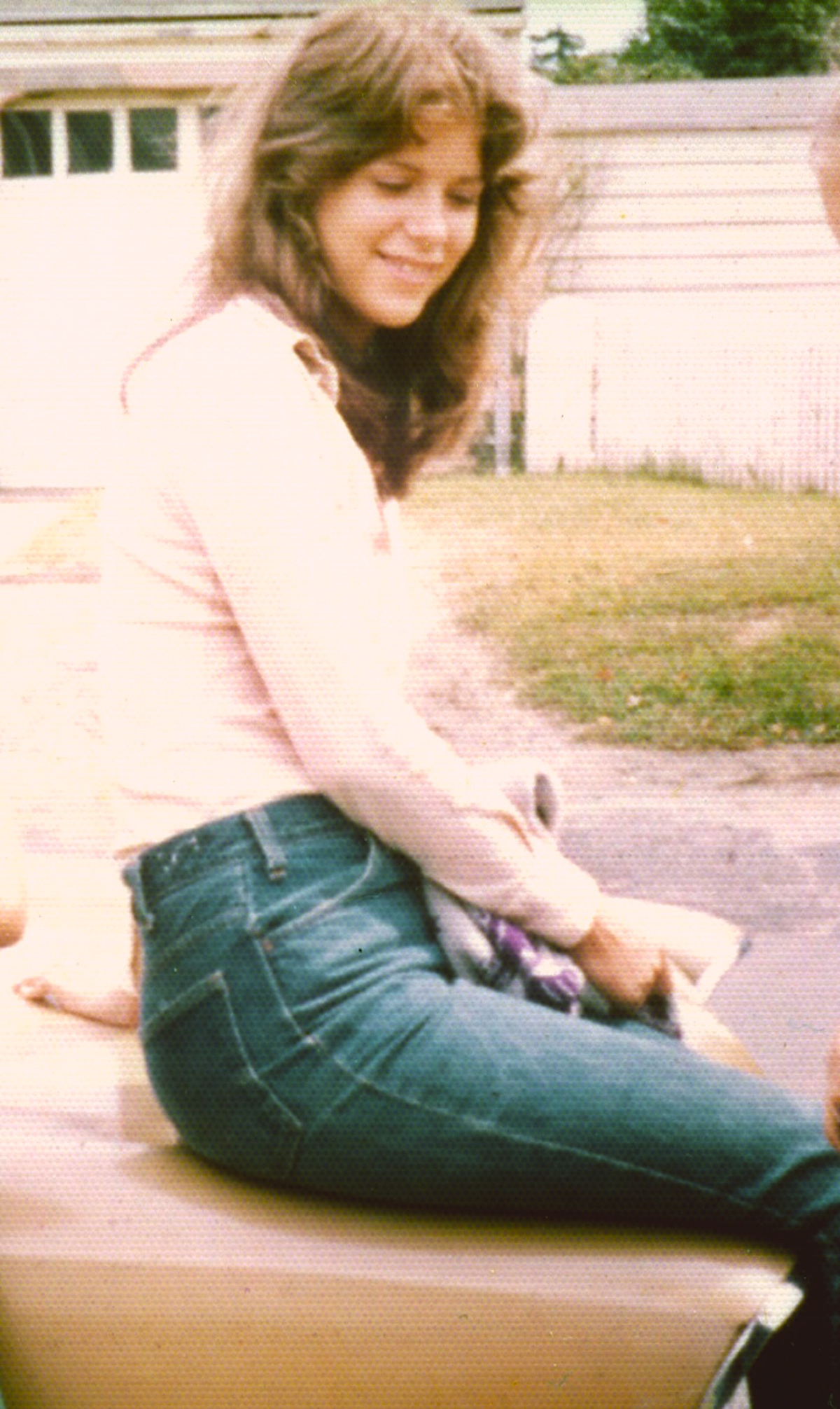
ann1975-76?

Does this young woman look logical to you?

I wandered far from the area mentally, emotionally, and physically; but then, I was always an outlier. One friend at the reunion told me that she considered me “a rebel,” a label that astonishes me. I thought of myself as a daydreamer and shy nonconformist, not as a rebel! Another friend thanked me for “always being the logical one” who kept her out of serious trouble. It surprises me to think of my teenage self as philosophical and logical. When one considers the challenges of being an adolescent girl in the USA, however, maybe I was more logical than most.

I find that difficult to believe, but I am willing to ponder it for awhile, adjusting my memories to what my long-ago friends recall and endeavoring a kind of synthesis between the two.

~

The story is inevitably partial, incomplete, possibly ambiguous. Has my thinking changed during the past 40 years? Have my values been challenged so deeply they have morphed significantly? Have I developed a different personality profile type? Are such radical changes even possible among human beings, despite the many transformation stories we read about and hear in our media and promote through our mythologies?

How would I evaluate such alterations even if they had occurred; and who else besides me could do a reasonable assessment of such intimate aspects of my personal, shall we say, consciousness? Friends who have not seen me in 40 years? A psychiatrist? My parents? A philosopher? It seems one would have to create one’s own personal mythology, which–no doubt–many of us do just to get by.

I have so many questions about the human experience. But now I am back in the classroom, visiting among the young for a semester…and who can tell where they will find themselves forty years from now? I hope they will make lives for themselves, and not give up.


9th as new

Last week, I tutored a student on a music appreciation paper in which she was asked to review a concert-going experience. Her family background is culturally rich–but not rich in terms of the Western cultural canon. She had heard the name Beethoven; but until this class, as a sophomore in college, she had never listened to his music. She attended a concert that featured a Liszt sonata, two brief Schubert pieces (Ständchen and one other), and Beethoven’s Symphony No. 9.

Because I cannot remember not knowing Beethoven’s music, I kind of envy this young woman’s revelations in the concert hall; what must it be like to hear Beethoven’s 9th symphony, for the first time, as a 19-year-old? I may not be familiar with all of the master’s works, but my parents had some of the symphonies on vinyl back in the 1960s. We listened to classical music on the radio and in church; even commercial television featured famous musical phrases. My sister and I liked dancing around the living room every weeknight to The Huntley-Brinkley Report’s closing theme (2nd movement Beethoven’s 9th).

portrait by Joseph Karl Stieler

portrait by Joseph Karl Stieler

~

Initially, she and I went over the structure of a review and how it resembles an analysis paper. She had used musical terminology reasonably well, and we had grammar and mechanics to work on. What she liked best, she said, was the part with the singers. She found the third movement “a bit boring. I kept wondering if this was the end.” But the fourth movement excited her: “It was really like a celebration or something, and you could see the expressions on the faces of the singers and the musicians, that they were so into it. Like, you kind of wanted to stand up for it, you know?”

Yes, I know–that’s how I have felt when I have heard the piece in concert.

~

Our discussion went on after our work on the paper’s mechanics had ended, though, because she asked me why courses like this one are required for college. Her major is early childhood education, and she says her parents asked her how a course on classical music has anything to do with teaching 4-year-olds.

It turns out I had more to say on that than I realized. Bless her heart, this student was eager to listen. [I have to admit that isn’t as common a response as one might wish.] Many of my friends, I said, are teachers or former teachers; they are among the smartest, most open-minded and curious people I know. They pay attention to contemporary culture and they read about history. They get allusions and references and make clever jokes and know all kinds of things and also, they admit what they do not know and are eager to learn about. They’d play Beethoven for kindergarteners and let them dance to the fast movements and ask them how it feels to hear the slower, sadder late quartets. They might have the children finger-paint to Beyoncé or twirl like leaves to Vivaldi’s “Autumn” or use round colored stickers to make their own “Starry Night” pictures or recite a poem that’s fun to say out loud. Culture is education.

And there’s more, I told her, that has to do with you as a person who understands the culture you are part of. You have to know about politics, especially local and state politics, because teachers need to understand how legislation and budgets can affect income and careers. You might feel uncomfortable in your job if you don’t get your colleagues’ allusions or feel you cannot participate equally in their conversations when the subject turns to culture, history, museums, music, art, policies and fiscal issues. It is fine to admit what you do not know or have not yet been exposed to–but it helps to know where you stand and to show you want to learn.

You’ll learn from your students, too. If you really want to be a good teacher, I said, you will never want to stop learning. Maybe you will reach a point where you don’t need to know a whole lot more about Beethoven, but you will want to explore other subjects. So when you take the required fine arts courses, the required literature courses, the courses in philosophy and math and all that other stuff, realize how all of it will get into your brain somehow, maybe touch a nerve here or there, and help you become a terrific teacher.

Besides, isn’t it beautiful? Even the boring parts…have you ever experienced anything like that before?

“No, honestly,” she said. “I wasn’t sure I was up for it, but it was worth it.”

Continuing the discussion

The semester is almost over, and my students and I have spent a few weeks doing writing that relates to Cass Sunstein’s book Why Societies Need Dissent. As it turns out, this semester coincides with considerable current-event attention on protest, conformity, stereotyping, and other issues Sunstein explores in that text. Social media pushes the herd mentality, the “troll” mentality, and the ease of using shortcuts in thinking: justification through bad analogies, irrational responses, barely-considered ideas, culturally-entrenched concepts, knee-jerk reactions.

In other words, the gamut of human social psychology in 140 characters or thereabouts, with links, memes, and dudgeon.

A case in point that appeared on social media last week is a photo of a black man holding a sign that reads, “No mother should have to fear for her son’s life every time he robs a store.”

That was a photoshopped “joke” in which someone altered the last line of the protester’s poster. The intent was to assert that Michael Brown had robbed a store before walking down the middle of a Ferguson street, and the intent was clearly meant to suggest that Brown deserved to be shot by police–or, at any rate, to suggest that he was not “innocent.” I agree with the poster even in its altered state because I propose that none of us are innocent, and that none of us deserves to be killed. A suspected robber should be tried by jury and should be considered innocent until proven guilty because that is the way US law reads.

I do not claim that “It’s that simple.” Indeed, the situation is far from simple, which is why it feels so fraught and inflames such exertions of logic, law, and character defamation, and so many conflicting opinions–not to mention Facebook “purges” and irate newspaper columns and public protests. These are reasons that discussion can be useful. We need to continue the discussion, even though it is awfully difficult to do so.

~

If only we could listen to other perspectives. If only we could engage in discussion. I listened to two of my male students talking about being stereotyped. One claimed he was seldom troubled by harassment and not really bothered when people tried to stereotype him. “You’re not black,” his friend responded, “You’re Latino, or whatever.” The first man held up his arm: “Hey, man, I’m darker than you. What makes you black and me not?”

“Neighborhood. Money.”

“Look at you, bro! You’re wearing $185 shoes and new jeans. Dollars to donuts your family has more money than mine.”

They continued in this fashion awhile, sometimes asking me what I thought. If it was history that made them different, couldn’t the black man put it behind him? And he didn’t even really know much about “his” history, it turns out. If it wasn’t skin color that made one man feel less sure of himself on the street, warier, even in a “good” neighborhood, to what could it be ascribed? Was it just a personal issue? A neurosis? Was the Latino man clueless, or oblivious? Or just lucky up to now? Are these issues of confidence, self-esteem, bravado, or fear? Social issues or private ones? All of the foregoing?

And how does all of this relate to how young people of any background, religion, or color comport themselves in the world, deal with society and its assumptions, codes, expectations?

~

I teach writing. My job consists in instructing students in the perhaps arcane code that clear, concise, informational, and persuasive writing requires if they are to succeed in writing for academia and, later, the world of business information. I tell them: “This is what you should expect others/authorities to expect of you. It’s your choice to follow the conventions or not to follow the conventions, but you need to at least know what the conventions are.”

Meanwhile, I hope they recognize that they should follow the conventions of the rule of law; and if they choose to oppose the law, they should do so with forethought and initially, at least, within the structure of the law. But bad laws do need to be changed, and bad protocols need to be changed, and unarmed people should not be killed for brooking authority; and stereotyping–a very natural and automatic human behavior though it is–should be consciously questioned, even though yes, that can make the discussion difficult.