Source material

Creative writers are often asked where they get their ideas from. In my own case, the answer to that varies a great deal. Sometimes ideas arise from personal experience, of course, but one’s life offers only so much material if you are a relatively staid person like me. Topics for poems can arise from recent headlines or from histories, written or oral; from conversations overheard in a grocery line; from stories other people tell me; from folk tales; from science books; from dreams; from works of art, and numerous other sources. It’s this wide array of possibilities that make the concept of the creative-writing prompt so popular. A quick Google search for “creative writing prompts” offered well over 20+ pages of entries, in several languages.

Photo by Pixabay on Pexels.com

I have written pieces based upon prompts, especially when in a workshop or class, or when I feel rather tapped out of my own imaginative source material. I’m especially fond of writing that stems from viewing or experiencing a work of art–sculpture, painting, musical composition, dance, installation art (ekphrastic poems). Generally speaking, though, that’s not from whence my poems originate.

I can’t really say why I feel an urge to put down in writing specific reflections about something that’s caught my attention–or even what sort of experience evokes my response. Maybe I feel intrigued by an image, a detail, or an ambiguity–a question arises in my mind that I tussle with for awhile. Then, I may compose a draft and let it sit. Two days. Two years. Longer. Lately I’ve been revising some old poems and have realized I no longer recall what their incipience was. Which can be a good thing, because I am no longer wedded to the “reason” I wrote them and can instead consider whether they can be crafted into decent poems.

I am also working on a manuscript that I let sit for at least six years. An idea got into my mind after reading Robert Burton’s 17th-century book on depression, The Anatomy of Melancholy, quite some time ago (2017, perhaps?). I took a stab at writing what seemed to be evolving into a historical fiction story, which is not my usual approach (I have zero practice at plot and dialogue). Then, I stopped. As one does. But the topic lodged in me somewhere, I suppose, and early this year I returned to it. What if, I wondered, the draft could be restructured into a series of prose poems? There might be a sort of hybrid novella-poem in the earlier draft.

That’s more or less what I’m developing, at least for now, and we’ll see what if anything emerges. It’s keeping me interested, which I like, and the experiment feels fresh compared with “writing what I know,” or writing “how” I know. Because yes, of course we ought to write what we know; but we also know about human beings, and we have imaginations, and anything is possible.

By Robert Burton – Burton’s Anatomy of Melancholy, 1628, in the British Library, Public Domain, https://commons.wikimedia.org/w/index.php?curid=84390857

Febru-dreary

I try not to hate on February. The days do get longer; there’s often some early blooming or greening, a little more birdsong in the mornings, days that aren’t too miserable for walking. But. A lingering malaise of the spirit often natters about in the background of my days. This year, I am trying an infusion of art.

I’ve enrolled in an art class–visual art–drawing, sketching, experimenting with different media such as gouache, watercolors, pastels, colored pencils. I just want something to do with my eyes and hands that isn’t reading, writing, photography, social media/texting. I think of it as an exploration. The workshop I took with Anita Skeen and Cindy Morgan Hunter in October made me realize that using other forms of art might feel good to me, body and soul. This year, starting now (February), I’m taking an 8-week art class with Helene Parnell of Blue Church Art. We shall see how that goes. I am not doing this to create a good “product” but to enjoy the less-intellectual, more freeing aspects of the art as process…the way I did with the collages and book-making in the New Mexico workshop.

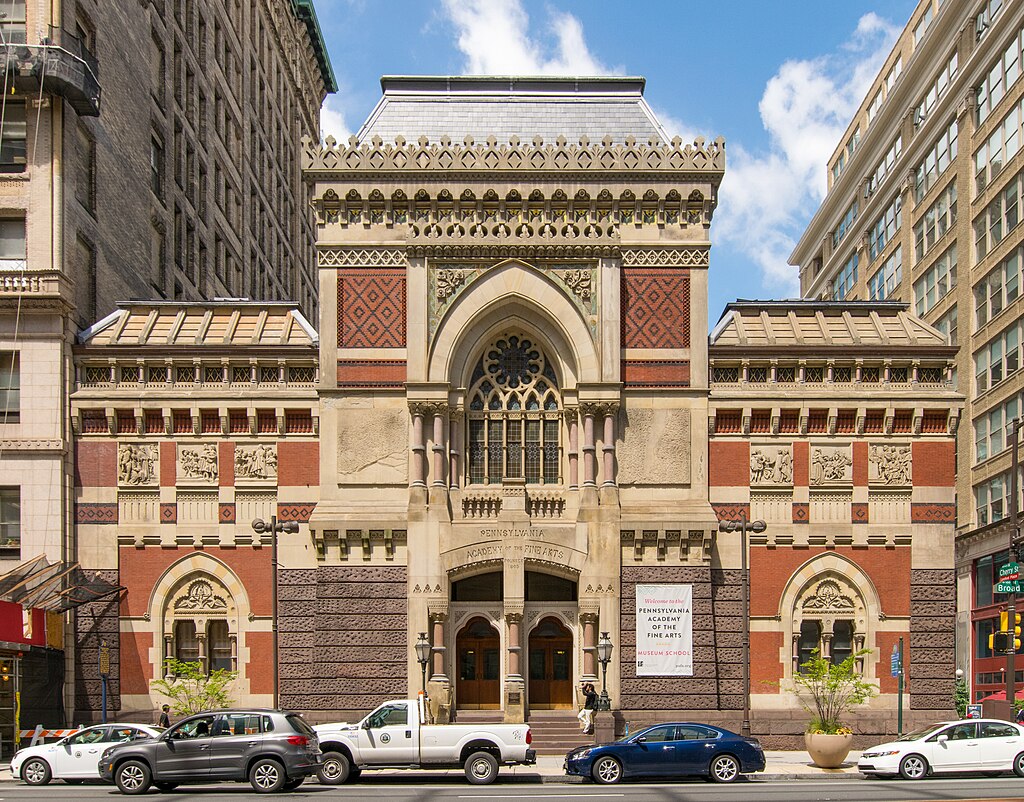
In that frame of mind, I accompanied my Best Beloved to Philadelphia to visit PAFA, Pennsylvania Academy of Fine Art. It’s something I have been meaning to do for, literally, decades–even though we are often in the city, somehow I haven’t gone back to PAFA which I recall from a visit (in my teens!) and kept meaning to see again.

Pennsylvania Academy of the Fine Arts

Here’s irony! The historic 1805 building I recall so well is closed for renovation until next year, and many of the paintings are “traveling,” i.e., on loan to other museums, through a show called “Making American Artists.” Most recently, to Albuquerque NM, though the exhibit closed there in September. The Academy, however, has employed the large, windowed, modern gallery spaces across the alley from the old building as temporary museum space and curated some fascinating exhibits for viewing and learning from. We enjoyed the Philadelphia-themed historical and cultural arts, crafts, and objects that came from the Atwater-Kent Museum. The mix of mostly-20th c. American paintings, prints, and sculptures in the upstairs galleries showed us how little we know about more contemporary US artists (outside of the super-famous ones like Hopper, Hockney, de Kooning etc). The plaster casts of famous European sculptures which students used–and still use–for drawing practice are now located in the lower level.

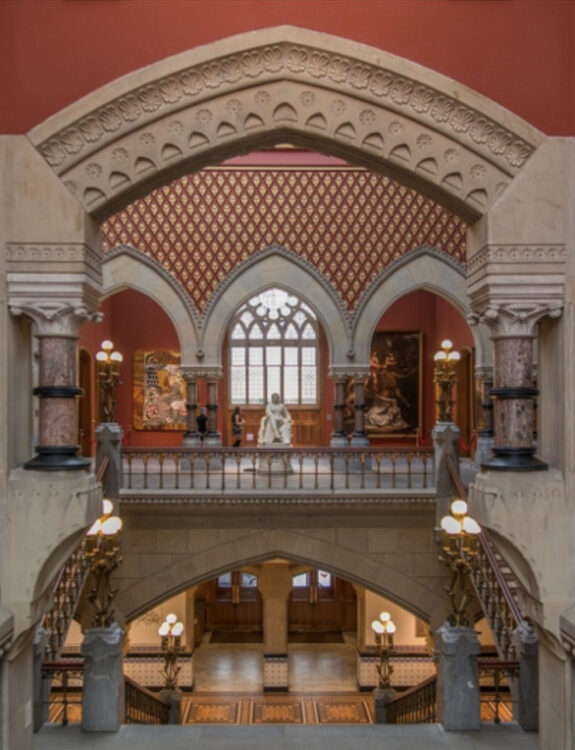
That brought back memories of when I was a teenager in love with art. I will have to go back once the renovations are done, because I remember the building as I visited it in the early 1970s, a strangely decorative place where students could be found sketching one of Michelangelo’s carvings or painstakingly drafting the composition of a painting by Winslow Homer. How I longed to be one of those art students!

PAFA interior, pre-renovations

That desire has been much altered by time, but my love of “the visual and plastic arts” stays with me. I enjoy writing ekphrastic poems; perhaps my foray into making artwork will energize me these last weeks of February and keep me going into spring.

Something like hope

Wintry weeks grind along like the noisy snowplows tearing through sheets of ice this morning. At least we are having a winter, unlike some years. I may not love winter–especially the short, grey days–yet I live in a region that needs it. Indeed, it is February (alas); but in a few weeks I’m liable to notice snowdrops emerging from the dirt. Anticipation stirs my heart. It feels something like hope, although hope is something I feel less inclined to believe in every year. I guess my problem with hope is that it feels like there is human agency invested in the concept, and as I age I recognize how little effect our wishes, hopes, and prayers have upon anything.

Photo from Feb. 9th of last year; as of now, no blossoms yet!

The snowdrops emerge all the same, until such time as they can no longer withstand changes in their environment. There is some comfort in that, for me.

~

Dave Bonta recently reposted (on his Substack and Bluesky accounts) a post by Guy LeCharles Gonzalez called “Why Keep Blogging in 2025?” It’s a lengthy piece (for a post) but brings up some worthy points. He closes with this paragraph, one that I find I heartily agree with–it is why I do what I do:

“Before they became walled gardens, social networks were great places for discovery, and although posts with links don’t get the visibility they used to on the bigger platforms, you shouldn’t be blogging or socializing for scale anyway. Defy Big Social and share those links to your own posts, and to posts you’ve enjoyed. Blogs only die when they’re abandoned by their owners.”

~

Not all of us need to be blogging for scale. That’s a capitalist, celebrity- and status-focused thing that sucks the love and beauty out of poetry, prose, and the arts. We shouldn’t be creating for Big Bucks or Pulitzers but because writing/art is what we love and what we do.

~

Speaking of art…here are three ekphrastic poems of mine, just published in Unleash Lit, which is an online journal that uses a Substack platform.

https://www.unleashlit.com/p/ekphrastic-poems-by-ann-e-michael

Verdancy

This report was posted almost a week ago, and the rainless weeks continue; today, fires are climbing their way along Pennsylvania’s forests beside the Delaware River, which looks almost as low as the Rio Grande in Albuquerque when I was there last month. Okay, I exaggerate a bit–but my alarm’s genuine. “No measurable precipitation” here, whereas Valencia, Spain gets a year’s rain in one day and western North Carolina receives 30 inches in two days. This stuff worries me even more than the upcoming election.

I’m not an alarmist, I’m a gardener. When do people start to admit to, and take action about, climate change? (Sorry, rhetorical question.)

~

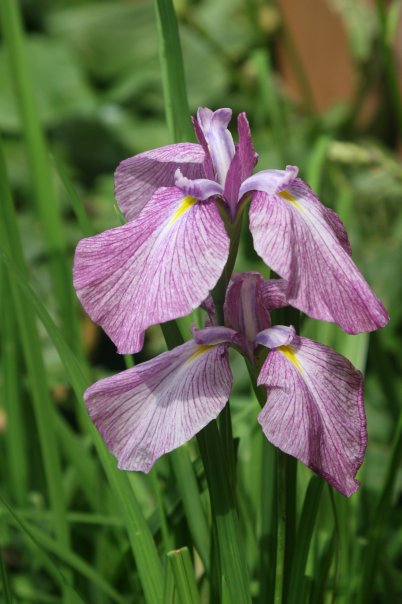
One theme of the writing workshop I took with Anita Skeen and Cindy Hunter Morgan, as I blogged about here, was color–color as prompt, color as image, color in ekphrastic work, color as inspiration. One prompt was to write about a color you can imagine hating, or a color that you love. It was autumn, and I was in the desert; so I decided to be difficult and write about loving green. Not typically considered an autumn or desert tone, though in fact the high deserts have more green, and in more shades thereof, than most people expect.

Here’s my draft. I used to hate showing unfinished work around, but now I don’t mind doing it. I find the practice of posting/sharing early drafts instructive (and it keeps me mighty humble).

~

Love Is Verdant

Listen, if I were to fall in love again,
it would be with a color: green.
So many variations and hues
ever-changing, surprising me with wilderness,
forest and pine, sage, olive, and moss,
the craziness of chartreuse,
glossy feathers of the teal.
Green as rushes in swamplands, bamboo
on mountains, diverse as rainforests
and summer tundra lichen, yellow-green
of maple leaves early in autumn,
the pitchy green of piñons high up the mesas.
Sure, there have been times I sought for
love that is constant, but now I know better,
for the only constant is change—and green
can accomplish that with as little as breeze
and sunlight, which are likewise things I love.

~

Photo by Pixabay on Pexels.com

Backstory, continued

What brought the idea of backstory to mind was a poem of mine that recently appeared in Peacock Journal’s  print anthology. The poem appeared last year in the journal’s online site. (See: “Imagined Painting of Mary Magdalene Bathing.”)

A friend read the piece and responded to the poem by saying, “This is a beautiful poem. It’s so visual–also, different the second time you read it. And I know how interested you’ve always been in saints and iconography and art, but where did you come up with the idea of imagined paintings? What’s that about?”

This is the best kind of question, as far as I’m concerned. It is a question about ideas, not inspiration or meaning or even craft–though I love questions about craft. It does beg the writer to reveal, however, a bit of the story-behind-the-story/poem/narrative, etc.

“Backstory” may seem self-explanatory. It’s a term used more frequently in drama, particularly screenwriting. Poetry critics are less inclined to employ the concept because–see last post–it is too easy to fall into explaining the poem, which is generally considered a no-no. My friend, however, is a reader and not a poetry critic. I felt free, therefore, to address the question on a personal level.

As my good friend knows, I have been intrigued since adolescence by the art and iconography, the symbolism and the stories of the saints, despite my Protestant upbringing. I love art, aesthetics, and the divinely natural (empirical, phenomenal) World and feel an ambiguous but compelling relationship with myth, religion, history and a culture I cannot escape. And I have imagination.

I began writing about a saints in less-than saintly pursuits. The idea interested me. Surely the saints could be imagined as real human beings, not only as intercessionaries between the human realm and Heaven. I wrote about St. Sebastian purchasing a tunic, Saint Agnes braiding her mother’s hair, and St. Anthony fetching a pail of water. Saints as human beings (rather than as symbols, icons, and religious items) led me to the depictions of saints in art as other-worldly, pure, suffering, or in all ways saintly; and I entertained thoughts of paintings I had never seen but would like to see–theoretically-possible paintings. In the case of St. Mary Magdalene bathing–would Da Vinci have painted it? Rubens? I can only imagine. The poems are a kind of ekphrasis.

I wanted to be a painter when I was a child. This imagining may be as close as I ever get to realizing my youthful ideals.

~

There is not much more backstory than that. None of it leads to meaning or interpretation, although the story above may cement some allusion or confirm referents in the reader’s mind. I hope, however, that the backstory here might interest one or two readers enough that they pick up a book on Renaissance or medieval art, on hagiography or history. Or perhaps someone will go to Amazon.com and purchase the anthology at the link above.

Thank you, friends in literature and imagination.


Autumn, time transfixed

IMG_0127

When we were initially landscaping our property, I chose to plant a particular species of zelkova known for its lovely fall foliage color. I cannot recall the variety now, although I am sure I recorded it in my garden journal 16 years ago. The leaf color is challenging to capture in a photograph. If only I were a painter, then I might manage. Of course, the color varies depending upon time of day, cloudiness, and atmospheric changes.

It is a lovely tree that announces the equinox quite articulately.

~

Equinox, autumnal: a slowing of crickets, the brief visits of migratory birds, quieter dawns, fewer bats at dusk, longer shadows. Time is far from transfixed.

~

I visited the Museum of Modern Art, New York City, on a warm October day to see the René Magritte exhibit. Magritte’s work is so easy to parody, so graphically amusing, that my brother–who was not all that familiar with the artist–at first said, “This reminds me of mediocre high school art.” After viewing the entire gallery, however, he had changed his mind about Magritte.

Magritte did a great deal of commercial art and, like Warhol years later, felt comfortable with the kind of graphic representation to which wide audiences respond. And then he played with that audience’s expectations, sometimes more effectively than others. One painting which certainly upends expectations and which I was glad to see again is La Durée poignardée, on loan from the Art Institute of Chicago; it was a favorite of my late friend David Dunn.

La Durée poignardée (1938)

time-transfixed-1938(1).jpg!BlogThis image of the painting appears at http://www.wikipaintings.org/en/rene-magritte#supersized-featured-211652

~

Here’s some playfulness concerning the title. The French word poignarder means to stab, and the implication is to stab with something pointed, ie, a dagger, since the verb is transitive. It interests me that the accepted English translation for this painting is “Time Transfixed.” The meaning I associate with transfixed in terms of, say, holding in one place (pointedly?) is that of pinning insects to a board as in lepidoptery displays. In this painting, the “stabbing” seems to be reversed: the pointy end emerges rather menacingly from the static, domesticated mantelpiece. If this image depicts the verso side of the display, it could be time itself that has been killed, spread open, and pinned, invisible from this aspect. Or perhaps the translation should be “Time Stabbed through Its Continual Duration,” stabbed with a poniard in the shape of something almost as ongoing, the contemporary barreling locomotive engine.

As it is a genuine surrealist painting, no particular meaning can be assumed. The images are random; make of them what you will. Magritte came up with wonderful, mysterious titles for his work–his paintings and their titles have inspired quite a few poets over the years. David Dunn was among them.

No wonder, really; this artist was quoted as saying, “The function of painting is to make poetry visible.”

~

Meanwhile, since I am not a painter, I will let the zelkova tree make poetry visible to me for a few days…and then get back to writing some myself.

“The Atlantic”

 Atlantic by John Sevcik

A few years back, I was privileged to join John Sevcik, his wife Lynne Campbell–who is also a marvelous painter–and a few art students and friends for three lovely days of art talk and plein air painting sessions and terrific food at a beach house in NJ. This painting, by John Sevcik, inspired the following poem, which appears in Water-Rites.

The Atlantic

She and her mother
are knee-deep in water
their backs to the shore

What they discuss
as they look eastward
you cannot hear–

breakers, the wind,
the natter of laughing gulls
cover their conversation

Besides, you are busy
fathoming the sea’s tones
and mixing the sky–

Trying to stake claim
to the reflective shallows
between you and them

At this hour
they are your subjects
as the sea is

and what they say
she will share with you
later. Or she won’t.

It doesn’t matter, you
have set down on canvas
their communion

And your own conversation–
the one between mind’s eye
and artist’s hand.

~~~

Many thanks to John Sevcik for allowing me to post his painting here on my blog. To see John’s other works and find out about gallery showings, visit him at his web page. He is also a teacher, poet, playwright and actor.

Haiku impressions

The reading Friday at Blind Willow Bookshop, a lovely used bookstore specializing in literature and unusual or rare books, combined the voices and perspectives of three poets who are exploring Japanese poetic forms.

Here’s a summation of my own remarks, though Marilyn Hazelton and Ann Burke had much to share. I’m not including the poems we read, either–Ann Burke’s haiga-like tanka poems coupled with art work or photos were lovely, though, and I wish I had files to post. Marilyn included work from the tanka journal she edits, red lights.

~

I learned about the haiku form long ago, but I can’t remember exactly when. I think it may have been during my junior high school years, though I certainly didn’t learn it in school—there was no poetry taught at my schools. I was exposed to poetry through other means: church, nursery rhymes, my own reading, relatives, song lyrics.

Initially I learned the syllabic approach, 5-7-5 syllables in English. That is the way the form was taught in the USA the 1970s. And it was clear to me early on that haiku is visual or physically-based; the imagery is sensual and real—in other words, what is in the world is in haiku, and vice versa. So it is not imaginative in the sense of fiction or dream. It engages the imagination in other ways, which means the poet has to corral quite a bit of compressed and specific imagination into a few words. The intense compression of these brief forms requires the poet to work hard at expression through the tightest possible means in language without employing what we in the Western traditions term symbolism. Classic Chinese poems often used symbolism, but Japanese poems relied more on allusions of several types (historical, poetic, seasonal). We tend to term these “symbols” (ie, cherry blossom equals spring romance) but that is not actually an accurate way to define the way concrete imagery is used in Japanese poems.

Later, after more study, I learned some details and contexts for the seasonal allusion, the references to previous poets or poems, the cutting word, the reasons haiku in English may need to be briefer than 17 syllables for maximum effect; and I found out about related forms of Japanese poetry such as haibun, renga, tanka. I met Marilyn Hazelton and learned through her, as she studied and taught the forms, in English, to other aspiring writers. Japanese poetry forms may seem to follow arbitrary rules, but that is no more true than asserting that western sonnet forms follow arbitrary rules.

My study of this poetry brought me a better understanding of the Imagist poets of the early 20th century in the sense of how they were influenced by, and how they misinterpreted, the haiku poem, crafting in the process some critically important poems for western readers. Poetry is a marvelously flexible art, elastic and willing to morph as its authors are willing to experiment. I think of much of my work as based in a ‘haiku moment’ for inspiration or image.

I will be the first to assert that haiku is not my métier, nor is tanka form. My poetry—and I’ve written a great deal of it—is generally more Western in style and tone, no surprise given my cultural and educational background. Yet haiku appealed to me immediately because, I think, of my interest in visual art and in the natural world.

~

My attraction to haiku is therefore image-based. My interest in Japanese poetry also increased after I studied Zen. The two are inter-related, also no surprise. In my notebooks, and on random pieces of paper I use to jot down ideas for poems, nine times out of ten the phrases I want to capture are physical images. Later, I may try to craft these jottings into a haiku. More often, they get employed as lines in other types of poems.

Sometimes, a poem I attempt to write as haiku becomes a tanka…or a longer poem in some other form (free verse, blank verse, etc.); in any case, the sensual first impression is usually what I first observe and note. My own interest in nature and my physical environment make haiku-type poetry sort of an inclination. So the inspirations and influences for me include Zen, visual art, physical or concrete imagery, nature and season, brief observation, compressed or concise language use, and a quality of universality in the poem.

~

For writers who have done Westerners the service of exploring, interpreting, and explicating haiku and the Zen practice that leads to the haiku moment, I suggest Jane Hirshfield, Robert Aitken, William Higginson, Penny Harter, Hasegawa Kai, Earl Miner, Richard Wright, Gary Snyder.