Febru-dreary

I try not to hate on February. The days do get longer; there’s often some early blooming or greening, a little more birdsong in the mornings, days that aren’t too miserable for walking. But. A lingering malaise of the spirit often natters about in the background of my days. This year, I am trying an infusion of art.

I’ve enrolled in an art class–visual art–drawing, sketching, experimenting with different media such as gouache, watercolors, pastels, colored pencils. I just want something to do with my eyes and hands that isn’t reading, writing, photography, social media/texting. I think of it as an exploration. The workshop I took with Anita Skeen and Cindy Morgan Hunter in October made me realize that using other forms of art might feel good to me, body and soul. This year, starting now (February), I’m taking an 8-week art class with Helene Parnell of Blue Church Art. We shall see how that goes. I am not doing this to create a good “product” but to enjoy the less-intellectual, more freeing aspects of the art as process…the way I did with the collages and book-making in the New Mexico workshop.

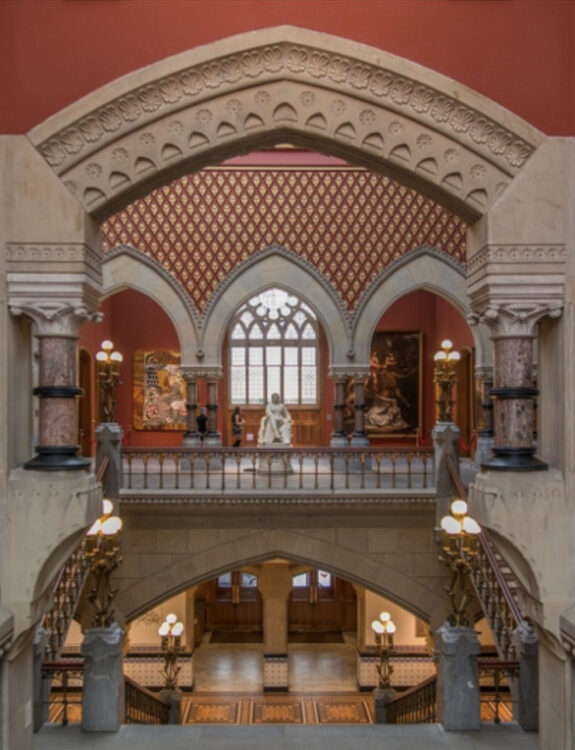
In that frame of mind, I accompanied my Best Beloved to Philadelphia to visit PAFA, Pennsylvania Academy of Fine Art. It’s something I have been meaning to do for, literally, decades–even though we are often in the city, somehow I haven’t gone back to PAFA which I recall from a visit (in my teens!) and kept meaning to see again.

Pennsylvania Academy of the Fine Arts

Here’s irony! The historic 1805 building I recall so well is closed for renovation until next year, and many of the paintings are “traveling,” i.e., on loan to other museums, through a show called “Making American Artists.” Most recently, to Albuquerque NM, though the exhibit closed there in September. The Academy, however, has employed the large, windowed, modern gallery spaces across the alley from the old building as temporary museum space and curated some fascinating exhibits for viewing and learning from. We enjoyed the Philadelphia-themed historical and cultural arts, crafts, and objects that came from the Atwater-Kent Museum. The mix of mostly-20th c. American paintings, prints, and sculptures in the upstairs galleries showed us how little we know about more contemporary US artists (outside of the super-famous ones like Hopper, Hockney, de Kooning etc). The plaster casts of famous European sculptures which students used–and still use–for drawing practice are now located in the lower level.

That brought back memories of when I was a teenager in love with art. I will have to go back once the renovations are done, because I remember the building as I visited it in the early 1970s, a strangely decorative place where students could be found sketching one of Michelangelo’s carvings or painstakingly drafting the composition of a painting by Winslow Homer. How I longed to be one of those art students!

PAFA interior, pre-renovations

That desire has been much altered by time, but my love of “the visual and plastic arts” stays with me. I enjoy writing ekphrastic poems; perhaps my foray into making artwork will energize me these last weeks of February and keep me going into spring.

Wet lion weather

Early March, but February’s doldrums appear to be hanging on with clouds and heavy rain in our weather (though it has been fairly mild) and my mood as well. If March comes in like a lion, it is this year a very damp panthera leo. Crocuses, yes; iris reticulata, yes; winter jasmine, yes; hellbore, yes. And the robins are chirping like mad every evening as dusk arrives–and it does arrive later each day.

I should feel merrier. There are some poetry-related things coming up this month, an informal reading at our friends’ house, a bit of recognition perhaps, a visit from a beloved before the month closes, and maybe even the new book. In addition, I have managed to collect and organize the first draft of yet another collection. (Don’t hold your breath–this one will be a long time coming.) My physiology has been annoyed by the rain and humidity, however, which keeps me out of the perennial beds where the winter weeds are having a party in the chilly mud. There’ll be hell to pay for this later if I can’t get out there pretty soon. But it would not be the first time–which is why I know there will be hell to pay!

I did take advantage of the many rainy, achy days by reading an amazing novel by (Nobel Prize winner) Olga Tokarczuk, The Books of Jacob. Dare I call something a masterwork? This marvelous historical novel is over 900 pages long, beautifully rendered in English by Jennifer Croft, and based upon 18th-c Polish history and the idiosyncratic Frankist religious movement. I’ve been thinking about it for days–reflecting on words, names, letters, philosophy, and even metaphysics. Several times I found myself setting the book down in admiration, wondering how on earth Tokarczuk manages to keep the thread of her numerous narratives together so beautifully.

When a book gives me that kind of joy and evokes so much wonder, I feel that being a writer might actually be a worthwhile occupation. And if the rain keeps up, I’ll be at the library looking for her other books soon.

Waiting

Trying new things, slowly. I made a profile on Chill Subs, even though I am about to take an extended break from submitting poems to journals. The task I have recently set for myself is to curate (?) collect (?) another set of my poems to make into a new manuscript. Generally, I start with a selection of about 100 poems and winnow, revise, and substitute from that initial batch. It takes time. Eventually, though, I will get around to exploring the Chill Subs platform to see whether it makes sending out poems any easier. My guess is that it won’t help all that much, since my real problem with submitting work is a lack of motivation and uncertainty about whether a poem suits the editorial tastes of the journal–or whether the poem is even a good poem. I have trouble judging my own poems, though I feel I am fairly adept at critiquing the work other people compose. It’s that log in my own eye, perhaps (Matthew 7:3-5).

The days are lengthening, but February remains a long month, typically a time of year I feel achy and low in mood even as the woodpeckers “laugh” their noisy calls high up in the trees and sun shines brightly on the not-melting-much snow. But the snow feels right; last year we had an “open” winter, and that lack of natural snow-mulch takes a toll on the kinds of plants and animals that reside here. In another week or two, the urge to put a few seeds in seed trays will likely take hold of me. For now, however, the seeds stay nestled in their unopened packets under the desk in my kitchen.

Waiting.

This superbly handsome pileated woodpecker photo was taken by my friend Fred Zahradnik at nearby Hawk Mountain Sanctuary.

Apology

Speaking of February, here’s a poem trying to make amends for my dislike of the briefest month. This apology appeared in Prairie Wolf Press Review*, and I may include it in my next collection (whenever that may be).

~

Apology

For years I have held February
answerable to many sorrows
as though the month itself
were responsible for its appearance:
the dour days too short, long nights
steeped in frosty bitterness.
Resigned to hibernation,
February made me sleepy.
Dulled my skin, sucked dream
into a cold vacuum
like a vacant acre of outer space,
a stone of ice upon my chest.

But today, I watch a small herd
of yearling deer file gingerly along
the hedgerow over crusted snow
and sense thaw within.
The days, brief, are nonetheless
beginning their shadowy
stretch into spring. It is the month
owls urge themselves
toward mating, their querying calls
strung along night’s bare branches;
the month buzzards return
from foraging the more southerly dead.

Skunks break dormancy amid
tussocks of snowdrops;
sometimes, the hellebore blooms.
I have been observing February
from all the wrong angles.
No, this is not the wild greening of April
nor the fragrant abundance of June,
but it is something that deserves better
than repudiation or scorn.
To February, which has given me much
besides unhappiness, I offer my apology.

~

~~~

*Prairie Wolf Press seems to have folded, alas.


29 days


I am trying really hard to learn to like February.

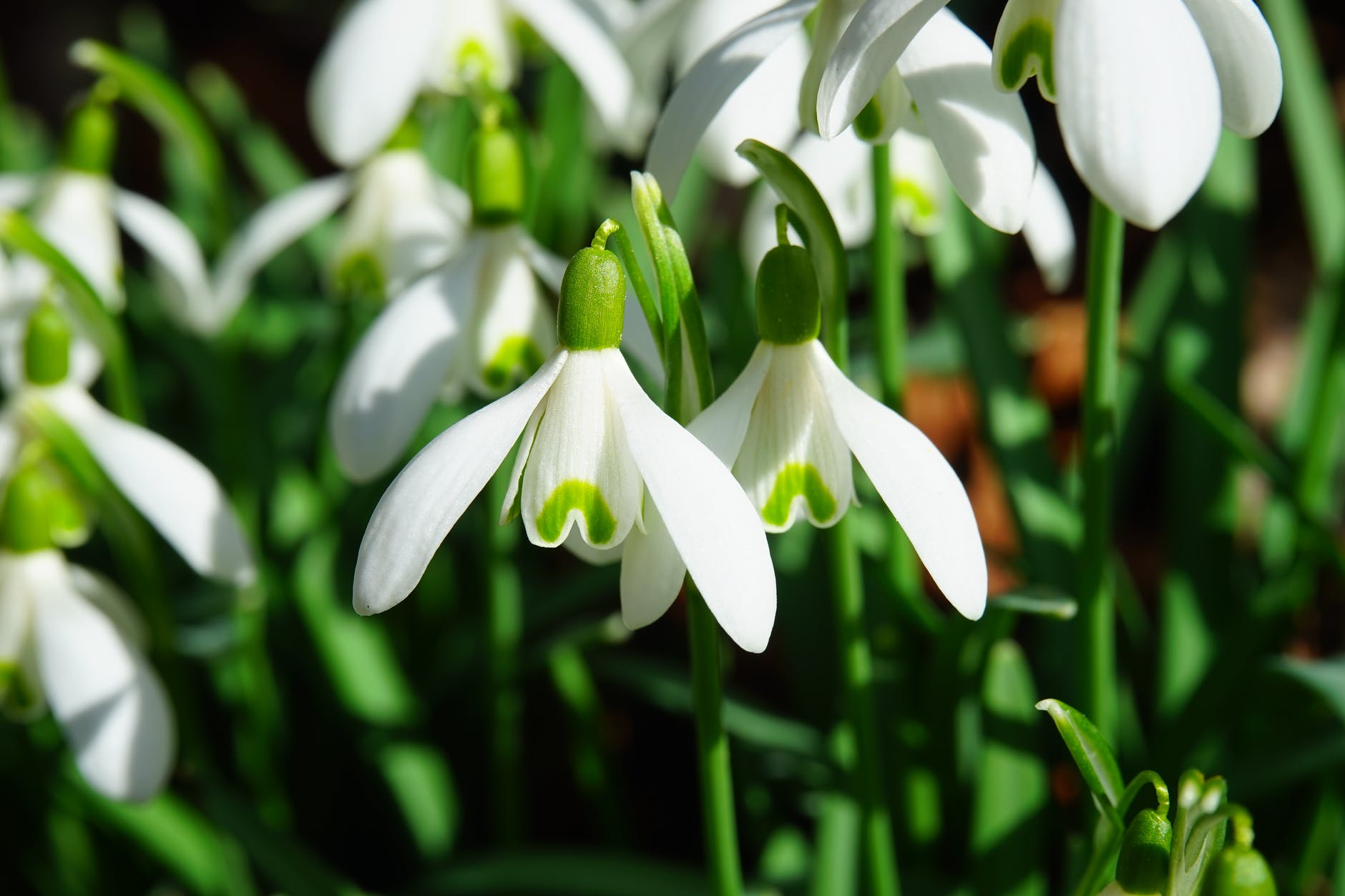
I already yearn for these blooms, which often open this month:

flowers plant spring macro

snowdrops photo by Pixabay on Pexels.com

52005884_10218951450921552_3046548602315866112_o


Indeed, the snowdrops are emerging slightly; I see hints of white amid the tufts of deep-green leaves. The winterhazel buds haven’t really swelled just yet, though. Some years, we have hellebore and dwarf irises in February–it isn’t entirely drab, grey, chilly, and wet for 29 days. Reminding myself of that helps a little. Why, we had one warm and sunny day earlier in the week! The flies and stinkbugs buzzed about drowsily, and the birds made a little more noise than usual.

But part of me says–oh, wait a bit. There could be plenty of snow in March.

53639405_10219093314068042_488479219123224576_o

March, 2018

How to allay the anticipation-stress that sits heavily on me, body and soul, this month?

J. P. Seaton’s translation of Han Shan (I own a copy of this book):

There is a man who makes a meal of rosy clouds:
where he dwells the crowds don’t ramble.
Any season is just fine with him,
the summer just like the fall.
In a dark ravine a tiny rill drips, keeping time,
and up in the pines the wind’s always sighing.
Sit there in meditation, half a day,
a hundred autumns’ grief will drop away.

~

I am not much for sitting in meditation, but Han Shan suggests it might do me some good–so that the griefs fall away, so that any season is “just fine” with me.

Worth a try…

       –anyway, it’s a short month.

On revision (again)

iceimageI am going to go out on  a limb here and make a blanket statement: Revision should be every writer’s middle name.

I tell this to my Comp-Rhet introduction to academic writing students all the time, but they have difficulty figuring out how to revise effectively. There are good tactics out there, but they do not work for everyone; how a person thinks and learns and processes information varies considerably. Lately, I have been using a strategy I teach to students writing essays to revise my poems. I ask myself: how is this poem organized? Is the structure working with or against the poem? Too predictable, or not predictable enough?

Just as in a well-wrought prose piece, a poem’s obvious and underlying structures matter a great deal in how well it “works” for a reader. It’s also an aspect of writing that people tend to overlook, so analysis of structure in the revision stage can be useful.

Another revision strategy I have been mulling over recently coincides closely with what Grant Clauser describes in this post, The Poem Is the Question. He writes:

I’ll scrounge around in the poem to try to find what it’s asking. If I figure out the question or the motivation in the poem, then I’m better equipped to solve its problems… Sometimes it helps to actually put a question in the poem–either as a crutch that you’ll eventually remove–or as a permanent part of the poem. A question is a pretty interesting part of speech in that it’s one of the few that almost always demands a response from the reader.

I have found myself going back to a draft and asking, “What got me going on this poem? Do I even recall? Is the impetus an interesting one? If not, can I change it?” Clauser suggests a more specific kind of investigation, and it’s one I have been employing today (snow and ice out there and the roads are lousy, so the campus is closed–hooray for a half day of unexpected free time).

Lesley Wheeler has also recently blogged about revising. She observes that the word revision, which places “emphasis on ‘looking anew’ doesn’t entirely capture” the process of late-project revision. She’s listening to her own words aloud as she revises…another approach that has worked for me.

Maybe the month of February calls to us as a quiet time of yin creativity, which is a way of looking at revision as an inwardly-focused energy–as opposed to marvelous bursts of creativity from inspiration or the much-vaunted Muse. The lunisolar calendar used for centuries in Asia calls February the first month of spring (立春  lìchūn)! I had better keep at the revising, therefore. Before I know it, yan energy will return with the start of the gardening season in eastern Pennsylvania.


Exhaustion & bloom

Isak Dinesen: “I write a little every day, without hope and without despair.”

~

Some days, the little is…quite little. I am not exactly taking a break from reading and writing, but a great deal of my reading these days is student-written work; and the writing tends to be corrective.

There are also events in one’s life that tend to push back against the time needed to dwell on creative things.

Kurt Vonnegut: “So it goes.”

~

I’m re-reading Descartes. The best part of his philosophical writing, in my opinion, deals with his conscious desire to remove all prejudicial thinking from his mind. I have my doubts as to his success in that regard, but I love the splendidness of trying to attain the mental tabula rasa. Open-mindedness, a virtue more human beings should strive to embrace.

~

And there is also exhaustion, pure and simple. Some days, I need my rest.

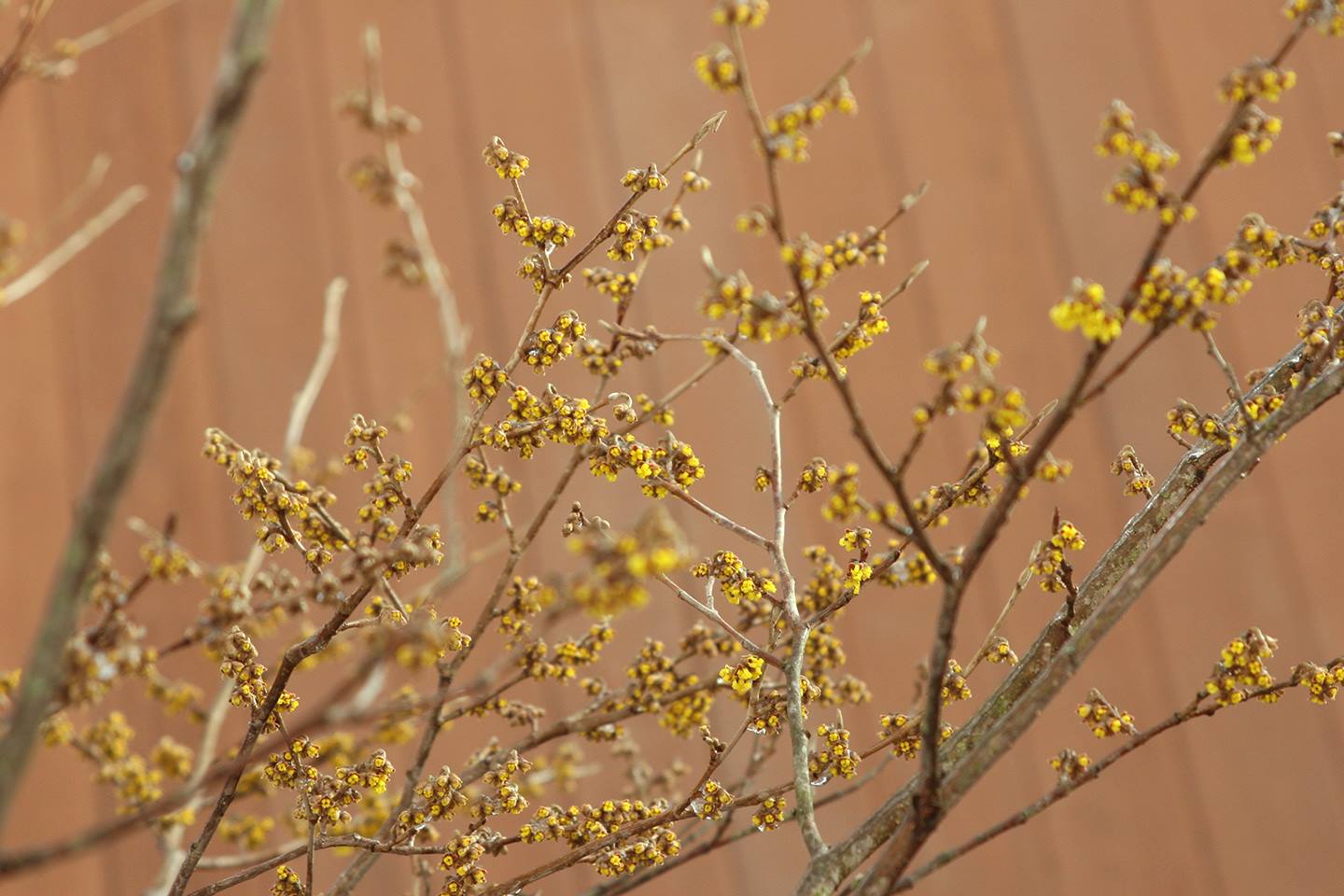
February: awaiting the snowdrops’ blooms. (They’re nearing…the white tips are visible, enclosed in the deep green spathes.) Meanwhile, fragrant yellow winterhazel.

corylopsis

winter hazel