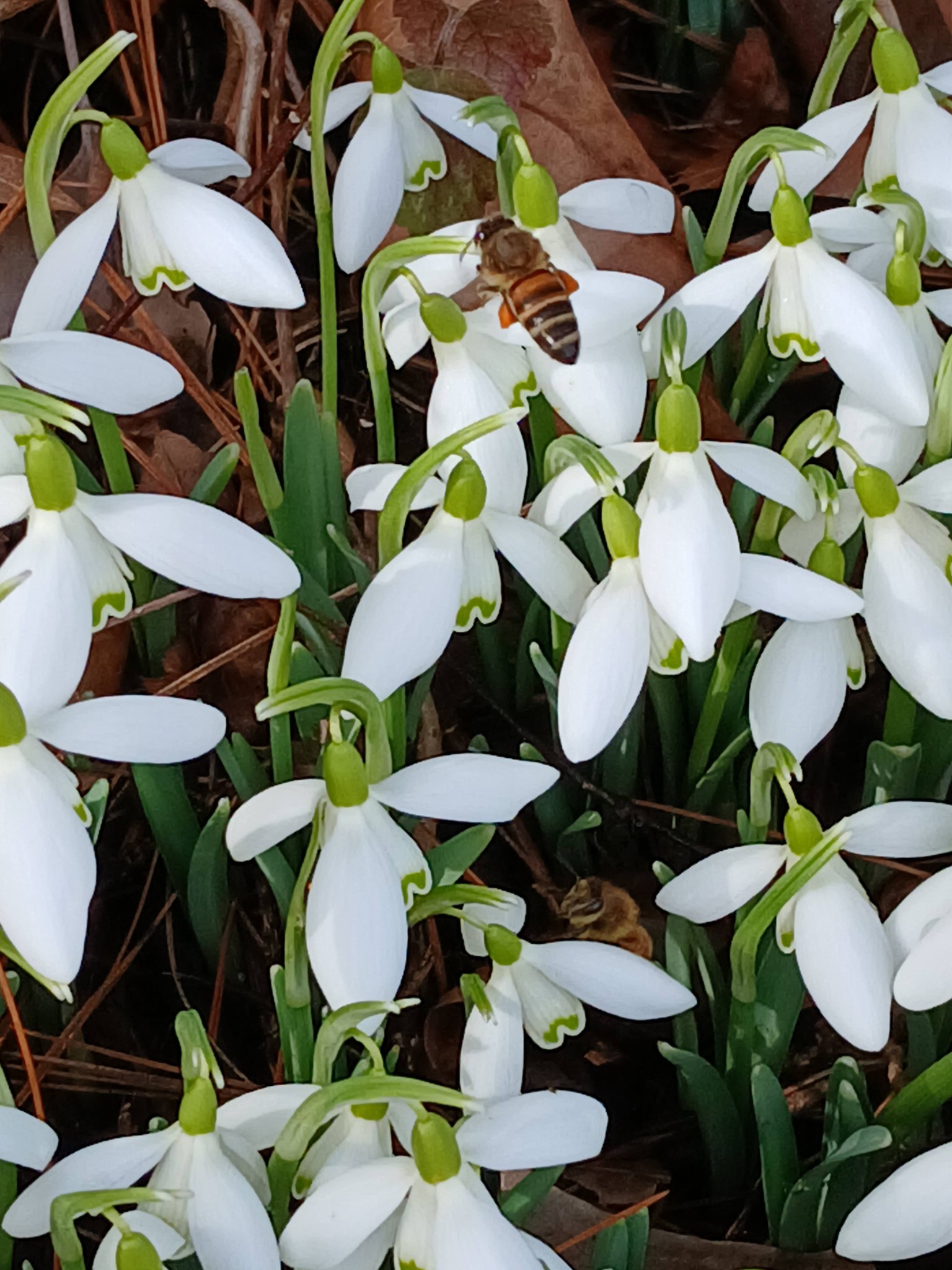
While I was traveling the high-altitude desert regions, my home valley got its much-needed rain. And the rain continues. And continues. My plan was to get to work on my gardens as soon as I came back, to weed and plant out seedlings. Well, it’s a bit too wet for that. Also chilly and humid and sea-level, and therefore my physical adjustment has been a bit …bumpy. So, Plan B.
The Plan B default for me usually entails spending “down time” reading, writing, or housekeeping, though visiting the library and meeting friends for coffee fall under Plan B, too. Today, since I feel lousy and have a spate of brain fog, reading has been the choice. I still have a few books on the bedside pile that I haven’t gotten to–mostly poetry collections I bought at AWP at the end of March. But also there is Ocean Vuong‘s heartbreaking and beautiful novel-that-reads-like-memoir, On Earth We’re Briefly Gorgeous, that I finally got around to reading, and a back issue of Rattle Poetry a friend gave me–one that was largely devoted to haiku and related forms–that featured a fascinating interview with Richard Gilbert (thank you, Lesley S!). On the poetry-only book list, I read January Gill O’Neil’s Glitter Road, Julie Kane’s Naked Ladies, and Ross Gay’s first collection, Against Which. All quite useful to me in times when I feel bleak and physically frail–there’s humor, sorrow, and bravery in all of these writers’ poems. Though I’m too foggy-headed to write mini-reviews at the moment, I encourage my readers to check these poets out.
Perhaps my next post will be about the lovely time my friend and I had in northern New Mexico, visiting my daughter and Santa Fe, including my opportunity to see Bandelier National Monument again and ponder its environments and history. A trip like that takes some time for me to “digest.” But it was wondrous. And so is a day at home to recuperate in my favorite way: reading.
Recently, a physician I see (for fibromyalgia and related conditions) suggested that I need to walk more often because “walking is the best exercise for you and will give you more energy in the long run.” The advice surprised me a little; I love to walk and, except when the weather is very cold or super wet, I walk most days. It turns out that what she meant is that I should be walking for 40 minutes or so “at a brisk pace.” When I asked her to define what she considered a brisk pace, she said two or three miles an hour.
This poses a slight problem for me because while I am happy to walk around my yard, woods, and neighborhood for 30-40 minutes almost daily, I can’t say I do it at a brisk pace. I get distracted and stop to look at things. Bugs. Worms. Toads. Birds. Flowers. New leaves. Nests. Spiderwebs…I loaf along, as Whitman claimed to do. Some days I start out with good intentions to keep up a lively pace, maybe even to the point where I can feel my heart rate going up. And then–was that a redtail hawk overhead? Did I hear an ovenbird? Oooh, the Solomon’s-seal is in bloom!
Today–the walk was very wet, as we’ve just had about 3″ of rain–musing on my not-exactly-exercise ambulations, I thought of this Mary Oliver poem.
Walking to Oak-Head Pond and Thinking of the Ponds I Will Visit in the Next Days and Weeks
by Mary Oliver
What is so utterly invisible as tomorrow? Not love, not the wind, not the inside of a stone. Not anything. And yet, how often I’m fooled– I’m wading along in the sunlight– and I’m sure I can see the fields and the ponds shining days ahead– I can see the light spilling like a shower of meteors into next week’s trees, and I plan to be there soon– and, so far, I am just that lucky, my legs splashing over the edge of darkness, my heart on fire. I don’t know where such certainty comes from– the brave flesh or the theater of the mind– but if I had to guess I would say that only what the soul is supposed to be could send us forth with such cheer as even the leaf must wear as it unfurls its fragrant body, and shines against the hard possibility of stoppage– which, day after day, before such brisk, corpuscular belief, shudders, and gives way.
~
At my place, it’s feeder creeks I hear and think I may visit, not ponds, but I identify with the mood of this poem. Walks offer me that joy, that unfurling of leaves, ferns, everything…time to reflect and feel gratitude. If I don’t do quite as well by my heart and muscles as I ought to, maybe my psyche or soul will compensate. If I loaf, it’s a purposeful, sweet loafing, the kind of activity that poets tend to do; it gives me energy of a non-physical sort. (And I think Mr. Whitman would concur.)
Walt Whitman in mid-life, probably a bit younger than I am now.
This year, my holiday plans are less busy than usual. I don’t have to cook a large meal, wrap a lot of gifts, travel much (or far), or attend a bunch of parties or festivities. There is a quiet joy in this low-key schedule, though it means the season possesses a slightly different character. I thought that the lack of holiday stress would mean I had more time to write, revise, maybe even to submit work to literary journals. The rain and chilly humidity have enervated me more than I expected, though, and some days even an hour of serious concentration seems to wipe me out.
I believe this weird exhaustion for no apparent reason is a kind of post-exertion malaise.
Post-exertion malaise (PEM) is not uncommon among people with chronic conditions such as chronic fatigue syndrome, Epstein-Barr, long covid, fibromyalgia and the like. Its key features are that the fatigue seems far out of proportion to the exercise or other exertion that preceded it, and that it is delayed–the exhaustion may set in two hours or even two days after the experience. I have had PEM, for example, after spending a lovely and high-energy day of hiking or wandering for hours around a city or museum and suddenly, without warning, “crashing” into bone weariness two hours later, or a day later (I have fibromyalgia). I’ve learned to manage the physical aspects of PEM, however. It does not happen all the time, and often I can plan for it.
Post-exertion malaise: it sounds like the title of a contemporary novel.
I’ve read studies that speculate PEM results from a sort of communications snafu among the many complex body systems: nerves, synapses, gut microbes, spine, brain, and probably processes science has yet to discover. What I wasn’t aware of until recently is that PEM can appear after mental or social “exertions” as well. Mental exertion such as submitting to journals; social exertion such as attending poetry readings, parties, family gatherings. It explains why I had to lie down for a nap at 5 pm every day the last few years I was working full-time, even though my job was a desk job. And why shopping has become such a tiring task for me.
Shopping, when you think about it, involves: 1) being in a public or social space; 2) attention to details; 3) frequent decision-making; 4) stress about finances, parking, and whether said decisions were the right ones; 5) unexpected stuff like long lines, a credit card that refuses to work, bad weather, and not finding what you were shopping for. Even if you shop online, some of these processes are involved. Yes, our brains are bombarded; and our brains are designed to filter and make efficient work of the bombarding, but perhaps that’s part of what goes awry with long covid and chronic fatigue. The filter may clog, so to speak. Brain fog and fatigue.
Similar micro-decisions go on when I send out poems to journals. Should this poem be sent to that publication? Do I like the other poems in this magazine, the editorial bent? Is this poem finished, and is it any good? Do they require a fee? Do I want to pay the fee? Are they okay with simultaneous submissions? Do they use Submittable, email, or some other method? Such analysis goes on constantly, as well as lots of even smaller decisions. I have to read the submissions guidelines carefully and, sometimes, re-format my work to suit. And then there’s the cover letter if required, and the bio–though I have a “boilerplate bio,” often it seems wrong for the journal; if they’ve asked for a personal touch or want me to stress place or background, I have to tweak the bio…and on and on. The task was never my favorite, but it didn’t exhaust me.
Because my PEM is intermittent, often I can send out a good deal of work in one sitting with no fallout, just as sometimes I can hike or walk for hours without pain or fatigue. I had almost no trouble when I was in Spain earlier this year. But this week in drizzly-snowy eastern Pennsylvania, I’m having to take too many rests after doing what seems like almost no real work. Frankly, it’s disheartening. So I’ve decided not to expect to get much done during the next two weeks and to appreciate the time I can spend reading a novel, decorating the tree, sitting by the fire, talking to loved ones by phone. No need to be disheartened.