Adventuring

The weather here has been hot and somewhat humid, though it continues to be dry–much drier than autumns used to be. Drought extending past August into October is becoming a more usual thing, according to my garden journal. One plant that thrives this time of year is tithonia (Mexican sunflower), and it attracts monarch butterflies like crazy. These are the monarchs that go adventuring: the super-generation of these insects that makes the 3,000-mile trip to Mexico. Here’s a brief blog from the Xerxes Society that has some quick facts. The monarchs I see in my garden may, if they are lucky enough to survive the trip, live up to 9 months, which is well past the life span of spring and early summer generations.

They are not even returning to a place they know or have ever been. Human science has never yet determined how monarch butterflies of the last summer generation find their way to Mexico. They just go adventuring, floating on air currents, supping on flowers as they travel.

I’m about to go adventuring, as well, traveling further east than I’ve ever been, in the company of one of my favorite persons in the world–my daughter. She and I had long talked about taking a mother-daughter trip together once I retired, and sooner is better than later! She found an environmentally-conscious adventure tour business that offers some really intriguing historical/archeological/environmental hike-and-bus options. We’ll find out whether the company is worth recommending & I’ll report back here, meanwhile keeping our destination unrevealed for now. A little mystery is fun.

While I am taking this trip for reasons beyond writing inspiration, I can’t help hoping it will act as a prompt and opportunity for drafting new poems. I’ve been working on new drafts, and revising older ones; but I have to admit that for awhile my creative mojo has been a bit off. Yes, this happens to any so-called “creative” occasionally, but it never feels terrific. One prefers the juicy, challenging urgency of creative flow. Wish me luck (and traveling mercies).
Mid-March

Tulip poplars begin to plump out their winter bud scales, where they will leaf out later in spring.

A marsh hawk zips overhead, winging above the treeline and vanishing over the northern hill.

Early ornamentals bloom: crocus, snowdrop, aconite, i. reticulata.

Red-winged blackbirds make the mornings noisy–they have so many different songs and calls that three or four of them sound like multitudes, almost drowning out our year-round singers, the song sparrows. Early migrant passerines have returned, but it’s still winter here. Some bugs have gotten active and are emerging from hibernation or incubation. No bees as yet. When I turn over rotting logs, I find amphibians’ eggs and lots of different varieties of soil centipedes.

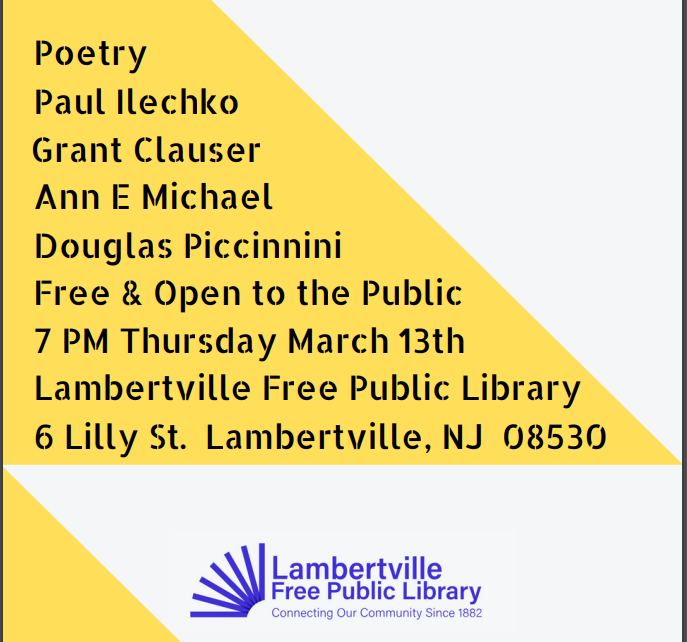
And, of course, worms. March’s moon is sometimes called the Worm Moon, and tonight there’s a total lunar eclipse around midnight here in PA. Is that auspicious? It’s also when I will be reading at the Lambertville Free Public Library in Lambertville, NJ. I’m excited to participate in an on-site, in-person reading again…I’ve been hibernating a bit from poetry events, but it is time to get stirring.

At the end of the month, I’m packing up for a brief trip to Los Angeles, where I will be attending one day only of the annual AWP Conference (Saturday’s Book Fair!) and spending the rest of the visit with my son. The conference always offers a terrific infusion of writerly companionship, community, and inspiration. Whereas time with my son offers love, cool places to see and eat and hike, a host of things I didn’t know I wanted to learn, and many moments of hilarity and conversation. It’s hard that he’s so far away–hard for me; I don’t think he minds, he is busy and having fun, which is as it should be.

Also, yes, the whole situation here in the USA is something I never could have imagined as a younger person, when I somehow had an unquestioning faith the US Constitution could actually be workable as an enduring rule of law. That careless people who value money over community could indeed disrupt that 1787 document was always a possibility (the moneyed property owners and slaveholders had their way with the original, after all), but most of us didn’t see this coming–naive, I suppose. Busy with our own concerns. I get it, and maybe we deserve what’s coming, but [ugh]. A concerned European friend recently asked me how I was faring under the stress of these first three months, and I told him that since making art (poetry) has generally been an unconventional act/behavior/response even under the patronage system, my response is to keep making art. Granted, it isn’t much, nothing earth-shattering, not gonna change society that way; but it keeps us observant little non-conformers on our toes, creative, and flourishing in the face of weirdness and oppression.

Which is something we can do. Like early bloomers in the cold days of late winter.

winter witch hazel blooming in snow

Cover reveal

Earlier this week, I went to a neighboring city–Reading–to record a TV segment for the local station, BCTV, that hosts a program about poetry! The host and interviewer is poet Marilyn Klimcho of Berks Bards (a non-profit poetry group in Berks Co, PA). It was truly pleasant to read a few of my poems in a professional setting (studio), but the best part of the day was just chatting with Marilyn about poems, poets, and poetry. We began our conversation half an hour before the cameras rolled and continued it afterward, so the 25 minutes that were recorded seemed just to be part of a longer, casual discussion.

I appreciated that. I’m part of a long-running critique group, but it’s seldom that I get the opportunity to pick someone’s brain and share ideas, influences, and general enthusiasm about the art of poetry the way I did in grad school. Probably could work on getting more such discussion into my life.

The “Poets Pause” segment will air in March and then reside on YouTube, so I will post that link at some point. It was kind of Marilyn to highlight The Red Queen Hypothesis and to give me a chance to mention my next collection, forthcoming from Kelsay Books later this year. Speaking of which, I do now have a photograph of its cover:

The photo is by Don Schroder, a friend who’s got a website full of lovely images from his numerous travels to the African continent as well as good shots of festivals of many kinds and floral beauties from arboretums and gardens. Go check it out!

The cernuous tulip seems appropriate to several themes I evoke in these poems–elegies and the sense of impending losses but also appreciation of beauty and brevity and life’s many colorations. Initially, I thought that I was using fewer of the animals, plants, weather and the “nature stuff” I tend to populate my poems with, because so many of the poems in Abundance/Diminishment are for or about humans. But…nope, just took another look through the manuscript in the final approval/editing process and realized that I cannot seem to leave the planet’s environment out of my work. I probably should have been a biologist, ecologist, or a science teacher instead of an instructor of English, but oh well.

Frankly, I love the simplicity of this cover, and I’m excited to have the book in print later this year…especially since it took me a decade to get The Red Queen Hypothesis into the world.

Lists

There can be beauty in a list: its specificity, also the rhythm and sound–which order does the poet choose for each word? That matters. Chronology perhaps; category, like the scientist; or else sound, such as alliteration; or possibly by the thread of some concatenation that gradually creates associations. The logic of a list poem differs from other forms of lists.

I always think of Whitman as an early and consummate “list poet,” though a great many of his poems do not rely on the strategy. There are list poems that employ anaphora and those that build through phrases. Others rely on modifiers that escalate or change tone to surprise the reader. In my own process it has been useful to begin drafting poems through listing, though often I abandon the list when I revise.

Also, I teach myself about the world and its people, environs, and ideas through lists.

For example, having strayed temporarily from my home region, I’m getting acquainted with a “new” place by making lists of birds, trees, flowers–yeah, the naming-things approach so basic to human beings, like when my children were just learning to talk and conversation with them consisted largely of naming objects or actions.

This is not a poem:

Pygmy nuthatch, juniper titmouse, pinyon jay. Gambel oak, Abert’s squirrel, pinacate stink beetle, skink. Quaking aspen, limber pine. Common raven, Woodhouse’s scrub-jay, fireweed, globemallow, bear corn, oak gall, crow. Pinyon, cholla, Ponderosa pine, alligator juniper, Apache plume, sandwort, groundsel. Gneiss, granite, gray oak, spotted towhee, rabbitbrush, bajada, arroyo, muttongrass, mesa, schist.

~

However, these words now evoke images, sounds, memories, senses that–who knows?–may end up in poems eventually. Because poetry is about and in the world.

Emergent

emergent (adj.) late 14c., “rising from what surrounds it, coming into view,” from Latin emergentem (nominative emergens), present participle of emergere “to rise out or up” (see emerge).

etymologyonline: etymonline.com

~

Spring equinox.

Very soon–perhaps days from now–the vernal ephemerals will appear. The vernal ephemerals are early spring flowers that thrive low to earth before the trees leaf out: spring beauties, dogtooth violet, squirrel corn, bloodroot, hepatica, and others that look delicate but are, in fact, tough little survivors who have found their ecological niche in the cool days and weak sunlight just post-equinox. We could consider their resilience an inspiration.

Vernal ephemerals sounds to me like a term for sprites, will o’ the wisps, or angels, but it’s a scientific term. I learned it from Tom Wessels (here’s one of his videos on coevolution https://www.youtube.com/watch?v=hCAvBmY7ZgA),* but I have been fascinated by these plants for decades. I have always been the sort of person who walked around with my head either facing the clouds or scanning the earth beneath my feet. Hence, a reason so much of my poetry uses images from nature even when I am not writing about the garden, the meadow, the woods, the sea. My clumsiness a byproduct of my peculiar need to observe the natural environment.

Anyway, hepatica is about as close to a sprite as any blossom I know of.

They aren’t common where I now live. Here, the vernal ephemerals I see most often are trout lily, bloodroot, spring beauty, violets, coltsfoot, trillium. Probably a few others that I’m forgetting because the ephemerals haven’t popped up yet. Still far too cold and a bit dry after a month of snow cover. The emergent greens in my gardens consist mainly of winter weeds, and I’m happy even to see those. Because: green.

“Just a little green like the color when the spring is born” says a line in Joni Mitchell’s song. The green things rise up or out of what surrounds them, coming into view.

I have been keeping under the standing snow, leaf litter, and dross for three months, processing (as the jargon terms it) my father’s death and a new manuscript and a backlog of poem drafts and covid-19 with its attendant disruptions, limitations, and opportunities. But the snow has subsided from all but a few gullies on the north sides of hills; iris reticulata and snowdrops are in bloom, along with the winter-blooming witch hazel. There’s work to do in the garden. Poems to revise. National Poetry Month ahead (April!). It’s the 25th year for this literary celebration.

Time for me, like the skunks and the skunk cabbage and the little ephemerals, to rise out of my surroundings. And take up this blog again? It’s a start. A little green shoot emerging in the chilly sunlight. Hello.

* Thanks to Dave Bonta for the video recommendation

Repetition

Repetition, the foundation of rote teaching and memorization, is a style of learning at which I have never been particularly successful.

Nonetheless, repetition has been useful in my learning process. Close observation reveals small differences in repeated events and refrains of all kinds; what I learn through repeated experience is that each time I see or do “the same thing,” I notice something new. Repetition permits me to analyze, and that is how I learn best.

Here’s an example.

~

Plants, particularly flowering plants, fascinate me. Every year, I find myself heading out to the yard, my camera in hand, to take photographs as the flowers unfold and the insects arrive to pollinate them. Every year. Yet a closeup of a bumblebee in a redbud blossom from 2005 looks pretty much the same as a bumblebee in a redbud blossom in 2019. Or a monarch on a tithonia–one year similar to the next. Why bother? What urges me out when the dogwoods bloom to record yet another photograph of flowering dogwood? How redundant. How unnecessary.

Yet I have learned much, gleaned much, from the process of noticing the buds and blossoms and insects as the days lengthen and then shorten again; the cycle of life a repetition. Each routine event of spring seems new to me after the winter’s rest.

~

The only types of poems I have managed to have some recall for are poems with refrains, and some song lyrics (also with refrains). The ones I have memorized are the ones I have heard and sung along with most often, such as the calls and responses of church rituals and hymns, the record albums I listened to over and over when I was a teenager. Each time I listened, I felt something new happen inside me. It’s the same with my walks in the garden and the woods and hedgerows and the meadow: each year the same, each year new. That kind of teaching, while repetitive, is far removed from rote.


April blossoms

Easter and Passover are late in April this year, which rather complicates the semester breaks of the university; the weather remains unsettled, and at present (6:30 pm, Eastern Time), I look out my north-facing window at bright evening light, lengthening shadows, and the narcissus and shadblow trees in bloom.

I have some visiting to do and may not be posting for a day or so–but will manage to do so if I can; and I will endeavor to at least compose one (I can at best promise one) poem per day even if I don’t get to this blog to post it.

[Note: This is more a reminder to myself than to my readers, who I’m sure have more  significant things to do than to keep track of whether I am holding to my discipline for National Poetry Month.]

IMG_6022

Aesthetic Potential

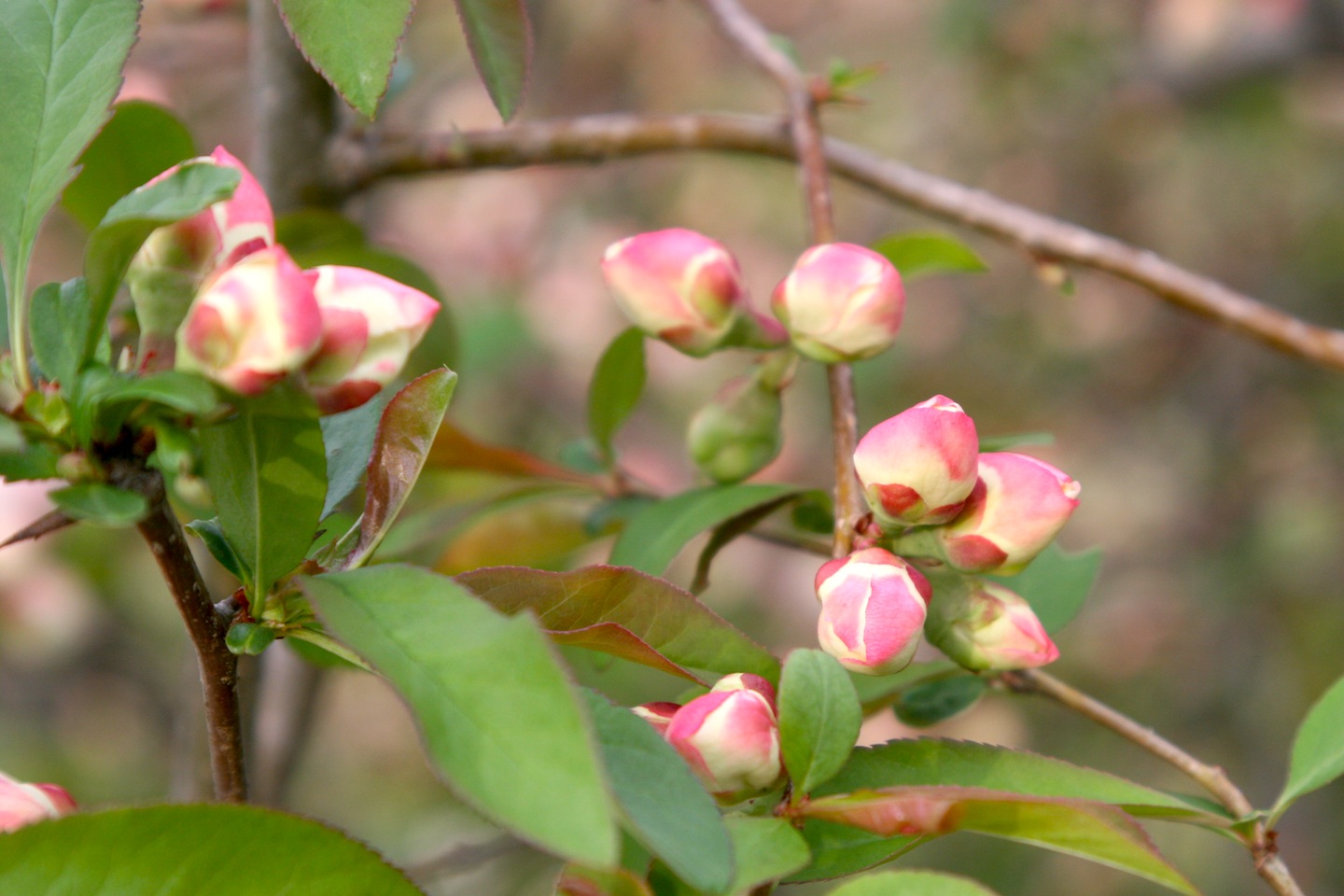
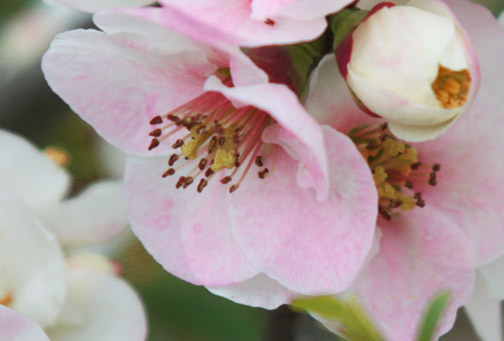
In her yard stood a large quince
which was her favorite flower, she said
though she admitted the bushes
ill-shaped and far too thorny,
the blossoms, though early, unscented
and often sparse or inward-facing,
simple in form, not good for cutting.
The fruits sour, useful only in jelly
which she never bothers putting up
anymore, the branches susceptible to rust.
It looks both forlorn and nasty all winter.
I like its tenacity, she told me, but also
its tenderness. For no other shrub
bears buds with such multi-colored
promise, that might open into anything—
sweet, complex, showy. Though it
doesn’t deliver, April’s bees indulge.

photo by Ann E. Michael

Wordless

The landscape’s brought colors and pollinators and all the juiciness of reproduction cycles into the season’s height. Time to take walks and breathe.

And say nothing.

And let the words subside for awhile, and percolate the way the rains percolate through the wet, warm soil and into the waiting earth.

~

azurea


The color orange

bouquet

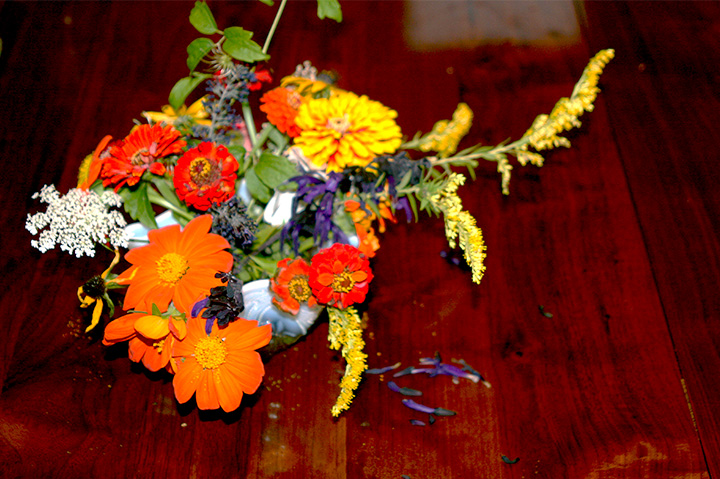
Late summer bouquet five days past its first blush…

~
The crickets are raising their “voices” each night; the darkness lasts a little longer, and the color orange emerges from the green of midsummer to remind us of all that is beautiful in the world, despite __________________________ [insert your list of unpleasant, tragic, disheartening things].

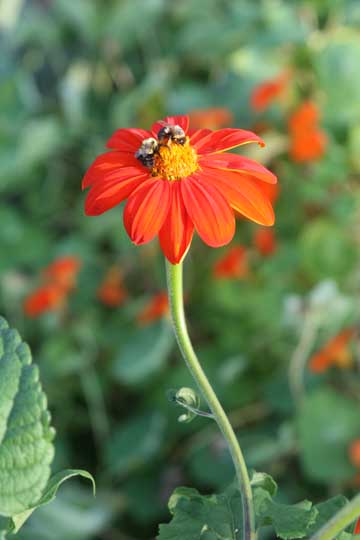
Here is my encomium to the Mexican sunflower, tithonia rotundifolia, a favorite of bees and monarch butterflies and also a favorite of my daughter’s, so it has special aesthetic-emotional appeal for me. The poem I’d like to write to the sunflower has not yet materialized, so praise in prose will have to do for now.

mexican sunflower, bee by Ann E Michael

Autumn approaches. I like autumn, though some of my dear ones do not–but one thing universally salvages the early weeks of the season, no matter how a person feels about the encroaching cooler weather: orange. Even people who don’t care for the color in clothing or decor admit that, in nature, the color orange attracts the eye, enlivens a scene, brightens the dullest corner.

Nasturtiums, zinnias, the last hurrah of daylilies, butterflyweed, and early-turning foliage such as sumac and sassafras sport the color well. There are also pumpkins and squashes warming up fields; and in some areas, there are butterflies wearing the hue: monarchs, viceroys, fritillaries.

But nothing delights in a bright red-orange so well as the Mexican sunflower, which evokes the warm climate of its designation and likely origin (I haven’t done a great deal of research on the plant. I know that tithonia diversifolia is native to the region of Central Mexico and am merely guessing that the rotundifolia variety has its roots there, too–excuse the pun).

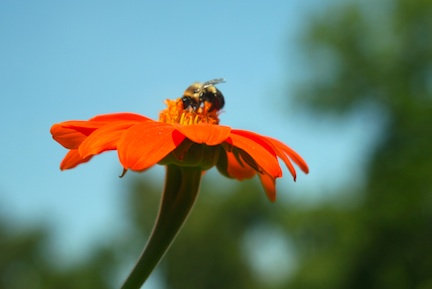
monarch.ann e michael

It sports well with one of its showiest pollinators, the gorgeous, orange, monarch butterfly.

Tithonia likes full sun and does not mind a bit of drought–all reasons it managed well in Mexico. It’s also ridiculously happy in the American Northeast, at least in the Mid-Atlantic region where I garden. The plants grow 6-9 feet tall and are veritable fountains of pleasing, brilliant points in the late-summer garden. They attract bees, butterflies, hummingbirds, and small songbirds and have few pests. Deer dislike their “hairy” leaves, and slugs and beetles seem also unimpressed with their food qualities.

Or perhaps the “pests” appreciate the blooms’ aesthetic value, as I do. [Okay, too much anthropomorphism there, I admit.] tithonia.2sm

Furthermore, as long as I get out to the garden and dead-head the plants regularly, they bloom right up until the first hard frost.

And they cut well for bouquets (see the not-excellent photo above).

When there is so much sorrow going on in the world, it may seem odd that a flowering plant can offer respite–a moment or two of awe, of joy, the discovery of a bumblebee with its legs pollen-yellow or a monarch’s slim proboscis coiled just above brilliantly golden stamens amid a red-hot orange daisy-shaped blossom…and maybe, above, an autumn-blue sky.

Not art, but nature. Both valuable to human creatures.


Far afield

My desire has been to wander, but my inclination does tend toward staying at home. One reaches a point in one’s life, however, at which wandering will shortly become more challenging than it was in youth. Also, it gets far too easy to stay comfortably within one’s zone of familiarity, which limits transitions and other difficult things.

Recently, I went far away, found myself (among other interesting places) in a field and happily fell into familiar behaviors I follow at home. In this case, scoping out the local flora and minor fauna in the hills in July.

IMG_4797

We were touring a small region of a small but extremely varied country: Portugal. The field featured small lizards that were so quick I couldn’t photograph them; dozens of types of wildflowers and grasses and their assorted tiny pollinators; robins, black redstarts, kestrels, and other birds I couldn’t identify. I am pretty sure we saw a hoopoe, which for me is exciting, though I expect it is not uncommon in Portugal.

As a humanities geek who loves Medieval and Renaissance art and architecture, I love the old cities; and the sea’s appeal abides, but the mountain regions appeal to the introverted gardener and naturalist in me. I was pleased with the quiet, with the pure air and blue sky, the twisting roads, the small farms. Most of all I was pleased to find so many plants and pollinating creatures in the field next to where we stayed for two nights, not far from the Peneda-Gerês National Park.

Some of these flower photos feature at least one bee or wasp or beetle-y thing. Below, a common sight on the mountains: heather, flourishing as well as it does in the British moors. Not much rain, but many misty mornings, even in July.

IMG_4702

This region is wind farm country. There are large, electricity-generating windmills atop much of the range, and quite a few of the many small rivers are dammed to create electric power and places to fish and swim. There’s certainly very little air pollution up in the hills…I have visited few places so pristine.

More little critters among the field flowers. Easy to overlook, despite how vivid these photos may appear.

IMG_4706

Nice to dwell, if only for awhile, in a place that offers a beautiful change of perspective.