Crabgrass

I have been at work in the vegetable garden during the past few dry, sunny, late-summer days–it has been rather droughty here–and pulling up weeds in an effort to get an early start on putting the patch to bed for autumn. I have decided not to do any late-season sowing this year, and therefore I can pretty much tear up everything if I feel like it. Today I was thinking about my mother-in-law, who died in 2017, but who was sometimes my partner in the garden, or I in hers, when we were younger. I learned a great deal about ornamentals from her.

At her property, crabgrass was a particular scourge. I remember us weeding flower beds together while she muttered, “Crabgrass! Always crabgrass, how I hate it!” It struck me odd at the time that she pronounced it “crebgrass,” with the first “a” like a short “e”, because she said the word “crab” and similar words with an open short “a.” It was almost as though she reserved that pronunciation to express her ire at this particular weed. She liked weeding at my house partly because I had so little crabgrass. Plenty of other weeds, but not much crabgrass.

Our weeding together took place over 15 years ago, when my gardens were on the new side, maybe a decade old. Today, however, I find my vegetable patch very much colonized by digitaria sanguinalis…one of the finger grasses, a very successful weed that can produce 150,000 seeds per plant. My garden now hosts both smooth and large crabgrass; the former is much easier to pull, though it can set seed even when it is mowed to under an inch in height! Large crabgrass, when it gets going, can grow over a foot tall and have a base rosette of 10″ with a star-like (or crab-like) set of leaves and quite tenacious roots, for an annual.

While I worked (too late, I really should have gotten to the weeds long before they began to set seed), I heard my mother-in-law in my mind: “Crebgrass! How I hate it.” Well, dearest Gene, I have finally encountered the Eurasian colonizer in my own gardens. And I miss having you around to sympathize with my plight.

 Maudib | Credit: Getty Images

There’s a metaphor here, I know there is. Maybe there’s a poem in this experience, too? For the time being, pulling weeds reminds me of someone I loved–and takes my mind off of another person I love, whose dwindling and decline (her “diminishing”) stay uneasily in the background of everything I do these days.

In the between-season time, with autumn almost upon us, I want to remind myself of the joys that come along with the crabgrass. Such as the brown crickets and the morning glories and the goldenrod…and memories of people for whom I have cared a great deal.

~

Getting through somehow

My mother has vascular dementia, which renders her more and more aphasic, though in her case–so far–her “emotional tone” (as philosopher Arne Naess calls it) has remained intact. I visited my mother on a recent occasion when I wasn’t feeling my best and had had a week of less-than-good health. It was not a matter of duty. The time I spend with my mother is beautiful. But it had been a tough week. Let’s leave it at that.

We sat in her apartment in the assisted-living wing and arranged the flowers I’d brought. Then we spent 20 minutes in a kind of conversation, to which I’ve become accustomed, during which she tries to convey information about something she needs to have done. In this case, after much of the usual (really, rather humorous at times) confusion, I deciphered that she wanted some sweaters taken to the dry cleaner.

Such minutia. And yet, so difficult to get across, across that divide of language and cognition. The incredible concentration and effort it takes her just to dial a phone number to call her ailing sister. To tell the nurse aide that she needs more yogurt. Anything.

Then she surprised me. She pointed to my forehead and then to her own. “This,” she said. “Is wrong. For you. What?”

Was she reading a crease in my brow? I told her I had not been feeling great. She wanted to know, so I told her details, the way one tells one’s mother. Even though I am never sure quite how much gets through.

“Lie down. Take off the peaks.” By which she meant shoes. Why not comply? We both took off our shoes and spent the visit relaxing. We even indulged in a glass of wine because she loves to offer wine to her guests. Never mind it was 11 am. My mother has lost that rigid cognitive sense of time that the rest of us spend our lives obsessing over. There’s something valuable in that loss, though it is a loss.

She’s still teaching me things. Other ways to live with loss (my dad, her “normal” brain, mobility, words…).

~~

The next evening, she called me. She wanted to know how I was feeling. I’m 63 years old and my mother is 88, and she’s still worried about me.

I’m feeling loved.


Love is all you need

Norway’s Philosopher

I first encountered Arne Naess’ work in 2012 (see this post), and I regret that I failed to follow up by reading more of his “ecosophy T” (deep ecology) and philosophy. I am finally getting around to his very late book Life’s Philosophy, and I love how it speaks to me on many levels. His claim that human emotions can and should be components of human reason makes so much sense that I wonder why so few researchers look into it; some folks on the edges of neuroscience and psychology seem to venture there, but few others. The concept of “relationism” resonates for me, too. It reminds me of the Dali Lama’s teachings that all things in the world are intertwined and valuable, even non-sentient beings.

Relationism, as Naess uses it, acknowledges the vast and impossibly infinite complexity of the universe, more strictly life on earth, and–can I use the word “celebrates”?–the interwoven strands of animal, vegetable, mineral, bacterial, cosmological, emotional, rational aspects of a life in the world: ecology on steroids (he would not have phrased it like that). My urge for balance in my own life makes this philosophy relevant: the opportunities for play and for imagination as well as for seriously abstract concepts, for the importance of emotions as felt in the human body and as interpreted or contained in the human intellect; the necessity of listening to even the tiniest sounds, of savoring the small moments, of not needing to be big or grand or successful but to be mature in how one feels with the world.

The incredible difficulty of saying any of this. Which Naess also acknowledges, saying the difficult job of conveying being felt in the world leads to music, to art, to sitting with the natural and sensing beauty. I might add: Poetry. Though poems are made of words, they often operate through images and felt moments rather than intellectual logic.

The wonderful paradoxes of this book delight me, but then, I always have enjoyed paradoxes. Naess was, indeed, a philosopher, a mathematician, a person who valued logic, reason, and analysis, an analysand himself and briefly a psychological researcher, a mountaineer, a teacher. What to do with the inherently analytical side of himself? Treasure and use it to find wonder! That’s what makes him different from so many thinkers. Wonder. He writes, “To me, the ability to analyze the experiences of the moment is a source of wonder: wonder at human creativity and the result of evolution during hundreds of millions of years. That which happens within us–in our minds and hearts–is so complicated that the psychoanalytical instruction to express everything that occurs to one becomes…and exhortation to to the impossible.”

He opposes Cartesian mind-body separation not just within the body itself (as medical science has proven) but in terms of landscape, natural environment, places. He posits that people need deep thinking about values that move us emotionally just as much as we need to think about rational, pragmatic, socially-pressured values that are based on intellect or the empirical. Place matters, and we need to consider our fundamental place, Earth. Naess’ oppositional stances are, however, never a fight. Instead, discourse, compassion, patience with what is complex. A sound life philosophy requires stillness sometimes, and listening, even–especially–to the “tiny, tiny things,” he urges: “The art of living is to be able to work with small things in a big way.”

How do you feel yourself and the world? is the title of one chapter. I read the question with emphasis on different words and began to realize what a complicated and interesting question it is, though it seems (at first) so simple. Naess says that humans have hewed to the idea that there’s a gap between reason and emotion, and that the gap is an artificial one; a change in perspective, and an understanding that the mind and the body live in a physical world where emotions play a huge role in human communication, might help us to enjoy our lives more–and maybe, while we are at it, treat the earth one which we depend with more love and respect. But we have to feel we are not just ourselves but the world: of it, from it, in it.

mapio.net/pic/tvergastein

Being receptive

When my parents moved to a senior-living campus about 10 years ago, one of the hardest aspects of downsizing was what to do with the books. My dad’s bookshelves were full of texts that he found meaningful, valuable, inspirational, informational, necessary; he loved to read. Choosing which books to give away and which to keep was agonizing for him. And then he faced the task again when he and my mother moved to a smaller, assisted-living apartment. That time, he donated many of his books to the facility’s library, so he could “visit” them if he needed them. There remained one large bookcase. Because you can’t live a happy life without books!

Then he died; and my mother, who also loved to read, developed such aphasia that she could no longer decipher sentences. Now, every time I visit, she gestures at the books and urges me to take some of them. It’s hard to explain the response I have to taking home my dad’s books–a mixture of tenderness and discomfort, nostalgia and pain. Sometimes I end up giving the books away, but usually I read them first. Because they are books and deserve to be read, somehow, just by virtue of existing. No–by virtue of their having been significant to my dad. That is why I feel compelled to read them.

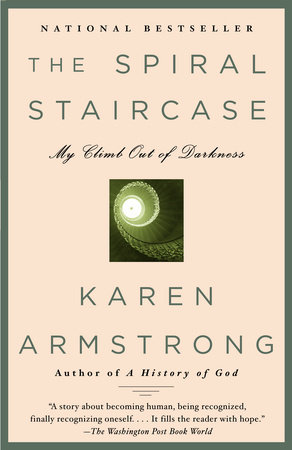
I cannot say I got much inspiration from my father’s 1955 copy of a text on caritas by Martin D’Arcy, The Mind and Heart of Love, although I found suggestions about the philosophy of Christian love that my father would certainly have noted {indeed, his penciled checkmarks in the margins confirm it}. Last time I was at my mother’s, I chose to take Karen Armstrong’s 2004 book The Spiral Staircase, a book I appreciate rather more than I did D’Arcy’s. Much of Armstrong’s memoir deals with the frustration she felt as she struggled to find her place and purpose in the world of work. As it turns out, she is a writer, although it took her awhile to discover and admit it. Part of being a writer involves isolation or solitude, which Armstrong equates with silence: “Without the distraction of constant conversation, the words on the page began to speak to my inner self…I was no longer just grabbing concepts and facts from books…but learning to listen to the deeper meaning that lay quietly and ineffably beyond them. Silence became my teacher.” That passage resonates for me. I can recall times when what I learned, and subsequently, what I wrote or composed, emerged from such silence.

But I like most of all what she says in her next paragraph (p. 284).

This, of course, is how we should approach religious discourse. Theology is–or should be–a species of poetry, which read quickly or encountered in a hubbub of noise makes no sense. You have to open yourself to a poem with a quiet, receptive mind, in the same way as you might listen to a difficult piece of music. It is no good trying to listen to a late Beethoven quartet or read a sonnet by Rilke at a party. You have to give it your full attention, wait patiently upon it, and make an empty space for it in your mind.”

It helps if we can give our hearts to poems and books we read, make space for them in our minds, hear what they have to say before rushing in with our own clever ideas and personal perspectives. When writing, the same approach applies. Often I think I know what I have to say, yet the poem on which I’m working proves me wrong. And it helps to be compassionate to the writerly self, which is another thing Armstrong had to learn, as she was far too hard on herself about her thinking and writing.

Her subsequent books, and her recent work, center around compassion, I notice. I have not read them yet, but I plan to. Another thing I notice is that the copy of The Spiral Staircase I brought home from my dad’s bookshelf is inscribed:

Tom and Bonnie    with best wishes     Karen Armstrong

Altered perspectives

One of the arguments Arthur W. Frank makes in his book The Wounded Storyteller–and in his subsequent books about “illness narrative”–is that there’s a compelling ethics for medical diagnosticians and caregivers involved in just listening to the other person’s story. The difficulty emerges when the storyteller cannot put his or her story into words or lacks enough objective distance from the illness to narrate the kind of story that others are expecting.

When people’s circumstances push into the chaos realm, they’re in the midst, overwhelmed; few of them can construct a cogent and concise narrative. In their pain, in their grief, everything seems equal–no beginning, no end, all middle.

The listener expects: a beginning. a middle. an end.

The listener expects: chronology. a goal. a desired outcome.

If the listener’s job means determining a course of healing, the listener requires history, onset, comparisons. Truly good diagnosticians therefore need more than sleuthing skills, experience, and education. They need to listen well in the midst of the storyteller’s chaos; Frank calls this listening with.

That often means taking a deep breath and endeavoring to change perspective.

~

[Which, by the way, is excellent practice for poets.]

Tibet-Mountains-Everest-Kailas-Tibet-tours-Tibet-travel-Tibet-trekking-Tibet-hiking-3-of-8-1024x676

Himalayas: view from a high lake plateau (Snow Lion tours)

natural_fractals_tibet

Himalayas from satellite: a fractal view

~
We cannot climb into an airplane and get an overview of a human being’s situation. Nor can we get into another person’s thought processes to determine what’s going on. Listening without rushing the person, without offering advice, without finishing the sentences with what we expect to hear–that’s a hard task.

In a previous post, I tried to replicate what it was I could hear when someone I cared for experienced cognitive damage.

It was very, very difficult to listen. For me, heart-breaking because of my previous understanding of who the person was. It was only in her final days that I started to realize I’d needed to change in my relationship with her in order to get some idea of what she wanted to say. And it was too late, really.

~

As another Best Beloved is now experiencing significant cognitive changes, I want to do better. I need to acknowledge the chaos narrative, the interruptions, the lacunae in the person’s story. It’s important that I develop a new perspective on what a conversation entails, too; my expectations surrounding a conversation no longer hold, and both of us will get frustrated if we stick to former habits.

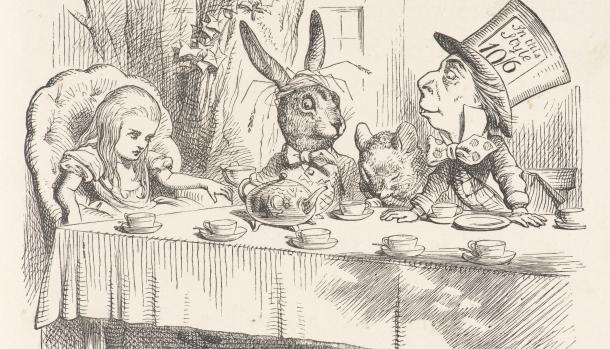
If sometimes a visit feels a bit like the Mad Hatter’s tea party, so be it. There’s a story in that, after all, thanks to Charles Lutwidge Dodgson.

mad hatter tea party tenniel

Tenniel’s sketch for Alice’s Adventures in Wonderland

And, just as an aerial view of the Himalayas alters the perspective of what the mountains are and how they appear, an altered perspective of a loved one keeps the person, as a human being still in the world (no matter how changed), in view. True, perhaps with changed patterns and unexpected gaps that we who love them may grieve the loss of. The conversations may be interrupted and chaotic, or full of long pauses and grasping for words and concepts. It is just a different kind of human communication.

Not what I expect, but what I am given. I’m trying to listen with, before it is too late.

Etc. & refrains

Some years, I have devoted my National Poetry Month energies to attending readings, getting out in the world to listen to writers; some years, I’ve tried hard to submit at least 30 poems to magazines and journals; some years, I have read two poetry books a week for the month of April. This year, I wrote a poem draft a day. OK, now what?

When you love poetry, you do all of these things anyway. Having a month to celebrate the art merely acts as a public awareness campaign, though it has reminded me, year after year, to aim for a bit more discipline in my creative life.

~

I have also been reading, of course, bookish person that I am; this past month, a real standout–and a difficult book in a few ways–was An Orchestra of Minorities by Chigozie Obioma. The novel offers a way in to the cosmology of the Igbo people (Nigerian, mostly) while wrenchingly capturing the anxieties of modern life and the timeless agonies of lovers separated by class, race, status, religion (whatever gets in the way of lovers). Obioma successfully interchanges voices, languages, creoles, narrating from the point of view of a guiding spirit. Spoiler alert, the book ends with tragedy, and there are tragedies large and small throughout. The tension of human anxiety works really well, and all of our fears.

The guiding spirit, who has accompanied centuries of human hosts through their lives, has a refrain: “I have seen it many times.” I thought of Vonnegut’s “So it goes.”

Trying to imagine my own refrain…it might be something on the lines of: Life’s difficult, so we have art and poetry and love and one another to get us through.

alice-heart1 copy

art by my daughter at age 8


Punctuation

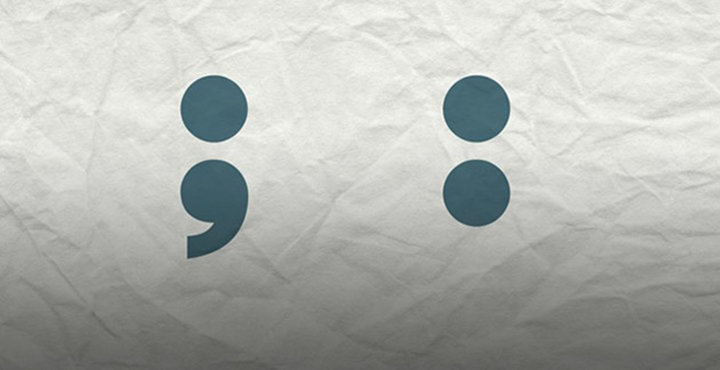
Semicolons-and-Colons-2_720x370…or lack thereof!

One thing I notice about my draft poems is that I often ignore punctuation. Sometimes that lack remains in the final draft, if I think that the ambiguously run-on approach works for the poem or that line breaks alone serve the purpose; but more often, punctuation is something I work into the revision process. Billy Collins tells an anecdote attributed to Oscar Wilde about proofreading a poem, and how he spent all morning deciding to remove a comma, and then spent the afternoon deciding to put it back in.

I do not devote quite that much time to commas. I do think that punctuation matters as an aspect of poetic craft and can convey more than we realize. The draft below, if I decide it is salvageable, will probably require some punctuation.

~
Down Will Come Cradle

She rocked you to soothing in her
warm young arms
do not forget how young she was
you so new
to the world you felt safe unquestioning
but look back
from yourself as you are now and
think of her
embracing your small body with her fears
and with love
she barely understood herself saying to you
what she’d heard
from her mother until she could confirm
in herself
secure against her novice worries as she
rocked you both
warm and soft and young in the
darkened room
where you now attend to her no longer
young neither
you nor she young but the mutual
comforting
continues the lifetime of strain and slack
you so new
to the process of soothing her how
easily
you rock beside her holding her hands in
your warm hands

~

Writers, letters

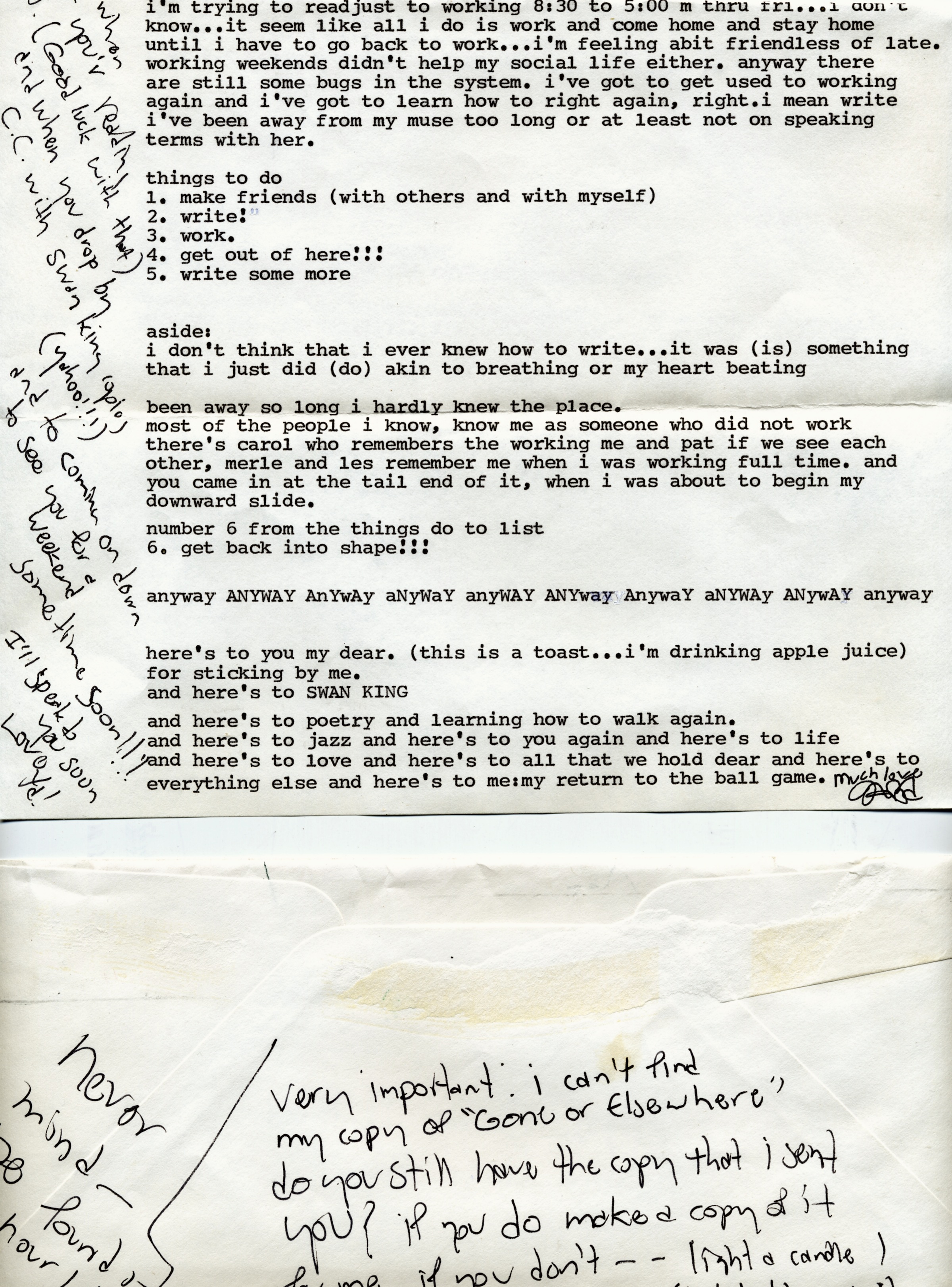
26 January 1983

AnN aNn ann ANN!!

…it seems like all i do is work…i’m feeling abit friendless of late. working weekends didn’t help my social life either. anyway there are still some bugs in the system.i’ve got to get used to working again and i’ve got to learn how to right again, right. i mean write. i’ve been away from my muse too long or at least not on speaking terms with her.

things to do

  1. make friends (with others and with myself)
  2. write!
  3. work.
  4. get out of here!!!
  5. write some more

(aside:)

i don’t think that i ever knew how to write…it was (is) something that i just did (do) akin to breathing or my heart beating

been away so long i hardly knew the place.

number 6 from the things to do list

6. get back into shape!!!

ddunn1983002


anyway ANYWAY anyWay anyWAY aNYWay anYway ANyway anyway–

here’s to you my dear. (this is a toast…i’m drinking apple juice) for sticking by me.

and here’s to SWAN KING

and here’s to poetry and learning how to walk again. and here’s to jazz and here’s to you again and here’s to life and here’s to love and here’s to all that we hold dear and here’s to everything else and here’s to me: my return to the ball game.

much love. david.

~~


Poetry as a value

If individual consciousness exists among human beings, and I believe it does, it is however the collective consciousness that has the longest-ranging impact. We are social mammals. We crave some object or objective with which we can connect and form relationships around in order to create community. Humans cannot survive without communities.

Those communities can be centered around almost anything as long as the focus keeps social members busy with the process of group-forming, skill-sharing, skill-teaching, communication and, ultimately, the development of a shared history. Hence family, tribe, language, or religion–among many other social magnets–keep us cohesive. Until we bicker and subdivide. Society works in ways analogous to the brain and body: through complex systems and nearly-random relationships and long, twisty networks.

I’ve been thinking about the things we “worship”–things we value and therefore believe are inherent among good human beings–and how such perspectives affect the consciousness of entire civilizations. Simon A. May, in Love: A History, suggests that in the early 21st century, “Western” societies have been elevating the idea of love to that socializing focus. An interesting premise, and I suppose there are worse rallying concepts than love, though May points out ways in which even love can be transformed into an ideology rather than an emotion.ann e. michael

In a large society are many sub-societies, each with its own locus of organizing a human collective; these may often overlap or coexist with the vast variety of human interests. Reflecting on this, I consider myself as part of the society of educators, and of book-readers and book-learners, and of art lovers; and also a member of those people who feel that poetry assists in the lifelong endeavor to engage meaningfully and attentively to life.

Here is a list of people like me who subscribe to the necessity of poetry and who write about it on their blogs. Donna Vorreyer has compiled a listing of poetry-related blogs to follow. I will be following some of them, too.

https://djvorreyer.wordpress.com/2017/12/26/it-feels-just-like-starting-over/

The beloveds

In my last post, which featured a draft of a new poem, I should have mentioned my indebtedness to Gregory Orr and to the King James version of the Bible, as well as to Rudyard Kipling for the affectionate phrase “O Best Belovéd.” *

It’s fascinating, the inflections of English–and the way some of our archaic forms of speech still show up, such as the extra syllable pronunciation option for a word like beloved. I appreciate, too, the connotation of one whose emotional being feels connected to another person. We nurture those connections when our children are young, when we fall in love, when we feel intense compassion for another person–sometimes, even, when the person has died and the feeling of being a beloved and having that beloved near linger.

My own best-beloveds fall into all of those categories. I believe I can say I have a full heart.

~

As my last two posts featured poems of sadness, I wish to change things up. This one’s a love poem and a food poem, a cozy piece for the approaching darker weeks.

stewcook


Says the Stew Cook to Her Belovéd

Cat’s leaped on the kitchen counter, pawed a walnut from the bowl.
Liter of red wine waits for dinnertime—can’t say I’m not tempted, though.

Low sun highlights the bottle’s deep maroon while I make stew:
turnips, potatoes, garlic’s liquor, bay-leaf—needs only you.

Cool weather calls for firelight and whatever cooks long.
This cook longs to influence your taste, your tongue.

Since night’s expanded its acreage, taking over December,
we can build upon the dark, fill nooks with aromatic hours.

Come taste soup, share coriander scent, sip from this spoon.
Lick clean the bowl, my love, cover pots, come to bed soon.


~


~~  * I recognize, however, that for many many readers, the word Beloved will most closely be associated with Toni Morrison’s daring, beautiful, wrenching novel by that title–a work I highly recommend.