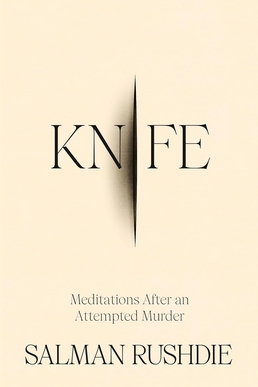
I’ve just finally gotten around to reading Salman Rushdie’s memoir Knife, in which he writes:
“…[A]rt challenges orthodoxy. To reject or vilify that art because it does that is to fail to understand its nature. Art sets the artist’s passionate personal vision against the received ideas of its time. Art knows that received ideas are the enemies of art…clichés are received ideas and so are ideologies…without art, our ability to think, to see freshly, and to renew our world would wither and die.
Art is not a luxury. It stands at the essence of our humanity, and it asks for no special protection except the right to exist. It accepts argument, criticism, even rejection. It does not accept violence.” [Salman Rushdie]
There are others who’ve said this. I think immediately of Audre Lorde: “Poetry is not a luxury. It is a vital necessity of our existence. It forms the quality of the light within which we predicate our hopes and dreams toward survival and change, first made into language, then into idea, then into more tangible action. Poetry is the way we help give name to the nameless so it can be thought. The farthest horizons of our hopes and fears are cobbled by our poems, carved from the rock experiences of our daily lives.”
What makes a person really a writer, really an artist, is–in my mind–this quality of necessity. And of the right to exist, regardless of whether the nation, state, government, religion, or other ideology suggests that one ought to shut up. For many years, I questioned whether I was, or would ever be, “really a writer.” Now, I feel that I am. Regardless of what the academy, the current aesthetic, the powers that be might say. There’s a deep contentment that accompanies this feeling: somehow or other, I got here; it has little to do with publication or public acknowledgment, and even less to do with remuneration.
Maybe it’s age. (Crone wisdom, anyone?) So, for any of my readers who are younger people, by which I mean under 55, who feel like impostors or dilettantes or who question whether they deserve the title of “a serious writer,” I’m going to suggest that you keep writing and endure. And maybe stop asking yourself so many questions about your worth. You don’t have to be famous or acknowledged to be a writer, you just have to be dedicated to writing and to learning about writing. There’s value even in that, in looking hard at the “rock experiences” of your daily life and endeavoring to make something of those experiences. Stay curious, stay unorthodox.
A recent anecdote to illustrate: For a few years now, I have been revising and revising a challenging poem that says something that is important to me, even though the idea came from someone else. I finally realized it would have to be a persona poem and would need to use the person’s actual words as a starting point. It’s a poem about a major breach of faith, a sad piece that questions orthodoxy in a significant way, in a way that is braver than I would be able to do myself. Once I finally got the poem to work, I had no idea who would want to publish it. (My Best Beloved found this poem “troubling,” which is a reaction I’m happy with because it should be troubling to readers, that was the point.) And then I saw a call from a journal I have admired and read online for quite awhile…looking for thorny pieces on this sort of topic. Working with the unorthodox isn’t easy.
Anyway? The poem’s been accepted. I’m thrilled! I’m a writer!
(The poem is here. Scroll down quite a bit or, better yet, read the work in this issue of Persimmon Tree!)