Science is poetic? A debate

Here’s a video I found entertaining and thought provoking–a scientist, a poet, and a philosopher discuss the intersection (or if there is an intersection) between poetics and science.

This debate hinges on a Richard Dawkins statement: “Science is poetic, ought to be poetic and has much to learn from poets.”

The home site is the Institute of Art and Ideas, which is also worth exploring a bit.

Poetic Theories: Can scientists learn from poets?

Ken Binmore, Mary Midgley, Ruth Padel.

What is your take-away from the discussion? I’m curious about which stance seems most convincing, though I suspect one’s fundamental opinion on such topics isn’t easy to change.

Gratitude & Qigong

My mother is still living. I am grateful for that.

My mother and I get along well. In that, we are fortunate.

Furthermore, although she is an octogenarian, my mother is in reasonably good health. Another reason for gratitude.

Her interests are varied, and she’s willing to try new things. My mother has always been quietly innovative about life. She has pursued alternative therapies for health and emotional well-being, read difficult texts, studied disciplines and subjects that challenged her, traveled the world, lived in foreign lands.

Mostly, she has been a care-giver of one kind or another. This past weekend, I took my mother with me to a Qigong and Mindfulness retreat, thinking she could use a couple of days of restorative practices and a little time off from care-giving for others in order to care for herself. In addition to several hours of “medical qigong” (Yi gong), we learned some practices for spiritual qigong (Tao gong), got information about implementing a plant-based diet, observed a tea ceremony, tried our hands at Chinese bamboo brush painting, and followed a labyrinth path in a walking meditation. It was quite a significant conclusion (of sorts) to my recent weeks of thinking about consciousness as presented by various “Western” thinkers on the subject.

Yin-Yang

Kirkridge Retreat Center hosted the weekend. Kirkridge’s organization is dedicated to peace, compassion, and community–to the concerns of social justice and to individual healing. It is a peaceful place, located on a steep, wooded hill. The setting alone fosters a sense of restorative energy. Our teachers were excellent, informative, and full of grace. The meals were terrific. The crickets sang sweetly and the moon shone amidst the clouds. My mother and I felt grateful for the event, the weather, the place, the people, for the breaths animating our bodies and for one another.

Consciousness & cosmology

"Syntax" by Steve Tobin. Copper, bronze.

“Syntax” by Steve Tobin. Copper, bronze. What can be said about all the things we think make up an “I”?

~

I’ve completed I Am a Strange Loop and Why Does the World Exist? and found, not entirely to my surprise (but to my delight–braiding and synthesis!), that the existential, metaphysical, and cosmological aspects of both authors connect intriguingly. Thomas Nagel, an important “philosopher of mind,” appears as an influence in both of these writers’ books, and Einstein and Plato and Heidegger. Both authors end up citing Derek Parfit’s work, and Holt even interviews him! It turns out that trying to determine the “reason” the world exists at all is not that different from trying to understand what consciousness is made of and where it resides.

After taking up mathematical proofs and several philosophical arguments, as well as neurological science as a basis for the evolution of “mind,” Hofstadter’s book gradually takes apart the mind-body problem that Descartes made so iconic for Western civilization’s thinkers. He keeps returning–and that’s an appropriate word–to the metaphor of looping. He looks at the strange loops of Escher’s drawings and of string theorists’ rolled-up dimensions and alerts us to how crucial the concept of self-reference is to the theory of consciousness.

The need for self-referentiality in a fully “human” consciousness gets him to the idea of “small-souledness” (among, say, such beings as mosquitoes). What portion of our selves makes us able to think about thinking, for example? Is that identity, or consciousness? What’s the difference? Here is where Parfit comes in. Hofstadter writes that Parfit “staunchly resists the idea that the concept of ‘personal identity’ makes sense. To be sure, it makes sense in the everyday world we inhabit…we all more or less take for granted this notion of ‘Cartesian Ego’ in our daily lives; it is built into our common sense, into our languages, and into our cultural backgrounds.”

~

If we care at all about what there may be beyond our everyday lives–and certainly people like Hofstadter, Holt, Bachelard, and me, among others, do care–we need to get “meta” in our meditations, which invariably leads to paradoxes and thorny tangles. Hofstadter’s book also engages with his ‘personal life’ (if, indeed, a personal identity or personal life exists). When his wife died, he found himself engaged in the seemingly unanswerable question of “Where did Carol go?” Did “Doug-and-Carol,” the shared dreams and lives and understandings of two people who knew one another intimately, simply vanish when Carol’s body died? Hofstadter cannot fathom that this shared identity “goes poof” when the body stops. He, after all, still feels connected to the Doug-and-Carol shared consciousness.

It feels real to him. So–what is consciousness? From whence does it emanate, or originate? Is it real, or is it an illusion–is there no such thing as the personal identity we hold so dear that we cannot even imagine ourselves any other way than as an “I”? (Are feelings real?)

~

Jim Holt’s book likewise gets more personal as the chapters progress and as he wrestles with his existential inquiry through texts and interviews. That seems quite appropriate: how can we use language to untangle what language itself makes vague and confusing? (See Tobin’s sculpture “Syntax,” above, for a physical view of loopy entanglement and potential words). Holt’s inquiry initially seems based on the abstract, mathematical, physics of why/how the universe got here; but he ends on the metaphysical and philosophical…whereas Hofstadter entertains the metaphysical from the get-go but employs mathematics, psychology, and brain physiology as well as philosophy. And they encounter similar quandaries, paradoxes, and uncertainties. Both authors essentially come to a similar conclusion about the mystery of existence, though they accept or compromise with their conclusions in slightly different ways. Then again, they are different people who have lived different experiences. Reading both books has been, for me, a valuable experience and one that’s made me examine my own thinking about being.

~

Apropos of these musings, and thanks again to Popova of Brainpickings, here’s a few more words on some contemporary thinkers who have theorized as Holt has (in particular, Lawrence Kraus) in the debate on Something vs. Nothing: “What is Nothing”

~

…And, apropos of nothing in this post, but to lighten the mood, here’s an amusing little blog from The New Yorker about pilcrows & pound signs & ampersands.

Critique: an anecdote

A group of friends gathers once a month to read and share and critique one another’s poems. They know one another well enough that they can be empathic, honest, and helpful; also, they are trusting enough to bring poems that really aren’t “working.” The critique’s the best way to get some understanding of why a poem is not working.

Recently, one member shared a poem that was somewhat philosophical in its overtones. The rhetoric of the poem was shifting, getting away from her, and she knew it. But she couldn’t figure out why, or how to correct the problem.

The talk moved away from critique and into values–for awhile. So the group was no longer exactly discussing the poem, or poetry, at all.

And yet, through the conversation, the writer recognized where at least part of the poem’s problem lay…which was in image and in structure (as illuminated, perhaps, by value and by rhetoric).

Reason can lead to beauty.

Too difficult?

Another difficult book, Poetry, Language, Thought by Heidegger offered me less insight than I’d hoped and irritated me more than other philosophical readings I’ve been perusing lately. I do see a link between Heidegger and Merleau-Ponty, Bachelard, etc.; these essays also connect to linguistic and semiotic philosophies. In the semiotic-etymological vein, however, I much prefer Umberto Eco‘s writing.

Of the essays in Poetry, Language, Thought, my favorites are “The Thinker as Poet,” “Building Dwelling Thinking,” and “The Origin of the Work of Art,” although that last one is problematic in a number of ways. Heidegger uses etymology, history, and his own concept of the fourfold making  up the onefoldedness of being (crucial to his philosophical cosmos but unconvincing to me) to question being and origin. The problem, always, is language. How to express the inexpressible? How can we use words to communicate when we cannot even reasonably define them–there’s no staying-in-place with words. Wittgenstein proves that even so simple a word as “game” has no single, stable definition that can serve as a premise for a logical assertion–yet, he notes, we do not need a definition in order to use the word. [For a ‘cave-man’s explanation’ of this topic, see the section called “Meaning and Definition” in this Wiki article: philosophical investigations.]

Dwelling: a light-house

Dwelling: a light-house

As a poet, I work with words, so these ideas interest me. Heidegger hasn’t helped much, though his discussion of what it means to “dwell in” will stay with me, resonating a bit with Arne Naess’ writing. I also found helpful his assertion that the best meaning for the word truth is unconcealedness. I like the idea that Truth, that vague abstract Big Concept we invoke so often as pursuit or justification, is always and ever present–but that we must un-conceal it, a slight variance in connotation from the usually-cited revealing of truth.

~

Some Heidegger quotes of note:

“Truth is at work in the work [of art]”

“Art…is the becoming and happening of truth. All art is essentially poetry” –because, “poetry is the saying of the unconcealedness of what is.”

~

So onto what irritated me. Among other things, most of all the essay “What Are Poets For?” The discussion stems from a famous line of Hölderlin‘s: “…and what are poets for in a destitute time?” Heidegger proceeds to use this famous inquiry to examine a lesser known poem by Ranier Maria Rilke–in the sort of philosophical critical analysis that drives me bonkers. Granted, this is a personal bias of mine and I won’t go into a rant upon it in this post. But, if you have read Nabokov’s novel Pale Fire, you’ll have some idea of what I mean by interpretation for one’s own purposes. This essay could almost have been Nabokov’s inspiration.

Maybe it’s me, and Heidegger is just too brilliant for my limited depth in philosophy and art. But I am pleased to be leaving him behind now and am already enthusiastic about the lectures and essays in Octavio Paz’s The Bow and the Lyre.

I suppose I ought to stick with poets who philosophize about poetry.

Hail and Heidegger

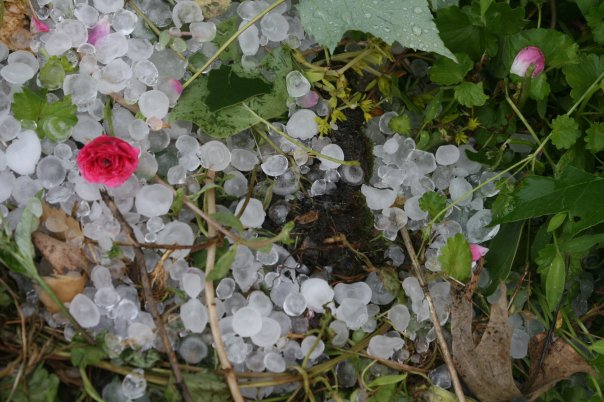
hail and roses

Another freakish, brief summer storm swept through–this time bringing wind, fog, downpours, and hail. Not a gardener’s favorite weather system under any circumstances. Some years ago, a June 9 hailstorm literally decimated (reduced by 10%…though I think it was more like 25%) my gardens and produced the mammatus cloudforms that show up on my “About” page. Yesterday’s hailstorm was–thankfully–not as damaging. Most of the plants will recover fairly rapidly, I think.

~

Meanwhile, I’m trying to educate myself a bit more on the history of phenomenology as it relates to poetry, art, and poetics by reading a bit of Martin Heidegger. This is a backwards chronology, but I’m not feeling ready to take up Husserl yet. Heidegger’s also problematic because of his early embrace of the Nazi party (he resigned early, too, in 1938, but never made a full repudiation). I understand that great thinkers can nonetheless be very flawed human beings. Michael Wheeler’s thorough essay in the Stanford Encyclopedia of Philosophy touches on some of the contradictions and covers Heidegger’s major work. But I am reading Hofstadter’s translation of “Poetry, Language, Thought” and six other shorter essays, such as “What Are Poets For?” and “The Origin of a Work of Art.” Actually, it is hard to consider the first text as an essay. It’s more like a poem in aphorisms. An excerpt:

~

When through a rent in the rain-clouded
sky a ray of sun suddenly glides
over the gloom of the meadows .  .  .  .

We never come to thoughts. They come
to us.

That is the proper hour of discourse.

Discourse cheers us to companionable
reflection. Such reflection neither
parades polemical opinions nor does it
tolerate complaisant agreement. The sail
of thinking keeps trimmed hard to the
wind of the matter.

From such companionship a few perhaps
may rise to be journeymen in the
craft of thinking. So that one of them,
unforeseen, may become a master.

~

Almost Confucian, no?

~

Later in his life, Heidegger moved on from his earlier philosophizing on the ontology of being (he pointed out the need to define “exist” as a premise in any such inquiry) and began to suggest that art exists within the materials/tools of the artist as well as within the artist’s being and abilities, all in a perhaps simultaneous collection of conditions. Wheeler says, “poiesis is to be understood as a process of gathering together and fashioning natural materials in such a way that the human project in which they figure is in a deep harmony with, indeed reveals—or as Heidegger sometimes says when discussing poiesis, brings forth—the essence of those materials and any natural environment in which they are set.”

Heidegger writes, for example, that “a true cabinetmaker…makes himself answer and respond above all to the different kinds of wood and to the shapes slumbering within wood—to wood as it enters into man’s dwelling with all the hidden riches of its essence. In fact, this relatedness to wood is what maintains the whole craft. Without that relatedness, the craft will never be anything but empty busywork…” Wheeler calls this manifestation of the art within the materials (which the artist must understand in order to use her talents and tools to bring forth) a “process of revealing.” Kin, I suppose, to the words often attributed to Michelangelo: I saw the angel in the marble and carved until I set him free.

~

Art, gardens, weather, poetry, the craft of thinking…all processes of revealing and transformation. “We never come to thoughts. They come to us.”ann e. michael hail foot

Enabling & stewardship

The season of seed catalogs is upon us, and I begin to fantasize about all of the vegetables and flowers I want to grow and how I will arrange my small garden area to accommodate them. I imagine having time to keep the rows cultivated and the foliage free of insect pests. Yes, I need to do some work on the fencing. And yes, some terracing might help where the garden’s taking a decidedly southeasterly dip. The asparagus patch finally played itself out, so it will need some restructuring and weeding; I’ll have an opportunity to use that area in a new way.

There’s snow on the garden now. All of this planning is purely speculative on my part. Yet–how clearly I can envision it, in my mind. One of my concerns is whether I’ll feel hale and hearty and energetic enough to get all of this work accomplished!

Ah, my garden-consciousness brings me to the mind-body problem, though perhaps in a more physical way than philosophers encounter it. My conscious mind imagines the garden that does not yet exist. Is that garden real or an illusion? What makes it possible for me to conjure it so vividly? Is it merely memory of past experience? If so, why does my imagination invent a slightly different garden–this year’s ideal? My animal self takes action, physical action (phenomenological action) in order to bring about fruition to feed the physical body that loves the taste of vine-ripe tomatoes and fresh beans and tender lettuces. Do my actions cause the plants to grow? No. I’m more of a steward or a guide. I help them get a better-than-average start.

This sort of thinking brings me around to a (2011?) post by biologist Stuart Kauffman, on the NPR philosophy blog.

Kauffman says:

We think we live in a web of cause and effect. We do. We also live in a web of enabling opportunities that may or may not be seized, and the living world, biosphere up, unfolds in a different way, creating ever new possibilities of becoming.

But these possibilities often can’t be stated ahead of time. No one foresaw Facebook when Alan Turing did his work in the first half of the 20th century. Nor can we foresee all the possibilities of the evolution of life.

Life is not a well-formulated, complex optimization problem to be solved. We do not know all the variables that may become relevant.

Science is my life, and it is wonderful. But science will not ultimately know everything.

In the world of modernity, our values have become badly deformed. Gordon Gekko’s “greed is good” has replaced “integrity, generosity, and courage” as our First World cultural ideal. Modernity does not serve our humanity well, although it does offer enhanced standards of living. We are reduced — to price tags, cogs in an economic system making often useless products in the name of forever GDP growth on a finite planet. The bankers corrupt themselves and our government. Our government does not yet realize that its better job is to enable, not command, to “garden,” to coach, to enable the creativity of its peoples, here and around the globe.

Yes, that’s it. I engage with my environment partly by enabling things to grow or flourish. The term enabling has garnered some negative connotation in recent years due to its use in psychology: we are warned not to enable alcoholics, manipulative people, or those who need to learn some grit and self-motivation. The idea of enabling is, however, essentially positive: to help, to nurture. In fact, I think I prefer to think of myself as one who enables the earth rather than as a steward–though both concepts suggest that we human beings must engage willfully with the world.

We have work to do here on earth. And I am well aware that I do not know, with my garden, “all the variables that may become relevant.” (Past complex variables have included drought, hail, flooding, and beetles.) My small part this year includes serving the land I temporarily inhabit as well as serving myself and my family our favorite foods.

31281_1488041725309_1074892_n

My favorite sources for seed include: Seeds of Change, Territorial Seed Co., Peaceful Valley Farm Supply, and–while less on the organic spectrum, the British firm of Thompson & Morgan for its amazing variety of herbs, vegetables, fruits, ornamentals and grasses from heirloom to the latest hybrids. For American gardeners interested in some truly historical strains, Thomas Jefferson’s Monticello offers quite a selection.

(Photo: a previous year’s garden in May)

Phenomenology: a beginner’s understanding

“Phenomenology is the attempt to discover the origin of the object at the very centre of our experience…[to] describe the emergence of being and…how, paradoxically, there is for us an in-itself.”

             Maurice Merleau-Ponty

The philosopher argues that while empiricism, psychology, and neurology (brain science was still in its infancy in 1951, and I think Merleau-Ponty would have been fascinated by current medical science involving brain studies) are valuable and offer insights into philosophy, they fail to uncover the origin of being. He also argued that philosophy could become less relevant if philosophers continued to ignore phenomena. Granted, many of us could not care less about the origin of being; but this philosopher claims there is no way to truth if the questioner does not recognize the limits of his or her own perspective first, including physiological limitations that earlier philosophers ignored. Because of radical, rapid developments in science and medicine during the 20th century, and the impact on medical and environmental ethics, Merleau-Ponty’s writing is significant today.

That for us in the quote above means within each individual’s perspective; that in-itself, derived from the Kantian ding an sich, means we possess the ability to ken that the other is unknowable even as we treat the other as an object empirically, physically, intellectually–hence the paradox. Those readers familiar with Kant will recognize similarities with noumenon.

One of Merleau-Ponty’s analogies involves a house. We name it: house. We perceive only one aspect of it in time: what is visible with our human eyes or our other senses. We see the front of the house while knowing the house has a back, sides, a foundation, and interior–none of which are visible to us simultaneously, given our physiology. Yet we are capable of believing (not merely assuming) that there are hidden facets to the house, the pipes, the insulation, electrical wiring for example. And we can believe in a world that embraces all of these facets, even what we cannot see, hear, touch but all of which we can “know.” The house can be a physical phenomenon, one I encounter with my physiological senses; and it can also be imagined by me (intellectually) whole or in part–the house for-me as opposed to the house in-itself–and the person next to me will experience the house for-her and even the house in-itself in a different way due to a whole spectrum of physiological, psychological, and intellectual perspectives. Are any of these perspectives “true”? Are any of them “false”? The facts of empiricism do not explain the mystery of our knowing what we cannot empirically know through induction. The hypotheses of intellectual philosophy do not acknowledge the being-here of the physical experience and the complex psycho-socio-neurological goings-on that make up cognition.

What appeals to me about phenomenology is its awareness that we are limited by our perspectives to the fields of our physical, physiological, psychological, and intellectual points of view–including the empirical, science and its “facts.” And yet, this philosophy admits of our ability to imagine beyond these limits, to speculate; we function amid apparent paradoxes such as the simultaneous existence of unity and monadic separateness, perspectives that overlap, interconnect, communicate with and relate to those other than our own perspectives (or phenomenological fields). Phenomenology accepts that the philosopher’s thinking must be conditioned by situation. Thus, if I understand it aright–and I may not–phenomenology admits of us being in the world-as-itself.

Hence:

“Be here now,” as Ram Dass famously advocated in a book all of my friends had in their libraries in the 1970s.

Ram Dass' Be Here Now

Ram Dass’ Be Here Now

I’m over-simplifying. Yet I see a correspondence between the phenomenological approach and some aspects of (so-called) Eastern knowledge-practices/philosophies. The idea of consciousness as a network of intentions. The statement that “consciousness does not admit of degree.” The notion that actions and observations matter.

And now I am like the Zen practitioner…as far as phenomenology goes, I have “beginner’s mind.”

Still more difficult books

I am perpetually out to confound myself.

After reading Larson’s odd but lucid koan-like “biography” of John Cage’s creative interpenetrations with Buddhism, I have begun Maurice Merleau-Ponty’s 1961 text The Phenomenology of Perception. Already I have encountered some thoughts in Merleau-Ponty that relate to the indeterminate, a concept that excited Cage and that Larson demonstrates shares a great deal with Zen. But reading Merleau-Ponty is more challenging than reading Larson’s book, as I have less background in early 20th-century philosophy than I do in Zen studies. I enjoyed reading Bachelard’s imaginative, image-based take on phenomenology because I could relate to it on a poetry level even when I missed some of the philosophical antecedents (or contemporaries) he references. That possibility isn’t available to me with Merleau-Ponty.

I do appreciate that his writings were formulated before technologies that made neurological processes visible and while psychology was still bickering with the “hard sciences” about empirical measurements. (Actually, that bickering continues in some areas of study.) I do not think Merleau-Ponty would agree with, say, E. O. Wilson’s rather reductionist idea of consilience. Yet clearly, the philosopher was willing not to discount the sciences or empirical study–he just felt those areas were not of particular use to a philosopher, particularly a phenomenologist.

The body is what we have with which to experience the world, Merleau-Ponty tells us. But the human body is limited by its perceptual experiences. Structures–and that includes abstract structures such as thought–appear to have recognizable patterns, and the perceiver may posit cause and effect as a result. But another body may perceive differently, due to a different biological process or a different time or any number of physical or environmental variables. We perceive yellow with the cones and rods of our human eyes; the dog or the bee, the spider or the hippopotamus, may have eyes that do not see yellow as we do. Is yellow a quality or a perception? Merleau-Ponty seems to be saying (I am not very far into the book, so I  may be in error) that science cannot be objective, even though it is science that made us question our senses: “We believed we knew what feeling, seeing, and hearing were, and now these words raise problems.”

And how does this all relate to consciousness? Maybe I’ll figure that out as I go along.

ann e. michael poet

~

Here’s a sentence I love because it speaks to me of poetry and the arts on the level of ambiguity: “[Science, with its categorization] requires that two perceived lines, like two real lines, be equal or unequal, that a perceived crystal should have a definite number of sides, without realizing that the perceived, by its nature, admits of the ambiguous, the shifting, and is shaped by its context.”

Or perhaps by observation? A little Uncertainty Principle going on there. I feel that good poems change when observed, and change in the context of the reader’s time, place, experience; that they possess ambiguity not in the sense of rhetorical wishy-washiness but in the rich sense of complex possibilities, indeterminacy, transformation.

~

I’m especially pleased to have found Bernard Flynn’s article in The Stanford Encyclopedia of Philosophy (the link to the entire article is above), which ends with the following reflections on Merleau-Ponty:

If we think how the thought of Merleau-Ponty might prolong itself into the 21st century, or as it portends a future, then we cannot not be struck by the fact that his philosophy does not entertain any conception whatsoever of an ‘apocalyptic end of philosophy’ followed by the emergence of some essentially different mode of thought. Unlike Heidegger, there is no anticipation of an ‘other beginning’, also there is nothing like Derrida’s ‘Theory’ which is waiting in the wings to displace philosophy, and unlike Wittgenstein, Merleau-Ponty’s thought does not await the disappearance of philosophy. In the academic year 1958–1959, Merleau-Ponty gave a course at the Collège de France entitled “Our State of Non-Philosophy.” He began by saying that ‘for the moment’ philosophy is in a crisis, but he continued, “My thesis: this decadence is inessential; it is that of a certain type of philosopher…. Philosophy will find help in poetry, art, etc., in a closer relationship with them, it will be reborn and will re-interprete its own past of metaphysics—which is not past” (Notes de cours, 1959–60, p. 39, my translation). After writing this he turns to literature, painting, music, and psychoanalysis for philosophical inspiration.

The theme of the indeterminate frequently recurs in the thought of Merleau-Ponty. Philosophy is enrooted in the soil of our culture and its possibilities are not infinite, but neither are they exhausted. In an essay entitled “Everywhere and Nowhere, ” Merleau-Ponty explicitly reflects on the future of philosophy, he writes that philosophy “will never regain the conviction of holding the keys to nature or history in its concepts, and it will not renounce its radicalism, that search for presuppositions and foundations which has produced the great philosophies” (Signs, 157). In his Inaugural Address to the Collège de France, he claimed that “philosophy limps” and further on that “this limping of philosophy is its virtue” (In Praise of Philosophy, 61).

What will philosophy do in the 21st century? It will limp along.

Apparently, I shall be limping along with it.

Hurricane & silences

Having been through some big hurricanes before, I was prepared as possible for the weather that hit along the MidAtlantic states of the USA (and west to Pittsburgh PA, and north to the New England states).

We are somewhat rural, and we do not have city water or sewer; so if the electricity fails, we lose those modern amenities along with lights and computers and a stove. In Europe, and in newer developments in the US, power lines are more often underground. A wise idea, but not in our current infrastructure at my home.

So weather events–as the news media terms them–are significant to us. They alter our relationship with our house, our land, the earth. That is not necessarily a bad thing. Sometimes, it is pleasant to wake at dawn and hear no humming, no sounds of modern appliances at work. We note, instead, the noise of owls or wind or starlings. The rustle of grasses.

We miss hot water the most. That the well pump isn’t working and the water heater’s not heating: that means our standards of cleanliness necessarily fall. We can get used to it, but we miss it. Cooking on charcoal or a camp stove takes longer but isn’t really a problem for us, however. We can sleep in the livingroom by the fireplace if the cold weather sets in before the electricity comes back on to make the furnace fans operate.

We lost power Monday evening, and since then the human-made sounds are those of vehicles, chainsaws, and generators. And a pleasanter noise: my windchimes.

~

When the winds were very high, I sensed the resolute structure of our house, which did not shudder, though the windows made some alarming sounds–a kind of whistle, a bit of rattling, the occasional thump.

~

Days without electricity take me back ten years when my family spent a week on an island off of Nova Scotia. Our host lived off the grid by necessity–no electricity or plumbing on the island even though it had been inhabited since the mid-1800s. Tides, sunrise and sunset were our time-keepers. The natural sounds were restful and healing.

~

So, too, the kinds of silence I experience when a large tree falls on the powerline, though the sense is less restful because of anxieties over family members, job, and the awareness that there are messes and expenses to deal with once we are reconnected to the 21st century. For a day or two, however, I feel my breath returning to a more animal pace and fullness. I watch things more closely. The line of water droplets beading irregularly under the porch handrail, the grass tassels’ subtle color variations as they move in a breeze, a toad’s progress across the patio slate, a few brilliantly yellow trees that kept their foliage despite the gale.

~

Weather like this is refreshing, my sister says, even if frightening, because people need to be reminded that technology cannot control everything. The hurricane interrupted cell phone use, communication systems, transport networks, traffic, electrical grids. We ended up wet and cold and we needed to take shelter with friends and to share supplies and stories, to wait awhile before we hurry on our way.

~

So here’s irony, that I am using technology to enter these words into a system that keeps them in an electronically-maintained, digitized data ‘cloud’ so people in the Netherlands or Norway, Seattle or Colorado, India or Britain can retrieve and read them…even though my theme is the joy of low-tech lifestyle (for awhile, at least). My power at home is still out, so I am posting these thoughts from a borrowed computer an hour from home; but I composed these thoughts at home, on paper, with a pen, by kerosene lamp. And I will be going back to that quiet, chilly environment later this evening to feed our pets and continue waiting for the valiant and hardworking utility crews to get to our backwater…

~

My reading material during this ‘weather event’ has been The Ecology of Wisdom by Arne Naess, an excellent philosophical companion for study by lamplight. I was struck by his essay “The Place of Joy in a World of Fact” which is so life-affirming. Not playful–Naess is serious about joy–but sensible. Environmentalists need to get out and find joy in the environment, he says, not just focus on the joyless losses. He urges all of us to give up the “cult of dissatisfaction” and promote good causes by example.

“One may say, somewhat loosely, that what we now lack in our technological age is repose in oneself. The conditions of modern life prevent the full development of the self-respect and self-esteem required to reach a stable, high degree of acquiescentia in se ipso [self-acceptance].”

~

What I feel when the power goes off is repose in myself. While it may not reside within me for long, the fact of its appearance–its existence–is gratifying, joyful, powerful. I do not require the fridge, the computer, the lights. I am an animal alive in an animate, changing, living world.

It’s good to be reminded, now and then.