Correspondences

Dear Beejay,

Remember how we used to correspond by email every week? Sometimes more often. You, the best correspondent ever, though we never wrote paper letters–in those pre-internet years, we’d lost touch, moved too often; no postal mail from you until, once we were connected again, you sent me a birthday card. And tomorrow is your birthday. So here’s your birthday email. You see? I didn’t forget.

It remains dry here. That spate of rainy days in early April? Over with and barely a half an inch since then. I’m watering my veg garden daily. Today I sowed another row of spinach. The first and third sowings are doing well, but the second sowing didn’t germinate–can’t figure out why not. The lettuces and other greens are looking good, and the strawberry plants are in bloom. I even took a chance and planted some zucchini seeds. The task of thinning lettuce and carrots is indeed tedious, but it is a lovely day and the air is mild; and frankly, thinning carrots is less tedious than sending poems out to literary journals, I know you’d agree.

I’ve been reading a lot of contemporary poetry. It comforts me somehow, even when the poems are sad or angry poems (that seems to reflect the times, which poetry can do). Your own writing, who has it? Does it exist on some hard drive somewhere? You always were excellent at organizing things. A talent I envy and do not possess.

Anyway, I did a bit of weeding to prep for the tomatoes and peppers when the seedlings are ready to transplant, but I got a late start on them and may not even move them to the garden until after my trip to New Mexico. Right now we’re getting pollen blow here. I expect your pollen blow was over two or three weeks ago, and that the azaleas are past their showy bloom time down there. I know how you love azalea season. And the beach–I guess you won’t get there this year.

I do find myself, at odd moments, wondering about your cats. When our lives were routine and there was nothing of interest to write about, we could always turn to cat anecdotes. Today, my Nessie joined me in the garden while I was working on the carrot patch. The catnip plant in the herb bed has leafed out quite early, and Nessie stretched his whole lean body over it and lolled himself into a snooze-fest, exposing his white belly. You would have laughed. You always called tuxedo cats “Holsteins.” I’m insulted on Nessie’s behalf.

When a person we love dies, I guess there’s an impulse–almost an instinct–to memorialize them, at least among those of us in “Western societies.” Or maybe it is a human impulse, I can’t say. I have written too many poems of elegy, and there will be more; but sometimes, it takes awhile before I feel I have the right perspective or frame of mind to write about them, or about my feelings of loss. Today, so much reminded me of you, Beejay, that I had to write something. If not a poem, then an epistle–the way I used to write to you, of ordinary things, the garden, cats, seasons, poetry.

Happy birthday, wherever you are.
Reading my contemporaries

The poetry collections I’ve been reading during much of the past year have largely been works of contemporary writers–books that were published during the past two decades, some during the past two years. My focus on such current work was not intentional. After all, there is still so much poetry from the past three or four thousand years that I haven’t yet explored! Grad school, however, was decades ago; that’s when I last studied both contemporary and classic/canonical/influential poems with a specific eye to learning from them. I continue to learn from the poems I read, though. I just don’t take as many notes or write any papers about them these days.

Three collections I read recently have got me thinking about the grittier sonic elements in poetry; the use of scientific, foreign, antiquated, and invented words; wordplay in general as a poetry component; and how sound can push both experiment and meaning in a poem. I’ve been mulling about the task of writing anything that feels “new,” to me or to my readers, and about the challenges more sonic wordplay would mean for me as a writer. I’m saying here I think it would be difficult to do, because it differs from my long-accustomed voice and style. I’m also saying I like a challenge in creative work, and that my style(s) go though changes always, so why not? In creative art of any kind, the passing of years makes a difference in many things. Content (because: experience). Situation (because: life happens). Methods (because: technology and materials). And influence–what I was reading in high school vs. grad school vs. today–though some favorites will always hold a place in my creative mind.

My poems tend to be plain-spoken, although I’ve never been shy about going beyond the standard vernacular to employ a geological term, a botanical name, or a somewhat archaic noun or adjective when it suits the feel and sound of the poem. Most of my poems don’t fall under the description of experimental or edgy. I’m not making waves with language, but some poets are. And my recent reading has me wanting to experiment more. It will mean failing a lot, because I’m working against my habitual methods of composition. I won’t be as good at it as these poets (below) are. What I’m hoping, though, is that the practice of trying more sonic wordplay in my work implants a tracery of that practice onto my poetic voice.

~

So which contemporaries do I mean? More than the three I’ll briefly mention here, for sure (and it is not as if the only poets playing with words and sound are my contemporaries–far from it). However, here’s a start with some examples that I particularly love.

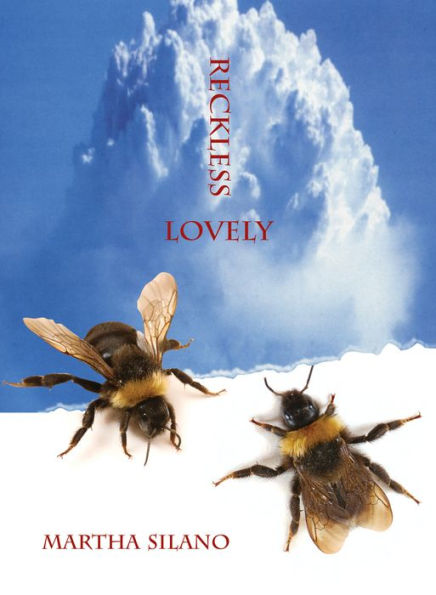
I mentioned Silano’s poetry in a recent post when I appreciated her scientific ideas that meld with an “everyday” life. Reckless Lovely contains many long-lined couplet verses that name objects such as a 64-ounce Big Gulp, Wells-Fargo, Italian Renaissance paintings, or the red spot on Jupiter as the poet observes and speculates on the cosmos that surrounds her. And she invents or alters words that suit her for rhythm, alliteration, sound: “the sfumato is sfumato-ing, the lute-r is lute-ing;” “when most of all that creep-eth/breath-eth buzz-eth/galump-eth sex-eth spar-eth/went AWOL/paving the avenue of asp/the boulevard of bee…” or the totally wild mashup Silano composes in “Summons and Petition for Name Change”:

Dim sum-my dilberry. Down there Daquiri.
Ear of Eden. Eminently Earthy. Empress Gensho.
Fandango-ing funnel. Fox foot. Flamingo.
Geranium in the Gate of the Gourd. Gentian's grin.

~

I find much to admire in Martha Silano’s work even though I often have to look up words (physics and geology nomenclature, usually).

Lesley Wheeler’s most recent book demonstrates her ability with form and sound in a different way, though in “Gran Torino Gigan” the alliteration is as snazzy as Silano’s abecedarian poem above: “Buzzes fade up front,/where beltless adults murmur and smoke//after unfurling musty sleeping bags…in rhizomatic zigzags, with a sharp zipper.” Contemporary technology gets into the poems and, with it, the sounds of our infrastructure, as in “I believe in utility poles, transformers,/lightning arrestors. Subtransmission lines/and static lines. The dead southern yellow pine…” and the theme of fungal connectivity means that we learn some useful and often beautiful mycology terms. Yet Wheeler often relies on shorter words when they suit the tone of the narrative. In a poem dealing with the aftermath of her mother’s death, she writes “No one’s grimmer inside/than me. My bully of a heart wears cheap/scuffed pumps and cusses like a mobster.” The repetition of the word “snow” in “Minus Time” establishes the poem’s pace. So many poems in the collection offer experiments in form!

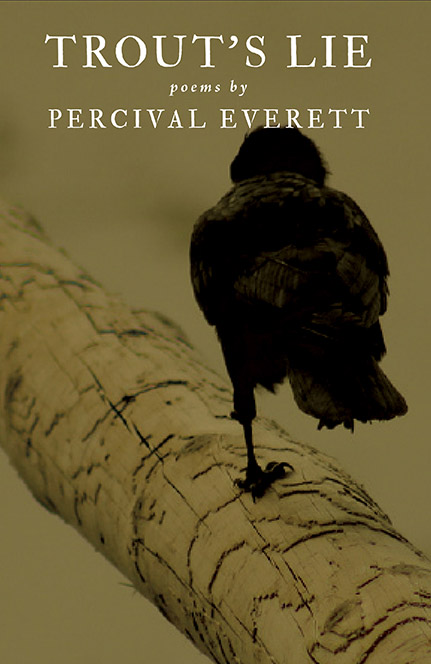
Percival Everett has gained an even stronger following thanks to his novel James, but he’s been writing poetry for years (Trout’s Lie is from 2015). This collection is deceptively simple in language and vernacular: there are surprises. Several poems make allusions to “great poetry of the past” by name or phrase; short lines build and build, twisting the lyric where we don’t think it would go. There are several examples I’d like to give, but this post is getting pretty long. I think I will close with an excerpt from Everett’s “Maybe Even Clouds,” the first section, which begins “Count the marines..”

They look like nice
Boys and bad boys,
From Vermont-and-Montana-
Following-orders-dumbshit-
Non-blinking-soon-
to-kill-soon-to-die boys,
Who might or might
Not, should or should
Not, but never would
Not and never can
not.
Not sure doesn't matter.
Doubt is a penniless
Customer, conscience
Waits for the weather
To change.


National Poetry Month may be almost over, but I’ll keep reading poems. And posting about them. And writing them. I encourage you to do the same, because there is no time in the history of the world when human beings haven’t benefited from poems.

Riches

The past week gave me riches galore; though I am somewhat poorer in the pocket for it, my cup runneth over in about every other way. It’s true that often, lately, I’ve felt that I am living in “interesting times” that are all too much and too awful to contemplate for long. Then again, I could have been alive (possibly quite briefly!) during Boccaccio’s time and weathering the bubonic plague. Thanks to The Decameron, readers later in history have been able to get a picture of what people were thinking about and imagining–or trying to escape–when things were truly terrible all around. And while I’m not pollyanna-ish about the present, I do feel grateful that I live during an era when travel to distant places is possible and rather speedy, that books are readily available, and that some of the wealthy people of the not-too-distant past decided that philanthropy included funding libraries, gardens, and museums for the average citizen to visit and enjoy. Current billionaires, please take note!

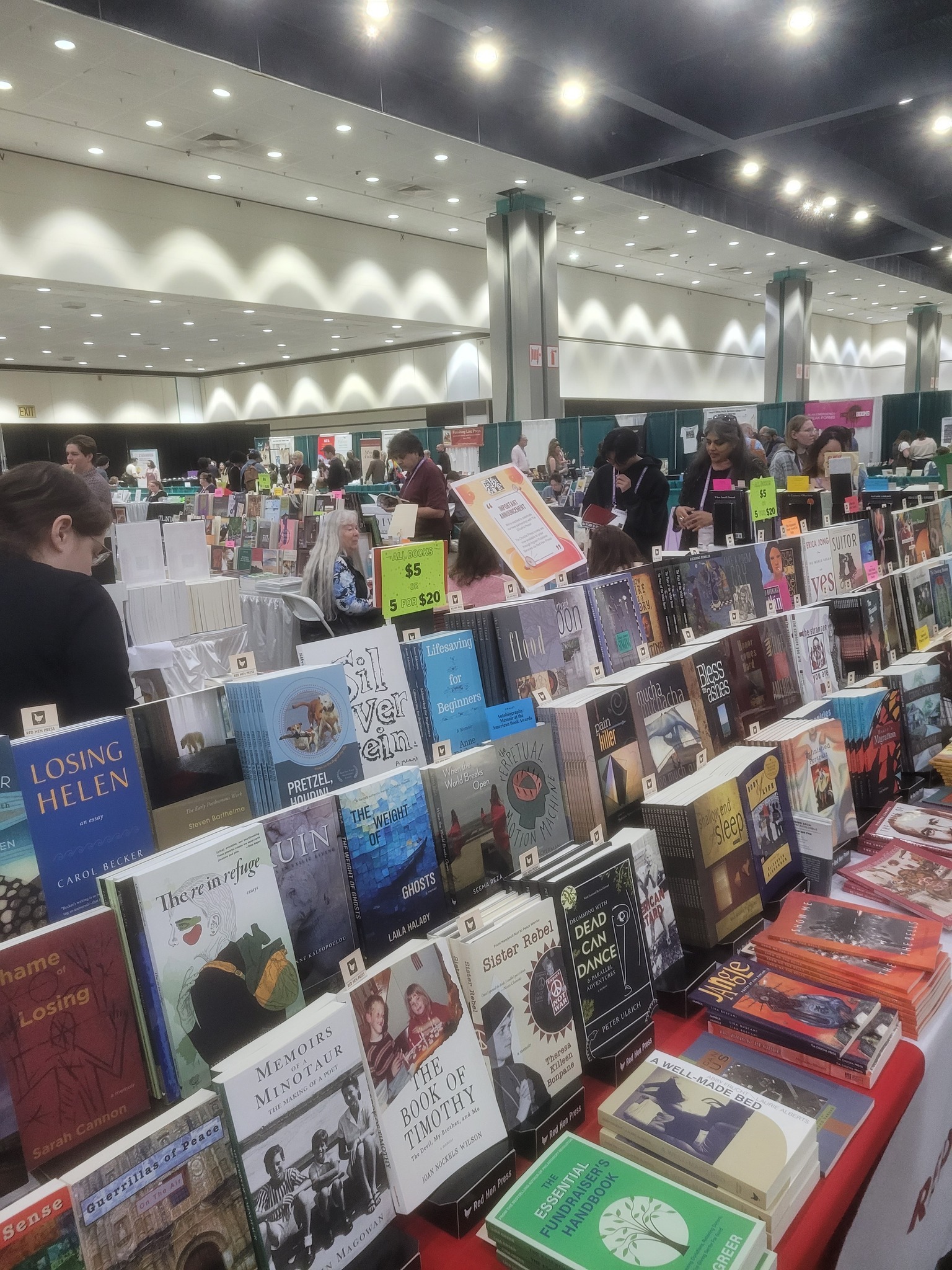
What the week entailed was a trip to Los Angeles to visit my eldest child and, while there, to spend a morning at the AWP conference book fair. Riches indeed! I “packed light” to be sure I had space in my carry-on for poetry books, which thankfully tend to be slim paperback volumes. I bought almost 20 books, I confess. So I came home weighted with literary riches, and while at the convention managed to connect (however briefly) with numerous poet colleagues. A shout-out here to Lesley Wheeler, whose book I had to purchase online because Mycocosmic had sold out! Congratulations, and I cannot wait to read it.

My days in LA were limited to four, but my son had curated a things-Mom-would-like-to-do list that included Mom’s necessary down time. It’s terrific to have offspring who are now old enough to respect my limits. [They have not always been so accommodating.]

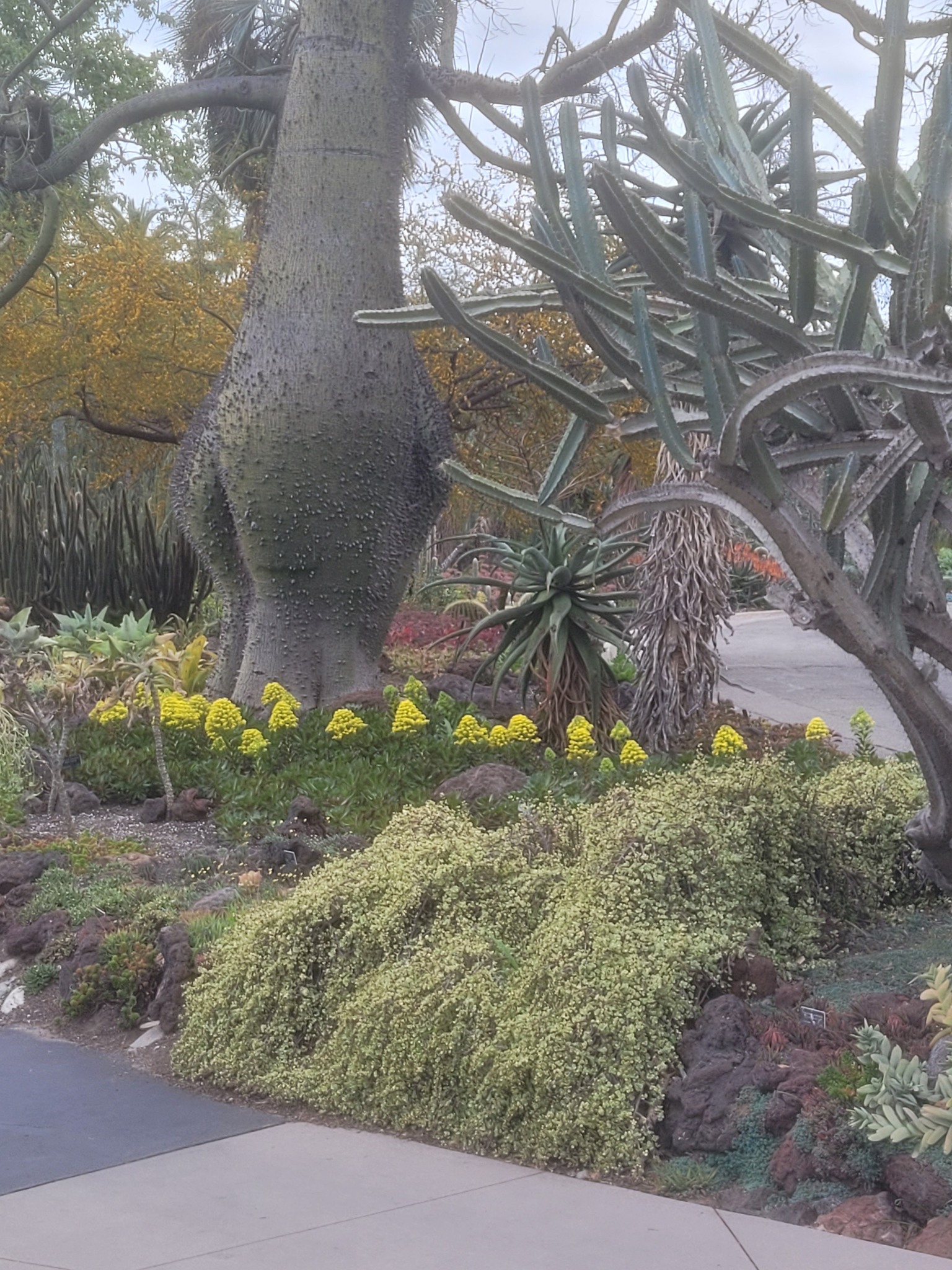
The list included several lovely meals out, a full day at Huntington Gardens and Library, a day trip up to Santa Barbara, a visit to LACMA to get an “art fix” for me and for my son’s best beloved, who loves art and architecture, and a visit to the amazing Museum of Jurassic Technology which, as far as I am concerned, is basically a series of amazing poetry prompts. I cannot possibly explain it; and the museum’s website is purposely a bit obscure and limited, compared to the immersive experience of going to the place in person. I am still thinking about it and will be for weeks.

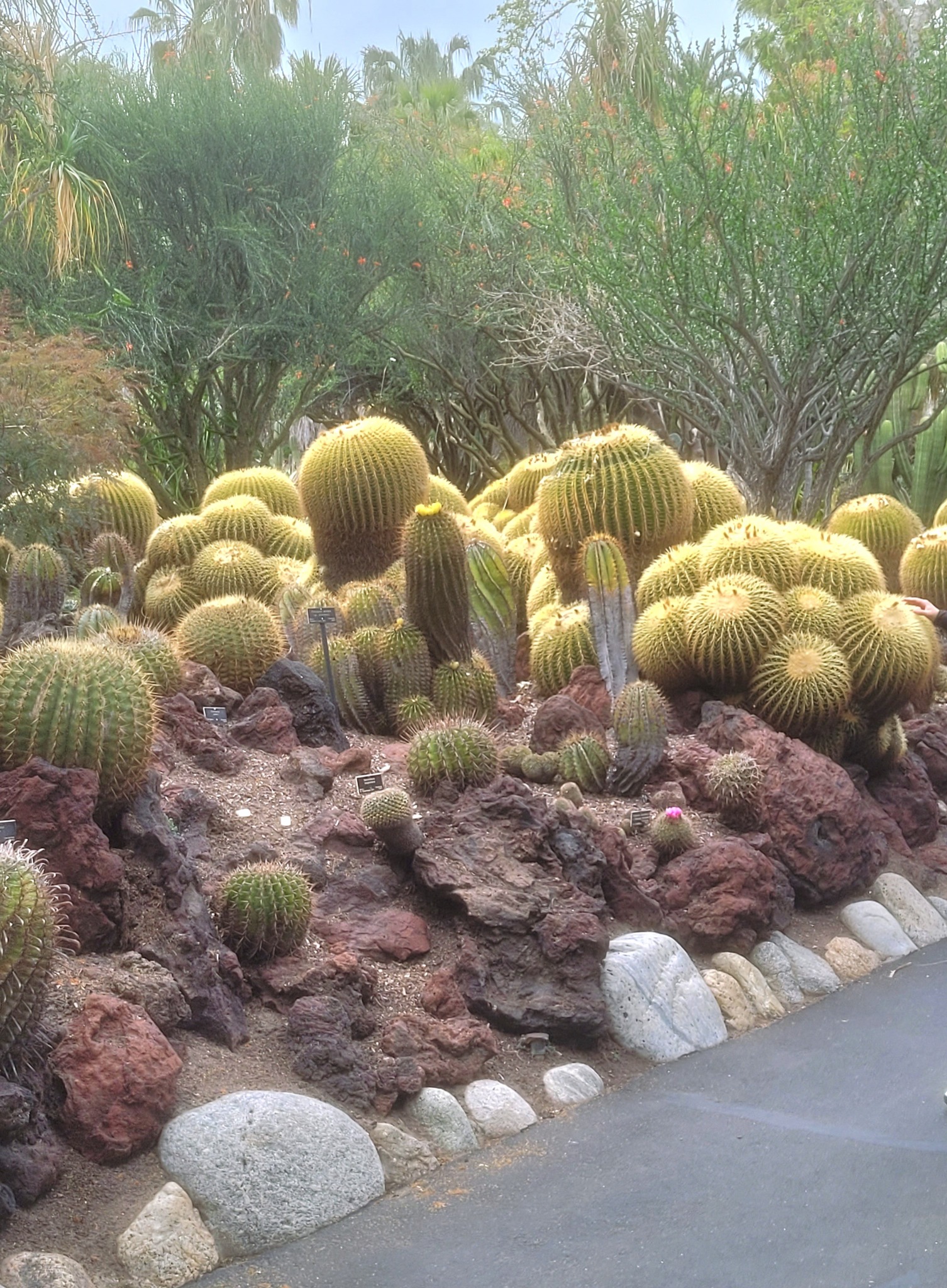
The barrel cacti at Huntington

While photo ops abound at the gardens, no photos are permitted in the Museum of Jurassic Technology; I will lead you to the website and just keep you guessing. But among the riches of the last week are germs of new poem drafts. We shall see what emerges.

Four+ days away, and I returned to spring in eastern PA: narcissus, magnolias, glory-of-the-snow, squill, bloodroot, forsythia, ornamental plum. Even more richness. Gratitude for the glory.

August

August is the month of the Sealey Challenge, which basically urges those who like/love poetry to read a book of poetry each day of the month. I haven’t given myself the challenge this year, but I am posting individual poetry books on my Instagram account daily–books from my personal library, mostly–and that means that I read a few of the poems, too. Sometimes I get carried away and re-read the entire book. [@aemichaelpoet]

This is not a bad thing.

Meanwhile, August this year behaves as it usually does, weather-wise: blisteringly hot and wiltingly humid. That would be okay except that June was so hot and dry and now an early hurricane has begun its climb up the coast; for now, we are stalled in a heat dome, and by Friday we may be inundated with rain. All of this means that my tomatoes are likely to split just as they all get plump and ripe. It also means that our annual folk life festival (Goschenhoppen) is likely to be a muddy, damp affair with fewer attendees than usual. These things happen, and they happen more frequently when the planet undergoes climate change.

~

August, as most of us learned back in grade school, is named after the emperor Augustus, whose name means “venerable, noble, majestic.” [Source: my favorite, Etymology Online]. The online source notes that “In England, the name replaced native Weodmonað ‘weed month’.” Weed month is a perfect name for August, and I think I will adopt it from now on. It certainly fits the current state of my vegetable patch as the dog days keep the outdoors too miserable for heavy labor in the dirt.

At least for me, however, the laboring can be optional as long as I don’t object too strenuously to a haggard-looking garden. The people who are truly hard workers this time of year are construction and road crews, landscaping crews, farm workers, roofers, line workers, and others who have to brave the heat and humidity to make a living. Also the janitorial staff crews at schools and dorms and other older buildings that don’t have reliable–or any–air conditioning. When we are outdoors working at the festival in August, we get a taste of how challenging it is to do physical work in the heat. This is actually an educational aspect of the festival for those who participate, especially for younger people who are new to the festival. We remind them that people worked like this all the time, in summer and during snowy winters and in the rain and without electricity…with no escaping it, since they needed to work hard just to stay alive.

Perhaps unfortunately, our forebears’ grinding efforts may have led to the idea that only hard work will save us and make us morally upright human beings. Few of the early Germanic settlers here had much time to read or compose poetry, to savor novels, to learn to play an instrument. Art was acceptable to a degree, so long as it decorated otherwise-useful objects. The poetry of the Bible was acceptable, but it wasn’t studied for its beauty. A person with my sensibilities and temperament would probably have been an outlier in Goschenhoppen’s historic community. If I’d lived to be 66 in the early 1800s, I’d be considered “an old cripple,” mostly blind and bent over with arthritis and stenosis. But maybe I’d be the kind of old woman who tells stories.

On the other hand, maybe I’d be considered a witch! I guess it depends on what sort of stories one decides to tell.

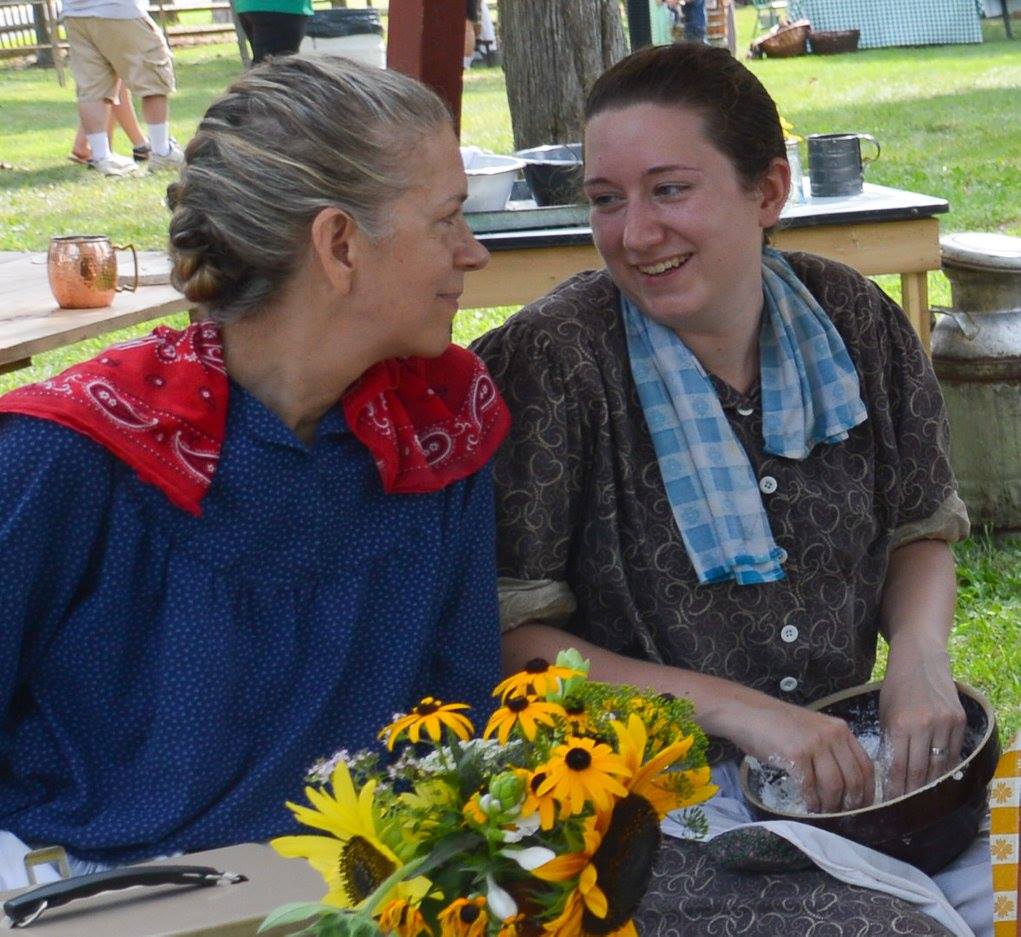
At a previous year’s festival, with my daughter. Bewitching the local kids with potato candy!

Milling & worthiness

Probably because I have been stalled on my manuscript (see previous post), I’ve been reading blogs and speaking with friends about the whole “project” of publishing poetry books. People sure have widely varying opinions. It had occurred to me there would likely be some controversy over this even in a world as small as poetry; but I am surprised at how heated poets, and publishers, can get concerning the whys, whens, and hows of poetry collections. Whether a poet’s work is ready, for example, or–as some folks might put it–worthy of a book or chapbook, and when in one’s “career” is the time to put a book out into the world…and whether the time it takes and the costs of submitting and contest fees are worth the effort or act as a barrier to the underfunded, the less-known, and the uninitiated (or to people who just are not very good poets).

Where a writer is in her poetry (career, journey, artistic path, life, whatever) surely makes a difference in whether or when she pursues manuscript-making. Some folks suggest getting a chapbook out as soon as one has enough good poems because a chapbook looks good on a poet’s CV. Others insist it is better to wait and get work published poem-by-poem in journals and literary sites.

Some poetry publishers are more selective than others, so writers new to the process are likely to feel discouraged when they keep getting rejections from these “top tier” places. There are publishers who are less selective, but sometimes writers get warned away from having their manuscripts produced by a so-called poetry mill. “Get your books accepted and published by the best-regarded publishers,” they’re advised; a chapbook-mill press will not look as good on the CV.

But getting that manuscript accepted by the best-regarded place can take a long, long time. (Speaking from experience!!) What to do?

I’d advise poets who want to compile a manuscript to think about what the purpose of doing so is. There are more reasons than you might realize. Are you trying to get a job in a creative writing program? Are you trying to stand out in the crowd? Do you want to publish mostly for your friends and relatives? Or for yourself? Do you need publication in order to stay on the tenure track? Does your manuscript represent the creative output of a difficult time that you want to make art from and share with others? Are your poems gathered together in order to inform, to argue/convince, to entertain, to be relevant in the moment? Is your manuscript a kind of personal document, a memoir in verse and, if so, do you view it as important for other people who may relate to your experiences? How crucial is is to have the book published soon? Do you think it is important to have the book be a prizewinner?

These are just a few things to consider. Other reasons abound. And at any rate, thinking about what you want your book to be or do or accomplish should help you to decide the where and how of getting it into print. Or if that is even necessary. These days, poets can garner quite a few readers by having poems that get posted online in literary blogs, journals, social media platforms, and other sites. Do you really need, or care about, having a book? What makes the process “worth it”?

Then there’s self-publishing–which, thanks to Lulu, Amazon, Blurb, BookBaby, and similar businesses is not that hard to do–and which no longer carries quite the stigma of “vanity presses” (though if you are trying to get tenure, I’d advise against this choice). Not all of us feel up to learning the ins and outs of templates and design limits that these businesses offer. Some presses began their lives as ways to self-publish or to publish the work of a poet whose work wasn’t getting much attention; Lamont Steptoe started Whirlwind Press (now defunct) to publish Dennis Brutus‘ poetry, then started publishing his own work, then morphed the press into Whirlwind Magazine for several years. Of course, there is no promotion at all; poets have to do their own PR even with some very good presses, and self-publishing requires even more.

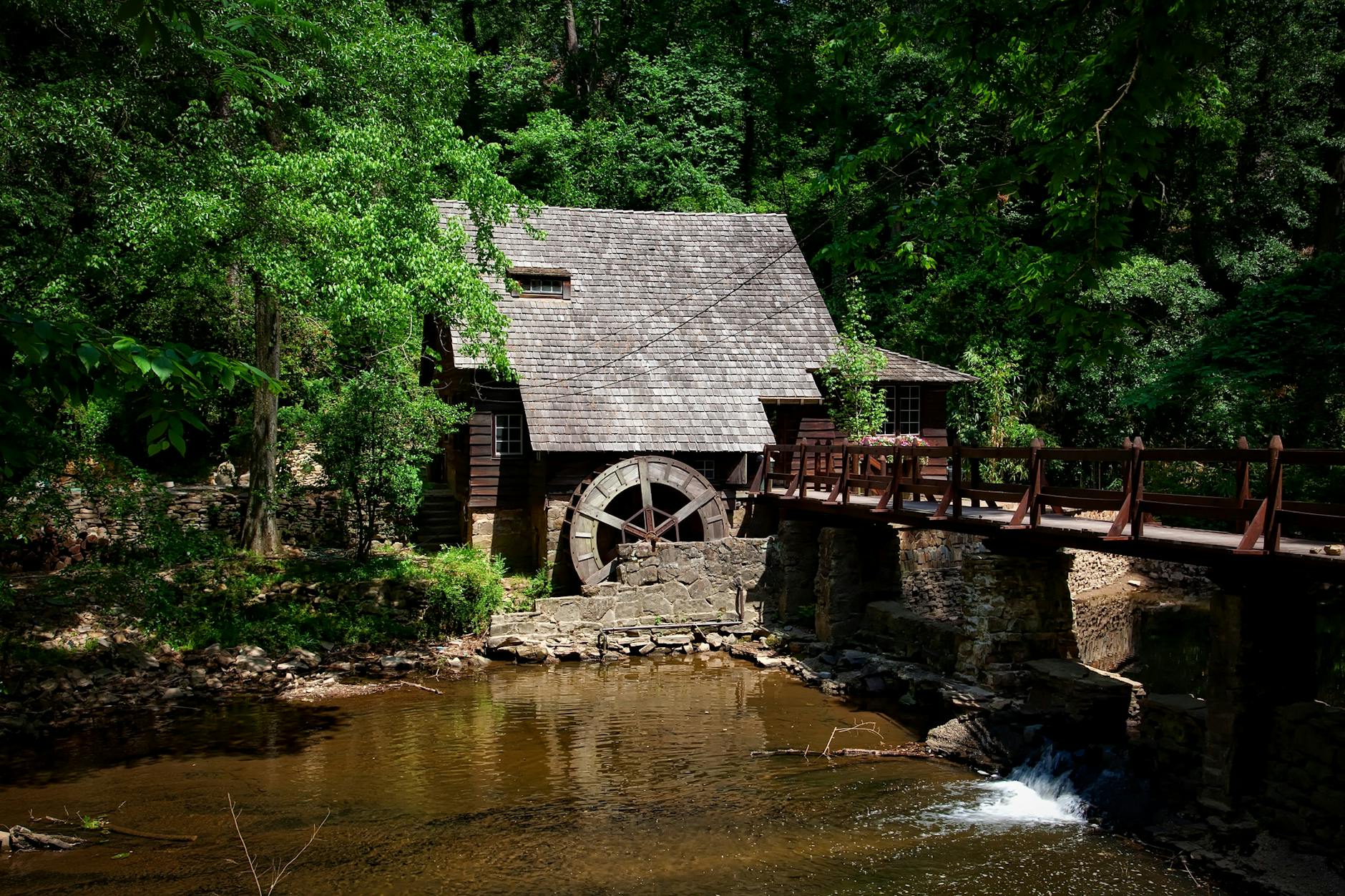
Photo by Pixabay on Pexels.com

Then there are the “mills” I mentioned earlier. These would be poetry publishers that, critics note, are less “discerning” than the hard-to-crack literary presses. The ones I know of are not as predatory as vanity presses and are easier to work with than the Amazon-style self-publishing route. Some of them offer promotional advice or social media activity, and some may invite their authors to participate in regional group readings. And in fact, I have had one book and a chapbook or two published by presses I’ve heard referred to as mills. I suppose the publishers might object to the characterization, but it doesn’t bother me.

My feelings on getting my books in print have evolved over the years, and I think that they should. I am no longer a young poet new to the challenge of getting my poems into magazines (they were all print when I was starting out) and thinking about whether I wanted to work in the creative writing field or not. As it turns out, while I did earn an MFA, I never really used it in the academic area where I ended up. But I attend writing conferences, engage in critique, send my work out for publication–singly and in manuscript form–which are all parts of the poet’s career (if you can call it a career).

At this point in my life, I want to make books! I love books, and I love reading poems in books and not on a screen of any kind. It doesn’t matter to me if my books win prizes (though one did!) or are published by top-tier literary presses (er, no…), or if they ever result in my earning anything from my writing (not yet…). Yes, I want my manuscripts to be worthy–by which I mean that a few readers find something of value and enjoyment in them. On balance, that seems good enough for me.

~

Legacy vs the present

For National Poetry Month, I’ll be posting a poem here every few days…something from one of my books and chapbooks.

First, though, musings on why it matters to me that my poems get collected in book form. I’ve been asked about this by a few people recently, sparked by conversations about the changing technology of “print,” and also artistic purpose, and even the concept of legacy. If I were a visual artist–say, a painter–there would be objects my hands had produced. Even a mediocre painter creates something apparently lasting or worth something. You die, and your paintings go to family members or to flea markets where people can purchase them (for the frames if nothing else…). A ceramicist may make truly useful things such as bowls and mugs; those items can last and be used, even if they end up in thrift shops or post-apocalyptic archeological digs. Maybe the painter or potter isn’t remembered, but the product endures for awhile.

But poems? So many people leave behind sheaves of unread, unpublished, perhaps private writing, much of which won’t resonate with anyone. Even if it could, the chance that anyone would care enough to sort through before burning or recycling and uncover a heretofore unknown genius is vanishingly small. I, for one, am not writing for eternity or for the future. I write for the now. The main reason I want to get books in print is that the product (a book! I love books!) matters while I’m here. After I die, no one will want my pile of drafts, old journals, revisions, false starts–not even my children. And why should they? Will future society value archives of anyone, let alone very minor poets of the early 21st c? Maybe the demise of technologically-based societies is right around the corner. All the more reason to work in and for the present moment. If I garner a few readers today, I feel blessed.

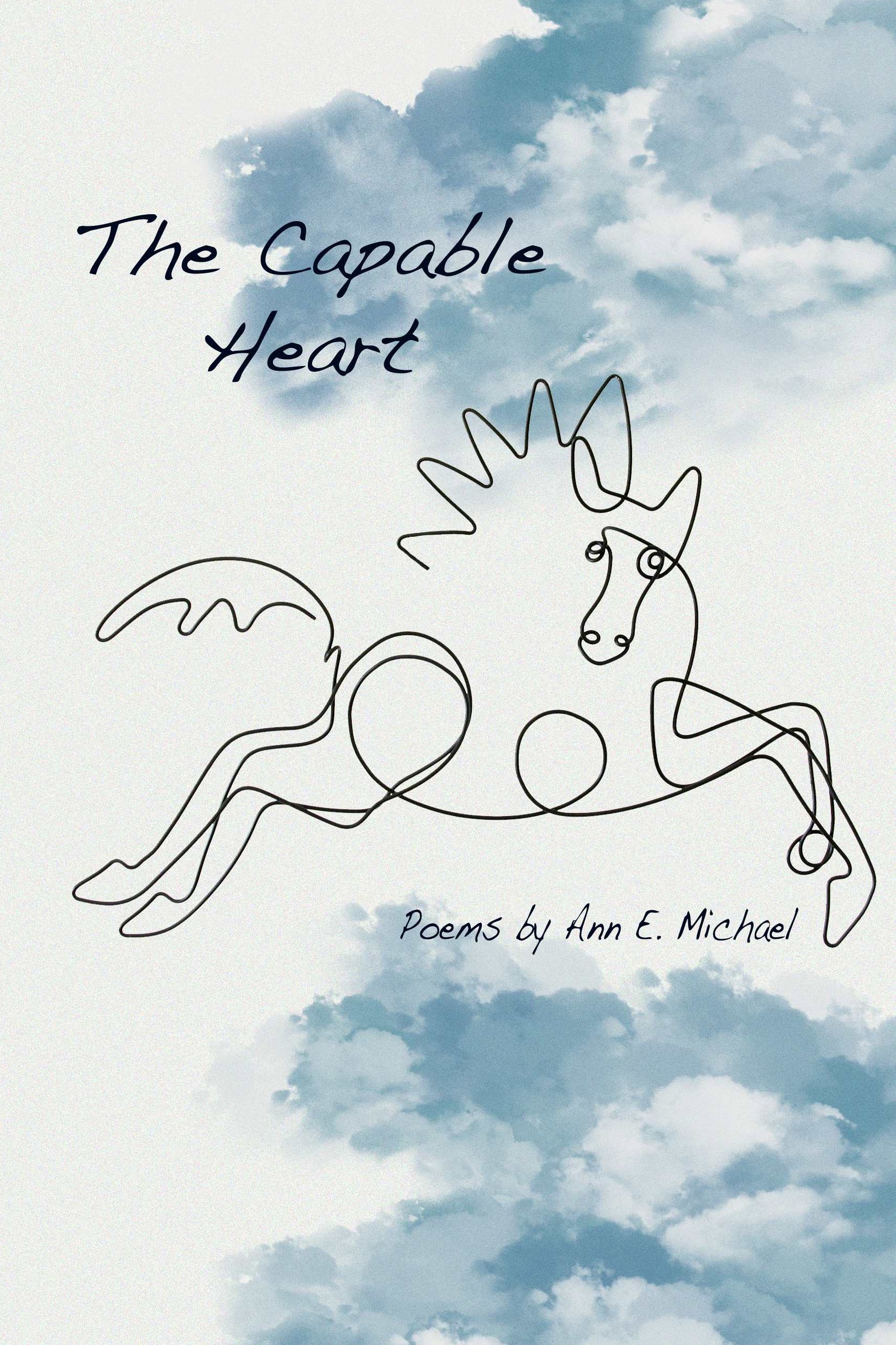
~ Today’s poem is from my 2011 FootHills Publishing chapbook The Capable Heart.

No Long Farewells

The weedy field.
On the rise beyond,
armies of brown corn,
ready to fall.
Willow looses streamers,
yellow kites
floundering in
tall grass.
I look at my hands,
fingers gold. We
walk past grapevines.

Later I think of this day
as a drafty barn,
sun on its walls,
clouds high beyond rafters:
roofless.
Nothing blocks our vision
for once. No blinders.

There is little time
for long farewells.
A light goes on.
Your bus is leaving now.
Moon follows you home.

Cover reveal

Earlier this week, I went to a neighboring city–Reading–to record a TV segment for the local station, BCTV, that hosts a program about poetry! The host and interviewer is poet Marilyn Klimcho of Berks Bards (a non-profit poetry group in Berks Co, PA). It was truly pleasant to read a few of my poems in a professional setting (studio), but the best part of the day was just chatting with Marilyn about poems, poets, and poetry. We began our conversation half an hour before the cameras rolled and continued it afterward, so the 25 minutes that were recorded seemed just to be part of a longer, casual discussion.

I appreciated that. I’m part of a long-running critique group, but it’s seldom that I get the opportunity to pick someone’s brain and share ideas, influences, and general enthusiasm about the art of poetry the way I did in grad school. Probably could work on getting more such discussion into my life.

The “Poets Pause” segment will air in March and then reside on YouTube, so I will post that link at some point. It was kind of Marilyn to highlight The Red Queen Hypothesis and to give me a chance to mention my next collection, forthcoming from Kelsay Books later this year. Speaking of which, I do now have a photograph of its cover:

The photo is by Don Schroder, a friend who’s got a website full of lovely images from his numerous travels to the African continent as well as good shots of festivals of many kinds and floral beauties from arboretums and gardens. Go check it out!

The cernuous tulip seems appropriate to several themes I evoke in these poems–elegies and the sense of impending losses but also appreciation of beauty and brevity and life’s many colorations. Initially, I thought that I was using fewer of the animals, plants, weather and the “nature stuff” I tend to populate my poems with, because so many of the poems in Abundance/Diminishment are for or about humans. But…nope, just took another look through the manuscript in the final approval/editing process and realized that I cannot seem to leave the planet’s environment out of my work. I probably should have been a biologist, ecologist, or a science teacher instead of an instructor of English, but oh well.

Frankly, I love the simplicity of this cover, and I’m excited to have the book in print later this year…especially since it took me a decade to get The Red Queen Hypothesis into the world.