As I’ve previously mentioned–I have been putting together another manuscript of my poems–a collection. I had a few ideas on how to make the poems work as groups, but it turns out they are not happy together. I don’t think a poetry collection needs an “arc,” but I like to have the poems converse with one another in some way. Resonate with or inform one another. That’s what I am enjoying in Louis Simpson’s 1980 collection Caviare at the Funeral. I realized my aim in collecting my work was off when reading his book just recently…and now, I am reconsidering my manuscript approach. Again.
This may be one reason why, despite being a fairly prolific and reasonably well-published poet (in journals, etc.), I am so pokey at getting books into the world.
But I am considering what it means to be a collector, which is not the same as a curator. There is a difference between collecting one’s work and curating it into an experience for a reader (including oneself). Curating has never been my strength: I was the kind of child who collected things randomly, attempted to organize a doll or rock collection, but mostly just had little piles of stuff that interested me.
That’s poetry, too…little piles of stuff that interest me.
Some years, I have devoted my National Poetry Month energies to attending readings, getting out in the world to listen to writers; some years, I’ve tried hard to submit at least 30 poems to magazines and journals; some years, I have read two poetry books a week for the month of April. This year, I wrote a poem draft a day. OK, now what?
When you love poetry, you do all of these things anyway. Having a month to celebrate the art merely acts as a public awareness campaign, though it has reminded me, year after year, to aim for a bit more discipline in my creative life.
~
I have also been reading, of course, bookish person that I am; this past month, a real standout–and a difficult book in a few ways–was An Orchestra of Minorities by Chigozie Obioma. The novel offers a way in to the cosmology of the Igbo people (Nigerian, mostly) while wrenchingly capturing the anxieties of modern life and the timeless agonies of lovers separated by class, race, status, religion (whatever gets in the way of lovers). Obioma successfully interchanges voices, languages, creoles, narrating from the point of view of a guiding spirit. Spoiler alert, the book ends with tragedy, and there are tragedies large and small throughout. The tension of human anxiety works really well, and all of our fears.
The guiding spirit, who has accompanied centuries of human hosts through their lives, has a refrain: “I have seen it many times.” I thought of Vonnegut’s “So it goes.”
Trying to imagine my own refrain…it might be something on the lines of: Life’s difficult, so we have art and poetry and love and one another to get us through.
so, I did what I set out to do: I exercised the necessary discipline to draft a poem a day during National Poetry Month, and I pushed against my “comfort zone” by publicly posting those drafts as they came to me. Usually I do not share my initial drafts with anyone other than fellow writers in my writer’s group or a few poets with whom I correspond. This was an interesting experiment on the personal level, therefore, a sort of forced extroversion as well as effort in productivity. I now have 30 new drafts to reflect upon, revise, or ignore.
It has been years since I came up with that much work in four weeks’ time. For the last decade or so, my average has been closer to six or seven poems a month. And I would not have posted any of them as they “hatched.” I would have waited until I spent some time with them and figured out how best to say what they seemed to want to say.
That’s not an unwise approach in general; I see nothing wrong with letting poems stew awhile. And quite a few would have ended up in the “dead poems” folder. Nevertheless, trying something innovative tends to prove valuable. The takeaway is that I am glad I finally managed the NaPoWriMo challenge. A few of the poem drafts you may have read here stand a chance of evolving into better poems. Maybe some will end up in a collection (years down the road). That result feels good.
The takeaway is also the realization that I no longer worry about how others judge my poems, the way I did when I was starting out and discouraged about having my stuff rejected by magazines. Not because there’s less at stake–indeed, I feel as invested in my writing as I ever was. The difference comes with the kind of investment, the ambition to write something meaningful or beautiful, and not viewing the poems as results waiting to be determined as valuable by someone more authoritative.
I’m 60 years old and well-educated in poetic craft, style, purpose, analysis. I’ve been writing poetry for over four decades. At this point in my life, that’s authority enough.
~
Self in the World
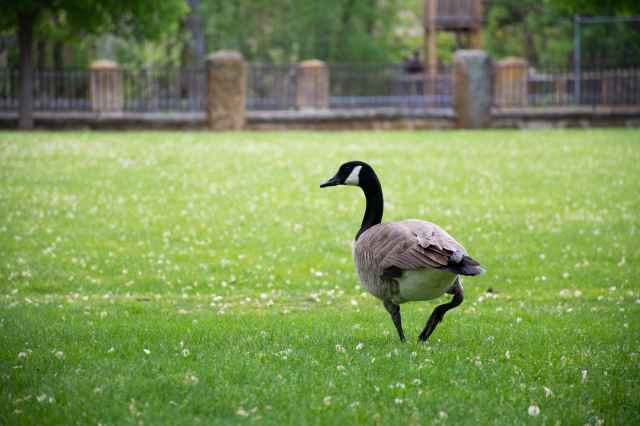
Goose stands sentry in the dew-strewn meadow.
Blackbird browses dry grasses woven along embankment,
emerges, slim stems clenched in its beak.
Under the footbridge, polliwogs gather,
backing into its shade–hawk overhead,
bluejay screaming territory! the crows respond–
Sun halos the water-strider’s shadow,
making a cluster of coronas on submerged stone
where wood frogs squeak and leap into stream current
surrounded by bedstraw, henbit, dandelion,
Amur honeysuckle, garlic mustard, stiltgrass,
invaders all. Except the frogs, who found the stream–
itself new to the landscape, gouged here in the 70s.
What do I notice, then? That some of the living adapt?
What do I make of myself in this world?
The second day of my daily poem challenge won’t give me much time to compose. A tanka poem may be in order.
These 5-line poems pose considerable constraints on the writer and, in my experience trying to write them, require frequent revision to get the moment vivid enough. So this one will be a rough draft. An experienced tanka poet may be able to compose tanka rapidly; my attempts usually need eight or ten revisions…well, here goes.
~
Past midnight, silence
4 am, flying squirrels chirp–
maple buds redden at dawn
Like Hayden Carruth’s “Mother,” (see my last post) Stafford’s poem is, for me, a kind of zenith–something to which I might aspire, but look, it’s already been done. So why pen my versions of the experience? Especially when I am not the writer Stafford was.
And might a reader accuse me of hijacking Stafford’s imagery when I write about similar incidents? I suppose I do run that risk. Nonetheless, the whitetails occur often in my poems from the past 20 years because I live in eastern Pennsylvania. Pennsylvania has an estimated 1.5 million deer—about 30 deer per square mile–and I suspect that in the suburban-rural zones such as the region where I reside, the number is higher.
As a writer, my inclination has pretty much ever been to write about environment and place and to supply anecdote or lyrical narrative. Deer abound in my environment and in my work; and deer get killed on the roads here. The imagery lodges in my consciousness. After so many years observing them, deer have become both subject and metaphor. I may swerve, but I cannot always avoid them.
The following poem is from my collection Water-Rites, and here it is the speaker’s husband who pushes the doe’s body off to the side of the road. The presence of children changes the perspective considerably, despite other similarities to the Stafford poem. Maybe that is all I can offer: a slightly changed perspective, a different closure. I cannot un-moor myself from the images and places that inhabit me.
~
Yellow Forsythia
We glimpsed the doe
trying to rise, and failing,
in the roadside darkness.
“Stay here,” my husband said—
and a moment later,
“She’s hit.” I nodded. I’d seen
skidmarks on macadam.
The doe lay on her side and thrashed
while our engine idled,
thrashed, shuddered;
my husband placed his hand
on her neck.
In the car, our son stared
at the darkness. Our daughter wept:
“He’s frightened the deer.
She’s kicking to get away.”
The doe jerked, paused. “No,”
I said, “Your father is touching it.
Soothing it, so it will not die alone.”
He knelt by the quieting body.
Blood ran from the muzzle.
One ear twitched, I could see it
in the headlights. Death
closed in, a gentle exhalation.
My husband eased the carcass
off the road shoulder. He said,
“She must have suffered awhile.”
“Stupid cars,” my daughter muttered.
Her outrage engulfed our station wagon.
My son watched the white-
throated body, the yellow
forsythia lit by car lights.
He said, “Close the windows, please.”
I am going to go out on a limb here and make a blanket statement: Revision should be every writer’s middle name.
I tell this to my Comp-Rhet introduction to academic writing students all the time, but they have difficulty figuring out how to revise effectively. There are good tactics out there, but they do not work for everyone; how a person thinks and learns and processes information varies considerably. Lately, I have been using a strategy I teach to students writing essays to revise my poems. I ask myself: how is this poem organized? Is the structure working with or against the poem? Too predictable, or not predictable enough?
Just as in a well-wrought prose piece, a poem’s obvious and underlying structures matter a great deal in how well it “works” for a reader. It’s also an aspect of writing that people tend to overlook, so analysis of structure in the revision stage can be useful.
Another revision strategy I have been mulling over recently coincides closely with what Grant Clauser describes in this post, The Poem Is the Question. He writes:
I’ll scrounge around in the poem to try to find what it’s asking. If I figure out the question or the motivation in the poem, then I’m better equipped to solve its problems… Sometimes it helps to actually put a question in the poem–either as a crutch that you’ll eventually remove–or as a permanent part of the poem. A question is a pretty interesting part of speech in that it’s one of the few that almost always demands a response from the reader.
I have found myself going back to a draft and asking, “What got me going on this poem? Do I even recall? Is the impetus an interesting one? If not, can I change it?” Clauser suggests a more specific kind of investigation, and it’s one I have been employing today (snow and ice out there and the roads are lousy, so the campus is closed–hooray for a half day of unexpected free time).
Lesley Wheeler has also recently blogged about revising. She observes that the word revision, which places “emphasis on ‘looking anew’ doesn’t entirely capture” the process of late-project revision. She’s listening to her own words aloud as she revises…another approach that has worked for me.
Maybe the month of February calls to us as a quiet time of yin creativity, which is a way of looking at revision as an inwardly-focused energy–as opposed to marvelous bursts of creativity from inspiration or the much-vaunted Muse. The lunisolar calendar used for centuries in Asia calls February the first month of spring (立春 lìchūn)! I had better keep at the revising, therefore. Before I know it, yan energy will return with the start of the gardening season in eastern Pennsylvania.
It’s important, I think, to experience discomfort–it means I am facing a new task, a new perspective–that I’m learning something. I tell my students that if they are totally comfortable with the concepts in their coursework they are not learning anything yet. Education does not come without risk, whether the risks be physical, social, emotional, or intellectual. When we feel uneasy, it may mean we sense danger or sense the presence of someone manipulative, dishonest, or unkind. It may, however, mean we are simply “outside of our comfort zone.”
Tony Hoagland‘s poems offer examples of how we learn through leaving our familiar attitudes. Daisy Fried’s insightful 2011 commentary on his poem “The Change” notes the need for such uncomfortable moments. Poems Hoagland wrote as he headed toward his death from cancer at age 64 do not shy away from making the reader feel awkward, unhappy, or–in some cases–relieved, even glad. It can feel wrong to acknowledge relief as part of death. That recognition tends not to follow U.S. culture’s social norms.
I’m not claiming all good poems rile up discomfort; some poems offer joy or embrace a comforting openness; and, as readers bring their own differing experiences to the reading of a poem, the same poem that discomfits one person may appeal beautifully to another reader.
This post came about because I feel I have come to a period of discomfort in my work, and it troubles me but in a good way. I would rather feel discomfort with my writing than disengagement with it. Disengagement is writer’s block, which does not describe where I am at the moment. Instead, I feel rather as I did when I began to write and revise using formal patterns. My written expression up to that point had all been in free verse or prose, so adapting to villanelle or sonnet structure or sapphic meter seemed risky, difficult, “wrong.” Wrong for me, for the writer I believed I was, for the writing voice I had developed for 20 years.
And I was wrong about that, too! My initial discomfort aside, I learned so much about poetry, including about my own style, through the practice of formal verse. The wonderful online journal Mezzo Cammin (formalist poetry by women writers, edited by the amazing Kim Bridgford) has published several of my poems in the past. Now, two more of them! Please click here.
~
Sarah Sentilles’ bookDraw Your Weapons elicited discomfort in me but also marvelous connections (she and I have read many of the same authors). Her observations about art, violence, pain, and language weave in and through stories of a soldier-turned-artist and a WWII conscientious objector.
Between the development of these men’s stories, Sentilles cites research, philosophers, artists, and personal experiences and forces her reader to recognize how even the language we speak is complicit in accepting violence as a given rather than as something that human intention and action can change, if slowly.
I finished reading this book two weeks ago and am still mulling it over, returning to passages, marking some of her sources as “to-read” for myself.
It’s possible that Sentilles’ text in some way stirred up my discomfort with my own work.
And that would not be a bad thing. Getting out of the familiar is not only how learning happens; it’s how creativity happens.
It’s not a social norm–real listening. Despite the recognition that human beings are social animals that require communication, despite the recognition that “talk therapy” (which at its foundation employs active listening) and writing therapy can heal broken psyches, even though many studies over decades have demonstrated how relationships rely upon partners’ openness to listening–listening stays a bit unconventional.
So many people think listening is passive. No, it is an active verb. Bombarded with information from numerous sources, the processes of discerning what one should listen to get tattered and confused. Our brains want to chunk information, to ignore, to elide, to suppress and glean and separate the various threads so the mind can prioritize.
Listening is difficult.
~
Not asphodel but Solomon’s seal, also a greeny flower
William Carlos Williams famously claims it’s difficult to get the news from poetry–and, in the same poem, he asks us (by way of Flossie, his wife) to listen:
…Hear me out.
Do not turn away.
I have learned much in my life
from books
and out of them
about love.
Death
is not the end of it.
There is a hierarchy
which can be attained,
I think,
in its service.
…
the mind
that must be cured
short of death’s
intervention,
and the will becomes again
a garden. The poem
is complex and the place made
in our lives
for the poem.
[I am not html-savvy enough to code the spacing of this poem on my blog, but you can find it here (p. 20) or here; the excerpts are from “Asphodel, That Greeny Flower.”]
~
Poetry : “A way of happening, a mouth.” It survives, says Auden, in his poem on the death of Yeats.
The mouth expresses the mind and also what we call the heart, the soul. To make a poem is an intentional act.
This weekend, I am trying to concentrate on poetry-wrestling, herding poems, culling and grooming and all that. So–less time to reflect on writing my own blog posts.
However! I follow many poets and writers, and one or two philosophy and science blogs, would like to direct my readers to two writers who responded to Mary Oliver’s recent death--both of these poets commented on Oliver’s reputation as a nature writer and a poet of “joy.” Reputation isn’t the same as analysis.
Here is Grant Clauser, wondering whether it will be possible for him to write gladness into his observations (which are quite keen and worth reading).
And here is Catherine Pierce, a poet much younger than I who admits to her own prejudices when deciding which poets to read–which poets are “worth the effort” of reading (ie, which writers teach us most about life and about poetry-writing).
The death of a beloved animal companion some years ago took me to Oliver then. And in the sorrow, I recalled the gladness of having that dog in my life.
“Nature poets” can be fierce, asserting the need for stewardship of our blue planet; poets who write happiness well understand–and convey–that pain and sorrow remain our companions in life. That does not mean a focus-on-the-positive Pollyanna attitude. No–to compose poems that show us we have every reason to love what we encounter takes bravery, because we so often fear what the world offers. To do so takes deep acknowledgment of suffering, not just a glancing nod, but compassion. The poet may not “behave well” in his or her own life but has the practiced gift of observation and enough craft to show the reader difficult perspectives.
Sometimes, gladness and optimism and beauty get obscured by experience and griefs. Next time that happens, maybe turn to poems?
My brother, whose avocation is science historian and whose papers I often proofread, has acquainted me with the 18th-c. comparative anatomist Johann Friedrich Blumenbach. As often occurs when one becomes attuned to new knowledge or focus, I suddenly seem to find Blumenbach’s name or theories “everywhere.” Mostly in books, of course, but also in a natural history museum where I came face to face with a trilobite that bore his name. I have also been reading Andrea Wulf’s book on Alexander Humboldt, The Invention of Nature; Blumenbach was one of Humboldt’s professors and influencers.
calymene blumenbachii
Wulf’s book begins as a biography of Humboldt but closes with several chapters on others who were inspired by his work; she makes the claim that Humboldt’s ideas about the deep connectedness of everything on earth laid groundwork for environmentalists and the discipline of ecology. Indeed, Darwin, Thoreau, Marsh, Muir, and many others found his texts revelatory and transformative. His writing is supposedly poetic and emotional–he did not think the earth and its denizens deserved less than awe and appreciation. Even though his books are packed with measurements, comparisons, careful botanical descriptions, and minute observations of practically everything he encountered, he allows space for admiring the view. Or, so Wulf’s book says. Now, I suppose I shall have to do a bit of reading Humboldt!
~
Along these lines, the lines of the natural world’s connectedness and relationships–ourselves among these, despite our frequent destruction of them–I find myself thinking of the recent death of poet Mary Oliver. I so admire the work and the woman, or what little I knew of her from a few appearances and through friends who studied with her. My social media feed has been alive with tributes, postings of her poems, and some critique about her standing as an American poet, as if that would matter to her (I doubt it would).
I can just make note that her poems have encouraged me to continue to write about nature, even when I’ve been told nature poets are unfashionable, uninteresting, or unnecessary. Her work taught me how to observe closely, like Aristotle at the tidal pools or Haeckel peering at radiolaria. First notice, listen; then describe, then try to obtain more information, and all the while percolate what experience has created within the observer herself. Maybe nothing earth-shattering comes of the process, but sometimes there’s a poem…
Here’s one of Oliver’s early poems (from Twelve Moons, 1979), one readers are less likely to find in all of the tributes to her but which offers a sense of how well-observed–for all their ‘simplicity’–her poems are.
Buck Moon–from the Field Guide to Insects
Eighty-eight thousand six-hundred different species
in North America. In the trees, the grasses
around us. Maybe more, maybe
several million on each acre of earth. This one
as well as any other. Where you are standing
at dusk. Where the moon
appears to be climbing the eastern sky. Where the wind
seems to be traveling through the trees, and the frogs
are content in their black ponds or else
why do they sing? Where you feel
a power that is not yours but flows
into you like a river. Where you lie down and breathe
the sweet honey of the grass and count
the stars; where you fall asleep listening
to the simple chords repeated, repeated.
Where, resting, you feel
the perfection, the rising, the happiness
of their dark wings.
Her poems are not metaphysical by any means, but Oliver is avowedly spiritual, which is not a fashionable thing. I am not spiritual, but I have always respected that in her. May she rest in the perfection and the happiness of those dark wings.



 I am going to go out on a limb here and make a blanket statement: Revision should be every writer’s middle name.


 ann e michael