Dogs & lions

By chance, I encountered the poem “Thorn Leaves in March” by W.S. Merwin (1956, Poetry magazine) a day ago and felt levels of resonance such as poems can evoke. The powerfully “clear expression of mixed feelings”–thank you again, W.H. Auden–converges with seasonal details in this early Merwin piece and merges, completely by happenstance, with events in my current life.

Walking out in the late March midnight
With the old blind bitch on her bedtime errand
Of ease stumbling beside me, I saw

At the hill’s edge, by the blue flooding
Of the arc lamps, and the moon’s suffused presence…

My elderly dog stumbles beside me on these late-winter nights; I do not think she will see another full-blooming spring. Resonance.

alicelamb

Rescue of an orphaned lamb.

“As a white lamb the month’s entrance had been…” Well, that has certainly been true of this year’s weather. And the lamb allusion makes me think not just of the old saying about March but about my daughter, who is spending this month’s last two weeks working among ewes on a farm in Scotland as lambing season progresses.

Merwin’s speaker refutes the aphorism; his March comes in like a lamb because it is white, and goes out in white, as well:

…as a lamb, I could see now, it would go,
Breathless, into its own ghostliness,
Taking with it more than its tepid moon.

The lion, he claims, is “The beast of gold, and sought as an answer,/Whose pure sign no solution is.” No lion in this quiet, late-winter/cusp-of-spring snowfall–the light is silvery, the budding leaves of the thorn trees translucent and cold. The speaker stands beneath the “sinking moon” and wonders, questions, listening for something he knows he will not hear.

The old dog, domestic companion (neither lion nor lamb), completes her mission; the man lets go of metaphysical thoughts; the earth inexorably turns toward summer–despite the snow.

I’ll keep this poem in mind as the next snowstorm heads my way on the equinox.


Roadkill

As the spring equinox approaches and creatures rouse from dormancy, the number of roadkill incidents spikes. Yesterday as I made a left turn into my driveway, I noticed a groundhog carcass lying in the middle of the street. I was stopped to retrieve my mail anyway, so I figured I should move the body off.

And then it moved–bloodied mouth opening and shutting, one heavily-clawed forepaw shuddering slightly. It wasn’t quite dead.

Poems about road kills sprang to mind. I thought immediately of Stafford’s “Traveling through the Dark” and that moment of swerving, replete with caesuras, in the last couplet; Billy Collins’ “Ave Atque Valealso skittered into my thoughts, that bloated woodchuck waving “hail, Caesar” to the passing vehicles.  As I pulled a plastic bag from my car, one of my own poems resonated–“Burials,” which is in my collection Water-Rites (available through this link and posted below).

I made a glove of the bag and grasped the poor beast by its tail, a precaution: it might have been lively enough to snap at me. Not the case this time. A car running over the body would have put the groundhog more quickly out of its misery, but by daylight drivers tend to avoid road kill; it gets smashed during the night hours. So I left it on the embankment to gasp out its last breath with the birds larking about above it and some damp wintry weeds under its dark body.

This sort of experience feels oddly metaphorical…obviously, not only for me but for people like Stafford and Collins. I am sure one could put together an anthology of very lovely roadkill poems.

~groundhog-day-groundhog

BURIALS

1.
Last week the neighbors’ dogs eviscerated a woodchuck,
left it, stinking, at the perimeter of our woods

which is how we found it, by the smell—
body bloated, partly hairless:

a scientific demonstration on the rapidity
and absoluteness of decay, the brief time it takes;

but today my daughter cannot bear the stray cat’s
road-killed stillness, the soft, domestic body,

the pet, which isn’t hers—she begs to bury it.
The schoolbus arrives with my promise

to give the cat some cover. Under mulberry I scrape
a shallow grave, in thin and gravelly roadside soil,

cover it with fallen leaves, an autumn prayer—
nothing more, because I know burial does not forestall

death’s swell, its stink, desiccation,
absoluteness; I do what I promised,

disguising the body’s inevitable progression
from the eyes of my grieving child.

2.
Shall I cover my gray hairs
with dry leaves, shall I layer
my wrinkled hands beneath clay,
hide my own departure—

or shall I teach my children
to understand the truth of maggots,
which consume equally
the treasured and the stray—

which arrive unasked,
fulfill their contract with the earth,
never seeking recognition
or time, more time?

~

© 2012 Ann E. Michael


March, march

March has been a busy month for me. Instead of composing posts on my usual topics (poetry, nature, education, philosophy), I am going to refer my readers to other sites or other writers…a treasury of riches on the web.

To commemorate the 50th anniversary of the Voting Rights Act of 1965, I ask my readers to check out my father’s memoir of the Selma to Montgomery March, here, and to consider this heartbreaking poem by the late Jake Adam York:

~~

For Reverend James Reeb
     9 March 1965, Selma, Alabama

The ministers rise from empty plates like the steam
of chicken and greens and puff into coats, prayers,

and then the unlit streets, the night, ready
for tomorrow’s march or gathering or prayers,

and then the dark is beating Hey niggers
though only their coats are black and the night and everything

so they cannot see what’s coming, what hits them,
what clubs or pipes, what feet are kicking

at their ribs, who’s saying Now you know,
now you know what it’s like to be a real nigger.

No one can see what lands, what cracks Reeb’s skull.
No one can see the hairline fracture

or what’s nesting, what’s beating there,
what wings are gathering in his eyes.

      by Jake Adam York

from the Blackbird archives.

Biography of Reeb here.

Barnacles, finches’ beaks, art

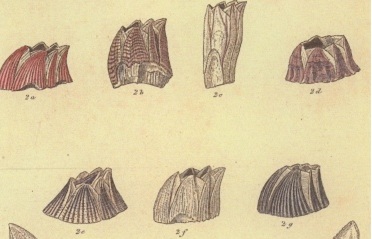
Cirripedia, the barnacles, occupied Mr. Charles Darwin for many years, even though his extensive studies of the class are not what he’s famous for (except among cirripedists). The average layperson knows Darwin as the man who came up with the theory of evolution–though that is not strictly what he did, and none of his books bear that title. After the publication of On the Origin of Species and The Descent of Man, and the subsequent and ongoing controversies that followed, pretty much everything in the world could be–and has been–examined “under an evolutionary lens.”

The original “lens” involved finch beaks, pigeon-breeding, and early geology studies. It was fueled also by taxonomy, anatomy, and barnacles, by a member of the landed gentry who stayed at  home, more or less, for 45 years after his five-year journey on the Beagle. A scholar, an “armchair naturalist” by today’s standards; a genius.

finch beaksMany people who interpreted what evolution suggested went off the deep end one way or another, which is what happens with ground-breaking ideas. Both critics and supporters re-interpreted and often misinterpreted Darwin and the implications of his work, as well, all of which means he accomplished something truly significant. Why not, therefore, examine fundamental human traits to see whether evolutionary currents can be discerned? Certainly Darwin and a few of his contemporaries speculated that altruism might have an evolutionary basis, a concept that was taken up, debated, and temporarily dismissed in the 1960s-70s; recent neurobiological and genetic studies have brought the possibility of a biological basis for kindness back into discussion (see also Damasio).

There is also the question of art (and aesthetics, though taste seems more likely to be social than biological–but who knows?), which brings me to Denis Dutton’s delightful book The Art Instinct: Beauty, Pleasure, and Human Evolution.

Rather than summarize my responses to his thought-provoking and rather convincing arguments, I’m posting some quotes. These are ideas I find juicy to consider; perhaps other readers will feel similarly.

~

Wondrous aesthetic experiences are possible in the absence of a sense of larger community: the response of an individual to a beautiful landscape, for instance, …or to a recording of the Goldberg Variations heard in solitude. If the arts were intrinsically social in the way that social-cohesion theory claims, people…would prefer standing in a crowd to see a painting in a museum, rather than standing alone.

Because of sexual selection, the arts retain an incorrigible sense of being made by one individual person for another…the motives of art, as even Darwin knew, are ancient and complicated–directed toward a community perhaps, but also created to captivate an audience of one.

~

The artist…probes the content of human emotional life with an eye toward articulating, or making clear, a unique emotion, an individual feeling.

Can you imagine taking [a] pill to save the expense of concert tickets, or even the time spent in listening to a recording of the piece? The answer is very likely to be no, and the reason tells us something about the nature of artistic expression. It is not just the emotion as bare feeling we want from art, it is the individual artistic expression of emotion–how emotions are revealed in the art, through technique, structure, balance, and the blending of sounds….Yes, we want feeling from art, but not as an end for which the art is a means: with art, the means is the end itself.      [italics mine]

~

Extending Darwin’s original suggestion, I believe this intense interest in art as emotional expression derives from wanting to see through art into another human personality: it springs from desire for knowledge of another person….talking about art is an indirect way of talking about the inner lives of other people.

~

All of the above excerpts are from Denis Dutton, The Art Instinct, 2009.

http://taxo4254.wikispaces.com/file/view/darwins_barnacles.jpg/274764236/409x262/darwins_barnacles.jpg

wikispaces.com/file/view/darwins_barnacles.jpg

Consciousness as story

Some recent questions to myself:

Reading philosophy and psychology for so many years, was I looking all along for an explanation of consciousness?

Through neurological and evolutionary science, and more philosophy and more psychology and, in addition, some anthropology, some history. And fiction. And rhetoric. Trying, perhaps, to understand the self? Through criticism, through art, through literature?

Looking carefully at art, reading literature closely: were those also endeavors to comprehend what mind is? Other minds? My own mind? Through the creative act, perhaps?

Is the ars poetica a kind of manifesto of human consciousness from an individual perspective, yet open to interpretation by other human minds? And the beautiful–what is it that even makes beauty a significant concept? Where did that come from? Evolution and the sexual drive (see Dutton riffing on Darwin)? Society? Synthesis? Ego? Inspiration? Angels?

Is every story a scaffold to consciousness? A hedge against oblivion? (Self-oblivion, the hardest navigation act there is: depression, hopelessness, loss of self-knowledge, coma).

I wonder if the stories we tell to others and to ourselves, employing memory selectively whether or not we realize it, act as a kind of (modern-day, metaphorical) Chain of Being through which we develop Theory of Mind and, beyond that, a sense not just of ego but of neurological consciousness. If stories are what make us human.

~

The chain of being, from Charles Bonnet, Œuvres d'histoire naturelle et de philosophie, 1779-83

The chain of being, from Charles Bonnet, Œuvres d’histoire naturelle et de philosophie, 1779-83

[Note: I do not hold the medieval concept of a hierarchy in which Man, angels, and God stand above all other things; the stone and the plankton have as much value–likely more–than I do in the workings of the cosmos, as far as I am concerned. I post this Enlightenment-Era engraving here for metaphorical and aesthetic reasons because I take pleasure in the delightful monkey.]

~

Stories have tremendous value to human beings in ways we are still discovering; see my previous posts here, here, here, and here (among others). I keep coming across claims for the significance of story in surprising places–most recently in Dutton’s The Art Instinct and in Atul Gawande’s latest book, Being Mortal. Widely different texts, similar observations.

How is it we know who it is we are?

Possibly, in the process of inventing the story of ourselves, we become human. Perhaps the story of ourselves is fundamental to conscious “human” minds.

Speculation. But I love recalling that my children, when they were very very young, consistently made one particular demand of me: “Mama, tell me a story!”

~

Key images

I had intended to post on Denis Dutton’s book The Art Instinct: Beauty, Pleasure, and Human Evolution; and I will (I suppose) at some point, because I enjoyed it immensely. Looking through my files, however, I found the transcripts from the initial interview Karen Jogan and Hernán Pereira conducted with me when they were compiling the book So Far…So Close and realized that my answers to some of their inquiries connect with my last post about poetic voice and Kunitz’s thoughts on key images. (The longer, but edited, version of the interview appears in the book).

~~

  1. What colors or aromas remind you of your childhood?

Cinnamon toast, mown grass, onion grass (wild garlic), lily-of-the-valley, cedar-water and pine trees, the scent of a muddy river in summer, wintergreen, play-dough, school paste, steam-irons, fresh peaches, campfires, burning leaves, talcum powder, Pepto-Bismol, air-dried clothes and linens, mimosa blossoms, roses, strawberries.snowdrops

  1. Describe yourself as a child.

I wonder from whose perspective I should attempt to answer this question. I know from others that I was considered to be shy and polite, talkative when comfortable, imaginative. I certainly felt uncomfortable among groups of people, preferring small groups of friends with whom I played make-believe. I made up stories which I told my sister and brother, and when I was old enough to write I made little children’s books that I illustrated and bound in cardboard.

My sister was my best friend, but I spent a good deal of time all by myself. When alone, I walked my dog, climbed trees, played on the swings, sketched and painted, and read books. I really was a bookworm and spent many happy hours with books and in libraries. Being alone was, and still is, deeply satisfying for me—it helps me regain creative energy.

  1. At what moment in your life did you begin to write?

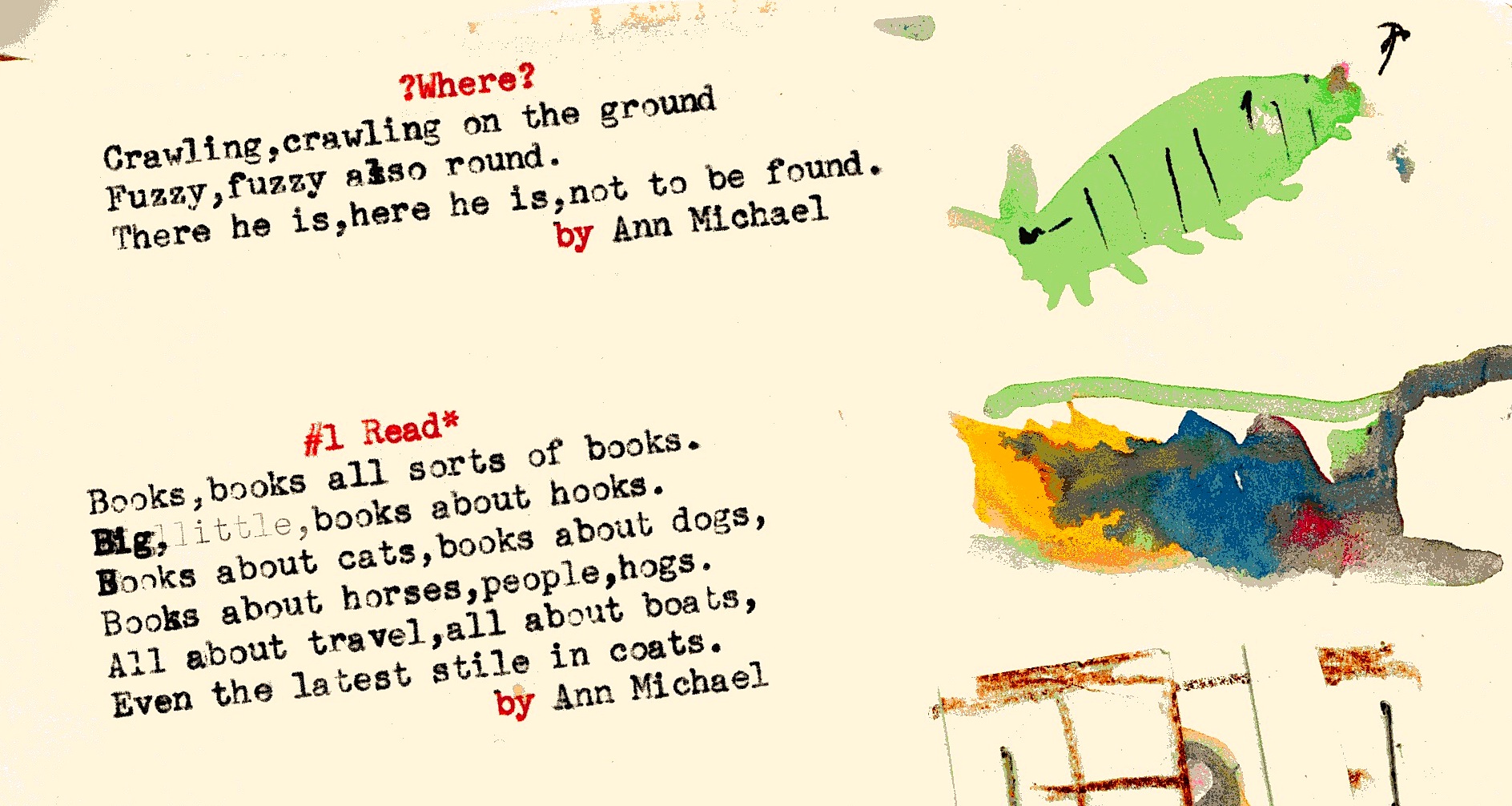
I don’t remember when I began writing. My storytelling began early, and I suppose the writing developed from there. The first story I recall writing down was about a princess; I was in second grade. I felt proud of myself, even though the story was only about three sentences long. Apparently, the poems started when I was about nine. I don’t remember writing poems then, but I recently found some that I had composed and typed up (I was fascinated by the typewriter), and my mother’s notes said I was nine when I wrote them. What I really wanted to be was an artist, but writing seemed natural to me. I started keeping a journal when I was ten…

9yroldpoems010

Rhyming and typing and illustrating and bookmaking– at nine years old.

  1. What influences have been important to you?

Other writers, naturally, but first of all, visual art. From the time I was very small, I’ve loved paintings and sculptures and architecture. Church hymns and Bible verses and nursery rhymes were influential to me, as well as folk music and the lyricists of popular music when I was growing up. I am also influenced by non-fiction work, especially in the sciences, and philosophy. My early poetry influences were Donne, Shakespeare, Blake, and the King James Bible; but then I fell in love with contemporary women writers, then surrealist poets, then Latin American writers, then Asian poetry, then contemporary lyric poems…it goes on and on. It might be easier to say what I have not found particularly influential!

~~

With further reflection, I could go deeper about early images that have become, for me, “key” aspects of my writing voice…a particular landscape, the feeling of an empty nave, bees and birds, milkweed, cloud patterns, my parents singing, my little sister beside me in our shared bed, the sound of a symphony. They may not appear in my poems as such, but these images connect with me in ways I probably don’t understand. What do such keys unlock, I wonder?

~

Voice

I follow the Women’s Poetry Listserve (Wom-Po), and recently there was a discussion there concerning what poetic voice is. Can it be defined clearly? Does it differ, and if so how, from style? Is it personal, belonging to the writer herself–an attitude? Is it distinct from the creator of the poem, as the “speaker” of the poem arguably is in the case of poetic voice/persona?
A listserv member offered this quote from Kunitz:
“One of my convictions is that at the center of every poetic imagination is a cluster of key images which go back to the poet’s childhood and which are usually associated with pivotal experiences, not necessarily traumatic. That cluster of key images is the purest concentration of the self, the individuating node. You can tell the poets who are working at their center by the distinctiveness of their voice, their constellation of key images, their instantly recognizable beat.” … from Stanley Kunitz‘s 1975 lecture at the Library of Congress, “From Feathers to Iron.”

A constellation of key images may seem to be imagery, not voice at all; but Kunitz’s decision to connect distinctive voice with a recognizable beat and images, and to further suggest that these mesh to in the compositions of a poet who is writing with clarity and authenticity (my interpretation of what he means by “working at their center”), indicates that voice is a critical component of poetry. I have read the above-mentioned lecture, but Kunitz does not there elaborate on whether he means the writer’s personality, style, or attitude or whether he means, instead, persona. It seems to me, though, that he wasn’t talking about persona (the “speaker” or mask the writer uses in an individual piece). I interpret that the key constellation of images, the “individuating node,” would have to be personal experience of the actual writer–Roland Barthes be damned.

CH Chucrch

Gaston Bachelard’s phenomenological approach to poetics and, to some extent, psychology, appears to jive with Kunitz’s pivotal childhood images. It is easier to recognize one’s own key images in one’s work, of course…and I cannot help but recognize that Kunitz has nailed it for me, at least, if not for all poets (writers, artists, musicians, etc.). My own cluster of images, drawn from childhood, include the church. Also the beat of hymns and responsive readings and the King James and RSV Bibles. Also the bleat and wail of diesel engine horns, the progression of fields and trees and flowers, the hum of highways, the sluggish flow of certain rivers. To mention but a few that stay with me.

I am not an adherent to any particular style or form of literary critique, and I am not a whole-hearted phenomenologist, either–but I have to admit that these concepts (the individual’s key images, the individual voice and the persona voice, the rhythm or beat of a writer/speaker) intrigue me. I find them well worth exploring, mulling over.

See Dave Bonta’s Via Negativa post here for a mini-photo-essay that illustrates what I mean.

Protest (Selma)

The past 10 months have been especially notable for public protest here and abroad. As it happens, I’ve been trying to write a poem about my father’s participation in the voting-rights march (1965, Selma to Montgomery AL), a kind of occasional poem to commemorate the 50-year anniversary. Then the movie “Selma” was released, which I just saw at the cinema.

The film, like all “based on a true story” dramatizations, may have focused on perspectives of the protest that worked best for the scriptwriter, may have some historical inaccuracies, may raise some controversy. But as a child whose parents were, though marginally, connected with civil rights through the churches’ participation, the movie felt true in the big way: “capital T” True. Funny, the aspects of the film that engaged me: how I could immediately identify who the actors were portraying (Abernathy, Young, Lewis); the way so many important discussions took place in church basements and classrooms (as the child of a minister, I am intimately familiar with church basements and classrooms); the televising of Bloody Sunday.

And another True thing:  the familiar, biblical-style, preacher-cadence and allusions in King’s speech. People do not talk that way anymore. But they once did, and I recall it well. Rhythm and intonation and the use of allusions and analogies impress the sort of listeners who eventually become poets, I am sure of it.

Right now, I am struggling with my poem. I am not sure I will ever complete a draft that I feel pleased with–maybe it will end  up in my “dead poems” file. What I will do instead is to devote my next post to my father’s depiction of the Selma-to-Montgomery march, from his point of view, looking back 50 years.

Poetry, history, connectivity

We are connected, perhaps too closely, too immediately. With Nigeria and Boko Haram. With Paris and Charlie Hebdo. Ferguson, MO. Eric Garner in New York. George Zimmerman. Iraq. Syria. It’s easy to continue this list–too easy.

What we tend to want are simple solutions, dichotomies, dualities, one choice or another–not complexities and subtleties. But the human brain, the human culture, the human genome, the human body and the systems in and through which we operate are damned complicated.

~

Former US Poet Laureate Billy Collins gets a great deal of press, and sometimes he gets criticism for his popularity; but in a recent interview he states in apparently simple terms how complex the human condition is, and why we need compassion, and poetry:

The poem shows us that these emotions, love and grief, have been going on through the centuries; and that the emotion we’re feeling today is not just our emotion, it’s the human emotion.

Poetry is the only history we have of human emotions. Most history books, what we call history books, are stories of battles and treaties, negotiations and beheadings and coronations. But poetry is the only reminder of this very essential part of being human, which is one’s emotional life and all the dimensions it entails.

The history books will leave out many of the crimes, massacres, terrorist acts, and bloody little belligerent actions of people and their governments and cultures and belief systems. History cannot help but be compromised by point of view–it is always, as Churchill noted, “written by the victors,” even when they are trying to be even-handed and objective. But poetry is all about point of view. The “tell it slant” of Dickinson, ambiguity and mixed feelings, individual imaginations and individual interpretations. As Collins puts it:

I think writing and creating are expressions of an epistemological position — that is, how you look at the world, that slant you look at it from. And that’s all I feel I am in a palpable way responsible to: using that slant to get at some truth or a little smidgen of beauty.

It’s a matter of being true to your imagination, and being true to your vision, and true to the material you’re working with, whether it’s a violin or the dictionary of the English language. You have to listen to all the other violinists who have ever played, and read all of the poetry you can consume. That’s my sense of responsibility. It’s an artistic responsibility, not so much a political one, not so much a financial one or a responsibility based on commodity. It can’t be commodified.

As a teacher myself, I love the anecdote in this interview about a past student who, years later, could recall a poem he’d memorized for Collins’ class. Collins says:

[T]eaching is a very mysterious process. You’re throwing information, in a sense, into the dark. I mean, you spend an hour talking to this group of increasingly younger people and you walk out of there and you think sometimes you’ve had a good class, and other times it’s not been that great. But no matter what it is to you, you’re not sure how it’s being taken or what effect you’ve had.

The story reminds me of one time when I was getting my teeth examined; my dentist (knowing I teach poetry) said to me, “You know, in college and dental school, I took Chemistry. I had five classes in Chemistry. And I never, hardly ever, in my current job, use that information. I almost never think about chemistry. But I took a class on Milton’s Paradise Lost. A poetry class, really. And  you know, to this day–sometimes I find myself thinking about that poem. And that class, and those lines. Really. It’s stayed with me much longer, and more significantly, than any of the chemistry courses I took.”

Billy Collins would surely smile and nod if I were to tell him this story. Those connections are the invaluable sort: beyond information and into the mystery of what makes us human beings. Teachers learn from this sort of experience. It stays with us.

~

We may not be able to resolve the wars, prejudices, pride and anger and sense of  injustice that cause people to murder one another for revenge, honor, religious feeling, economic or territorial needs, or fears so deep we may not even be able to name them. Even tolerance has its downside: a tendency to refrain or excuse when speaking up might be necessary, if dangerous. Not all of us enjoy the learning we can gain from adversity or from trying to understand our enemies, who may not respect a willingness to listen. Not all of us learn from great literature, or have the patience to live with art that discomfits or challenges us. It is easier to paint Satan with the broad brush of evil, when Milton’s character possesses nuance and depth. The same with Mohammed or Jesus, the Pope or Buddha, Putin, Obama, or any world leader or financial oligarch.

We are all people in the world, flesh and bone, loved by someone, suffering and gratified by daily life, under the same sun and moon. The sun and moon that have appeared in poems from time immemorial. The biosphere that connects us whether we like it or not.

Gestation

Without committing to any resolution to do so, I spent some time recently with my own poetry: the unfinished drafts, the partially-revised pieces, the fragments and the poems I had put aside for the time being. “For the time being” was, in some cases, over a decade.

This putting-aside led me to wonder what process–other than forgetfulness–leads me to abandon a poem for such a long time. I am aware that artists in other media experience this sort of pause in the working of making; sometimes, the years on a project are full of revision and detailing (Rodin’s doors “The Gates of Hell,” for example) but often, the composition just lies about for a perhaps-indefinite number of years. I believe the poet Donald Hall refers to this as a poem’s necessary gestation.

In a 2008 interview (by Wendy Andrews), Galway Kinnell said, “When I can take a poem of mine that I think is finished and put it aside for a month and pick it up and read it and find it interesting, and if I encounter no place where I think it should be changed, and if at the end it surprises me, even though I wrote it, I think it might be done.”

That’s what I have been endeavoring to accomplish for the past two weeks or so: a reading of my own drafts to discover whether any of the poems are capable of surprising me, or if any of them might be revised into achieving that state. It is a lengthy project and a quiet one that requires considerable internal analysis and an objective stance. And maybe that is one benefit to letting the work sit around for so long…by the time I peruse the draft again, I have forgotten the initial inspiration, so the poem has to operate on its own merits as a composition rather than through any residual inclination or emotional attachment I may have once had for it.

If my own work manages nevertheless to impress me in some way, I tend to harbor the hope that it may be salvageable. If not, I can keep revising, or put the drafts into my “dead poems” file and consider it incapable of resuscitation.

The parallels to pregnancy and gestation may be inevitable–parents harbor hopes that their children will be good people who are successful in the world, just as poets want their poems to be “good” –but that sort of gestation analogy only goes so far. We cannot revise or rework our human offspring, and an objective analysis of their strengths and weaknesses is unlikely to lead to betterment of either party. But a work of the imagination can be re-envisioned, reconsidered, and made new.

That’s the work of the next many weeks. I am curious indeed as to where the work, after its long gestation, will lead me.

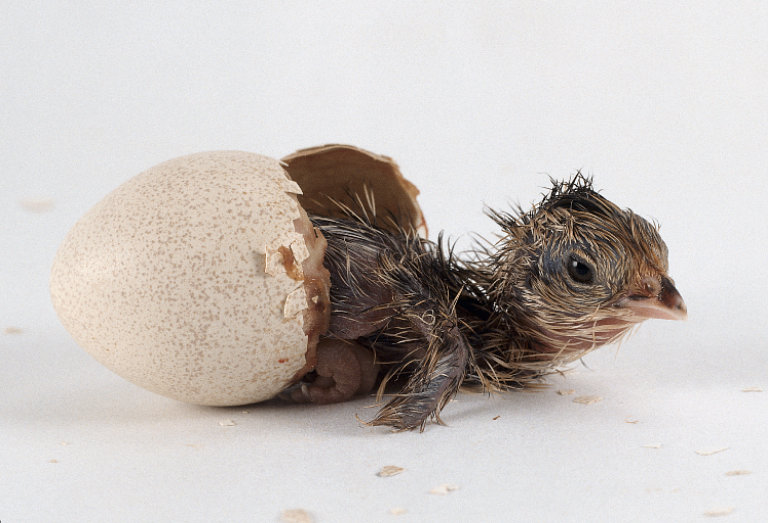
chick-hatching