What poetry says

My dad was a newshound. Always had the radio on and newspapers: New York Times, Philadelphia Inquirer, Camden’s Courier-Post. I grew up watching the Viet Nam War on the 6 o’clock nightly news. I am fortunate enough not to have lived through war in my own country, but I read a good deal of fiction–and wars supply natural conflict for plots, either as background or foreground. I found it a little too easy to put myself in the situations of the characters in novels.

Also, I was of a Cold War generation. The threat of nuclear warfare loomed, and we drilled for that eventuality in our school hallways the way children today drill for active shooters.

Dread. I get it.

Many friends and colleagues have been posting poems on social media the past week, as poems about the useless pain of war can be recycled generation after generation without becoming irrelevant. Really, that fact alone ought to teach us that armed conflict offers nothing but suffering; but when have governments ever listened well to what poetry has to say?

What follows is a work of the imagination, a poem I drafted in 1990, if my records are correct, and revised last in 2008, after which it was published online in a now-defunct literary magazine. Reading it, I realize that with a few changes, it could become a poem about a pandemic as easily as about a war.

~~

DURING WARTIME

First we lose
our certainties
and some of our trust.
The rest depends on events,
our nearness to the front.

Cities feel it earliest,
a dry panic, rations,
the irrational becoming
stuck, continually,
in our throats.
We practice
not being hysterical,
learn to live without
bacon, or oranges.
On worship days,
silence and weeping.

Life in hills and farms goes on
more quietly than before,
difficult situations held
as they usually are
like a straw between teeth.

The last things lost
are nonetheless changed:
a bounty of curls
on the pillow of a once-shared bed
turns grey. 
Linen closets, kitchen cabinets,
the child’s pale room
have altered, become simpler,
more desperate.

When infrastructures fail—
rails, roads, electricity— 
we are merely afraid;
it’s when simple things leave us
we have lost all our wars.


(1990/2008) Ann E. Michael

That need to publish? –eh…

The hazel’s buds are about to open, first yellow of the season; red-winged blackbirds have returned; this morning, several flocks of snow geese in Vs high above me. Then, a brief but crazy-wild snow squall. Yes, it is February.

What I find myself assessing lately is “the need to publish” thing. I feel a reckoning coming on, personally, in which societal changes are implicated–and my age, as well.

Let me backtrack.

When I first started writing poetry seriously (reading, studying, crafting, workshopping), publishing was a paper-only endeavor that involved typing and retyping poems, sending them with SASE (self-addressed, stamped envelope) to various literary magazines and journals both Major and minor, and waiting for up to a year for rejection or acceptance. The acceptances were necessary if I wanted a book publisher to take my work seriously, or to have an academic institution consider me as worthy of hire, or to apply for higher-stakes literary grants and opportunities. The game, as it were, operated on those hierarchies: journal publications, chapbooks, solo collections, college stints.

I did a bit of that, though not enough, I suppose. I got my chapbooks and solo collections (see books here) and a fair number of poems in actual (and, now, virtual) print. But ambition ain’t exactly my middle name; my college work has not been tenured and doesn’t fall under the creative writing category–I run the writing center at my university, where it’s all about grammar, spelling, documentation, essay structure. I enjoy the work, but it is not poetry.

Back to poetry publication: the new assessment is about whether I care anymore.

I’m theoretically close to retirement, though academia lets us continue to our dotage if we wish. [See The Chair.] Will further publications, or higher-status publications, enhance my position at the university? No. That ship, as the saying goes, has sailed. Anyway, it was more of a daysailer than a cruise liner. And will further publications, online or in print, keep me in royalties in my retirement years? You jest, my friend! Poetry adds little to the income balance sheet.

Furthermore, the current state of literacy requires social media presence; virtual journals abound, and many of them are fantastic (seek them out! read them!). Their editors respond slightly more rapidly than lit mag editors did in the 1980s, and though there’s sometimes a submission fee, the price has not escalated much more than postage has (and is in some cases lower). But submitting to journals even online nonetheless consumes a sort of energy and time commitment that not all of us have. Or are willing to make to keep ambition going.

So. My current assessment suggests I’m past the point where it matters much where the poems appear, although I personally love poetry BOOKS and will continue to get my books in print if I can. This assessment allows me to say, “I hereby forego Submittable, etc., for the most part and will send out poems to journals if asked, and otherwise…” Hmmm. Otherwise, what?

Maybe post them here? As I did two years ago during National Poetry Month. I could do that again. Something to consider. Since I no longer have much to gain, I could at least continue my audience here.

photo: Hernán Gonzalo Pereira Palomo

Readers, if you want to weigh in on this concept, I’m all ears.

In which my dad appears

When does bereavement permit the writer to get back to the writing process? I have had quite a few conversations about this topic in the past few decades, and the answer’s pretty obviously “It depends.” I think of Donald Hall writing during Jane Kenyon’s illness and death and afterward–the stunning poems of Without. When my friend David Dunn died, I wrote immediately and often, sorrow emerging through elegies and remembrance. But I was younger then, and less experienced in the arena of bereavement.

During my mother-in-law’s two-year decline toward dying, I found myself writing about the challenges we faced–physical, emotional, communicational (that’s not a word, but I’m leaving it here all the same). Afterward, I could not/did not write. What interferes?

Why my thoughts turn this way: because, lately, my dad keeps turning up in my poem drafts.

I did not write much last year and did not submit any work.* For some reason, though I blogged and wrote long emails to friends and read many inspiring books, I did not feel particularly creative. But I wouldn’t have associated that semi-arid year with my father’s death; I figured my creative void was more about covid and an increase in chronic fatigue symptoms.

To jump start myself this year, I signed up for an online workshop (see this post). It has helped–I’ve drafted more poems in five weeks than I wrote in five months last year. But there’s been a peculiar outcome to these poems: despite widely differing prompts, source poems, and initial processes, my dad or something I connect with him appears in almost a third of the new drafts. I wonder what my subconscious is doing behind my day to day routine. Is this a response to bereavement, or a sign that I’ve accepted his death, or a reminder to self of what a huge loss it has been to me?

Not that I have a definitive answer to any of those questions. I do feel grateful for his appearance, though. He had a good sense of humor and loved to sing–nice things to have in a poem.

~

Thanks, Dad.

~

*Well, almost no work. Thanks to Marilyn Hazelton, editor of red lights tanka journal, I did submit tanka poems in 2021; and she accepted a few for this season’s edition (print only).

Winterwords

It wasn’t exactly a New Year’s resolution–I do not bother with those–but I have promised myself to spend more time on poetry again following a fairly long interval, not exactly a hiatus, but…

Serendipity, then, to learn of Two Trees Writing Collaborative‘s poetry workshop that is taking place online in the early months of the year when motivation’s most welcome. As well as a chance to meet other writers where they are as the pandemic limps along. This online workshop is facilitated by Elena Georgiou, who was one of my advisor/mentors when I was in graduate school at Goddard. Feels like old times (not. because modality-virtuality-experience much altered). I have drafted four new poems, and the process is fun though the output has been mediocre so far; well, one must sometimes prime the engine.

I’m also reading Anthony BurgessNothing Like the Sun, wildly Shakespearean rollicking-with-language, a novel that reads like iambic pentameter. I’m thinking of poetic cadence, which is a craft aspect of poetry that has not been much on my mind until renewed by this novel. Not that rhythm is unimportant to my work, but thinking about it hasn’t been foremost. I have been thinking more about lyricism lately, it seems my default mode.

And I’m thinking about winter, and snow.

A photo taken by Claire McCrea, in Colorado, earlier this month. Something about this image says “Winter” to me and conjures Japanese woodblock prints that act as visual haiku.

What I would really like to do: make more time to revise the huge stack of old poems languishing in various boxes. And perhaps submit work to journals again, and send out the most recent manuscript. Patience with self is what I need right now, but also a kick in the derriere.

In awe

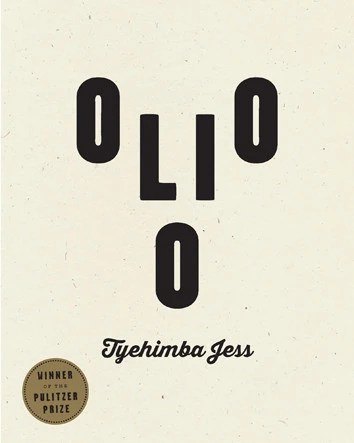
I know I’m late giving accolades to this Pulitzer-prize-winning book, but I finished reading Tyehimba Jess’ Olio recently and: wow! This 2016 collection goes on my must-keep-&-read-again shelf (okay, that’s not a real shelf in my house, but it should be).

How to describe the experience of reading this book? The poems are mostly lyrical, largely persona pieces, yet the scope of the book as a whole is encompassingly narrative. It takes readers from the mid-19th century through the late 20th century through poems that imagine the voices of slaves, ex-slaves, singers, composers, musicians, performers: all of them real people. It’s part history, part fiction, interspersed with dynamic prose that suggests interviews and letters and song lyrics; furthermore, the sureness of Jess’ use of classic and experimental poetic craft astonishes.

Plus, the stories are just so compelling. Inspirational? Sometimes. Sad? Often. Entertaining? That, too. The title comes from the term that means an amalgam, a mish-mash, and which was used to describe the various acts of minstrel shows. Yet Jess’ book does not feel like that sort of random “show.” It holds together like a carefully-sawn jigsaw puzzle or a masterful collage.

In the midst of the “entertainers” who voice the poems in Olio, there is the unavoidable pain of Black lives in the United States. It’s depicted clearly in the words of the speakers of these poems, and sometimes more subtly, as in the litany of Black churches burned, bombed, or shot up that appears under the choir poems.

Most awe-inspiring for this reader is the section about the conjoined twin girls Millie and Christine McKoy. What Jess does here, besides a spectacular imagining of the characters of the twins (born into slavery and exhibited in “freak shows,” they sang duets!), is to create sonnets that are twinned, star-shaped on the page, syncopated in meter, rhymed and off-rhymed, and–here’s the kicker–that can be read across each line or on each side, (columns or linearly). How did he come up with that form? It’s so suitable to the lyrical aspect of the pieces, which are interwoven into a kind of unexpected crown of sonnets.

If this is hard to imagine, here’s a reading and article that may explain better than I can. Also, if you can locate a copy of the book, you’ll see that the publisher went out of the way to accommodate Jess’ unusual approach: there are fold-outs, illustrations, changes in typeface, and the book’s size is larger than the standard trade book or poetry collection.

Olio doesn’t fit on a shelf as easily as some poetry books; it’s going to stand out. As it should.

~~

Reading poetry can be uncomfortable; some of Jess’ poems are deeply discomfiting and sad. Nonetheless poetry helps me put the world into perspective, perhaps especially when it forces me out of my personal point of view. So I value it immensely. Times like lately, when I am writing only a little and not submitting my work at all, reading the work of fellow writers reminds me of why we bother to create.

Robert Bly

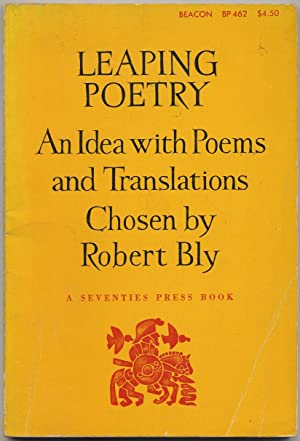
The recent death of poet Robert Bly brought to mind his book Leaping Poetry; I have this edition of the famous little book, which I bought in Grand Rapids Michigan in 1978.

My dear friend Ariel Dawson recommended this book to me. I have read it many times–my copy’s pretty beat up. A 1975 book of his prose poems influenced my thinking about poetry’s many forms, too; I love my copy of The Morning Glory: Prose Poems. The thing I like most about Leaping Poetry is its open-endedness, by which I mean that Bly embraces ambiguity in poems by suggesting readers–and writers–examine the gaps, the leaps, the surprises that encourage curiosity. Free associations into the unknown can lead to obscure and unreadable poetry; but they may also offer a way in to the unconscious, the emotive, the innate–what, in previous decades, was called the “primitive” and associated with non-Western religion and ritual song-poems. When I was first writing poetry more seriously–as a craft, an art–Bly’s little book helped me to reflect on what I was doing. It gave me new direction.

The Morning Glory poems moved me into researching what poems feel like on and off the page and how poets have used forms in different ways through thousands of years. Haibun, for example.

In subsequent years, I have read persuasive criticisms of Bly’s translations and of some of the concepts in Leaping Poetry; certainly there is much one can criticize concerning Bly–because he wrote so prolifically and took a certain joy, I think, in standing out. I made a point of going to his readings and presentations when I could, just to hear what his latest enthusiasms would be. (I must admit I never liked the way he read his own poems, but I often liked the poems themselves.) I am grateful for his work and have been recalling going to hear him and reading his poems over the years, discussing them with friends.

The book itself is an old, dear friend. I think it’s time to read it again. Each time anew.

Norway’s Philosopher

I first encountered Arne Naess’ work in 2012 (see this post), and I regret that I failed to follow up by reading more of his “ecosophy T” (deep ecology) and philosophy. I am finally getting around to his very late book Life’s Philosophy, and I love how it speaks to me on many levels. His claim that human emotions can and should be components of human reason makes so much sense that I wonder why so few researchers look into it; some folks on the edges of neuroscience and psychology seem to venture there, but few others. The concept of “relationism” resonates for me, too. It reminds me of the Dali Lama’s teachings that all things in the world are intertwined and valuable, even non-sentient beings.

Relationism, as Naess uses it, acknowledges the vast and impossibly infinite complexity of the universe, more strictly life on earth, and–can I use the word “celebrates”?–the interwoven strands of animal, vegetable, mineral, bacterial, cosmological, emotional, rational aspects of a life in the world: ecology on steroids (he would not have phrased it like that). My urge for balance in my own life makes this philosophy relevant: the opportunities for play and for imagination as well as for seriously abstract concepts, for the importance of emotions as felt in the human body and as interpreted or contained in the human intellect; the necessity of listening to even the tiniest sounds, of savoring the small moments, of not needing to be big or grand or successful but to be mature in how one feels with the world.

The incredible difficulty of saying any of this. Which Naess also acknowledges, saying the difficult job of conveying being felt in the world leads to music, to art, to sitting with the natural and sensing beauty. I might add: Poetry. Though poems are made of words, they often operate through images and felt moments rather than intellectual logic.

The wonderful paradoxes of this book delight me, but then, I always have enjoyed paradoxes. Naess was, indeed, a philosopher, a mathematician, a person who valued logic, reason, and analysis, an analysand himself and briefly a psychological researcher, a mountaineer, a teacher. What to do with the inherently analytical side of himself? Treasure and use it to find wonder! That’s what makes him different from so many thinkers. Wonder. He writes, “To me, the ability to analyze the experiences of the moment is a source of wonder: wonder at human creativity and the result of evolution during hundreds of millions of years. That which happens within us–in our minds and hearts–is so complicated that the psychoanalytical instruction to express everything that occurs to one becomes…and exhortation to to the impossible.”

He opposes Cartesian mind-body separation not just within the body itself (as medical science has proven) but in terms of landscape, natural environment, places. He posits that people need deep thinking about values that move us emotionally just as much as we need to think about rational, pragmatic, socially-pressured values that are based on intellect or the empirical. Place matters, and we need to consider our fundamental place, Earth. Naess’ oppositional stances are, however, never a fight. Instead, discourse, compassion, patience with what is complex. A sound life philosophy requires stillness sometimes, and listening, even–especially–to the “tiny, tiny things,” he urges: “The art of living is to be able to work with small things in a big way.”

How do you feel yourself and the world? is the title of one chapter. I read the question with emphasis on different words and began to realize what a complicated and interesting question it is, though it seems (at first) so simple. Naess says that humans have hewed to the idea that there’s a gap between reason and emotion, and that the gap is an artificial one; a change in perspective, and an understanding that the mind and the body live in a physical world where emotions play a huge role in human communication, might help us to enjoy our lives more–and maybe, while we are at it, treat the earth one which we depend with more love and respect. But we have to feel we are not just ourselves but the world: of it, from it, in it.

mapio.net/pic/tvergastein

Physics, poetry, notes

In a discussion among some of my poetry-reading friends, two readers said they feel “stopped” when they encounter unfamiliar words or terms in a poem. They feel poets should avoid writing work that uses specialized knowledge as metaphor, in imagery, or to establish the poem’s context. Their argument is that when a reader feels stopped by anything in the poem–from an unusual line break or stanza structure to an unfamiliar word–a kind of alienation occurs between reader and text, and that when poets choose to employ the unfamiliar they need to explain somehow/somewhere (notes? prose headings?) to guide the reader. But then they added that referring to notes is, in poetry, distracting.

“Some vocabulary and allusions just make me feel inferior,” one friend says. I don’t think they’ve spent much time with Ezra Pound’s later work but imagine this statement by Sam O’Dell applies: “Now, whether or not Ezra Pound intended to make others feel less intelligent while pulling obscure outside references into his poems and essays is up for debate. The guy seems the type who may have enjoyed making sure others knew he was smarter than they were.” (Read the rest here).

Nerdy autodidact that I am, I rather like those stop-the-reader moments in poems–if there’s a payoff. If I learn something new, and if that thing I have learned enriches the poem’s meaning and also enriches me, then I don’t mind feeling surprised or puzzled or even interrupted. Some poems take more work to read than others, and that’s ok. Some novels prove less easy to read than others, and some movies make the audience-experience fraught, unnerving, or strange. For me, the essential work that artistic endeavor does is open new perspectives, present puzzles, invite inquiry. Make me curious!

Example: Recently I re-encountered the work of poet Daniel Tobin, whose collection From Nothing speculatively examines the life–the interior, intellectual, and spiritual life–of the Belgian priest and cosmological physicist Georges Lemaître. In the process, this series of poems covers war, genocide, the atomic bomb, physics. I haven’t read anything by Tobin since his book The Narrows (2005), and the Lemaître poems take considerably more work to comprehend. That work on the part of the reader is rewarded, I should add, especially a reader with more than a passing interest in cosmology and the cosmos itself. A reader who doesn’t mind a bit of theology or physics or history and quite lengthy notes at the end of the book, and who will actually read said notes. And then refer to her books on the expanding universe theory and Hubble Effect and look up more about Lemaître. [That reader would be me; but Tobin has many readers with all kinds of interests and expectations about poetry.]

In Tobin’s lovely poem “(Origin),” I found the word marver, and while looking up the definition learned that when molten glass is poured onto a slab for cooling, the process is called gathering the glass–and I love that use of the word gather. Maybe it will make its way into one of my poems someday. Even if it does not, I feel happier knowing that little fact.

But most of From Nothing contains allusions to cosmology, to Einstein and Planck, to World War II and conflicts of many other kinds, internal as well as external. I kept being wowed by Tobin’s research into Lemaître and by the poet’s imagination as he plumbs his subject’s complicated world of math, motion, and a conceptual physical universe that could also have room for God. I mostly remembered his earlier work that was so tightly crafted, often rhyming (or employing surprising and delightful assonance). In this collection, I didn’t notice the craft aspect until I went back and did some re-reading. I was too caught up in the complexities of physics and the momentum of the subject’s life-as-scientist/life-as-priest. The lines each have six strong beats, the stanzas are tercets, and there are eight stanzas in each poem. There’s more to the craft than that, but what I like is that–unlike some of Tobin’s earlier work–the craft takes a backseat to the narrative (though I think that’s also true in The Narrows, to some extent.)

Maybe this “difficult” book appeals to me because I like difficult books. Maybe it appeals because it reminds me of my father, a person invested in the world of reason and fascinated by science…who yet believed there can be faith, that god exists. Here’s an excerpt of Tobin’s “(Cinema)”:

You, who chose two ways equally at once, circuit 
the conferences, meetings fueled by enigma, mixing 
with the eminent and their sidereal regard,   

your morning Masses before library and lab.

~

My dad was not a Catholic, but the balance between faith and reason was one he wrestled with, too.


Collecting & creativity

Somehow or another, I completed a chapbook manuscript. The longer collection is coming together, as well. Yet it feels to me as though I have not spent nearly enough time on my creative work. And when I find myself awake at 3 in the morning, it’s not poetry that runs through my mind. Usually those wee-hour thoughts are work-related. I guess that makes me normal.

The next step, once a writer has completed a manuscript, is to have another writer or two review it; I’ve done that, too. So now? I guess I submit the work and find out whether a publisher agrees the poem collection does the job of poetry.

And I get prepared for rejection. Comes with the territory.

Upon reflection, the reason I feel I haven’t been doing creative work is that I am not generating many new poems right now. Some, but not many. But let’s re-think the process of revision: it’s a process of deciding upon the order poems should appear in a book, and which of the poems ought to be there to speak to one another, to resonate with one another (and with the imagined future reader). Hey, I am using my imagination here, and I am doing creative work. If all I ever do is generate new poems, those poems won’t have a chance to go out into the world and endeavor to speak to other humans.

Figuring out how to make that happen is the creative work of revising, editing, rethinking. Imagining the reader. Striking the tone of each individual poem to see whether it adds harmony, or works with a fugue-like trope, or changes the mood to minor, or unleashes a surprise. The book of poems can have an arc or act as a chorale or zigzag about to keep the reader on her toes.

The collection of poetry, when it is not yet a book, presents problems the writer and editor must solve. Problem-solving requires creative thinking–I tell my students this almost every time I see them in class!

Will the manuscripts find homes? That’s a different “problem.” Meanwhile, more new poems, more revisions, maybe more manuscripts ahead…while I await the first frost, while the leaves turn and fall. All part of the cycle.

Being receptive

When my parents moved to a senior-living campus about 10 years ago, one of the hardest aspects of downsizing was what to do with the books. My dad’s bookshelves were full of texts that he found meaningful, valuable, inspirational, informational, necessary; he loved to read. Choosing which books to give away and which to keep was agonizing for him. And then he faced the task again when he and my mother moved to a smaller, assisted-living apartment. That time, he donated many of his books to the facility’s library, so he could “visit” them if he needed them. There remained one large bookcase. Because you can’t live a happy life without books!

Then he died; and my mother, who also loved to read, developed such aphasia that she could no longer decipher sentences. Now, every time I visit, she gestures at the books and urges me to take some of them. It’s hard to explain the response I have to taking home my dad’s books–a mixture of tenderness and discomfort, nostalgia and pain. Sometimes I end up giving the books away, but usually I read them first. Because they are books and deserve to be read, somehow, just by virtue of existing. No–by virtue of their having been significant to my dad. That is why I feel compelled to read them.

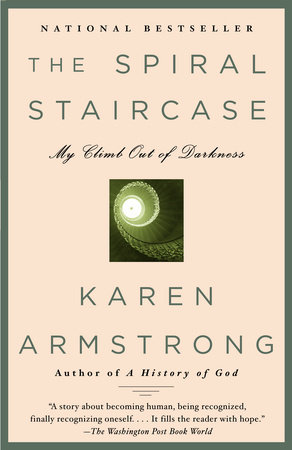
I cannot say I got much inspiration from my father’s 1955 copy of a text on caritas by Martin D’Arcy, The Mind and Heart of Love, although I found suggestions about the philosophy of Christian love that my father would certainly have noted {indeed, his penciled checkmarks in the margins confirm it}. Last time I was at my mother’s, I chose to take Karen Armstrong’s 2004 book The Spiral Staircase, a book I appreciate rather more than I did D’Arcy’s. Much of Armstrong’s memoir deals with the frustration she felt as she struggled to find her place and purpose in the world of work. As it turns out, she is a writer, although it took her awhile to discover and admit it. Part of being a writer involves isolation or solitude, which Armstrong equates with silence: “Without the distraction of constant conversation, the words on the page began to speak to my inner self…I was no longer just grabbing concepts and facts from books…but learning to listen to the deeper meaning that lay quietly and ineffably beyond them. Silence became my teacher.” That passage resonates for me. I can recall times when what I learned, and subsequently, what I wrote or composed, emerged from such silence.

But I like most of all what she says in her next paragraph (p. 284).

This, of course, is how we should approach religious discourse. Theology is–or should be–a species of poetry, which read quickly or encountered in a hubbub of noise makes no sense. You have to open yourself to a poem with a quiet, receptive mind, in the same way as you might listen to a difficult piece of music. It is no good trying to listen to a late Beethoven quartet or read a sonnet by Rilke at a party. You have to give it your full attention, wait patiently upon it, and make an empty space for it in your mind.”

It helps if we can give our hearts to poems and books we read, make space for them in our minds, hear what they have to say before rushing in with our own clever ideas and personal perspectives. When writing, the same approach applies. Often I think I know what I have to say, yet the poem on which I’m working proves me wrong. And it helps to be compassionate to the writerly self, which is another thing Armstrong had to learn, as she was far too hard on herself about her thinking and writing.

Her subsequent books, and her recent work, center around compassion, I notice. I have not read them yet, but I plan to. Another thing I notice is that the copy of The Spiral Staircase I brought home from my dad’s bookshelf is inscribed:

Tom and Bonnie    with best wishes     Karen Armstrong