Paper files

Frankly, I have never been much of a fan of organization. I don’t mind planning, in brief and purposeful bursts, but getting things in shape after the fact–once the mess exists–well. I know people who truly enjoy pitching in and re-organizing, but I am not one of them. Besides, I’m also facing similar tasks in my household, rooting through the kids’ rooms (they left years ago) and our attic and basement to cull, straighten up, and organize. The tasks are mutually distracting. And often tedious. I’m working on my attitude, though, trying to find some method of making these chores, er, “creative” in some way. (File under “Lying to Self”).

Call me old-fashioned, I’ll readily admit to it; but lately I have decided that the most efficient way for me to keep track of my own writing is by using a physical filing system. I have experimented with various spreadsheets (I have no patience with Excel, however and alas) and computer folders. I do use the latter for a year-by-year archive of my work, but I cannot easily extract what I am looking for that way. Now that I’ve retired from my 40-hour work week, I have wanted to manage my creative work better and keep track of what needs revision, what seems finished, what has been submitted, what’s been published. That strikes me as a necessary part of tending to myself as a writer. The past year has been a time of working through options, with accompanying irritation and tedium.

Photo by Anete Lusina on Pexels.com

After years of endeavoring to use electronic files, it came to me that there’s nothing wrong with old-fashioned paper systems, organized alphabetically by title, with the computer-file names and draft number at the bottom of each poem. This is how I think about the poems when I want to work on them or submit them, so it feels natural to me. Why operate against one’s own operating system?

I suspect one reason (oh, there are many, but let’s start with one) I am so angry about Elon Musk’s “DOGE” initiatives is that efficiency is never all it is cracked up to be and is also not the be-all and end-all of any society’s best organization. Of course those who push AI believe that algorithmic calculations can make the world run smoothly, but said people are egregiously uninformed about human nature and the myriad forms of individual thought processes. We are non-standard. Averages account for almost nothing, really. We do not think the same thinks. (And yes, I meant thinks not things, autocorrect). Diversity is what keeps evolution going. There is no change without it; and without change, we die.

So: I’m inefficient, to a degree, when it comes to keeping my creative work in order. However, the paper filing system, with a notebook and index cards and files on my hard drive, assisted by my still-useful memory (a human brain!!), have so far been working pretty well. It has taken me several weeks to put my stuff together, but now it’s far easier to fetch what I want to work on, send out, or collate, which I need to do to prepare for upcoming reading [I have two online readings coming up–one on Feb. 18 and one on May 2]. I’m also grateful that the task kept me busy while I was anxious and worried and grieving over recent not-so-terrific experiences in my (physical, real) life. Real life, which is not averaged. Seldom predictable. Inefficient. And something to celebrate for all its strangeness.

Useful avoidance

Trapped inside with the air conditioner on for over a week, I sat by my bookshelves going through the poetry books in my library. I’m re-reading, assessing which books I truly want to keep because I turn to them often or learn something each time I read them, which books I keep for sentimental reasons (maybe I know the author personally), which ones to keep because they are signed copies, which ones are long out of print and I would never be able to replace them. Some of them remind me strongly of places or eras in my life: I bought this one in a small bookshop in Grand Rapids MI, or this one at Barnes & Noble when it was just one store on a NYC street corner, or these at the storied and much-mourned Gotham Book Mart or St. Mark’s Bookshop. What are good reasons to keep books when I really have to downsize? It’s not an easy task, and the first of many in the process of getting rid of stuff so my kids won’t be stuck doing it. Besides, I enjoy re-reading these books. My children are not as enthusiastic about poetry as I am, so it makes sense that someone who loves the works on the shelves be the one who makes such decisions. It feels good to be surrounded by the words of wonderful writers when the outdoors is brutally hot and humid, and every joint in my body aches.

Surrounding myself with other people’s books also acted as one more way of avoiding my own creative work. Sometimes, though, waiting around and doing nothing on a project ends up bringing clarification or new ideas. It can prove useful. I have been stalled on my in-progress manuscript, so a month or so back I asked someone to take a look at it–and then I got caught up in doing other things. Like getting cataract surgery and having covid, and then it was gardening in full swing under sweltering weather, and then the bookshelves… I wasn’t exactly procrastinating, but neither was I actively working on, or even thinking about, the collection.

Acquired when I was much younger, and cool bookshops abounded.

And one night recently–during a much-needed rainstorm–I got a brainstorm! I realized I was trying to pack too many topics into what really should be a manuscript more closely focused on how people who love one another vary in their relationships to old age and death, and on how the contemporary social and medical aspects of the aging process pull us in uncomfortable directions, often distancing us from those relationships. So yes, there should be family poems, hospice poems, biblically-influenced poems, and dealing-with-everyday observation poems. Also some poems of hope and love, poems reminding me (and readers) of the need for compassion in all dealings. But the draft had 92 poems in it, far too many; and some were there just because I like them or they’d been published in a good journal. Which are actually not good enough reasons to include a poem in a collection, according to most of the editors I know.

I am back to thinking about the manuscript and digging up potatoes–a nice crop this year–instead of culling the poetry books because, thank goodness, the heat wave’s subsided a bit. But in the process of this non-routine summer I have allowed numerous weeds to flourish and set seed; all the more work for NEXT year’s gardening, but it’s been too hot to deal with said interlopers. I like to believe the weeds and I are reaching a sort of understanding, but it is not really a compromise. All the concessions have been on my part. [Note: weeding a personal library is less physically taxing but not really any easier.]

Oh, the mundanity!

Ah, the challenges of staying organized! I spent this morning finally starting the process of reorganizing my poetry files–the paper ones, which I keep in various arrangements of document boxes, accordion file boxes, and an index card box. This is stage one of a project I have procrastinated on for far too long. The digital files will be the next step, assuming I actually complete this stage. Being something of a Luddite when it comes to digital organization methods, I have no idea how to manage that stage yet; paper documents, however, I understand.

January’s tenor usually strikes me as a bit dull, damp, chilly, dark, and generally unmotivating. My mood concurs. It’s therefore rather heartening that I find myself up to this task–and that the task itself has given me a sense of accomplishment in more ways than one. For one thing, getting around to doing what you know has to be done but have been putting off can feel surprisingly good. For another thing, the reorganized materials take up less space, which is never a bad thing.

Also, it was a boost to my writerly confidence to make an informal accounting of my published work. After 40 years of writing it feels good to know that many editors, and a few publishers, thought my poems “good enough” to print. The unpublished poems take up considerably more space, of course. And I haven’t even started to page through THAT pile yet, let alone find a method of organizing the pages. The sense of having at least begun this lengthy process cheers me in the middle of the bleak, blah, January days.

~

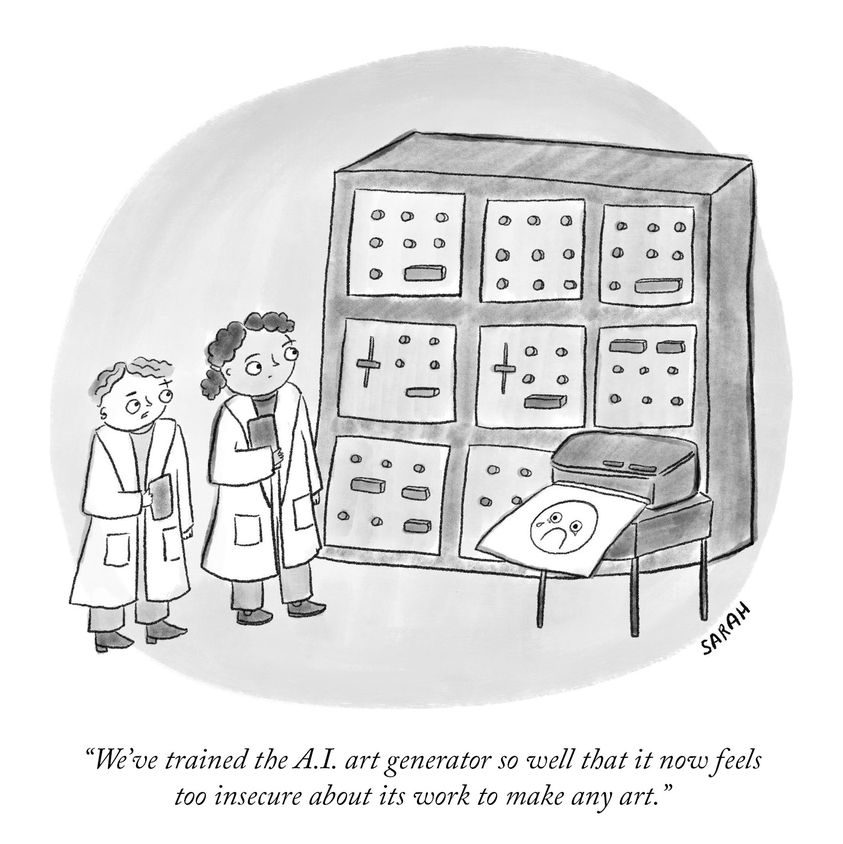
This cartoon by Sarah Kempa (The New Yorker, Jan 11, 2023) struck me as applying also to poets and other creative writers. I know this feeling well. Many of us benefit from the occasional boost in confidence.

And believe me, I have many thoughts about AI-generated prose and poetry; but that’s for a later post.

Pro+crastination

procrastination (n.) Look up procrastination at Dictionary.com
1540s, from Middle French procrastination and directly from Latin procrastinationem (nominative procrastinatio) “a putting off from day to day,” noun of action from past participle stem of procrastinare “put off till tomorrow, defer, delay,” from pro- “forward” (see pro-) + crastinus “belonging to tomorrow,” from cras “tomorrow,” of unknown origin.

This, thanks to OE, the Online Etymology dictionary, a favorite site of mine. What I was hoping to find is some aspect of “pro” as in Latin’s for, ie, the positive side of putting things off until tomorrow. Surely there are times when a bit of delay works toward the desired goals. The more leisurely approach to accomplishing a large task allows a person time to think things through and avoid some of the risks that the jumping-into-the-lake-all-at-once method contains.

At least, that’s my rationalization for putting off the next set of tasks I have set for myself regarding my writing.

~

Delay can be fruitful, if it’s the right sort of delay. Procrastination that arises from distraction, however, tends to be of the less productive sort. When putting things off because of distraction ends up being somehow beneficial, it’s usually just a lucky strike.

~

~

distraction (n.) Look up distraction at Dictionary.com
mid-15c., “the drawing away of the mind,” from Latin distractionem (nominative distractio) “a pulling apart, separating,” noun of action from past participle stem of distrahere (see distract). Meaning “mental disturbance” (in driven to distraction, etc.) is c.1600. Meaning “a thing or fact that distracts” is from 1610s.

The drawing away of the mind. What a perfect description. Just how it feels.

~
 
But the mind can be drawn into the tasks at hand, a Zen-like or Taoist middle-way approach. The steps to the goal neither hard nor easy. The delay can be a time of focus and serendipity, a way to establish equilibrium before proceeding on what appears, initially, to be a daunting project. What belongs to tomorrow is not here now–live the day.
 
My three-month project is to send out two manuscripts, revise and organize my current work, submit new poems for publication, compose an essay and a couple of reviews. But it turns out there are a number of other tasks I had to accomplish before heading into the larger project. It’s all part of the process, during which I have discovered some poetry drafts I had forgotten about and revised older work and found a cache of images and ideas I had filed away “for later.” And I realized I had not finished transferring my poem files into new digital folders… It all needs to be done, but it follows the same general path.
 
Not distracting, exactly. A different form of–positive– “mental disturbance.” The pro aspect of procrastination.