Source material

Creative writers are often asked where they get their ideas from. In my own case, the answer to that varies a great deal. Sometimes ideas arise from personal experience, of course, but one’s life offers only so much material if you are a relatively staid person like me. Topics for poems can arise from recent headlines or from histories, written or oral; from conversations overheard in a grocery line; from stories other people tell me; from folk tales; from science books; from dreams; from works of art, and numerous other sources. It’s this wide array of possibilities that make the concept of the creative-writing prompt so popular. A quick Google search for “creative writing prompts” offered well over 20+ pages of entries, in several languages.

Photo by Pixabay on Pexels.com

I have written pieces based upon prompts, especially when in a workshop or class, or when I feel rather tapped out of my own imaginative source material. I’m especially fond of writing that stems from viewing or experiencing a work of art–sculpture, painting, musical composition, dance, installation art (ekphrastic poems). Generally speaking, though, that’s not from whence my poems originate.

I can’t really say why I feel an urge to put down in writing specific reflections about something that’s caught my attention–or even what sort of experience evokes my response. Maybe I feel intrigued by an image, a detail, or an ambiguity–a question arises in my mind that I tussle with for awhile. Then, I may compose a draft and let it sit. Two days. Two years. Longer. Lately I’ve been revising some old poems and have realized I no longer recall what their incipience was. Which can be a good thing, because I am no longer wedded to the “reason” I wrote them and can instead consider whether they can be crafted into decent poems.

I am also working on a manuscript that I let sit for at least six years. An idea got into my mind after reading Robert Burton’s 17th-century book on depression, The Anatomy of Melancholy, quite some time ago (2017, perhaps?). I took a stab at writing what seemed to be evolving into a historical fiction story, which is not my usual approach (I have zero practice at plot and dialogue). Then, I stopped. As one does. But the topic lodged in me somewhere, I suppose, and early this year I returned to it. What if, I wondered, the draft could be restructured into a series of prose poems? There might be a sort of hybrid novella-poem in the earlier draft.

That’s more or less what I’m developing, at least for now, and we’ll see what if anything emerges. It’s keeping me interested, which I like, and the experiment feels fresh compared with “writing what I know,” or writing “how” I know. Because yes, of course we ought to write what we know; but we also know about human beings, and we have imaginations, and anything is possible.

By Robert Burton – Burton’s Anatomy of Melancholy, 1628, in the British Library, Public Domain, https://commons.wikimedia.org/w/index.php?curid=84390857

Writing act

Lately, I’ve been experimenting again with prose poems and with very short poems that are not quite tanka or haiku, but not much longer. Six to ten lines. Short lines. Then, the online journal Six Sentences got me intrigued about experimenting with that idea as a prompt–long sentences, short sentences, a mix of both–but only six sentences. I like playing around with words. I enjoy writing almost as much as I enjoy reading, and it’s fun to enjoy what I am doing these days, when so much else seems unenjoyable, sad, fraught, scary (another mass shooting, of children, today).

The garden offers comforts, too. Now we are in the harvest-and-rip-up phase as August nears its close. Lots of tomatoes, still a few green beans, plenty of butternut squash and sweet peppers and basil. It looks as though I will harvest a lot of hot peppers, too; although I only have one plant, it is robust and full of spicy peppers that will get hotter as they ripen. And the summer flowers, those glorious annuals, are lovely this year. We even have more butterflies than usual!

So many people have written about gardens, I sometimes find myself wondering what value there is in it, what could be political or artistic in a garden poem, what could make such a poem dangerous or antisocial. Why it is deemed necessary to yank NEA grants from poets, for example. What is it about the act of writing that makes us outliers? Can it be because any description or observation takes a perspective, possibly personal, possibly outside the norm, potentially widening another person’s viewpoint? And is that dangerous? (Perhaps.) Because a plant or animal or place name might evoke an event or person or symbolize something that might rock the boat–a sunflower for Ukraine, a bald eagle for the USA? Could that be risky? And might the interpretation be incorrect, but the writer assumed guilty of…whatever? (There is nothing new in any of this.)

Here’s a draft of a prose poem that came of my reflecting on such questions.

~~

The Act of Writing

only occurs when pen in hand meets paper, or the act is mere mechanics, pressing typewriter keys and imprinting page, or is virtual, encoded onto disk, on cloud encrypted, ephemeral, the act one of persona, a mood or dream, some moment observed, imagined, a recollection, a heart-stab, a shattered vase, anchors dragged along ocean floor, a plea, promise, letters never sent, a life of pain, a sworn compassion, or love that cannot otherwise be expressed, an argument for understanding. The act of writing rallies, rages, sets forth accusation or denial, sues for mercy, brays at nothing, pointlessly puts forth what’s known but long ignored, unacknowledged, unaccepted, an act political by proxy, being the kind of behavior those in power seek to suppress, who make the act of writing into reams of tedious fine print outlawing every fervent danger that clings to the very act of writing which is the practice of free and conflicted expression even when the reader sees only a description of deep scarlet bougainvillea arching over a poet’s unmarked grave in a landscape of olives and oleander.

~

Wet summers

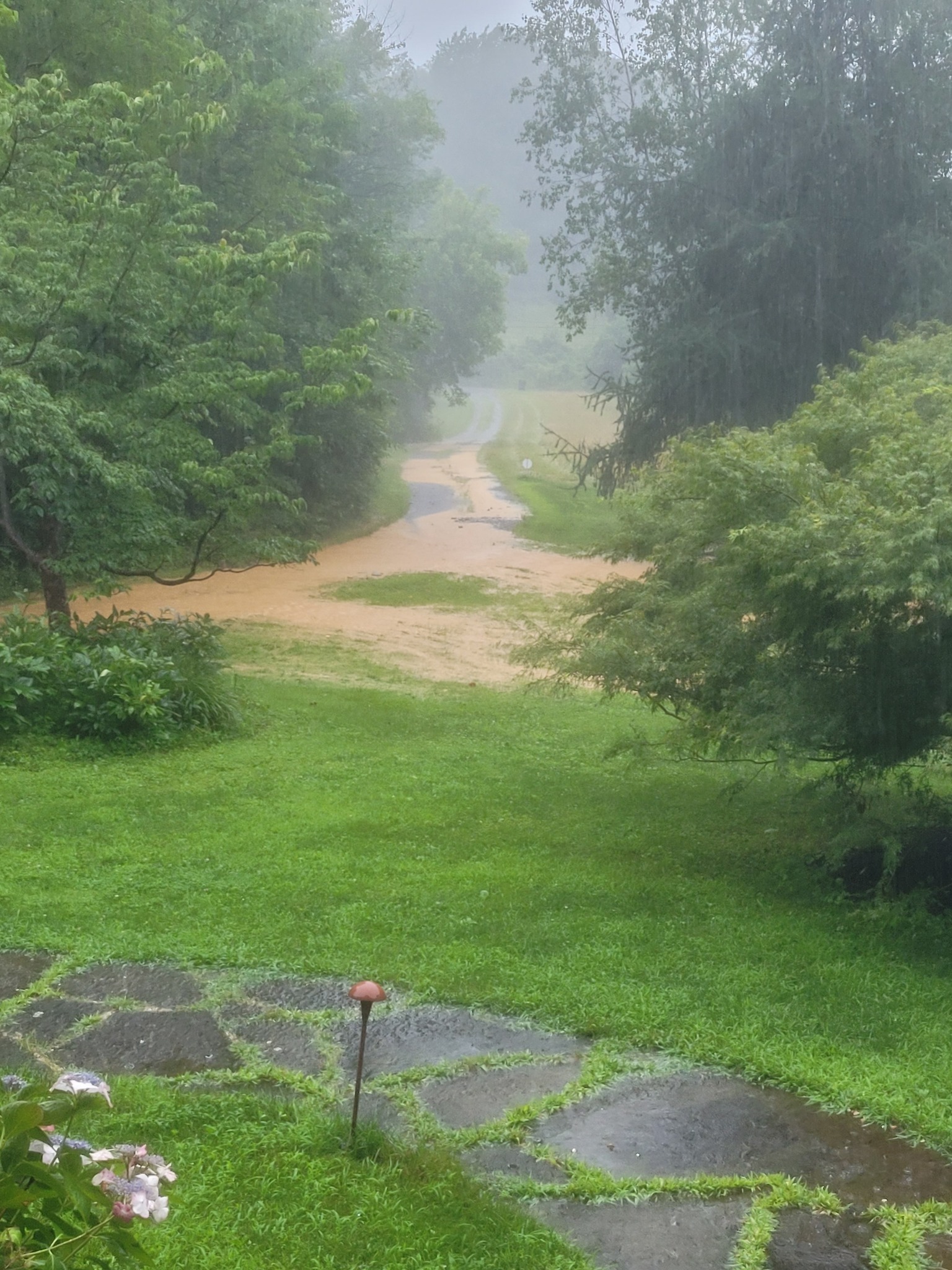
Thunderstorms used to thrill me, and still do–that combination of potential damage with the relaxing sound of rain on trees and rooftops, rain rushing through downspouts, and overcast skies that seem to lull me to sleepiness. Yesterday’s rain was a doozy. We had a flash flood in our front lawn, which has never happened before. But the basement stayed dry, no trees have come down (yet), and we didn’t lose power.

Cracking loud thunderclaps with arrow-straight downpours on hot summer days remind me of childhood. Yesterday afternoon I sat on my porch for an hour just watching the rain and remembering days like this. When we aren’t in drought years, these summer storms appear commonly in the region; yet they always evoke memories of long ago, I suppose because when I was a child I could just sit around watching a thunderstorm instead of, well, doing grownup things. Like working in an office, teaching a class, grocery shopping, laundry, reading emails, whatever I’ve been doing during the past 50 summers.

I spent many a mid-summer week or two in northern Indiana, where this type of storm was common. My grandmother always appreciated them, saying, “They make the corn grow.” Which must also have been true in the coastal plains of southern New Jersey, where I spent the rest of every summer. (Sweet corn is excellent in both regions.)

So, I think of thunderstorms on days so hot we could just run around outside in sundresses or bathing suits, getting doused, or sit on a porch and read while the lightning flashed and the rain came down in torrents. And then have garden tomatoes and corn on the cob for dinner, and go outside after dusk arrived and chase fireflies in the wet grass. These are the kinds of things that I feel nostalgic about, though I am not generally a person who gives much energy to nostalgia. It has been awhile since I had enough unoccupied time on my hands that an hour on the back porch observing the rain seemed like a valuable thing to do.

But it is.

Anyway, here’s a prose poem from my book Abundance/Diminishment that I recalled to myself while I was watching the storm.

~~

Competition, Wet Summers

…so here’s this young woman practically in tears—it’s almost one o’clock
and raining harder than ever, thunder so close it’s practically grabbing us by the
shoulders and the lights dim inside each time the sky goes millisecond-bright.
It doesn’t feel like midday. Every stall is full and the horses aren’t happy.
We can hear the skittish ones hollering, pawing, kicking at the doors. It’s a squall,
I tell Sara; but she’s frustrated, fuming, has her tack cleaned and her dress breeches
on for a three o’clock show she’s convinced won’t happen now that all hell’s let
loose in the form of torrents and flash floods, and there’s a stream coursing from
the south door into the first bay of the stable—it looks like the River Jordan.

The roof leaks at a spot directly above her shampooed and just-groomed mare
and I’ve run out of cheery platitudes and patience; I just walk myself to the barn’s
far end, feel the rain splash up my legs from the puddle at the threshold, dripping
on my neck and face through rotten shingles. The wind stops. It’s a straight-
falling deluge and hot, a no-relief rain with big drops that bubble in temporary
pools of runoff by the wash stalls. The afternoon is green and grey, the puddles
a stirred-up brown, and I remember my former boss—thirty years ago—standing
in the type shop doorway on a day like this one. The look on his face was worse
than Sara’s, not frustration or mutiny but numb desolate recall, slack and empty.

“Man,” he said, “It used to rain like this in ’Nam.”

~

Changes & alterations

We built our house here about three decades ago. At the time, I was young and excited about landscaping the place; although I had been growing our own vegetables for years by then, I was fairly new to ornamental gardening. I made mistakes; I underestimated the speed at which shrubs and trees grow; I thought I could keep a handle on invasive species; the world of various bark beetles and aggressive vines was new to me; and I had no idea how hard it would be to manage almost seven acres without, say, a team of landscapers.

Or how rapidly an environment alters when the climate changes, and when cornfields and early-growth wooded areas become housing developments, parking lots, and streets. I have learned a great deal and much looks different now than thirty years ago, but the swallows still return to my garden between April 26 and May 6. My land contains fewer efts in May than it used to, but the gray frogs, spring peepers, wood frogs, and toads make their usual frenzied chorus at mating time each spring.

~

Recent changes have come from the emerald ash borer, which has decimated, or worse, the green ash native to this valley. The huge trees have come crashing down during the past 10 years, making hard work for us even if it does provide a bit of firewood. Cutting, splitting, stacking hardwood isn’t a task I’m much good at anymore. Thirty years ago, maybe…and there does not seem to be any good that comes of this tree loss, which I’ve been mourning each year as we have less and less of a woodlot treeline above the hedgerow and see more and more of the neighboring subdivision.

But on my damp, early-morning walk today, I perceived some changes that I should have expected and that offer a glimmer of hope for native trees and shrubs–despite the proliferation of Russian olive, multiflora rose, Amur honeysuckle, mugwort, wintercreeper, Asiatic bittersweet, mile-a-minute weed, and more colonizing invaders than I can tick off in one blog post. There, beside the tractor path, along the edges of the hedgerow (for edges are where things happen most quickly), I observed more tree saplings than in past years. With the vase-shaped, leafy arcs of green ash absent, sun reaches further through the thickets. And there I spot horse chestnuts starting to push up, tiny walnut trees, oak trees of differing species, “baby” hickories and maple varieties, along with understory’s smaller shrubs and trees like amelanchier, ironwood, redbud, buckeyes.

Granted, most of them won’t survive to maturity, but some of them will–gradually re-making the woodlot unless other disturbances undo the renewal.

I won’t be here in another 30 years to find out, but I find hope in these saplings. I’m also happy to see that the little woodland and field wildflowers such as false Solomon’s seal, jack-in-the-pulpit, wild violets, and mayapples remain. And though I find myself swearing inwardly at the way the Russian olives grow massive along the property line and the invasive bittersweet sends thick tendrils coiling up into the trees, it’s not the fault of the plants that they got here. Humans brought them to North America, and the plants–like European colonists–became a bit too successful in their new homes, pushing out what was here before their arrival. Am I any different, really, than the dandelion or the honeybee? My ancestors came to these shores not so long after those species were imported with earlier “settlers.”

~

The rain we’ve been getting means I haven’t been out weeding in the vegetable garden. After I take my walks, I come inside to dry off and do household chores, or make soup, or work a little on my poetry. I feel excited by a little writing project I have recently given myself, and I’ve also been playing around with drafting prose poems. Next week, I head to the high desert again for further inspiration and a chance to travel with a good friend, visit museums, and spend some time with my daughter. When I return in mid-May, the gardens, the meadow, and the woods will already be much changed.

Prose/poetry

In the first weeks of this year, I participated in a virtual poetry workshop with Anita Skeen. It was so useful to me that I signed up for another workshop, this one on writing the prose poem, with mixed-media artist and poet Lorette Luzajic. She is the editor of an online prose-poetry lit journal, The Mackinaw.

In this workshop, I’m returning to a form I learned early in my writing practice. My friend and mentor David Dunn may have introduced me to prose poems, I cannot recall anymore; but I do know he was writing them in 1980 and that some of the poems in our collaborative chapbook The Swan King are either prose poems or on the verge of being prose poems. Prose poetry was then considered a “new” form and was (& in some quarters, remains) controversial among poets and critics. It sounds self-conflicting: if it is prose, how can it be poetry?

In the decades since I was very new to poetry, reading everything I could find of contemporary work and experimenting all over the place, the prose poem has been much written-about in literary forums and academia and is–mostly–on pretty sturdy footing as a “form” of poetry. I never completely stopped writing prose poems, and a few appear in most of my books. I’ve been writing so many sad lyrical-narrative poems since 2018, however, that I haven’t spent much time really playing with poetry, and play is a huge part of creative thinking. So Lorette Luzajic’s workshop, which gives us a chance to experiment and play, appealed to me.

The workshop has got me thinking about versions and expansions of the form, turned up some exciting new poets to read, and offered amusing prompts that have moved me into ekphrastic, surrealistic, dream-based, and pop-culture themed poems. I have found some surprises in my own work, which is always a reviving feeling.

Also, we are almost at the vernal equinox. My environment is brightening in small ways, which tends to help with enduring the tough stuff.

Msr. Coulon & memorization

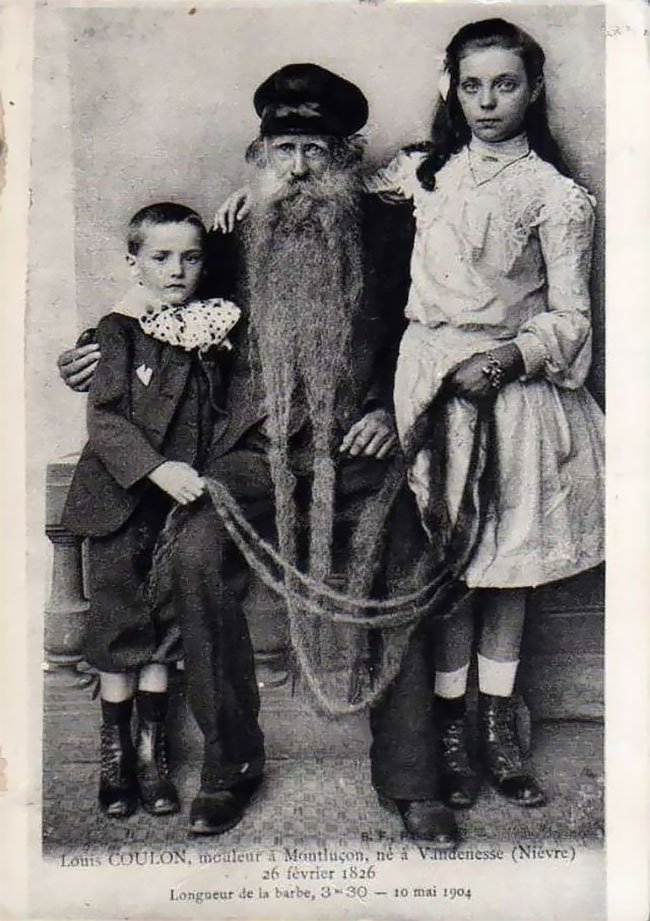
This post responds to Cleveland Wall, a poet for whom recitation is part of presentation and who reminded me of an old poem of mine I had written in response to a visual image on a postcard. The image and the poem are below, but what strikes me about recalling the work is that it is one of the few poems I have managed to memorize.

Ms. Wall memorizes much of her work and has presented at performances such as slam poetry events and No River Twice shows [Facebook video link below–you can catch a glimpse of me reading here, too.]

Alas, I have ever and always been terrible at memorization. In Sunday school, my younger sibling earned points for Bible verse memorizing at probably twice my pace. I enjoyed theater but never learned lines well enough to manage more than walk-on roles. Song lyrics came more easily, probably because the music helped cue me to the phrases.

You would think a poet–a versifier!–could commit her own work to memory. But no. Add that to my numerous failings.

~~

I bought the Louis Coulon postcard in 1980 at a New York City stationer’s. What I did not know then (hey, no interwebs) was that Coulon sat for a number of portraits and was a relatively famous postcard subject at the fin de siecle.

Here’s the poem, first published by the estimable Harry Humes in the now-defunct Yarrow: A Journal of Poetry in 1992.

La Barbe

Monsieur Coulon, my grandfather, wore large mustaches and a beard three meters long. He tied it to the bedposts by night to avoid strangulation in his sleep; as it was, he died of fever in 1904, and the beard grew two centimeters more the day after his death. For years I had nightmares, Grandfather silently choking me in the posterbed I’d inherited from his estate. I bobbed my hair before the style became fashionable; Mama said it was scandalous, but the dreams ceased. I left Nievre for Paris and America, to avoid strangulation.

In 1942, I visited Savannah, Georgia, where trees resemble men, their great beards choking ocean breeze. I dream of trees opening gray coffins into a humid night–

                           I am an old woman, now, and waiting–

         ah, listen:

the wind is speaking French, Grandfather, it takes my precious breath away!

~

Louis Coulon, beard

~

P.S.–I have updated my P&W directory entry. Check out https://www.pw.org/directory/writers/ann_e_michael

Prose poem, memoir

The prose poem seems a fraught and contradictory thing to its critics, a formless form, different in some way from flash fiction–more lyrical? More imageric? Lacking plot? Years ago, I went through a period of writing them, usually taking on a persona. Lately I find I am writing them again. Sometimes I think I’m writing a haibun, yet there’s no accompanying haiku. But mine do tend toward the lyric impulse.

And here’s a prelude to a prose poem draft, which follows (if you can be patient).

~

Perhaps it was not the most sensible thing to do, given my sore foot, but I had planned a trip to Poets House for a Finishing Line Press-sponsored reading by James Ragan and did not want to forego my visit. Ragan’s poems are lovely and often deep, and he offers a reading in the spirit of a raconteur. All the places I needed to stop were within three blocks of the A train, and therefore the main concern was going up and down subway stairs. It seemed do-able, and it was; though I am physically “paying” for my journey today, it was worth it.

The bus ride to New York and back takes about two hours, during which I read, nap, or daydream. We take the Lincoln Tunnel into town, a route familiar to me for decades, this time evoking memories that have been tucked away for ages.

Of course, some of this draft is invented–when I start writing, I often have no idea where I will end up. This one surprised me.

~

We were children in the years of Sunday drives, burning fossil fuels to tour the countryside and leave the city’s skyline, obscured in puce-yellow, lead-bearing smog, for tree-lined back roads and a picnic lunch. Sometimes over bridge, sometimes under the Hudson. Each crossing tested our bravery: fear of heights, of darkness. We had a song for the bridge which we sang while watching cables’ span. We were too small to see out the windows down to sailboats and barge traffic. The tunnel had no song. We hunched in the back seat, held hands, squeezed shut our eyes, expecting to drown. On the curved ascent in New Jersey my sister chose the house she wanted to live in—many-dormered, stone, with a round tower, it jutted over Weehawken. Once we’d learned to read, we realized it was the town library, which suited her imagined lifestyle. She would choose that even today, retire to live in a library and work part-time in a bookshop. She imagines I will join her there, perhaps I might.

~

Memory to prose memoir to prose poem. Founded on rocky physicality.


weehawkenlib

The Weehawken Free Public Library