As you wish

Photo by Ahmed u061c on Pexels.com

Discouragement, a regular visitor to this writer (and many other writers), has settled into the house with me. Summer is often, for me, a time of writing less and doing outdoor and social things more; this year, though spring was lovely despite torrents of rain, summer commenced with the deaths of two long-time friends, and I haven’t been able to shake my low mood. Now the rejection slips are arriving thick and fast, and I’m questioning the value of my work in particular and of creative writing in general. Like, why bother? What am I doing this for? For whom? What’s my purpose? And under what circumstances? Why?

Brooding certainly offers no help, nor does it change “declined” to “accepted.” Creative persons often find themselves questioning their pursuits, so I have good company. (Having just about completed the last book of Remembrance of Things Past, I can report that Proust’s narrator–largely a stand-in for Proust himself–wanders in the dark through wartime Paris pondering his own decision to try being a novelist and feels discouragement and doubts aplenty.)

Somewhere on a social media platform, I encountered these words by Virginia Woolf (from “A Room of One’s Own”): “So long as you write what you wish to write, that is all that matters, and whether it matters for ages or only for hours, nobody can say.” Good perspective, that, to stop being concerned for how long your writing matters, or to whom, as long as what you write is what you wish to write. And then if you don’t submit your work for publication? Maybe that is something you can live with. Rather, something I can live with; at this point in my life, I have had hundreds of poems and essays published, six chapbooks, and three poetry collections…maybe from now on, I should write (as I always have) for myself. Even if my work is not in fashion, or considered irrelevant, or judged as potentially lasting, it is still what I wish to write, what I find necessary to express.

Though one does write to express things, and expression seeks audience. That’s a perspective for another day, perhaps. Meanwhile, back to weeding the garden and picking cucumbers, beans, tomatoes, zinnias, and sunflowers.

Wet summers

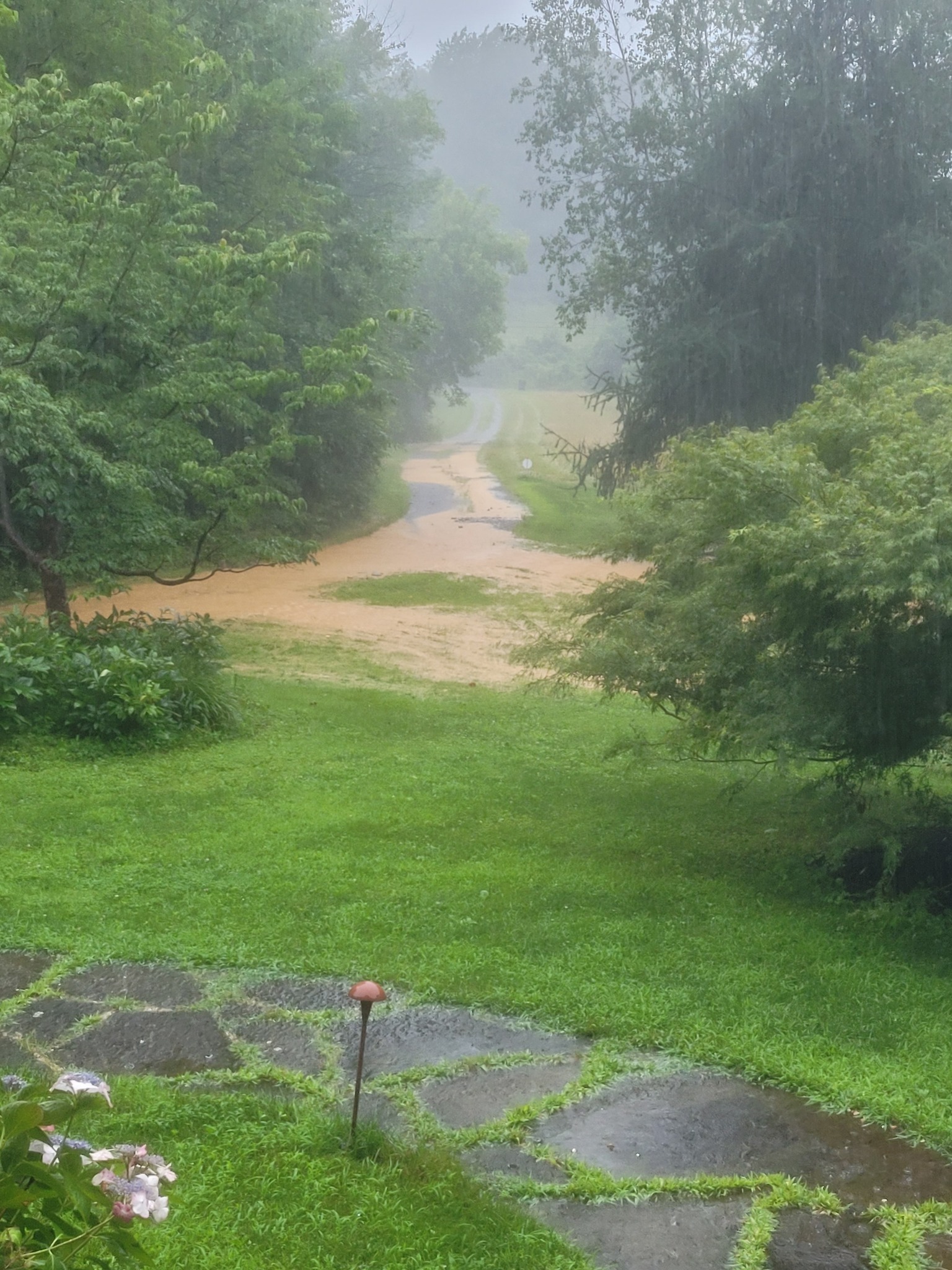
Thunderstorms used to thrill me, and still do–that combination of potential damage with the relaxing sound of rain on trees and rooftops, rain rushing through downspouts, and overcast skies that seem to lull me to sleepiness. Yesterday’s rain was a doozy. We had a flash flood in our front lawn, which has never happened before. But the basement stayed dry, no trees have come down (yet), and we didn’t lose power.

Cracking loud thunderclaps with arrow-straight downpours on hot summer days remind me of childhood. Yesterday afternoon I sat on my porch for an hour just watching the rain and remembering days like this. When we aren’t in drought years, these summer storms appear commonly in the region; yet they always evoke memories of long ago, I suppose because when I was a child I could just sit around watching a thunderstorm instead of, well, doing grownup things. Like working in an office, teaching a class, grocery shopping, laundry, reading emails, whatever I’ve been doing during the past 50 summers.

I spent many a mid-summer week or two in northern Indiana, where this type of storm was common. My grandmother always appreciated them, saying, “They make the corn grow.” Which must also have been true in the coastal plains of southern New Jersey, where I spent the rest of every summer. (Sweet corn is excellent in both regions.)

So, I think of thunderstorms on days so hot we could just run around outside in sundresses or bathing suits, getting doused, or sit on a porch and read while the lightning flashed and the rain came down in torrents. And then have garden tomatoes and corn on the cob for dinner, and go outside after dusk arrived and chase fireflies in the wet grass. These are the kinds of things that I feel nostalgic about, though I am not generally a person who gives much energy to nostalgia. It has been awhile since I had enough unoccupied time on my hands that an hour on the back porch observing the rain seemed like a valuable thing to do.

But it is.

Anyway, here’s a prose poem from my book Abundance/Diminishment that I recalled to myself while I was watching the storm.

~~

Competition, Wet Summers

…so here’s this young woman practically in tears—it’s almost one o’clock
and raining harder than ever, thunder so close it’s practically grabbing us by the
shoulders and the lights dim inside each time the sky goes millisecond-bright.
It doesn’t feel like midday. Every stall is full and the horses aren’t happy.
We can hear the skittish ones hollering, pawing, kicking at the doors. It’s a squall,
I tell Sara; but she’s frustrated, fuming, has her tack cleaned and her dress breeches
on for a three o’clock show she’s convinced won’t happen now that all hell’s let
loose in the form of torrents and flash floods, and there’s a stream coursing from
the south door into the first bay of the stable—it looks like the River Jordan.

The roof leaks at a spot directly above her shampooed and just-groomed mare
and I’ve run out of cheery platitudes and patience; I just walk myself to the barn’s
far end, feel the rain splash up my legs from the puddle at the threshold, dripping
on my neck and face through rotten shingles. The wind stops. It’s a straight-
falling deluge and hot, a no-relief rain with big drops that bubble in temporary
pools of runoff by the wash stalls. The afternoon is green and grey, the puddles
a stirred-up brown, and I remember my former boss—thirty years ago—standing
in the type shop doorway on a day like this one. The look on his face was worse
than Sara’s, not frustration or mutiny but numb desolate recall, slack and empty.

“Man,” he said, “It used to rain like this in ’Nam.”

~

A little green

Summer arrived rather suddenly here in the valley. After a rainy May that was a bit cooler than average, June has slapped us with 80° days and sunshine. Not that I am complaining, but it does throw a curve at the vegetable garden’s usual progression.

And all that rain burgeoned into so much verdancy–my eyes almost ache from all the green! We’ve needed the rain (the wettest May on record) to make up for the driest October on record (2024). Nature appears to be doing its best with balancing things out in the face of all we humans have been doing to unbalance it.

Quite a switch from the spring greenery in the mountains of New Mexico, greens that are far less chartreuse in hue, the kind of green you have to be looking for amid the deep jades of pines and the brownish-green cholla. Prickly pears are a bright shade of green but don’t evoke any sensation of lushness. The little-leaf oaks start out with a fresh hue but become very dark, nearly black, as the season progresses.

I was thinking about the hues of the high desert because of our visit to the Georgia O’Keeffe Museum in Santa Fe. One of the galleries there is a display of the artist’s pastel chalks, brushes, and color chips she created for herself to get the palette she felt best represented the landscape she knew. Many shades of ochre, browns, dull oranges, sandy yellow, and that famous turquoise blue of the New Mexico skies–but also the green of cottonwoods in spring, the green of pinyon and ponderosa, the sage green so common among low-growing plants like sage and rabbitbrush.

Try defining the word green.

A little Joni Mitchell to accompany that request:

Useful avoidance

Trapped inside with the air conditioner on for over a week, I sat by my bookshelves going through the poetry books in my library. I’m re-reading, assessing which books I truly want to keep because I turn to them often or learn something each time I read them, which books I keep for sentimental reasons (maybe I know the author personally), which ones to keep because they are signed copies, which ones are long out of print and I would never be able to replace them. Some of them remind me strongly of places or eras in my life: I bought this one in a small bookshop in Grand Rapids MI, or this one at Barnes & Noble when it was just one store on a NYC street corner, or these at the storied and much-mourned Gotham Book Mart or St. Mark’s Bookshop. What are good reasons to keep books when I really have to downsize? It’s not an easy task, and the first of many in the process of getting rid of stuff so my kids won’t be stuck doing it. Besides, I enjoy re-reading these books. My children are not as enthusiastic about poetry as I am, so it makes sense that someone who loves the works on the shelves be the one who makes such decisions. It feels good to be surrounded by the words of wonderful writers when the outdoors is brutally hot and humid, and every joint in my body aches.

Surrounding myself with other people’s books also acted as one more way of avoiding my own creative work. Sometimes, though, waiting around and doing nothing on a project ends up bringing clarification or new ideas. It can prove useful. I have been stalled on my in-progress manuscript, so a month or so back I asked someone to take a look at it–and then I got caught up in doing other things. Like getting cataract surgery and having covid, and then it was gardening in full swing under sweltering weather, and then the bookshelves… I wasn’t exactly procrastinating, but neither was I actively working on, or even thinking about, the collection.

Acquired when I was much younger, and cool bookshops abounded.

And one night recently–during a much-needed rainstorm–I got a brainstorm! I realized I was trying to pack too many topics into what really should be a manuscript more closely focused on how people who love one another vary in their relationships to old age and death, and on how the contemporary social and medical aspects of the aging process pull us in uncomfortable directions, often distancing us from those relationships. So yes, there should be family poems, hospice poems, biblically-influenced poems, and dealing-with-everyday observation poems. Also some poems of hope and love, poems reminding me (and readers) of the need for compassion in all dealings. But the draft had 92 poems in it, far too many; and some were there just because I like them or they’d been published in a good journal. Which are actually not good enough reasons to include a poem in a collection, according to most of the editors I know.

I am back to thinking about the manuscript and digging up potatoes–a nice crop this year–instead of culling the poetry books because, thank goodness, the heat wave’s subsided a bit. But in the process of this non-routine summer I have allowed numerous weeds to flourish and set seed; all the more work for NEXT year’s gardening, but it’s been too hot to deal with said interlopers. I like to believe the weeds and I are reaching a sort of understanding, but it is not really a compromise. All the concessions have been on my part. [Note: weeding a personal library is less physically taxing but not really any easier.]

Aft a-gley

Today marked the first day of the Fall semester at the college, but I had no reason to be there. Instead, I enjoyed the surprisingly fine August weather, harvested tomatoes and basil, and began the much-delayed task of weeding our numerous perennial beds. At 4 pm, I rested in the hammock after a walk and spent a few minutes reveling in retirement; though generally I’ve been too busy to find myself in reflective or relaxation mode, it was nice to pretend for awhile.

Yes–I wanted to read books in that hammock, and get to the community pool, and hang out with friends on the patio until the bats came out and the last fireflies gleamed over the meadow. Ah, but Robert Burns nailed it: “The best laid schemes o’ mice an’ men / Gang aft a-gley.” There were so many other things to do.

That said, while I did not do the Sealey Challenge this August, I managed to read several really terrific poetry books–and the month’s not over yet! To keep this post brief, I’ll just mention the book I’m reading now, Jennifer Franklin’s stellar new collection If Some God Shakes Your House. Lots of (mostly) non-rhyming sonnets, a series of memento mori poems, and lyrically linked poems titled “As Antigone–” connect anger, grief, and suggest that anti-authoritarian acts are often more about love than bravery. The speaker keeps denying that bravery’s behind her disobedience, but these poems are brave. I found many of them utterly heart-breaking, so it may not be an “easy read” if you want something cheerful to uplift a low mood. Nonetheless, Franklin’s poems secure hope to love so intensely I could not look away and keep returning to them even before I have finished the book.

I grew up confusing opinion
with oracle. She reminded me
all men are dangerous, each time
I left the house alone….

Jennifer Franklin

It can be difficult to avoid comparing such strong poetry with…well, with what I write. I think that most writers do this occasionally, some more than others. If one is a competitive or ambitious person, analysis and comparisons may be second nature; I have known poets who feel dismayed by their own inadequacy compared to the “greats,” and poets who felt bitterly overlooked because they didn’t get the attention or lauding other writers garnered. Either way is a trap, though. In general, I look to admirable literature as something to enjoy, learn from, admire, and to analyze to figure out how it can be done. If I have ambition, it is the ambition to learn. Oh yeah, the autodidact in me again!

And speaking of ambition, or lack thereof, I am far behind in promoting my book. Next post should contain details of the book launch in the Chicago area (September 9), and perhaps other writing-related newsiness.

Moment(s)

Very small pear.

~

It was delicious.

After last year’s complete dearth of pears, this year both trees were laden with fruit so that the boughs drooped, making things easier for the deer, who love to eat them. We were happy to share, as I haven’t got time these days to make pear butter or prep fruit for canning. We gave pears to friends, made pear cobbler, ate pears for breakfast, and enjoyed them immensely. And we liked watching a doe and her twin fawns nibbling around and under the trees at dawn and towards dusk.

The summer heat broke at last after the “remnants” of hurricane Ida crashed over us. If those were just remnants, I have deep respect for the people of Louisiana, who felt the initial force. We got 7″ of rain in less than a day, and the flash floods affected many of our friends. My basement office on campus is drying out during the 3-day weekend–our building’s drainage system was not quite up to the task of directing water away from our doors. Now, the brown crickets are noisier than the katydids, the grasshoppers have grown large, the days are shorter. Tomato harvest has slowed, and gardening consists mostly of pulling up weeds and dead plants. It is as though the downpour swept away summer, despite my knowing that the hot days will return. (September can be steamy here in my valley.)

I’m reading A.E. Stallings‘ collection Like and relishing her new takes on traditional poetry forms as well as her facility with establishing a sense of place in the poems. I appreciate her images and thought-provoking ideas, too. Her work does the things that I think poems are supposed to do.

Finally, I have been drafting a few poems, or at least hoping these drafts will turn into poems. I’ve also begun examining some older work for revision and, maybe, collection into another book. But that’s looking perhaps too far ahead. After a challenging couple of years, maybe just living in the moment serves me better.

The taste of fresh pears. The sticky sweetness of fresh local peaches. The smell of basil.

Cycles & theories

The Chinese lunisolar calendar puts us between 立秋 lìqiū, or start of autumn, and 處暑 chùshǔ, or limit of heat. Certainly the heat here lately has felt limiting, but the term more likely refers to the end of the hottest days of the year. My backyard world fills with haiku imagery for waning summer and impending autumn: katydid and annual cicada calls, birds starting to flock, morning glory and goldenrod, ripe pears, apples beginning to redden, hosts of butterflies. I watch as a hummingbird visits sunflowers, cannas, buddleia, corn tassels, and zinnias. Ripe tomatoes and zucchini weigh heavily on their vines.

Yesterday, a doe nibbled pears while her late-born twin fawns wove between her legs and the Queen Anne’s lace beneath the tree. The air hangs so humid, even the monarch butterfly’s wings seem to droop. A sense of waiting.

And I prepare for the fall semester. Cycles continue: that’s a good thing, isn’t it?

~

Therefore, to engage my intellect when my expressive ability with words seems sparse, I’m reading about theory. Specifically, the theory of the lyric in Western poetics, which turns out to be abstract and scholarly (no surprise, really–theory tends to be scholarly). My guide for this outing is Jonathan Culler’s book Theory of the Lyric. This text manages to be relatively readable despite its terminology; and as the terminology for the lyrical poem encompasses a long history of definitions, rhetoric, explanations, subgenres, and antiquated jargon, the going occasionally gets tough. I’m learning a great deal, however, about poetic experimentation over the centuries.

I now recognize that I have subsumed the idea of lyricism as it came down to American writers through Romanticism (see Hegel). It’s just that the concept of subjectivity in the lyric, and inward-turning emotion and the poet as speaker, has been so pervasive in Western poetics and pedagogy that it seemed a basic premise. Yet it was not always thus, and certainly other cultures employ lyricism differently and view it differently. It’s never an easy task to view from outside what is inherent in one’s own culture, but that’s where books like this one enlighten and challenge.

Besides the theory and historicity of poetry and the task of poetics, however esoteric and abstract, theory texts often elicit from me the urge to move to something more concrete, more creative.

I can only hope.

The berries

It is my custom to pick blackberries in the heat of the day. Perhaps I relish discomfort: the heat, the muggy late-June or early July weather, the thorny canes interspersed with other thorny canes and exuberant vines, poison ivy among these. I always end up scratched, sweaty, sunburned, and itchy; but I end up with blackberries.

Picking at midday means I encounter fewer mosquitoes, for one thing. And in midday I am likely to be the only berry-gatherer in the thickets. Everyone seems to love blackberries and mulberries—which ripen about a week earlier, so these berry seasons overlap. Everyone! Birds, squirrels, deer, foxes, groundhogs, raccoons, possums, bears…

Blackberry fruiting gives way to blueberries, and blueberries to wineberries and elderberries, so that bellies get filled and seeds get dispersed all over the place. I hear rustlings in the hedgerows and at the edge of the woods at night, so yes, I would rather loot my fruit when only “mad dogs and Englishmen” are outside.

Tonight, we’ll have berry cobbler.

I’m still not writing very much new work, but blackberry picking brought to mind this poem from quite some time ago. The poem’s speaker is hiking, not berrying, but I thought of it just the same.

~

Bear & Cloudburst


Blue Ridge, 4200 feet:
we start our ascent, sweet
cicely going fast to seed

trailside goldenrod in bloom.
Bees hover and hum,
we walk one by one by one by one

summer-heat left behind
smothered in pipe vine.
Track and blaze. Trail climbs

through laurel—twisted, dry
from two years’ drought, sky
overcast, color of thin whey

but the ranger doubts rain,
has hoped too long, in vain.
As we file by, he waves.

Further up. Dense shrubs
thickets of berries slubbed
like raw silk, leaves daubed

with stippled insect eggs
or lichen, fungus, swags
of spider webbing, sacs and bags

and butterflies, brute gnats
undeterred by repellent. We swat
stobs, are scratched. The scat

along trailside I recognize as bear
but say nothing, though a fear
threads my ribs tightly where

instinct thumps. Our feet tramp
soil, each step sounds the tamp
of soles ascending; camp’s

four hundred meters’ altitude
below. Skeletal crane-fly skewed
dry in a web. We walk through                       

woods, a clearing up ahead
when a pungency attests
to recent presence, and Alice says

“There’s a funny smell.”
Her voice seems oddly small.
We summon our collective will,

engage in loud conversation.
Bears aren’t known for discussion,
are likely to flee in disgust. Then,

thunder. Air, though thin,
grows humid. Under the din
the tree-line begins

to go, our path exposed
as a blade of lightning explodes
ahead, just to the north.

Pick up the pace. Slouch
back to the undergrowth, the touch
of brambles like a scutch

on skin. We scuff the leaves
in the musky, bracing odor, pleased
to be off-summit, our speed

faster than before and louder
as we plunge downhill and wonder
where the bear has wandered

and if it’s found shelter.
We’ve half a mile to weather
in the rain. I slip. I’d rather

climb into some outcropped sweep
hidden beneath a sweetgum tree,
nuzzle the berry-breathed bear, and sleep.


Respite, refuge

Last night, first time I heard the tree crickets’ din blossoming in darkness; cicadas’ daytime clatter began last week, and the lantern fly nymphs are in their last stage before morphing into winged tree-pests. The heat’s oppressive, which seems to suit the general mood. I have not been writing poems, but this morning wakened early to surrounding birdsong and felt a moment of beauty amidst the tension.

As usual, my garden has offered respite. I harvest beans in evening’s humid warmth, pulling pods from the resilient stems. I marvel at the squash blossoms–bright bells amid enormous green leaves–and gather cucumbers and zucchini, and wait for tomatoes to ripen as I tie up the vines heavy with green globes. The scent of lemon basil pervades dusk as the last fireflies start to wink. Yes, there are disappointments and bugs and there will be yet more weeding and work. It is, however, labor of the body for the nurture of the body. A body in the world.

~

Twenty-odd years ago, we planted an American beech and a stellata magnolia 15 feet apart in the yard. For years, the magnolia–an understory tree (more of a shrub)–grew taller than the beech. Beeches are slow growers in their early years, but it caught up. Now the magnolia flourishes happily under the spreading beech, and in the space between them there’s a mossy, shady refuge where I sometimes sit to escape the heat or the stress and worry of life. I’m not the only one who seeks the protective room beneath the spreading trees, as that’s where the snapping turtle buried her eggs, and there’s a sandy spot in the mosses where another creature has made a place to lie.

I sought the place last evening after watering the garden. Wandered there over the brittle grass and spent clover blossoms of our meadowy yard. Felt the things of the earth beneath my feet. Still a barefoot girl. Still in need, now and then, of refuge.

~

Oh yes–my book of poems, Barefoot Girls, is still available. It is a limited run, though. $8.95 from Prolific Press. Reading poetry: another type of refuge.


The color orange

bouquet

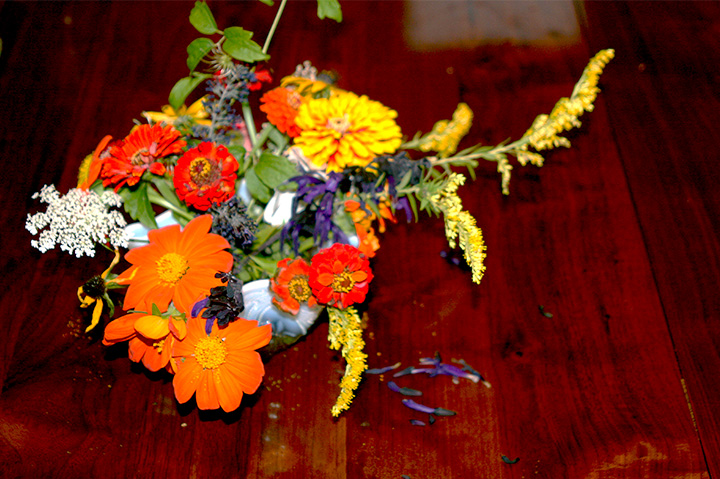
Late summer bouquet five days past its first blush…

~
The crickets are raising their “voices” each night; the darkness lasts a little longer, and the color orange emerges from the green of midsummer to remind us of all that is beautiful in the world, despite __________________________ [insert your list of unpleasant, tragic, disheartening things].

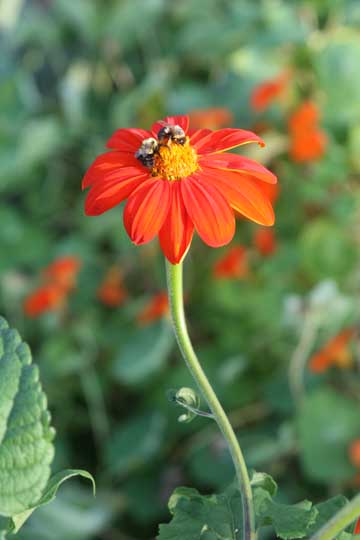
Here is my encomium to the Mexican sunflower, tithonia rotundifolia, a favorite of bees and monarch butterflies and also a favorite of my daughter’s, so it has special aesthetic-emotional appeal for me. The poem I’d like to write to the sunflower has not yet materialized, so praise in prose will have to do for now.

mexican sunflower, bee by Ann E Michael

Autumn approaches. I like autumn, though some of my dear ones do not–but one thing universally salvages the early weeks of the season, no matter how a person feels about the encroaching cooler weather: orange. Even people who don’t care for the color in clothing or decor admit that, in nature, the color orange attracts the eye, enlivens a scene, brightens the dullest corner.

Nasturtiums, zinnias, the last hurrah of daylilies, butterflyweed, and early-turning foliage such as sumac and sassafras sport the color well. There are also pumpkins and squashes warming up fields; and in some areas, there are butterflies wearing the hue: monarchs, viceroys, fritillaries.

But nothing delights in a bright red-orange so well as the Mexican sunflower, which evokes the warm climate of its designation and likely origin (I haven’t done a great deal of research on the plant. I know that tithonia diversifolia is native to the region of Central Mexico and am merely guessing that the rotundifolia variety has its roots there, too–excuse the pun).

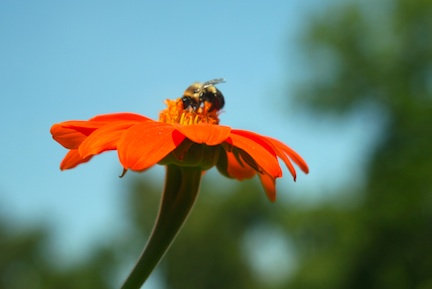
monarch.ann e michael

It sports well with one of its showiest pollinators, the gorgeous, orange, monarch butterfly.

Tithonia likes full sun and does not mind a bit of drought–all reasons it managed well in Mexico. It’s also ridiculously happy in the American Northeast, at least in the Mid-Atlantic region where I garden. The plants grow 6-9 feet tall and are veritable fountains of pleasing, brilliant points in the late-summer garden. They attract bees, butterflies, hummingbirds, and small songbirds and have few pests. Deer dislike their “hairy” leaves, and slugs and beetles seem also unimpressed with their food qualities.

Or perhaps the “pests” appreciate the blooms’ aesthetic value, as I do. [Okay, too much anthropomorphism there, I admit.] tithonia.2sm

Furthermore, as long as I get out to the garden and dead-head the plants regularly, they bloom right up until the first hard frost.

And they cut well for bouquets (see the not-excellent photo above).

When there is so much sorrow going on in the world, it may seem odd that a flowering plant can offer respite–a moment or two of awe, of joy, the discovery of a bumblebee with its legs pollen-yellow or a monarch’s slim proboscis coiled just above brilliantly golden stamens amid a red-hot orange daisy-shaped blossom…and maybe, above, an autumn-blue sky.

Not art, but nature. Both valuable to human creatures.