Online reading, online learning

I blog, therefore I am part of the digi-technological consciousness.

Here’s a situation Descartes might have had fun imagining…have we invented our own “evil genius” in Boolean or algorithmic forms? I won’t venture there, as I am not tech-savvy or social-media savvy enough to philosophize around tech aspects of modern culture; though, yes, I do use portal systems when I teach; I do use (limited) forms of social media for communication and to publicize my work; I do take part in the networks community online; my poems and essays appear in online journals; I read blogs and online journals although in general I prefer paper, especially for book-length works.

It isn’t as if I don’t consider the intellectual challenges these communication platforms offer. It would be silly to ignore them. They are not going to go away any time soon. One question is, however, to what extent should I employ or embrace them?

~

Recently, I’ve had a poem published in Carbon Culture Review, an online and print journal that states, as part of its mission, that the publication “advocates a creative, thoughtful and visually appealing dialogue about our complex relationship to technology. We strive to promote the work of those who employ technology and utilize technological designs and terms in art and literature.” The Intersection of Technology + Literature + Art, says the masthead; interdisciplinary in scope–that’s something I find fascinating, so I’m happy to report a rather atypical poem of mine has found a place in the new issue (“21st Century Research”).

I read Chronicle of Higher Education online and have linked to several of its essays in past posts. Lately, I find much of interest in Hybrid Pedagogy, a fairly new digital source about technology, teaching, radical re-thinking of the educational framework, and exploring the possibility of intentional, compassionate connections between teachers and students–even in the digital world. Here’s a recent essay that appeals to me: “Teaching as Wayfinding.” I am still wrestling with the challenges of how to create a genuinely interactive and personal learning space in the classroom, let alone via distance education. There is so much to learn, and welcoming interdisciplinary synthesis into the discourse of the humanities offers intriguing potential.

~

Speaking of the interdisciplinary: I am pleased to report that The College of Physicians of Philadelphia chose one of my poems, “How the Body Works” as an honorable mention in its Poetry Month contest celebrating medical/health themes in poetry. [You can also check my Events page for information and tickets.]

The College, a professional medical organization founded in 1787 (same age as the U.S. Constitution), is also the site of the Mütter Museum, which has a terrific slogan: “Are you ready to be disturbingly informed?” The College boasts a library of historic significance.

It’s a great venue for a reading, and if you are in the area, please join us. My brother says the food is really good, too–the ticket price includes a dinner. How festive is that!?

Synthesis & cigarettes

My students are too young to remember a time when smoking was permitted in public places. They’ve never seen cigarette ads in magazines. While a few of them do smoke, all of them are well aware that smoking can be dangerous. Most 18-year-olds seldom even see people smoking in movies; few celebrities flaunt a cigarette in their promotional shots anymore.

And none of them are aware of the history of anti-smoking campaigns: the legal wrangling, lawsuits, longitudinal studies, public service announcements, warnings, shaming, second-hand smoke claims, discrimination against smokers, tobacco industry lobbies, or the length of time it took to convince the general public that there were genuine risks involved in the addicting and heretofore glamorous habit. Yul Brenner died of cancer in 1985, long before my students were born, so his posthumous anti-smoking public service announcement–which was big news at the time–is not even a blip on their radars. They never saw the famous “Johnny Smoke” cartoon (which terrified me as a child) featuring the frightening and authoritative voice of James Earl Jones.

Why should they know–or care–about the combined efforts of state governments (cigarette taxation), non-profits (The American Lung Association and others), medical researchers, and health advocates…and why should the fact that this process took decades matter to them? Well, maybe they could learn something from this kind of history.

Like the actions of Civil Rights protesters, who employed social advocacy for the stated purpose of changing the expectations and behaviors of citizens, “awareness campaigns” such as those created to reduce smoking offer important lessons about how long it takes to influence large communities and which methods are most likely to be successful. Cass Sunstein notes that most legislation officially becomes the law of the land after the majority of citizens are already practicing the behavior, having individually and privately decided that, say, refraining from cigarette smoking is “common sense.”

An instructor at the college where I work recently assigned his students a synthesis paper in which they were to analyze and consider a JAMA Mozaffarian, Hemenway & Ludwig article–about using public health campaign strategies in an attempt to reduce firearms deaths in the US–along with another source (or two) and then derive, from their expert sources, an approach of their own that might be a step toward decreasing the number of gun-related deaths. His students are freshmen: he did not ask them to anticipate constitutional stumbling-blocks, censorship issues, or other complexities that would–naturally–arise. He did not tell them to propose gun control at all (and only some of them did); he wanted to see what they would come up with and whether they could infer, from the JAMA article, that there are methods other than federal legislation through which social changes can be implemented.

It is a valuable assignment because his students have trouble understanding it. They show up at meetings with me and the peer tutors in writing and they complain and question and wrestle with what the professor wants. What he wants is simple: he wants them to think. He won’t judge their ideas as right or wrong as long as they show that they understand the texts and can think about the complexities.

johnny smoke

Johnny Smoke

Here’s what I love about his assignment: students have to infer, reflect, analyze and synthesize, in the process of which it dawns on many of them that there are no easy answers; the issues are not black-&-white but depend upon perspective and social attitudes–not merely upon individual moral values, parental decrees, or civil laws. In other words: there are many other people in the world. Think about what you, the student and citizen-of-the-globe, can say to those people, respectfully, with some facts that you can convey.

It can be more than an argument. It can be a conversation, from which all of us learn more than a confirmation of our own correctness.


Poetry, history, connectivity

We are connected, perhaps too closely, too immediately. With Nigeria and Boko Haram. With Paris and Charlie Hebdo. Ferguson, MO. Eric Garner in New York. George Zimmerman. Iraq. Syria. It’s easy to continue this list–too easy.

What we tend to want are simple solutions, dichotomies, dualities, one choice or another–not complexities and subtleties. But the human brain, the human culture, the human genome, the human body and the systems in and through which we operate are damned complicated.

~

Former US Poet Laureate Billy Collins gets a great deal of press, and sometimes he gets criticism for his popularity; but in a recent interview he states in apparently simple terms how complex the human condition is, and why we need compassion, and poetry:

The poem shows us that these emotions, love and grief, have been going on through the centuries; and that the emotion we’re feeling today is not just our emotion, it’s the human emotion.

Poetry is the only history we have of human emotions. Most history books, what we call history books, are stories of battles and treaties, negotiations and beheadings and coronations. But poetry is the only reminder of this very essential part of being human, which is one’s emotional life and all the dimensions it entails.

The history books will leave out many of the crimes, massacres, terrorist acts, and bloody little belligerent actions of people and their governments and cultures and belief systems. History cannot help but be compromised by point of view–it is always, as Churchill noted, “written by the victors,” even when they are trying to be even-handed and objective. But poetry is all about point of view. The “tell it slant” of Dickinson, ambiguity and mixed feelings, individual imaginations and individual interpretations. As Collins puts it:

I think writing and creating are expressions of an epistemological position — that is, how you look at the world, that slant you look at it from. And that’s all I feel I am in a palpable way responsible to: using that slant to get at some truth or a little smidgen of beauty.

It’s a matter of being true to your imagination, and being true to your vision, and true to the material you’re working with, whether it’s a violin or the dictionary of the English language. You have to listen to all the other violinists who have ever played, and read all of the poetry you can consume. That’s my sense of responsibility. It’s an artistic responsibility, not so much a political one, not so much a financial one or a responsibility based on commodity. It can’t be commodified.

As a teacher myself, I love the anecdote in this interview about a past student who, years later, could recall a poem he’d memorized for Collins’ class. Collins says:

[T]eaching is a very mysterious process. You’re throwing information, in a sense, into the dark. I mean, you spend an hour talking to this group of increasingly younger people and you walk out of there and you think sometimes you’ve had a good class, and other times it’s not been that great. But no matter what it is to you, you’re not sure how it’s being taken or what effect you’ve had.

The story reminds me of one time when I was getting my teeth examined; my dentist (knowing I teach poetry) said to me, “You know, in college and dental school, I took Chemistry. I had five classes in Chemistry. And I never, hardly ever, in my current job, use that information. I almost never think about chemistry. But I took a class on Milton’s Paradise Lost. A poetry class, really. And  you know, to this day–sometimes I find myself thinking about that poem. And that class, and those lines. Really. It’s stayed with me much longer, and more significantly, than any of the chemistry courses I took.”

Billy Collins would surely smile and nod if I were to tell him this story. Those connections are the invaluable sort: beyond information and into the mystery of what makes us human beings. Teachers learn from this sort of experience. It stays with us.

~

We may not be able to resolve the wars, prejudices, pride and anger and sense of  injustice that cause people to murder one another for revenge, honor, religious feeling, economic or territorial needs, or fears so deep we may not even be able to name them. Even tolerance has its downside: a tendency to refrain or excuse when speaking up might be necessary, if dangerous. Not all of us enjoy the learning we can gain from adversity or from trying to understand our enemies, who may not respect a willingness to listen. Not all of us learn from great literature, or have the patience to live with art that discomfits or challenges us. It is easier to paint Satan with the broad brush of evil, when Milton’s character possesses nuance and depth. The same with Mohammed or Jesus, the Pope or Buddha, Putin, Obama, or any world leader or financial oligarch.

We are all people in the world, flesh and bone, loved by someone, suffering and gratified by daily life, under the same sun and moon. The sun and moon that have appeared in poems from time immemorial. The biosphere that connects us whether we like it or not.

Preparation

As I prepare for the upcoming semester, my thoughts turn from weather, the garden, and philosophical readings to the gnarly process of educating the young adult. In fact, I just spent four days with a group of 46 incoming freshmen who were involved with an intensive college preparatory orientation. So much potential there. So many high hopes.

What tends to be lacking is “grit.” Most young adults have not yet developed the mindset that accepts the unavoidable need for hard work, for mastering skills that are tedious, for thoroughly and correctly finishing assignments that bore them–all in order to attain the seemingly far-off goals they have set for themselves. I don’t blame them for this attitude, since I shared it when I was their age.

And growth is as hard as it is rewarding. I like what blogger Danny Anderson says:

“Education is growth, and like all growth (think of your shins at night when you were a teenager) it is painful and requires struggle. At its most basic level, education is the twofold act of acknowledging a shortcoming in one’s self and working to improve in that area. This is simple, but, if taken seriously, brutal.”

Acknowledgment of this kind takes reflection, and effective reflection takes analysis; and few 18-year-olds in the USA are spectacularly skilled at analysis (of self or of any other kind). They know precious little about themselves, the job market, adult society’s expectations, college expectations, debt load, and back-breaking personal responsibility.

And that’s ok, as long as they learn these things in good time, which most of them will.

I agree with Professor Anderson’s assessment that many students arrive at college thinking that four years of grind and partying will get them a diploma and a magical job offer, and that such assumptions are woefully in error. He writes, “Education is not a product you purchase and consume. You are not a blank slate waiting for me to write something marketable on you. On the contrary, Education is something that consumes you.”

That’s one thing I always understood about education, even when I was as irresponsible and callow and un-grounded and enthusiastic as the students I’ll be teaching later this month. Even now, I am preparing for my Education (continuing, always) to consume me.

If you’d like to read the rest of Anderson’s post, it is here.

Maximally bent & broken

bent and broken

bent and broken

The linguist/scholar David Crystal writes that “Poetic language is the domain where linguistic rules are maximally bent and broken.”

The context here (in his book The Stories of English) is an explanation of how historians of language accomplish their sleuthing; Crystal notes carefully the differences between written and spoken versions of the same language, not to mention dialects and artistic expression and diversified diction based upon the intended audience, and uncertainty as to region, origin, and date of the manuscripts and texts under scrutiny. He cautions readers not to take linguistic theories and received stories about language evolution too readily; the story is a multitude of stories, examinable from a variety of disciplines and perspectives. Much of the story is ephemeral, being oral/aural and carried on in dialects. A fascinating puzzle, really, full of lacunae and contradictions…and a reminder that when I am in my teaching role, I should remain mindful that Standard English is something of a misnomer. A living language, as Crystal demonstrates, operates on many levels and evolves concurrently with social, economic, religious, and technological trends.

I fervently agree that poetry offers language new routes of expression, a place to expand, warp, and break rules while managing all the same to convey information. The information may be conveyed in surprising ways, though, non-standard ways: neologisms, compound words, old words used in a new fashion, or as a different part of speech. Poetry is a major arena for this sort of experimentation, though not the only one. Further, I am inclined to follow a non-prescriptivist approach to writing  even though my job at the college is to impart the basic rules of Standard English, a task which (alas) tends to involve judging things as less-than-correct or “in need of improvement” for the sake of clarity and general comprehensibility.

Should I therefore be more tolerant of non-standard use of the apostrophe? I’m not quite ready for that, because the resulting texts are still so frequently confusing. The point of good writing is, most often, to convey information–though that could be argued–

~

Crystal points out that much stereotyping of speech patterns and much arbitrary standardizing (to the degree possible) has been due to our creative writers, and compounded by writers’ love-hate relationships with printers (and, later, editors) who rely upon codification. A widely-literate audience benefits from generalized written standards, he notes–but there’s no need to become “Grammar Nazis” despite human beings’ natural inclination to be conservative and, let’s face it, contentious. He takes a sociological all-embracing stance about English, welcoming changes.

Having read this text, I am of the opinion that ours is another of those linguistically-transformative periods of messy additions and alterations thanks, largely, to technologies and the sciences but also to media and particularly social media. [viz, meme. What an adaptable coinage!] As long as I have been teaching, I have reiterated to my students that I am giving them a code, a tool, Standard Written English; the way they speak or write is not wrong or incorrect. It is simply not clear and standardized enough for academic work. Get the right tool for the job!

~

Crystal lauds Samuel Johnson for his zeal for language and languages and dialects, even as Johnson sought to “stabilize the disorder” of English in the 18th C. The author goes on to insert his view that prescriptive, “correct” approaches to the language “prevented the next ten generations from appreciating the richness of their language’s expressive capabilities, and inculcated an inferiority complex about everyday usage which crushed the linguistic confidence of millions” (not to mention enforced class distinctions even further). I need to remember this balance between clarity and variety. I admit I have been a not infrequent eye-roller at the “sloppy, slangy, abbreviated” English of television, tabloids, Twitter, texting, and my students’ lingo. It is refreshing to think of these annoyances as potentially enriching–rather than degrading–to the language I love to read, speak, and write.

When I read poems, I know there are writers who employ archaic words, dialect words, slang words, colloquial syntax, interrupted syntax, irregular capitalization and punctuation, neologisms, invented compound word-phrases, curses, technology terms, scientific jargon, Latin, Spanish, Spanglish, Chinese, obscure place names, alternate spellings (orthography)…and on and on. Some are looking back; others look ahead. Some are encapsulating the moment–now–in the framework of a verse. They bend and break the language in startling, haunting, beautiful, memorable ways. This they can do because a living language allows them to.

End of semester crunch

The university year here in the USA is almost over; at my college, today is the last day of classes, and next week is final exam week. As a result, I have little space in my mind for speculative musings and little time for reading–other than reading student papers.

This is also the time of year when my colleagues in academia, feeling stressed and slightly burned out, share stories from the trenches and sigh over perceived inadequacies of students in general, higher education in general, academic administrations in general, and life in general. I admit to occasionally joining the chorus, but this year I am making a concerted effort to refrain from generalities in order to cultivate a bit more mindfulness and compassion.

I have been thinking a great deal lately about stereotyping and how the short-cut of pigeonholing people by general traits, which demographics tends to bolster as sociologically “true,” can hinder the ways human beings interact and value one another. Most of us shy from outright stereotyping by race; and many of us are aware that there are ingrained stereotypes concerning sexual preferences, disabilities, and nationalities about which we ought to try to be sensitive. So I would like to remind my colleagues–who do have every reason to be exasperated as the academic year closes–that much as we want to generalize people by their generation or their status as students, each one of them is a human being, individual, unique, with his or her own burdens and inconsistencies, worthy of compassion.

Not necessarily worthy of a higher grade than they’ve earned…that would not be compassion so much as rescuing or caving to some sort of pressure. But when we must place an ‘F’ on the transcript, I hope we remember to do so with compassion rather than irritation, resentment, or triumph.

photo by Patrick Target

The “Black Madonna” –A view from the heights of the DeSales University Campus; photo by Patrick Target


There are other stereotypes we employ regularly, partly because language was invented to get information across to others rapidly, and generalities offer the expediency of compressed information. The culturally and perhaps evolutionarily ingrained “us vs. them” attitude of included, excluded, and outliers of community also lends itself to forgetting the individual. As a person who often takes such language- and thinking-related shortcuts in conversation (and in little angry rants), I am in no position to chide my fellow human beings about their shortcomings. I do, however, want to remind myself that it would be a good idea to recognize, in my heart, that general judgments of others occur all too easily–unconsciously–unmindfully.

Now, back to the pile of student papers. {crunch, crunch, crunch}


Leading the witness

Please forgive me if my recent posts are devoted more to teaching than to poetry, gardening, and speculative philosophical thinking–the semester end approaches, and I am endeavoring to ascertain whether my students have acquired any new knowledge about poetry and literary analysis. There are these supposedly-evaluative items known as “grades” which I must register for the college administration.

Spring and AllSo, exactly what, if anything, have they learned thus far? Considering that for the first few weeks of class I practically had to apply forceps to their vocal chords to get them to speak in class at all, let alone express a thought concerning poetry, most of them have progressed. Only a few students volunteer to answer a question I pose or offer an opinion in response, but when I look one of them in the eye and ask “What do you say?” I now get an answer instead of an embarrassed shrug.

This is headway indeed. Granted, the method I have used to initiate response might more accurately be called “leading the witness,” as opposed to Socratic inquiry. Most college sophomores I’ve met are so stymied by the whole genre of poetry that the classic method of advancing knowledge through inquiry results in nothing but puzzled silence and guessing, most of the time. I soften the approach by suggestions that, I hope, will lead to inference on the student’s side but that do not give away exactly what I am looking for. Because I do not always know, myself, what I am seeking. Because I want, once in awhile, to be surprised and delighted by a student’s inference–usually a point of view I have not previously considered (because I am not 19 and not a literature novice).

One of the things I love most about good poetry is the opportunity to be surprised, and perspective shifts offer the unexpected. I can lead the witness, perhaps, but I cannot lead all 30 witnesses (or whatever number of them happen to be paying enough attention to be led). The student I call on will respond directly and then inspire other, slightly variant, responses from classmates.

A discussion may actually ensue! Oh, joy!

I try to take note of which students seem to be engaging most actively so I can somehow calculate that into the evaluation, but I have not really developed an effective way to indicate the hoped-for “a-ha!” moment into a grade.

Theoretically, grades are objectively based upon a carefully-constructed rubric that reflects what the student knows about the discipline or subject area. I have therefore invented criteria, percentages, and the like for assessment as required by academic best practices–or at least by academic protocol. Having been always a student at seminar-style, narrative-evaluation-based higher education institutions, I admit that I find the typical grading methods disheartening and arbitrary.

Meanwhile, I continue leading the witnesses until the end of the semester.

~

By the way: It is April, and once again National Poetry Month. Please, go out and purchase a book of poetry. Or borrow one from the local library. Shout your barbaric yawps into the springtime air!

IMG_0575Iris reticulata

Enter the philosophy paper…

My “day job” at a small university is part administrative, part teaching, part assessment, and largely tutoring in writing. The last of these requires a peculiar balancing act, because my directive says I must not tutor discipline content; I have to tutor students toward “clear expression” while staying within the areas of grammar, spelling, vocabulary use, assignment interpretation, thesis writing, paper structure, and documentation. As a job description, that all sounds quite clearly delineated and objective enough, but writing well cannot happen when the writer fails to understand content material. Enter the Philosophy paper.

In any discipline, it’s difficult to separate tutoring “clear expression” in terms of grammar and vocabulary without also tutoring content. With philosophy that process is especially challenging, because to a large extent, philosophical understanding (content) relies on grammar (rhetoric). A student can contradict himself simply by neglecting to type the word “not” in a sentence, rendering his attempt at argument void. Or a student may announce she will use one approach to prove her claim and then prove the claim, quite adequately, with a different (and opposite!) approach.

This bust resides in the Louvre, and was found here: http://www.humanjourney.us/greece3.html

This bust resides in the Louvre, and was found here: http://www.humanjourney.us/greece3.html

Cases like these cause me to ponder. How can I coach the writer without offering a content-based answer? Philosophy itself supplies the method: inquiry.

“So, you say here that because Locke believed in Natural Law, he would not apply Natural Law in the case of the social contract. Can you explain that statement? Because it seems as though you are contradicting yourself, unless you accidentally added the word ‘not’ or unless you have more to say after this sentence…maybe, why he would not do so?”

“Here, you do a pretty good job explaining why beauty is in the eye of the beholder, although you need to pay more attention to your use of the comma. But back at your claim in paragraph one, you say you will prove beauty is transcendent–and your definition of transcendent doesn’t work with your argument in paragraph three…do you mean beauty is not transcendent? Did you forget a word, or are you missing a paragraph of explanation?”

When the science students or economics students bring papers to me, it is, I admit, much easier for me to stick to grammar and mechanics. The same sorts of logical structure or argument issues crop up, however. Sometimes, I feel as though I am right on the borderline, and sometimes I think I’ve teetered a bit too far into content tutorial–especially when the students are writing about history, philosophy, literature, or philosophy. Yet would any philosopher disagree that you cannot completely disentangle grammar logic from any other kind of logic? They stem from the same root.

The poet & the Good

I have recently finished reading Robert Archambeau‘s collection of essays The Poet Resigns and am mulling over the idea of resigning with him.

It’s not that I necessarily want to give up writing poetry but that, in my reflections about where I can do the most good among the community of sentient beings, my work as tutor and teacher almost certainly has an effect both deeper and broader than my work as poet. This “good” hearkens to the ancient Good of Socrates, Plato, and their ilk but also to the sense of mindful “middle way” of the Tao: a practical path between two values that may be incompatible in many ways.

~

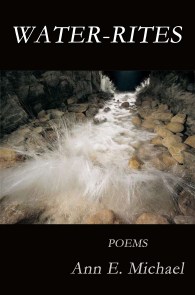
water-rites_coverThe readership for contemporary poetry is small, and my readers number only in the hundreds; among those readers, resonance of any kind–aesthetic, emotional, lyrical–is likely to be limited to a small number of poems. A poem of mine that effects some measure of The Good upon readers represents a minuscule good moving into the world. The net effect, I imagine, hardly registers…not that net effect matters so much. I suppose if a poem of mine moves just one person enough to evince even a small transformation, something has been achieved beyond my individual abilities in the composition of that particular piece.

As a teacher and tutor for the past ten years, my role expands not merely to number of people encountered (few of whom will remember me as an individual) but to the concepts I present to them, most of which will be significant in their lives one way or another–although not immediately, and probably unconsciously. Lately I have been devoting more of my limited energies to this aspect of my life work. Such focus does impede my ability to do creative work of other sorts.

~

This bust resides in the Louvre, and was found here: http://www.humanjourney.us/greece3.html

This bust resides in the Louvre, and was found here: http://www.humanjourney.us/greece3.html

Example: I am reading a little book on philosophy for beginners by Thomas Nagel. The Nagel book is on my table because I have been trying to find simpler ways to talk with students about their philosophy essays. While my main enterprise as writing tutor is to help students to clarify and correct their mechanical weaknesses (sentence and paper structures), it is not always possible to ignore content weaknesses; a student can write correctly about nothing of value–and receive a D or, in the case of Philosophy classes especially, an F.

But understanding philosophy is important.

Now, it is often extremely difficult for beginning writers to express their understanding of philosophical concepts in writing. They are just learning rhetoric and fall into fallacy errors through grammar as often as through thinking. Since I am not supposed to be a content tutor, I have to find ways to tease out what the student understands (or does not understand) and make that idea come through clearly on the page.

Kind of like mind-reading.

[Aside: I have to admit this can take a lot out of me by the end of the day.]

The Nagel book is one of several philosophy primers I have been reviewing to try to find a text to which I can refer my more confused students, the ones who cannot infer the basics from their professors’ lectures or assigned readings. There are academics who might suggest such students do not belong in college in the first place; but I believe in the ideal of an educated populace, and whether or not these students stay in the university through graduation, they can benefit from the discipline of thinking about thinking.

It feels rewarding when, after half an hour of discussion and writing coaching, a young person leaves my office slightly more enlightened. So they tell me, anyway. I know from experience that writing about something helps a person to understand not only the subject but, more importantly, what the writer thinks about the subject.

~

So perhaps my creative energy is better served in the direction of others through tutoring than through poetry; perhaps the former leans more toward the Good. Perhaps I am a better tutor than poet; this is indeed likely, although I have been poet-ing longer than I have been teaching. Then again, not to knock the art of teaching, but writing poetry is much more difficult than the teaching I do. And I get paid to enlighten people through my tutoring.

Not so through poetry. Indeed, Mr. Archambeau–you have gotten me seriously to think about tendering my resignation as a poet, though not without considerably more reflection on the possibility. Writing about the idea has helped me to understand where the Good fits into all of this, and what the middle way might be.

Now, I suppose I could write a poem about the subject…

~

Concerning the apostrophe

I am not the sort of English enthusiast who makes a habit of ranting over bad grammar. I often feel annoyed at egregious errors; occasionally I go as far as to say “it drives me crazy when (insert common grammar mistake here),” but I understand that living languages change. Evolution is not just for finches, and stasis  cannot be maintained in a complex system of human communication when technology and society and culture constantly create and destroy not only our environments but our methods of communication. Communication takes many forms and reflects the influences of many stresses, common usage being foremost among them.

Common usage may be verbally-based or textually-based or may depend upon references to popular culture or recent history, and it alters language whether we want it to or not. This fluid, flexible aspect of language fascinates me. As a poet, I relish it. As a teacher, I have to allow for compromise now and then.

I am willing to predict, for example, that very soon the accepted pronoun for words such as everyone and anybody is likely to be “they.” The reference was acceptable to Jane Austen and her writing peers, then went out of fashion in the Victorian era, when “he” became the norm–the word “he” is singular, as anyone is; thereafter, educated writers and orators used “he” for the nonspecific singular antecedent.

Of course, such use omits half of the population. Non-gender-specific writing employs “he or she” as the correct pronoun for words like someone. That usage leads to many a tortuous sentence, however. I generally advise my students to change the antecedent noun to a plural form whenever possible and to keep “they” as the pronoun; yet almost all newspapers, many news journals, popular magazines, and certainly most of whatever text appears on the web now employs the pronoun “they” for nonspecific antecedents. I don’t really have a problem with that–Jane Austen was able to make it clear enough whom it was she meant by “they.” Clarity’s what matters.

I do have a beef with the misuse of apostrophes, though. The apostrophe I’m talking about is a punctuation mark, not the poetic apostrophe which addresses someone or something absent or metaphorical. I mean the little superscript mark  that is used for two main reasons:

1. To note an elision (the omission of letters)

2. To indicate the possessive case (barring the silly exceptions hers, theirs, ours, yours and its)

I understand the why behind a noticeable uptick in the number of times apostrophes go missing these days: texting, tweeting, and other shortcuts employed in social media communication. My students are vague about the comparatively simple rules of when to use the apostrophe largely because they never bother using it when they text one another. Furthermore, their customary “proofreader,” SpellCheck, doesn’t always alert its users to this type of error. Computer programs can recognize that dont is not a word, but cant means “sanctimonious talk” or, alternately, a tilt or slope (says Merriam Webster). It is a useful word, but it is not the elision for the word cannot. Furthermore, SpellCheck won’t (elision for will not; wont means habit or custom) be able to correct the typist who uses the wrong form of your/you’re or its/it’s.

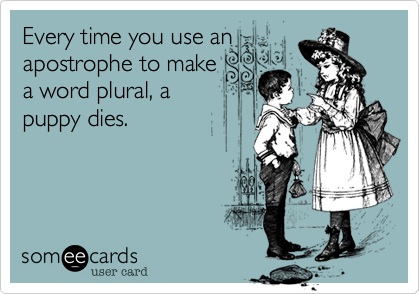
Irksome, yes. But most mystifying to me has been the ridiculously frequent use of the apostrophe to indicate the plural. Surely no one is teaching our second graders to pluralize by adding ‘s to the end of a word. (Teachers who do so should have their certifications revoked!) Recently, when working with a student, I learned one reason this mistake crops up so often in my students’ papers: AutoCorrect. When the typist gets sloppy and tries to add an s to a word that takes a different ending for the plural form (puppy, puppies), AutoCorrect defaults to possessive case. The computer is too dumb to detect the difference, because this is English, and English is damned difficult.

I suppose another reason may be character limits for tweets and texts, but that seems less likely. If people don’t bother to use the apostrophe for elisions, why bother for plurals? “Susie got 2 puppys” conveys the same information just as incorrectly.

Proper use of the apostrophe in English is actually pretty simple–even though computer programs cannot quite figure out the two rules above–and clears up a host of potential ambiguities and misunderstandings. The world could benefit from communication that isn’t studded with misunderstandings.

The warning below is one I use with my students. Sometimes, it even has the effect of becoming a useful reminder. Many thanks to the anonymous teacher who posted it on someecards.com.

puppy dies•NOTE  [Alas, just to complicate things, some editorial styles use the apostrophe to indicate plurals, but ONLY for letters or numbers, as in: “There are four 6’s in this statistical table.”]