Au revoir, institution

It was not a huge surprise–the proverbial writing has been on the metaphorical wall for some time–but the college I attended for graduate studies has announced that it is folding.

In January 2001, shortly after I won a grant in poetry from the PA Council on the Arts, I rallied myself and my work, packed a bag, and took the family car by myself to Vermont for two weeks. In a burst of confidence and enthusiasm post-grant, I’d applied to creative writing graduate programs. There were none nearby enough to commute to, and Goddard’s low-residency model seemed my only choice. Well, I could have abandoned my husband and young children and moved to another area, but that seemed untenable and unkind.

But Goddard was perfect. I met new people and made (so far) lifelong friends-in-writing and friends-in-feeling. The work challenged me; the reading was intense! When I look at the bibliography at the back of my thesis, I admit I wonder how I managed. Hard work, intellectually demanding work, constant revision. Well, I needed less sleep in those days. Many times I read and annotated while waiting for my kids while they took piano lessons or riding lessons or whatever they were doing in middle school.

Sometimes my parents or spouse spent a Saturday or Sunday with the children so Mama could study and write. It is kind of a blur, but the community of fellow students seemed so supportive at the time. It’s not that I was without supportive people in my life–but the folks at Goddard, students and faculty, deeply understood my passion for writing. I found I could spend hours talking about things that matter to writers (which is kind of everything, but also, WRITING), which wasn’t easy to do in other areas of my middle-aged, middle-class, mom-life existence.

The iconic Goddard College Clocktower

Goddard often has been termed an “experimental” college. That term covers a whole host of meanings in the world of education. No point in trying to define it, since one thing that experimental institutions tend to do is change and evolve. The program I attended in 2000-2003 differed from the programs of 1985 or 2015. Which is as it should be–education should not be a static set of activities even when some exploration of canonical texts is necessary. One reason I chose to pursue my education at experimental colleges (The New School, Thomas Jefferson College, Goddard) is that I am a slightly odd bird, an autodidact who did well enough in standard subjects but who got the most benefit from deep study of things I felt passionate about–literature, history, botany, poems, dance, philosophy, feminism, visual art. Experimental colleges offered mentors who could guide me in self-directed learning, recommend books and authors, feed my often-changing interests, offer personal, one-to-one advising and critique. I am 100% sure I would not have excelled in universities that followed more standard educational subjects and protocols, and I’m glad I received good guidance (usually) and a well-rounded, if eclectic, education.

Many of the poems in my book Water-Rites are from my time at Goddard, since Water-Rites in an earlier form was part of my graduate thesis. And a fair number of the poems in The Red Queen Hypothesis were first drafted during my years there, when I was experimenting with forms. So, having just learned for certain that Goddard will cease to function as an offbeat, transformative, self-directed institution of higher education–thus joining my undergraduate school, Thomas Jefferson College of Michigan, as defunct institutions–I will post a poem that I know for certain I drafted just before I graduated. It’s a response to the events of 9/11 and was not quite ready, nor suited, for inclusion in my first collection; it appears in The Red Queen Hypothesis and Other Poems.

~

Shreds
for Judith

We ran, leaves before a bitter wind,
& some ran headlong & some in circles,
we did not know what to do with ourselves,

& watched, pressed to our windows & could
do nothing: streets erupted with people
like clustered beetles wakened from dormancy.

We walked, in all directions but mostly north,
& we were silent and our mouths were dry.
Things like shoes and hats made us human.

We wept and it was not sufficient,
& swept, then, for months & recalled
mostly paper, the ways we occupy ourselves,
the mild wind carrying what lingered. Scraps.


(after “Exhibit 13,” Blue Man Group, 2002)


~

lìchūn

As is not uncommon in our region, we have a warm and sunny spate of days that evoke thoughts of spring…often thoughts that are dashed by late-arriving snow and ice storms. The days are an hour longer than they were at the December solstice, and some plants bloom or start to bloom: witch hazel, snowdrops, hellebores, skunk cabbage, winter aconite.

In the Chinese lunar-solar calendar, these weeks mark the start of spring: 立春 lìchūn. (Hence the new year commences, celebrated this year on February 10.)

I love the emergence of new growth in springtime and enjoy looking for buds and leaf-tips, but winter’s crucial to this environment. It plays its role by enforcing dormancy and restful, unperceived rejuvenation. Nonetheless, sometimes I resent the way it teases–knowing that the freezing will return and that mid-March snows are not uncommon here. That has made me think to post my poem “Spring Lies,” which appears in The Red Queen Hypothesis.
~~

Spring Lies

Sun through fog. The leaves of beech trees gleam
low under the tall expressive line of ash and poplar
whose topmost reaches, feathered by the mist,
wait budded but un-leafed. The starlings stop, are
tethered to their twigs for brief collective
breaths and urgent calls that rally all
to action once again—a whir, black-speckled sky,
the poplars barren after the birds’ brawl
moves off. An hour goes by. The meadow’s damp
expanse reveals patches and threads of green.
Here, mud seems harmless: winter has decamped.

Meanwhile, a small town near a river bank
sighs beneath a dank slide, silenced, loses
all but longitude and latitude.

People want to feel the home they choose is
safe but, at best, they stake a compromise—
fire, flood, crime rate, mud. Spring’s temperate. Spring lies.

~

Promotional

I keep forgetting to mention a few nice happenings regarding my recent book, so I may as well stuff them all into one post here in case anyone is interested. Have I mentioned how much I hate doing promotion for my poetry? Why yes, I believe I have. And since these days I feel no career ambitions related to my work anymore, why does it even matter?

I think there is an answer to why it matters. Sort of an answer, anyway–that without some form of prompting to the World at Large, my poems will be reader-less. A sad fate for a poem or book, and a common one. I don’t write just for myself: I keep a journal for that. I write as a form of communication, a way to connect with a reader I may or may not know.

Sometimes no one connects because the poems don’t work for them. Sometimes no one connects because no one knows the poems exist. The first lack is unavoidable–there is no kind of artistic creation that works for everyone. The second lack I cannot do much about, but I can do a little. Hence, this post.

Some months ago, a current student at one of the colleges I attended called to ask a few questions about my new collection. I did not expect it to be more than one of those “here’s-a-thing-an-alumna-did” paragraphs, and no one got back to me to make sure the piece is accurate (and, yes, a fact or two are incorrect and no, I didn’t say I believe “anyone can write poetry because anything can be poetry; people just have to look for it,”); but it’s a nice little promo bit all the same. Link here.

Then, Michael Escoubas of Quill & Parchment reviewed The Red Queen Hypothesis. Somewhat to my surprise (I don’t think of myself as very “edgy”), he writes, “Michael’s latest collection is edgy; chock full of poems that challenge everyday assumptions about life.” He does recognize that often what I try to do in poetry is exactly that: confront assumptions, observe from different angles. Less surprisingly, he adds that my poems are “sensitive to analogies between the natural world and human experience.” Um, that would be me. That review can be found here.

I know that in a previous post I mentioned Lesley Wheeler’s generous mini-review of the book, which can be found here; she’s an especially insightful reader. I’m thrilled that she writes: “Michael’s second full-length collection is meditative, witty, and smart, with a scientific and sometimes philosophical bent. Also like her blog, it’s closely observant of the more-than-human world in flux…The Red Queen Hypothesis suggests the advantage of sexual reproduction, and there are plenty of seductively “soft persuasions” in this collection. Like the “Stew Cook” speaking to her beloved, this is a book to “fill nooks with aromatic hours.” Shout-out to all the tasty slant-rhymes amid a profusion of traditional forms.” Thank you again, Lesley!

Another little thing to celebrate is Highland Park Poetry’s nominating my poem “Game” for a Pushcart Prize. By the way, that poem appears in The Red Queen Hypothesis!

Finally–or maybe, down the road, there’ll be more to add to promotional posts–I have been getting out and around to readings a bit, in person and virtually. The latter is easier, since many readings are in the evening; these days, I am not too terrific most evenings thanks (ha! as if!) to fibromyalgia fatigue and symptoms. But I do enjoy in-person events and have been glad to read at the Easton Book Festival, at Nowhere Coffee in Allentown PA, and at Bethlehem’s Sun Inn, to mention a few. I was featured in a Mad Poets “OK Zoomers” online reading (love the pun) virtually and will be participating in a group launch of Inlandia‘s most recent issue online on November 19th (info below).

That’s about all the energy I can spare right now for self-promotion. And no, I don’t use Instagram or Tik Tok or Substack or YouTube, at least not yet, so this is all I got, folks. Thank you for bearing with me. Less promotion and more poetry and philosophizing and nature/gardening next time.

If you join the Inlandia event–make sure you account for the time zone! That’s 1-3 pm PACIFIC time.

Restorative

I often start a post with a mini-weather report; I guess that’s one way I prepare myself to write, centering myself in the environment I inhabit. Our region received much-needed rain this weekend, but I was out of town–and the weather in Chicago was glorious: cloudless, crisp, mild, a light breeze. Odd, though, how weather conditions can evoke strong memories for me. The amazing clarity of the sky and air reminded me vividly of September 11, 2001, and the two days following it when we had a run of glorious weather and a mood of intense disturbance all around us…and no plane traffic at all. It took a few moments for that recall to settle in, and a few minutes more to let the memory go so I could enjoy the present moment.

~

I was in the Chicago area–Highland Park– for the book launch of The Red Queen Hypothesis. Many thanks to my publisher, Julie Dotson, and the welcoming and supportive group of poets and audience; the reading went well, and we sold some books (always a satisfying thing). I met quite a few interesting people and learned a bit about the city of Highland Park, its relatively long history, its parks, architecture, the storied Ravinia Festival, and how the city’s been coping since the July 4 tragedy last year. Travel always offers perspective. In this case, travel offered community as well: a lively community of people who support the literary arts.

~

I even got to be recorded, with Jennifer Dotson as the interviewer–a first for me. Here’s the link:

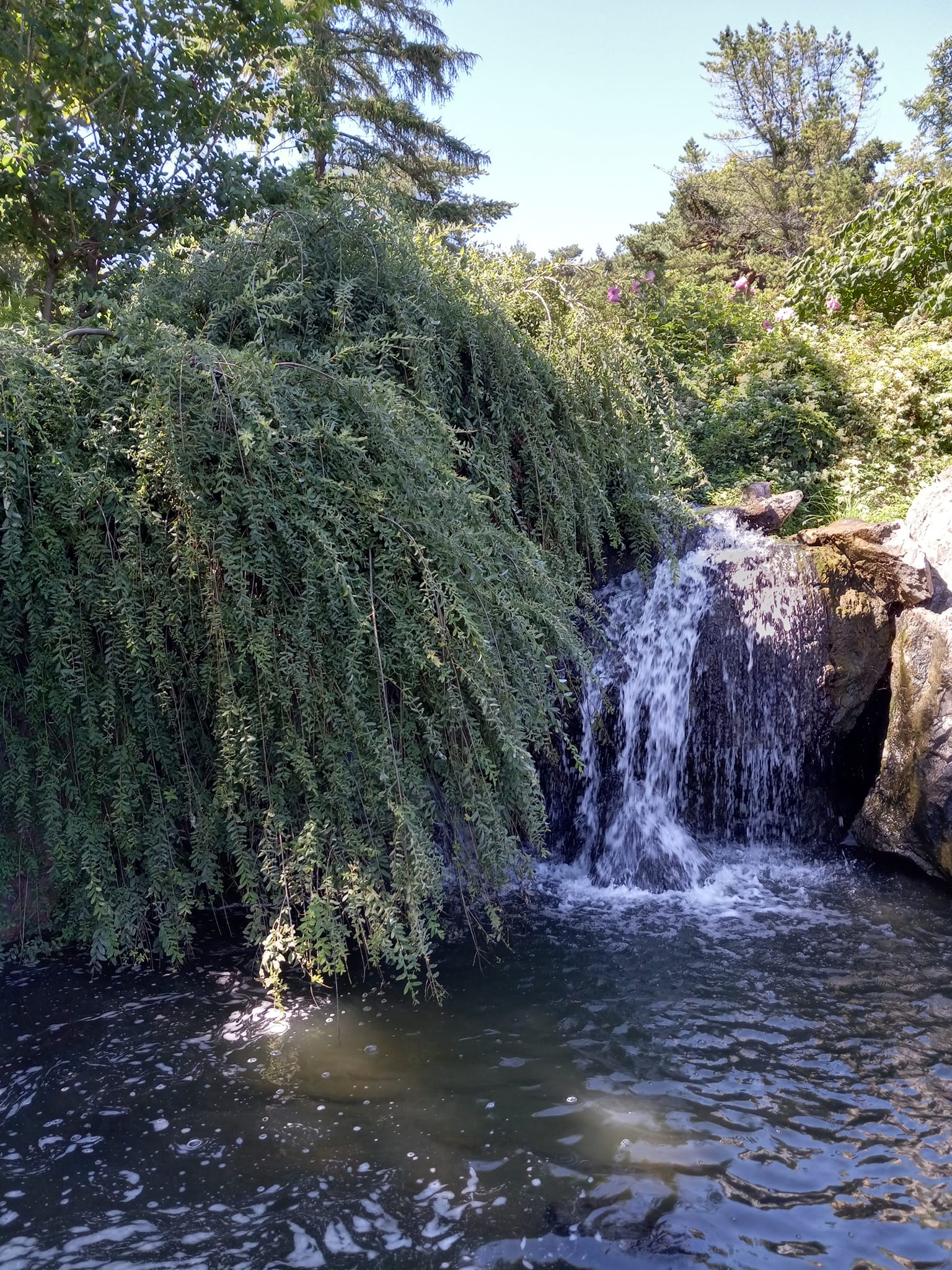
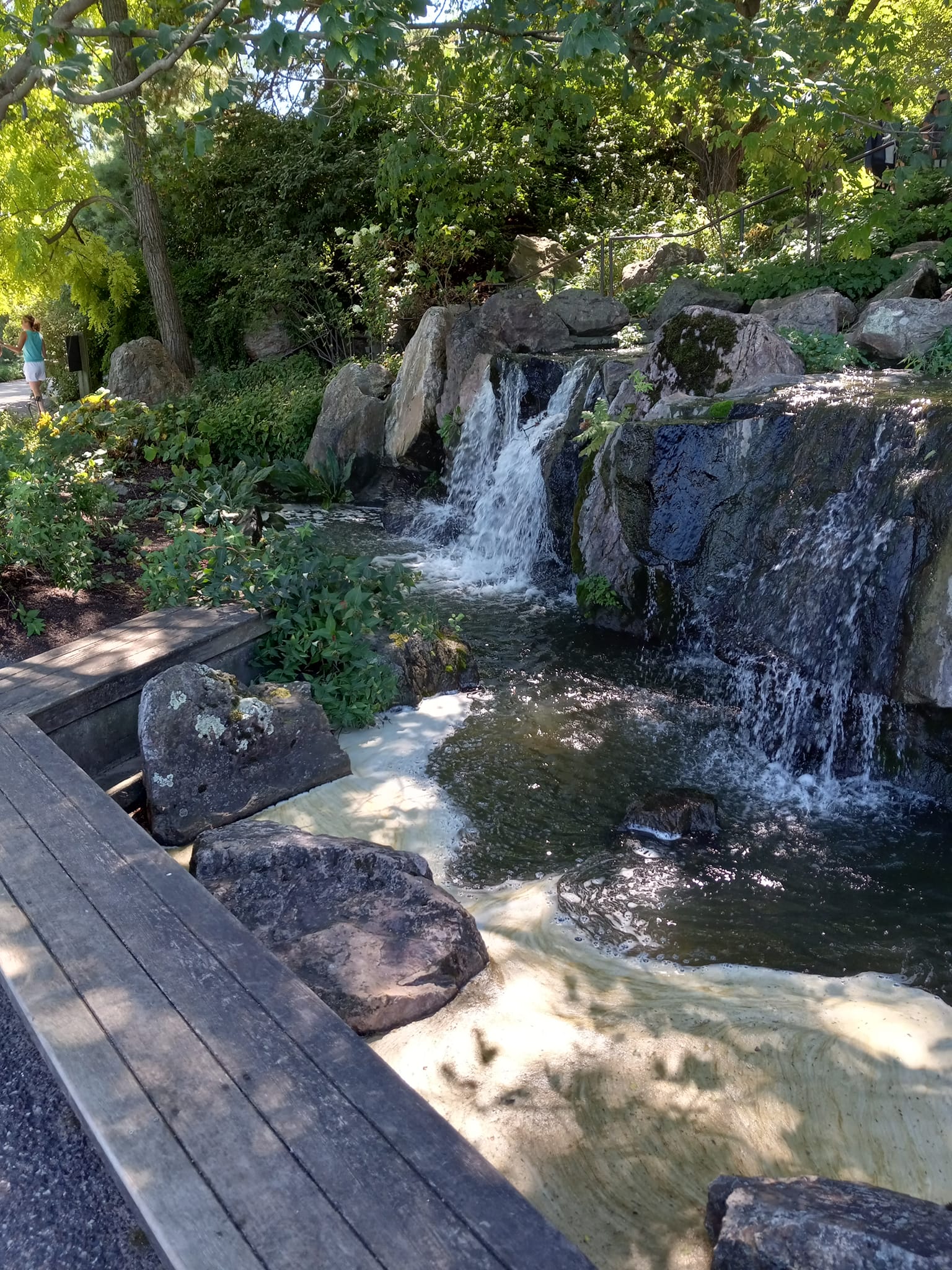
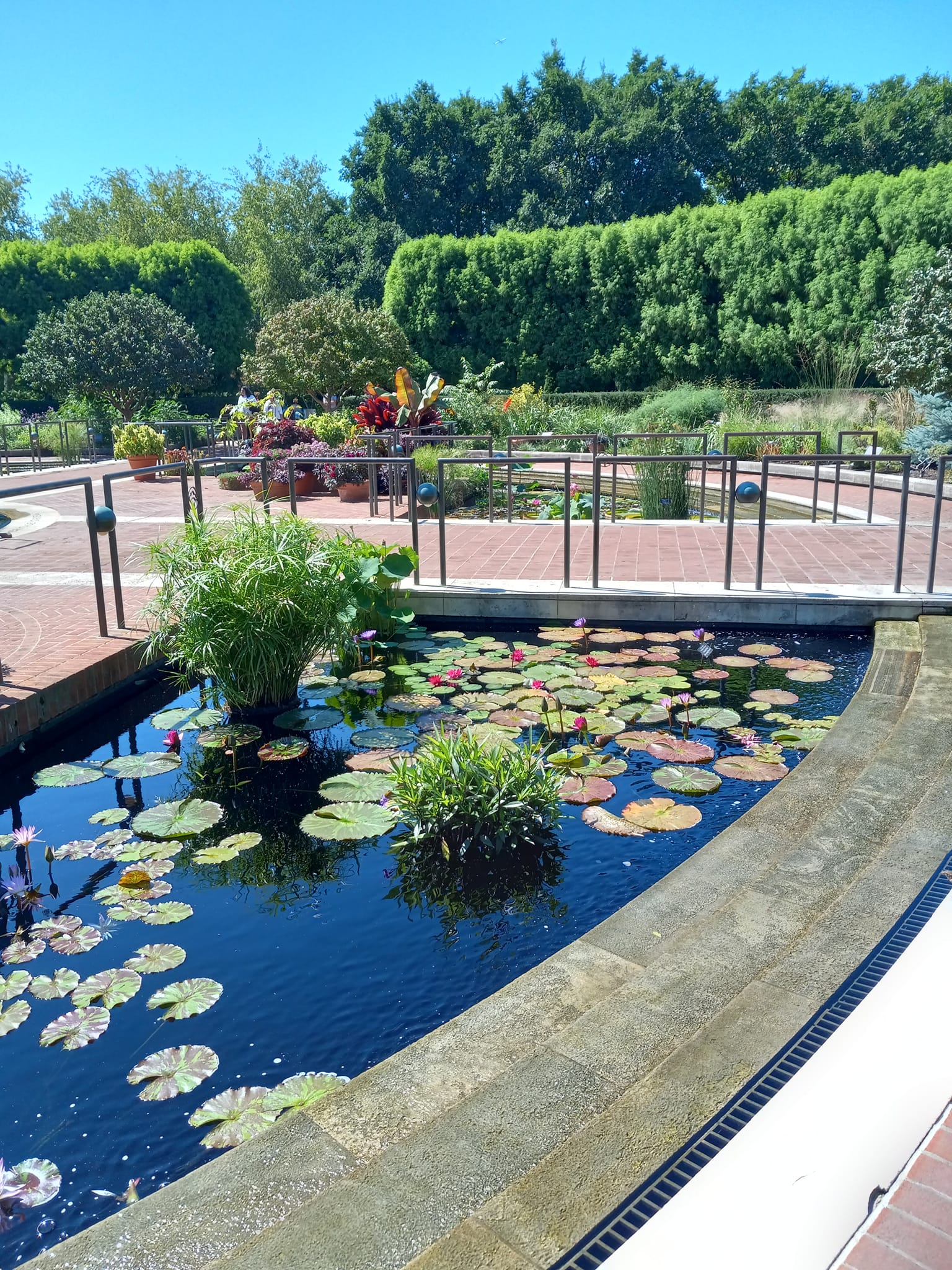
My generous poet-host, Julie Isaacson, knew from my writing and my biography that I would enjoy a walk around the Chicago Botanic Gardens–and she was so right! The gardens offered just the respite I needed after airplane travel. We hadn’t the time to stroll all 280+ acres, but the chance to walk amid trees and beside water in the middle of an urban expanse was genuinely restorative.

Now I am pulling weeds and pruning for the approaching autumn, activities that allow me to settle into myself internally and which sometimes result in poem drafts. Please wish me luck on both endeavors!

Language power

In advance of my reading this weekend, Jennifer Dotson of Highland Park Poetry asked a few questions and created the flyer below. I especially like the last question and have more to say about it below.

~

The graffiti on the NJ and NY Palisades sent a thrill through my childish mind and body. I first recall seeing words spray-painted on the cliffs when I was under age five and barely cognizant of letter forms. The view puzzled and frightened me, partly because of the heights (I was acrophobic from a very early age) and partly because I had no idea what those huge, high-up letters signified. When I got to kindergarten and began deciphering letters, the graffiti confused me because it contained signs that weren’t in the alphabet I was learning at school: Ω, Φ, the scary-looking Ψ; θ, Δ, and Σ, which resembled a capital E but clearly wasn’t. Once I could read and still could not understand them, I asked my father what those letters were and why they were up there on the rocks. They reminded me of the embroidered on some of the altar cloths in church, but I didn’t know what that stood for, either.

Frat boys from the colleges painted their Greek symbols on the rocks long before spray paint was invented, my dad said, possibly as part of hazing rituals. By the time I was a child, the 50s-era “greasers” had begun announcing their love for Nancy or Tina through daring feats of rock and bridge painting; then the graffiti era came into full swing after the mid-sixties, and the process got colorful–the Greek symbols vanished, replaced by “tags.” All of which just reinforces the importance of words in the world.

I will never climb up high to write or declaim my own words, as heights continue to terrify me. But I continue to push ideas, words, arguments, pleas, elegies, and gratitude into the world. Writing is the only way I know how to do that. It’ll have to be enough.

Book launch, travel, PR

Highland Park Poetry press has set up a book launch/poetry reading for The Red Queen Hypothesis (and me) with poet Rene Parks and an open mic to follow. This event takes place Saturday, September 9th at 5 pm, at Madame ZuZu’s, 1876 First Street, Highland Park IL. Here’s a link, and here’s another link. It’s a ways to travel from eastern Pennsylvania but a good reason for yours truly to visit a new place, meet new people–including the book’s publisher–and listen to other poets.

Too often, perhaps, I stay around the home front, indulge in my introversion by gardening and reading, and shy away from promoting my work. Lately, it’s been months since I did any submitting. There was my participation in the annual Goschenhoppen Festival, then a short but lovely week in North Carolina, camping and seeing friends. Now, the veggie season is starting to wind down–tomato sauce simmers on the burner–and I will have fewer excuses for why I am not sending out poems.

But my travel for the year is not quite done. In September there’s one more trip away from PA, and after that we can settle into autumn. I have writing plans, so once we return, I need to create a schedule that is flexible enough I can stick to it but framed clearly enough that it feels necessary and not difficult to integrate into my days and weeks. Every one of my writer friends knows how challenging that can be. Wish me luck. There’s a chapbook that’s been languishing in my desk area for quite a long time, but to which I’ve recently returned; there’s a ream of poems under 21 lines that might make up a collection, too. Then there’s the next manuscript, rather grief-heavy at present, that I need to re-think and revise.

Oh, and all those poem drafts I have not looked at in awhile…

Then there will be the next round of promotion, not just for RQH but for a collection for which I just signed a publishing contract! That book may be released as soon as April or May of 2024. We shall see. After the drawn-out publication wait for this last book, I will not be holding my breath. Still–it’s heartening news on the poetry front.

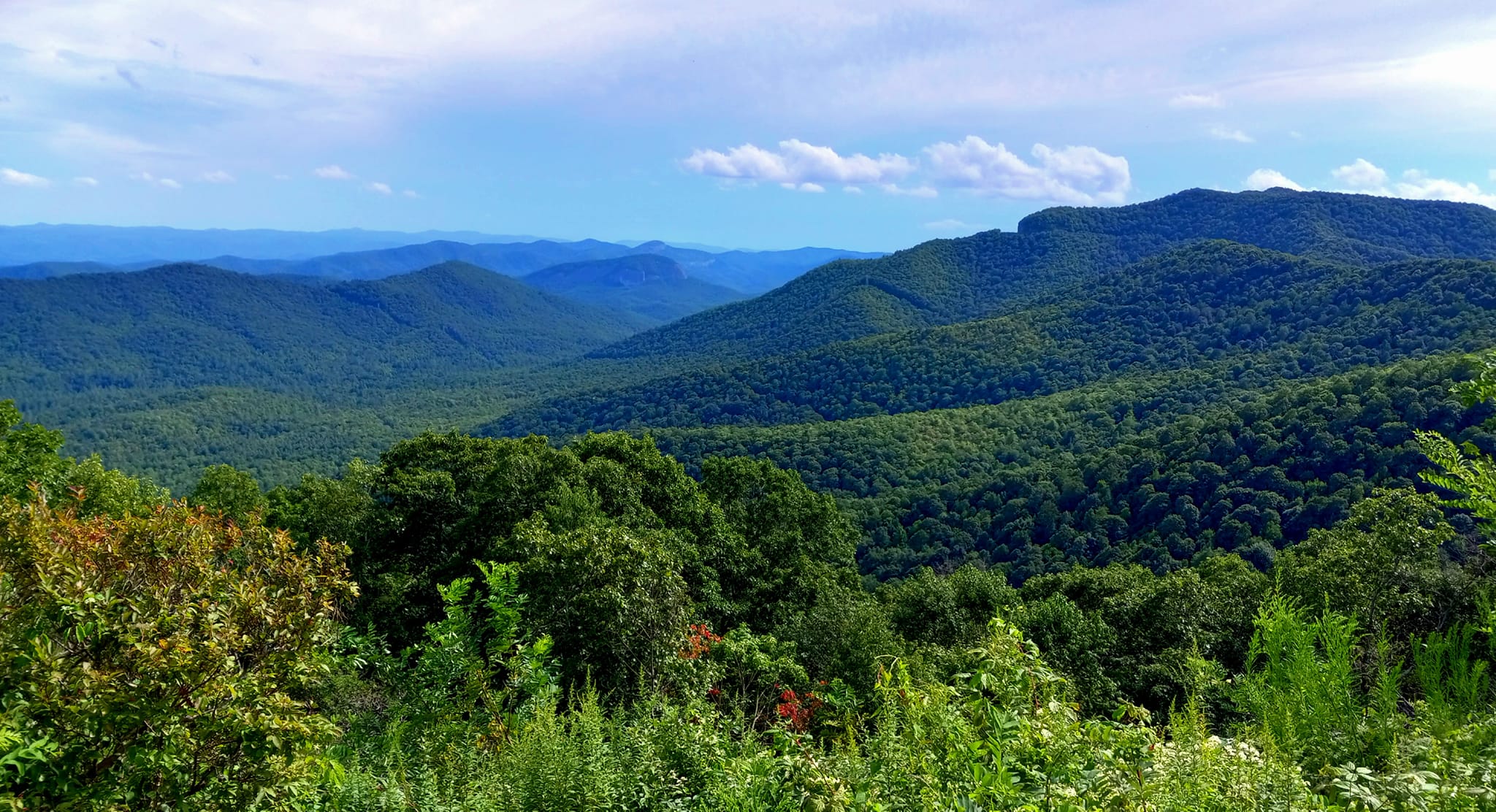
Above, Blue Ridge Mountains in August.

Classification

An admission: I’m barely competent at the promotional aspect of The Writing Life and would prefer to hole up in my house and garden and just… write. But writers need readers, and writers benefit by meeting other writers (and readers); and I’ve always been interested in learning new things, even things that are not particularly fun or that I am not naturally adept at. Such as educational learning management systems (ie, “portals”). Such as recording audiofiles of my poems. Such as contacting potential poetry-reading venues or reviewers. Or coming up with clever ways to let people know about my book.

I got a couple of responses from my initial forays, which is lucky. One of these sent me a sort of writer’s questionnaire about my book, and one of the responses I’m supposed to give is to say how I would classify my latest poetry collection. That got me mulling over the whole idea of categorization, classifying, and stereotypes. Genre–that’s easy. It’s poetry. But the sub-category of this book? uh…

~

At the beach earlier this week, we found a much-broken up rock jetty that teemed with creatures. As I sat back on my heels and peered into the mixture of sand-water-rock-mullosk-kelp, I found myself thinking about Aristotle’s immanent realism (epistemology/natural philosophy), ideas he likely nurtured while examining the tide pools of Lesbos. Or I imagine that he may have done so. We humans observe, and then classify or categorize based upon these observations: similarities, differences, various adaptations–in environment, habit, behavior, construction of the being or entity itself.

I think if I had known as a child and young woman that there was a career path called “a naturalist,” I would have pursued it.

~

Unclassifiable doesn’t strike me as much of a selling point. However, there are always art forms that are, to use a current term, intersectional or interdisciplinary, and creations that repurpose, alter, or reimagine the known or customary into something new and intriguing. Fellow blogger and talented poet and novelist Lesley Wheeler‘s books come to mind, as do works by Anne Carson and books from Coffeehouse Press and Tarpaulin Sky (among others).

My poetry is not experimental nor groundbreaking, though it is a little quirky; so here is my recent attempt to classify The Red Queen Hypothesis and Other Poems:

Touching on a range of topics and employing variety in poetic craft—free verse, metrical verse, rhyme, and classic forms—the poems in The Red Queen Hypothesis play with invention, science, and the environment of the everyday.  One example of these juxtapositions is the title poem: a villanelle, based on an evolutionary theory named for an episode in Alice through the Looking Glass, that sums up the corporate rat race. Sometimes tongue-in-cheek, sometimes disturbing, the poems urge readers to observe and to reconsider what is beautiful.

~

I dunno. Does that seem like a remotely interesting description?

(Really not adept at the promotional biz.)

Aristotle, supposedly.
from https://www.nytimes.com/2016/05/27/world/europe/greece-aristotle-tomb.html

Aloft at last

My second full-length poetry collection is finally available. Whew! It took a good bit of patience, some frustration, and considerable persistence to get here, but I believed that this was a manuscript worth plugging away on. And thank you to Highland Park Poetry and to judge Cynthia Gallaher for choosing RQH as a prizewinner.

Persistence doesn’t always pay off, but when it does, we tend to focus on how important it is to keep on keeping on. However, I’m not sure I wholly believe in the process of sticking-to-it no matter what; there are times when you do need to let go of an unattainable goal or the pursuit of a not-terrific idea, and just–well, fail. I have let go of quite a few goals, plans, and previous manuscripts when I honestly evaluated my feelings about them and their possibilities for becoming realized. It’s okay to fail. You learn more from failure than from success. I have gained quite an education that way myself.

But I wanted this book to get into print. I like the poems in it. I like the things I learned as I played with meter and form and (mostly slant) rhyme. It was fun to find a range of topics that managed, one way or another, to work together. Mostly, I wanted an audience, to find out whether readers find it thought-provoking or entertaining or interesting. Also, I was starting to sense that it was getting in the way of my next manuscript. Yes, of course I have the next manuscript…

Do I wish the book had come out four or five years ago? Yes. My first collection, Water-Rites, came out way back in 2012; RQH was supposed to have followed more rapidly on that book’s appearance. Am I glad it has appeared at last? Also yes, very glad!

I am grateful to so many people for this book. And I will be grateful to anyone who buys it, reads it, and doesn’t find it a complete waste of time. Meanwhile, I’m working on getting some readings lined up. I know I will appear at the book launch September 9, 2023 in Highland Park, IL! I’d love to read at other venues, so if you know of one let me know.

And if you have a manuscript you really believe in–keep trying.