Last messages

End of another year. This one included some truly joyful times that will stay with me for quite awhile. But in that almost-inevitable reflection that arrives with the winter solstice, I find myself recalling dear ones whose lives closed in the past 12 months. I used to have physical reminders of friends and family, the last card or letter they wrote, something to put into a file or drawer or keepsake box and take out from time to time; a photograph or two, or maybe a recording of their voice on tape. Now that human communication has mostly migrated to the digital, to the “cloud,” those tangibles are much less common. But the messages persist.

A few weeks back, I migrated to a newer cellphone and, in the process, moved a year’s worth of text conversations to the new device (I’m not sure how I did that). All the old messages popped up, including three from dear people who are now deceased. Quite a different form of “ghosting.” I’ve kept in an online folder many email messages from my most frequent correspondent and long-time friend, who died February 1st, but I can’t quite bring myself to look at them yet. And it isn’t quite the same experience as opening and unfolding old letters.

I can’t bring myself to delete the messages from my phone, however. I suppose at some point that will occur, perhaps in another upgrade. Letters are ephemeral, too; all it takes is flood or fire. We have to rely on our minds, our memories, when it comes to recalling loved ones. Maybe that is what elegy is for, I don’t know.

~

As for the present–the Spirit of Christmas Present* ?–some of my Best Beloveds will be gathering here and there with me soon. Once the holiday hubbub dies down and the lonelier, cold January days arrive, I have poetry workshops to look forward to. They’ll be online, which suits my schedule in winter. Last year, I enrolled in two such workshops and found they spurred me to get a good deal of writing done, so I figured I might try repeating the process. Anita Skeen is doing another series for The Friends of Roethke Foundation with readings, prompts, and discussion on “writing toward wisdom.” In Dickens’ era, I’d be considered old enough to be wise (though most of us, Dickens certainly included, know better about age inevitably bringing wisdom). But the operating word for Skeen in this case is “toward.” It will be interesting to see where she takes her workshop participants in the new year.
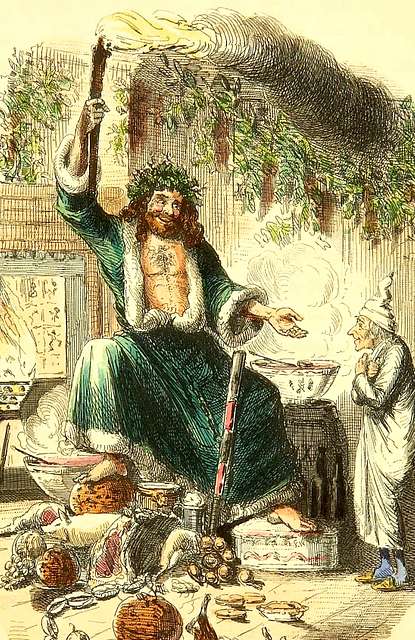
* John Leech illustration

Points of view

I ran across something online that made me shudder–and it wasn’t politics or global tragedies but something sillier and more personal. Apparently there was a trend a decade ago of adults reading their adolescent diaries, aloud, in public (see “Mortified”). Ugh. The few times I have been tempted to read any of my old diaries or journals, I’ve stopped after a few sentences. Shuddering. This is less likely to happen with journal entries I wrote in my 30s or later; at least I hear my younger adult self in those words. But hearing the adolescent me, or the young woman of college age? No, thank you. I embarrass too easily.

Yet I found I was thinking today of this passage of Proust’s, which he gives to the character of the artist Elstir:

“There is no man,” he began, “however wise, who has not at some period of his youth said things, or lived a life, the memory of which is so unpleasant to him that he would gladly expunge it. And yet he ought not entirely to regret it, because he cannot be certain that he has indeed become a wise man–so far as it is possible for any of us to be wise–unless he has passed through all the fatuous and unwholesome incarnations by which that ultimate stage must be preceded…We do not receive wisdom, we discover it for ourselves, after a journey through a wilderness no one else can make for us, which no one can spare us, for our wisdom is the point of view from which we come at last to regard the world.”

There’s some comfort in that. I would not call myself wise, but I’m definitely wiser than I was at 15 or 21. I suppose I’m still sometimes “fatuous and unwholesome” (whatever Elstir meant by that), awkward in society, and mistaken in some of my intuitions. But I have discovered myself for myself, with all the pain, sorrow, embarrassment, and joys that such discovery requires, and have developed my own point of view. In addition, I’ve learned that each person holds their own point of view. We don’t all think alike or in concert and may never fully understand one another. That makes the world contentious, yes. And interesting.

Reading Old Diaries

When I wrote about the city
it was as though I knew
I didn’t belong there,
would not thrive—as though
I wouldn’t stay long
and so pressed each line
on page urgently, camera
shutter clicks, each image
framed in fractioned seconds
as people jaywalked and
side-walked, as pigeons
or sparrows alighted to peck
at civilization’s least crumbs,
as young men lovely and
unattainable grew ill, as city
failed to succor any of us,
as my ambition floundered.
Years back. So that what
I recall is what I photographed
or wrote, however inconsistent.
Naively urbane, the city
my youth inhabits lies brittle
in the pages. The past undoes
itself at last. Or I do.

~~
I'm embarrassed to note that I've forgotten where this poem was published. My files are elsewhere at the moment. I'll update if I remember... *It appeared in Loch Raven Review!

Story as vagabond: Intizar Hussain

Kahani to awara hoti hai. Story is a vagabond…My nani…used to tell me a story in which a girl says to her father, “I love you as much as salt.” My nani didn’t know about King Lear…She belonged to a tradition of storytelling in which space was unbounded and time was fluid; the hero could travel across forests instantly, and ignore borders separating Heaven, Earth, and Hell. Fairy princesses and monkeys spoke classical languages, and trees and birds told stories. This made for a more generous world, and, of course, a more imaginatively vibrant one; and it made the question “What does it mean to be human on this Earth?” a genuinely inclusive one–because the answers had to account for our relations with everything around us. It is because I am an inheritor of this way of thinking and being in which boundaries are always porous, always shifting, that I can accept that there is a grave of a Muslim disciple of Krishna in Brindiban…

~Intizar Hussain, Pakistani (but, earlier in  his life, Indian–from Dibai) fiction writer, from an interview with Alok Bhalla in Manoa journal. [The surname can be spelled either Hussain or Husain in English.]

33414458Bhalla–one of several translators of Husain’s work into English–comments during this interview: “The poet-storyteller is both blessed and cursed; he is exiled from Heaven and the courts, but he understands how integrally he is ‘of this Earth’–that is, secular. This seems to be the tradition in which you have been trying to locate yourself. Isn’t that why both the religious fanatics and the ideologically motivated find it difficult to accept you?”

~

Earth–we are embodied of earth, part of earth, indivisible from our earthliness, and we exist in relation to the things of this earth.

It might be wise to stay mindful of our necessary integration with all things earthly and embodied, to recognize how intricately we are connected. Bhalla, whom I met at this year’s AWP, mentioned that Husain was fundamentally opposed to identity politics; in  his generous inclusiveness, he believed that to define oneself under a single identity forces boundary-relationships with others, that tribalism has led to nationalism and thence to genocide in far too many instances of human history.

Naturally that means he had a fraught relationship with Pakistan itself, and–to quite some extent–with Islam [he upheld the notion of Mussalmani]. He was revered enough and diplomatic enough to keep those boundaries porous and those relationships open.

Few of us will ever be as wise.

~

This lovely issue of Manoa features cover artwork and illustrations by Imram Qureshi, whose work I walked upon at the Met in NYC, roof garden installation, 2013.


The skill of grieving

In a recent post, Sigrun of the blog sub rosa pointed me to Poetry Society of America’s page on Natalie Diaz; I’m even going to post the same paragraph she does, in which Diaz states:

When I write, I bring all of my truths, even the Judas-truths that make me feel like the betrayer whose dirty hands are resting on the table for everyone to see, including God. For me, writing is less a declaration of those truths than it is my interrogation of them. Uncovering the darkness in me that led to some of the poems about my brother also lights up the hard, bright way in which I love him and the small wars I wage to win him back…the truths that have built in me a strength and compassion that help me to survive this world. Truth is that little animal we chase and chase until we suddenly glance over our shoulder and realize it has been chasing us all along.

This passage about “uncovering the darkness” and the hard ways in which we sometimes love–maybe with some people, there is no other way to love–interestingly coincides with my recent reading of Stephen Jenkinson’s Die Wise, a manifesto on how we die and how we might die better (wiser) if we carried our darkness better, as Diaz suggests in the passage above. While I am reading Jenkinson for specific reasons around end-of-life concerns, there’s no doubt that there is often poetry in his philosophy that we need to learn the skill of how to grieve and to learn all that such a skill contains, including its “Judas-truths” and its unflinching confrontation with the ways in which death is a gift to us collectively and individually.

Most of us do not see death as any kind of gift, and Jenkinson admits it can be a challenging perspective; he endeavors to persuade the mostly-American or European reader that each of us and each of our societies or cultures would benefit by reclaiming death as a natural sequence in our being in the world.

Claiming or reclaiming death (you might read here: darkness), says Jenkinson, requires us to face the fact that we have no language for dying, not really. He says “we are taught almost nothing about what language to use or why when we are trained for the job [of tending to the dying].” The Dying, he writes, are “them,” meaning they are “not us.” Which makes them outsiders and invisible and yet all of us die; we are all of us dying–and we work so hard to distance ourselves from the fact.

Poetry is a language that, I think, sometimes guides us toward the hard truths, when poetry is well-made and conflicting and sundered with surprise. Poetry isn’t the language that gets us to dying, exactly; but it can do some of the hard work of teaching us how to grieve.

This is not to say that poets or artists are any better at dying than the rest of us. Sometimes the darkness uncovered in the fiction or poem or painting is true and authentic and deep, but the artist does the grief-working well in art and not so well in life’s physical dying process. Artists who choose suicide may be people who suffer pain and can express it artistically without actually learning the work of grief, which differs from suffering. If we learn that anything that does not last forever is meaningless (an idea drummed into many of us through the concept of “eternal life”), we are apt to feel bereft at every loss and may embrace a kind of horrible existentialism. Sometimes our artists strive to overcome the meaningless through lasting works of art, but their personal desire to be somehow immortal may bog them down as death nears.

We admire this artistic striving, but it is a kind of working against our darkness rather than confronting it with the love Diaz mentions. Jenkinson writes: “Dying isn’t the end of true things…It is one of the true things, that is all.” [My italics.]

However, I do believe that art–particularly the storytelling arts–can offer much in the way of teaching us the physical, on-the-level, hard work of grieving. Really good novels and plays can help teach us if no one in our “real lives” does. Even if we weep at the end of the book and wish the author had chosen a different way of ending it. Good poetry that leaves us excited and confused by complexity or blasted with gut-level sorrowing might be teaching us the ways of grief we aren’t learning from our culture.

When a loved one dies, we often get lost, pushed away from grief through the signing of papers and the bland condolences of marginal friends and the plea to move on with our lives. Good poems can keep us dangling in the now of real grief and force us to figure our way through the losses we incur–losses which do not exclude even our selves. Because “death waters the living.” And so does poetry.

http://www.philamuseum.org/collections/permanent/82820.html

Rain [La Pluie] Vincent van Gogh, 1889. Thanks to the Philadephia Museum of Art


Wisdom of insecurity

My mother pointed me to a short piece on mindfulness meditation excerpted from Jack Kornfield‘s work (it probably came from one of his books, such as The Path of Insight Meditation).

He spends several paragraphs writing about the dharma of wisdom and about impermanence, quoting a Buddhist sutra “Thus shall you think of this fleeting world.” He notes that when meditating, one is more likely to realize that everything around us is in a state of change. It’s more noticeable, this changing, because the person meditating has become still and is observing closely.

Change is dharma’s first law: uncertainty and impermanence. The laws of science bear this out; entropy, evolution, constant change and motion everywhere.

Kornfield then does a good job of explaining to Westerners what Buddhists mean when they say “all life is suffering.”

“This brings us to dharma’s second law. If we want things that are always changing to stay the same and to get attached to them, we get disappointed, we suffer. Not because we should suffer–this is not something created to punish us. It is the very way things are, as basic as gravity. If we get attached to something the way it is, it does not stop changing, Trying to hold onto ‘how it was’ will only create suffering and disappointment.”

What could be clearer? We know we cannot wrestle a person or a place to the ground and pin it in place and have it remain unchanging for us. Without change, nothing can live.

What upsets people is that they are uncomfortable with the insecure feelings change tends to bring. Also, there’s that tendency to look for cause and effect, for blame, for control and certainty.

Thinking about thinking–as I have been lately–and consciousness and, to some extent, fear, I recognize I need to “relax with uncertainty.” That’s how Kornfield puts it. he says there is wisdom in insecurity because it is natural.

“Letting go does not mean not caring about things. It means caring for them in a flexible and wise way,” Kornfield writes. Sometimes, when I feel content and relaxed and able to “let go” of nagging and difficult and scary and challenging things, loved ones ask me whether I care or not. I do care. I recognize, though, that there are times no amount of caring can “fix” a problem. Sometimes, acceptance and encouragement and letting go work much better than controlling intervention.

A great deal of my poetry begins in a flexible, accepting “space” that recognizes, and embraces, uncertainty. I wish I could find myself in this Way more often.

Impermanence (thanks to David Sloan)

Impermanence (thanks to David Sloan)