Practice makes poetry

I’ve been challenging myself to write 7-line poems lately. Half-sonnets? Not necessarily. Just an exercise in writing a poem in brief. I have used haiku and tanka as brevity/image exercises in the past, and that work has been helpful. While I seldom write poems that are longer than, say, 30-35 lines, practice with conciseness never hurts, especially when my inclination is to go narrative.

I’m not knocking narrative poetry: I love it. Love reading it, love writing it–especially the lyrical narrative. In addition, I’m a big fan of the discursive and tangential in poems and essays (looking at you, Ross Gay). But one does tend to fall into familiar territory, and it’s useful to push away at what’s easy. That means, every now and again, trying something unusual: persona poem, aphorism poem, Spencerian sonnet, cadralor, surrealism, slant rhyme, golden shovel, or an invention of one’s own…something to freshen up the craft.

Many writers I know rely on prompts for imagery, language use, theme, or topic. For some reason, that sort of prompt seldom gets me really working in a new vein, though I can get a poem draft or two that way. Using a form, trying something new with how the words land on the page, is much harder to do (for me)–and therefore, more useful. I honestly want to feel as though I am working at poetry, doing the good and rewarding sort of work during which I learn new techniques and rediscover how craft can deepen meaning.

Real work takes practice. And real practice doesn’t actually lead to perfection. It leads to new explorations and revelations. There’s my wisdom-for-the-day to poets who are just starting out.

practice doesn’t make perfect…

Back to the garden

Late spring weather, mild and pleasant; lettuce and spinach ready and quite tasty, strawberries, asparagus–all the early harvest, with mulberries ripening on the trees and tomatoes starting to blossom. I have weeding to do, and it’s a task I don’t mind when the weather cooperates. Later on in summer, when the days get humid, hot, and blazing–then I am no fan of weeding. But on perfect days in early June, weeding is one of those mindless puttering tasks I can attend to while half-daydreaming.

I’m thinking about task-oriented work and creative work as opposed to wage-based work thanks to Jenny Odell’s second book, Saving Time: Discovering a Life beyond the Clock. Weeding’s one of those forms of work one does when it is necessary–the time it takes, and the best time to do it, don’t conform to clock schedules but to environmental ‘schedules,’ which vary. Too rainy? I don’t weed. After the soil has dried a bit and the weeds are sprouting like crazy? Time to weed. Too dry and hot? Not time to weed. Yet if I were a wage-paid groundskeeper and my boss said, “Get weeding today, $14 an hour, don’t waste your time,” I would have to weed, to look busy, to keep busy. Even though it might be a poor time to accomplish that particular task.

I’m no longer on the clock, at least in terms of wage-earning, but that socially-ingrained urge to keep busy and accomplish things and meet deadlines? That’s hard to move away from. Ill with covid, I kept complaining to myself that I wasn’t accomplishing anything. By which I guess I meant housekeeping, gardening, laundry, cooking, submitting work to journals, making plans for summer events, visiting my mother, taking walks, going to the gym…but really, it’s rather strange to think of such things as accomplishments. They’re not even work, per se, just tasks. They don’t have time constraints; doing them only becomes necessary when I run out of clean clothes, or need to eat or harvest spinach before it bolts.

Odell later addresses the sort of care-giving work that can’t really be broken into wage-based tasks, though industries do try that. Nurturing children, caring for livestock, being a teacher, social worker, farmer, artist: sure, some people do wage-work for these jobs, but hourly accountability doesn’t suit such work well, tends to distort the varying needs of the moment and the fallow or less-busy times that are just as crucial to accomplishing “good work” as the more rushed times are.

An artist needs down time. So does a Certified Nursing Assistant. So do farmers and teachers. And parents!

…and gardeners. We have all winter to do less and plan more, and then we have to respond to the weather and the circumstances around us as the circumstances require. Warming trends from climate change, floods or droughts, invasive beetles, viruses, weeds. What cannot be changed must be adapted to; didn’t we learn that from Darwin? If I have a job, as far as the garden goes, it is learning to balance things so that my effects on the earth are sustainable, harming the earth’s balance as little as possible–providing for pollinators and birds and amphibians, and also for my family.

It’s a difficult task and not clock-measurable, but more rewarding than most jobs are.

~

Because I like this song, and Mitchell’s lines about being billion-year-old carbon and getting ourselves back to the garden, here she is:

~

Good w/words

I hear it often from people: “You’re a writer, you’re good with words.”

What I’m reflecting on while in a space where I have the time to reflect is that maybe, some writers are those folks who are not by nature “good with words.” Words, we may have, yes! We love words, love to read, love books, love poetry, love language. But that doesn’t mean that words come easily. We may have to work for and with them, rearrange and revise, check meanings and spellings, consider etymology and new ways of using words.

It may be we wrestle with them and, like Jacob with the Angel, find the process causes injury as well as revelation.

A study by Marc Chagall for his Jacob Wrestling with the Angel, ca, 1963

Writing may be a cat that follows us home when we really have nothing to feed it and our apartment building doesn’t allow cats, but there it is: needy and appealing, sitting on our doorstep.

For many writers, words are hard. As Virginia Woolf wrote, “Oh to be silent! Oh, to be a painter!” Some writers might prefer to be making a non-wordy art. Less energy to expend on how to say.

I know I can speak for a few writers when I state that, at least sometimes, words can be easier to write than to speak. If I’m chatting to somebody about my family or the garden or my opinions about online learning management systems (LMSs), I don’t usually have trouble with words. Those concepts stay within the familiar and the easy-to-express, even among people I barely know. In such conversations, I can be lively, make jokes, have opinions, and tell stories. This is social speech of a casual sort, even when the subjects are often close to my heart (well, not LMSs…).

But many things that are either more philosophical or more deeply reflective, even intimate, evade me when I try to say them in conversation. Questions I have, I may fear to ask. Describing a feeling, sensation, or emergent idea can be so difficult I decide just to stay quiet, listen to what I can glean from others. If my fellow conversationalists are patient and sympathetic and stay with me through more abstract, emotional, or artistic/philosophical topics, I will still find myself losing the thread of my sentences and tapering off into gesture. Gesture covers (badly) what I can’t seem to put into words. Even though I am supposedly good with words.

Later, I may endeavor to express in writing what I wanted to say when I resorted to silence. Writing is not the heat of the moment–there can be revisions, honing of concepts, maybe some research to cover the various vague lacunae during which I’d previously resorted to shrugging. Shall we say: clarification of thought through better words in a better order.* I may never learn to be adept at succinct intellectual conversation, but I can eventually get to compression of language for effect in a written text.

That would be enough. Or maybe it’s as David Kirby writes in his poem “The Wreck of the Edmund Fitzgerald”— “Writing isn’t hard./You just have to be patient. You just have to get/everything right.”

~

*Samuel Taylor Coleridge‘s definition of poetry: best words in the best order.

Work

Ending the year reading new-to-me poetry collections was my plan, though of course family life and all that distracted me quite a bit, in a pleasant way. Maybe I will reframe that as starting the new year with poetry collections. Which is to preface the following, an excerpt from “The Work,” a poem that contains a lovely reflection on what it means to leave one’s job and find one’s work–eg, retirement–in David Mason’s latest (2022) collection, Pacific Light:

~

Once, work was the thing one rose to by the clock,
the place one drove to, the faces one met getting coffee.
Now there are stones to be moved, but will they be moved?

...We are doing the work no other demands in the light
we are given, forgetting what day of the week it is,
the work all other work was a way of putting off.

That’s a useful way of thinking about post-job life, the work that everything else was a way to put off. So now we are poets or writers, artists, gardeners, people who spend time fishing, walking in the woods, hanging around in libraries, caring for grandchildren or pets. In his poem “One Day,” Mason writes “I was always too slow/and now my deadline/nobody knows,//not even the moon…” That concept of a deadline, so ubiquitous in all industries (and academia), churns workers into all kinds of stress. Needless to say, the term has a violent origin–“time limit,” 1920, American English newspaper jargon, from dead (adj.) + line (n.). Perhaps influenced by earlier use (1864) to mean the “do-not-cross” line in Civil War prisons.” [Thank you Etymology Online.] I am happy not to have so many deadlines now. Whatever work I do now, moving stones or writing poems, no other person demands it of me or sets the timing. “Not even the moon.”

Or maybe I’m mistaken, just a bit, because: gardening. I do have to follow the environment’s requirements and timing when it comes to that work. Nature can be a demanding “boss,” but the work rewards me. As does the work of reading and writing poetry. Pacific Light, by the way, is one of those rewarding books.

Repetition

Repetitive tasks often lead directly to boredom, then to daydream, and then–if forced to continue said task–to numbness. The sheer effort involved in repetitive operation makes for drudgery; if the labor is also dangerous, hot, physically difficult, and unrelieved, the human mind gets sapped of joy and creativity. For much of human history, our time on earth has consisted largely of this sort of work, constant toiling, just to survive.

My thoughts dwell on that fact when I spend a day or two as a re-enactor and when I harvest beans and other produce that won’t keep and need immediate attention, else the food will go to waste. I think of all the people now and in the past who have to cut firewood and stack it, keep it dry, then keep fires burning in stoves or hearths and watch the food so it doesn’t burn. And do the same, day in day out.

I think of my grandmother who, when she was still in her 50s and 60s, kept a large truck patch from which she fed her extended family. All the canning and processing and freezing she did…the jars of peaches, jellies, tomatoes, beans…meant hours of often-tedious, not to mention exceedingly hot, work.

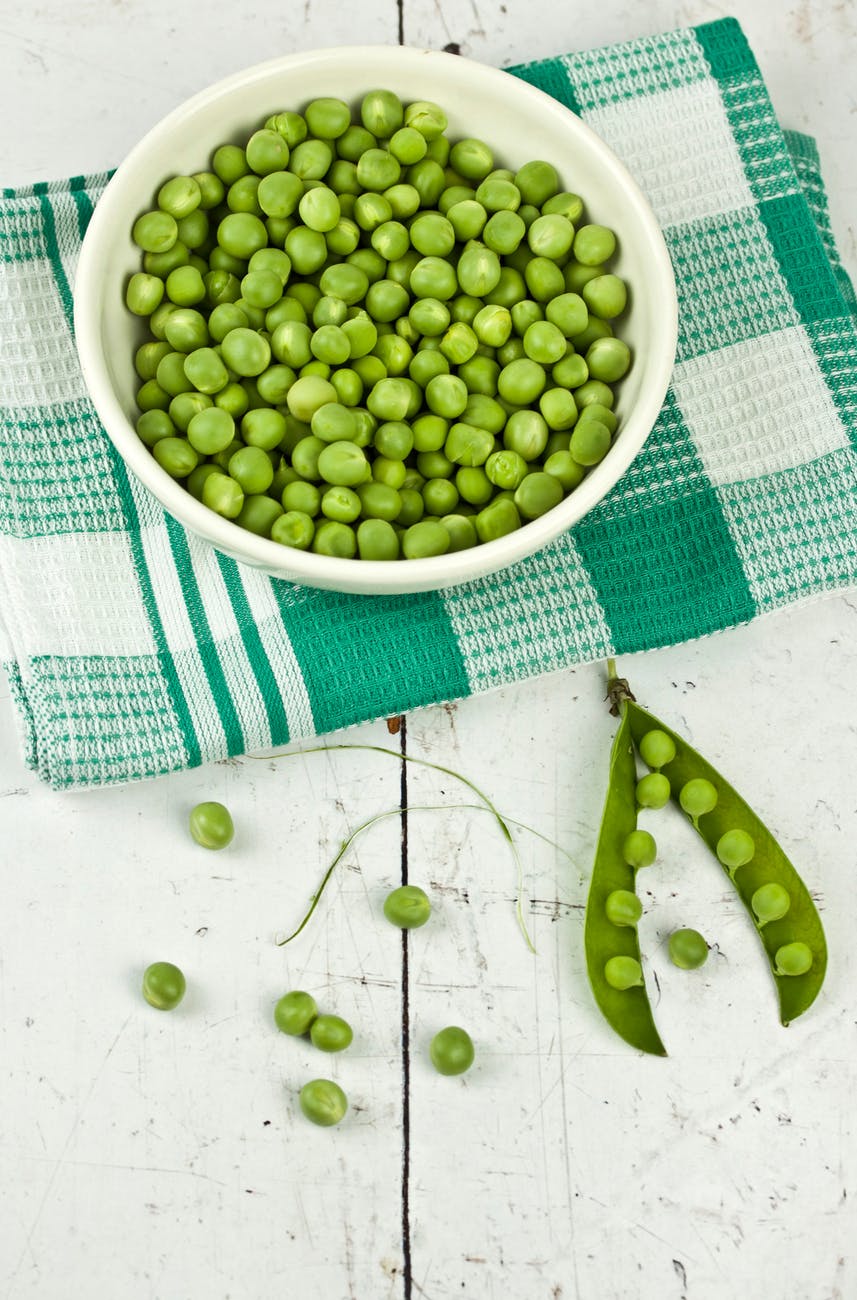
green peas on white ceramic bowl

Photo by R Khalil on Pexels.com

I cannot recall ever assisting her with canning; but from the time I was a very small child, I would sit beside her on a wooden bench or chair and “help” her shell peas or snap the ends from green beans. I suppose I prattled to her, because I recall her distracted “Mmmm Hmmm” responses. After awhile, however, I’d get quiet and daydreamy just opening the green pods and slipping the fresh, round peas out with my finger over and over, listening to the plunk as they dropped into the bowl in my lap. It was soothing.

~

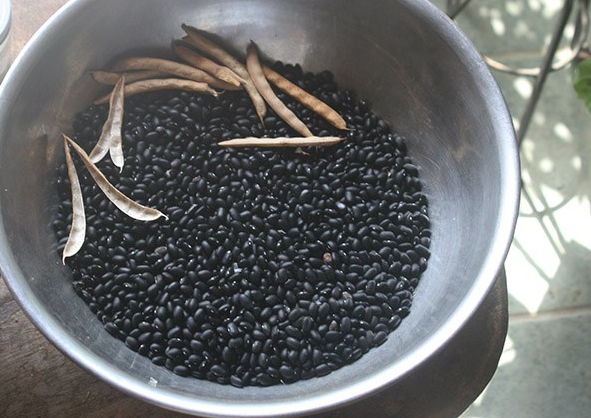
I remembered that long-ago activity today as I shelled black beans from their dry, tan husks: two or three pounds of them! My shelling created a crackly noise that intrigued our kitten, who has otherwise been drowsy from the heat. I’ve been freezing green beans, cooking tomato sauce, and harvesting pears and black beans for days in the humid August heat–but not non-stop (I have a day job, and the students have returned to campus!).

black beans in a bowl

So for me, the potential boredom of the repetitive task gets replaced by a rather Zen attitude. Be here now, shelling the beans, stirring the pear butter. Appreciate bounty and what the earth has given us. Remember childhood. Daydream awhile. Think about poems.

~

In this case, repetition means abundance. New poems as autumn arrives.

Manuscripting redux

I have read reams of advice and guidance on how to choose poems for a collection, how to order them, whether to construct an arc in a poetry collection, and so on. I have also had the excellent personal input of good poets and mentors in the process, all of which leaves me deeply grateful and still stumbling when I once again begin the process.

One challenge is excess. I have put off revising for collection for a few too many years, and now I need serious critique and culling; thus, I didn’t know where to begin (as I mentioned in an earlier post). Given a problem, however, creative people tend to develop a method. I chose the simplest one I could come up with: start by pulling all the published work that is not in my previous collections, and see what happens.

What I will discover–in fact, in the early process, already have noticed–is that not all work accepted for publication in a poetry journal reflects my judgment of my strongest poems. Then, too, down the road I will pull some good poems from the evolving manuscript because they do not play well with the others…that is, in terms of tone or subject. As I add things up, I’ll begin to see what might be missing or needed, or I’ll be reminded of an unpublished piece that ought to be included.

This work is exciting. And it takes weeks or months. It will change; my feelings about what I want the collection to say will change.

And then the reading will begin. I will read and re-read the book-as-it-exists and ask generous friends to read and critique the whole.

If I were a more ambitious and organized person, I might approach the manuscript process differently–certainly sooner, and possibly with more of a projected arc in mind from the start. I know that putting together another manuscript will be yet another learning experience, different from chapbook-writing, different from the past books I have composed. The poems differ, too–of course! My perspective, my physiology, my experiences, even my environment, though I have lived in the same house for 20 years.

At this stage, a month or so into the process, a coherence begins to occur. Yes, a book exists in the piles of poems. Probably two books, in fact–but let me begin with abundance (or perhaps, with diminishment) and proceed from there.


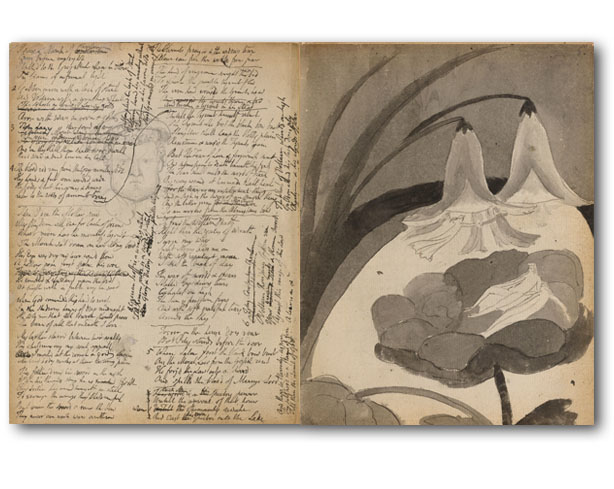
http://www.ebooktreasures.org/william-blakes-notebook/
[Not my manuscript…William Blake’s]

Neglecting the work

It seemed to me to have been a long time since I devoted serious focus to my creative work–I mean in terms of organizing, keeping track, revising, submitting to journals, compiling a draft manuscript of newer work…the so-called business of poetry. I resolved therefore to spend a weekend at the task. Alas. The weekend revealed to me the extent of my benign neglect: ten years of not-really-being-on-the-ball.

inflating-clipart-beach-ball-6

I do not consider myself a particularly prolific poet, but I found myself faced with well over a ream of poetry pages, many poems only in their second or third draft and far from “finished.” Maybe an average of 70 poems a year for ten years. Do the math: this is not a weekend’s work. [le sigh]

Where to begin? There is no beginning. After an hour or so of trying to prioritize the various components of the job, I gave up and just started at whatever had become the top of the pile. Analysis: which drafts had any glimmer of possibility? Some erstwhile poems could easily be culled into the “dead poems file” I keep under the cabinet with the dust bunnies. Others required considerable revision.

Fascinating process, despite aspects of tedium. I encountered poems I forgot I’d composed. I looked at the dates I began and revised them, tried to discern where my thoughts and feelings were at the time. Somehow, going through poems in no way resembles looking at old photographs–it’s not that sort of memory jog. Indeed, the poems are not involved with the memory part of my brain but with the creative part.

And that is exactly what I have been neglecting: the creative, imaginative, intuitively analytical side of myself.

In the process, I found a chapbook manuscript to submit–I had completely neglected it–and several worthwhile poems. I have no idea yet how much further I can get into the pages of past poems, and whether I might fashion another manuscript from the lot. But I’ve decided the work should not be neglected.

And I have a lot of catching up to do!


Writers. Groups.

Untitled-writerCreative writers, who are often solitary creatures given the kind of work we do, nonetheless must communicate with the wider world: that is, after all, the purpose of poetry. It is a form of artistic communication using words as medium. I do not know much about the (possibly long?) history of writers offering feedback, critique, encouragement or collaboration with one another aside from the more well-known spats and criticisms of Some Famous Authors. I do know that during the 20th century, evolving from artistic and literary salons of the 1800s, there arose the idea of writers’ groups and writers’ retreats, seminars, getaways, workshops…culminating in the MFA program, I suppose. Despite the popularity of the concept, I have had people ask me about writers’ groups and whether or not I recommend joining one.

First, I think we must ask: What is the purpose of a writers’ group? What do writers gain by meeting regularly and discussing their work, sharing their drafts, listening to feedback, and offering one another advice on publishing or goals or career moves? Is the writing group a place for jealousies and competition, or an environment of encouragement and networking? A bit of both? Is it good for friendships? Is it useful?

Then, we can ask: For how long can one expect a writers’ group to run? Months? Years? Decades? And how committed to the group is it necessary for members to be; and what number of members works best? How does it work, assuming that it does benefit the members? What happens if someone gets hurt, or angry, at the group or at a member in the group?

And where do we put the apostrophe? Writers’ group, or writer’s group? Or do we ignore the apostrophe? (Sorry. Had to make a punctuation observation.)

Full disclosure: I have been a member of writers’ groups for most of my writing life. I joined my first group in 1980 in Brooklyn, NY. I joined a loose coalition of poets when I moved to Philadelphia and some of us met for critique, though mostly we participated in readings. When I moved to my current region, I was invited to a feminist writers group; my spouse and I purchased our first house from one of the member poets! After that, I was invited to two other groups. One of the groups “clicked” for me. I have met with this core group of poets and writers for nearly 25 years now, and the experience has changed me.

The artistic question here is: Has the experienced changed my work for the better?

The personal question is: Have I benefited from the experience?
bookmkheartleaf

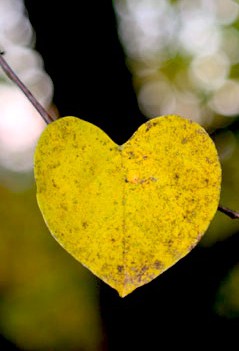
Redbud leaf in fall

I could perhaps write a book on these questions, but I am far too lazy. As to whether my work is better because of the discussion and critique, I’m pretty sure the answer is yes. Even though my colleagues are not famous writers, they are excellent and thoughtful readers–and that is what one most requires from this sort of group. If you want to improve your writing, you must have readers who can tell you whether or not they “get” your work.

Or make you reflect carefully upon why it is they don’t.

Have I benefited personally? That one is an easy and certain yes. I have a community, a very small community, devoted to creative writing and willing to read and think about that sort of work. I have learned–from their writing itself and from our discussions surrounding ideas pertinent to the process of writing and revision–much about their daily lives, backgrounds and fears and hopes, their cultures and their passions, their careers, their health, their homes (in which we meet). We have shared recommendations on which books to read, which poets to learn more about. Often, we disagree. Without conflicting opinions, no forward momentum. We are passionate, we are gentle, we are probing. Sometimes we probe too deeply. We learn to back off when necessary. We also embrace.

During 25 years, there have been serious losses, real tragedies, that our members have lived through, written about, survived. Such strength. Such humility. Such proof of the ways art can help people to express to others that in their grief they are not alone. That in their love and in their confusion they are not alone. That others feel the weird varieties of joy, the ambiguous sensations, the coincidences, the empty hours, the gladness in small things that human beings experience.

And also…might you consider a different line break here? It might heighten the punch of that phrase, and function as stronger alliteration in the following line.

Just a suggestion.  😉



Renewal, work

One never can know when work will arrive. By the term work, I mean what some people call “inspiration” but which, for me, is more work than it is a shower of divine gifts from the Muse. The past week brought an uptick in poetry drafts, as well as the acceptance of a poem by a publication I admire. All the more reason, therefore, to continue the process of working on the composition of creative writing.

I wonder if there’s an urgency pushing me to write new poems–the semester begins this week, and once I am teaching and tutoring again, time to write seems to evaporate–so I had better get cracking! Or it could be my response to the losses about which I have recently written, supposing that there is merit to the practice of writing as a way of healing or the writing cure (and I do suppose there is merit).

Maybe, just maybe, one might presuppose a connection with the arrival of a new year. Renewal. That would be arbitrary and perhaps subconscious; but the possibility remains. I can consider myself in the not-quite-midwinter renewal period, wrestling with potential poems that might turn out to be essays or blog posts or total duds or, if I am diligent and analytical and compassionate and lucky, completed poems.

Wintry hours ahead

Winter arrives…in red & white

~

Wish me luck. And hard work. I don’t mind being urged toward hard work; it’s the only way renewal really ever happens.

Some endings

On a bleak wet day: thinking about revising my poems. The pile of “needs work” drafts appears daunting; I have put off for too long the required work of rethinking, the hard, conscientious effort–and unstructured time–necessary to the craft. I have always enjoyed the task of revision because it offers a chance to revisit the initial urges of the poem and to refine and reconsider my ideas, but lately my motivation has abandoned me.

I notice, above, all of the words that begin with “re.”

Latin: “in the matter of” or, (res), “thing.” But as a prefix: “again,” likewise, to indicate a backwards or repetitive motion.

revise   §    require      §      revisit     §    refine   §

    rethink    §     reconsider

Maybe I am eager to move forward instead of always going back. Nevertheless, one method of moving on is to complete what one is working on so as to create a sense of closure. Sometimes, all a poem needs is a better ending.

When I think of revision under that perspective, as a means of completing an unfinished job in order to prepare for the next, new task, the pile seems slightly less unmanageable.

And by way of re-envisioning the endings…Molly Spencer’s blog The Stanza offers a good list of closure options here.

sunset1~The ending of a day~