Reading Proust again

I’m embarrassed to note that the name of Proust evokes hilarity in my two (adult) children, since they immediately think of the Monty Python skit (see it here). Needless to say, neither of them has read Proust; but at least they have some familiarity with the famous writer, so I’m not a total failure as an educational model for my kids.

I read the novel(s) at age 19 or 20 and was entranced. Probably that indicates a kind of romantic nerdiness on my part as well as a love of words, of art and music, evocative sentences, descriptive prose, complex emotional situations, history, and confusion about the world of adults I was at that time entering. That I stuck it out through all seven volumes of the Scott Moncrieff translation says something about my persistence with literature and the beauty of that translation. [The Public Domain Review has a nice overview essay on Moncrieff here.] In the decades that followed, I kept meaning to re-read In Search of Lost Time; but it’s quite a commitment and, let’s face it, that is the sort of plan one tends to postpone.

But I began the task this summer with the Lydia Davis translation of Swann’s Way, though I may move on with the Moncrieff editions if that’s what I can find at the library. (Somewhere in my attic is the three-volume Mitchell edition, but I started that years ago and found I didn’t like his approach.) I suppose a first-time reader might want to experience the books all through the same translator, but even the Moncrieff doesn’t succeed in that since he died before he got to Time Regained. The new Penguin series, for example, has a different translator for each book.

Ah, the difficulties of translation. If only I could read French!

During the past decade, I have done a smattering of re-reading novels (and poetry collections) that I first read in my late teens or very early 20s: Tolstoy, Woolf, Dostoevsky, Dickens, Blake, Atwood, LeGuin, among others. It’s always interesting to re-read a book that I haven’t read in decades because, although the book has not changed, this reader has, to some extent at least. Fewer allusions and implications go over my head, for one thing. The motivations of mature characters make more sense now, and the yearnings and errors of youthful characters, while sentimental and familiar, seem distant; also, I have a better sense of the historical eras in which these novels were set or written. As a teenage girl in the USA in the late 1970s I had very little background in the social strata of fin de siècle France or of Russia during the Napoleonic Wars, or even of Victorian Britain, yet the authors swept me up in the petty striving and the political aspects of their worlds…and the difficulties involved in surmounting them, achieving them, or living outside of society’s expectations.

Photo, 1971 Opel Kadett: Rudolf Stricker, https://commons.wikimedia.org/w/index.php?curid=16078675

For all that I may be the wiser now, and can pick up more of the irony and humor, and more of the ‘adult themes’ (for example, until I was 17 or so I knew absolutely nothing about homosexuality), it is still the beauty of the prose and the rhythmic sweep of sentences and paragraphs that get me wrapped up in a book like this one. Besides, I love art and artists, architecture and music, and evocative descriptions of landscapes and gardens just as much now as I did then–possibly even more. Proust introduced me to so much when I was first reading these novels. Because of him, I read Racine, and Zola, and art criticism of the early 19th century, and looked at Impressionist painting in a new way, and recalled to mind the one trip I have ever taken to France (three years earlier, at age 16) as his novels described the Champs-Elysées, the Louvre, Versailles, the streets and parks of Paris’ arrondissements, and the villages in the countryside through which we had driven in a rented Opel.

Now, those recollections of France are dim. And the world has changed in 50 years. Proust knew: if I were to return, I would not be likely to reclaim my past–possibly not even remember it. France would be new to me, which is an idea I rather like. Possibly I’ll go back; in the meantime, I will relish the remembrance of reading what I have read in the past.

Reading in shade

It’s the time of year when, according to the lunisolar calendar, we move from 小暑 xiǎoshǔ–when the heat begins to get unbearable–to 大暑 dàshǔ, the hottest time of the year. It may also be the greenest time: my garden suddenly plumps out huge squash leaves, giant sunflowers, masses of beans, zinnias, basil. The tomatoes are finally burgeoning after a late start. It’s too hot to spend much time weeding and pruning: I harvest what I can and retreat to the shade as soon as possible, where I can read.

A friend recently lent me a book of short stories, Human Sacrifices, by María Fernando Ampuero, an Ecuadoran writer. It’s been ably translated by Frances Riddle, and the stories are startling and harrowing. Not something to check out for a light summer read on the beach, but memorable and thought-provoking. One critic says Ampuero’s work is South American gothic. I don’t agree–and I think it’s kind of a cheesy shortcut in a review–but perhaps that phrase does convey the flavor of some of her stories. Anyway, it’s always a treat to find a writer whose work I’m unfamiliar with and whose work is admirable.

I’ve been taking a break from reading poetry, though that wasn’t planned on my part. July brought a wedding, a death, and some travel; and now, in the intense summer doldrums, I prefer to read for entertainment or information, or just to pass the time. Poetry takes more brain and heart space for me, more “intentionality” or concentration, than most non-fiction books or novels do. This is not to say any other genre is less demanding in and of itself. It’s a personal quirk: I am more attentive when reading poetry than I am when I read other forms of literature, probably because I’m unconsciously (or consciously) endeavoring to learn something of the craft and style and context of poems by other poets. It’s a method of processing how to write poems. But as I have no plans to write fiction or non-fiction, I read such genres for entirely different reasons.

Usually I try to read outside on the porch, in the hammock, on the garden swing. Some days it is just too damned hot and humid, though, and I resort to the air-conditioning indoors. The indoor climate has no flies or gnats but also no bird songs, cicada hums, cricket calls, breezes, scents of summer. Indoors is less than ideal (except in the teeth of winter!).

Recently I’ve added a shade garden where the chicken run was in decades past, under the umbrella of our largest white oak. I haven’t yet added a bench, but a lawn chair suffices for now. Alas, it is a bit buggy, but so is the hammock. The pleasure of summer reading in shade outweighs the inconvenience of the minor fauna…most of the time.

Wet summers

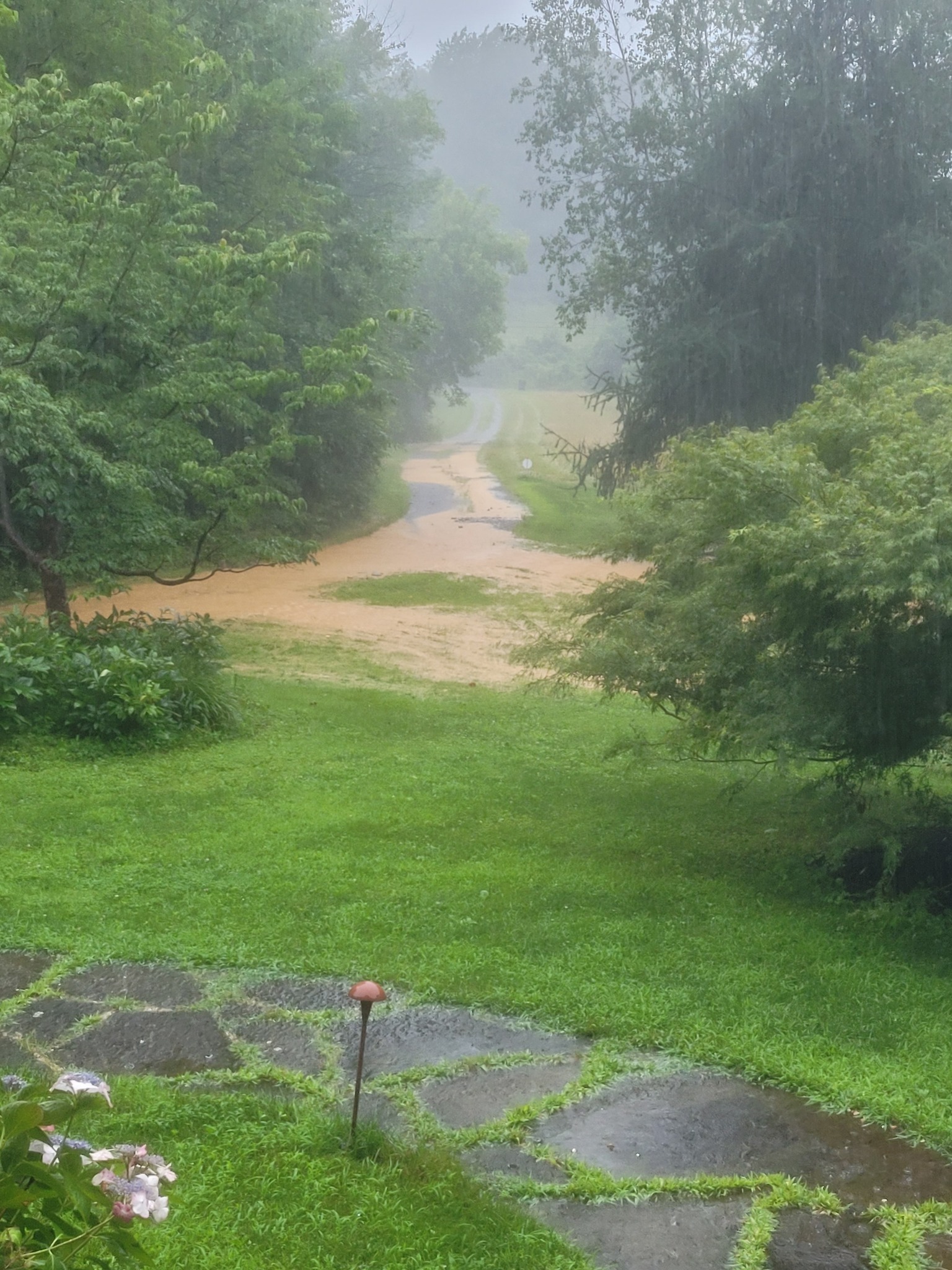
Thunderstorms used to thrill me, and still do–that combination of potential damage with the relaxing sound of rain on trees and rooftops, rain rushing through downspouts, and overcast skies that seem to lull me to sleepiness. Yesterday’s rain was a doozy. We had a flash flood in our front lawn, which has never happened before. But the basement stayed dry, no trees have come down (yet), and we didn’t lose power.

Cracking loud thunderclaps with arrow-straight downpours on hot summer days remind me of childhood. Yesterday afternoon I sat on my porch for an hour just watching the rain and remembering days like this. When we aren’t in drought years, these summer storms appear commonly in the region; yet they always evoke memories of long ago, I suppose because when I was a child I could just sit around watching a thunderstorm instead of, well, doing grownup things. Like working in an office, teaching a class, grocery shopping, laundry, reading emails, whatever I’ve been doing during the past 50 summers.

I spent many a mid-summer week or two in northern Indiana, where this type of storm was common. My grandmother always appreciated them, saying, “They make the corn grow.” Which must also have been true in the coastal plains of southern New Jersey, where I spent the rest of every summer. (Sweet corn is excellent in both regions.)

So, I think of thunderstorms on days so hot we could just run around outside in sundresses or bathing suits, getting doused, or sit on a porch and read while the lightning flashed and the rain came down in torrents. And then have garden tomatoes and corn on the cob for dinner, and go outside after dusk arrived and chase fireflies in the wet grass. These are the kinds of things that I feel nostalgic about, though I am not generally a person who gives much energy to nostalgia. It has been awhile since I had enough unoccupied time on my hands that an hour on the back porch observing the rain seemed like a valuable thing to do.

But it is.

Anyway, here’s a prose poem from my book Abundance/Diminishment that I recalled to myself while I was watching the storm.

~~

Competition, Wet Summers

…so here’s this young woman practically in tears—it’s almost one o’clock
and raining harder than ever, thunder so close it’s practically grabbing us by the
shoulders and the lights dim inside each time the sky goes millisecond-bright.
It doesn’t feel like midday. Every stall is full and the horses aren’t happy.
We can hear the skittish ones hollering, pawing, kicking at the doors. It’s a squall,
I tell Sara; but she’s frustrated, fuming, has her tack cleaned and her dress breeches
on for a three o’clock show she’s convinced won’t happen now that all hell’s let
loose in the form of torrents and flash floods, and there’s a stream coursing from
the south door into the first bay of the stable—it looks like the River Jordan.

The roof leaks at a spot directly above her shampooed and just-groomed mare
and I’ve run out of cheery platitudes and patience; I just walk myself to the barn’s
far end, feel the rain splash up my legs from the puddle at the threshold, dripping
on my neck and face through rotten shingles. The wind stops. It’s a straight-
falling deluge and hot, a no-relief rain with big drops that bubble in temporary
pools of runoff by the wash stalls. The afternoon is green and grey, the puddles
a stirred-up brown, and I remember my former boss—thirty years ago—standing
in the type shop doorway on a day like this one. The look on his face was worse
than Sara’s, not frustration or mutiny but numb desolate recall, slack and empty.

“Man,” he said, “It used to rain like this in ’Nam.”

~

Blue

At one of our local used book stores,* I found a copy of William Gass’ 1976 On Being Blue: A Philosophical Inquiry. Gass writes in a style one might term prolix; but if you are like me and sometimes appreciate lists, wordplay, allusions, lengthy sentences, and fine distinctions in your sentences–as well as humor–while exploring the limits and the stretches of words and language, this book-length essay on the word/concept/color/iconography/sexual innuendo/moody attitude and conflicting meanings of the word blue might appeal. I’ve been feeling a bit on the blue side lately, hence my attraction to the book (though I do like Gass as a writer, as long as I don’t have to read too much of him at one time). And guess? It cheered me! [I will caution the reader who avoids the use of “bad language” that Gass employs such words in this essay, for purely intellectual reasons…]

Granted, my feeling blue has a different tone from other uses of the word: blue postcards, sexual meanings of blue–I’m reminded of the movie “I Am Curious (Blue)” which was considered racy and given an X rating when I was a kid, though the blue in that title referred to the Swedish flag, apparently. My blue is the blue of songs like “Baby’s in Black” or Joni Mitchell’s “Blue” album. Or just that classic music form, the blues.

And I’ll get over feeling this way. That’s what moods are: feelings that come and go, transitory. It always seems as though low moods stay around longer than neutral or cheerful ones, but many scientific studies show that it is our perception and memory of the negatives that make us think we are sadder for longer. Even Wikipedia has an entry on negativity bias, with some sources if you want to check things out yourself. As I age, I realize that bad moods and sad events and past mistakes don’t need to stick around as much as I used to think. A bit of mediation, some practice and readings in Zen and in psychology, a lengthening perspective on life’s vicissitudes, some counseling and even some medicine; whatever it is that’s brought me here, I recognize that before long the depressive hours will lift. Also I know some methods of thinking that assist me to move to more neutral ground.

I will note there are many kinds and hues of blue, enough for Gass to write 112 pages on it and for the word to appear in 85 files of my own poetry during the past 12 years–I did a quick word search just to find out. That is in the files alone, and each file contains many poems. so I can only imagine how much I have over-used the word in my writing life! Certainly, not all of those blues are sad. Many are beautiful, sunny, the blues of blueberries and balloon flowers, the New Mexico sky, mountains and oceans; teal-blues and turquoise, the bright royal blue I like to wear, the pale color of robin’s eggs.

Blue. It has always been my favorite color.

~~

*The bookstore is Apport, in Emmaus, PA. Ben has an active Instagram feed and really cool catalogues of odd books, art, and ephemera.

*The first “blue” above is an encaustic painting by Deborah Barlow; the second is at Bandolier National Monument; the third is of the Blue Ridge Mountains; the last was taken at an inlet bay, maybe in Delaware–I’ve forgotten.