Maximally bent & broken

bent and broken

bent and broken

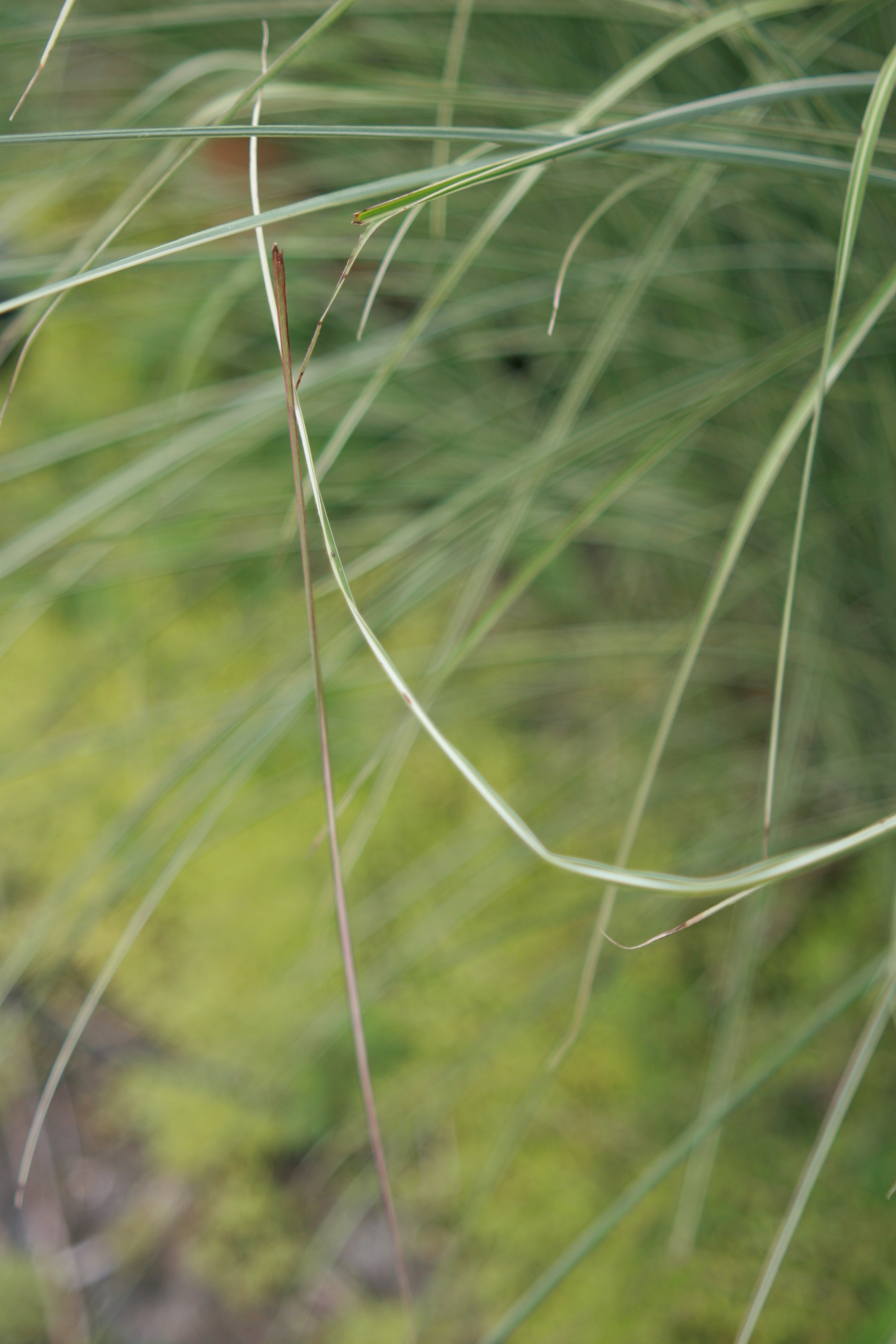
The linguist/scholar David Crystal writes that “Poetic language is the domain where linguistic rules are maximally bent and broken.”

The context here (in his book The Stories of English) is an explanation of how historians of language accomplish their sleuthing; Crystal notes carefully the differences between written and spoken versions of the same language, not to mention dialects and artistic expression and diversified diction based upon the intended audience, and uncertainty as to region, origin, and date of the manuscripts and texts under scrutiny. He cautions readers not to take linguistic theories and received stories about language evolution too readily; the story is a multitude of stories, examinable from a variety of disciplines and perspectives. Much of the story is ephemeral, being oral/aural and carried on in dialects. A fascinating puzzle, really, full of lacunae and contradictions…and a reminder that when I am in my teaching role, I should remain mindful that Standard English is something of a misnomer. A living language, as Crystal demonstrates, operates on many levels and evolves concurrently with social, economic, religious, and technological trends.

I fervently agree that poetry offers language new routes of expression, a place to expand, warp, and break rules while managing all the same to convey information. The information may be conveyed in surprising ways, though, non-standard ways: neologisms, compound words, old words used in a new fashion, or as a different part of speech. Poetry is a major arena for this sort of experimentation, though not the only one. Further, I am inclined to follow a non-prescriptivist approach to writing  even though my job at the college is to impart the basic rules of Standard English, a task which (alas) tends to involve judging things as less-than-correct or “in need of improvement” for the sake of clarity and general comprehensibility.

Should I therefore be more tolerant of non-standard use of the apostrophe? I’m not quite ready for that, because the resulting texts are still so frequently confusing. The point of good writing is, most often, to convey information–though that could be argued–

~

Crystal points out that much stereotyping of speech patterns and much arbitrary standardizing (to the degree possible) has been due to our creative writers, and compounded by writers’ love-hate relationships with printers (and, later, editors) who rely upon codification. A widely-literate audience benefits from generalized written standards, he notes–but there’s no need to become “Grammar Nazis” despite human beings’ natural inclination to be conservative and, let’s face it, contentious. He takes a sociological all-embracing stance about English, welcoming changes.

Having read this text, I am of the opinion that ours is another of those linguistically-transformative periods of messy additions and alterations thanks, largely, to technologies and the sciences but also to media and particularly social media. [viz, meme. What an adaptable coinage!] As long as I have been teaching, I have reiterated to my students that I am giving them a code, a tool, Standard Written English; the way they speak or write is not wrong or incorrect. It is simply not clear and standardized enough for academic work. Get the right tool for the job!

~

Crystal lauds Samuel Johnson for his zeal for language and languages and dialects, even as Johnson sought to “stabilize the disorder” of English in the 18th C. The author goes on to insert his view that prescriptive, “correct” approaches to the language “prevented the next ten generations from appreciating the richness of their language’s expressive capabilities, and inculcated an inferiority complex about everyday usage which crushed the linguistic confidence of millions” (not to mention enforced class distinctions even further). I need to remember this balance between clarity and variety. I admit I have been a not infrequent eye-roller at the “sloppy, slangy, abbreviated” English of television, tabloids, Twitter, texting, and my students’ lingo. It is refreshing to think of these annoyances as potentially enriching–rather than degrading–to the language I love to read, speak, and write.

When I read poems, I know there are writers who employ archaic words, dialect words, slang words, colloquial syntax, interrupted syntax, irregular capitalization and punctuation, neologisms, invented compound word-phrases, curses, technology terms, scientific jargon, Latin, Spanish, Spanglish, Chinese, obscure place names, alternate spellings (orthography)…and on and on. Some are looking back; others look ahead. Some are encapsulating the moment–now–in the framework of a verse. They bend and break the language in startling, haunting, beautiful, memorable ways. This they can do because a living language allows them to.
Mere philosophical speculation

I have been reading more of Daniel Dennett. One of his earlier books, Brainstorms, consists of essays and talks and thus, being available to read in short bursts, has served as my intellectual entertainment in between the busy social events of this particular June.

I liked three of his essays better than the others. The first one in the book describes, explains, and argues for “intentional systems;” the author also does a fairly good job of asserting that philosophers and psychologists ought to study computer models of intelligence as a means of leaning more about human intelligence. He does not make lots of mechanistic claims, however–he does not suggest human beings are mere soft machines, and he gives a good argument in Chapter 11 as to why we cannot make a computer that feels pain. But he does separate, by degrees, the differences between basic consciousness states and consciousness that exhibits intentionality, and he separates basic consciousness from simple instinct–something that confuses many people when they are posed difficult questions about non-human animal “minds”.

His essay “How to Change Your Mind” offers terrific, logical insights about human “feelings,” “intuitions,” and opinions. Dennett shifts the perspective on the psychological question of why it is so difficult for human beings to “change their minds” and to give genuinely rational (or mechanistic) reasons for doing so.

The book’s final chapter, “Where Am I?” is available as a PDF at this link, and here Dennett offers a much more entertaining and readable philosophical thought experiment on personhood (and consciousness/mind) than Derek Parfit posits in his book Reasons and Persons. Those readers who are interested in how a thought experiment can argue for the existence of a person-as-consciousness-state without embodiment-in-carbon-based-materiality, without the usually-required religious or spiritual crutch, but also without the dense counterarguments of Parfit’s approach, may wish to check out this chapter.

Granted, I understand that many people feel thought experiments are a monumental waste of time, tantamount to navel-gazing; others feel sure that teleportation out of fleshly bodies is the stuff of science fiction (emphasis on the fiction). But as our inventions permit us to test out theories that once were “mere philosophical speculation,” all kinds of surprises may await us. Quantum physics was an imagined idea, for example, that scientists have been able to revise and explore in a more machine-based way…Thomas Kuhn’s The Structure of Scientific Revolutions does, often, operate historically as he envisioned the process. The recent excitement over teleportation of coded data provides an example of mechanical testing of theories (here is a good basic article on the experiment for the layperson, with graphics and a Star Trek image, and here is the scientist-written article).

All of which is fascinating, yet none of which decreases my enjoyment of a run of perfect June summer days. Incarnate, I attempt meditation. There is honeysuckle on the breeze. Insects whir and buzz around me; sun warms my left shoulder. Time for consciousness. Time to be here, among the things of this world.


IMG_0787

Consciousness as multiple drafts

Daniel C. Dennett’s 1991 book, Consciousness Explained, has kept me entertained and interested for a couple of days now. How could I refuse a book with that title? And Dennett–whose conversational writing style appears to toss off one idea after another in quick succession–actually stays mostly true to classic philosophical reasoning in his arguments as he endeavors to make claims for what consciousness is. He begins with phenomenology as one way to initiate the concatenation of empirical science (physics, biology, neurological research) with logic. He dispenses with Husserl and the early Phenomenologists but invents his own form–hyperphenomenology–breaking phenomena into three divisions and exploring each until he arrives at a way to destroy the long-held concept of the mind, hence consciousness, as “Cartesian Theatre,” and replace that model with a construction more biologically sound.

The book is far too complex to summarize, but the concept he develops that most appeals to me is what he calls the multiple drafts theory of consciousness. Dennett draws upon neurological and psychological research as well as past and current philosophical thinking to propose that what we term consciousness may consist of multiple narratives created through physical input, memory processing, and other processes that result in fraction-of-a-second “revisions” in thinking. Narratives! Revisions! As a writer, I can certainly relate to this idea. The theory of multiple drafts consciousness would explain many phenomena, such as the unreliability of eyewitnesses, the repression and re-constructing of traumatic experiences, the embellishment of stories (as Dennett puts it, “What I should have said at the party becomes what I said at the party”)…and it has examples in the way we “tell” fiction, movies, and family stories.

Currently, I am engaged in the work of revising dozens and dozens of poems. Many drafts. Many narratives, many layers. Subtle shifts in perspective or story or language or style–which version is the real me? All of them, across a continuum.

Derek Parfit’s Reasons & Persons suggests some of the same conclusions through a more traditional philosophical approach (harder to read than Dennett’s often-humorous prose which is geared more toward the non-philosopher and which employs considerable neurological and psychological research as part of its rational evidence).

Although these texts intrigue, and are convincing, they remain speculative. For me, the science aspects of the inquiry remove none of the mystery or delight I experience in terms of my own consciousness. Nor do they negate my sense of myself as individual, unique as to perspective, or whole in myself and in the cosmos. I know that many people resist the idea that consciousness is not soul, who feel that scientific research somehow diminishes human beings into–what? Fancy hardware for intelligent software? Automatons with the illusion of free will? Purposeless life forms? Robotic zombies with no moral bearings?

continuum

A continuum version of tao

Apparently, we desire awe; but knowledge doesn’t have to kill awe.

I find myself fascinated with the ideas posed by Douglas Hofstadter wherein he theorizes consciousness-as-continuum (see this post). People love to default to a black & white way of analysis, thinking, and judging, but everything in nature contradicts that concept. No doubt our brains, wired to make quick decisions using the simplest shortcuts, sieve out a great deal of content and then justify later (Daniel Kahneman’s book Thinking Fast and Slow covers this process in fascinating depth). It’s simply easier to think of balance as tao, perfectly harmonious black and white, or to sort people or objects or ideas into yes-or-no categories. But the distinctions are seldom so clear–there’s a continuum that stretches from the black to the white, as in the spectrum, as in the fringes of a forest or a meadow, as in the so-called races of human beings, as in places where societies and cultures meet and often intermingle, as in the coastline of the sea or a riparian environment. And all of those things are awesome, even miraculous.

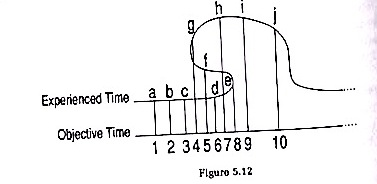
In Dennett’s Chapter Five, “Multiple Drafts vs. the Cartesian Theater,” he offers this diagram:

~

dennett003It’s a proposed version of what happens when we think.

You will have to read the book to decipher this illustration; but I recognize in it the way I tell a story, think about a story, remember an event, record an experience, and the narrative method of the many kinds of stories (many genres, many media) that I love.

One thing it is not is straightforward. We have all those revisions to make, to layer our experiences with, to explore along the fringes of, and to find deeply miraculously awesome. Wading among my drafts now, I feel revitalized. These reflections and revisions are part of my Self as a conscious being in a physical and wonderful world.


Reading as drug

“…Let us admit that reading with us is just a drug we cannot do without–who of this band does not know the restlessness that attacks him when he has been severed from reading too long, the apprehension and irritability, and the sigh of relief which the sight of a printed page extracts from him?–and so let us be no more vainglorious than the poor slaves of the hypodermic needle or the pint-pot.”  ~ W. Somerset Maugham, “The Book-Bag”

azaleas by Ann E. Michael

In June and July, my situation lets up enough that I am not in my office 40 hours a week and can, for a time, attend to the garden or the hiking trail or avail myself of more time to read. Yesterday, I browsed through the campus library and came away with seven or eight books. How I loved that feeling when I was a child: walking through the stacks, thumbing through card catalogues, picking and choosing, now with deliberation, now with impulse, until I had reached the borrowing limit!

It is, in a way, a kind of addiction, though for the past three decades I have been a bit more studied and less compulsive in my reading habits. A bit. Plants and animals, and the workings and seasons of the garden, are my alternate texts when the printed page is unavailable or my eyes feel tired. Certainly I read on-screen quite often, but that process is not nearly as fulfilling. I have downloaded a book by Deleuze (Difference and Repetition) as a kind of experiment; I’m not at all sure that philosophy will be comfortable to read on screen, but I suspect I might prefer reading philosophy on a computer than reading a novel on a computer.

For me, the worst thing about onscreen reading, as I possess neither laptop nor tablet computer, is the inability to stretch on a lounge chair or curl up on a sofa (or, best of all, in a hammock) while reading. And the pleasant experience of leaf-shadows gently caressing the off-white pages of a paper book, the tone of the paper shifting ever slightly as the light changes, the sensation of dozing off with a book over one’s face when the sun gets hot…book addicts find these aspects as enjoyable as the intellectual response to the material, the words themselves.

Several significant events & celebrations appear on this summer’s horizon, but with any luck I can employ my library cards to good purpose a few more times before the fall semester arrives.


Two springs

I left the budding springtime in eastern Pennsylvania to visit Glasgow, Scotland for six days. Springtime along the north Atlantic was full of gorse blooms, primroses, daffodils beginning to fade (though there were several hillside hosts of golden daffodils worthy of Wordsworthian apostrophe), early tulips, and wildflowers alongside lakes, streams, and rivers, even in the city.

The days are longer than they are at my latitude, and the diurnal length has an effect on many of the bloom times. I saw few saucer magnolias–too windy, too chilly–but there were stellata magnolias and, to my surprise, camellias apparently thrive in Glasgow as long as they are planted in a sheltered area.

I spent a fine Saturday afternoon at the Glasgow Botanic Gardens, which are lovely. The greenhouses there have an excellent collection of carnivorous plants: sundews from South Africa, pitcher plants from North America.

The entire span of days I visited, the weather was sunny. Glaswegians took advantage of the unusual break in the weather and were out in droves, picnicking at the Botanic Gardens Saturday and–on Easter Sunday–wandering Loch Lomond’s shores.

Like many of the rivers, canals, and lakes in the region, Loch Lomond is frequented by swans. It is nesting season, and I was thrilled to find cobs patrolling the waters and the female swans draped elegantly over their large nests. I didn’t see any cygnets, though I saw some ducks and ducklings.

10247279_10203757614005125_5675182446853711106_nMany years ago, my first book of poetry was a collaborative chapbook with my dear friend David Dunn. The book is listed on my Books page, but it is out of print. The title is The Swan King.

I returned home Monday, where my yard is resplendent with daffodils, hyacinths, grape hyacinths, magnolia, forsythia, and a zillion tufts of wild garlic (onion grass, we used to call it) punctuating the green grass of the lawn.

But lovely as my view was this morning, I wish I could have spent longer at Loch Lomond and the Trossachs…

Loch Lomond

Loch Lomond

Leading the witness

Please forgive me if my recent posts are devoted more to teaching than to poetry, gardening, and speculative philosophical thinking–the semester end approaches, and I am endeavoring to ascertain whether my students have acquired any new knowledge about poetry and literary analysis. There are these supposedly-evaluative items known as “grades” which I must register for the college administration.

Spring and AllSo, exactly what, if anything, have they learned thus far? Considering that for the first few weeks of class I practically had to apply forceps to their vocal chords to get them to speak in class at all, let alone express a thought concerning poetry, most of them have progressed. Only a few students volunteer to answer a question I pose or offer an opinion in response, but when I look one of them in the eye and ask “What do you say?” I now get an answer instead of an embarrassed shrug.

This is headway indeed. Granted, the method I have used to initiate response might more accurately be called “leading the witness,” as opposed to Socratic inquiry. Most college sophomores I’ve met are so stymied by the whole genre of poetry that the classic method of advancing knowledge through inquiry results in nothing but puzzled silence and guessing, most of the time. I soften the approach by suggestions that, I hope, will lead to inference on the student’s side but that do not give away exactly what I am looking for. Because I do not always know, myself, what I am seeking. Because I want, once in awhile, to be surprised and delighted by a student’s inference–usually a point of view I have not previously considered (because I am not 19 and not a literature novice).

One of the things I love most about good poetry is the opportunity to be surprised, and perspective shifts offer the unexpected. I can lead the witness, perhaps, but I cannot lead all 30 witnesses (or whatever number of them happen to be paying enough attention to be led). The student I call on will respond directly and then inspire other, slightly variant, responses from classmates.

A discussion may actually ensue! Oh, joy!

I try to take note of which students seem to be engaging most actively so I can somehow calculate that into the evaluation, but I have not really developed an effective way to indicate the hoped-for “a-ha!” moment into a grade.

Theoretically, grades are objectively based upon a carefully-constructed rubric that reflects what the student knows about the discipline or subject area. I have therefore invented criteria, percentages, and the like for assessment as required by academic best practices–or at least by academic protocol. Having been always a student at seminar-style, narrative-evaluation-based higher education institutions, I admit that I find the typical grading methods disheartening and arbitrary.

Meanwhile, I continue leading the witnesses until the end of the semester.

~

By the way: It is April, and once again National Poetry Month. Please, go out and purchase a book of poetry. Or borrow one from the local library. Shout your barbaric yawps into the springtime air!

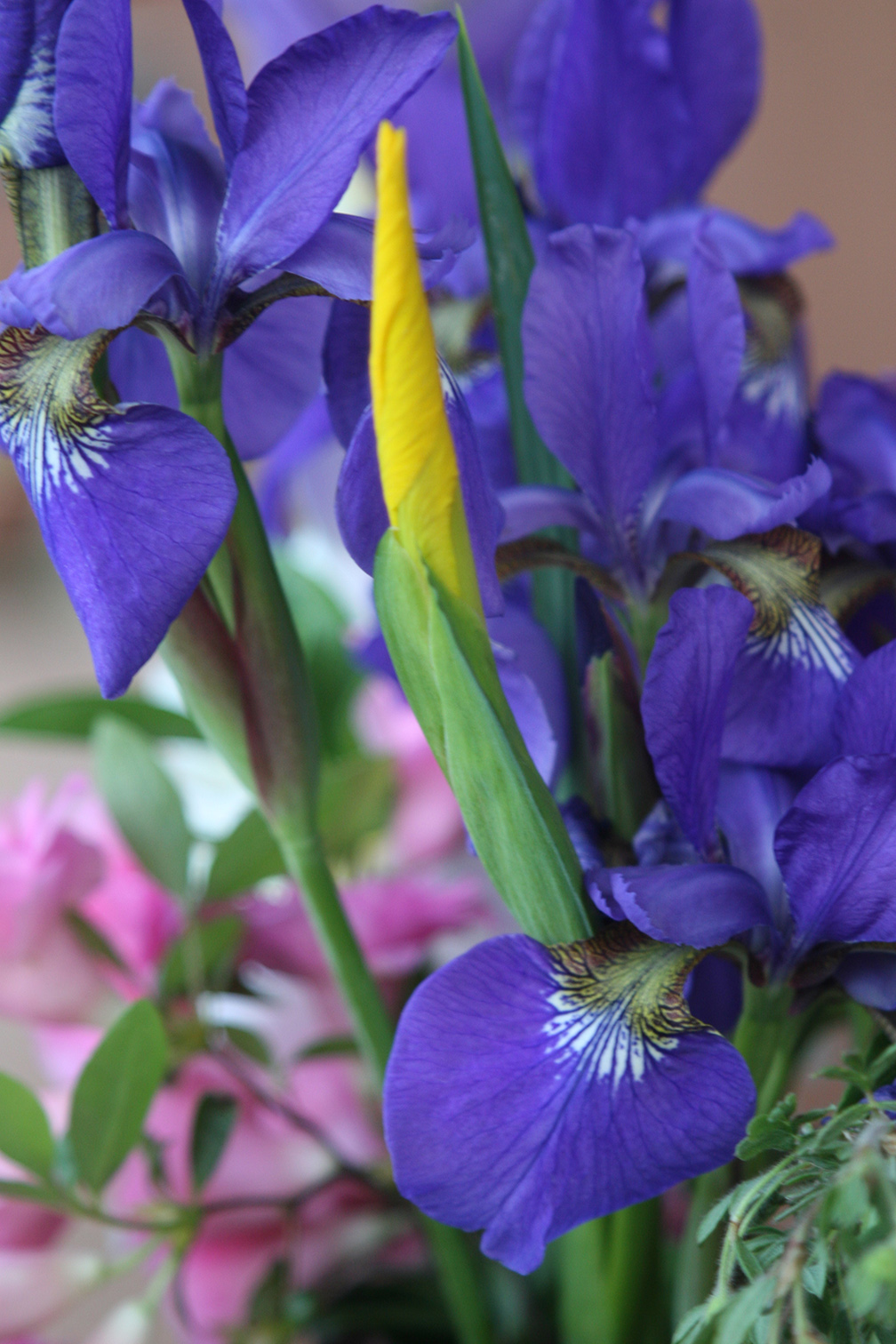
IMG_0575Iris reticulata

Ink art

Last weekend, I went to New York with friends to see the Ink Art exhibit at the Metropolitan Museum of Art. The art, all of which is contemporary (the oldest artist represented was born in 1953), has been installed in the museum’s extensive Asian galleries alongside ceramic, sculptural, religious, and paper works going back centuries.

The rationale behind this juxtaposition, says the museum’s site, is to point up “how China’s ancient pattern of seeking cultural renewal through the reinterpretation of past models remains a viable creative path. Although all of the artists have transformed their sources through new modes of expression, visitors will recognize thematic, aesthetic, or technical attributes in their creations that have meaningful links to China’s artistic past.” That certainly proved true for me; and I cannot decide which was more intriguing, the similarities or the differences.

The young artists in Ink Art employ age-old cultural tropes: the triptych, the scroll, woodblock printing, calligraphy, moody landscapes, ideograms, ink, and repetition. The resonance with Chinese heritage is palpably authentic and is often employed in the service of criticism, mostly criticism aimed at the destruction of cultural icons and of the environment (some of the represented artists are exiles). Mounting the exhibition in the Asian galleries meant that the visitor confronts the historical and the contemporary simultaneously.

In Yang Yongliang’s “View of Tide,” the artist uses digital photography collaging to replicate the mood of an ancient Chinese landscape scroll which, on closer inspection, reveals that the austere and mystical imagery of sea and mountains has been composed of smokestacks, highways, powerlines, and the like. I found this work powerful as commentary and shocking in the best possible way.

Being a word person as well as a visual art appreciator, I was especially drawn to the section of the exhibit called “The Written Word.” The highlight of this section is Xu Bing’s installation “Book from the Sky”. My friends and I–avid readers all–entered this room and felt shivers of recognition and joy at the concept of a room-sized, descending, ascending, wall-to-wall book. (I urge my readers to click on the link for a peek.) The information plaque notes “while the work is inspired by the form and typography of traditional Chinese woodblock publications, faithfully replicating every stylistic detail of traditional Chinese printing, not a single one of its roughly 1,200 characters—each printed with type hand-carved by the artist—is intelligible. Each of these imaginary characters conveys the appearance of legibility but remains defiantly undecipherable.” The paradox and the beauty of the concept are amazing; in addition, I find it oddly thrilling to think of the imagination and the craft and simple hard work Xu Bing put into creating meaningless calligraphic pictograms, cutting them into woodblocks, and repetitively setting up the careful lines in rows on long scrolls.

What emerges when the scrolls are installed on ceiling, walls, and floor manages to be indecipherable but not meaningless. There is in fact much opportunity for meaning in “Book from the Sky,” and for discussion and interpretation and playfulness.

One example: after reading about “Book from the Sky” and taking in the environment for awhile, my friend Mark commented, “Imagine if you were a beginner learning Chinese script, and you encountered this room. You might just spend hours in here trying to figure out whether you could read any of it…I mean, if  you hadn’t read that it was indecipherable. Or even if you had that knowledge, maybe you’d spend a long time here thinking that at least something in all this text meant something you could translate. Wouldn’t that be awfully frustrating?”

Or maybe that’s the point?

Carved type for “Book from the Sky” by Xu Bing

~~

Conceptual metaphor. Art. Thinking. Decipherability; communication. These are large ideas, and crucial ones in the scope of human community. Without art–how can we encounter such metaphors? How would we share them?

Living metaphor

“There were times when I could not afford to sacrifice the bloom of the present moment to any work, whether of the head or hand.”

~ Thoreau

ann e. michael photo

Socked in by far too many snowstorms,* I’m running out of reading material (haven’t been able to get to the library!). I did get a gift book from a friend and a book in the mail recently, however; blessed relief! As often happens when reading quite different books at the same time, I notice ways they overlap or complement one another.

The gift from a friend is Jon Kabat-Zinn’s Wherever You Go, There You Are, a poetic companion to his 1990 book on mindfulness as healing, Full Catastrophe Living. Kabat-Zinn uses Thoreau’s “bloom of the present moment” as a section head and metaphor for mindfulness practice, and it serves exceedingly well in that capacity. This is not a text to read in one sitting or to move through rapidly–or even chronologically. It offers space for the mind, space for reflection and, indeed, for the kind of ’emptiness’ that waits patiently, observing the present moment. Not the ghastly, desperate emptiness of numbness or depression, but the Zen vessel of the now.

Vessel. Space. Bloom. Each of these metaphorical, analogous, a way of indicating connections between or likenesses to or relationships with. The richness of language and the incredible stickiness of its concepts form the basis of Lakoff and Johnson’s seminal 1980 examination of how human beings use language–specifically metaphor–in the book Metaphors We Live By. A significant section of the first 4 chapters appears here, if you want a taste of how the authors set out their investigation; but I recommend the entire book, the 2003 edition of which contains an insightful afterward by the authors that incorporates some material on neurology and other things not available to them in the 1970s.

~

* From the Express-Times of Easton: “The Lehigh Valley has gotten 66.7 inches of snow so far this season. Meteorologists agree this storm might not push the snowfall totals to break the seasonal record of 75.2 inches from 1993-94, but there’s still a chance to top the total this winter in the first couple weeks of March, they said.”

Psychobiology & art

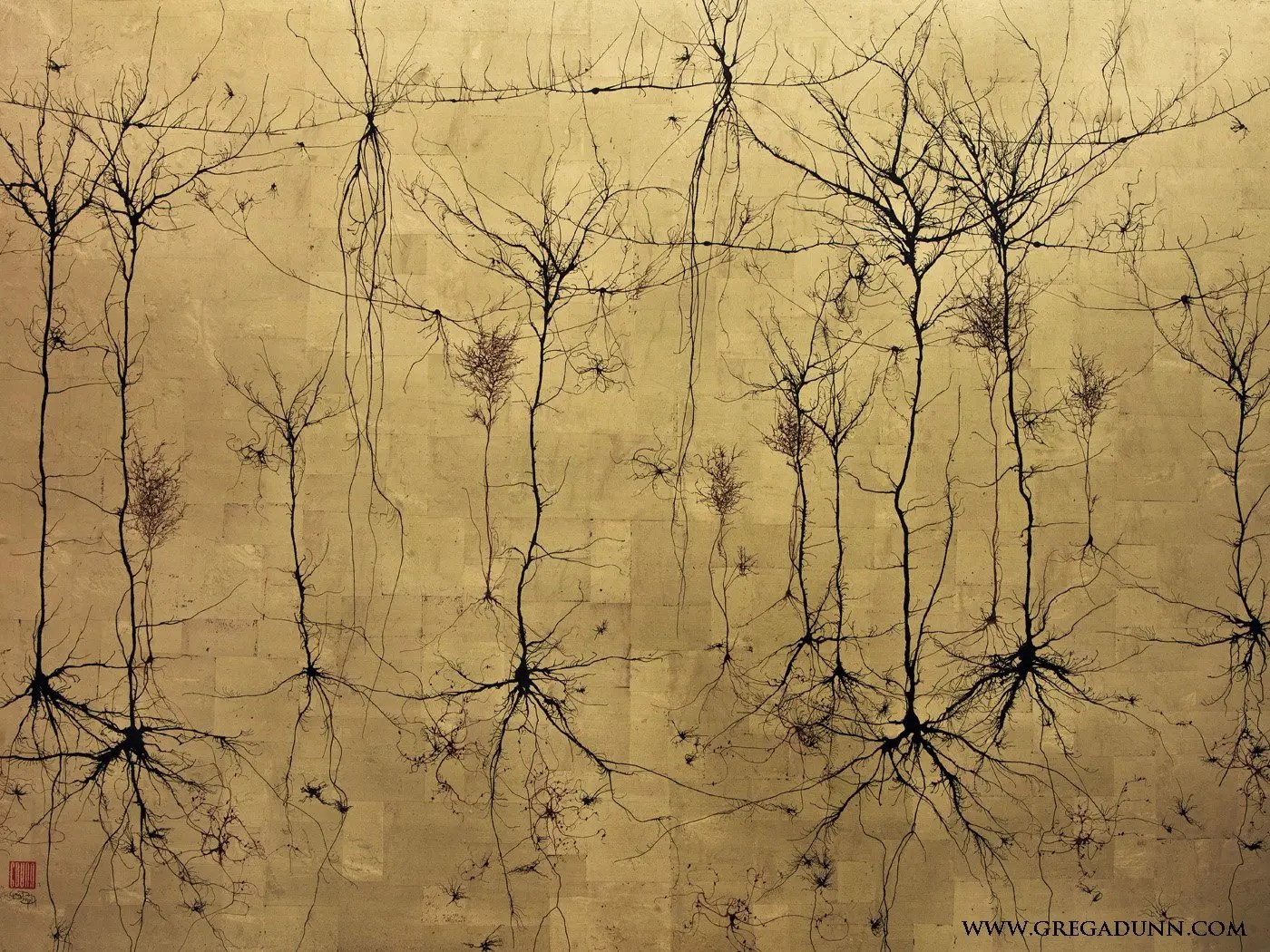
Greg Dunn’s gold-leaf neuroscience art: “Gold Cortex”

~

Howard Gardner once said aesthetics is considered the “dismal branch of philosophy” and that psychobiology, the scientific examination of art, might therefore be called the “dismal psychology.” This view derives from the difficulty of pinning down what qualifies as art, the artistic process, the artistic personality, and the like–especially the challenge of trying to categorize, measure, and in any genuine way evaluate art. Psychobiology as a discipline is new to me; is it merely an earlier form of behavioral neuroscience? How does aesthetics play a role? I went looking.

~

Here is an excerpt from D.E. Berlyne’s abstract of his exploration into stimulus behavior and art (including humor), Conflict, Arousal, and Curiosity, written in 1960:

The highly variegated human activities that are classed as art form a unique testing ground for hypotheses about stimulus selection. They consist of operations through which certain stimulus patterns are made available, and so they must unhesitatingly be placed in the category of exploratory behavior. The creative artist originates these patterns, the performing artist reproduces them, and the spectator, listener, or reader secures access to them and performs the perceptual and intellectual activities that will enable him to experience their full impact.

It’s intriguing to note the different ways a social scientist (Berlyne was a psychobiologist) uses language to write about a generally-considered subjective subject: art. Different in tone and terminology than the language a philosopher or artist would employ, the description characterizes yet another inquiry into the ontology and the exercise of art and the artistic process:

The content of art can range over virtually the whole scope of human communication. It may be used as a source of information about the appearances of objects, the course of historical events, the workings of human nature, as a means of effecting moral improvement, as a vehicle for propagating religious, political, or philosophical ideologies. Art is, however, distinguished from other forms of communication by …the communication of evaluation. While human beings may produce art and expose themselves to it for an endless variety of reasons, collative variables must play their part, as they do in all forms of exploratory behavior. They underlie, in fact, what is commonly called the “formal” or “structural” aspect of art.

The author is interested in whether psychosocial behaviors, culture-building, and communication all derive from exploratory behavior and stimulus-response and what role evaluation plays in the assessment of art, its social or moral value, artistic merit, “timeless” art, and to some extent the very making of art.

The psychology of aesthetics offers intriguing insights–if one can get past the jargon. From the little I have read about it so far, the science seems to share a few points with phenomenology: its task, according to Dr. William Blizer, is to “describe observable phenomena and to note associations and correlations among them which enable such phenomena to be predicted, controlled, and explained.” In psychobiology, the “observable phenomena” are “the behavior of the creative…artist and the appreciator.” Philosophy and psychology are strange bedfellows, though; throw aesthetics into the mix and the entire project begins to seem suspect. I am not at all sure that these inquiries end up explaining–certainly not predicting or controlling–anything about art.

I admit I prefer to read such musings when the makers themselves are doing the exploring. Nonetheless, this little intellectual excursion led to my discovery of Greg Dunn‘s amazing neuroscience designs, one of which appears above. Who knew the brain was so gorgeous?

Curiosities & stories

Here’s James Delbourgo’s recent article in Chronicle of Higher Education (I read the Chronicle regularly, if that’s not already obvious) about collections of oddities. While the article itself is sometimes a bit maddening (what is his main idea here?), it put me in mind of Mantel’s The Giant, O’Brien and of collections my friends have accrued. Toshio Odate, for example, has some fascinating accumulations he keeps in clear acrylic boxes, and some of his art constructions feature curious things: a favorite of mine is a large frame displaying every pair of sneakers his son wore as a child.

Edmund de Waal wrote movingly about objects and collections in his book The Hare with Amber Eyes. Several months ago I promised myself I’d get back to the topic of objects and their stories, but it has taken me awhile to resume my meditations on the subject. As a child, I loved wandering slowly through the world, stopping and dawdling and picking  up acorns, buttons, marbles, leaves, whatnot. Sometimes I would arrange these found objects into tiny houses, or float them on puddles, or arrange them on my windowsill. I might imagine stories around them, drawing on Andersen’s “Thumbelina” or the song “Froggie Went A-Courting.”

"Swiss Shoot the Chutes" by Joseph Cornell

“Swiss Shoot the Chutes” by Joseph Cornell

Not too many years later, when I encountered Joseph Cornell’s work, I was enchanted. His boxes contained mysteries, stories, possibilities, and fears; and they were achingly beautiful to me. Not unsurprisingly, Cornell’s work gets a mention in Delbourgo’s piece, which is partly a review of Brian Dillon’s book Curiosity: Art and the Pleasures of Knowing.

From the Chronicle essay:

Curiosity, Dillon proposes, is a way of knowing that looks askance. It draws attention to the unexplained or overlooked fragment, to invite us, if possible, to look sideways and look closely at the same time. As such, its promise of knowledge is ambiguous. Does curiosity seek to unmask the strangeness that absorbs its attention, or is it an invitation to luxuriate in that strangeness? Does it carry an inherent Baconian injunction to go further and illuminate, or does it recommend the alternative pleasures of not knowing?

I like those inquiries and feel they may inspire some poetry. Later, while considering the way some collectors, particularly wealthy or scientifically-minded ones, made detailed lists of the oddities, Delbourgo notes that

Dillon suggests that such lists also constituted “a kind of story,” but do they? The list is an open form, not a closed and completed one. Curiosity collections could absorb countless new objects precisely because they didn’t propose a coherent narrative about them. Unlike spoils that tell of conquest, curiosities don’t preach and don’t teach. What makes them curious is their oblique relation to the world in which they’re embedded. And yet, as a matter of historical fact, early-modern Europeans accumulated curiosities in no small part through trade, colonization, and war…

The 18th-2oth century ascendancy of science and the current trend of interdisciplinary art-tech-science aesthetics gets a mention in the article, too:

Curiosity and wonder—distinct terms but often used interchangeably—turned out to be interwoven with theology, civility, craftsmanship, nature’s playfulness…Curiosity thus helped dethrone the modern fact from its hegemony over the history of science.

Again a connection with de Waal, and also with the work my brother has been doing in reconsidering the skull collection of Samuel Morton (and other early modern anthropological collectors). In the case of many people who collect ‘curiosities,’ there are thorny questions of ethics vs. the ‘value’ of extending knowledge or awareness. The political, the legal, the ethical–these can conflict with curiosity in many forms it can take, from the problematic Rauschenberg  sculptural combine “Canyon” which features a stuffed bald eagle, to the superficial thrill that gets us to sit through an adventure movie even if we can guess the ending.

Curiosity is basically an exploratory response, as psychologists term it, which covers a vast arena of animal and human perceptions of the environment to orient us to potential situations and to prepare us for behavior/action. In the late 1950s and early 1960s, D.E. Berlyne studied what I call curiosity quite extensively, including some exploration into art and aesthetics though mainly concentrating on the reactive responses that make us susceptible to enjoyment or evaluation of art, humor, literature. (He published, in 1954, A Theory of Human Curiosity, which I think I must read after I read Dillon’s book).

But now I am drifting far from my topic of stories and objects. Probably that’s Delbourgo’s influence, as his essay wanders a bit, though the author cites some books I plan to add to my to-read list; for that, I am grateful, but I would prefer to look at how objects inspire stories, or make the need for stories. There’s the sun in the sky each day, and it leaves each night. We make up a story about that, or about why the leopard has spots or why there are stars in the sky.

Here’s something from my own collection of curiosities, a wooden ampersand from an antique type magazine. &&001And there’s a story I could tell about it which would be more or less ‘true,’ but there are better stories yet to be invented.

Or, tell the story of Cornell’s “Observatory Box.”

http://www.thisisnotacraft.com/

“Observatory Box,” Joseph Cornell