Source material

Creative writers are often asked where they get their ideas from. In my own case, the answer to that varies a great deal. Sometimes ideas arise from personal experience, of course, but one’s life offers only so much material if you are a relatively staid person like me. Topics for poems can arise from recent headlines or from histories, written or oral; from conversations overheard in a grocery line; from stories other people tell me; from folk tales; from science books; from dreams; from works of art, and numerous other sources. It’s this wide array of possibilities that make the concept of the creative-writing prompt so popular. A quick Google search for “creative writing prompts” offered well over 20+ pages of entries, in several languages.

Photo by Pixabay on Pexels.com

I have written pieces based upon prompts, especially when in a workshop or class, or when I feel rather tapped out of my own imaginative source material. I’m especially fond of writing that stems from viewing or experiencing a work of art–sculpture, painting, musical composition, dance, installation art (ekphrastic poems). Generally speaking, though, that’s not from whence my poems originate.

I can’t really say why I feel an urge to put down in writing specific reflections about something that’s caught my attention–or even what sort of experience evokes my response. Maybe I feel intrigued by an image, a detail, or an ambiguity–a question arises in my mind that I tussle with for awhile. Then, I may compose a draft and let it sit. Two days. Two years. Longer. Lately I’ve been revising some old poems and have realized I no longer recall what their incipience was. Which can be a good thing, because I am no longer wedded to the “reason” I wrote them and can instead consider whether they can be crafted into decent poems.

I am also working on a manuscript that I let sit for at least six years. An idea got into my mind after reading Robert Burton’s 17th-century book on depression, The Anatomy of Melancholy, quite some time ago (2017, perhaps?). I took a stab at writing what seemed to be evolving into a historical fiction story, which is not my usual approach (I have zero practice at plot and dialogue). Then, I stopped. As one does. But the topic lodged in me somewhere, I suppose, and early this year I returned to it. What if, I wondered, the draft could be restructured into a series of prose poems? There might be a sort of hybrid novella-poem in the earlier draft.

That’s more or less what I’m developing, at least for now, and we’ll see what if anything emerges. It’s keeping me interested, which I like, and the experiment feels fresh compared with “writing what I know,” or writing “how” I know. Because yes, of course we ought to write what we know; but we also know about human beings, and we have imaginations, and anything is possible.

By Robert Burton – Burton’s Anatomy of Melancholy, 1628, in the British Library, Public Domain, https://commons.wikimedia.org/w/index.php?curid=84390857

A little green

Summer arrived rather suddenly here in the valley. After a rainy May that was a bit cooler than average, June has slapped us with 80° days and sunshine. Not that I am complaining, but it does throw a curve at the vegetable garden’s usual progression.

And all that rain burgeoned into so much verdancy–my eyes almost ache from all the green! We’ve needed the rain (the wettest May on record) to make up for the driest October on record (2024). Nature appears to be doing its best with balancing things out in the face of all we humans have been doing to unbalance it.

Quite a switch from the spring greenery in the mountains of New Mexico, greens that are far less chartreuse in hue, the kind of green you have to be looking for amid the deep jades of pines and the brownish-green cholla. Prickly pears are a bright shade of green but don’t evoke any sensation of lushness. The little-leaf oaks start out with a fresh hue but become very dark, nearly black, as the season progresses.

I was thinking about the hues of the high desert because of our visit to the Georgia O’Keeffe Museum in Santa Fe. One of the galleries there is a display of the artist’s pastel chalks, brushes, and color chips she created for herself to get the palette she felt best represented the landscape she knew. Many shades of ochre, browns, dull oranges, sandy yellow, and that famous turquoise blue of the New Mexico skies–but also the green of cottonwoods in spring, the green of pinyon and ponderosa, the sage green so common among low-growing plants like sage and rabbitbrush.

Try defining the word green.

A little Joni Mitchell to accompany that request:

Something like hope

Wintry weeks grind along like the noisy snowplows tearing through sheets of ice this morning. At least we are having a winter, unlike some years. I may not love winter–especially the short, grey days–yet I live in a region that needs it. Indeed, it is February (alas); but in a few weeks I’m liable to notice snowdrops emerging from the dirt. Anticipation stirs my heart. It feels something like hope, although hope is something I feel less inclined to believe in every year. I guess my problem with hope is that it feels like there is human agency invested in the concept, and as I age I recognize how little effect our wishes, hopes, and prayers have upon anything.

Photo from Feb. 9th of last year; as of now, no blossoms yet!

The snowdrops emerge all the same, until such time as they can no longer withstand changes in their environment. There is some comfort in that, for me.

~

Dave Bonta recently reposted (on his Substack and Bluesky accounts) a post by Guy LeCharles Gonzalez called “Why Keep Blogging in 2025?” It’s a lengthy piece (for a post) but brings up some worthy points. He closes with this paragraph, one that I find I heartily agree with–it is why I do what I do:

“Before they became walled gardens, social networks were great places for discovery, and although posts with links don’t get the visibility they used to on the bigger platforms, you shouldn’t be blogging or socializing for scale anyway. Defy Big Social and share those links to your own posts, and to posts you’ve enjoyed. Blogs only die when they’re abandoned by their owners.”

~

Not all of us need to be blogging for scale. That’s a capitalist, celebrity- and status-focused thing that sucks the love and beauty out of poetry, prose, and the arts. We shouldn’t be creating for Big Bucks or Pulitzers but because writing/art is what we love and what we do.

~

Speaking of art…here are three ekphrastic poems of mine, just published in Unleash Lit, which is an online journal that uses a Substack platform.

https://www.unleashlit.com/p/ekphrastic-poems-by-ann-e-michael

Verdancy

This report was posted almost a week ago, and the rainless weeks continue; today, fires are climbing their way along Pennsylvania’s forests beside the Delaware River, which looks almost as low as the Rio Grande in Albuquerque when I was there last month. Okay, I exaggerate a bit–but my alarm’s genuine. “No measurable precipitation” here, whereas Valencia, Spain gets a year’s rain in one day and western North Carolina receives 30 inches in two days. This stuff worries me even more than the upcoming election.

I’m not an alarmist, I’m a gardener. When do people start to admit to, and take action about, climate change? (Sorry, rhetorical question.)

~

One theme of the writing workshop I took with Anita Skeen and Cindy Hunter Morgan, as I blogged about here, was color–color as prompt, color as image, color in ekphrastic work, color as inspiration. One prompt was to write about a color you can imagine hating, or a color that you love. It was autumn, and I was in the desert; so I decided to be difficult and write about loving green. Not typically considered an autumn or desert tone, though in fact the high deserts have more green, and in more shades thereof, than most people expect.

Here’s my draft. I used to hate showing unfinished work around, but now I don’t mind doing it. I find the practice of posting/sharing early drafts instructive (and it keeps me mighty humble).

~

Love Is Verdant

Listen, if I were to fall in love again,
it would be with a color: green.
So many variations and hues
ever-changing, surprising me with wilderness,
forest and pine, sage, olive, and moss,
the craziness of chartreuse,
glossy feathers of the teal.
Green as rushes in swamplands, bamboo
on mountains, diverse as rainforests
and summer tundra lichen, yellow-green
of maple leaves early in autumn,
the pitchy green of piñons high up the mesas.
Sure, there have been times I sought for
love that is constant, but now I know better,
for the only constant is change—and green
can accomplish that with as little as breeze
and sunlight, which are likewise things I love.

~

Photo by Pixabay on Pexels.com

Many amazements

Subscribe to continue reading

Subscribe to get access to the rest of this post and other subscriber-only content.

In residence

It’s been some time since I was away at a residency with other artists and writers. Conferences, yes, but residencies are different–more intimate in scope, less social-life activity, more one-to-one conversations, and a great many overlaps in interests, inspirations, and approaches. The intensity doesn’t feel at all like the intensity of a large conference such as AWP, where I often feel I must cram my schedule with panels, meet-ups, and attendance at presentations and where the exchanges, while often intellectual, generally require the context of careers and situational details. At a residency, we certainly don’t avoid topics like families and day jobs; but such getting-to-know-you chats are secondary to conversations about art, artists, reading, technical methods, responses to environment, discussions about intent and audience, aesthetic and artistic philosophy.

A residency also offers that key component of creativity: unstructured time (or, time one gets to structure to one’s own liking). I cannot stress enough the value of reflection, contemplation, and woolgathering; the residency I attended in Spain offered this to a degree I haven’t had in quite some time, and I relished it. I took along Olga Tokarczuk’s book Flights, perfect reading for a plane-bus-train trip, and Mark Doty’s Deep Lane, contemplative and fearless poems that urged me to spend the necessary time with my thoughts and my environment.

~

It was interesting to hear about the methods and processes of other participants who were there the week I was. While all of them write in some form, their creative work is visual: Photography, film, digital art (animation, 3D, comics), performance/performative art, painting, multimedia. At first, I felt a bit out of step since what I “produce” is…well, abstract, I guess? And the means a person uses to create poems is mostly invisible; it’s not as though you can see us at work. A person at a desk, sitting on a rock, or lying under a tree doesn’t appear to be in the process of making anything and, except when the written work appears in print/online, the “artwork” isn’t something one can show to others. As I began to converse more with the visual artists, however, once again I experienced the joy of discourse with fellow creatives, no matter their discipline. I certainly have friends who are sculptors, painters, photographers, ceramicists, dancers, musicians, actors, & craftspeople of all stripes–and I don’t feel out of step when talking with them. I suppose it is my initial hesitation around “strangers” that kicks in. Shortly into the residency, we were no longer strangers.

The word la joya is Spanish for “jewel,” and it can also refer to a geographic hollow–a bowl-like area, which is fitting since the cortijo is situated in a sort of high valley surrounded by the mountains of the Parque Nacional de Sierra Nevada. On my last day at Joya-AiR, we held an artist talk to inform one another of our creative work and processes, influences, and possible future directions we imagine our work going in. Some of the other participants will be working there for another week or two! Which would be lovely, but I could not extend my stay at this time. Nonetheless, the residency has been very useful and productive for me. I feel so grateful to the people at Joya and to my Best Beloved for encouraging me to attend.

Conditioning

In regards to my last post: I’ve conferred with some people who knew Jack Fisher, and I may have mis-remembered parts of the story. Although those who knew him agree it sounds like something he would do, no one else can place the painting that I recall. His daughter says it’s possible I saw a sketch or preliminary painting that Jack never completed. (She definitely recalls how much he abhorred the water tower!) If so, perhaps his talking about the possibilities of the composition made an impact on me, even if the work itself was a watercolor sketch that never made it to canvas. Entirely possible.

The point of my post remains the same, however–that “ugly” things can be understood in ways that may offer new perspectives on what we consider beautiful.

I guess what I am trying to get to qualifies as a kind of conditioning. That’s now a therapeutic approach to teaching people how to overcome, say, a phobia of airplanes or elevators. You put your toe in the water, so to speak, or learn about the thing that causes fear. And knowledge can overcome fear. Not always, but often.

Inadvertently, I discovered conditioning on my own, when I was about twelve. I decided to study some things I was afraid of–spiders, bees, darkness–and managed to unlearn the fear. It does not work with everything: I’m still acrophobic.

famous photo construction workers

‘Lunchtime Atop A Skyscraper’ Charles Ebbets, 1932

My biggest fear was one most human beings acknowledge–the fear of death. From the time I was quite small, I worried and feared and had trouble getting to sleep because my mind raced around the Big Unknown of what it would be like to die. Many years into my adult life, I decided to explore that fear through my usual method: self-education. I read novels and medical texts and philosophy and religious works in the process. Finally, after visiting an ICU many times during the serious illness of a best-beloved, I decided to sign up as a hospice volunteer.

It’s one way to face death–one sees a great deal of it in hospice care. But the education I received from other caregivers, from the program instructors, and from the patients and their families, has proven immensely valuable to me. Am I afraid of death? Well, sure; but fear of death (thanatophobia) no longer keeps me up nights. I possess a set of skills that helps me recognize how individual each death is–just as each life is. More important still? I treasure and value the small stuff more and am less anxious about the Big Unknown. It’s going to happen, so why agonize over it? This is conditioning. For me, anyway.

Conditioning does not have the same meaning as habituation, because conditioning requires learning and is more “mindful” than habituation. Habituation occurs when we just get accustomed to something and carry on; perhaps we repress our emotions or our values in order to do that carrying on. People can habituate to war, poverty, all kinds of pain, and can make not caring into a habit. We are amazing in our capacity to carry on, but it isn’t necessarily healthy. Getting into the habit of warfare, hatred, ignorance, hiding our feelings, or other hurtful behaviors is often easier than getting into more helpful habits like daily walks. I do not know why that is.

I am, however, endeavoring to condition myself to stay awake to new perspectives, to stay inquisitive, to plumb the world to find, if not beauty, at least understanding and compassion and gratitude. Maybe one day I will even manage to get that perspective from somewhere very, very high up…    [yikes!]


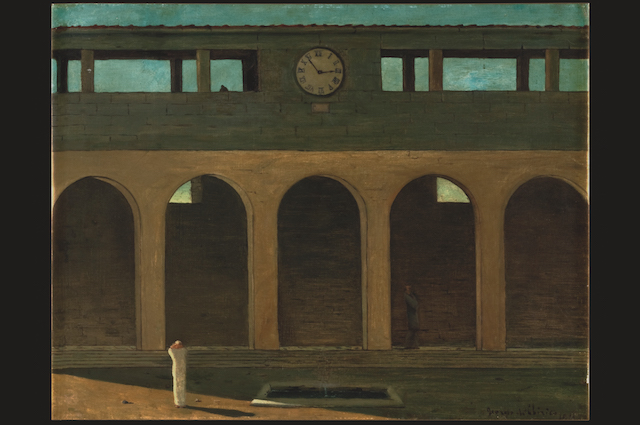
L’enigma

“What is especially needed is great sensitivity: to look upon everything in the world as enigma….To live in the world as in an immense museum of strange things.”

This quote is attributed to Giorgio de Chirico, favorite artist of my poetry mentor & best pal, the late David Dunn. I like the way this idea is phrased (it may be the translator, it may be de Chirico): to live as in a museum; for a museum’s purpose–behind its collection, curation, and presentation–is simply to offer up items for the community to observe.

Paolo Baldacci makes an argument for de Chirico as “the first conceptual artist” that I find intriguing if ultimately unconvincing. There is merit, however, in considering the artist’s “surrealist era” paintings as conceptual in the sense that experiencing the work unsettles the viewer, distorts her sense of the real and requires her to enter the world of the painting with its enigmatic strangeness. And to observe without knowing, exactly, what it is she can see.

Artist Deborah Barlow, on her blog Slow Muse, has some words worth reading on the subject of “not knowing” that visitors to museums and galleries, and those who can view the world as an immense museum of strange things, may recognize. Barlow suggests that there may be an “essential incomprehensibility” in the acts of art-making and path-making as the human being moves from the known to the not-known. The enigma, as de Chirico terms it. The ambiguous and uncertain, the experiment, the unanswered question.

David Dunn often wrote letters to me in which he expressed his occasional discomfort with words, with sentences and language; he wished he could paint or play a musical instrument–felt that jazz might have enabled him to enter the enigma more fearlessly, as his jazz heroes did when they jammed and improvised.

WEB_sized_De_Chirico_-_LEnigma_dell_Ora_1910_HR-p

“L’enigma della Oro” (1910)

We wrote about writing, often. Poetry–and the problem of saying the unsayable. Lately, I feel almost ready to retrieve his letters from the box where I’ve kept them for 20 years. My personal museum, those old letters. My immense museum, this strange, strange world.

A poem that offers entrance into a potentially uncomfortable world–by Luisa Igloria on Dave Bonta’s via negativa site: click here.


Transitions & ambition

letter I
have maintained this blog pretty regularly, for years now, writing about books and poems and gardens and teaching, examining the concept of consciousness and trying to plumb–from a novice’s perspective–the brain’s wiring and functions. I suppose I am seeking a kind of “interdisciplinary” approach in these posts and in life: a philosophy of values that considers the arts, aesthetics, evolution, biology, social structures, neurology, consciousness, physics, etymology, pedagogy, ecology, and compassion (have I forgotten anything?) in a distinct but expansive method of living in which I can situate myself and which might guide my behavior as I make my life-long way through the world. If, by some chance, my words influence a reader–so much the better; this is, after all, a public space (WordPress.com).

Like many people who use social media platforms for their writing, though, I have a mixed view of its suitability as a medium and of its perceived necessity for contemporary writers. My purpose, originally, was to practice writing prose and to promote the arts and the natural environment as necessary complements to and instruction for the development of empathy (compassion) and metacognition in human beings.

The blog has been reasonably suitable for practice; it gets me writing what is basically a brief essay on a more-or-less weekly basis. It has several thousand “followers,” but only a handful of readers. [I can discern this through the statistics page on WordPress, though I don’t check often.] In general, I use this platform mostly as a way of “seeing what I think,” and it serves that purpose, too.

IMG_0127

I have come to some conclusions about the problem of consciousness (and about whether it actually is a problem) through the reading and experiences of the past ten years or so. Those conclusions are, however, private ones. While the process of discovery and inquisitiveness works in a public forum, the takeaway remains, for this blogger, a thing carried within.

But.

~~

But other blogger-writers have influenced my thinking about what a public forum such as blogging or Facebook can do for the writing process. Dave Bonta and Luisa Igloria, as well as Michael Czarnecki and Lou Faber–among others–promote by example the option, and value, of publishing new or unedited, unfinished, partially-revised work. Granted, not all of them have thousands of readers who weigh in on criticism or encouragement; but the very process of making public the work-in-progress seems to me to be courageous. This may be because I am a wimp, or it may be because the social aspects of the vaunted “po-biz” have dampened my willingness to show a kind of transparency in my writing methods.

I am not on the tenure track and will not be teaching in an MFA program, however, so why would it matter?

Therefore: be prepared, oh limited but blesséd audience. I may begin to foist upon you the recent sad, sad poems I’ve been writing–in draft form. Or I may begin to reveal the poems from my seven-years’-unpublished manuscript online. Or I may, like Luisa and Michael, begin to blog “a poem a day” (unlikely, but…). It seems to me that a transition is in order here. And that stands as my writing ambition for the moment, as autumn makes its way toward the solstice and I face another stack of student essays to grade.


Backstory, continued

What brought the idea of backstory to mind was a poem of mine that recently appeared in Peacock Journal’s  print anthology. The poem appeared last year in the journal’s online site. (See: “Imagined Painting of Mary Magdalene Bathing.”)

A friend read the piece and responded to the poem by saying, “This is a beautiful poem. It’s so visual–also, different the second time you read it. And I know how interested you’ve always been in saints and iconography and art, but where did you come up with the idea of imagined paintings? What’s that about?”

This is the best kind of question, as far as I’m concerned. It is a question about ideas, not inspiration or meaning or even craft–though I love questions about craft. It does beg the writer to reveal, however, a bit of the story-behind-the-story/poem/narrative, etc.

“Backstory” may seem self-explanatory. It’s a term used more frequently in drama, particularly screenwriting. Poetry critics are less inclined to employ the concept because–see last post–it is too easy to fall into explaining the poem, which is generally considered a no-no. My friend, however, is a reader and not a poetry critic. I felt free, therefore, to address the question on a personal level.

As my good friend knows, I have been intrigued since adolescence by the art and iconography, the symbolism and the stories of the saints, despite my Protestant upbringing. I love art, aesthetics, and the divinely natural (empirical, phenomenal) World and feel an ambiguous but compelling relationship with myth, religion, history and a culture I cannot escape. And I have imagination.

I began writing about a saints in less-than saintly pursuits. The idea interested me. Surely the saints could be imagined as real human beings, not only as intercessionaries between the human realm and Heaven. I wrote about St. Sebastian purchasing a tunic, Saint Agnes braiding her mother’s hair, and St. Anthony fetching a pail of water. Saints as human beings (rather than as symbols, icons, and religious items) led me to the depictions of saints in art as other-worldly, pure, suffering, or in all ways saintly; and I entertained thoughts of paintings I had never seen but would like to see–theoretically-possible paintings. In the case of St. Mary Magdalene bathing–would Da Vinci have painted it? Rubens? I can only imagine. The poems are a kind of ekphrasis.

I wanted to be a painter when I was a child. This imagining may be as close as I ever get to realizing my youthful ideals.

~

There is not much more backstory than that. None of it leads to meaning or interpretation, although the story above may cement some allusion or confirm referents in the reader’s mind. I hope, however, that the backstory here might interest one or two readers enough that they pick up a book on Renaissance or medieval art, on hagiography or history. Or perhaps someone will go to Amazon.com and purchase the anthology at the link above.

Thank you, friends in literature and imagination.