Lost trees

Image

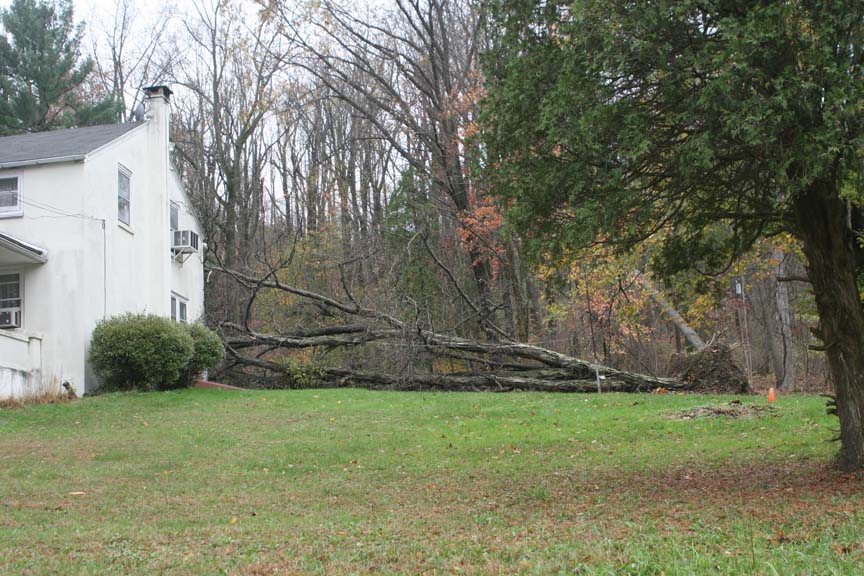
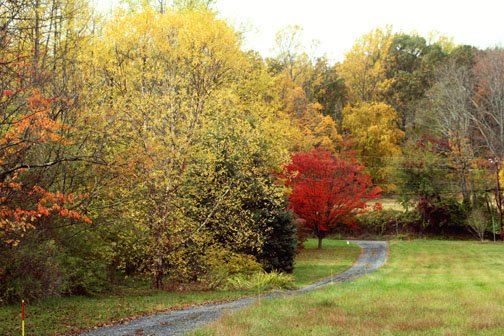
Herewith, some photos of neighboring tree damage. There is an environmental aspect to huge devastating storms…some of my neighbors’ houses have been standing for over 150 years. Some of the trees are 50-90 years old.

Image

Not old by, say, Asian or European standards. But pretty mature and historic for the USA.

Image

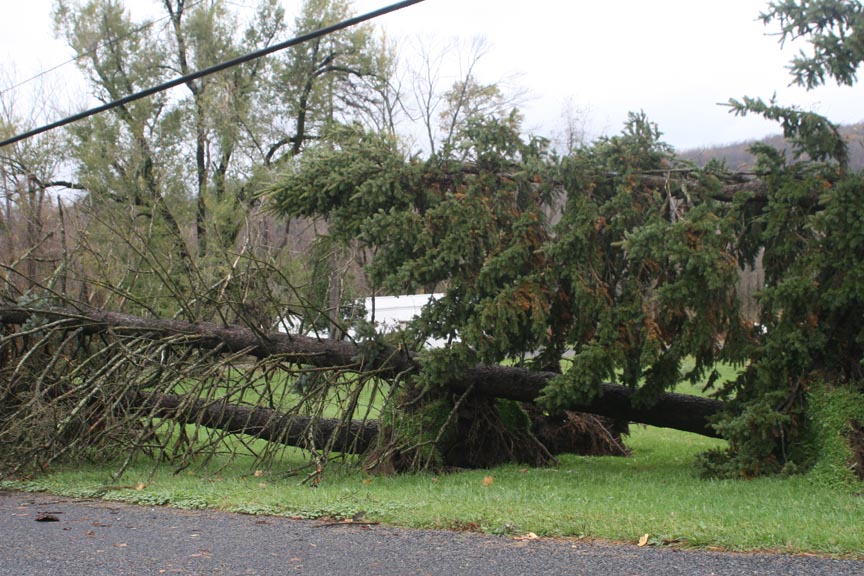
New Jersey and Staten and Long Islands were hit much worse, as they also got sea-water surges and flooding. Here, we mostly had tree-down damages. Wires snapped, pulling out transformers and knocking down utility poles and wires.

It was a different type of storm from the ones we experienced last year at around this time (see my post from 2011).

Things are gradually returning to normal. I wish to thank, whole-heartedly, the men (and a few women) who work on the utility and tree crews and who came from all over the USA to help out. Convoys of utility trucks have been greeted with joy by all of us in the mid-Atlantic states. May we never have to return the favor–may you and your loved ones remain safe, sound, and connected! But if you do need help at any time, I hope we can return the favor.

Hurricane & silences

Having been through some big hurricanes before, I was prepared as possible for the weather that hit along the MidAtlantic states of the USA (and west to Pittsburgh PA, and north to the New England states).

We are somewhat rural, and we do not have city water or sewer; so if the electricity fails, we lose those modern amenities along with lights and computers and a stove. In Europe, and in newer developments in the US, power lines are more often underground. A wise idea, but not in our current infrastructure at my home.

So weather events–as the news media terms them–are significant to us. They alter our relationship with our house, our land, the earth. That is not necessarily a bad thing. Sometimes, it is pleasant to wake at dawn and hear no humming, no sounds of modern appliances at work. We note, instead, the noise of owls or wind or starlings. The rustle of grasses.

We miss hot water the most. That the well pump isn’t working and the water heater’s not heating: that means our standards of cleanliness necessarily fall. We can get used to it, but we miss it. Cooking on charcoal or a camp stove takes longer but isn’t really a problem for us, however. We can sleep in the livingroom by the fireplace if the cold weather sets in before the electricity comes back on to make the furnace fans operate.

We lost power Monday evening, and since then the human-made sounds are those of vehicles, chainsaws, and generators. And a pleasanter noise: my windchimes.

~

When the winds were very high, I sensed the resolute structure of our house, which did not shudder, though the windows made some alarming sounds–a kind of whistle, a bit of rattling, the occasional thump.

~

Days without electricity take me back ten years when my family spent a week on an island off of Nova Scotia. Our host lived off the grid by necessity–no electricity or plumbing on the island even though it had been inhabited since the mid-1800s. Tides, sunrise and sunset were our time-keepers. The natural sounds were restful and healing.

~

So, too, the kinds of silence I experience when a large tree falls on the powerline, though the sense is less restful because of anxieties over family members, job, and the awareness that there are messes and expenses to deal with once we are reconnected to the 21st century. For a day or two, however, I feel my breath returning to a more animal pace and fullness. I watch things more closely. The line of water droplets beading irregularly under the porch handrail, the grass tassels’ subtle color variations as they move in a breeze, a toad’s progress across the patio slate, a few brilliantly yellow trees that kept their foliage despite the gale.

~

Weather like this is refreshing, my sister says, even if frightening, because people need to be reminded that technology cannot control everything. The hurricane interrupted cell phone use, communication systems, transport networks, traffic, electrical grids. We ended up wet and cold and we needed to take shelter with friends and to share supplies and stories, to wait awhile before we hurry on our way.

~

So here’s irony, that I am using technology to enter these words into a system that keeps them in an electronically-maintained, digitized data ‘cloud’ so people in the Netherlands or Norway, Seattle or Colorado, India or Britain can retrieve and read them…even though my theme is the joy of low-tech lifestyle (for awhile, at least). My power at home is still out, so I am posting these thoughts from a borrowed computer an hour from home; but I composed these thoughts at home, on paper, with a pen, by kerosene lamp. And I will be going back to that quiet, chilly environment later this evening to feed our pets and continue waiting for the valiant and hardworking utility crews to get to our backwater…

~

My reading material during this ‘weather event’ has been The Ecology of Wisdom by Arne Naess, an excellent philosophical companion for study by lamplight. I was struck by his essay “The Place of Joy in a World of Fact” which is so life-affirming. Not playful–Naess is serious about joy–but sensible. Environmentalists need to get out and find joy in the environment, he says, not just focus on the joyless losses. He urges all of us to give up the “cult of dissatisfaction” and promote good causes by example.

“One may say, somewhat loosely, that what we now lack in our technological age is repose in oneself. The conditions of modern life prevent the full development of the self-respect and self-esteem required to reach a stable, high degree of acquiescentia in se ipso [self-acceptance].”

~

What I feel when the power goes off is repose in myself. While it may not reside within me for long, the fact of its appearance–its existence–is gratifying, joyful, powerful. I do not require the fridge, the computer, the lights. I am an animal alive in an animate, changing, living world.

It’s good to be reminded, now and then.
Place

A family member has recently complained that she wants to move from her apartment because her feelings for the place have changed. It’s been on her mind so much that she seems obsessive about this urge to find a more suitable home, somewhere she feels she can “fit in.” My response, initially, was compassion; then, I began to feel irritated (other people’s obsessions often seem irritating). I’ve been reading essays by the Norwegian philosopher Arne Naess for the past few days, however, and his work has tempered my irritable response. Place matters.

Naess was an originator of the “deep ecology” movement, a follower of Gandhi’s non-violence philosophy, a mountaineer; his influences include Taoism and Spinoza. Deep ecology, as a movement, is fairly controversial and has been subject to some pointed criticism–but as a philosophical practice, its inquiry and premises have been valuable to subsequent thinking and critical problem solving as applied to the earth and its environmental limitations.

What appeals to me about Naess, though, is the personal aspect of his “ecosophy,” a term he coined to refer to earth-wisdom, to place-wisdom. He called his own place-wisdom Ecosophy T: the “T” stands for Tvergastein, a mountain he loved and sometimes chose to live on. Living above the timberline for weeks at a time, Naess observed tiny flowers, diverse lichen forms, changeable and severe weather systems, mice, foxes, herds of reindeer bedding down in front of his hut. He contemplated life’s interconnectedness, the concept of peace in all aspects of earth-dwelling, compassion for all sentient beings, respect for earth-forms from rock to plant to insect…


(saxifrage photo–http://torirotsstitches.blogspot.com)

As Buddhist studies say: “When one has great loving-kindness towards all sentient beings, there are limitless beneficial effects.” Naess seems to have believed this whole-heartedly. He loved the mountain, he loved the miniature saxifrages, he loved the view of the valleys and the lake. These things enlightened him about the inherent earth-wisdom of the place itself. All of his thinking seems to spring from the mountain’s earthy source, its seasons. A mountain seems unchanging to most of us, but Naess appreciated its transformations. Such acceptance can lead to an abiding sense of peace and peacefulness, and certainly to a comfortable feeling of belonging to place.

I understand that urge to belong to place. It’s one reason I have stayed in one region for so long: I do not live in an area of breathtaking natural beauty or harsh extremes, as Naess chose to do, but I respond to my surroundings deeply here in the valley. The temperate climate with its four distinct seasons, the plants I recognize, the familiar birds and mammals, insects and toads, salamanders, the gravel and the different soils, the creeks and meadows, the agricultural fields and–yes–the suburban sprawl and nearby highways all make up the place where I exist. It’s comfortable, and it is comforting, and it is always surprising in small ways as I push my observations and attempt to deepen my understanding of and connection with the place I call home.

There have been times I’ve had to leave places that felt like home, and there’ve been times I’ve felt uncomfortable in the place I dwelt. And I needed to move on when that discomfort became too nagging, to irritable to ignore.

So I’m back to my place of compassion again.

Here’s “Urge for Going.”

http://www.youtube.com/watch?v=Z3EofN3Flag

Not a dry spell

October arrived in a remarkably ordinary way, considering how inconsistent the weather in my valley has been during the past year. There were a few clear days of brilliant sky, some heavy breezes with leaves beginning to drift into the lawn, a couple of glorious autumn days–mild and crisp–followed by a spate of rain and humid air (and toadstools and mushrooms cropping up everywhere), a further yellowing and reddening of foliage, and then, chilly rain.

This is “normal” weather for our area in early- to mid-October. Although the heavy skies and damp chill are not always welcomed by residents, including me, the gardener in me feels relieved. We need the rain and the coming dormancy. The birds relish the late, large insects that frequent gutters and fields, ponds and puddles, providing proteins for a trip south or for winter ahead. Seeds need the watering-in and the cooling-down. Trees need reminders to store their nutrients deep inside when the cold air really sets in.

And pretty soon, I will have bulbs to plant. I want the soil to be moist enough to dig up and the ground temperature cool enough to keep the daffodils still and quiet for several months.

Some years, I write prolifically in autumn; it’s as though the change in season effects a kind of transition within me, and creativity abounds. Other years, not so much. I do notice that when I spend a good deal of time out in the garden, I write more. This fall has not been that kind of season. I have been busy with writing tasks that do not exercise the philosophical or metaphysical side of myself–though I have been writing, most of the work has been reviews, proposals, pedagogy.  I will be posting links to the reviews and essays on the sidebar to the right, adding to the list…

Should fortune–and the Muse–smile upon me, there may be a few new links to poems, as well, in the coming weeks. In November, I’ll be giving a few readings locally. In January, I’ll be teaching Introduction to Poetry again, and I’m eager to try new texts for my students.

Perhaps the post-equinox period will have a creative harvest after all.

A great din

My friend Ann sent me this link to an NPR story on cities (Adam Frank on “The City as Engine”).

Frank closes on a note similar to Mumford’s closing chapter: “We live at a moment when cities are poised to become the dominant mode of human habitation on the planet. But we don’t yet know if such a mode can be made sustainable for more than a century or two.”

An earlier observation of his got my attention, however. He says–

There is a word that applies to the sound of cities which almost never gets applied to nature: “Din.” The din of cities heard on the rooftop as a rising wall of noise is a testament to the true nature of cities as engines of organization and dynamos of disorder.

The first time I became aware of this din of acoustic entropy, I was sitting across from Manhattan on the cliffs of Weehawken, N.J. It was night and the great city was blazing from horizon to horizon. Its low rumble of noise flowed like a breeze blown at me from a mile away across the dark river.

The reason this stopped me is that just a fortnight ago, I heard the word “din” applied to nature.

One of my nephews had just arrived for a visit. He’s been living at Oxford, attending school for several years at that ancient and venerable British institution; and he grew up in England outside of London in the suburbs (Buckinghamshire). My husband retrieved Max at the airport in the evening, and they arrived at our place past dark. We live in a semi-rural area of eastern Pennsylvania where we are surrounded by fields, meadows, woodlots, state roads, and the inevitable housing development. And it is August, a lively time for insect life.

As we unloaded my nephew’s luggage from the car and walked him toward the door, he stopped and looked about curiously. “What is that great din?” he asked, “Is it birds, this time of night?”

Din?

He was referring to the cicadas and tree crickets (and probably a few tree frogs and the occasional flying squirrel). I suppose they do make quite a racket, though we are accustomed to the noise–the ‘dynamos of disorder,’ as Frank would say. When we explained, he remarked, “Oxford is quiet. But I do realize it is its own peculiar world.”

Nice to know there are pockets of organization somewhere: no acoustic entropy at Oxford.

Nonetheless, I treasure our noisy regional denizens and prefer their din to the roar of motorcycles, trucks, and  cars that speed past on the state road, although those noises have their own associations and dynamics and perhaps charm…the way I still find the sound of trains appealing because it reminds me of my childhood summers at my grandparents, I can imagine there are people who associate the rumble of vehicles and the great acoustic roar of cities with pleasant things.

Here is a photo of a cicada. A colleague says they are “the ugliest bugs in the world.” This one doesn’t look so awful to me.

Din, discord, or music. Ugly or appealing. To each his or her own.


Here’s a link to the tree cricket–one of several American varieties:

black horned tree cricket

Confident but not certain: the garden

Recently, I listened to a radio interview with Madeleine Albright, former Secretary of State, who is promoting her latest book. The interviewer asked her what quality she thought most crucial to a good leader. Albright has met many, many leaders; she is also a brilliant person. It was a good question to ask her, and she had an excellent and thought-provoking answer: A good leader should be confident, but not certain. (If you download the mp3 file in the link above, her explanation of this idea comes near the end of the program.) Powerful people who are both confident and certain of themselves, their aims, knowledge, and ideas, are too likely to veer into autocratic dictatorship. Those who are neither certain nor confident are too easily swayed by advisors with their own agendas or are unable to make decisive moves. A person who is open-minded–and therefore not certain–but who is confident in his or her ability to make a good decision once the facts are in, leads wisely and well even when mistakes occur due to faulty information or circumstances beyond anyone’s control.

We could all benefit from becoming more confident and less certain. It strikes me that Socrates might have possessed this pair of qualities. The philosopher continues to question and is therefore not certain; but the uncertainty isn’t of the waffling, inconclusive kind. Uncertainty in Albright’s use of the word means curious, inquisitive, searching. The confident person trusts his or her values (confidence, from fidere, “to trust”) but does not let dogma or single-perspective “certainties” obscure research, facts, other perspectives.

I will grant that this approach is difficult for us humans, and that is why so few leaders possess this pair of traits. While I have no interest in becoming a world leader, I plan to keep Albright’s phrase in mind and discover whether I can become more confident and less certain in my life.

This bust resides in the Louvre, and the image was found here: http://www.humanjourney.us/greece3.html

~
Gardening is one area that relates well to confidence and uncertainty, though in a slightly different form of practice. I’ve been a gardener for over 30 years, and one thing you learn when you garden is that there are no certainties. Planning takes mental and physical effort and preparation, and then there are the endless obstacles involved in planting and overcoming soil deficiencies, insects, fungi, and weather inconsistencies just to name a few. Am I a confident gardener? Yes. Years of research, experiment, study, practice, trial and error–and successes–have made me confident. But there are always new hybrids to try, new species to plant, and there are problems that never seem to go away (why can’t I get carrots to grow here, when I have grown carrots every other place I’ve lived? How to keep certain fungi at bay using organic means?).

And one never has any sort of surety or pledge (the etymology of “certainty”) that those tomatoes will ripen without blossom end rot or fusarium wilt, that the pigweed will not take over during the gardener’s five-day vacation (well, that’s almost a certainty!), or that hail will not wreck the whole summer’s worth of plantings.

Ann E. Michael

June, 2009–after the hailstorm

This year, my vegetable garden is producing well despite overbearing heat, hard brief rains, and far too many weeds. I feel annoyed with its overgrown appearance, but one thing about gardens is you get another chance as long as you can wait a couple of seasons.

Meanwhile, with a little more thought and research, I’m confident I can plan an even better garden next year.

Berries

My region, like many others, has been sweltering through a heat wave lately. The mild winter pushed bloom times and fruiting times a bit earlier than usual; blackberries started ripening ten days ago, and now we have blueberries before July.

But not much before July. In celebration of blueberries and other joys of summertime, here’s a poem from my collection Small Things Rise & Go.

The Blue of July

We pick the first blueberries
while lilies gape at us,
peering over their green fans.
Birds’ tirades scatter over wind
and into our ears,
buffeting us with scold and caw and
something not melody but song:

a song of fruit, of seeds and
mealybugs and inchworms,
the wild clack of bamboo
or maple branches.

Summer’s like a mulberry,
a blueberry, dark and vivid.
It stains the day sweaty,
leaves bright pollen on our noses
as we inhale the sun

on lilies, as white clover gathers
like clouds upon the grass
and, sweet in our mouths,
the day explodes—blue.

~

A note to anyone who has ordered or wishes to order Water-Rites: The order has gone to the printer. Possibly 2-3 weeks before my book is in your hands. Many thanks.

Control

middle island ~

Human beings crave control. We want to be the masters of our own fate or to believe that there is a master of our fates who can be entreated or persuaded, propitiated or cajoled into helping us to gain control of our lives or the lives of others. We want to change the weather so that the rain falls when the soil needs rain, wetting the seeds we’ve sown, and so that the warmth comes when our plants need warmth. We want the sea to be calm and the fog to lift when we are ready to set sail. We want fine, sunny days when we visit the beach to swim or head out for a picnic. We want just enough snow so that school’s canceled, but not so much that our power goes out. We pray. We dance. We chant. We invent little private rituals and participate in community rituals.

We want to control our health. It does not seem to be an unreasonable aim. We want to control our relationships–just enough to keep ourselves happy. We want control over our careers and  our income–not so much to ask. We want to be able to make our own decisions. We want choices so that we feel we have control over our lives.

My gardens are my analogy today. I’m still endeavoring to exert some control over my vegetable garden, but I kept my purposes modest this year; I planted fewer beans, fewer tomatoes, fewer peppers, fewer potatoes, no onions, no peas, no edamame, no radishes…the walk-through rows are wider so it is easier to weed. Beginning with the dry warm winter and some assemblies of challenges that do not pertain to the garden, the season looked “iffy.” Then came lashings of showers in May. A challenging season, but not insurmountable. I have been gardening a long time, and I have methods of adapting to things I cannot control. It comes with the territory.

The ornamental beds have presented the most difficult struggle with my need to control the space I (somewhat ridiculously) consider my own. When the beds get overgrown–as they are now–I know that I can accept their exuberant rioting with the successful weeds. I can say, “This is what nature intends. There is beauty here.”

overgrown

I do know that. But the controlling mind–the monkey mind–says, “Too much penstemon; it’s gotten aggressive. Deadhead the peonies. Pull up the plantian, the wild asters, fleabane, wild garlic, crabgrass, bermuda grass, creeping charlie, five-leaf vine. Get the seedlings out of there (mulberry, redbud, oak). Mulch. Keep the rabbits off the hostas. Move the marybells. Get the weeds out of the alchemilla…”

My head clouds with fog. The seas get rough and I despair, because I cannot control things. Not even a small garden.

Instead, I could be meditating on green. On the amazing variety of leaf-shapes, on dappledness (like G. M. Hopkins):

Pied Beauty

Glory be to God for dappled things—
For skies of couple-colour as a brinded cow;
For rose-moles all in stipple upon trout that swim;
Fresh-firecoal chestnut-falls; finches’ wings;
Landscape plotted and pieced—fold, fallow, and plough;
And áll trades, their gear and tackle and trim.

All things counter, original, spáre, strange;
Whatever is fickle, frecklèd (who knows how?)
With swíft, slów; sweet, sóur; adázzle, dím;
He fathers-forth whose beauty is pást change:

Práise hím.

~

Here is one aspect of my ornamental garden. Overgrown, yes. Lush, diverse, lovely in its unrefined way. Until I have the wherewithal to tear through and divide and move and mulch, this is not a bad view, the definition of … lack of restraint, ornamentals gone wild. Freedom, I suppose.

A little too much of some good things.

As we grow, we learn to let go. So I am told. Garden, you have a chance to go wild!

And I guess I have the opportunity to learn to live with that.

Ephemera

My collection Water-Rites was begun in response to a drought and a death. Interesting that the book’s release appears during an unusually wet spring here in my valley. On my morning walk through the meadow today, I saw quite a few species of dragonflies, generally a sign of a damp period in my region. Two days ago, mantis cases hatched; now there are tiny praying mantises on the patio slates, in the lawn, and among the grassy flora where we seldom mow.

The bees are out; the cabbage moths and early butterflies busy themselves with knapweed, eupatoria, penstemon, golden alexanders, honeysuckle, milkweed. The fragrance settles above the dewy grasses.

Most people are aware of honeysuckle’s scent. Few people know how lovely the aroma of milkweed blossom is. You have to time it just right–there’s no perceptible scent when the buds are furled, and the blooms are open only briefly. Almost at once, the blossoms ripen into pale knobs that will produce the familiar pods full of seeds packed cone-like into the pointed cases, silks battened tightly until autumn dries the pods and they burst.

But in early or mid-June, when the butterflies begin to arrive, those blooms are pale purple clusters of fragrance on a stem.

milkweed bloom

~

Ephemera intrigues me. Human ephemera usually is just that: brief, transitory, “lasting a day” (the Latin name for daylily, hemerocallis, comes from the same root: ἐφήμερα). Our letters, our emails, our YouTube videos and Hallmark greeting cards and shopping receipts.

Biological ephemera, however, is part and parcel of the cycle of life.

And poetry? Perhaps it’s an effort on the part of human beings to contribute to the lasting sort of ephemera.


~


milkweed in autumn Ann E. Michael


22 years ago this week

Here’s another post from some time back, one I have updated to reflect current experiences: the graduation and the 22nd birthday of the subject of this brief reflection.

azaleas by Ann E. Michael

The morning was hot, and I had not kept up with the gardening. I needed to get the zucchini seeds, etc. in the ground before the weather got too hot and dry. We were a little behind schedule with the garden because we had a 17-month-old, and I was 9 months pregnant. I was sowing and weeding as women have done since the earliest establishment of agriculture, heavy with child, my back aching, working like a woman obsessed.

You know, that “nesting” thing you hear about with mothers-to-be? I was a week overdue and sick of waiting around; and  gardens won’t wait. The weather was perfect for planting the post-frost seeds. The time was–of course–ripe. Eight hours later, I gave birth to a daughter.

A couple of years later, too busy to write much, this set of cinquain stanzas arrived in my mind (published in 2001 in June Cotner’s anthology Mothers & Daughters, A Poetry Celebration).

Now, that infant is a grown woman with a  college degree. Happy Birthday, Daughter.

To My Daughter

Early
morning I had
planted seeds, cucumber,
melon, squash—I pressed them into
warm earth.

The blood
in my body
sang and I listened for
a cry to join my own—straining
to hear.

And there
you were, all pink,
unfolding in our hands,
a blossom opening with a squall:
daughter.

© 1994 Ann E. Michael