Control

middle island ~

Human beings crave control. We want to be the masters of our own fate or to believe that there is a master of our fates who can be entreated or persuaded, propitiated or cajoled into helping us to gain control of our lives or the lives of others. We want to change the weather so that the rain falls when the soil needs rain, wetting the seeds we’ve sown, and so that the warmth comes when our plants need warmth. We want the sea to be calm and the fog to lift when we are ready to set sail. We want fine, sunny days when we visit the beach to swim or head out for a picnic. We want just enough snow so that school’s canceled, but not so much that our power goes out. We pray. We dance. We chant. We invent little private rituals and participate in community rituals.

We want to control our health. It does not seem to be an unreasonable aim. We want to control our relationships–just enough to keep ourselves happy. We want control over our careers and  our income–not so much to ask. We want to be able to make our own decisions. We want choices so that we feel we have control over our lives.

My gardens are my analogy today. I’m still endeavoring to exert some control over my vegetable garden, but I kept my purposes modest this year; I planted fewer beans, fewer tomatoes, fewer peppers, fewer potatoes, no onions, no peas, no edamame, no radishes…the walk-through rows are wider so it is easier to weed. Beginning with the dry warm winter and some assemblies of challenges that do not pertain to the garden, the season looked “iffy.” Then came lashings of showers in May. A challenging season, but not insurmountable. I have been gardening a long time, and I have methods of adapting to things I cannot control. It comes with the territory.

The ornamental beds have presented the most difficult struggle with my need to control the space I (somewhat ridiculously) consider my own. When the beds get overgrown–as they are now–I know that I can accept their exuberant rioting with the successful weeds. I can say, “This is what nature intends. There is beauty here.”

overgrown

I do know that. But the controlling mind–the monkey mind–says, “Too much penstemon; it’s gotten aggressive. Deadhead the peonies. Pull up the plantian, the wild asters, fleabane, wild garlic, crabgrass, bermuda grass, creeping charlie, five-leaf vine. Get the seedlings out of there (mulberry, redbud, oak). Mulch. Keep the rabbits off the hostas. Move the marybells. Get the weeds out of the alchemilla…”

My head clouds with fog. The seas get rough and I despair, because I cannot control things. Not even a small garden.

Instead, I could be meditating on green. On the amazing variety of leaf-shapes, on dappledness (like G. M. Hopkins):

Pied Beauty

Glory be to God for dappled things—
For skies of couple-colour as a brinded cow;
For rose-moles all in stipple upon trout that swim;
Fresh-firecoal chestnut-falls; finches’ wings;
Landscape plotted and pieced—fold, fallow, and plough;
And áll trades, their gear and tackle and trim.

All things counter, original, spáre, strange;
Whatever is fickle, frecklèd (who knows how?)
With swíft, slów; sweet, sóur; adázzle, dím;
He fathers-forth whose beauty is pást change:

Práise hím.

~

Here is one aspect of my ornamental garden. Overgrown, yes. Lush, diverse, lovely in its unrefined way. Until I have the wherewithal to tear through and divide and move and mulch, this is not a bad view, the definition of … lack of restraint, ornamentals gone wild. Freedom, I suppose.

A little too much of some good things.

As we grow, we learn to let go. So I am told. Garden, you have a chance to go wild!

And I guess I have the opportunity to learn to live with that.

Ephemera

My collection Water-Rites was begun in response to a drought and a death. Interesting that the book’s release appears during an unusually wet spring here in my valley. On my morning walk through the meadow today, I saw quite a few species of dragonflies, generally a sign of a damp period in my region. Two days ago, mantis cases hatched; now there are tiny praying mantises on the patio slates, in the lawn, and among the grassy flora where we seldom mow.

The bees are out; the cabbage moths and early butterflies busy themselves with knapweed, eupatoria, penstemon, golden alexanders, honeysuckle, milkweed. The fragrance settles above the dewy grasses.

Most people are aware of honeysuckle’s scent. Few people know how lovely the aroma of milkweed blossom is. You have to time it just right–there’s no perceptible scent when the buds are furled, and the blooms are open only briefly. Almost at once, the blossoms ripen into pale knobs that will produce the familiar pods full of seeds packed cone-like into the pointed cases, silks battened tightly until autumn dries the pods and they burst.

But in early or mid-June, when the butterflies begin to arrive, those blooms are pale purple clusters of fragrance on a stem.

milkweed bloom

~

Ephemera intrigues me. Human ephemera usually is just that: brief, transitory, “lasting a day” (the Latin name for daylily, hemerocallis, comes from the same root: ἐφήμερα). Our letters, our emails, our YouTube videos and Hallmark greeting cards and shopping receipts.

Biological ephemera, however, is part and parcel of the cycle of life.

And poetry? Perhaps it’s an effort on the part of human beings to contribute to the lasting sort of ephemera.


~


milkweed in autumn Ann E. Michael


22 years ago this week

Here’s another post from some time back, one I have updated to reflect current experiences: the graduation and the 22nd birthday of the subject of this brief reflection.

azaleas by Ann E. Michael

The morning was hot, and I had not kept up with the gardening. I needed to get the zucchini seeds, etc. in the ground before the weather got too hot and dry. We were a little behind schedule with the garden because we had a 17-month-old, and I was 9 months pregnant. I was sowing and weeding as women have done since the earliest establishment of agriculture, heavy with child, my back aching, working like a woman obsessed.

You know, that “nesting” thing you hear about with mothers-to-be? I was a week overdue and sick of waiting around; and  gardens won’t wait. The weather was perfect for planting the post-frost seeds. The time was–of course–ripe. Eight hours later, I gave birth to a daughter.

A couple of years later, too busy to write much, this set of cinquain stanzas arrived in my mind (published in 2001 in June Cotner’s anthology Mothers & Daughters, A Poetry Celebration).

Now, that infant is a grown woman with a  college degree. Happy Birthday, Daughter.

To My Daughter

Early
morning I had
planted seeds, cucumber,
melon, squash—I pressed them into
warm earth.

The blood
in my body
sang and I listened for
a cry to join my own—straining
to hear.

And there
you were, all pink,
unfolding in our hands,
a blossom opening with a squall:
daughter.

© 1994 Ann E. Michael

A William Carlos Williams moment in Emmaus

As the spring semester closes, I am trying to get to some housekeeping of several sorts–literal and metaphorical housekeeping. Yard work, filing, dusting, going through poems and essays and books I meant to comment upon…revisions, half-finished proposals and papers, and folders on my computer that are obscurely titled and mysteriously organized.

One thing I thought I’d do when I have a few minutes at the computer is to upload some past notes from a site I no longer use. Most of them are not worth saving, but there are a few I still like. Here’s one dated Saturday, April 18, 2009:

~

Working in the yard and garden this morning. The peas are sprouting, the asparagus are poking up. Here’s the anecdote of the day for those of you who appreciate a little poetry allusion.

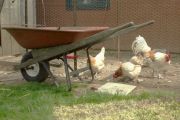
My husband, preparing to move some topsoil, yells to me, “Where’s the red wheelbarrow?”

And I was able to reply, because it was literally true: “Glazed with rain water, beside the white chickens!”

white chickens

[A photo from later in the day–the rainwater glaze had evaporated.]

Interview

“Who has not sat, afraid, before his heart’s
curtain?  It rose:           the scenery of farewell.
Easy to recognize. The well-known garden…”
–Rainer Maria Rilke
~

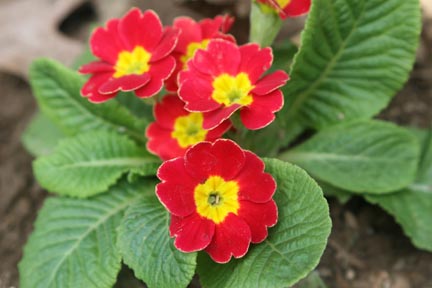
primrose by Ann E. Michael

Herewith, a recap of my side (much edited) of the ArtsAlive! conversation this past Sunday at Soft Machine Gallery. SØrina Higgins was also reading and being interviewed by Lehigh Valley Arts Council director Randall Forte, but I can’t adequately summarize her insightful comments. You can find her book here, however.

~

RF: What is your favorite poem in the collection Water-Rites?

AM: I hate to try to pin down a favorite poem, by my favorite writers or by myself. I once heard Billy Collins reply to that question by saying his favorite poem is always the one he is currently in the process of writing. That’s kind of cleverly evasive, but it’s also a little true. Though sometimes I hate the poem I’m currently working on…

I like the title poem, but I get a kick out of “Doxology” because it is so odd; and perhaps my favorite poem is “Tailfeathers” or “The Big Umbrella” or, for purely sentimental reasons—not because it is my best poem—“At Bull’s Head Pond.”

~
RF: What was the most difficult poem to write?

AM: The most difficult poem to complete was probably the long poem in the center of the collection, “The Valley, the Whitetail: A History.” That was difficult in terms of managing the length and the purpose of the poem; also, it required some research. Yes, occasionally poems take quite a bit of research—I have no desire to be inaccurate when I am writing about history or geology or botany (though I often am, inadvertently, despite my best efforts). Not all poetry is solely a work of the imagination.

There are other ways to be “difficult” however. A poem that was hard to complete was the elegy “I Shall Never Be Nearer,” which came quickly initially but took a long, long time to revise and to come to terms with. Not all of these poems—or any of the poems I write—are “about” me or my experiences, I mean, not as biographical as they may seem. But this poem does deal very specifically with the death of my close friend. It was the day after I learned of his passing, and, completely numbed and sleepless, I went with my family for a canoe trip on the lake. I titled this poem “Single Lines” for several years while I was revising it, because the images came to me in – well – single lines. Single images. I must have revised little tiny things in it oh, about 14 times. So I guess that means it was “hard to write.”

~

RF: So, the opposite question. Which poem was easiest to write?

AM: Some poems do come quickly and relatively easily. Not often, and sometimes those that come rapidly end up being sort of crappy poems. But “Lot’s Wife” only underwent about 2-3 drafts and mainly arrived, haiku-like, as a visual image that carried with it some cultural freight.

Another poem that arrived rather miraculously is “River by River.” That was the result of a car trip to Indiana with my kids and is kind of a list poem. It spooled out as a result of a kind of inadvertent prompt. Will Greenway and Elton Glaser were looking for poems about Ohio for an anthology. I read the call for work, went back to my notebook about the car trip, and recalled an incident with my son and a roadmap. The editors chose it as the opening poem in the main text of the book—immediately following the preface poem by James Wright. I felt completely graced and humbled.

~

RF: How did you choose the title of the collection?

AM: Early on, while I was working on my graduate thesis project, I chose the title for the book. I’d written the title poem but hadn’t really thought of it as the title poem until I recognized how many of the poems dealt with drought or with bodies of water or rain or artworks that portrayed water. And spelling the second word as “rites” as in ritual, rather than as an other interesting aspect of water—the “rights” to water that have caused so much conflict over the centuries—seemed fitting given that there are also rites associated with death. Funerary rites, religious rites. And rites in the form of chants and dances people have done to invoke rain during times of drought. So there’s a pun there, rights and rites, and I love literary puns.

I wanted to use Steve Tobin’s sculpture as the cover art, and Steve granted the rights for that photo (more rights, legal rights) and Keith at Brick Road approved of the image for the book cover. So I am gratified by all of that. The sculpture is an early work of Tobin’s, when he was making art using surgical glass piping. It’s environmental, site-specific art that really looks like a splashing creek. But it isn’t—it is glass.

~

RF: Tell us about your publishing history and about how and if poetry publishing has changed over the years.

AM: I had my first poem published in a tiny literary journal back in the days of Xerox-ed micro-magazines, 1981 or 82. I’ve been publishing pretty regularly since then, regularly but not ambitiously. Lots of individual poems and essays in individual journals. I had no academic reason to get a book out, and I had no real direction either. It didn’t seem to be on my to-do list when I was in my twenties. Then, at 30, I had my children. Most of my creativity went in the parenting direction, though I continued to write. I didn’t really work toward book publication until about 1999. Then I began to think about it—after David Dunn had died. In fact, I got a chapbook and a full-length collection of his work out after his death. This is hard to do—to convince a publisher to put out a book posthumously. After all, the poet cannot promote his work. That’s hard on small publishers. But I succeeded. So I thought, I guess I can get my own books published. Maybe. And my first collection was a chapbook Spire press published right after I graduated from Goddard, 22 poems about building a house, sort of ecologically-invested nature-type poems.

Things have changed in the world of poetry publishing, but it is still hard to get your work into actual print—ebooks and POD self- or partially-self-published options, as well as the web and blogs, have changed the spirit of the poetry world only marginally, though I do think these options have made it possible for more people to read and encounter poetry. The absence of critical, discerning, well-read editors & proofreaders is a loss, in my opinion; but poetry is finding other ways to deal with that. And those editors are still out there. Underpaid and overworked and cranky, but out there nonetheless. MFA programs, perhaps. Critique groups have maybe replaced salons and absinthe cafes. I don’t know.

~

RF: Any advice for aspiring poets who want to get published?

AM: I’d advise aspiring poets to be ambitious. But there are many ways to be ambitious. I’m a bit of a plodder, but I hang in there. I’m not great at networking or schmoozing or even being sort of normally assertive—I’m quite shy with strangers and hate to ask even small favors…like asking an editor to consider publishing my work. Or asking people to host readings. I mean, that goes with the job, but it’s taken me a long time to get good at doing that. I hate that stuff lots more than I hate being rejected. I don’t take the rejections hard at all. My weaknesses lie in other areas. So I can say, if you want to get published, you might not want to do what I did…anyway, if you are eager to see print soon, you might want to be more assertive and organized. On the other hand, I have been self-promoting rather badly for thirty years; and I’m okay with that because the poems are better after thirty years even if my publicity skills are not.

I’m kind of outside the box as far as the “po-biz” goes. I do my job at the college, which is only marginally poetry-related, and then only when I am teaching a section of intro-to-poetry. (Mostly I teach remedial comp and tutor students in English; I like to remind myself that Kay Ryan has the same kind of job!). I attend conferences when I can get away and when I can afford them; I have taken seminars and workshops over the years, but not religiously or frequently. The “big thing” I did for my so-called career was to get an MFA from Goddard College in 2003. This was after I had won a PA Council on the Arts Fellowship—back when the council was giving those out. Please lobby your congress people for an increase in federal and state arts funding. That was so crucial for me, earning that grant. A great confidence-builder.

Since then, I’ve earned my MFA and have four chapbooks and this full-length collection coming out and a job in academia that I probably wouldn’t have if it hadn’t been for my graduate studies and a certain amount of dogged persistence of a sort of quiet variety that I seem to possess in abundance. I still send out individual poems for publication in print and online, though not as often as I should if I were really eager to stay on the po-biz radar. I keep up a blog and a Facebook page for “promotional purposes” but don’t expect to see me on your Twitterfeed anytime soon. Technology takes me away from my reverie zone and is, generally, bad for my poetry. What’s good for my poetry are long walks, gardening, and genial loafing, visits to museums, viewing architecture and geological formations, long face-to-face chats with friends, and reading reading reading.

The quote that opens my book, the Rilke quote, kind of sums that up for me. It’s really the well-known garden that makes me recognize where the poems are coming from. The scenery of farewell, in this case, opened up the place this collection began, in loss and later in fullness.
Water thoughts

This weekend brought some rain to our valley. Gratitude! The rain softened the soil and the air, bringing haze and drizzle and greening up the parched grasses. Nonetheless, a little searching of weather-history sites revealed that this March was the fourth-driest on record, with only .92 inches of precipitation; the average precipitation is 3.4 inches. The region is also 6″ below average for the first quarter of 2012. As a gardener, I take my “stewardship” of the earth and its resources seriously; and water is one of the most valuable resources that we take for granted here in the United States. I can conserve water at home through many means–and I have established fairly resilient plants in my ornamental gardens (if it survives drought and flood and the deer don’t eat it, I find a way to make it look pretty in the yard). There isn’t anything I can do to change the weather patterns, though.

Given my deep concerns about cyclical drought, long-term equitable distribution of water, potable water and clean waterways, I thought I would use this post to share the title poem of my upcoming collection, Water-Rites. The publishers at Brick Road Poetry Press will be bringing the book out this spring. If the year continues to be a dry one, then it’s strangely suitable for this particular collection: I wrote many of these poems during a serious drought cycle. Some of the poems deal with the loss of a close friend, too. For me, drought and grief are metaphorically closer than “floods of tears.” Loss felt more like the numb, dry absence of drought than like the gift of rain.

For some soothing photos of running natural waters, I recommend Don Schroder’s series taken at Rickett’s Glen. Meanwhile, I’m grateful for the rain.

Water-Rites

I.

I take my shower
lean into water’s hot stream
too many minutes
lathered in steam, guilty skin,
greedy pores

knowing the well empties
and the earth’s in drought.
II.

Off Nova Scotia’s south coast,
small islands spring fresh water
surrounded by sea. We hauled
the pine-brown but potable
stuff from the well in buckets,
heated it on the woodstove,
dabbed at our bodies, and dried
in the sea wind. We drank it:
pine-water coffee—water
sprung from nowhere, gift of rocks,
glaciers, lost to eons.
III.

The Mideast erupts again.
Retribution. Religion. Water-rights.

Oil will get you water;
water will buy you oil.
Barrels and tanks,
tanks and barrels—

each has a meaning
for water and warfare.

I reach for soap.
IV.

On the Caribbean volcanic island,
rain’s the only source. Rock
carved into cisterns. Water
hauled in like gasoline, by truck.
V.

We do not need to be so clean.
The industry of soap cajoles us—
promoting glycerin, methyl paraben
and the lauryl sulfates—
exposes our filth and offers
deliverance from evil.
Lye and tallow. Better to wallow.
The cost is less. Think:
Were we not formed of clay?
VI.

Tap
like sap
provides
sustenance.

Water
up root and
down:
taproot.
Soil            unsoiled
needs rain

silt       sand       loess—
water-loss

water’s
lost,
VII.

runs down my body,
thirsty skin, down drain
into pipes, tanks, drainage field
where ryegrass covers meadow,
percolates through sand, loam; disperses—

if it should rain
I will run out, arms wide,
mea culpa, mea culpa,
so many parched human beings
desiccating earth and I—
I thought to wash
my trespasses away
in something other
than rain.

© 2012 Ann E. Michael

Early blooms

photo by Ann E. Michael

Quince blossoms.

The strangely warm weather around this equinox has sped spring along. Above, one of my favorite ornamental shrubs, a quince (Chaenomeles speciosa) in the named variety “Tokyo Nishiki.” I love its pale blossoms that lack the orange-y hue of the more common varieties of chaenomeles.

While it’s lovely to see the sun, blue skies, and so many flowers, it is worrisome because an open winter requires–in our temperate region–a rainy spring to make up for the lack of snow-melt. Instead, we are three inches below the average precipitation for March. It is unusual to have to water the spinach bed; usually, I am instead dealing with sprouts that pop up far from the intended rows because heavy rains have dislodged them.

Of course, everybody talks about the weather, but nobody does anything about it, as the old saying goes. I am just going to wait and see what happens. Will we get our blackberry frost? Will it be a hard frost that kills off the redbuds and damages the early blossoms? Will we get a freak April blizzard to bookend our freak October blizzard? Or will we have a dry, too-warm spring that means the daffodils wilt early, few blossoms in May, and a tough summer for food crops?

I have some thoughts about gardening in drought years, but I am crossing my fingers that maybe we will get spring rains after all.

Anyone know a rain dance, chant, or prayer?

5 good things

Daniel Kahneman, in his book Thinking, Fast and Slow, describes psychological research that strongly suggests human beings have stronger responses to negative events or stimuli than to positive ones. That makes sense; for survival reasons, it is “wise” to be able to recognize threats or aggression rapidly. Once humans understand this fact of our natures, however, we ought to be able to put its effects into rational perspective…if we are rational human beings.

Kahneman cites a study that looked at marriages and found that, in a marriage the spouses described as “happy,” each partner said or did five pleasant things for every one unpleasant comment or action. The five-to-one ratio turns out to be a steady one in other types of psychological research into mood, threat-response, and attitude assessments among employees, family members, and groups.

In other words, we have to do five nice things to outweigh the emotional effect of one unpleasant thing. Which is, by the way, irrational. A rational equation would be one-to-one for a neutral emotional grounding, and two nice events would (rationally) make up for one nasty remark. Philosophers would agree, but given that human nature is not as rational as we often like to believe, philosophers also readily understand the problem of what Stephen Covey has called “the emotional bank account.” That one negative situation taints our moods pretty severely, even though it should not. The emotional bank account draws down very rapidly if we consider that 5-to-1 ratio.

I propose that we learn from this research to practice five actions as we navigate the challenges of getting along with other people:

1) Try harder to do those so-called random acts of kindness. Smiling is a good start.

2) Repress at least a few of our negative markers (frowns, sarcastic remarks, resentful sighs).

3) Identify more good things people do so we realize that good things do occur.

4) Try to teach ourselves to be more rational when negative things happen.

5) Remember that others are recalling the one bad thing, just as we do, and let it go.

It’s harder than you’d think, but it isn’t impossible. Neither easy nor hard: the middle way.

Here are five good things I encountered today:

Pansies (viola × wittrockiana). Daffodils (narcissus). Chickadees (poecile atricapillus). Shakespeare’s Sonnet 55. Respighi’s Ancient Airs and Dances Suite No. 3 (1932).

daffodil photo Ann E. Michael

Snow scene

photo Ann E. Michael

winterhazel

Temperate regions in zones 5 and 6 benefit from snow cover, which moistens soil as it melts and insulates the living things that depend upon soil–a cold “open” winter is particularly hard on plants. Except for an unusual late-autumn blizzard, this season has been mild; so I welcome today’s snow even as signs of spring become visible: a few blooms on the hazel boughs, some snowdrops, reddening stems in the hedgerow shrubs.

phot Ann E. Michael

winterberries

Winterberries are beginning to shrivel, and soon bluebirds and the earliest robins will pick them off for sustenance before the grubs and insects are plentiful. Today, as winter gently asserts itself, there are revelations in the outlines of white against shadow. The squirrel dreys are visible, loaded with dollops of snow, amid treetops. The deer paths and deer beds are more obvious because those areas are flattened by use and thus blanketed more evenly than the surrounding grassy spots.

Meadow’s stalks droop in criss-crossed patterns. If I look closely enough, I can identify the species, dry and broken, tangled together and covered in snow: solidago, eupatoria, aster, clematis, ryegrass, penstemon, milkweed. The snow’s ephemeral, yet I find myself thinking of Steve Tobin’s Earth Bronzes.

The ways shrubs and trees collect snow fascinate me, too; I love the fractal sketching of dogwood and Japanese maple, the calligraphic hatchwork of long-needled pines and the way thorns embrace little cups of ice along vine-y stems. I love the larch and birch that create the perfect image of lacework when a light snow coats their branches:

photo by Ann E. Michael

larch and birch

Overhead, vines rope trees together, creepers that take on a creepy mien, ghostly and dripping, when snow-covered. Vines have become a hazard in our region, with both native varieties (poinon ivy, wild grape) and non-natives (too many to name!) choking wooded areas, killing off tree crowns, usurping the niches of native plants, and adding to the hazards of storm damage.

Maybe that is why the ice-draped vines appear sinister to me.

And yet. A plant is neutral, alive, neither good nor bad, possesses no conscience, cannot be evil, plays its role in the environment–and can serve as inspiration. One woody tendril sways high above the ground, a line drawn against the featureless sky. Using a stick, I copy its shape in the snow at my feet. It might be part of an alphabet I do not know, an ideogram I have yet to decipher, the course of a river. Imagination steers from that point on: I take up my pen and write.

Inspiration

The word “inspiration” is from the Latin inspiratio: to blow into, to inflame. I began musing on inspiration today while on a walk with Spouse and Dog, during which the idea of muse came up in conversation (with Spouse; Dog kept her own silent counsel). He observed that he had never had a muse and asked if I had ever had one. I said I cannot think of ever having a person serve as my muse, but perhaps other things have played that role.

“Isn’t a muse a person?” he asked. We discussed, then, the difference—as each of us saw it—between a muse and a mentor. He has had mentors at various stages of his life; I think most of us encounter someone along the way who serves as a sage, a guide, a teacher, or as a role model. That person certainly offers a kind of inspiration. A muse, however, seems to connote inspiration of a different character or quality from mentorship. The muse acts as trigger, someone or something whose mere presence elicits a creative urge. The muse inflames, blows on the spark of creativity and ignites it.

Richard Hugo’s book The Triggering Town is justifiably famous among creative writers, particularly poets, for its author’s sensitive explanation of a source for the creative process and his description of how inspiration percolates into the creative act. He uses the example of American towns that act as triggers for memories or conjure of specific details of place and personhood. The town becomes muse. In a similar way, works of ekphrastic poetry may employ art as muse (though not always). For other creative people, music provides that initial flicker of inspiration—which seems especially fitting, given the word “music” originates from the word for the Greek muses themselves: mousike techne “art of the muses” from mousa, “muse.”

Mousa itself derives from the ancient proto-indo-european linguistic base *mon-men-mn, most closely associated with the meaning “to think, to remember.” Inspiration, though we feel it emotionally, psychologically, even physically at times, takes us into our minds, where the creativity takes place and can be formulated into art.

Much of my inspiration over the years has come from what people tend to term “the natural world”—as if we humans were not a part of that. But other things spur my creativity, including art and things I read. Having finally completed Parfit’s Reasons and Persons, I am now consuming more easily-digestible fare and finding much to inflame my interests in Alberto Manguel’s 1995 book A History of Reading, which I highly recommend.

Perhaps I will later find time to discuss the joys and pitfalls of reading several books at once. Meanwhile, I plan to spend the last light of a late winter afternoon observing hawks and woodpeckers.

Kalliope or Calliope, Athenian-style, the muse of epic poetry.