Diversity of form

“Diversity” is a buzz word among educational institutions these days, and I sometimes get a bit tired of hearing it. Diversity as a buzz word becomes like a dead metaphor; we stop thinking about what it means.

Yet when I am reading about biology or evolution, “diversity” flowers into meaning again.253142_2101392498695_2412222_n

Also, after the reading I recently gave, a thoughtful member of the audience remarked upon how literal and concrete the poems in my first book are–especially compared with some of the more speculative and abstract poems I read in response to the “questioning” theme.

Has my writing become less concrete over the years, I wondered. The response is yes and no. In some respects, my poems convey specific and concrete images and actually-possible events, but a mixing tends to occur between & among the lines. Even in that first book: it is, in fact, about building a house. (Concrete was involved!) As I composed the poems that make up the book, however, I realized how metaphorical the whole idea of house, home, hearth, shelter is. Think of the imagery of a house and ingrained, almost mythical connotations arise. The window. The door. The key. The roof. The rooms (stanza means “room” –even the poem offers shelter).

So back to diversity–there is, in the world of poetry and poetics, diversity of form, just as in biology. There are “set forms” such as the sonnet, which turns out not to be quite as “set” as might be expected (see this entry at The Academy of American Poets and this one by Rachel Richardson at the Poetry Foundation). I love diversity of form and have experimented throughout my life with different strategies of written expression, sometimes sound-based or rhythm-based or image-based or codified by the “rules.” I have also broken the rules just for fun, often to good effect. Free verse, metrical verse, alliteration, allusions, puns…I love them all.

The downside of such play, if this can be considered a downside, is that winging it the way I do–as to formal approaches–means that my collected work does not fit a style. I wonder if that is why my second full-length collection languishes unpublished. It’s entirely possible that the poems in The Red Queen Hypothesis are not very good poems. Critical feedback has suggested that isn’t the problem, though (whew!). The problem may be diversity! Publishers, like most human beings, love to categorize. What does not nestle into categories becomes the odd duck.

http://asymptotia.com/wp-images/2009/10/odd_duck.jpg

odd duck

The reason I chose these poems for this collection, however, has much to do with varieties. The poems deal with the abstract and the biological, the cosmological and the everyday. They stem from a notion that life evolves continuously, making each object and being individual as part of an ever-changing, meshing, chaotic and– paradoxically, but of course!–unified universe. Uni (one). Verse (a pun). The underpinning of The Red Queen Hypothesis is diversity, though that may not be its theme.

So I am not planning to revise the already-much-revised collection; I’ll just persist in sending it out to publishers while hope springs eternal. In the meantime, I have been pondering where the next set of poems is headed. Possibly along the edges. It will be interesting to find out.

Doubt

The prompt of questioning, and recent reading on ethics, have led me to pose for myself a framework for poems that walk between the abstract (ideas, values, philosophies) and the more concrete, pragmatic phenomena in my life (ethics, gardens, weeds, human beings). I find myself thinking again about edges, about fringes, hedgerows, the between-spaces.

That happens to be where doubt arises, too–when we feel in-between, on the edge, and in all likelihood, uncertain.

Fanny Howe, excerpt from “Doubt”

While a whole change in discourse is a sign of conversion, the alteration of a single word only signals a kind of doubt about the value of the surrounding words.

Poets tend to hover over words in this troubled state of mind. What holds them poised in this position is the occasional eruption of happiness.

While we would all like to know if the individual person is a phenomenon either culturally or spiritually conceived and why everyone doesn’t kill everyone else, including themselves, since they can— poets act out the problem with their words.*

Acting out problems and doubts in words. Yes, that directive works for poetry as I understand it. Theater, a related art, allows an acting out of conflicts employing a method that keeps us from killing ourselves and each other. The same may be said for any art; perhaps even our development of a philosophy of aesthetics offers the possibility of acting out.

And there is always room for doubt, as doubt has a way of making room in us and among us. The alteration of a single word–from you to them, from proper to prosper, from hie to high: in student writing, these are generally spelling errors; in the work of a thoughtful poet, they may signal a change in viewpoint, a pun that twists the initial intention, a turn in the poem’s story or rhetoric, a region of ambiguity. Howe wrestles with doubt and celebrates it:

“Doubt is what allows a single gesture to have a heart.”

overgrown

Edges. The meadow’s just beyond.

Any single gesture. The prayer hands, the bow, the outstretched arm, the Mona Lisa’s smile, the inked line, the poem.

The trapeze artist who walks along a genuine edge, balanced.

Doubt may live deep in the center of everything, but it is hidden there. Along the fringe of things, where the meadow and the forest meet, doubts are much more visible and less harmful.

What we learn along the edge we can take with us into the deeps: our doubts and ambiguities go with us, a kind of enrichment we might learn to accept instead of resent, if we are poets. The troubled state of mind persists, but “the occasional eruption of happiness” keeps the balanced hovering possible.

That eruption of happiness? I am familiar with it. Sometimes, when I’m working on a poem, I feel like a kite in an inconstant wind.

~


*Howe, Fanny.  Gone : Poems. Berkeley: University of California Press, 2003. 

Questioning

Next week, on May 5th, I’ll be the featured poet for the River Poets of Bloomsburg, PA (info here and here). Bloomsburg is situated along the Susquehanna River, and the region will be beautiful in early May.

Linda Dietrichson, the MC for this event, has posed a theme for the poet (me) to consider when choosing poems to read and to follow up in a Q&A with the audience. The theme is “Questioning.” At first, I read the word as questing–the mythic journey toward some remotely-attainable goal. But question’s etymology offers a varying perspective:

japanese maple

Quest (n): early 14c., “a search for something.”

This searching comes to Westerners mostly via chivalry’s poems and Arthurian legends, derived from “Old French queste ‘search, quest, chase, hunt, pursuit; inquest, inquiry’ (12c., Modern French quête), properly ‘the act of seeking,’ and directly from Medieval Latin questa ‘search, inquiry,'” according to the Online Etymology Dictionary.

Question, the noun, derives from “Latin quaestionem (nominative quaestio) ‘a seeking, a questioning, inquiry, examining, judicial investigation,’… early 13c., ‘philosophical or theological problem'” with even a suggestion of interrogation (or torture!).*

These definitions overlap in some areas; but the word-basis does differ in the Latin. The act of seeking tends to connote search for an object–a physical search for a physical something–whereas inquiry and examination (yes, even torture) suggest that the “question” has a rhetorical object: the abstract or metaphysical aim (never an answer!) that’s more contentious and usually more ambiguous.

Questioning offers interrogation toward the unknowable, and that is poetry’s territory.

So this is where I begin next Thursday evening’s reading: with the unknowable. Who knows where we’ll go from there?

~~


*(see the site Online Etymology Dictionary for further brief origins–or any OED).

Poetry Month & Simic’s prose

I have read and enjoyed a great deal of Charles Simic‘s poetry over the years. How did I miss his prose?

I just picked up The Life of Images (2015) and find myself delighted indeed. This book makes a wonderful read for National Poetry Month, despite its subtitle “Selected Prose,” because so many of the pieces in this collection are about poetry or act as prose poems–a form Simic is well-known for.

Every other paragraph or so I find myself wanting to write down a glorious sentence, or a quote I should share with my poetry students, or a concise description that fits perfectly, such as Simic’s observation about Buster Keaton‘s persona in his silent movies: “Bedeviled by endless obstacles, Buster is your average slow-thinking fellow, seeking a hidden logic in an illogical world.”

9780062364715.jpg

Being of a philosophical bent myself, I was thrilled to read and then re-read “Notes on Poetry and Philosophy,” with its foundation of Heidegger and Simic’s sly and humorous references to Hegel, Schroedinger, Shakespeare, Dickinson, Whitman and others. That essay is really a series of prose poems that resemble philosophical puzzles and paradoxes.

His essays here often focus on visual art, as well. Movies, paintings, photographs. The image as metaphor.

“The poet is at the mercy of his metaphors. Everything is at the mercy of the poet’s metaphors, even Language, who is their Lord and master.” Ah, yes. One of many paradoxes surrounding the practice and theory of poetry:

“Everything would be simple if we could will our metaphors. We cannot…It took me years to admit that the poem is smarter than I am. Now I go where it wants me to go.”

“Metaphor is a part of the not-knowing aspect of art, and yet I’m firmly convinced that it is the supreme way of searching for truth.”

~

The usual progression of spring unfurls and blossoms around me, a bounty of images, thank goodness, and Simic has me mulling over my metaphors again.


Book launch & reading

Momegg.png

I am pleased to be among the many fine poets whose work appears in this issue of Mom Egg Review. The reading & launch takes place at an exciting venue–The Gallery at (le) Poisson Rouge in Greenwich Village, NY, NY. Tickets here.

Connected

Jonathan Franzen’s The Corrections revolves in part around a family’s interconnected–and expanding–circles of influence (of harm, mostly, but also of steps toward healing) as the “patriarch” begins to lose his health and independence. It’s a depressingly familiar scenario for many of us who have aged parents. I often hear anecdotes from friends and colleagues about how an elderly parent’s decline tears apart family connections and lately have been living the problem a bit more close at hand.

So I am mulling about how we are interconnected, and also about how we decide to narrate our connections: the stories we tell ourselves, the stories we tell others. That’s the poet/observer in me mulling; but I also want to find out more about the psychological side of the equation, so I recently read Christakis’ and Fowler’s book Connected: The Surprising Power of Our Social Networks and How They Shape Our Lives, which takes a social-science and statistical look at what connects human beings to other human beings. 330px-Broad_chain_closeup

Writers are often our keenest social observers, and as it happens, Hungarian poet and writer Frigyes Karinthy wrote a story (“Chains”) that more or less posited the six degrees of separation theory back in 1929. Franzen’s novels tend to explore how even seemingly-minor disruptive or dysfunctional human relationships create butterfly-effect chaos among those connected to it–even among people not closely connected to the ‘disrupter.’

Christakis and Fowler examine much more than the six-degrees theory, such as how those human connections build themselves into social cascades, cultural norms, support systems, clans, families, political parties, and economic outcomes. On the one hand, these claims seem obvious: of course our relationships are based upon shared connections, and of course those relationships have impacts upon our lives. We know this intuitively, but now scientists want to give us proof.

Stuart Kauffman’s book At Home in the Universe offers “hard science” studies (though based upon theoretical computer- or math-based simulations) in physics and biology that suggest random disturbances, or chaos, can create chain or even lattice-like behavior. He suggests that if molecules or genes behave the way the simulations do, the cosmos may continually undergo a sort of self-organization that leads to forming connections.

Hence: life. Or life as we experience it. In which small differences in initial conditions can be amplified into transformational events that do not affect anyone in exactly the same way.

That’s more or less the butterfly effect, but it could not happen in social situations among human beings if we were not so interconnected or interdependent. Social beings require other social beings as support systems: that’s how humans work (with, naturally, the occasional outlier).

butterflyOur poets, playwrights, and our fiction writers–the narrators of human existence–understand isolation and community in non-scientific but no less valuable and authentic ways. They have been telling us for thousands of years the many ways we are connected.

Maybe what the scientists should do next is read hundreds of years of great literature as evidence of how social networks shape our lives. Science can learn as much from the humanities as the humanities have learned from scientists…

What we, as observant human beings in a chaotic world, intuitively understand.


Complications

National Poetry Month has rolled around again, and sophomores enrolled in the Poetry classes are trying to interpret poems. Somewhere along the line, people in the USA acquired the notion that teachers ought to make things simple to understand so that students can learn the material. What about diving into the material in order to learn about it? Asking it questions? Having a heart-to-heart conversation with it? Those are alternate approaches to reaching an understanding.

Truly, one aspect of teaching that frustrates me is that the majority of human beings want everything to be simple. “Simple” has become a click-bait word, an advertising slogan. Even the American embrace of mindfulness largely bases its premise on the idea that mindfulness is simplicity itself, when anyone who has seriously attempted meditation and mindful living can attest that the theory sounds simple enough but the practice is more complex than it seems.

Now, I have nothing against simplicity–I yearn for simpler ways of living in the world, myself. Nevertheless, a person does not reach her fifties without a clear recognition of how complicated life is; and no one can deny complexity has considerable value. We would not be human beings, capable of speech and abstract thought and deep love and senses of humor, if it were not for the incredibly intricate operations of neurons and synapses, nerves and hormones, rods and cones, DNA and all the rest that somehow connects us inside our physical corpus.

blood_vessels_1.jpg

blood vessels=fractals=complicated

All of these contribute to our conflicting emotional states, to our individual and, because we are group-dwelling creatures, our communal (cultural) psychologies, morphing into social structures of vast networks and multiple influences. Nothing about any of this is simple.

In an effort to assure my students that they can, indeed, become better writers, I endeavor to simplify the writing process as to structure and foundational principles as much as I can. I refuse, however, to suggest that written expression can be simple–because human expression is not simple. We desire and feel and experience in ways that are complicated, layered, multifaceted–hence not easy to put into spoken words, let alone written ones. Writing is work that requires complicated approaches to thinking and reflecting. That doesn’t necessarily make writing hard, but it does not make it simple.

Writing requires inquisitiveness, which seems to come easily to little children but which doesn’t mean inquiry is simple. One of the things my students struggle with most is asking questions. When I say, “Ask some questions about this text,” they look at me as though I have three heads. Students assigned philosophy papers feel gobsmacked by Socrates–he seems so surface-value simple, but he never answers any questions! And now their professor requires them to ask further questions, rather than asking them for the right answer to a simple question.

Oh, my darlings, if there were truly simple answers we would not have developed art or dance or music or poetry.

natural_fractals_tibet.jpg

cloud formations (Von Karman vortices) seen from space*

In other words, if everything were simple, we could say what we need to say and all other people would understand everything they needed to know about us without nuance or subtext or background or socio-cultural context, or whether we are secretly embarrassed by our slight lisp, or grouchy because we had a spat with our spouse the previous night. That sounds pleasant and easy, but that’s not how things evolved among human beings.

I would tell my students I’m sorry about all this, but I’m not. Complexity: I revel in it.


*from http://www.jessicacrabtree.com/journal1/wp-content/uploads/2010/09/natural_fractals_tibet.jpg


Annelids

IMG_2106

This is my compost pile, early spring. See those redworms? Eisenia fetida: the squiggling workhorses of the compost heap. We used to call them red wigglers. They are earthworms that don’t actually live in the earth but on it; they ingest plant matter and the result is worm castings, which make for excellent garden compost. A pound of redworms can eat 3.5 pounds of food waste per week.

I have every reason to believe that the worms pictured above are descendants of an adventure in vermiculture dating back to 1996 or ’97, when I purchased one pound of redworms as a science project for my children (as well as a way to get my rather lethargic compost pile working more efficiently). Since I always “start” my next heap with the not-fully-composted remainder of the previous season’s detritus, I am reasonably sure that some of the redworm egg casings get in the mix.

My son was young enough in 1996 that he does not recall the redworm “farm” we kept in the house one late winter and transferred to the compost heap in spring. He doesn’t even remember where the pile was at our former residence. But he does, somewhat grudgingly, help me turn this year’s pile onto a big tarp and spread the finished stuff onto my vegetable patch. (He’s a bit squeamish. The worms don’t bother him, but the millipedes do.)

And he enjoys stopping by the garden fence and reaching for a ripe cherry tomato straight off the vine in summer.

For me, the turning of the heap in early spring is one of those rituals that signals the arrival of pleasanter weather and new fragrances.

I have not been writing much poetry lately; life has been distracting. The ideas are nevertheless mixing and stirring, I hope.


Landscape, personal place

I’ve been enjoying Rachel Solnit’s prose lately, most recently her book As Eve Said to the Serpent, some of which derives from art criticism but which is also the kind of multidisciplinary approach to observing the relationships between things that intrigues me. What she notices about the environment, about art that engages with or alters place/landscape, and about environmentalists themselves piques my own inquisitiveness and gets me asking questions I might not otherwise have come up with. Place, particularly the personal “environment” that shelters, inspires, or calms me, is something I consider frequently.

31281_1488041725309_1074892_n

[one of my happy places]

Perhaps that’s because I am by nature an introvert; perhaps it has to do with being a poet. The personal aesthetics of place–a room or a landscape–exert significant effects upon my frame of mind and mode of thinking.

Why is that?

Maybe there is an evolutionary reason for the need to find a favorite spot, a hide-away, a happy place. We may still possess that ancient urge for security, the cave or treehouse we can use to hide from predators or from the weather.

And landscape itself can be a secret place, or a sacred place. A wide expanse of openness means it is easier to observe predators prowling in the distance, giving the prey animal time to flee. Or to explore, to survey, to run embracing what is far away and only imaginable.

12841317_10209081894708815_1677238824119852160_o

Neolithic stone circle, Castlerigg, Cumbria, UK

~

C.D. Wright: “What landscape is: not a closed space, not in fact capable of closure. With each survey the corners shift. Distance is the goal; groping the means.”

“Be critical, and sing”

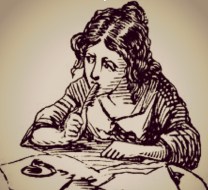
pompeiian woman-writer

The poet C. D. Wright died in January of this year. She was an American original. She was a critical thinker of the first order, an experimenter.

For no apparent reason, I thought of her when I saw this fresco painting (unearthed in Pompeii) of a woman with a stylus and book. Something in the thoughtful musing look in this portrait suggested a critical eye, analysis, consideration–a keen and penetrating intelligence. She will reflect before she writes, but she has opinions she  is not afraid to share.

A collection of Wright’s pronouncements, which she combined and arranged in a sort of extended prose poem, was published as “69 Hidebound Opinions.” The hidebound is both tongue-in-cheek and earnest; typical, really, of Wright’s work. I’ll post the link and also share a few that I find intriguing.

“69 Hidebound Opinions” by C. D. Wright.

Here’s #22:

“To opt to be a poet, is to have some resolve. It leaves you free–to sing as you will, with the lungs god gave you–even if no one but god might hear. It leaves you that naked and obligated to sing your best. Suzuki teaches that ‘in the beginner’s mind there are many possibilities; in the expert’s mind there are few.’ Beginner’s mind then, is not only where you start, but where you must remain. It is what will keep you–long after you have children, job, house, dog, too many keys on your ring–free.”

Number 27:

“An atmosphere of depression will arouse artists’ attention over an atmosphere of prosperity nearly every time. Because it derives from consciousness, art is critical. Also true, ruins are beautiful to us; the Blues make us feel good; it is through the wound that we perceive the body whole.”

Yet, #42 says, “It is left to the poets to point out the shining particulars in our blunted lives like the strands of blue lights Cotter, Arkansas, draped every haunting Christmas from one empty storefront to the empty storefront across the street for eight unoccupied blocks.”

Number 41 resonates deeply: “It is poetry that remarks on the barely perceptible disappearances from our world such as that of the sleeping porch or the root cellar. And poetry that notes the barely perceptible appearances.”

An aside: [I want to write about the sleeping porch, which I loved in my early childhood and which hardly exists anymore. I’d like to sleep on one again, build a house that has a sleeping porch. Also, my joy at discovering my former neighbor had–and used–a root cellar; his joy at discovering the young person new to the neighborhood was fervent about her truck patch.]

“53

Poetry is the language of intensity. Because we are going to die, an expression of intensity is a necessity.

Extended awareness, isn’t that central to the art?”

No. 67–

“Gradually one comes to fathom exactly what it is one has chosen–what is poetry. Poetry avails itself of the listener, the watcher. Whether called upon to emancipate, comfort or forecast, poetry responds. The possibility that the poem you were born to write, will not join you on the porch this summer or the next, looms taller than the sunflowers and the hollyhocks. It could have taken the fork to the river or ended up at the slaughterhouse. It could have died as quietly as the moth on the screen. Or just borne itself up on the breeze. Who can say. This is the poet’s choice: to attend a presence no one else was aware of, to spend the better part of a lifetime preparing for an arrival, that could not occur but for her attention, that would not in fact otherwise make its blaze on this world.”

waterpaper


I close with #51: “Now that I am beyond the initial paralysis of calling one’s first teachings into question, I am left with: be critical and sing.”