Post-exertion malaise

This year, my holiday plans are less busy than usual. I don’t have to cook a large meal, wrap a lot of gifts, travel much (or far), or attend a bunch of parties or festivities. There is a quiet joy in this low-key schedule, though it means the season possesses a slightly different character. I thought that the lack of holiday stress would mean I had more time to write, revise, maybe even to submit work to literary journals. The rain and chilly humidity have enervated me more than I expected, though, and some days even an hour of serious concentration seems to wipe me out.

I believe this weird exhaustion for no apparent reason is a kind of post-exertion malaise.

Post-exertion malaise (PEM) is not uncommon among people with chronic conditions such as chronic fatigue syndrome, Epstein-Barr, long covid, fibromyalgia and the like. Its key features are that the fatigue seems far out of proportion to the exercise or other exertion that preceded it, and that it is delayed–the exhaustion may set in two hours or even two days after the experience. I have had PEM, for example, after spending a lovely and high-energy day of hiking or wandering for hours around a city or museum and suddenly, without warning, “crashing” into bone weariness two hours later, or a day later (I have fibromyalgia). I’ve learned to manage the physical aspects of PEM, however. It does not happen all the time, and often I can plan for it.

Post-exertion malaise: it sounds like the title of a contemporary novel.

I’ve read studies that speculate PEM results from a sort of communications snafu among the many complex body systems: nerves, synapses, gut microbes, spine, brain, and probably processes science has yet to discover. What I wasn’t aware of until recently is that PEM can appear after mental or social “exertions” as well. Mental exertion such as submitting to journals; social exertion such as attending poetry readings, parties, family gatherings. It explains why I had to lie down for a nap at 5 pm every day the last few years I was working full-time, even though my job was a desk job. And why shopping has become such a tiring task for me.

Shopping, when you think about it, involves: 1) being in a public or social space; 2) attention to details; 3) frequent decision-making; 4) stress about finances, parking, and whether said decisions were the right ones; 5) unexpected stuff like long lines, a credit card that refuses to work, bad weather, and not finding what you were shopping for. Even if you shop online, some of these processes are involved. Yes, our brains are bombarded; and our brains are designed to filter and make efficient work of the bombarding, but perhaps that’s part of what goes awry with long covid and chronic fatigue. The filter may clog, so to speak. Brain fog and fatigue.

Similar micro-decisions go on when I send out poems to journals. Should this poem be sent to that publication? Do I like the other poems in this magazine, the editorial bent? Is this poem finished, and is it any good? Do they require a fee? Do I want to pay the fee? Are they okay with simultaneous submissions? Do they use Submittable, email, or some other method? Such analysis goes on constantly, as well as lots of even smaller decisions. I have to read the submissions guidelines carefully and, sometimes, re-format my work to suit. And then there’s the cover letter if required, and the bio–though I have a “boilerplate bio,” often it seems wrong for the journal; if they’ve asked for a personal touch or want me to stress place or background, I have to tweak the bio…and on and on. The task was never my favorite, but it didn’t exhaust me.

Because my PEM is intermittent, often I can send out a good deal of work in one sitting with no fallout, just as sometimes I can hike or walk for hours without pain or fatigue. I had almost no trouble when I was in Spain earlier this year. But this week in drizzly-snowy eastern Pennsylvania, I’m having to take too many rests after doing what seems like almost no real work. Frankly, it’s disheartening. So I’ve decided not to expect to get much done during the next two weeks and to appreciate the time I can spend reading a novel, decorating the tree, sitting by the fire, talking to loved ones by phone. No need to be disheartened.

Whatever works

My last post (here) generated some intriguing feedback and was cause for further reflection about revisions, at least on my part. Because I was writing a poem for a specific person–my son–I got useful information from his response, as well as responses from other readers; so I had the chance to hear back from my audience, however small, and to compare reactions. My son, the “you” in the poem, told me he liked the descriptions and that the piece did a good job evoking the atmosphere of the experience he’d had. He liked the closing lines, too. However, he said that while he had some moments of anxiety during his stint on the military ship, his overwhelming feelings cantered more toward frustration and an almost-constant irritation. He thought I had focused over-much on the anxiety aspect. “Though a person certainly could be feeling exactly that way in those conditions,” he added.

And that’s fascinating, because in earlier drafts I did not work toward evoking anxiety; I was trying to get the details right and to create a sense of annoyance, even anger, at the situation. (Apparently, that is closer to how he responded.) Here’s the “BUT”–but those revisions weren’t making the poem work any better. This is a challenge for many of us writers: when the impetus for writing the poem, and the initial intentions of the writer, don’t resolve into a good poem…and then some alterations–some “fictionalization”–make a better poem, but maybe not the poem the poet set out to write. Do we stay with our initial idea and keep whaling away to make it work as we initially imagined, or do we let the poem move into new territory somewhat removed from initial inspiration if the resultant revisions are more powerful, more believable?

I’m inclined to go with whatever works to make a stronger poem, most of the time. There are other options, though. Sometimes I end up with two or more poems stemming from the same initial idea. A bonus! One prompt I have occasionally used for myself is to re-write an earlier, less-satisfactory poem from a different viewpoint or to focus on a different aspect of the experience. This practice has been awfully helpful, and it keeps me from getting over-invested in the more obscure, personal components of a writing piece.

Photo by Leon Ardho on Pexels.com

Strengthening one’s work takes practice, and possibly a kind of discipline–not to suggest that I am a very disciplined poet, although I wish I were. I do take my practice seriously, though, and revision is a major aspect of my practice, always has been, even when I was a “baby poet” starting out. I never could quite agree with Ginsberg’s famous “first thought best thought,” since my first thoughts are seldom deep, reflective, or in any way excellent; and my first words set on paper are generally equally weak. For me, writing is thinking, in the way of E. M. Forster’s famous quote “How do I know what I think until I see what I say?” Thinking is often flawed, so analysis and critique and revision? They’re required.

Finally, whatever makes the poem better as a poem is worth doing. That’s my opinion: whatever works.

Revising for the personal

I’ve been working on the poem below for 11 months now, and the process has made me think about the purpose(s) of revision, the why of why artists and writers do it. In the case of this poem, I’m revising for entirely personal reasons. My revisions have little to do with creating a stand-out poem that strangers will read and appreciate; I want to tell a particular story about someone I love in a way that might demonstrate, to that person, compassion and some understanding of his feelings. I believe this is a valid purpose for making art, even if it is subjectively personal–ie, not “universal,” not groundbreaking, not timeless.

Certainly, the classic lyric poem, and many narrative lyrical poems, often are addressed to a particular someone. It seems to me that the classic lyrical poem is less based in context, however, and can therefore be read, aesthetically, as more universal. The narrative poem by nature relates its story in a time or place, using contextual descriptions that can become obscure in different eras or locations.

Such is the poem below; it may benefit from some backstory, which I will supply afterward. But read the poem first and maybe let me know if I’m correct. Maybe it will “work” for other readers, maybe not; but it is something I have been wanting to write for my son for awhile now. And he “gets it,” so my purpose has been achieved. 🙂

~

In the Warship’s Belly

How you hated those five days in harbor,
amid steel and cable, fearful each minute but
constrained from showing it.

You prefer to see shoreline and sky.
Discomfort pervaded every hour you spent
on board, walking through hazards,

noting construction, rewiring, repairs;
how you hated the low-ceilinged passages
through which you half-crawled,

wearing neoprene-soled boots and a hard
hat, as anxiety, hyper-alert, worked its
wormy way through your body.

There were power outages that canceled
light completely for unexpected
seconds deep below decks,

then generators’ earthquake roars would
rumble and shake so every wall threatened,
sparks lit up and light returned—

your breath rapid and near wheezing,
tremulous, you inhaled the stale, acrid
diesel-fumed air pushed by industrial fans

through that beast’s belly, that machine
of men’s work, war’s work. Built to threaten
and combat, it felt nothing like a boat, nothing

like the small wooden dinghy of your heart
that sailed the cove, with your little sister,
one summer years ago.
~

Context: When my son was employed doing navigational software de-bugging for a US Navy contractor, the job required a week on board a military ship that was being retrofitted and overhauled in drydock. The assignment took place during covid. He hated almost every minute of the experience and left the job soon after the on-board stint. Due to non-disclosure agreements and national security stuff, he couldn’t really tell us much about why he was so miserable; but he described the circumstances and gave us some idea of how anxiety-producing the tasks were, given the environment and his temperament (which does lean toward the anxious). He was a grown man and quite responsible for himself, so this poem is really about my feelings for him. When those we love are going through unpleasant things, we feel for them.

And here is the dinghy, though it is technically a pram–poetic license.

Re-assessing

Another clear day; we finally got an inch or so of rain on Friday, which was much needed, and since then the temperature has cooled a little. This late in November, it finally feels like autumn. On my morning walk today, I was happy to see this handsome creature airing its wings in the sunshine. Our local turkey buzzards have been active lately. I’m fairly certain that the snag this one’s perched on is a green ash tree, clearly well-visited by woodpeckers.

My low mood seems to have abated, at least temporarily, and I wrote a few poems and revised a few others during the past three days. I’m trying to accept the fact that this year, we will see neither our son nor our daughter for the Thanksgiving and Christmas holidays. So I’m trying to get creative about things to do that we might not have done if we were preparing for family celebrations. Yet we miss the concept of family celebrations. I guess that’s a socio-cultural thing, right? I may need to reassess what value “the holidays” have for me these days.

~

I have also kept myself busy re-assessing a chapbook manuscript I’ve worked on forever (it seems) and am now looking for the sort of small, independent publisher that might consider a hybrid poetry-journalistic/historical work influenced by Muriel Rukeyser‘s long-poem The Book of the Dead. My poem is about a Korean War veteran tried as a traitor upon his return to the USA, a man who was my friend David Dunn’s father. It has been a real creative challenge to figure out how to tell his story, and the resulting text is definitely “hybrid,” with footnotes, magazine articles, military court proceedings, letters, and poems. People who believe that poems simply flow from some internal inspiration would probably take issue with a poem-ish thing like this, but I keep feeling compelled to find a way to tell this man’s story. The unfairness of it, the long-term damage, the people who used him as a scapegoat, his short life (he died at his mother’s, age 39, discouraged and unwell from physical wounds that never healed, divorced, unable to overcome the dishonorable discharge that kept him from gainful employment). David kept losing his father over and over: to prison, to PTSD, to divorce, to death. It’s an all-too-common narrative, but each tale is also deeply and profoundly individual. Hence the need to write it.

Drying up

….and the drought continues into mid-November. This is a very long stretch of dry weather, and the rivers I’ve crossed recently–the Delaware, the Schuylkill, the Lehigh, the Susquehanna–are looking mighty low. Little islands are showing up in the center of the riverbeds. Tree roots visible along the banks. I found this government website that filled me in concerning the current situation. Looking at the charts, wow.

My low mood continues, for a number of reasons: the recent political news, the continuing wars, my mother’s consistent decline, the drought, my physical distance from my grown children on the other side of the continent, a friend’s death, a bunch of recent poetry rejections, the fact that I can’t go into a store without hearing Christmas music…granted, some of these reasons are not earth-shattering but the effect is, well, cumulative. Han VanderHart’s recent blog post speaks to the rejection, reminding me of things I know and should keep in mind. The challenge is just getting through and occasionally finding delights at which to marvel, for the delights surely endure. Ross Gay’s Book of Delights is my book group’s next selection, a book I’ve read before but which–at this particular moment–will probably benefit me when I re-read it.

I also feel creatively dried-up, and that’s dismaying. Reading novels (see my last post) offers peasant distraction but seldom gets me writing my own work. I’ll never be a novelist. I’ve been reading poetry, online and in books, as I always do; yet right now, the poems I have been reading, no matter how wonderful, have not inspired me to work on my own.

I’m not even revising! This is not my usual self, not my poetry “norm,” not a space in which I feel happy or well-regulated or at least inspired. Perhaps I have encountered the dreaded writer’s block. Or rather, a drought of some kind, an inner sluggishness of the imaginative flow. Despite the glorious stretch of sunny days and moonlit nights, the incessant blue sky reminiscent of those high-altitude desert environments I seem to love, despite these delights, I’m discontented.

How very human of me.

Listen, there’s a trio of redtail hawks along the woodlot. Their nasal “screeee” and their graceful swoops between the bare branches catch my attention. Sunlight on the field tells me, “You could at least get outside and take a walk.” Okay. Can do.

Recuperating

Last week took a lot out of me, many reasons for that, mostly keeping those reasons to myself. I needed some rest from exertion and from social media, so I’m re-reading Les Misérables. In which Hugo seems to be trying hard to convince readers that compassion and goodness can be awakened in the hardest of hearts through the process of gentle persistence and genuine decency. Radical decency, as a friend of mine put it. Well.

I won’t write that off as an impossibility, since lord knows many things that seem impossible are not. But yes, Hugo was writing fiction, and one turns to fiction for escapism but also for reference, and for understanding human actions and feelings, and for perspective, and for information. I just completed Richard Powers’ Overstory, which offers a vast range of perspectives on the above-mentioned and adds ecology and forest infrastructure and the psychology of groups into the mix. Novel-reading has been giving me a sense of overarching historical range that lifts me a bit from my too-close focus on my own small life and my ability to sustain hope and make art. That acts as a form of recuperation, if you’re me.

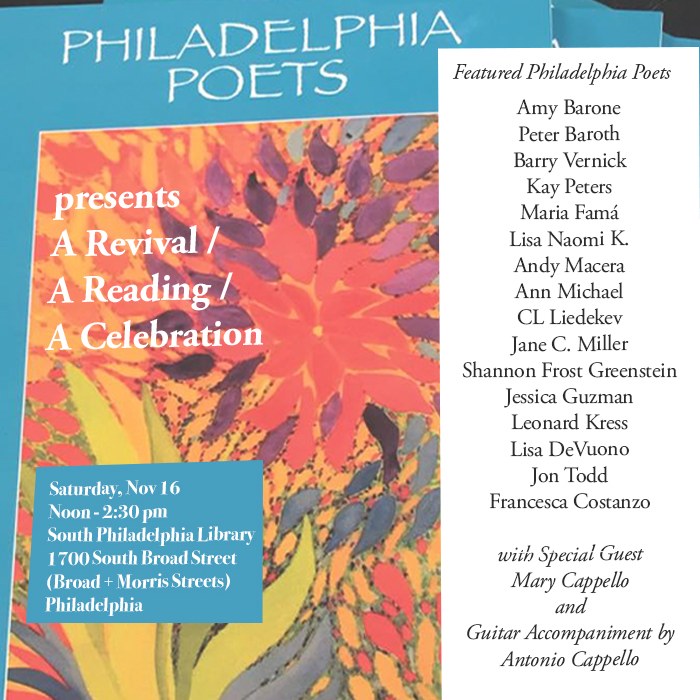
This week, though, happens to be full of poetry. Tomorrow, I’m attending a reading at a nearby public library, where I’ll see many poetry colleagues, the sorts of folks who create a community of local writers. Friday, I’ll be reading with Montgomery County’s Poet Laureate, my friend Lisa DeVuono, at the retirement community where my mother resides. Saturday, I’m heading down to Philadelphia to read with another long-time poetry community in celebration of Philadelphia Poets, a long-running zine established decades ago by the late Rosemary Cappello.

It is good I have had some reading-novels time, and it is good I’ll be having some reading-with-poets time ahead. Both are nourishing to my soul. I haven’t been writing much lately, but I will be eventually. Meanwhile, I’m still waiting for the drought to break…we got a fraction of an inch of rain a couple days ago, and I really hope there is more ahead.

Whatever you happen to need to nourish your own soul, make time for it.

Drought, again

The temperatures here in this eastern Pennsylvania valley have been mild, even warm, which isn’t that unusual for October, anymore. What’s different is the lack of rain. Northern New Mexico had more rain the past three weeks than our region did. Now that is unusual, and a bit worrisome. Our local trees have been enduring numerous stresses in recent years: irregular rainfall, invasive insects, road construction and housing developments, run-off, and viruses. Droughty autumns and winters do not make for resilient, happy trees and other perennials, unless they are desert varieties.

I love the desert, but the Lehigh Valley (where I live) is not primed to be a desert. We need the temperate moisture of rivers flowing down to sea level and 50″ of rain each year. It would be interesting to learn xeriscaping and how to garden in low-moisture regions, but only if I were living in one. I’ve been concerned for a long time about the climate changes I see occurring around me, noted the differences year by year in my gardening journal, tried to limit my own water use even in this temperate, damp-ish area. But. On my own, I cannot conserve enough water to keep the 70-foot-tall tulip trees and large oaks and colorful maples healthy. Nor the soil and its microorganisms, fungi, understory plants, and useful arthropods.

True, sometimes the long days of rain and overcast skies we get in autumn, winter, and spring feel oppressive; and they make my joint pains flare. But I count for little, whereas the earth counts for a lot. I’d gladly trade some low-barometer aches for a vibrant, healthy local climate.

~

The frosts, though light and few, are arriving now. Maybe we will get rain by Election Day? I have too many hopes for next week. Best not to speculate; I can wait.

In the meantime, I have just finished reading Cindy Hunter Morgan’s very beautiful new collection, Far Company, and I recommend it, especially if you like poetry with an environmental resonance and poems of memoir and recalled experience. Purchase it from Wayne State, not Amazon, if you can. To frustrate a certain billionaire, not that he will notice.

We do the small things, right?

Two falls

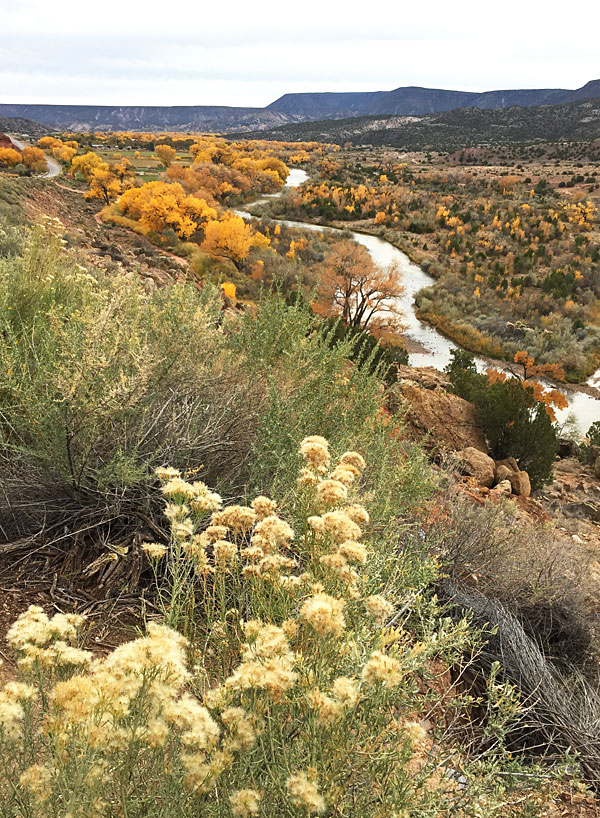
I have experienced two autumns this October: one in New Mexico, one in Pennsylvania. In the American Southwest, high up in the world, the cottonwood trees that hug every available water source were going a brilliant gold while I was there. Any view above a creek or river revealed a winding path of yellow–along the Chama, along the Rio Grande. The tiny-leaved oaks were turning brown-leaved and dropping scads of acorns along the paths. The oranges and reds are mostly there year-round, on the mesas and in the canyons.

It was wonderful to experience a poetry workshop with Anita Skeen and Cindy Hunter Morgan and to learn how books are made by hand, wonderful to draft some poems using color imagery and ekphrasis, wonderful to meet some fascinating people with whom I enjoyed pushing past my/our comfort zones and into art forms we may have been a bit less comfortable with. These are reasons to attend an instructor-led workshop, seminar, or residency. I spent part of last September in New Mexico, but it wasn’t the most spectacular time for autumn coloration–whereas October certainly gleams in northern NM!

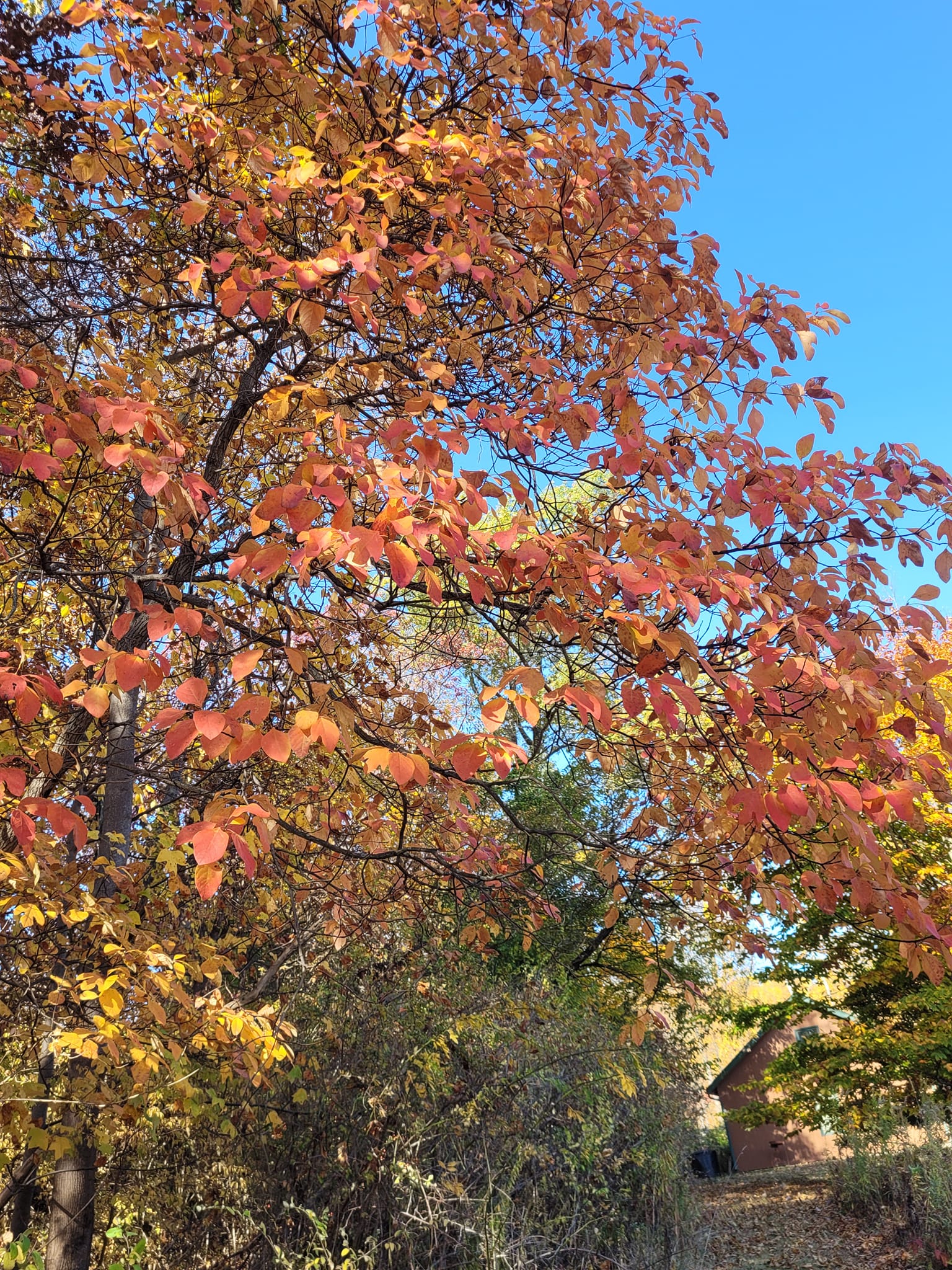
When I returned home, I had missed “peak season” for color in Pennsylvania; my husband said that came a bit early this year because of drought. But it’s still very bright here. The maple leaves haven’t all fallen, most of the tulip trees are still yellow, the hickories haven’t reached peak gold yet, and many of the sassafras are that warm coral color I love so well. The burning bushes? Ours hasn’t dropped its bright fuchsia-maroon leaves. It’s a vivid presence at the corner of the house.

~

Therefore, I have two autumns this year, one sea-level Mid-Altlantic East, and one high-altitude Southwest.

Which strikes me as an abundance of beauty and color. So I am continuing the theme of last week’s workshop. Here’s a new draft of a new poem just for the joy of it. [This fall, those of us in the USA could use a bit of joy.]


I don’t have a title for it yet. Maybe you can help me think of one.

~


The difference between orange leaf color
and orange rock color.
Between the greens of grass and juniper,
the pale dun of meadow’s die-back
and beige sand stretching westward
to the mountains.
Even the clear sky’s blueness
on fair, mild mornings
differs by an almost measurable degree.
Something to do with altitude
and aridity, the science of which
I don’t really understand.
Life’s variations and hues—
striated like cliffs, buttes, mesas,
like hills of maple and hickory in fall—
beautiful and strange.
Even when I close my eyes, color-
memories, all those shades
I can’t define, sift through my skin.
Into blood. Into bone.

With color

I’m taking a break from the garden and from the news cycle and indulging in a different form of work: “Making Poems, Making Books,” a 4-day workshop with poets Anita Skeen and Cindy Hunter Morgan at Ghost Ranch in Abiquiu, NM. Yes, I’ll be making my own book–a small accordion book. There are about a dozen of us in the workshop, which is centered around the idea of color. Autumn in northern New Mexico offers a range of hues somewhat different from the post-equinox colors of eastern Pennsylvania. Perhaps that will inspire me. The last time I took a workshop here was in 1993, and I learned how to draw/paint in chalk pastels. A long time ago–and yet, walking around the dusty alfalfa field in the center of the Ranch’s office and dorm buildings, I felt completely at home. As if I’d been here just last year.

This week differs from the artist residency I attended at Joya-AiR in May because I’m part of a class getting instruction in how to make a hand-made book and also participating in feedback on our writing. Nonetheless, every afternoon there’s a nice stretch of time to work on solo projects, hike, drive to some nearby sites of interest, or nap. I will admit I have been doing more napping than I had hoped. The high altitude, dry air, walking more than usual (on rocky trails) and the emotional energy it takes to learn a new skill and meet new people have conspired to creep up on me some afternoons.

That’s fine with me, though, because I’m banking many images, quotes, anecdotes, ideas, prompts–all the things memory can do.

And I am drafting some new work, so there’s that as well.

~

Enjoying the session and the people, third best thing about this trip. Being back at Ghost Ranch, second best thing, though it is perfectly wonderful. Best thing? Getting some time in the Albuquerque area to visit with my daughter and her partner. And their dog. And their cat, guinea pigs, and beehives. According to her, bees kept in hives (apiculture) are considered considered agricultural animals.

Who knew?

It’s time for my nap, I think. But I have wanted to post about this workshop/retreat before I get home again, just to remind myself of how grateful I am to be here, to be writing, to be seeing my child, to be–yes–escaping from the media frenzy as the presidential election looms. If that seems like something you need, as well, all I can do is send a few cheerful photos I took at the Albuquerque Balloon Fiesta.

~

Just reading

Sunday evening, my weeding stirred up so much dust and chaff that I needed to wear a bandanna around my nose and mouth. A continuous late-summer drought. There are still tomatoes and basil, sunflowers and zinnias, but the avian migration has been going on for some weeks and the days are getting shorter. Just after equinox, three weeks without rain; at last the sky clouds over and drops a little moisture on the parched soil. Yellow leaves sift onto the lawn. Small flocks of robins rejoice in the softer top layer of dirt, pull at grubs and worms, then fly off.

~

The rain’s necessary, and I’m grateful. Rainy days, however, take issue with my body–or, probably, the other way around. The need to take NSAIDs and rest offers the opportunity for just reading. This isn’t a bad thing, especially as I had Richard Powers’ novel The Gold Bug Variations to hand. It’s a tour de force of pattern, structure, code-breaking, DNA-building, relationships, love, chemistry, music, art, literature, and much more. I love the references (the narrator is a reference librarian), the minutia, history, alliteration, lists, compilations*, the whole thread of the novel’s dramatic arc, its relationship (mathematically, metaphorically, structurally) to music and the work of the gene-sequencing science. The book tells the parallel stories of couples who fall in love 25 years apart, the coincidences and randomness, the patterns that may not be patterns. I’m thoroughly wowed by an author who puts so much research into his writing and makes everything fit somehow.

Powers must have been about 33 when he completed this novel. I can’t imagine being so wise about human behavior and so informed about the sciences and music theory at that young age. Well, for one, I’m not as brilliant as he is; and two, I was raising toddlers when I was 33, which is a science unto itself and as revelatory as any book I could have been reading or writing in early mid-life.

But I digress. This book interests me on so many levels that I’ll be thinking about it for weeks. I may have to re-read it, take notes next time. I kept wanting to underline passages–it’s a library book, and marginalia is a no-no. I can imagine reading it again to the strains of the Goldberg Variations–indeed, I read a few chapters to said accompaniment this time. This is not a swift and easy read: it took me awhile to feel warmed up about the narrator, though she’s funny and smart. By the end, I loved her like a friend.

Honestly, novels seldom get me this excited or inspired. I’m glad I had a crappy day so I could justify lying around and “just reading.” As if “just reading” is not a worthwhile endeavor. The weeds can wait.

~

* re compilations: a word Powers employs often in this novel is the neologism/computer programming term “kludge.” I wasn’t familiar with it. But it’s a terrific word! https://www.etymonline.com/search?q=kludge