Wet year

This year seems the wettest locally in some time. Flash floods, gray days, soggy fields, mildew in the garden (and everywhere else). Annual average rainfall per year in my region is about 50″. We have already received 107″ at just past the equinox.

Yet it has been even damper elsewhere in the USA: I have friends and family in the Carolinas, which felt the brunt of Hurricane Florence.

Despite my complaints, I prefer rain to drought. After all, one of my books is titled Water-Rites.

I’m posting the draft of a new poem today. Thankful for the sounds that comfort me.

~

All night, even as rain pounded
the crickets called and called
their high-pitched throb offering
a different perspective
on the downpour’s
thrum, a bass string’s thump
on windows, roof, the dark’s
wild fullness that we don’t
understand and thus fear.

Shiver of screech owl, damp in its
hickory-tree perch
sad dreams, body aches, waking
into memory. We animals
amid bedsheets, sweaty and tossed,
find ourselves alert, listening.
Rain drums down in long bands
and crickets sing.
~

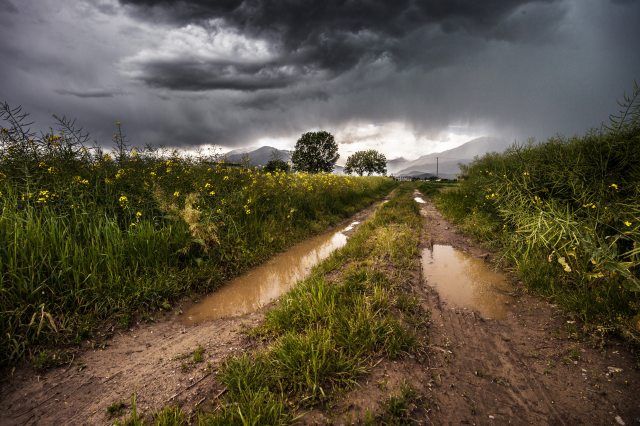
country-lane-field-meadow-1551.jpg

image thanks to Pexels


Reverie, with interruption

On the first warm, sunny, not-horribly-humid day in a long time, to reward myself for marking up a pile of student essays, I lay in the hammock and looked up at the clouds. The clouds are amazing today, shifting, fast-moving, likely thanks to Hurricane Florence far to the south.

I wanted reverie, but I got spotted lanternflies instead, which interfered with my admiration for the clouds. Dozens of the creatures were aloft on this mild afternoon.

IMG_5605

They are a recent invasive species to our region; their appearance causes concern because they use fruit trees, mast trees, grapes, and hardwoods as host plants when they cannot find their traditional host, ailanthus. We have no ailanthus on our property, but we do have oaks, hickories, maples, beeches, and many scraggly cherry, walnut, and mulberry trees along the hedgerow and into the woodlot. Development in the valley–housing developments, business plazas, parking lots–coupled with stress from climate weirding, has been hard on trees. We already have diseases that have damaged the Pennsylvania ash, hemlocks (PA’s state tree), and dogwoods. I notice weakened bark on many trees. The droughts and the too-much-rain cycles, and unusual, high winds with storm fronts, plus road-widening, contribute to considerable loss of trees.

I lay in my hammock under the trees and worried about the lanternflies. Which accomplished nothing (I think of a James Wright poem at this point…).

What was there not to despair about? So much anxiety surrounds me. Even the damned bugs. If only starlings were to take a liking to spotted lanternflies, I mused.

A butterfly went past. I looked down at the zinnias blossoming their stems off in the garden and felt pleased to count four monarchs there. It has been a good year for monarch butterflies in my yard, and green darners and other dragonflies, and hummingbirds–which used to be quite uncommon visitors here. The little brown bats are returning each dusk, recovering slowly from the decimation of white-nose virus.

The balance may seem off in many ways. But there are restorative moments.

Even if “I have wasted my life.”

monarch.ann e michael

Monarch on tithonia blossom


…Some rain must fall

Longfellow wrote that “Into each life some rain must fall” (“The Rainy Day“). The poem is an extended metaphor; here in my valley, the rain has been actual, physical, moist, sopping, wringing, drizzly, humid, soaking, and all the rest.

The metaphorical hasn’t been absent, either.

So this week, my post consists of other writers’ posts. Explore, please. All of these links offer much to enlighten the reader.

https://www.daletrumbore.com/unthinkable

Now Hold On There; or Slowing the Revision Process

On first looking into Shenandoah’s submissions

Barberous

http://www.writerintheworld.com/2018/09/03/cathedrals-and-yurts-a-reprint/

Feeder streams

A friend and I had a conversation about storytelling and human connectedness, relatives and family myths. We recognize that with age and relationships come references and allusions–some that operate only within the family system, others that interconnect with the wider social world. The televised funerals of some celebrated US citizens (Aretha Franklin, John McCain) offer excellent examples of how various eulogists–family, colleagues, close friends–endeavor to extend their feelings about the person to others. The best eulogies tell stories. It’s how human beings learn about one another, how we connect, bond, and cohere. The process reminds me of feeder streams that follow gravity and the earth’s geological patterns to wend their ways to join a river.

A river enlivened my childhood. Several rivers, in fact–the Hudson, the Delaware–but the one that comes to me at this moment is the Eel River in Indiana, pictured in my recent post here. By coincidence, just this week Streetlight, an online literary review, published my poem “Eel River Meditation.” In less cheerful news, someone whose presence I associate with South Whitley, IN has entered hospice care. These associations summon memories that carry me into that realm of family tales, rituals, jokes, sorrows, generational mythology.

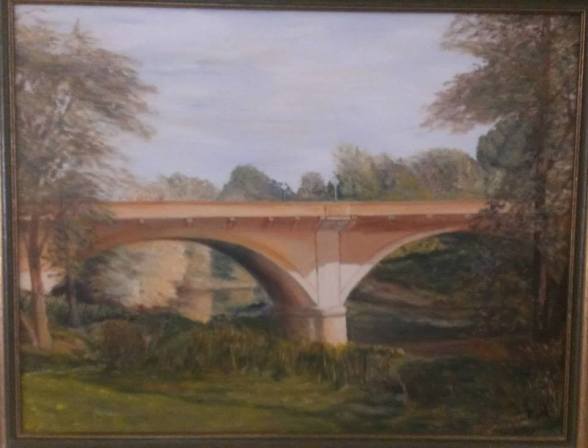
My grandmother lived beside the Eel. A self-taught artist, she painted the bridge over the river many times, in all seasons. It must have steadied her sense of being in the world, of being in place; certainly, her paintings evoke that place, a small Indiana town, in those of us who knew and loved her.

And what could be more metaphorical than a bridge? Than a river? Than the changing seasons?

Locally, this rainy summer in my valley region, the feeder streams are full to overflowing and rushing to the Lehigh River, flooding the low-lying marshy areas, stranding the occasional cow or motorist. The fall semester has begun, and the garden’s mostly abandoned to the aforementioned weeds. My mind and heart are full, too. Maybe there will be poetry.

Eel River Bridge Edna Michael

South Whitley’s Eel River bridge, early summer. Edna Michael


Parsing the garden

To parse is to analyze components–in linguistics, we parse a sentence, in computer science, we parse coded commands. In the literary analysis of a poem, a reader may divide a line or phrase into its parts of speech and then analyze the components (or look at an unusual expression or syntax in a line) to try to interpret meaning or to expand on possible readings or meanings…the semantics behind the tokens of image, grammar, metaphor, allusion, sound, punctuation, placement upon the white space of the page.

Today, I pushed the metaphor by parsing my garden.

The weather from July onward has been hot, humid, and unusually wet. The corn and the beans in local fields were happy; but much in my vegetable garden reveals, with parsing, specific summer details of stress and the gardener’s neglect.

IMG_5601.jpgToo much rain during ripening time led to cracked tomato skins and viruses in the vines. The zucchini did well for a time, then succumbed to powdery mildew. The beans didn’t mind the weather, but I had a plague of voles whose small depredations worked some cumulative damage–they nibbled a number of plants at the stem base, which meant a slightly less abundant yield, of course. Cucumbers offered lots of fruit initially, then downy mildew set in. I harvested one of the two cabbages with only minor slug damage, and the fat variety of carrots grew well (with no sign of whiteflies); but there were lots of bugs on the kale this summer and, given the intense heat, I had a short lettuce season.

And then, there are weeds, which offer many details about the weather conditions…and the fact that the gardener gave up and stopped pulling weeds when the soil devolved into heavy mud and who then refused to brave the task in the numerous over-95 degree F days that weren’t rainy. Today, I began a list: nutsedge; crabgrass; English plantain; pigweed; puncturevine; bindweed; galinsoga; creeping thistle; multiflora rose; horseweed; knotweed; spotted spurge; rabbitfoot clover; virginia creeper; japanese stiltgrass; wintercreeper; mugwort; solidago; wild aster; chicory; poison ivy; not to mention various sorrels and clovers and Queen Anne’s lace…and others I have yet to identify.

If I were to parse each weed, I could detail its likes and dislikes as to soil, growing conditions, root systems, pollinators & pollination strategies, seed dispersal methods, attractiveness to birds or rodents (see seed dispersal methods), and eventually could compile a meaningful ecological and environmental semantics for the little plot that is my backyard truck patch. No doubt I’d learn a great deal about the garden, but no doubt I have done so already–if less exhaustively, less “scientifically.” Would the garden then become more meaningful to me?

It’s a thought experiment; I’ve no intention of trying it, though I do think it would yield interesting results. In the many years I have worked the soil, I have written poems that, perhaps, do parse the garden. That will have to be interpretation enough for my part.

overlay

Interesting sky above the garden.

River of poetry

I attended a lively and unpredictable poetry reading/performance recently, No River Twice. The poets who participate in the group reading develop the concepts at each performance, endeavoring to find meaningful and entertaining ways to permit audience members to sense an active engagement with poets and to experience poems more vividly. It appears to be an evolving performance process, and I enjoyed myself!

Grant Clauser explains the idea on his blog. Most of the poets involved have at least some acting or performance background. They are also active as mentors, instructors, advocates for the arts, and “working poets,” by which I mean they get their work published and performed and are constantly writing, revising, and reading the work of other poets in the service of learning new things.

The poets who performed in Phoenixville, PA, on Friday evening are as follows, but I understand the line-up may change from event to event.

Ethel Rackin

Hayden Saunier

Chad Frame

Cleveland Wall

Bernadette McBride

Joanne Leva

Grant Clauser

Kudos to these folks, who presented a varied and exciting performance. Let’s hope there are more to come.

1978 South Whitley IN, Eel River

South Whitley, IN. Eel River Bridge, 1978.


Grammar


Steven Pinker‘s early book, The Language Instinct (1994)–controversial among linguists, psychologists, social anthropologists and probably semiotics philosophers–is nonetheless relatively easy for the interested non-scholarly layperson to read. Pinker has since become well-known for his best-selling books, TED talks, and willingness to engage in lively debates on controversial topics such as violence in society and his claims for the embodied brain, scientifically-supported atheism, and rational culture. [Totally off topic, but I’m a great fan of his current wife’s novels and philosophy books–Rebecca Goldstein–what an amazing mind she has! Not that Steve Pinker is a slouch in that department, either…an intellectual power couple indeed. But I digress.]

The Language Instinct got me thinking more broadly about grammar, especially as the semester is about to begin and I’m once again wrestling with how to teach conventional writing skills to under-prepared, newly-minted college freshmen. I harbor no intentions of talking to them about linguistic theories. But I do want them to understand that they can already express themselves perfectly well verbally, with the help of body language (even students who are still learning English; even students who have told me that they have learning disabilities). The tool they need to succeed at the college level is the skill of writing that employs enough agreed-upon conventions–prescriptive grammar–to convey clear ideas to the standard reader.

Lots of assumed definitions there: who is the ‘standard’ reader? How many and which ‘conventions’ are enough, and who is it that agrees upon them? I have to let the students know that the answer is: “It depends.” They are seldom very pleased to hear it, but human beings are nothing if not adaptable.

~

After defending slang, split infinitives, the ‘verbing’ of nouns, and other shibboleths, Pinker–in a chapter denigrating language mavens (hence his Jeremiah example toward the end of this excerpt)–writes:

The aspect of language most worth changing is the clarity and style of written prose. Expository writing requires language to express far more complex trains of thought than it was biologically designed to do. Inconsistencies caused by limitations of short-term memory and planning, unnoticed in conversation, are not as tolerable when preserved on a page that is to be perused more leisurely. Also…a reader will rarely share enough background assumptions to interpolate all the missing premises that make language comprehensible. Overcoming one’s natural egocentrism and trying to anticipate the knowledge state of a generic reader at every stage of the exposition is one of the most important tasks in writing well. All this makes writing a difficult craft that must be mastered through practice, instruction, feedback, and–probably most important–intensive exposure to good examples…a banal but universally acknowledged key to good writing is to revise extensively…Anyone who does not appreciate this necessity is going to be a bad writer. Imagine a Jeremiah exclaiming, “Our language today is threatened by an insidious enemy: the youth are not revising their drafts enough times!”

Indeed, I agree with him here. Taking the time to read good writing frequently, and taking the time to revise carefully when writing pretty much anything (even a Twitter post) would go a long way toward improving anyone’s writing.

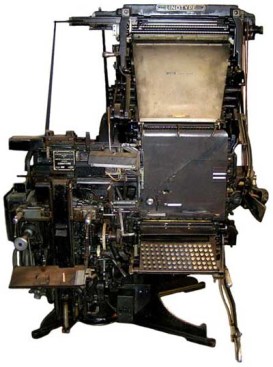
linotype

Mergenthaler’s Linotype machine

We do need concise, standardized, well-revised written texts, especially when we are relaying new information, instructing others how to do something, or convincing our professors that we comprehend the fundamental theories of the coursework. That’s not “grammar,” the magical tool that my students think they somehow missed learning in grades K-12, it’s craft, attention, and revision–with a few prescriptive rules, enough to level the ground on which the we lay our communicative foundations.  The rest is work.


Connections


4446_1159463871068_1826910_n

August has arrived and a few of our incoming freshmen are on campus already, as well as students on various fall sports teams who need to get a jump on the competition season. It was quite awhile ago that I was a teenage person entering my first year at college, but each year our students arrive with the same anticipation and excitement I felt. They’re ready to exercise a little responsibility, a little freedom, and to make the kinds of connections–personal, emotional, and intellectual–that will affect the rest of their lives one way or another.

~

In the 1970s, science historian and television broadcaster James Burke created and hosted a show called Connections. I was a fan of the series because I loved the surprising ways discoveries, events in history, people, and accident led to innovations and the criss-crossing of continents and ideas. The interdisciplinary aspect of human culture, of science and the arts, fascinated me as a teen. Those networked ideas have shown up many times through my life.

Connections: The photo above was taken by my fellow student Steve Lohman when we were freshmen. Steve later attended Pratt School of Art.  We lost touch for a long time, and–I have forgotten how–I found his metalwork while I was looking for cover art for my book of poems The Capable Heart.


running_horse

Running Horse by Steve Lohman

Connections: I liked Steve’s wireworks, but I remembered him as a photographer. Granted, what a person pursues at age 17 or 18 is easily liable to change–but I was curious about how he started doing sculpture. When he mentioned he’d attended Pratt, I asked if he had ever met Toshio Odate, who taught there for years. “One of my favorite teachers!” said Steve. “I loved his class.”

Connections: My spouse took a job writing for a woodworking magazine, where he met Toshio, who wrote about Japanese tools and woodworking techniques. Meanwhile, Toshio was creating his own works of art at his home as well as mentoring many students. He’s now a long-time friend of ours. (Photo of Odate’s “Pride of New England,” below, by Laure Oleander).

toshio-pride copy

Connections: Neural networks, the embodied mind, the ways writing assists in psychological healing, the twists in a good novel’s plot, the turn in a poem, metaphor, surprise. The unexpected thrills us–unexpected connections fill us with curiosity and a kind of joy, as does the closure.

~

Connections: The commercial creation Thinkhub, invented for teaching, offers yet another example of connections. A cultural thinkhub project based in Toledo, midstory.org has produced my poem “River by River” as a soundscape: click here.

The project researchers found my poem in the anthology I Have My Own Song for It: Modern Poems of Ohio. Look around, folks–connections are everywhere, and we learn from them.


Process

William Stafford:

A writer is a person who enters into sustained relations with the language for experiment and experience not available in any other way…A writer is not so much someone who has something to say as he is someone who has found a process that will bring about new things he would not have thought of if he had not started to say them.

Writing is a process that elicits consciousness in the individual writer, often as the writing unfolds. Flannery O’Connor: “I write because I don’t know what I think until I read what I say.” Joan Didion: “I don’t know what I think until I write it down.”

imagestafford

Perhaps oddly–perhaps not–Stafford’s definition that what a writer is comes down to what a writer does bears a certain resemblance to Gerald Edelman‘s “neural Darwinism” theory (ca. 1989 in Bright Air, Brilliant Fire, a more reader-friendly version of models developed in his neural topology trilogy*). Edelman basically says consciousness isn’t a “thing in itself” so much as it is a process that the embodied brain does. The brain’s processing capabilities are individual and endlessly myriad and they operate, claims Edelman, through the re-entry of information in intricately complicated links and physiological systems.  Thus, through evolution’s incremental layering of human beings’ brains, what we call higher-order consciousness makes its appearance.

And then on to gesture, semantics, lexicon, syntax, language, culture, &c.

~

Gerald Edelman:

What is daunting about consciousness is that it does not seem to be a matter of behavior. It just is–winking on with the light, multiple and simultaneous in its modes and objects, ineluctably ours. It is a process and one that is hard to score. We know what it is for ourselves but can only judge its existence in others by inference.

…Once a self is developed through social and linguistic interactions on a base of primary consciousness, a world develops that requires naming and intending. This world reflects inner events that are recalled, and imagined events, as well as outside events that are perceptually experienced. Tragedy becomes possible–the loss of the self by death or mental disorder, the remembrance of unassuageable pain. By the same token, a high drama of creation and endless imagination emerges…The wish to go beyond these limits [of embodiment] creates contradiction, fantasy, and a mystique that makes the study of the mind especially challenging; for after a certain point, in its individual creations at least, the mind lies beyond scientific reach…the reason for the limit is straightforward: The forms of embodiment that lead to consciousness are unique in each individual, unique to his or her body and individual history. [italics mine]

To me, this passage–in a book about neural mapping and brain physiology–feels “poetic.” But what do I mean when I say the concept of embodied consciousness, and consciousness as a series of intricate, synthesized processes, coincides with being a writer? Or in my case specifically, a poet?

It has something to do with taking in the world–through the senses, which is all my body’s really got–and synthesizing all those years of experiences, memories, books I’ve read, poems and plays I’ve loved, people I’ve known, relationships with the environment and with human beings and with other creatures, the whole of my personal cosmos. Referents and reentrants. Relationships actual and imagined. “The remembrance of unassuageable pain.” The process of loafing through the world.

Writing, where much of my so-called consciousness dwells. Not in the outcome, the resulting poems or essays, but in the doing.

~

More about writing-related processes and politics here: Poet Bloggers


* Neural Darwinism: The Theory of Neuronal Group Selection; Topobiology: An Introduction to Molecular Embryology; The Remembered Present: A Biological Theory of Consciousness.
Difficult books, iterum

After some readings on metaphor and language, I tackled A Grammar of Metaphor (1958) by Christine Brooke-Rose. Admittedly, I was hampered in my reading by my lack of facility in the jargon and structure of what used to be, but is no longer, “basic” English grammar. It did help that I have read The Trivium and could refer to it now and again; and of course it helps to have a background in poetry and literature, though not one nearly as thorough as Brooke-Rose’s. I definitely can add this one to the “difficult books” I have enjoyed, and benefited from, reading.

The grammar part of metaphor was not something I took into much account when I studied poetry. Certainly, when I read for pleasure, I do not analyze for grammar. Poets often experiment with grammar–altering syntax purposefully, creating sentence fragments, run-on sentences, new compound words, jarring phrases, all in an effort to make something happen in the poem. That “something” may be sound, dream, argument, exhortation, emotion, surprise, pattern, recognition, or a matter of perspective on outlooks, worldviews, culture, tasks, the personal. I do not read for such insights until I want to return to the poem and find out how the poet managed to make the amazing process of language work upon me.

If I were to try parsing a contemporary poem using the Reed-Kellogg system I learned in elementary school, some poems would buck and kick and refuse to reveal their structures. It would depend upon the poem and upon how one interprets such things as line breaks and stanza breaks. I am not convinced the process would really assist most readers in developing an understanding of the poem.

diagram

NPR.org Juana Summers [read here]

Then again, it might. Analytical scholars have taught me many things I would never have thought to investigate on my own.

~

Here’s a post from the 2018 blogroll journey: Marilyn McCabe on mindset–in writing and other things. Also a matter of perspective.