Blooms, books, buddies

I headed southward on a recent trip to visit a friend and to see if I could find spring, since my Pennsylvania valley has been extensively clobbered by late-winter/early spring snow storms. In southeastern North Carolina, the air was cool but the plants were blooming. Spring at last! May it head northward soon.
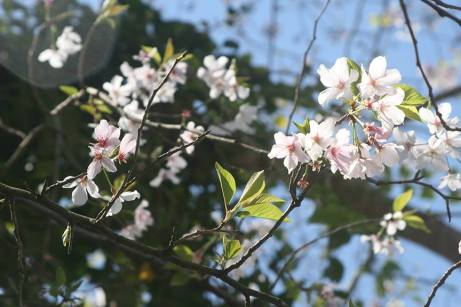
springblooms

~

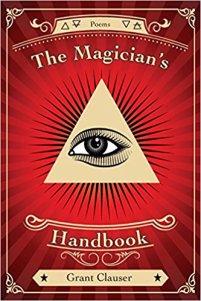
On my travels, I took along Grant Clauser‘s collection The Magician’s Handbook. One of my best-beloveds has been learning sleight-of-hand and card tricks lately, and as a result I found it especially fun to “get” Clauser’s references to trick names and magicians’ moves in these poems. The poems demonstrate Clauser’s sense of humor, balanced with insights about contemporary life and a good use of metaphor, sound (nice alliteration in particular), and poignancy that never teeters into sentiment.

I thought my hostess in North Carolina would enjoy The Magician’s Handbook; she randomly read a few pages and liked the book so much that I gave it to her.

~MH poems
Poetry collections are terrific gifts for poet friends, of course; but it is particularly rewarding to introduce a friend to a poet’s work. I would not have discovered half of the writers whose work I love if it had not been for friends and fellow writers’ recommendations, although various public libraries and many a bookstore browsing session have been places of discovery, as well.

I like to read poems while traveling. On the one hand, it proves difficult to keep from being distracted by crowds, announcements, and departure times–which can make it hard to focus on the challenges a poem presents to its readers. On the other hand, poems tend to be brief enough that the inevitable interruptions do not completely disrupt the flow or content of the page; for that reason, I tend to struggle to read fiction while traveling. The brevity lends itself to gesture, so I can pick up on mood and tone and the sound of the poem (in my head–I don’t read aloud in airport terminal lounges). Later, when I am home again, I re-read the poems. That gives me a different perspective on the work.

So…I guess I will have to purchase another copy of The Magician’s Handbook for my re-reading pleasure. Meanwhile, my friend in North Carolina has something to read as a start to National Poetry Month, which is April!

Hey, that’s what friends are for! [And many thanks to BJG for her hospitality, Southern and South Jersey style.]
Obstructions

Things that get in the way, viz., from Online Etymology Dictionary:

1530s, from Latin obstructionem (nominative obstructio) “an obstruction, barrier, a building up,” noun of action from past participle stem of obstruere “build up, block, block up, build against, stop, bar, hinder,” from ob “in front of, in the way of” (see ob-) + struere “to pile, build” (from PIE *streu-, extended form of root *stere- “to spread”).

I’ve been in an odd sort of writing funk–not a writer’s block in the classic sense, because I am writing–both prose and poetry. Drafting, anyway. I feel the obstruction in a different area of the writing life, about which I’ve written in the past: publishing, submitting work, creating the manuscript…getting the work into the world. All writers face these issues if they want their work to find its readers.

My current obstacle is … motivational? existential? self-inflicted? I have not decided yet, but it feels real enough. I want to put together another manuscript and have, I think, enough completed, “good” poems to make a manuscript; many of them have already appeared in literary journals. What stops me from corralling the poems together and composing my next book?

I know what it is.

My not-yet-second book stops me.

images

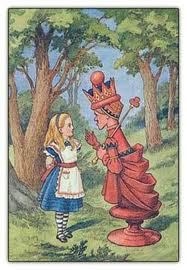
Sir John Tenniel, of course.

After about 7 years of endeavoring to get The Red Queen Hypothesis into print, no takers. Perhaps I have not sent it to enough publishers or contests, but I have done what I can given time and budget constraints. Perhaps, though I have had four excellent critical readers consult with me on it, the book still needs work; maybe the poems just are not strong enough (though the majority of them have previously been published in journals).

Maybe the book is simply too quirky to find a comfortable publishing house; I admit that I knew that before I even began submitting the manuscript around. The poems are semi-formal (yes, like a prom!). They range in form, and many of the poems use nonce forms, invented forms, slightly-damaged versions of formal poetry, and also free verse. Rhyme, off-rhyme. Rhythm, meter, off-meter, sprung rhythm. But a mix of these.

Outliers are often difficult to place, particularly when the imagery of the poems tends toward the natural environment, and the subject of the poems tends toward the speculative, and yet nothing about the poems is particularly edgy or youthful or ground-breaking.

This book represents me, the person (not just as poet) perhaps too well. I do understand why it’s been difficult to place.

As to how RQH acts as obstacle in my writing life? Um. I guess I have to say I am finding it hard to move to the NEXT manuscript when THIS one still hangs out in my psyche and on my hard drive, unpublished. I know that should not impede me; I have many colleagues who work on multiple books simultaneously, sometimes even books in different genres. How they do that remains a mystery to me, however; I guess I do not share that operating system–though I dearly wish I could learn it.

Etymology tells me I am building up a hindrance. There are other things building up can do, though. I need to build up a way over…and then “to spread” the words, perhaps in some other way. Maybe even self-publish. Or put aside the foundation I have built and use what I learned in that process on the next composition.

What is an obstruction but a challenge to surmount?

In defense of “is”

Contemporary poetry favors compression–perhaps all poetry employs that approach, condensing out of prose whatever has most vitality in terms of imagery, metaphor, emotion. Symbols, metaphors, actions, neologisms, wordplay, rhythm, whatever gets us to the kernel of the poem. My cultural inspiration began among biblical and metaphysical poems, however, and popular song lyrics (the lyrical narrative). Only later did I stumble upon the influences of Eastern poetic strategies, haiku and tanka, the Imagists, and the vividly imposing demand that writers of all kind, but especially poets, should avoid the “to be” verbs.

How would philosophy–or Hamlet–manage without to be? How shall a writer whose work often deals with the quandaries and paradoxes of being (namely: life, death) compose avoiding those verbs, verbs of existence? Existence has active components to it, to my way of thinking; and some of us need the to-be verbs, with all their various conjugations, to express the more inexpressible activity of being-ness.

During my long years of writing and of having my writing critiqued, I’ve been advised more than once to watch my verbs. I recognize the stylistic impulse and agree that too much to be, too much is, was, or has been, can slow or decompress a poem.

Sometimes, exactly what the poet intends to do.

Other times, exactly what the colloquially convincing narrator or character would say.

A time and a place for every verb.

~

Zhuangzi:zhuangzi

“There is a beginning. There is a not yet beginning to be a beginning. There is a not yet beginning to be a not yet beginning to be a beginning. There is being. There is nonbeing. There is a not yet beginning to be nonbeing. Suddenly there is being and nonbeing. But between this being and nonbeing, I don’t really know which is being and which is nonbeing. Now I have just said something. But I don’t know whether what I have said has really said something or whether it hasn’t said something.” (Watson, trans.)

~

I wrote this post not as an encomium for the to-be verbs but as a suggestion that they exist for good reason and possess action in their compressed sayability, that to be does not sidestep to mean. I defend “is” and its siblings. The important thing? Use them well.

8ec3e3e95af7bcd79ca688e7e26076e7--lines-quotes-william-shakespeare

Smalls

This week in the blog tour, both Kelli Russell Agodon and Lesley Wheeler (poets) blogged about smallness, small things, smaller lives.

And a lovely (small) erasure poem by Dave Bonta got me thinking about ‘little things’:

in the night bog
I part with my road
curious about other things

I lack philosophy enough
to understand bread
or the question of touch                                            —Dave Bonta

~~                                             ~~                                                     ~~                                             ~~

iris reticulata

~

Just yesterday, these tiny iris reticulata bloomed along the woodlot’s edge. This evening’s forecast is for a nor’easter and up to 8 inches of snow. So long, for now, little irises. During the brief time I observed you, beauty entered my day.

~

Can we even understand such small and usual things as bread? As touch? As the winter’s blossoms? Could we entertain an aesthetics of small things?

Or do I lack the philosophy for that?


Begun in reverie


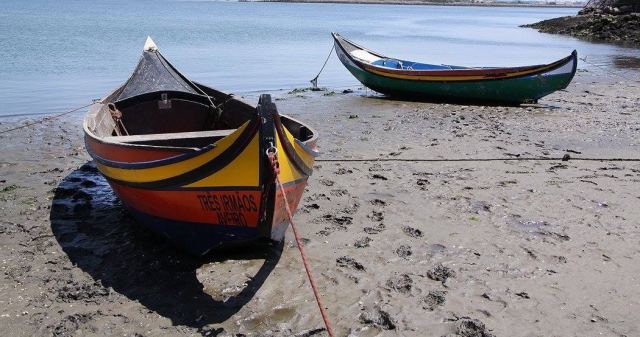
wooden fishing boats

Near Aviero, Portugal; photo: David Sloan

Today, I was thinking of Portugal. Nice memories. I went through my digital photographs, found this one, and fell into reverie. It is amazing how images enhance memory or enable us to embellish it. Sometimes, that is where a poem begins.

When my physical body walked upon this sand, beside this bay, the encounter was a mix of new–a place I’d never been before–and familiar or expected: smell of brine and fish, the feel of breezes in my hair and on my skin, of damp sand underfoot. I recall my delight at seeing the vividly-painted wooden boats, though I had certainly seen paintings and photographs of similar fishing crafts, so their appearance was not surprising. That’s because I have a friend who is an expert in wooden boat-making, Simon Watts; he has been around the world examining wooden boats and had told us to watch for these along the coast of Portugal. Simon is a teller of stories, as is his sister Marjorie Watts. So many hours Simon has regaled us with tales of the writing life, the sailing life, the traveling life, the woodworking life, his forays in Portugal…

Back to Portugal. I think of a most pleasant week there, not so long ago. Mind hums with possibilities. With images. With words.

~

This post is an effort to illustrate how image, memory, sensory experience, stories, human connections, and activities bounce around the neurological synapses while a person experiences reverie.

It isn’t reverie, of course, because I am writing; true reverie seldom includes much activity. Let me suggest the paragraphs and picture are somehow analogous to the reverie process, which often leads to imagination.

~

Next stop: Imagination! train 1And perhaps even a draft for a poem.

 

Resilience

A couple of poets whose blogs I am “touring” this year have mentioned resilience. Sometimes resilience is coupled with persistence; generally, the topic revolves around how to sustain one’s writing practice when all is not going well. When there are rejections, interruptions, failures…when the writer cannot seem to carve out time to write, when support for creative endeavors is lacking.

Kelli Russell Agodon just posted a response to Lori McNee’s 5 traits of successful artists. Sure enough, one of the five traits is resilience.

Here’s an excerpt.
~
“Successful artists are resilient. They know that success does not happen overnight – it requires hard work. These artists understand that things don’t always work out the way they expect. When they make mistakes, they focus on solutions, not on regrets. They learn from experience and experiment to improve on any success they have.”

Agodon’s response is that “some of the best poets aren’t the ones who are the best, but they are the ones who won’t stop writing, who won’t give up. They don’t let a rejection, a NO, a missed award, an overlook, stop them.” She cites the example of a colleague who does not submit work: “the rejection part was too hard to handle. It’s a loss for the readers in the world when that happens.” And then she adds:

I have made huge mistakes as a poet, from sending my Visa bill in with a snailmail submission, to missing a deadline, to writing a terrible poem and thinking it was good. We all do it (okay, maybe not mailing in your Visa bill), but mistakes will be made, failures will happen, and so what.
Keep writing.”
~
Which is resilience. I have counted myself lucky to possess the resilience trait, as it may be the thing that has kept me living with my tendency toward depression, kept me if not balanced at least…springy. If you have followed this blog for awhile, you may notice that most of the header photographs over the years have been grasses, wand-like branches, gently-bending blooms, eclipse-shadows of leaves, waterfalls. There is a reason for that: I am reminding myself to bend instead of break.
~
Criticism is valuable. Mistakes can teach. Failures are not the end of everything good in the world, even if they feel that way in the first moments. Keeping on is all we can do, really. So I am signing off now to tend to my poems, my journal, my notes–and to the tall weeds in the meadow, swaying in wind that foretells a storm.


First person, continued…

When a poem employs first or, in some cases, second person, readers generally assume the stance is the writer’s. (For more on this, see previous post.) I won’t deny that that is sometimes the case, a situation which has led to the contemporary idea that a poem is always a form of self expression–yet another assumption that is only true in part.

My Best Beloveds have been known to accuse me of writing a lyrical narrative incorrectly. “That isn’t how it happened,” they say–and they are right. But poets are not journalists, nor even memoirists. A poet chooses the event, image, or story that will make the poem do its best work which, dear readers, is not necessarily factual.

Even relationships may be imagined, or imagined from a different-than-expected point of view. The poem may have emerged from a prompt having nothing to do at all with the poet’s own relationships or experiences, and yet seem true.

Here is an example of how the first person (lyrical narrative) point of view may or may not reflect the writer’s actual experience. In the example below, revision, change of stance, and allusion make this “father poem” not about my father, exactly. (For a poem that is about my father, as I imagined his experience, see this post.)

I began this poem when I came across the Chuang Tzu quote. Call that my “writing prompt.” As my father had been dangerously ill at the time, the aphorism resonated. Yet the poem did not seem to head where I thought I wanted it to go…to be specifically “about” my own father. The allusion to the Chinese sage does not feel much like my own family–the image did not jive with my parents’ backgrounds. I tried the poem without the aphorism, and it became totally boring. I returned the quote as an epigraph and tried couplet stanzas then, developing the image of old slide projector screenings (pardon the pun), something I recall vividly from my childhood.

Then, my dad’s condition improved. He recovered. I put the poem away for awhile, and when I went back to consider it, I realized the poem did not need to be about him. Or about me, for that matter. It’s still a poem in progress but works better now.

Who is the “I” in this poem? Shall I let the reader decide?

~~

莊子

Familiarity

The sage Chuang Tzu says, when you step
on your parent’s foot you know
you are already forgiven.

My father’s no sage,
just an old man beginning to die.
Unable to smile at his pain

he smiles at us
at my mother holding his hand
at my sister holding her anxious thoughts;

he smiles at her fears and they seem
translucent, like slides projected
on the wall, pictures of our childhoods

hovering near, colorful but not crisp—
and instead of our rounder faces
and smaller forms fading

he is fading, sallow among the sheets, white screen,
blank wall, and he’s forgiven me in advance
for all the injuries I may do

treating me with gentleness
though I’ve trod upon his foot
again, and again, and again.


~

continuum

The poet’s “I”

So often, when reading a poem written using the first-person perspective, my initial reaction is to consider the poet as the narrator–even though I ought to know better!

When I revisit the poem, when I analyze or interpret it on a more abstract or intellectual level, my view may alter. Interpretation sometimes leads me to decide that the “I” in a first-person poem may be a persona, a stand-in for the poet, or a perspective not of the poet’s personal experience but imagined or constructed. The foregoing are reasons to read and interpret poems with care and not to conclude, automatically, that the poet is writing from or of her own experience.

This makes poets sound like rather slippery or manipulative characters, employing use of the personal pronoun to mislead readers into believing something that isn’t “strictly true” (whatever that means). If I am telling a story, surely it must be my story; and if it isn’t my story—shouldn’t I confess that to my open-minded, engaged, possibly gullible reader? If a poem falls into the category of lyrical, readers tend to believe that the writer and narrator are one and the same, despite a reminder in the glossary of terms that the narrator who “expresses personal feelings” may be “the poet, the poet’s persona, or another speaker.” In other words—not the poet’s own feelings, despite the apparent authenticity implied in the use of the first-person pronoun.

Readers may feel betrayed by the writer. Yes, that happens. It also happens that rather awful human beings have penned soaring, beautiful, compassionate poems, because people are complicated and flawed and society often harms us.

And perhaps writing, in some complicated way, can redeem us. I’m not entirely convinced of that; but I do know that I have written poems that basically construct an experience or type of feeling I can imagine but do not authentically know, and that the work of having written such poems has felt like an enrichment of my own experience.

I have been asking myself why and how it happens that poets sometimes—often, perhaps—end up composing texts from other points of view, masquerading as their own. There seem to be a couple of reasons, one of which is simply that we practice writing by using our own much-loved poems as models. The lyric poem has a long history, and even autodidactic students of poetry eventually find that the biographies of some of their favorite writers do not correlate perfectly with the works themselves.

The lyric narrative has been around for less time, gradually supplanting the epic by drawing upon the ballad. And it’s here that readers often get confused about who is the “I” that tells the story, especially when emotional expressions of one kind or another enter the narrative.

I have more to say about this aspect of the poetic stance, the poet’s voice, and the lyrical narrative as lived or imagined experience. And about how that sort of thing evolves during the writing and revision process—with an example or two. But that is for another post. Meanwhile, I am mulling.

Image: Monterey Bay Spice Company

Mulling Spices

Filling the world with poems

Taking part in the blogging tour means trying to keep up with what other poets have been posting, and in the process raising my own writing frequency. Recently I’ve read several writers’ insights about, fears of, and approaches to the process of submitting work for publication. I have also had several in-person and by-email discussions about the perceived or genuine value of publication of one’s work, and some advice on how fervently to pursue publication (and in which venue).

A perennial topic among literary types:

http://ofkells.blogspot.co.uk/2018/02/on-rejection-and-some-advice-from-drag.html

http://webbish6.com/what-ive-learned-from-my-millennial-friends-as-a-gen-x-writer-or-how-to-submit-like-a-millennial/

https://uniambic.com/2018/01/24/poetry-submission-strategy-whatever-works-for-you/

http://webbish6.com/the-importance-of-resilience-in-the-poetry-game-and-in-life/

https://lissaclouser.com/2018/01/26/accepted/

https://lissaclouser.com/2018/01/30/scared-to-submit-yer-poems/

~

I’ve also read articles urging poets to consider submitting on a “tier” basis. First-tier journals are the long-standing literary magazines such as Poetry, The Paris Review, APR, and the better-known university-affiliated literary journals. The tiers move down from there, and it gets complicated deciding whether a lively, well-visited online site is a “higher tier” than a lesser-known print venue.

A friend advised me not to post drafts or unpublished poems online, as they are then ineligible to appear in most literary venues, online or in print–generally, these journals want first-rights for publication. These concerns once mattered to me; I no longer care.

Why the change?

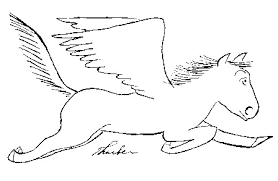
My outlook has moved on. I’m not seeking an academic appointment or a job teaching creative writing at the college or graduate level. I’m no longer starting out–I’ve had my poems published in literary venues of many types since 1981! If I haven’t made the “top tier,” maybe I never will; I still submit to those journals now and then, but I set no store by their rejections, though I would be happy if I had a poem accepted by–say–Poetry. [I miss the days when I’d get a little slip of paper with the formatted rejection emblazoned with what a friend calls Thurber’s “Evil Pegasus.”]


pegasus

This image by James Thurber belongs to The Poetry Foundation


My intention in this decade of my life is just to keep writing and to get the poems out into the world in whatever form, venue, media, or technological method may exist. I do recognize that many other poets are either just starting out or trying to secure a career in the writing field–or trying to advance in the university–and for those poets, a concern for the cachet of the journal or venue and the extent of its reach for the correct audience matters considerably. I’m not suggesting anyone take a cavalier approach to publishing; it is serious work (those curious about publishing, see the blogger links above).

Tedious work, for me.

Nonetheless, I do occasionally submit to journals, as the listing to the right with links that sometimes but not always work discloses. Most recently, I am glad to report that I have two poems in Antiphon #22. < The link will take you to the journal in .pdf format. This time, I did not provide an audio file; but some of the authors have, and these are always worth a listen.

Yet another new way of filling the world with poems. Psalms. Antiphons. Moving poems. Texts. Podcasts. Anthologies. Journals. Websites. And more.


Manuscripts

A draft, inspired by the book Meetings with Remarkable Manuscripts and related to a series of poems titled “Self Portrait as…”

Self Portrait as Illuminated Manuscript

This one exhibits some damage:
a missing folio, signs of mildew
and rodent chewing—calfskin a protein
and rats inevitably hungry.

It lacks signs of eminence (even books
have breeding), meant for use
and not for show. No burnished gold
for the initial letters, no sign of patronage

or dedication, though the illustrator
had a talent for small birds and
winsome sheep. The marginalia’s
interesting for what it doesn’t record–

genealogy absent, no list of relics
or property. The uncial style, workman-
like and unremarkable; the parchment
rough, irregularly cut; the binding,

late 18th century, carelessly done.
Yet any medieval manuscript is rare,
expensive in its era, product of cutting,
scraping, grinding, sewing, economies

of the book. Scribe correcting his copying
error, following his exemplar. Illuminator
in his carrel, sketching foliage and dove,
flair of alphabet and the glory of god.

If somewhat the worse for wear after
six or seven centuries, anonymous,
modest, pedestrian, this manuscript’s
survived. That is one of its merits.


Honestly, I originally wrote the last line as “That is its only merit.” But I felt that was disingenuous, particularly given the title and the series of poems I’ve composed on this semi-ekphrastic self-portrait theme. Probably I possess other merits. As would any surviving medieval book.    🙂