Support for poetry

It is April, and April is National Poetry Month, among many other things that April is.

2017npm-poster_0People have told me that poetry has helped them through times of fear and times of grief. That’s a familiar response when, on rare occasion, I happen to tell someone I am a poet. The thing is–I am not sure poems do that for me. Maybe writing poems helps, but reading them sometimes hurts even more.

Not that hurt is such a bad thing when one is grieving; there is the comforting recognition that sorrow is a shared experience, that others have been through and survived pain and sadness, that there is a community of Others who feel compassion and who can express it well and honestly. Too, there are poets I find myself reading when I just need to hear a familiar voice in my head. That familiarity in itself offers a kind of comfort to this reader.

This week, I am turning to familiar poetry voices although I am reading collections I have not read before. Jane Hirshfield, Mary Oliver, Wendell Berry. “Old friends” of mine.

I am not contributing to National Poetry Month much this year: I am giving no readings and attending only a few. My contribution this year is to book-buying: I have made several purchases of books by poets I do not know well or who are completely new to me.

Book-purchasing from small independent presses and through the poets themselves–not through Amazon, not second-hand–supports poets and poetry publishers. Another way to support poets is to borrow poetry books from your public library, so that the books are noted as “circulating” and thus are less likely to be culled when the library updates its collection.

Love can be expressed and shared in many forms. I ❤ poetry!

Citizen scientist

From as far back as quite early childhood, I have been interested in science: zoology, botany, biology, entomology, physics–if I had been mentored differently, I might have become a researcher instead of a poet. I possess that quality of curiosity that pushes for details, a trait that people refer to as ‘geeky.’ For me, it is fun to contribute my backyard observations to The Dragonfly Woman’s research or to the Eastern Pennsylvania Phenology Project, which asks for assistance from ‘citizen scientists.’ This evening, I am taking some elderly best beloveds to a fundraiser concert for March for Science.

17498711_10158425599030261_5744494573695525358_n

March for Science logo. The March is April 22, 2017.

~

Empiricists have to begin as observers, and here’s where my science and poetry passions twine. Today’s backyard notes involve gray squirrels and the hypothesis that they learn behavior swiftly through their (many) generations.

My backyard is essentially a lawn and meadow, quite open, with two pear trees and a quince almost halfway between the property lines, both of which feature narrow woodlots and brush hedgerows. For 16 years, we had a dog; between the dog’s presence and the fact of hawks–of which there are many–gray squirrels seldom ventured from one side of the property to the other. Both woodlots are replete with walnuts and sumac and wild cherries, so squirrels really did not need to get across the meadow.

As of last year, though, they have learned they can cross the lawn in relative safety, as long as they exert haste and stop nowhere along the way. The dog died, but the hawks are still around.

27

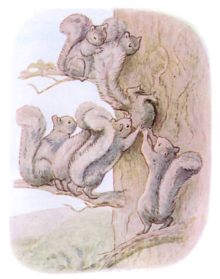
Gray squirrels by Beatrix Potter, “The Tale of Timmy Tiptoes.”

They may have learned this behavior last summer, when a mid-season drought led to very thirsty squirrels who were brave enough (no dog!) to dash to the pear trees and harvest pears. Juicy!

So now, they race across the lawn…to have sex. Squirrel sex is a frolic of prinking, rolling, tumbling–a bundle of tails and feet, a flurry of gray and white fur at the foot of a tree, dry leaves scattered by the wrestling. Then the pair scurries off side by side. Today is actually the first time I have witnessed squirrel mating, though clearly it occurs frequently to judge by the numbers of these creatures in our yard.

~

19

From Potter’s “The Tale of Timmy Tiptoes”

I think of Beatrix Potter as an excellent example of the citizen scientist. While her paper on mycology concerning the reproduction of fungi via spores [“On the Germination of the Spores of Agaricineae“] was not accepted as science at the time she wrote it, her observations were correct.

Her drawings of animals are marvelously accurate, even when she puts them into dresses, jackets, bonnets, and tiny slippers. Though she personifies them, she chooses human attributes that suit animal behavior rather than the other way around.

~

Science, then, is close reading of the world’s phenomena, not really so different from literary scholars with their close reading of texts. Poets also view the world with close reading–observation, curiosity, changing perspective–asking questions about what we think we know. And revelations sometimes occur. Like squirrel behaviors, including squirrel sex; like spores, and the life cycle of salamanders, and dragonfly swarms.

The 4 Cs

white

Sometimes, when I am in reading-after-a-hard-day-at-work mode, I feel mentally unprepared to tackle difficult books. On such days it is better to settle on the sofa with a glass of chardonnay and a text that entertains as well as informs. I confess that Ruth Whippman’s America the Anxious: How Our Pursuit of Happiness Is Creating a Nation of Nervous Wrecks had me snorting my wine a few times; her wry British cynicism kept me giggling even when her observations strongly critique some serious aspects of the culture and nation to which I belong.

In her book, Whippman finds understandable fault with the commodification of happiness, but she also threatens an American sacred cow: the concept of individual happiness that arises from our foundation document concerning our rights to life, liberty, and the pursuit of happiness. Implied in her critique of the American “happiness industry” (including positive psychology, attachment parenting, yoga, mindfulness, Facebook…) is that maybe our nativist stance of rugged individualism and the freedom to make money on anything we can capitalize upon, thus pulling ourselves up by our own bootstraps, does not result in “happiness.” (Maybe Jefferson meant something else by that term. We cannot really know.) One reviewer mentioned that it is just Whippman’s “outsider” status as a person not raised in the USA that makes her book so useful. Changing one’s usual perspective, as I constantly reiterate to my freshman students, can hardly fail to be a valuable exercise in critical thinking and broadening one’s outlook.

Here is an observation of Whippman’s with which I heartily agree: “If happiness is community, then a psychologically healthy society takes collective responsibility for the well-being of its most vulnerable members.” I agree, however, because Whippman’s conclusion happens to coincide with my culture, upbringing, or perspective. Like her, I am willing to accept contentment–with occasional bouts of joy–rather than run relentlessly after happiness; and like her I find most contentment among human beings, though I may want them to shut up and just hang out quietly in the same room with me for awhile! Furthermore, it increases my happiness when I know that in my community (or nation), other people are cared for, not just me. In my point of view, happiness–including personal happiness–arises when I know that all human beings have their needs met.

But I recognize that not everyone will agree with Whippman’s, or my, conclusion that community is happiness; indeed, there is a good argument to be made for Sartre’s “Hell is other people,” too.

~

Recent discussions on diversity among fellow people employed in academia (what it appears to mean, what it might include) and reflections on mortality, consciousness, the notion of the self–and spirituality and religion–not to mention science writing on evolution, have pushed me into a deeply introspective mode. Yet I find I want to converse with other people about these ideas, not hole up in my own head; I seek, and have been happy to participate in, discourse with others.

In another word: community.

~

Here’s a paragraph from Daniel Dennett’s Breaking the Spell that I want to share with my students:

If you can approach the world’s complexities, both its glories and its horrors, with an attitude of humble curiosity, acknowledging that however deeply you have seen, you have only just scratched the surface, you will find worlds within worlds, beauties you could not heretofore imagine, and your own mundane preoccupations will shrink to proper size, not all that important in the greater scheme of things. Keeping that awestruck vision of the world ready to hand while dealing with the demands of daily living is no easy exercise, but it is definitely worth the effort, for if you can stay centered, and engaged, you will find the hard choices easier, the right words will come to you when you need them, and you will indeed be a better person. [italics Dennett’s]

Complexity, community, curiosity, contentment. The four Cs?

Oh, let’s add chardonnay. Make it five.  🙂
Beautiful brain

While waiting for the snow to evaporate and melt, the gardener experiences agitation; the days are longer–it must be time to plant seeds…but the soil is too wet and too cold.

Fortunately, there are always books! I have read Daniel Dennett on religion, George Lakoff on the embodied basis for philosophy, and am plowing rapidly through Ruth Whippman’s (acerbic and very funny) America the Anxious.  Also I am slowly savoring an anthology of Jewish women’s poems, The Dybbuk of Delight, that I randomly discovered in the library.

beautifulbrainbook04-1080x644

But here’s a book I want to own, when I can justify more book purchases: Beautiful Brain: the Drawings of Santiago Ramon y Cajal, because Art! because Neuroscience! because Beauty! The blog Hyperallergic says the drawings are going to be touring museums (see The Dynamic Brain Drawings of the Father of Neuroscience), which might also become a must-do for me when the exhibit travels to New York City next January.

What Cajal was doing back at the turn of the last century still inspires artists, not just medical scientists, today (see my post on Greg Dunn’s neuro-artworks). These compellingly beautiful and quite accurate drawings may also inspire poets and armchair philosophers who have lately spent a great deal of time pondering the resilience of the brain and the challenges that rupture a sense of self when cognition is interrupted.

beautifulbrain01-1080x1373

~

Credit goes to Abrams Books for these graphics and for the decision to publish this beautiful text.


Randomness & poems

The past weeks unloaded upon the blogger a host of responsibilities and reasons for reflection: reams of student essays to read and grade, piles of snow and the resultant delays and work closure leading to backlogs, and such usual complaints. In addition, the dropping-of-everything while attending to the death of our no-longer-resident nonagenarian, not to mention the bureaucratic heaps of forms and notifications that follow a passing.

I’m writing poems. It seems to be what I need to do at present, despite the state of my household environment and the backlog at work.Untitled-writer

~

The blizzard put my gardening on hold, though I remembered to purchase some seeds and thus can get to the tomato-starting process within a week or so. Before the snow came, I did get outside to prune and deadhead a bit while the weather was unseasonably warm. A little at a time. Such things are sustaining to me, emotionally.

And watching the birdfeeders has been soothing and delightful. Today a small nuthatch joined the party. My youngest cat spends large segments of his day crouched by the window, as fascinated as I am (but for different reasons, I suppose).

scoot window

~

I am thinking of a friend-in-poetry who has need of special care and financial assistance while going through and recuperating from some extremely painful, delicate, dangerous and potentially-disabling surgery-&-rehab. She will need more than the initial $4K this GoFundMe portal suggests, so if any of my readers feel inclined toward a random act of (financial) kindness: Jessamyn’s Medical Fundraiser. Thanks.

~

Addendum: Yes, I’m sticking to my determination to read more poetry. And it is helping. Most recently, re-reading early Li-Young Lee, Mark Doty’s Deep Lane, Dave Bonta’s Ice Mountain: An Elegy, and a really wonderful new collection by Kim Roberts: The Scientific Method.


Problems of moral order

“Authority in the moral sphere is modeled on dominance in the physical sphere. The moral authority of the parent over the child is metaphorically modeled on the physical dominance of the parent over the young child…it is a metaphorical model in which the logic of moral authority makes use of the logic of physical dominance.”   –from Philosophy in the Flesh, George Lakoff & Mark Johnson (p. 301, my italics)

Here is a problem: “folk philosophy” assumes that the moral order is the natural order, a logic much used in the dogma of many Western religions; but Lakoff and Johnson point out how such suppositions lead to “a hierarchy of moral superiority and authority.” Because we are corporeal, physical phenomena in a physical world and our initial human relationships get established through the parent-child model, human beings have a hard time escaping the physical dependence-physical dominance-physical responsibility metaphors, which we incorporate into our languages and philosophies.

There is no reason to refute or escape such metaphors, fundamentally embodied as they are, as long as we are aware of them. For people who accept physical dominance as the natural order without recognizing it as evolutionary and metaphorical, however, the logic that [this metaphor]=Natural Law=Moral Order can be harmful.

And not just to them but to their families, their neighbors, and their societies.

Lakoff & Johnson write, “The consequences of the metaphor of Moral Order are sweeping, momentous, and, we believe, morally repugnant…the Moral Order metaphor gives us a better understanding of what fascism is: Fascism legitimatizes such a moral order and seeks to enforce it through the power of the state” (p. 304).

The authors later note that “the view of moral concepts as metaphoric profoundly calls into question the idea of ‘pure’ moral reason” (p. 330). In other words, pretty much all of Western philosophy since Aristotle. Which makes me contemplate whether that question also suggests there is no “pure” abstract consciousness–whether there is any me (I do not mean Ego here) without the body I inhabit.

content

Then again,  Dürr’s speculation that memories exist as data–a kind of cloud network, as an analogy–and somehow persist, merits some consideration. I find Lakoff persuasive, however. I know he has since added to, altered, and labored on the concepts laid out in this 1999 book.

The foundations and evolutionary development of our families, tribes, and languages create our philosophies; this much seems as certain to me as anything–and thus arrive in our collective consciousness as metaphors, stories, poems.


Nesting

When I go out of doors on a splendid day, I keep finding things to observe and tasks to do–before long, I realize I have spent more time than I intended (and indoor tasks are calling). Today’s yardwork entailed cutting back weed brush and vines before the trees and shrubs leaf. It can be challenging, as it requires the intrepid gardener to crawl into the woodlot and under the large pines and tamarack to yank loose entwined wild grape, Asiatic rose, elderberry, blackberry, and poison ivy stems, there in the tangled vitality of plants-that-thrive-where-I-don’t-want-them.

The mourning doves kept me company with their coos, and small birds busily checked out the birdhouses in the meadow. Soon it will be nesting time (already is, for the owls).

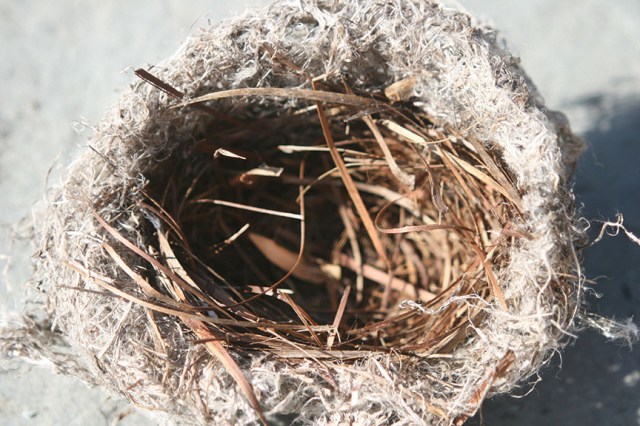
Always, when I cut brush, I find last year’s nests. Look at this one:

oriolenest

A bird made this! Probably an oriole. It is a sweet little bag woven or knitted without any tools but the animal’s own body. Beak and feet, saliva, and the nestling body rounding out the basket within.

Here, you can see the interior of the nest; I folded back the strong but delicately-woven sack and the interior nest is visible.

nest2

I was a little surprised at how well the bird-made mesh held up as I handled it. It is really resilient–those birds know what they’re doing!

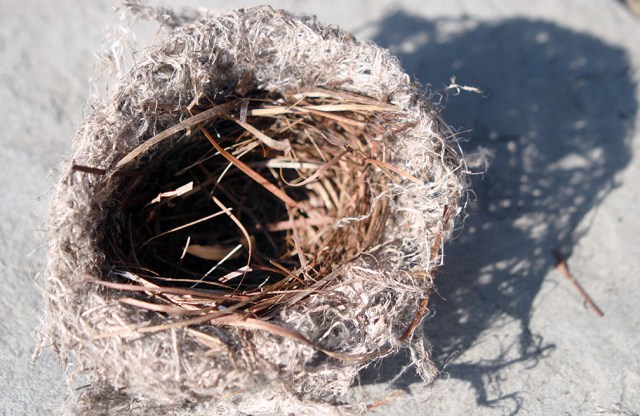
Here is a more detailed photo of the little nest-basket inside of the sack:

nest4

The process of gardening heals me in so many ways. I sense the need to write poetry again, and I get the urge to tidy up the landscape and prep the vegetable patch. Things will return to themselves in their own time and their own ways. The birds return. The flowers return. My own nest needs attention, and the energy for that attention will also return.

Give it time.

In this photo, the shadow on the right shows how porous the nest’s weave is, almost like macrame. It seems like a miracle to me. And so beautiful.

nest3

Spiritual quantum fields?


Herewith, an intriguing paragraph about physics, biology (the brain), and consciousness:

Wave-particle duality, a fundamental concept of quantum mechanics, proposes that elementary particles, such as photons and electrons, possess the properties of both particles and waves. These physicists claim that they can possibly extend this theory to the soul-body dichotomy. If there is a quantum code for all things, living and dead, then there is an existence after death (speaking in purely physical terms). Dr. Hans-Peter Dürr, former head of the Max Planck Institute for Physics in Munich, posits that, just as a particle “writes” all of its information on its wave function, the brain is the tangible “floppy disk” on which we save our data, and this data is then “uploaded” into the spiritual quantum field. Continuing with this analogy, when we die the body, or the physical disk, is gone, but our consciousness, or the data on the computer, lives on.

This comes from a brief article by Janey Tracey on Outerblogs. I spent a few minutes trying to find more on the physicists she quotes, among them Christian Hellwig, also of Max Planck Institute, and Robert Jahn of Princeton. But I have been too busy to follow up by reading papers and books–between semester mid-term and concerns about our Resident Nonagenarian, who is at present “declining” toward death, things have been…challenging. We are experiencing with our best-beloved the waiting period as the corporeal body shuts down organ by organ, bit by bit, consciousness becoming semi-conscious, then intermittent, and unresponsive, as the mind enters that realm none of us can understand.

Life closes in many ways–swiftly, at times, but more commonly in increments. This death is not the one our best-beloved would have chosen (in one of her recent moments of clarity: “This isn’t what I wanted,” she said). Alas. The slow, to all appearances agonizing, shutting-down toward death probably rates low on most people’s desires list.

The Rolling Stones warned us you can’t always get what you want [skip the ad, listen to the rock n roll]. I suppose that song has already been uploaded onto my spiritual quantum field. Not to mention the spiritual quantum fields of millions of humans. If Dr. Dürr’s speculations are correct, that may mean Mick Jagger, Keith Richards, et al are among the immortals already. And while I am mentioning this possibility with a sense of humor, I do ponder the interesting concept of a quantum code that encompasses human memory-processing, experience, and mind. It seems to be distinctly likely that consciousness is a tangled hierarchy.

Tangled hierarchy as in strange loop, or paradox, explained in Goedel’s Incompleteness Theorems. Douglas Hofstadter, trying to get his mind around the problem of consciousness, suggests that such a “flipping around of causality” appears to happen in minds possessing self-consciousness. The mind perceives itself as the cause of feelings, thoughts, etc. Our 20th-century scientific models posited that feelings and desires are caused solely by the interactions of neurons.

Though maybe quantum theory and biophysics and 21st-century neurological psychology studies will indicate we are still pretty far from the Whole Story.

Meanwhile, one story of one person draws nearer the close. No–that is not the case. The body will die. Her story–her many stories, told from many perspectives, her paradoxes, her own strange loopiness–91 years has only been the beginning.

300px-magrittepipe1928lacomuseumart

Rene Magritte “The Treachery of Images” 1928. Los Angeles County Museum of Art


Complex ambiguities

Rebecca Solnit from Ploughshares, May 2016: “We live in a time when …purveyors of conventional wisdom like to report on the future more than the past. They draw on polls and false analogies to announce what is going to happen next, and their frequent errors… don’t seem to impede their habit of prophecy or our willingness to abide them. ‘We don’t actually know’ is their least favorite thing to report.” [My italics.]

I am the sort of reader who loves to hear experts announce “We don’t actually know.” But I recognize I am in the minority–in this respect–in my culture. That most Americans are willing to abide such speculative prophecies worries me a bit, and I do what I can in the classroom to waken my students to the possibility of erroneous thinking, even on the part of supposed experts and aggregate sources.

Yes, once again I am teaching argument to freshmen…the classic example of what Solnit calls naïve cynics:

Non-pundits, too, use bad data and worse analysis to pronounce with great certainty on future inevitabilities, present impossibilities, and past failures. The mind-set behind these statements is what I call naïve cynicism. It bleeds the sense of possibility and maybe the sense of responsibility out of people.

Maybe it also says something about the tendency to oversimplify. If simplification means reducing things to their essentials, oversimplification tosses aside the essential as well. It is a relentless pursuit of certainty and clarity in a world that generally offers neither, a desire to shove nuances and complexities into clear-cut binaries. Naïve cynicism concerns me because it flattens out the past and the future, and because it reduces the motivation to participate in public life, public discourse, and even intelligent conversation that distinguishes shades of gray, ambiguities and ambivalences, uncertainties, unknowns, and opportunities.

Scholarly argument should ideally create discourse, not embattled absolutism on things that cannot ever be “proven.” In fact, I have forbidden my students to employ the word “prove” (or any of its conjugations) in their argument papers. They know my rationale for this lexical excision; I also warn them away from “always,” “never,” and “everyone.” But they are not yet experienced enough critical thinkers to recognize that my practice is also to encourage research and nuance, to shove them (gently) out of their naïve cynicism into the world of no-easy-answers, no-slippery-slope-thinking; a world of wonderfully complex ambiguities waiting to be more fully explored.

I think of my oldest child who, many years ago, was insistent on knowing ahead of time how everything was going to turn out: “Does the movie have a happy ending?” “Does the Little Red Hen get anyone to help make her bread?” “Can I win this game?”photo ann e. michael

Raising a child who is temperamentally anxious requires a form of parenting that offers comfort but admits to unknowingness. (Next up on my reading list: America the Anxious, by Ruth Whippman!) Solnit says the alternative to naïve cynicism is “an active response to what arises, a recognition that we often don’t know what is going to happen ahead of time, and an acceptance that whatever takes place will usually be a mixture of blessings and curses.”

I don’t think I have ever heard a more accurate description of what being a human entails.

Story as vagabond: Intizar Hussain

Kahani to awara hoti hai. Story is a vagabond…My nani…used to tell me a story in which a girl says to her father, “I love you as much as salt.” My nani didn’t know about King Lear…She belonged to a tradition of storytelling in which space was unbounded and time was fluid; the hero could travel across forests instantly, and ignore borders separating Heaven, Earth, and Hell. Fairy princesses and monkeys spoke classical languages, and trees and birds told stories. This made for a more generous world, and, of course, a more imaginatively vibrant one; and it made the question “What does it mean to be human on this Earth?” a genuinely inclusive one–because the answers had to account for our relations with everything around us. It is because I am an inheritor of this way of thinking and being in which boundaries are always porous, always shifting, that I can accept that there is a grave of a Muslim disciple of Krishna in Brindiban…

~Intizar Hussain, Pakistani (but, earlier in  his life, Indian–from Dibai) fiction writer, from an interview with Alok Bhalla in Manoa journal. [The surname can be spelled either Hussain or Husain in English.]

33414458Bhalla–one of several translators of Husain’s work into English–comments during this interview: “The poet-storyteller is both blessed and cursed; he is exiled from Heaven and the courts, but he understands how integrally he is ‘of this Earth’–that is, secular. This seems to be the tradition in which you have been trying to locate yourself. Isn’t that why both the religious fanatics and the ideologically motivated find it difficult to accept you?”

~

Earth–we are embodied of earth, part of earth, indivisible from our earthliness, and we exist in relation to the things of this earth.

It might be wise to stay mindful of our necessary integration with all things earthly and embodied, to recognize how intricately we are connected. Bhalla, whom I met at this year’s AWP, mentioned that Husain was fundamentally opposed to identity politics; in  his generous inclusiveness, he believed that to define oneself under a single identity forces boundary-relationships with others, that tribalism has led to nationalism and thence to genocide in far too many instances of human history.

Naturally that means he had a fraught relationship with Pakistan itself, and–to quite some extent–with Islam [he upheld the notion of Mussalmani]. He was revered enough and diplomatic enough to keep those boundaries porous and those relationships open.

Few of us will ever be as wise.

~

This lovely issue of Manoa features cover artwork and illustrations by Imram Qureshi, whose work I walked upon at the Met in NYC, roof garden installation, 2013.