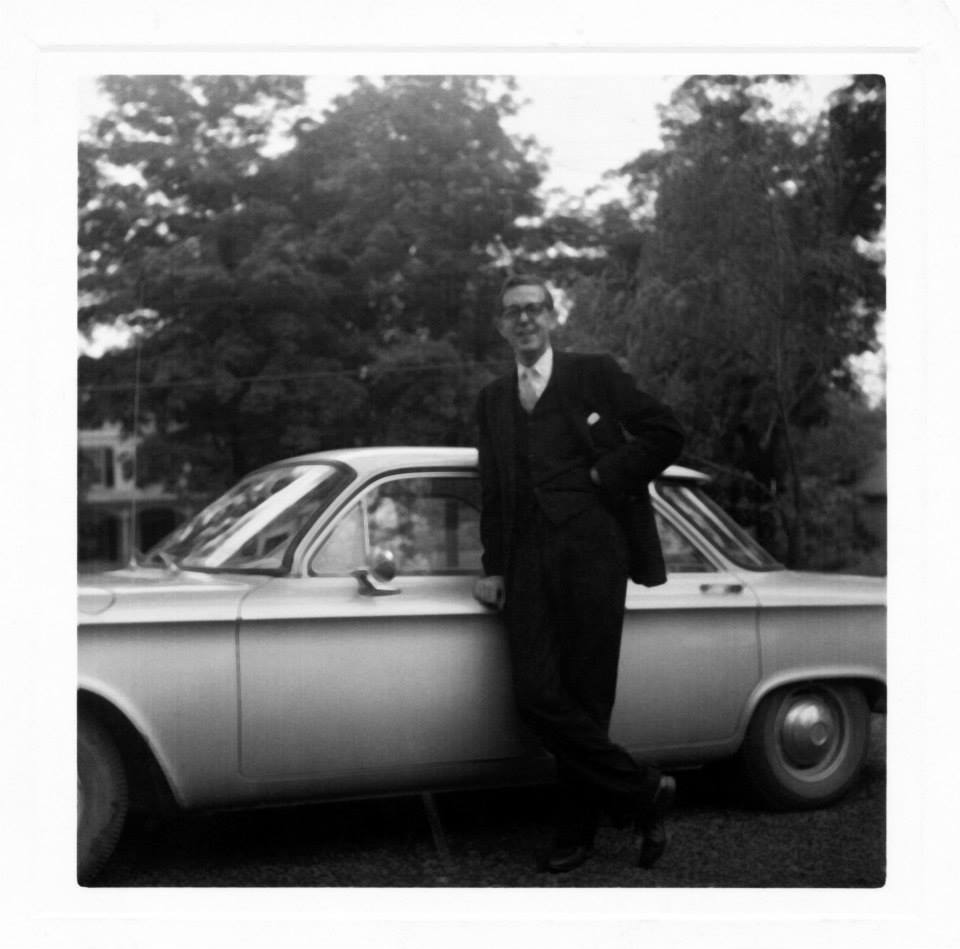
Today, I introduce a guest blogger dear to my heart, my 81-year-old father, Tom Michael.
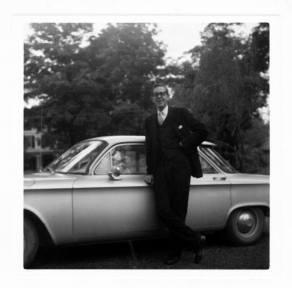
Tom Michael as a young minister in New York.
The March to Montgomery, 1965
by Tom Michael
A memorable experience I want to relate to you happened in 1965, when I was a 32-year-old co-pastor of a tall steeple church, First Westminster Presbyterian Church in Yonkers, New York. The United Presbyterian denomination was committed to the civil rights struggle, even though, as Martin Luther King said, the most segregated hour in the week was 11 o’clock on Sunday morning.
The call had come out from our denominational national committee on religion and race to ask clergy and laymen to participate in demonstrations throughout the South supporting voting rights for Black citizens. Small groups of ministers were asked to march around the courthouse in Philadelphia, Mississippi. My colleague and I flipped a coin and my colleague went down there. It was a potentially dangerous task, but he was able to return home safely.
First Westminster Presbyterian Church of Yonkers NY, 1964
After the first march from Selma was halted by police on the Pettus Bridge, they asked for volunteers to join the Freedom Marchers who had started out from Selma, Alabama on the way to the State capitol in Montgomery. It was my turn to go. So I had the rare privilege of participating in the March on Montgomery for voting rights. While I had very little influence on what happened there, it had an enormous influence on me. It was both an exciting and learning experience for me.
I first had to raise the money to go, so I asked members of the congregation to contribute to my trip. One member, a president of a savings and loan bank, disapproved and spent a long time on the telephone angrily telling Bonnie that I should not go. His wife quietly slipped me some money. That was something I learned about my congregation.
I carried along a change of underwear and some toiletries in an overnight case. That was the second thing I learned: don’t carry a suitcase on a civil rights march. This March I suspect that you will see newsreels of that event as we commemorate the fiftieth anniversary of the march. If you spot a skinny young man with big ears carrying a small suitcase, that will be me.
I don’t recall much of how I managed to get on an airplane, but soon I found myself on Delta Airlines. The stewardesses (remember when there were stewardesses in airplanes?) were lovely young women with southern accents. The pilot came on the intercom to tell us about the flight. He also had a southern accent. I thought, “Thank heavens, the pilot is in the plane.”
When we reached Montgomery we were taken to the campus of a school for colored girls on the East side of the city. There were, I’m told, twenty-five thousand of us milling about. Darkness came. There were two points of light: one, to my right, was a communications stand manned by Gary Collins, a movie actor who at that time was married to Lucille Ball. The other, directly in front, was a stage. We were entertained through the night by an all-star cast: Harry Belafonte, Tony Bennett, Frankie Laine (he sang “Mule Train,” “clippety clopping through the wind and rain,”), Sammy Davis, Jr., Joan Baez, Nina Simone; and we sang, with Peter, Paul, and Mary, “We shall overcome, we shall overcome, we shall overcome some day.”
Late at night we were assigned places to sleep. Mine was in the balcony of a one-room Baptist Church. At the other end of the pew was a man who snored all night long. In the morning I sat up and waited my turn to use the single bathroom. As I waited, I watched in fascination from my balcony perch as a coed with a Purdue University sweatshirt combed her blond hair into a beehive hairdo. That was the third thing I learned, though I don’t believe it has done me much good.
After breakfast we waited around the grounds for the march to begin. I happened to meet up with Dr. Gayraud Wilmore, whom I had met when he attended a Presbytery meeting to inform us of his work as executive secretary of the United Presbyterian Commission on Religion and Race. He was accompanied by the Rev. Metz Rollins, who was a field director for the United Presbyterian Board of Christian Education. As we were chatting, a white southerner walked up and was greeted by these two. They introduced me to him. His name was Myles Horton, founder of the Highlander Folk School in Tennessee. This school was responsible for training Rosa Parks, James Abernathy, John Lewis, Martin Luther King, Jr. and many others in the skills and tactics of non-violent resistance. While we were talking, a man joined us, and he was introduced to me as Charles Evers, brother of the slain civil rights worker Medgar Evers. As I shook his hand I said, “It is an honor to meet you.” He acted as if he didn’t believe he deserved that, and I learned later that he had spent time in Chicago engaging in criminal activities. Then a Union Theological Seminary classmate of mine, who was there from his home in Minneapolis, came by.
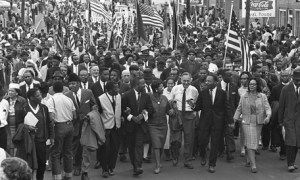
AP photo 1965
At long last the march began. We walked into the city on a main street that was lined with houses. Many of the locals were sitting on their front porches looking rather grim as thousands of us so-called outside agitators filed past. I caught the eye of one woman on her front porch and motioned to her to join us. I received a most hateful response.
My seminary classmate had offered to write dispatches for his local newspaper, so as we marched along we caught up with a slightly built older man. My friend decided to interview him. When he asked his name, he replied “Willard Uphaus.” Uphaus, a Methodist lay preacher, led a social action group with summer headquarters at Conway, NH. The New Hampshire Attorney General, empowered by the State Legislature to investigate subversive communists, demanded that he turn over the names of guests at the World Fellowship of Faiths. Dr. Uphaus freely testified about his own activities but refused to provide the names of others. In 1956, he was found in contempt by the Superior Court in Concord, NH. After the conviction was upheld by the United States Supreme Court in a 5-to-4 vote in 1959, Dr. Uphaus spent nearly a year in jail.
I began to think I was in Bunyan’s “Pilgrim’s Progress,” meeting up with stalwarts of the faith as we made our progress toward the Alabama State House. When we arrived there I took up a position in the center of the street in front of the statehouse. At the far end on the right side was an American flag. On the left side near us was the Confederate flag. I found myself resenting that flag. It was a slap in the face of all the descendents of slaves who had been oppressed and humiliated.
It was a hot day. I sat on my little suitcase. I had a headache. I thought “I am here. I am nowhere else.” There were several speeches, of course.
Then Martin Luther King gave the final speech, ending with the stirring words, “When will the radiant star of hope be plunged against the nocturnal bosom of this lonely night, plucked from weary souls with chains of fear and the manacles of death? How long will justice be crucified, and truth bear it?…I come to say to you this afternoon, however difficult the moment, however frustrating the hour, it will not be long, because ‘truth crushed to earth will rise again.’ How long? Not long, because no lie can live forever. How long? Not long, because ‘you shall reap what you sow.’ How long? Not long, because the arc of the moral universe is long, but it bends toward justice.”
Then we began the trek to return to our homes. We were told to go to what they called the colored section of the city, to the right of the statehouse. I was struck by the irony that I, a white man, should feel a sense of relief when I crossed into the ghetto. I found Gay Wilmore. He had rented a full sized Buick sedan and was planning to drive to the Atlanta airport with Metz Rollins. I figured that the airport in Montgomery would be chaotic, so I asked to ride with him. My seminary classmate joined us, and a young man from the Student Non Violent Coordinating Committee. He looked fierce with a black beard and dreadlocks, but he was in fact a most gentle young man.
So there we were, three Black men and two white men. We struck out on Interstate 85 toward Atlanta. After a while we needed to get gas and make a pit stop. Gay and Metz peered intently at each service station, asking, “Is that one?” This was another thing I learned. It is one thing to hear about segregated facilities in the South, and it was another to actually experience it. Here were two prominent, highly educated clergy reduced to the humiliation of having to bypass facilities that would refuse to serve them because of their race.
Finally, we found a station that would serve us. For my part, I was not able to tell the difference, but they had lived a lifetime of picking up the subtle clues about where they could be served. After we had finished, Gay Wilmore announced that he was sleepy, and would someone else drive. I was the only one who had my driver’s license, so I took the wheel. At that time the speed limit on highways was 55 miles an hour, and I was observing the speed limit. As I drove along, a string of cars passed us by traveling faster. Then an unmarked state trooper whizzed past and pulled over eight or ten speeders. I drove carefully on the outside lane at 55.
Gay Wilmore said to me, “OK, Tom, if a trooper pulls you over for speeding, just tell him ‘I’m just trying to get these (he used the N word) out of here as fast as I can.’” I guess it was a form of gallows humor. After we left the interstate we traveled in the darkness through small towns in Georgia.*
I carefully observed every speed limit sign, I came to full stops at stop signs, and if a traffic light even hinted that it was turning red, I stopped. Since that time I have observed speed limits and stop signs. You will never catch me traveling more than the speed limit anywhere.
At long last, late in the night, we saw the towers of Atlanta glowing in the distance. It reminded me of the experience when Dorothy and her friends first caught sight of the Emerald City of Oz.
At the airport we took our leave of one another as we boarded our airplanes. Gay Wilmore saluted me in the manner of a French general, kissing me on both cheeks. I boarded the plane and sat next to a man who looked very familiar. I believe he was Ralph Bunche, Nobel Peace Prize winner when he was assistant secretary general of the U.N. I did not ask him who he was, since I believe that famous people should be allowed some privacy; and besides, he immediately fell asleep.
When we arrived in New York I shared a taxicab with an editor of Time Magazine. The taxi driver, an African American, asked us where we had come from, and when we told him that we had been on the March on Montgomery, he said he had been watching it on TV. My companion gave the cabby an address on the upper West Side of Manhattan. I said that I wanted to go to Grand Central Station so I could wait there a couple of hours until a train could take me to Yonkers. The cabby said, “I could take you there.” “But,” I said, “I only have five dollars on me,” and I knew that the fare from midtown to Yonkers was at least three or four times that amount.
“Well,” he said, “You did something for me today, so I will do something for you.” And with that he took me all the way to my front door.
=
*Civil rights activist Viola Liuzzo was murdered by Klansmen the same day, also while driving African American protesters to the airport and bus stations.
~
For another story of the march and some pictures, see this lovely interview with photographer James Barker (on the Smithsonian’s website).