Adventuring

The weather here has been hot and somewhat humid, though it continues to be dry–much drier than autumns used to be. Drought extending past August into October is becoming a more usual thing, according to my garden journal. One plant that thrives this time of year is tithonia (Mexican sunflower), and it attracts monarch butterflies like crazy. These are the monarchs that go adventuring: the super-generation of these insects that makes the 3,000-mile trip to Mexico. Here’s a brief blog from the Xerxes Society that has some quick facts. The monarchs I see in my garden may, if they are lucky enough to survive the trip, live up to 9 months, which is well past the life span of spring and early summer generations.

They are not even returning to a place they know or have ever been. Human science has never yet determined how monarch butterflies of the last summer generation find their way to Mexico. They just go adventuring, floating on air currents, supping on flowers as they travel.

I’m about to go adventuring, as well, traveling further east than I’ve ever been, in the company of one of my favorite persons in the world–my daughter. She and I had long talked about taking a mother-daughter trip together once I retired, and sooner is better than later! She found an environmentally-conscious adventure tour business that offers some really intriguing historical/archeological/environmental hike-and-bus options. We’ll find out whether the company is worth recommending & I’ll report back here, meanwhile keeping our destination unrevealed for now. A little mystery is fun.

While I am taking this trip for reasons beyond writing inspiration, I can’t help hoping it will act as a prompt and opportunity for drafting new poems. I’ve been working on new drafts, and revising older ones; but I have to admit that for awhile my creative mojo has been a bit off. Yes, this happens to any so-called “creative” occasionally, but it never feels terrific. One prefers the juicy, challenging urgency of creative flow. Wish me luck (and traveling mercies).

Correspondences

Dear Beejay,

Remember how we used to correspond by email every week? Sometimes more often. You, the best correspondent ever, though we never wrote paper letters–in those pre-internet years, we’d lost touch, moved too often; no postal mail from you until, once we were connected again, you sent me a birthday card. And tomorrow is your birthday. So here’s your birthday email. You see? I didn’t forget.

It remains dry here. That spate of rainy days in early April? Over with and barely a half an inch since then. I’m watering my veg garden daily. Today I sowed another row of spinach. The first and third sowings are doing well, but the second sowing didn’t germinate–can’t figure out why not. The lettuces and other greens are looking good, and the strawberry plants are in bloom. I even took a chance and planted some zucchini seeds. The task of thinning lettuce and carrots is indeed tedious, but it is a lovely day and the air is mild; and frankly, thinning carrots is less tedious than sending poems out to literary journals, I know you’d agree.

I’ve been reading a lot of contemporary poetry. It comforts me somehow, even when the poems are sad or angry poems (that seems to reflect the times, which poetry can do). Your own writing, who has it? Does it exist on some hard drive somewhere? You always were excellent at organizing things. A talent I envy and do not possess.

Anyway, I did a bit of weeding to prep for the tomatoes and peppers when the seedlings are ready to transplant, but I got a late start on them and may not even move them to the garden until after my trip to New Mexico. Right now we’re getting pollen blow here. I expect your pollen blow was over two or three weeks ago, and that the azaleas are past their showy bloom time down there. I know how you love azalea season. And the beach–I guess you won’t get there this year.

I do find myself, at odd moments, wondering about your cats. When our lives were routine and there was nothing of interest to write about, we could always turn to cat anecdotes. Today, my Nessie joined me in the garden while I was working on the carrot patch. The catnip plant in the herb bed has leafed out quite early, and Nessie stretched his whole lean body over it and lolled himself into a snooze-fest, exposing his white belly. You would have laughed. You always called tuxedo cats “Holsteins.” I’m insulted on Nessie’s behalf.

When a person we love dies, I guess there’s an impulse–almost an instinct–to memorialize them, at least among those of us in “Western societies.” Or maybe it is a human impulse, I can’t say. I have written too many poems of elegy, and there will be more; but sometimes, it takes awhile before I feel I have the right perspective or frame of mind to write about them, or about my feelings of loss. Today, so much reminded me of you, Beejay, that I had to write something. If not a poem, then an epistle–the way I used to write to you, of ordinary things, the garden, cats, seasons, poetry.

Happy birthday, wherever you are.

Re-assessing

Another clear day; we finally got an inch or so of rain on Friday, which was much needed, and since then the temperature has cooled a little. This late in November, it finally feels like autumn. On my morning walk today, I was happy to see this handsome creature airing its wings in the sunshine. Our local turkey buzzards have been active lately. I’m fairly certain that the snag this one’s perched on is a green ash tree, clearly well-visited by woodpeckers.

My low mood seems to have abated, at least temporarily, and I wrote a few poems and revised a few others during the past three days. I’m trying to accept the fact that this year, we will see neither our son nor our daughter for the Thanksgiving and Christmas holidays. So I’m trying to get creative about things to do that we might not have done if we were preparing for family celebrations. Yet we miss the concept of family celebrations. I guess that’s a socio-cultural thing, right? I may need to reassess what value “the holidays” have for me these days.

~

I have also kept myself busy re-assessing a chapbook manuscript I’ve worked on forever (it seems) and am now looking for the sort of small, independent publisher that might consider a hybrid poetry-journalistic/historical work influenced by Muriel Rukeyser‘s long-poem The Book of the Dead. My poem is about a Korean War veteran tried as a traitor upon his return to the USA, a man who was my friend David Dunn’s father. It has been a real creative challenge to figure out how to tell his story, and the resulting text is definitely “hybrid,” with footnotes, magazine articles, military court proceedings, letters, and poems. People who believe that poems simply flow from some internal inspiration would probably take issue with a poem-ish thing like this, but I keep feeling compelled to find a way to tell this man’s story. The unfairness of it, the long-term damage, the people who used him as a scapegoat, his short life (he died at his mother’s, age 39, discouraged and unwell from physical wounds that never healed, divorced, unable to overcome the dishonorable discharge that kept him from gainful employment). David kept losing his father over and over: to prison, to PTSD, to divorce, to death. It’s an all-too-common narrative, but each tale is also deeply and profoundly individual. Hence the need to write it.

Drying up

….and the drought continues into mid-November. This is a very long stretch of dry weather, and the rivers I’ve crossed recently–the Delaware, the Schuylkill, the Lehigh, the Susquehanna–are looking mighty low. Little islands are showing up in the center of the riverbeds. Tree roots visible along the banks. I found this government website that filled me in concerning the current situation. Looking at the charts, wow.

My low mood continues, for a number of reasons: the recent political news, the continuing wars, my mother’s consistent decline, the drought, my physical distance from my grown children on the other side of the continent, a friend’s death, a bunch of recent poetry rejections, the fact that I can’t go into a store without hearing Christmas music…granted, some of these reasons are not earth-shattering but the effect is, well, cumulative. Han VanderHart’s recent blog post speaks to the rejection, reminding me of things I know and should keep in mind. The challenge is just getting through and occasionally finding delights at which to marvel, for the delights surely endure. Ross Gay’s Book of Delights is my book group’s next selection, a book I’ve read before but which–at this particular moment–will probably benefit me when I re-read it.

I also feel creatively dried-up, and that’s dismaying. Reading novels (see my last post) offers peasant distraction but seldom gets me writing my own work. I’ll never be a novelist. I’ve been reading poetry, online and in books, as I always do; yet right now, the poems I have been reading, no matter how wonderful, have not inspired me to work on my own.

I’m not even revising! This is not my usual self, not my poetry “norm,” not a space in which I feel happy or well-regulated or at least inspired. Perhaps I have encountered the dreaded writer’s block. Or rather, a drought of some kind, an inner sluggishness of the imaginative flow. Despite the glorious stretch of sunny days and moonlit nights, the incessant blue sky reminiscent of those high-altitude desert environments I seem to love, despite these delights, I’m discontented.

How very human of me.

Listen, there’s a trio of redtail hawks along the woodlot. Their nasal “screeee” and their graceful swoops between the bare branches catch my attention. Sunlight on the field tells me, “You could at least get outside and take a walk.” Okay. Can do.

Verdancy

This report was posted almost a week ago, and the rainless weeks continue; today, fires are climbing their way along Pennsylvania’s forests beside the Delaware River, which looks almost as low as the Rio Grande in Albuquerque when I was there last month. Okay, I exaggerate a bit–but my alarm’s genuine. “No measurable precipitation” here, whereas Valencia, Spain gets a year’s rain in one day and western North Carolina receives 30 inches in two days. This stuff worries me even more than the upcoming election.

I’m not an alarmist, I’m a gardener. When do people start to admit to, and take action about, climate change? (Sorry, rhetorical question.)

~

One theme of the writing workshop I took with Anita Skeen and Cindy Hunter Morgan, as I blogged about here, was color–color as prompt, color as image, color in ekphrastic work, color as inspiration. One prompt was to write about a color you can imagine hating, or a color that you love. It was autumn, and I was in the desert; so I decided to be difficult and write about loving green. Not typically considered an autumn or desert tone, though in fact the high deserts have more green, and in more shades thereof, than most people expect.

Here’s my draft. I used to hate showing unfinished work around, but now I don’t mind doing it. I find the practice of posting/sharing early drafts instructive (and it keeps me mighty humble).

~

Love Is Verdant

Listen, if I were to fall in love again,
it would be with a color: green.
So many variations and hues
ever-changing, surprising me with wilderness,
forest and pine, sage, olive, and moss,
the craziness of chartreuse,
glossy feathers of the teal.
Green as rushes in swamplands, bamboo
on mountains, diverse as rainforests
and summer tundra lichen, yellow-green
of maple leaves early in autumn,
the pitchy green of piñons high up the mesas.
Sure, there have been times I sought for
love that is constant, but now I know better,
for the only constant is change—and green
can accomplish that with as little as breeze
and sunlight, which are likewise things I love.

~

Photo by Pixabay on Pexels.com

Drought, again

The temperatures here in this eastern Pennsylvania valley have been mild, even warm, which isn’t that unusual for October, anymore. What’s different is the lack of rain. Northern New Mexico had more rain the past three weeks than our region did. Now that is unusual, and a bit worrisome. Our local trees have been enduring numerous stresses in recent years: irregular rainfall, invasive insects, road construction and housing developments, run-off, and viruses. Droughty autumns and winters do not make for resilient, happy trees and other perennials, unless they are desert varieties.

I love the desert, but the Lehigh Valley (where I live) is not primed to be a desert. We need the temperate moisture of rivers flowing down to sea level and 50″ of rain each year. It would be interesting to learn xeriscaping and how to garden in low-moisture regions, but only if I were living in one. I’ve been concerned for a long time about the climate changes I see occurring around me, noted the differences year by year in my gardening journal, tried to limit my own water use even in this temperate, damp-ish area. But. On my own, I cannot conserve enough water to keep the 70-foot-tall tulip trees and large oaks and colorful maples healthy. Nor the soil and its microorganisms, fungi, understory plants, and useful arthropods.

True, sometimes the long days of rain and overcast skies we get in autumn, winter, and spring feel oppressive; and they make my joint pains flare. But I count for little, whereas the earth counts for a lot. I’d gladly trade some low-barometer aches for a vibrant, healthy local climate.

~

The frosts, though light and few, are arriving now. Maybe we will get rain by Election Day? I have too many hopes for next week. Best not to speculate; I can wait.

In the meantime, I have just finished reading Cindy Hunter Morgan’s very beautiful new collection, Far Company, and I recommend it, especially if you like poetry with an environmental resonance and poems of memoir and recalled experience. Purchase it from Wayne State, not Amazon, if you can. To frustrate a certain billionaire, not that he will notice.

We do the small things, right?

Two falls

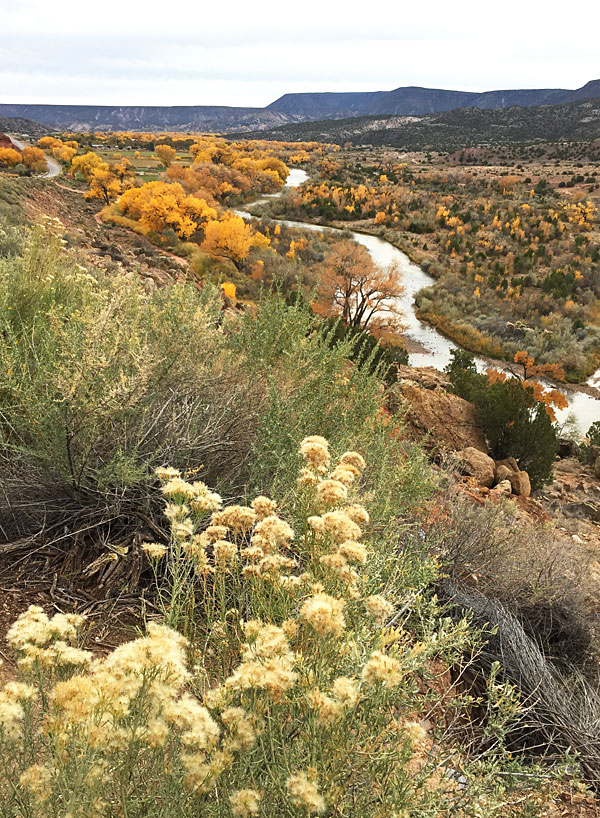
I have experienced two autumns this October: one in New Mexico, one in Pennsylvania. In the American Southwest, high up in the world, the cottonwood trees that hug every available water source were going a brilliant gold while I was there. Any view above a creek or river revealed a winding path of yellow–along the Chama, along the Rio Grande. The tiny-leaved oaks were turning brown-leaved and dropping scads of acorns along the paths. The oranges and reds are mostly there year-round, on the mesas and in the canyons.

It was wonderful to experience a poetry workshop with Anita Skeen and Cindy Hunter Morgan and to learn how books are made by hand, wonderful to draft some poems using color imagery and ekphrasis, wonderful to meet some fascinating people with whom I enjoyed pushing past my/our comfort zones and into art forms we may have been a bit less comfortable with. These are reasons to attend an instructor-led workshop, seminar, or residency. I spent part of last September in New Mexico, but it wasn’t the most spectacular time for autumn coloration–whereas October certainly gleams in northern NM!

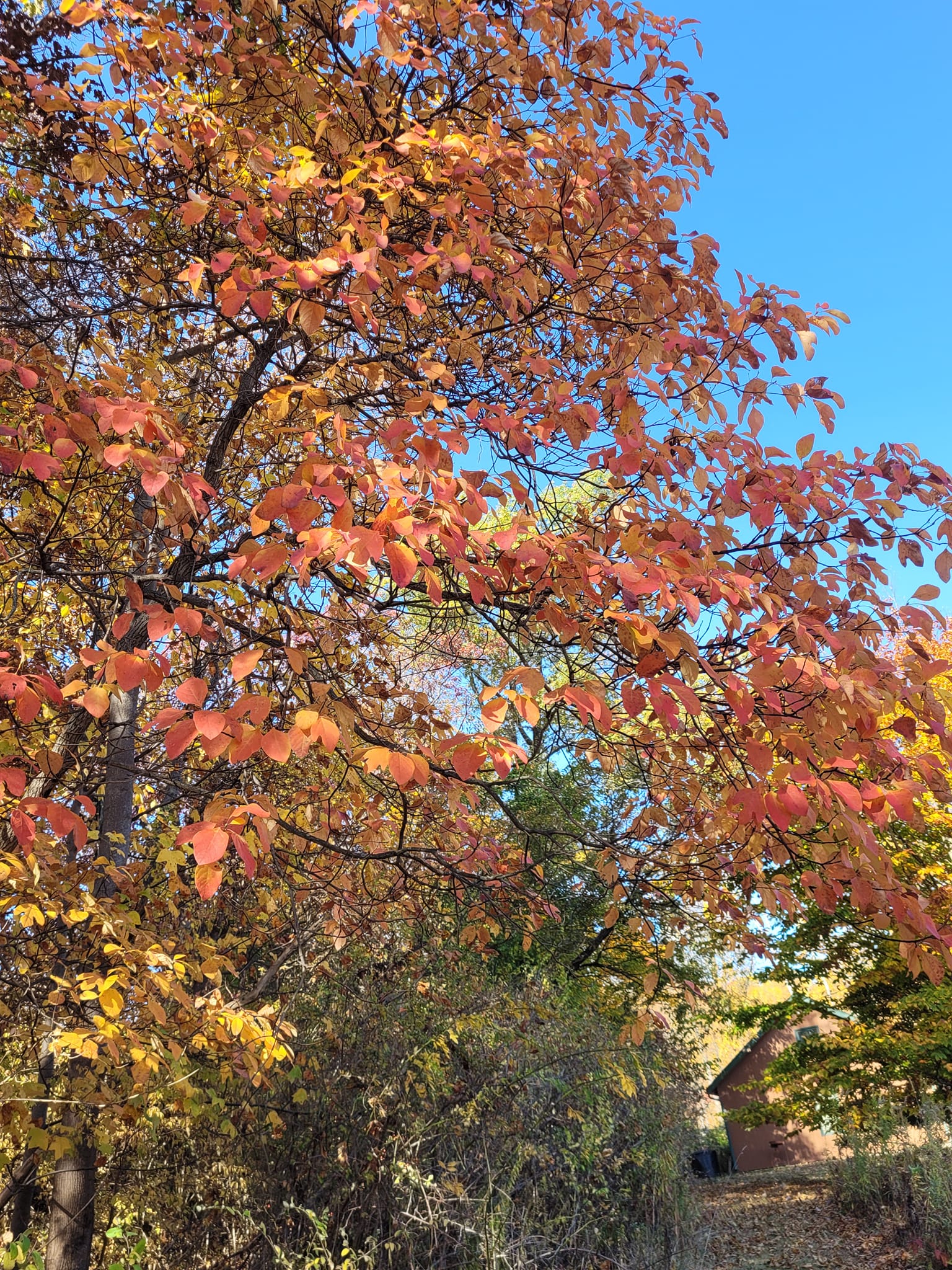
When I returned home, I had missed “peak season” for color in Pennsylvania; my husband said that came a bit early this year because of drought. But it’s still very bright here. The maple leaves haven’t all fallen, most of the tulip trees are still yellow, the hickories haven’t reached peak gold yet, and many of the sassafras are that warm coral color I love so well. The burning bushes? Ours hasn’t dropped its bright fuchsia-maroon leaves. It’s a vivid presence at the corner of the house.

~

Therefore, I have two autumns this year, one sea-level Mid-Altlantic East, and one high-altitude Southwest.

Which strikes me as an abundance of beauty and color. So I am continuing the theme of last week’s workshop. Here’s a new draft of a new poem just for the joy of it. [This fall, those of us in the USA could use a bit of joy.]


I don’t have a title for it yet. Maybe you can help me think of one.

~


The difference between orange leaf color
and orange rock color.
Between the greens of grass and juniper,
the pale dun of meadow’s die-back
and beige sand stretching westward
to the mountains.
Even the clear sky’s blueness
on fair, mild mornings
differs by an almost measurable degree.
Something to do with altitude
and aridity, the science of which
I don’t really understand.
Life’s variations and hues—
striated like cliffs, buttes, mesas,
like hills of maple and hickory in fall—
beautiful and strange.
Even when I close my eyes, color-
memories, all those shades
I can’t define, sift through my skin.
Into blood. Into bone.

Just reading

Sunday evening, my weeding stirred up so much dust and chaff that I needed to wear a bandanna around my nose and mouth. A continuous late-summer drought. There are still tomatoes and basil, sunflowers and zinnias, but the avian migration has been going on for some weeks and the days are getting shorter. Just after equinox, three weeks without rain; at last the sky clouds over and drops a little moisture on the parched soil. Yellow leaves sift onto the lawn. Small flocks of robins rejoice in the softer top layer of dirt, pull at grubs and worms, then fly off.

~

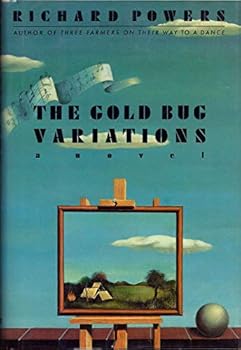
The rain’s necessary, and I’m grateful. Rainy days, however, take issue with my body–or, probably, the other way around. The need to take NSAIDs and rest offers the opportunity for just reading. This isn’t a bad thing, especially as I had Richard Powers’ novel The Gold Bug Variations to hand. It’s a tour de force of pattern, structure, code-breaking, DNA-building, relationships, love, chemistry, music, art, literature, and much more. I love the references (the narrator is a reference librarian), the minutia, history, alliteration, lists, compilations*, the whole thread of the novel’s dramatic arc, its relationship (mathematically, metaphorically, structurally) to music and the work of the gene-sequencing science. The book tells the parallel stories of couples who fall in love 25 years apart, the coincidences and randomness, the patterns that may not be patterns. I’m thoroughly wowed by an author who puts so much research into his writing and makes everything fit somehow.

Powers must have been about 33 when he completed this novel. I can’t imagine being so wise about human behavior and so informed about the sciences and music theory at that young age. Well, for one, I’m not as brilliant as he is; and two, I was raising toddlers when I was 33, which is a science unto itself and as revelatory as any book I could have been reading or writing in early mid-life.

But I digress. This book interests me on so many levels that I’ll be thinking about it for weeks. I may have to re-read it, take notes next time. I kept wanting to underline passages–it’s a library book, and marginalia is a no-no. I can imagine reading it again to the strains of the Goldberg Variations–indeed, I read a few chapters to said accompaniment this time. This is not a swift and easy read: it took me awhile to feel warmed up about the narrator, though she’s funny and smart. By the end, I loved her like a friend.

Honestly, novels seldom get me this excited or inspired. I’m glad I had a crappy day so I could justify lying around and “just reading.” As if “just reading” is not a worthwhile endeavor. The weeds can wait.

~

* re compilations: a word Powers employs often in this novel is the neologism/computer programming term “kludge.” I wasn’t familiar with it. But it’s a terrific word! https://www.etymonline.com/search?q=kludge

Crabgrass

I have been at work in the vegetable garden during the past few dry, sunny, late-summer days–it has been rather droughty here–and pulling up weeds in an effort to get an early start on putting the patch to bed for autumn. I have decided not to do any late-season sowing this year, and therefore I can pretty much tear up everything if I feel like it. Today I was thinking about my mother-in-law, who died in 2017, but who was sometimes my partner in the garden, or I in hers, when we were younger. I learned a great deal about ornamentals from her.

At her property, crabgrass was a particular scourge. I remember us weeding flower beds together while she muttered, “Crabgrass! Always crabgrass, how I hate it!” It struck me odd at the time that she pronounced it “crebgrass,” with the first “a” like a short “e”, because she said the word “crab” and similar words with an open short “a.” It was almost as though she reserved that pronunciation to express her ire at this particular weed. She liked weeding at my house partly because I had so little crabgrass. Plenty of other weeds, but not much crabgrass.

Our weeding together took place over 15 years ago, when my gardens were on the new side, maybe a decade old. Today, however, I find my vegetable patch very much colonized by digitaria sanguinalis…one of the finger grasses, a very successful weed that can produce 150,000 seeds per plant. My garden now hosts both smooth and large crabgrass; the former is much easier to pull, though it can set seed even when it is mowed to under an inch in height! Large crabgrass, when it gets going, can grow over a foot tall and have a base rosette of 10″ with a star-like (or crab-like) set of leaves and quite tenacious roots, for an annual.

While I worked (too late, I really should have gotten to the weeds long before they began to set seed), I heard my mother-in-law in my mind: “Crebgrass! How I hate it.” Well, dearest Gene, I have finally encountered the Eurasian colonizer in my own gardens. And I miss having you around to sympathize with my plight.

 Maudib | Credit: Getty Images

There’s a metaphor here, I know there is. Maybe there’s a poem in this experience, too? For the time being, pulling weeds reminds me of someone I loved–and takes my mind off of another person I love, whose dwindling and decline (her “diminishing”) stay uneasily in the background of everything I do these days.

In the between-season time, with autumn almost upon us, I want to remind myself of the joys that come along with the crabgrass. Such as the brown crickets and the morning glories and the goldenrod…and memories of people for whom I have cared a great deal.

~

Sweltering

I do not much care for air conditioning, and I believe it is bad for the environment; yet I admit I’m grateful for it lately, as I reside in one of the many regions of the USA that’s been enduring dangerously high temperatures for more than a week straight. I feel lucky that we’re not struggling with the heat wave–that we can shut up the windows and turn on the AC. We’re also in an earlier-than-usual drought situation though the air feels muggy and humidity has been as high as 98%.

My garden needs water every day; I generally water in the evenings because that is when the garden is in shade. The barn swallows swoop around me as I make sure the tomato and cucumber plants’ roots are getting a deep soaking. While I water, I watch for insects–fireflies, moths, dragonflies. And for bats, which have returned but aren’t as numerous as they once were. It’s pleasant for me that there are fewer mosquitoes and gnats, but I’m concerned about a drop in the number of junebugs and moths, and even (yes) mosquitoes. The heat and drought have taken a toll on all kinds of wildlife.

This morning, a pair of finches dive-bombed a squirrel that was up in the pear tree, chasing it far into the hedgerow. It may have been after the unripe pears, but squirrels also sometimes eat songbird eggs or chicks, especially when the squirrels are nursing kits or when there’s a lack of other food. The deer are so thirsty and desperate for greens that they’ve eaten every last hosta in my landscape, including the ones right up at the house foundation. They are consuming plants they have overlooked before, but I can’t blame them. Since it has been so miserable outside, I haven’t picked black raspberries this year; I’m sure the deer are happy about that. But I do wish they’d eat the poison ivy, wintercreeper, oriental bittersweet, and honeysuckle vines…that would make my landscaping tasks easier!

I’ve kept a garden journal for 30 years. If you have a garden, you don’t need to be an environmental scientist to recognize that the climate is undergoing changes. This is not a political statement but a fact. Everything right now is stressed–including the gardener! The stress enters into my consciousness and, I suppose, into my creative life. My poem drafts of the past week have been a bit on the bleak side.

Here’s a draft of one of the 7-line poems I was working on last week. Suits the weather, I guess.

~


Sweltering

A description accurate for the days past solstice
when even the wind lies sweating in a hammock
unable to rise for a brief turn around the block.
Blackbirds slow their trills, robins shelter in shade,
all the tasks we should tend to we leave undone.
Hours of lethargy seep into skin and set up house,
keeping us damp, achy, sunburned with the blues.

~