Behind the arts

The regional drought has officially ended, and the rain continues. Ironic, then, that the online site Feed the Holy just posted a poem I wrote near the close of a droughty August: “Zen Gold.” Fireflies and bats, while not abundant, manage to enjoy the recent dampness. The monarch butterflies have returned to our meadow, though I don’t catch sight of them on rainy days. But the moist conditions didn’t dampen the turnout or enthusiasm of local citizens who came out in droves for peaceful “No Kings” protests here…in a decidedly “purple-red” area of Pennsylvania.

Speaking of regional, this weekend I also attended the debut showing of a documentary film about the performing arts community in Bethlehem, PA, formerly famous for Bethlehem Steel Corporation. The film is titled “Rooted,” and it follows that “roots” idea with the planting of trees at arts sites, the metaphor of the mycorrhizal network (see my references to Lesley Wheeler’s latest book–so much overlap!) and the concept of community development. Especially through works of imagination. In the 1970s, when the steelworks was beginning to slow production and lose employees to retirement and business to competitors, small groups of young, talented artists in theater, dance, music, and puppetry started performing in parks, churches, etc…and gradually found inexpensive space in the city to establish themselves and pursue their dreams. Some of those little startups, such as Touchstone Theatre, have been operating, teaching groups of children, entertaining the community, and advocating for the arts for over 50 years.
Godfrey Daniels coffeehouse/listening room and The Ice House (home of Mock Turtle Productions) have been sites for poetry as well as for music and theater-craft. I have participated in and attended poetry and one-act play readings at both of those venues. I don’t live in Bethlehem, but it isn’t too far away from me–still in the Lehigh Valley region. And I deeply appreciate the work that pioneering arts-folks have done, and that arts advocates and teaching artists continue to do, for our area. The people behind the arts deserve recognition.

I’m not the sort of person who networks well; event-planning exhausts me, and preparing for committee meetings and writing grants are not my forte–though I gladly proofread grants and PR materials for local non-profits. Thus I admire the types of people who not only create in the arts but also find creative ways to keep the arts alive through outreach and planning, often in the face of very steep odds (yes, I’m talking funding here, and board membership, and organizing the necessary minutia, and the grind of public relations). God bless them for making space for actors, musicians, dancers, visual artists, sculptors, installation artists, poets, and visionaries of numerous kinds. It’s because of folks like these that I don’t have to travel all the way to New York or Philadelphia to experience lively contemporary arts of many kinds.

You can think of local arts organizations as the independent booksellers of the performance world. You go there to discover stuff that you won’t find on best-sellers lists, for work that’s by new artists, or work that’s been rediscovered, or cool perspectives on the familiar canon of major works by the famous. That has value. That offers inspiration. That gives you the courage to keep on doing whatever kind of art it is you do. Which in my case is poetry, not generally thought of as as performance art–though it once was, and slam poetry events prove it can still be. Maybe I’m a little more of a hermit-in-the-woods writer, but that doesn’t mean I never want to venture out into the wider arts community. And when I do? I’m grateful for the people who have established the beautiful network under my feet.
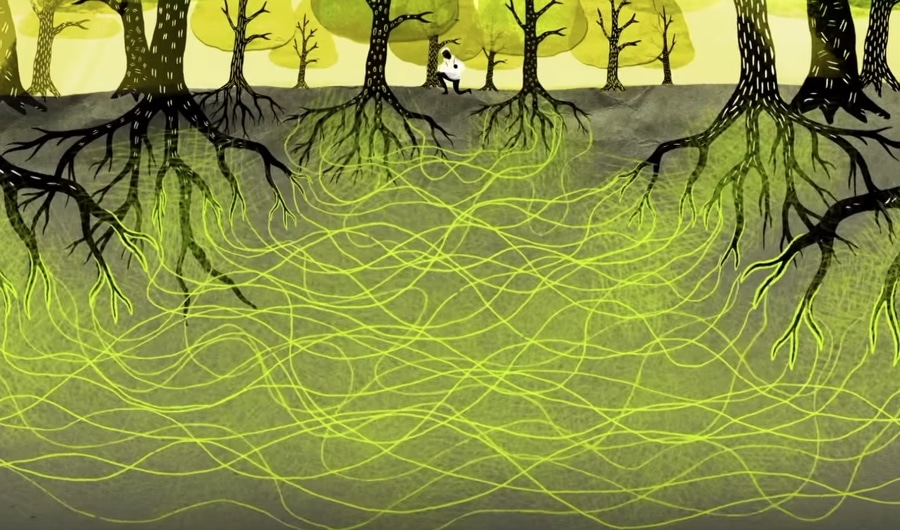
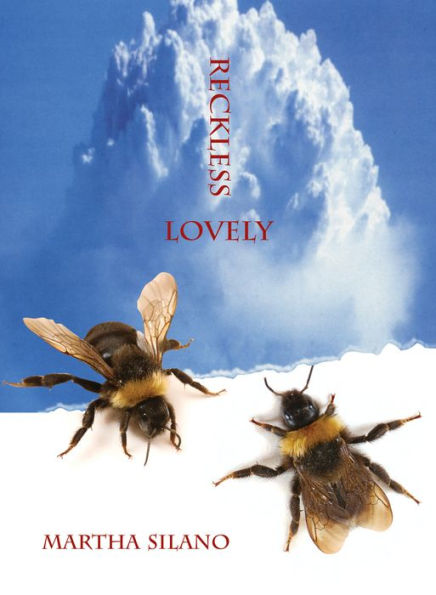
image: https://truetimber.net/TrueTimber arborists

Reading my contemporaries

The poetry collections I’ve been reading during much of the past year have largely been works of contemporary writers–books that were published during the past two decades, some during the past two years. My focus on such current work was not intentional. After all, there is still so much poetry from the past three or four thousand years that I haven’t yet explored! Grad school, however, was decades ago; that’s when I last studied both contemporary and classic/canonical/influential poems with a specific eye to learning from them. I continue to learn from the poems I read, though. I just don’t take as many notes or write any papers about them these days.

Three collections I read recently have got me thinking about the grittier sonic elements in poetry; the use of scientific, foreign, antiquated, and invented words; wordplay in general as a poetry component; and how sound can push both experiment and meaning in a poem. I’ve been mulling about the task of writing anything that feels “new,” to me or to my readers, and about the challenges more sonic wordplay would mean for me as a writer. I’m saying here I think it would be difficult to do, because it differs from my long-accustomed voice and style. I’m also saying I like a challenge in creative work, and that my style(s) go though changes always, so why not? In creative art of any kind, the passing of years makes a difference in many things. Content (because: experience). Situation (because: life happens). Methods (because: technology and materials). And influence–what I was reading in high school vs. grad school vs. today–though some favorites will always hold a place in my creative mind.

My poems tend to be plain-spoken, although I’ve never been shy about going beyond the standard vernacular to employ a geological term, a botanical name, or a somewhat archaic noun or adjective when it suits the feel and sound of the poem. Most of my poems don’t fall under the description of experimental or edgy. I’m not making waves with language, but some poets are. And my recent reading has me wanting to experiment more. It will mean failing a lot, because I’m working against my habitual methods of composition. I won’t be as good at it as these poets (below) are. What I’m hoping, though, is that the practice of trying more sonic wordplay in my work implants a tracery of that practice onto my poetic voice.

~

So which contemporaries do I mean? More than the three I’ll briefly mention here, for sure (and it is not as if the only poets playing with words and sound are my contemporaries–far from it). However, here’s a start with some examples that I particularly love.

I mentioned Silano’s poetry in a recent post when I appreciated her scientific ideas that meld with an “everyday” life. Reckless Lovely contains many long-lined couplet verses that name objects such as a 64-ounce Big Gulp, Wells-Fargo, Italian Renaissance paintings, or the red spot on Jupiter as the poet observes and speculates on the cosmos that surrounds her. And she invents or alters words that suit her for rhythm, alliteration, sound: “the sfumato is sfumato-ing, the lute-r is lute-ing;” “when most of all that creep-eth/breath-eth buzz-eth/galump-eth sex-eth spar-eth/went AWOL/paving the avenue of asp/the boulevard of bee…” or the totally wild mashup Silano composes in “Summons and Petition for Name Change”:

Dim sum-my dilberry. Down there Daquiri.
Ear of Eden. Eminently Earthy. Empress Gensho.
Fandango-ing funnel. Fox foot. Flamingo.
Geranium in the Gate of the Gourd. Gentian's grin.

~

I find much to admire in Martha Silano’s work even though I often have to look up words (physics and geology nomenclature, usually).

Lesley Wheeler’s most recent book demonstrates her ability with form and sound in a different way, though in “Gran Torino Gigan” the alliteration is as snazzy as Silano’s abecedarian poem above: “Buzzes fade up front,/where beltless adults murmur and smoke//after unfurling musty sleeping bags…in rhizomatic zigzags, with a sharp zipper.” Contemporary technology gets into the poems and, with it, the sounds of our infrastructure, as in “I believe in utility poles, transformers,/lightning arrestors. Subtransmission lines/and static lines. The dead southern yellow pine…” and the theme of fungal connectivity means that we learn some useful and often beautiful mycology terms. Yet Wheeler often relies on shorter words when they suit the tone of the narrative. In a poem dealing with the aftermath of her mother’s death, she writes “No one’s grimmer inside/than me. My bully of a heart wears cheap/scuffed pumps and cusses like a mobster.” The repetition of the word “snow” in “Minus Time” establishes the poem’s pace. So many poems in the collection offer experiments in form!

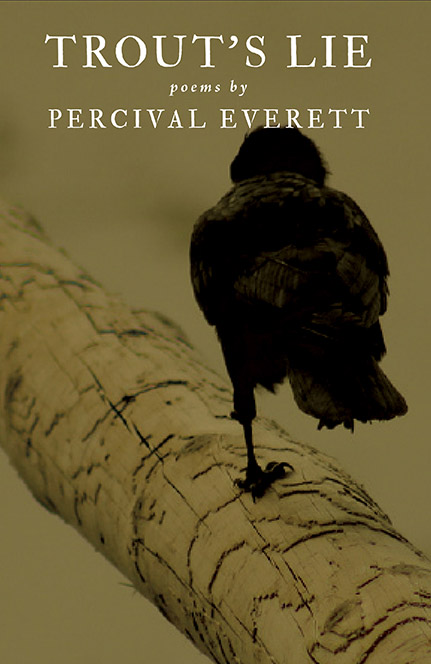
Percival Everett has gained an even stronger following thanks to his novel James, but he’s been writing poetry for years (Trout’s Lie is from 2015). This collection is deceptively simple in language and vernacular: there are surprises. Several poems make allusions to “great poetry of the past” by name or phrase; short lines build and build, twisting the lyric where we don’t think it would go. There are several examples I’d like to give, but this post is getting pretty long. I think I will close with an excerpt from Everett’s “Maybe Even Clouds,” the first section, which begins “Count the marines..”

They look like nice
Boys and bad boys,
From Vermont-and-Montana-
Following-orders-dumbshit-
Non-blinking-soon-
to-kill-soon-to-die boys,
Who might or might
Not, should or should
Not, but never would
Not and never can
not.
Not sure doesn't matter.
Doubt is a penniless
Customer, conscience
Waits for the weather
To change.


National Poetry Month may be almost over, but I’ll keep reading poems. And posting about them. And writing them. I encourage you to do the same, because there is no time in the history of the world when human beings haven’t benefited from poems.

Mud & connections

My region’s been unusually low on rainfall the past 18 months, but this year April showers seem almost to be compensating…my veg patch is mud. Weeding and more sowing will just have to wait. I walk around the neighborhood and my yard and the woods, squelching through muck and stopping now and again to upend a rock or rotten log and see who’s active now. Lots of worms and arthropods, the occasional spider, many ants.

In such moist circumstances, we get fungi; I’ve been enjoying Lesley Wheeler’s new book, Mycocosmic, which I’ve read twice now–once for content and sound, once to learn more from the poems’ craft structures, all the while fascinated by the science of fungus, which she incorporates into many of these poems. It’s a richly rewarding book, sometimes sorrowful, always intelligent, full of insightful poetry. The collection includes some poems that feel like spells, chants, divinations that suggest there are always imaginative methods for coping with anger, unfairness, and loss. Exploring the vein of how interconnected the natural world is, and the human world (with other humans and with the Earth) feels so vital to me, and Wheeler’s book pivots on this vitality. Look at the way Harry Humes threaded through my life, for example, in small but meaningful ways. The same goes for Lesley and for so many other people with whom I’ve shared intersections, interweavings, and connections over the years. That butterfly effect of influence. (Now that I think of it–Harry Humes has a book with that title: The Butterfly Effect). Or are those networks mycelial, as Lesley Wheeler suggests?

~

More connections: grad school was long ago now, but I’ve maintained a few colleagues from those days and will always treasure the fact that earning an MFA led to meeting fascinating people. For example, the recent issue of The Bookends Review features an interview my fellow Goddard alum Ian Haight conducted with me last summer. He asked me about teaching humanities, about higher ed in these fraught times, about AI and creative work, about my residency at Joya, and about poetry in general…https://thebookendsreview.com/2025/04/09/poetry-the-humanities-and-aesthetics-an-interview-with-ann-e-michael/. Some thought-provoking questions–thanks, Ian! And thanks to The Bookends Review for curating the interview into the journal.

Riches

The past week gave me riches galore; though I am somewhat poorer in the pocket for it, my cup runneth over in about every other way. It’s true that often, lately, I’ve felt that I am living in “interesting times” that are all too much and too awful to contemplate for long. Then again, I could have been alive (possibly quite briefly!) during Boccaccio’s time and weathering the bubonic plague. Thanks to The Decameron, readers later in history have been able to get a picture of what people were thinking about and imagining–or trying to escape–when things were truly terrible all around. And while I’m not pollyanna-ish about the present, I do feel grateful that I live during an era when travel to distant places is possible and rather speedy, that books are readily available, and that some of the wealthy people of the not-too-distant past decided that philanthropy included funding libraries, gardens, and museums for the average citizen to visit and enjoy. Current billionaires, please take note!

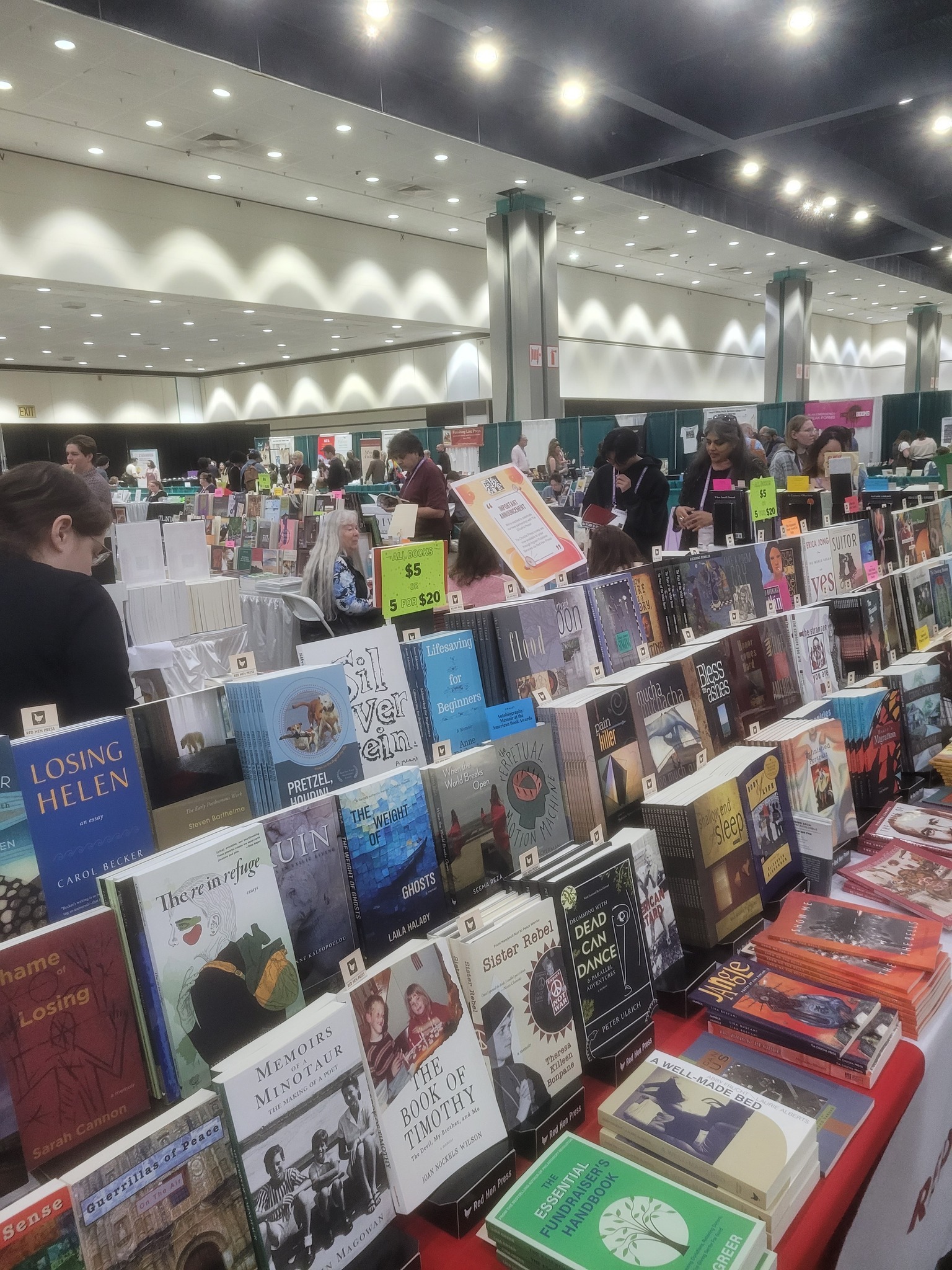
What the week entailed was a trip to Los Angeles to visit my eldest child and, while there, to spend a morning at the AWP conference book fair. Riches indeed! I “packed light” to be sure I had space in my carry-on for poetry books, which thankfully tend to be slim paperback volumes. I bought almost 20 books, I confess. So I came home weighted with literary riches, and while at the convention managed to connect (however briefly) with numerous poet colleagues. A shout-out here to Lesley Wheeler, whose book I had to purchase online because Mycocosmic had sold out! Congratulations, and I cannot wait to read it.

My days in LA were limited to four, but my son had curated a things-Mom-would-like-to-do list that included Mom’s necessary down time. It’s terrific to have offspring who are now old enough to respect my limits. [They have not always been so accommodating.]

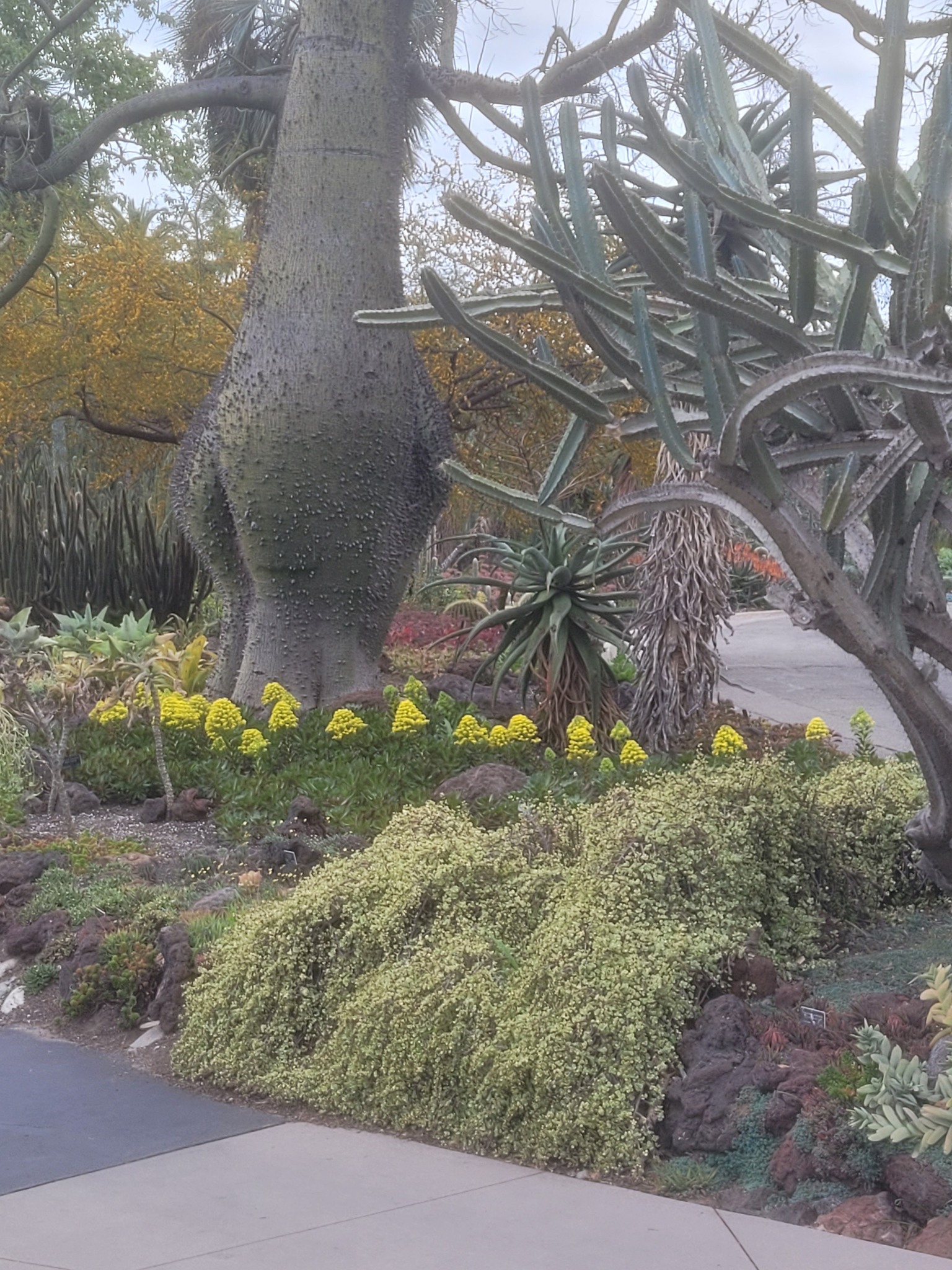
The list included several lovely meals out, a full day at Huntington Gardens and Library, a day trip up to Santa Barbara, a visit to LACMA to get an “art fix” for me and for my son’s best beloved, who loves art and architecture, and a visit to the amazing Museum of Jurassic Technology which, as far as I am concerned, is basically a series of amazing poetry prompts. I cannot possibly explain it; and the museum’s website is purposely a bit obscure and limited, compared to the immersive experience of going to the place in person. I am still thinking about it and will be for weeks.

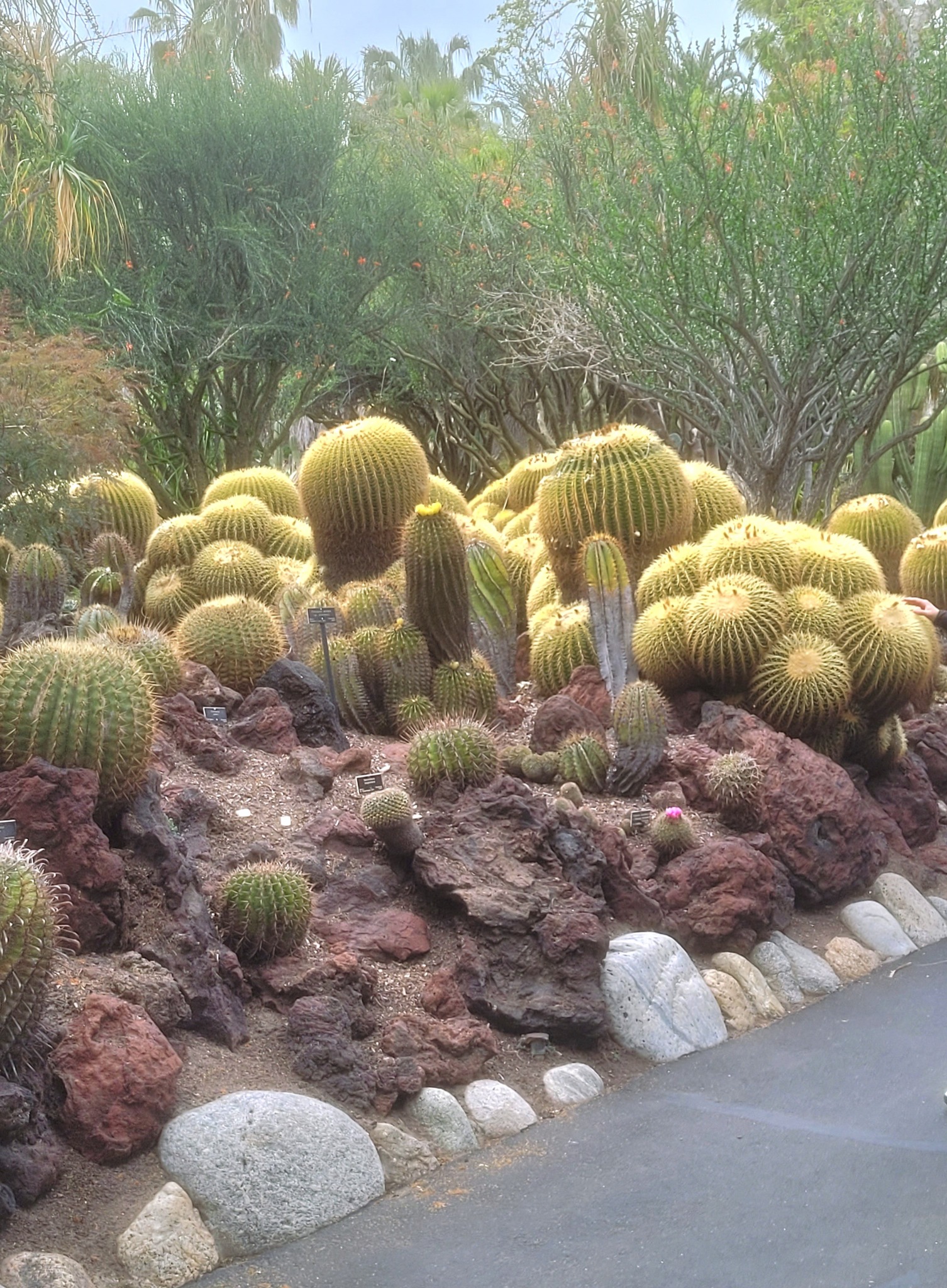
The barrel cacti at Huntington

While photo ops abound at the gardens, no photos are permitted in the Museum of Jurassic Technology; I will lead you to the website and just keep you guessing. But among the riches of the last week are germs of new poem drafts. We shall see what emerges.

Four+ days away, and I returned to spring in eastern PA: narcissus, magnolias, glory-of-the-snow, squill, bloodroot, forsythia, ornamental plum. Even more richness. Gratitude for the glory.

Chastened & learning

The temperature got wintry this past week, and now I feel inclined to make chili or giambatta, or savory stews with ingredients such as butternut squash, potatoes, beets, eggplant, cannellini beans. Or polenta, maybe–anything that takes awhile to cook, sending up steam and warming the kitchen so it feels toasty when I come in from a walk. I admit to being a wimp about walking in cold weather. I do it; I know walking in any weather is good for me and I bundle up, but my walks are decidedly shorter. Even on sunny days.

Today was not a sunny day.

And to my dismay, the downy woodpeckers are back again, hammering at the wood on our house. The one on the left banged into a window, but generally they cling to the boards. I wish they would drill at the many dead trees along our property line; they’d have more luck, too, if they’re seeking food. By the way, this photo is 10 years old. Now I would know not to handle a wild bird with bare hands because the oils on human skin are not good for feathers. (Three decades of educating myself about my own environment have chastened me–there’s so much I don’t know.)

I also don’t know which of my own poems are any good, or which ones to send to which journals, or whether I should care. It’s oddly heartening–and honestly, NOT schadenfreude! (because I get no pleasure from it, merely a sense of community)–to read in my colleagues’ social media posts that “rejection season” is here. I am not the only one whose poems have returned lately. Lesley Wheeler writes: “Magazine rejections have been trickling in, too, although mostly the please-try-us-again kind, and I know enough about editing now to really appreciate those.” I have had a number of those, too. And I’ve been an editor, so I get it, and I am appreciative. But I am mystified nonetheless–after 40 years, why am I so clueless at this sort of critical analysis? When I sit myself down to submit poems, I tend to find all my work lousy or, looking at the poems I think may be good, realize I lack any idea of where to send them–even though I am a frequent and avid reader of online and print literary journals. You’d think I’d have gleaned something about poetry the way I have learned about my geological region, its seasons, critters, viruses, predators, bloom times, pruning times, sowing/planting times and such.

Equally chastened by poetry’s landscape, I guess!

Transformation & intention

During the past few weeks, I have been reading–one at a time, with pauses–the essays in Ross Gay’s book Inciting Joy. His earlier book (The Book of Delights) was easier, a bit less complicated. About, you know, gratitude–even though he describes his father’s death in the first essay of that one. He gets to something about grieving in the 13th “Incitement” of this book, however, that made me put the text down and say to myself: This is what I have been trying to get my poems to do for some time now.

(I did pick it up again and finish reading it, by the way.)

He insists that we remember how transforming grief is. Not can be, but is. Always: “When that one thing [that we grieve] changed, everything changed. Light through the trees in October now different. The sound of the playground…cooking a meal. The future. The past. All of it changed. That is what the griever is metabolizing.” He points out this metabolizing can’t be timed, that grieving pays no attention to whether it has been a day or a year or decades: “It seems to me that grief is not gotten over, it is gotten into. And the griever teaches us, or reminds us, there is no pulling it apart. Because grieving, alert to connection, is never only one person’s experience.”

Maybe we grieve for one person, or one beloved companion animal. Maybe we grieve that our youth is over, that our children are grown, that our favorite mom & pop store has been razed to make way for a Starbucks. Or perhaps we grieve for our planet, as Greta Thunberg does: “You have stolen my dreams and my childhood with your empty words…People are suffering. People are dying. Entire ecosystems are collapsing.” There are so many reasons why we feel loss. Loss is what life offers us, loss but also transformation. I think what Gay tries to say in his recent essays is that because there is something to sorrow that we all can connect with, our grief itself can connect us, give us understanding–maybe even joy.

A complicated kind of joy. A joy that acknowledges that life can be tough and sad. And instead of reeling away from people who are clearly–and sometimes not so clearly–suffering, we could connect instead, even though we are also terrified of suffering. Maybe that is another reason I became a hospice volunteer years ago, after my dad had been in and out of the ICU frequently, even though I had spent my childhood and many of my adult years being frightened of death and dying.

Good poems offer readers that sense of connection, which Gay and others sometimes refer to as mycelial (Lesley Wheeler in her poems, Robin Wall Kimmerer in her books and Merlin Sheldrake in his, the movie “Fantastic Fungi”…among others). My favorite poems by my favorite poets, now that I think about it, have always had that effect on my heart: recognition of connectedness with other humans or with other beings, with the environment, with the past-and-future, with (thank you, Walt Whitman) the Kosmos. The recent interactions I had and connections I found at the Joya residency cemented this fundamental awareness, that all of us are part of our huge, interconnected experiences in life.

Of course, writing strong work isn’t easy, doesn’t often happen; but here’s the place in our mutual social connectivity where intentions really do matter–because the intention impels us to work, practice, and dream. The intention is to create and, through whatever we create, to extend our human network. NOT our much-ballyhooed “social networks.” Those can go to hell (and we can’t take ’em with us).

Anyway, such are my intentions for working in the world of words, of poetry. And that’s also the reason I read so much poetry, in case you were wondering.

~

https://www.smallwoodlandthings.com/ Heather Brooks, artist

Gratitude

Fountains of gratitude are flowing in my heart today despite the gray, humid weather that seems to set off every imaginable ache my body could have. ❤

Wow, that was a sentence of hyperbole and cliché, for which I apologize; let me begin again. I’m grateful for a number of reasons that I want to mention so I can give appropriate and public thanks to the people who have added to today’s happiness. The list starts with Dave Fry of Godfrey Daniels Coffeehouse & Listening Room in Bethlehem PA, who hosted an evening of poetry–with musical interludes and conversation–this past Wednesday evening. Two members of my long-time writers group and I read our poems and talked about a few poetic forms (haiku, waka/tanka, tanka prose, and short forms generally). Dave supplied some comments to encourage audience reflection and performed interludes on guitar. One observation he made is that the classic blues song follows a structure that has similarities to a short poem form: Line, Repeated line, Commentary line (often like a poem’s “turn”).

It was a lovely event and great to share the writerly camaraderie of a long & successful critique group onstage: Marilyn Hazelton and Susan Weaver are often the first readers of my own poems. I’m grateful for their support and for the way Dave gave us the opportunity showcase poems and maybe teach a few audience members new things about poetry. Another plus was that I sold a few books! Grateful to those folks, too. That’s one way to support the arts.

Thank you as well to my Best Beloved, who attended despite feeling a little lousy from allergies, and to those of my local friends who came out to hear us. The venue charges a cover, and not everyone’s willing to shell out for poetry. Therefore, I bow deeply to you all who do.

Today I also received a kind gesture from poet, scholar, educator, and blogger Lesley Wheeler. On her blog (which you really might want to follow), Lesley wrote a mini-review of my book The Red Queen Hypothesis and Other Poems, last summer. I’m thrilled that this week she included a mini-review of my brand-new book, Abundance/Diminishment (“ectoplasmic micro poetry reviews“). My book was in such good company! See the link above, between parentheses, for her comments on books by Diane Suess, January Gill O’Neill, Elizabeth Savage, and Jen Karetnick.

For promotional reasons, (ha!), I’ll close with what Lesley says about the collection:

“I have a similarly eerie sense of connection with a sympathetic mind reading Ann E. Michael’s Abundance/ Diminishment. This book tallies losses and bounties: it’s full of mathematical and scientific language, but what it counts and categorizes is deeply emotionally freighted. In ‘Filling Out Forms at the Gynecologist’s Office,’ she subtracts the number of her children from the number of times she’s been pregnant. In ‘Tongues,’ a child of six, mocked by classmates for the tongue sandwich in her lunchbox, prices out peanut butter–even as she loses her immigrant mother’s language. Also like Seuss’s book, this is poetry of maturity, from a time of life when a person has to begin giving it all away. I’m especially grateful, these days, for books from midlife and beyond. I learn what I need to know by reading them.”

I’m grateful, too, Lesley!

Promotional

I keep forgetting to mention a few nice happenings regarding my recent book, so I may as well stuff them all into one post here in case anyone is interested. Have I mentioned how much I hate doing promotion for my poetry? Why yes, I believe I have. And since these days I feel no career ambitions related to my work anymore, why does it even matter?

I think there is an answer to why it matters. Sort of an answer, anyway–that without some form of prompting to the World at Large, my poems will be reader-less. A sad fate for a poem or book, and a common one. I don’t write just for myself: I keep a journal for that. I write as a form of communication, a way to connect with a reader I may or may not know.

Sometimes no one connects because the poems don’t work for them. Sometimes no one connects because no one knows the poems exist. The first lack is unavoidable–there is no kind of artistic creation that works for everyone. The second lack I cannot do much about, but I can do a little. Hence, this post.

Some months ago, a current student at one of the colleges I attended called to ask a few questions about my new collection. I did not expect it to be more than one of those “here’s-a-thing-an-alumna-did” paragraphs, and no one got back to me to make sure the piece is accurate (and, yes, a fact or two are incorrect and no, I didn’t say I believe “anyone can write poetry because anything can be poetry; people just have to look for it,”); but it’s a nice little promo bit all the same. Link here.

Then, Michael Escoubas of Quill & Parchment reviewed The Red Queen Hypothesis. Somewhat to my surprise (I don’t think of myself as very “edgy”), he writes, “Michael’s latest collection is edgy; chock full of poems that challenge everyday assumptions about life.” He does recognize that often what I try to do in poetry is exactly that: confront assumptions, observe from different angles. Less surprisingly, he adds that my poems are “sensitive to analogies between the natural world and human experience.” Um, that would be me. That review can be found here.

I know that in a previous post I mentioned Lesley Wheeler’s generous mini-review of the book, which can be found here; she’s an especially insightful reader. I’m thrilled that she writes: “Michael’s second full-length collection is meditative, witty, and smart, with a scientific and sometimes philosophical bent. Also like her blog, it’s closely observant of the more-than-human world in flux…The Red Queen Hypothesis suggests the advantage of sexual reproduction, and there are plenty of seductively “soft persuasions” in this collection. Like the “Stew Cook” speaking to her beloved, this is a book to “fill nooks with aromatic hours.” Shout-out to all the tasty slant-rhymes amid a profusion of traditional forms.” Thank you again, Lesley!

Another little thing to celebrate is Highland Park Poetry’s nominating my poem “Game” for a Pushcart Prize. By the way, that poem appears in The Red Queen Hypothesis!

Finally–or maybe, down the road, there’ll be more to add to promotional posts–I have been getting out and around to readings a bit, in person and virtually. The latter is easier, since many readings are in the evening; these days, I am not too terrific most evenings thanks (ha! as if!) to fibromyalgia fatigue and symptoms. But I do enjoy in-person events and have been glad to read at the Easton Book Festival, at Nowhere Coffee in Allentown PA, and at Bethlehem’s Sun Inn, to mention a few. I was featured in a Mad Poets “OK Zoomers” online reading (love the pun) virtually and will be participating in a group launch of Inlandia‘s most recent issue online on November 19th (info below).

That’s about all the energy I can spare right now for self-promotion. And no, I don’t use Instagram or Tik Tok or Substack or YouTube, at least not yet, so this is all I got, folks. Thank you for bearing with me. Less promotion and more poetry and philosophizing and nature/gardening next time.

If you join the Inlandia event–make sure you account for the time zone! That’s 1-3 pm PACIFIC time.

Classification

An admission: I’m barely competent at the promotional aspect of The Writing Life and would prefer to hole up in my house and garden and just… write. But writers need readers, and writers benefit by meeting other writers (and readers); and I’ve always been interested in learning new things, even things that are not particularly fun or that I am not naturally adept at. Such as educational learning management systems (ie, “portals”). Such as recording audiofiles of my poems. Such as contacting potential poetry-reading venues or reviewers. Or coming up with clever ways to let people know about my book.

I got a couple of responses from my initial forays, which is lucky. One of these sent me a sort of writer’s questionnaire about my book, and one of the responses I’m supposed to give is to say how I would classify my latest poetry collection. That got me mulling over the whole idea of categorization, classifying, and stereotypes. Genre–that’s easy. It’s poetry. But the sub-category of this book? uh…

~

At the beach earlier this week, we found a much-broken up rock jetty that teemed with creatures. As I sat back on my heels and peered into the mixture of sand-water-rock-mullosk-kelp, I found myself thinking about Aristotle’s immanent realism (epistemology/natural philosophy), ideas he likely nurtured while examining the tide pools of Lesbos. Or I imagine that he may have done so. We humans observe, and then classify or categorize based upon these observations: similarities, differences, various adaptations–in environment, habit, behavior, construction of the being or entity itself.

I think if I had known as a child and young woman that there was a career path called “a naturalist,” I would have pursued it.

~

Unclassifiable doesn’t strike me as much of a selling point. However, there are always art forms that are, to use a current term, intersectional or interdisciplinary, and creations that repurpose, alter, or reimagine the known or customary into something new and intriguing. Fellow blogger and talented poet and novelist Lesley Wheeler‘s books come to mind, as do works by Anne Carson and books from Coffeehouse Press and Tarpaulin Sky (among others).

My poetry is not experimental nor groundbreaking, though it is a little quirky; so here is my recent attempt to classify The Red Queen Hypothesis and Other Poems:

Touching on a range of topics and employing variety in poetic craft—free verse, metrical verse, rhyme, and classic forms—the poems in The Red Queen Hypothesis play with invention, science, and the environment of the everyday.  One example of these juxtapositions is the title poem: a villanelle, based on an evolutionary theory named for an episode in Alice through the Looking Glass, that sums up the corporate rat race. Sometimes tongue-in-cheek, sometimes disturbing, the poems urge readers to observe and to reconsider what is beautiful.

~

I dunno. Does that seem like a remotely interesting description?

(Really not adept at the promotional biz.)

Aristotle, supposedly.
from https://www.nytimes.com/2016/05/27/world/europe/greece-aristotle-tomb.html

Reading friends’ books

One thing about being a writer is that, after awhile, you meet other writers one way or another: sometimes through social media, Zoom events, or in person at book signings and readings; sometimes through conferences, workshops, or various educational programs; sometimes by finding local writers groups or getting an introduction to someone through a friend. When you meet writers, you get the additional privilege of reading their work. It so happens that lately, many of my writerly friends and colleagues have published books, and I’ve been busy reading them!

First, I want to mention that whenever possible, readers should purchase literary volumes from the writers themselves or from their publishers, or–if it’s an option in your region–from an independent bookseller. I do resort to ABE and Thrift and Amazon when a book has gone out of print or when the publisher prints through Amazon, but I want to remind people that the other sources will support the writers themselves or the independent small bookshops and publishers who launch these books into the world.

Now that my virtuous aside has been accomplished, here are a few of the books-by-friends-&-colleagues I’ve been consuming lately–not all of them newly-published (it takes me awhile to get around to the reading).

~

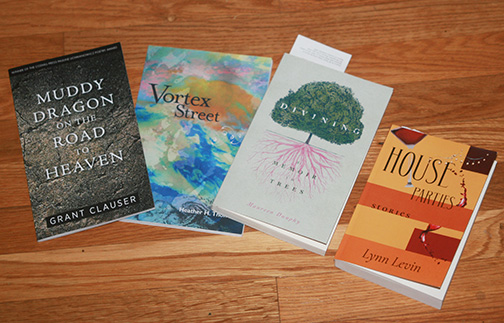
The near-abstract imagery and the concrete place-names and lyricism in Heather H. Thomas’ 2018 Vortex Street appealed to me on several levels, from the scientific (a repeating pattern of swirling vortices, see “fluid dynamics”) to the particular: my husband grew up in Reading, PA, where some of these poems are suspended in recollection. I’ve also loved reading Grant Clauser’s latest, the 2021 Codhill prize-winner Muddy Dragon on the Road to Heaven, a collection of poems that strikes me as both deeply beautiful and tenderly sad. Poet Lynn Levin has published a terrific book of short stories, House Parties, that remind me of the wry sense of humor and wide-ranging knowledge her poems have while proving she’s also a deft hand at plot and character. Maureen Dunphy’s memoir Divining, A Memoir in Trees, brought to mind parallels with Lesley Wheeler’s memoir in poems, Poetry’s Possible Worlds. In both books, the authors have chosen a locus [an American tree, a contemporary poem] and used the exploration of that “trigger” to draw out something personal. What better way to connect with readers than through something we love and value? Which brings me to a shout-out to Jane Satterfield, whose poetry collection The Badass Brontës isn’t in this photo because I’ve already lent it to someone who’s a Brontë fan.

~

In addition to the above books, I am eagerly awaiting new works from a host of other poet-friends: chapbooks by Beejay Grob (forthcoming from Moonstone Publishing) and Lisa DeVuono, poetry collections from Jerry Wemple, Jeanine Hall Gailey, and others that slip my mind at the moment. My only regret is that I have all this reading to do just as gardening season gets really underway!