Last messages

End of another year. This one included some truly joyful times that will stay with me for quite awhile. But in that almost-inevitable reflection that arrives with the winter solstice, I find myself recalling dear ones whose lives closed in the past 12 months. I used to have physical reminders of friends and family, the last card or letter they wrote, something to put into a file or drawer or keepsake box and take out from time to time; a photograph or two, or maybe a recording of their voice on tape. Now that human communication has mostly migrated to the digital, to the “cloud,” those tangibles are much less common. But the messages persist.

A few weeks back, I migrated to a newer cellphone and, in the process, moved a year’s worth of text conversations to the new device (I’m not sure how I did that). All the old messages popped up, including three from dear people who are now deceased. Quite a different form of “ghosting.” I’ve kept in an online folder many email messages from my most frequent correspondent and long-time friend, who died February 1st, but I can’t quite bring myself to look at them yet. And it isn’t quite the same experience as opening and unfolding old letters.

I can’t bring myself to delete the messages from my phone, however. I suppose at some point that will occur, perhaps in another upgrade. Letters are ephemeral, too; all it takes is flood or fire. We have to rely on our minds, our memories, when it comes to recalling loved ones. Maybe that is what elegy is for, I don’t know.

~

As for the present–the Spirit of Christmas Present* ?–some of my Best Beloveds will be gathering here and there with me soon. Once the holiday hubbub dies down and the lonelier, cold January days arrive, I have poetry workshops to look forward to. They’ll be online, which suits my schedule in winter. Last year, I enrolled in two such workshops and found they spurred me to get a good deal of writing done, so I figured I might try repeating the process. Anita Skeen is doing another series for The Friends of Roethke Foundation with readings, prompts, and discussion on “writing toward wisdom.” In Dickens’ era, I’d be considered old enough to be wise (though most of us, Dickens certainly included, know better about age inevitably bringing wisdom). But the operating word for Skeen in this case is “toward.” It will be interesting to see where she takes her workshop participants in the new year.

* John Leech illustration

Points of view

I ran across something online that made me shudder–and it wasn’t politics or global tragedies but something sillier and more personal. Apparently there was a trend a decade ago of adults reading their adolescent diaries, aloud, in public (see “Mortified”). Ugh. The few times I have been tempted to read any of my old diaries or journals, I’ve stopped after a few sentences. Shuddering. This is less likely to happen with journal entries I wrote in my 30s or later; at least I hear my younger adult self in those words. But hearing the adolescent me, or the young woman of college age? No, thank you. I embarrass too easily.

Yet I found I was thinking today of this passage of Proust’s, which he gives to the character of the artist Elstir:

“There is no man,” he began, “however wise, who has not at some period of his youth said things, or lived a life, the memory of which is so unpleasant to him that he would gladly expunge it. And yet he ought not entirely to regret it, because he cannot be certain that he has indeed become a wise man–so far as it is possible for any of us to be wise–unless he has passed through all the fatuous and unwholesome incarnations by which that ultimate stage must be preceded…We do not receive wisdom, we discover it for ourselves, after a journey through a wilderness no one else can make for us, which no one can spare us, for our wisdom is the point of view from which we come at last to regard the world.”

There’s some comfort in that. I would not call myself wise, but I’m definitely wiser than I was at 15 or 21. I suppose I’m still sometimes “fatuous and unwholesome” (whatever Elstir meant by that), awkward in society, and mistaken in some of my intuitions. But I have discovered myself for myself, with all the pain, sorrow, embarrassment, and joys that such discovery requires, and have developed my own point of view. In addition, I’ve learned that each person holds their own point of view. We don’t all think alike or in concert and may never fully understand one another. That makes the world contentious, yes. And interesting.

Reading Old Diaries

When I wrote about the city
it was as though I knew
I didn’t belong there,
would not thrive—as though
I wouldn’t stay long
and so pressed each line
on page urgently, camera
shutter clicks, each image
framed in fractioned seconds
as people jaywalked and
side-walked, as pigeons
or sparrows alighted to peck
at civilization’s least crumbs,
as young men lovely and
unattainable grew ill, as city
failed to succor any of us,
as my ambition floundered.
Years back. So that what
I recall is what I photographed
or wrote, however inconsistent.
Naively urbane, the city
my youth inhabits lies brittle
in the pages. The past undoes
itself at last. Or I do.

~~
I'm embarrassed to note that I've forgotten where this poem was published. My files are elsewhere at the moment. I'll update if I remember... *It appeared in Loch Raven Review!

Wet summers

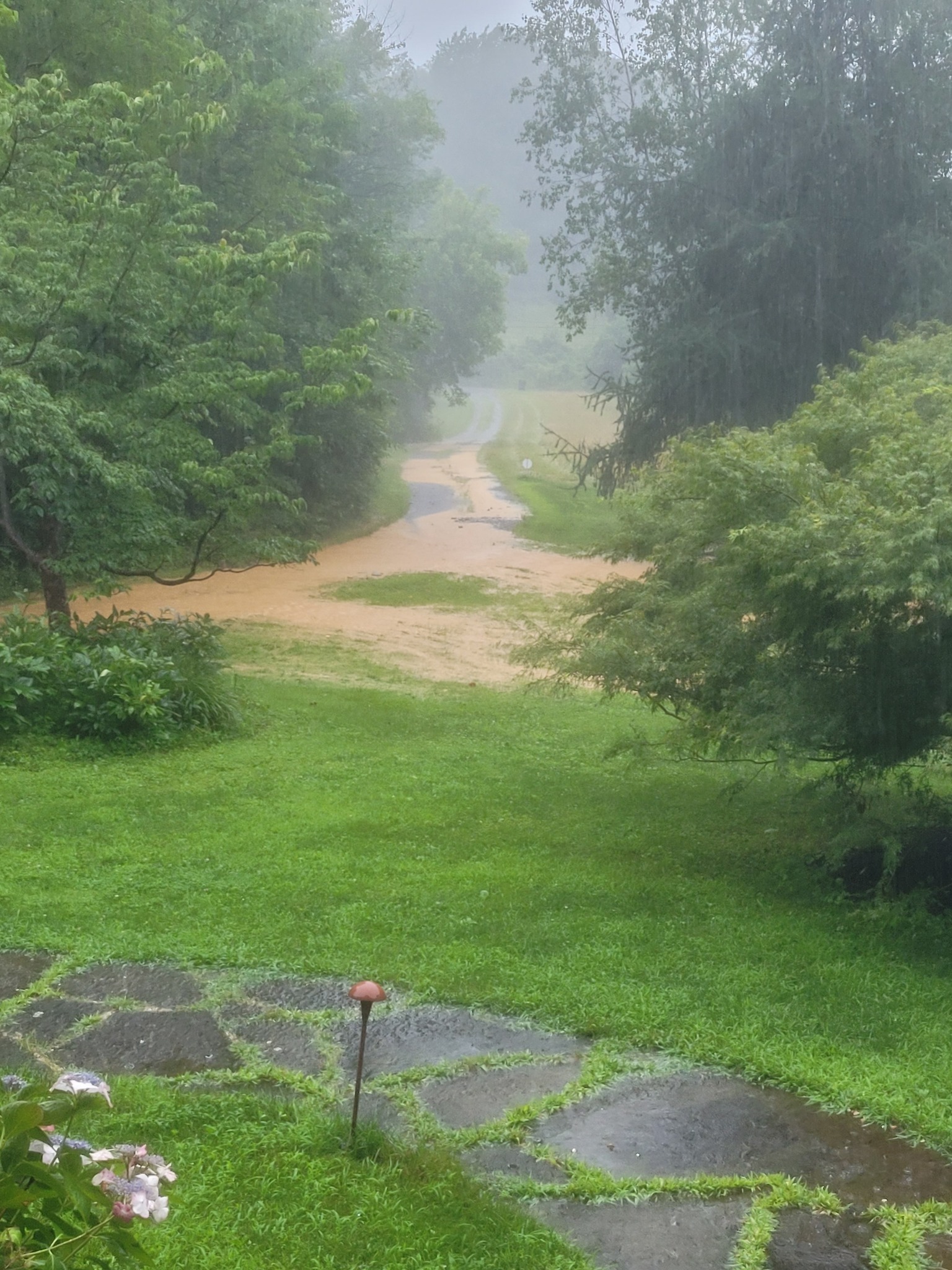
Thunderstorms used to thrill me, and still do–that combination of potential damage with the relaxing sound of rain on trees and rooftops, rain rushing through downspouts, and overcast skies that seem to lull me to sleepiness. Yesterday’s rain was a doozy. We had a flash flood in our front lawn, which has never happened before. But the basement stayed dry, no trees have come down (yet), and we didn’t lose power.

Cracking loud thunderclaps with arrow-straight downpours on hot summer days remind me of childhood. Yesterday afternoon I sat on my porch for an hour just watching the rain and remembering days like this. When we aren’t in drought years, these summer storms appear commonly in the region; yet they always evoke memories of long ago, I suppose because when I was a child I could just sit around watching a thunderstorm instead of, well, doing grownup things. Like working in an office, teaching a class, grocery shopping, laundry, reading emails, whatever I’ve been doing during the past 50 summers.

I spent many a mid-summer week or two in northern Indiana, where this type of storm was common. My grandmother always appreciated them, saying, “They make the corn grow.” Which must also have been true in the coastal plains of southern New Jersey, where I spent the rest of every summer. (Sweet corn is excellent in both regions.)

So, I think of thunderstorms on days so hot we could just run around outside in sundresses or bathing suits, getting doused, or sit on a porch and read while the lightning flashed and the rain came down in torrents. And then have garden tomatoes and corn on the cob for dinner, and go outside after dusk arrived and chase fireflies in the wet grass. These are the kinds of things that I feel nostalgic about, though I am not generally a person who gives much energy to nostalgia. It has been awhile since I had enough unoccupied time on my hands that an hour on the back porch observing the rain seemed like a valuable thing to do.

But it is.

Anyway, here’s a prose poem from my book Abundance/Diminishment that I recalled to myself while I was watching the storm.

~~

Competition, Wet Summers

…so here’s this young woman practically in tears—it’s almost one o’clock
and raining harder than ever, thunder so close it’s practically grabbing us by the
shoulders and the lights dim inside each time the sky goes millisecond-bright.
It doesn’t feel like midday. Every stall is full and the horses aren’t happy.
We can hear the skittish ones hollering, pawing, kicking at the doors. It’s a squall,
I tell Sara; but she’s frustrated, fuming, has her tack cleaned and her dress breeches
on for a three o’clock show she’s convinced won’t happen now that all hell’s let
loose in the form of torrents and flash floods, and there’s a stream coursing from
the south door into the first bay of the stable—it looks like the River Jordan.

The roof leaks at a spot directly above her shampooed and just-groomed mare
and I’ve run out of cheery platitudes and patience; I just walk myself to the barn’s
far end, feel the rain splash up my legs from the puddle at the threshold, dripping
on my neck and face through rotten shingles. The wind stops. It’s a straight-
falling deluge and hot, a no-relief rain with big drops that bubble in temporary
pools of runoff by the wash stalls. The afternoon is green and grey, the puddles
a stirred-up brown, and I remember my former boss—thirty years ago—standing
in the type shop doorway on a day like this one. The look on his face was worse
than Sara’s, not frustration or mutiny but numb desolate recall, slack and empty.

“Man,” he said, “It used to rain like this in ’Nam.”

~

Perfumes and tunes

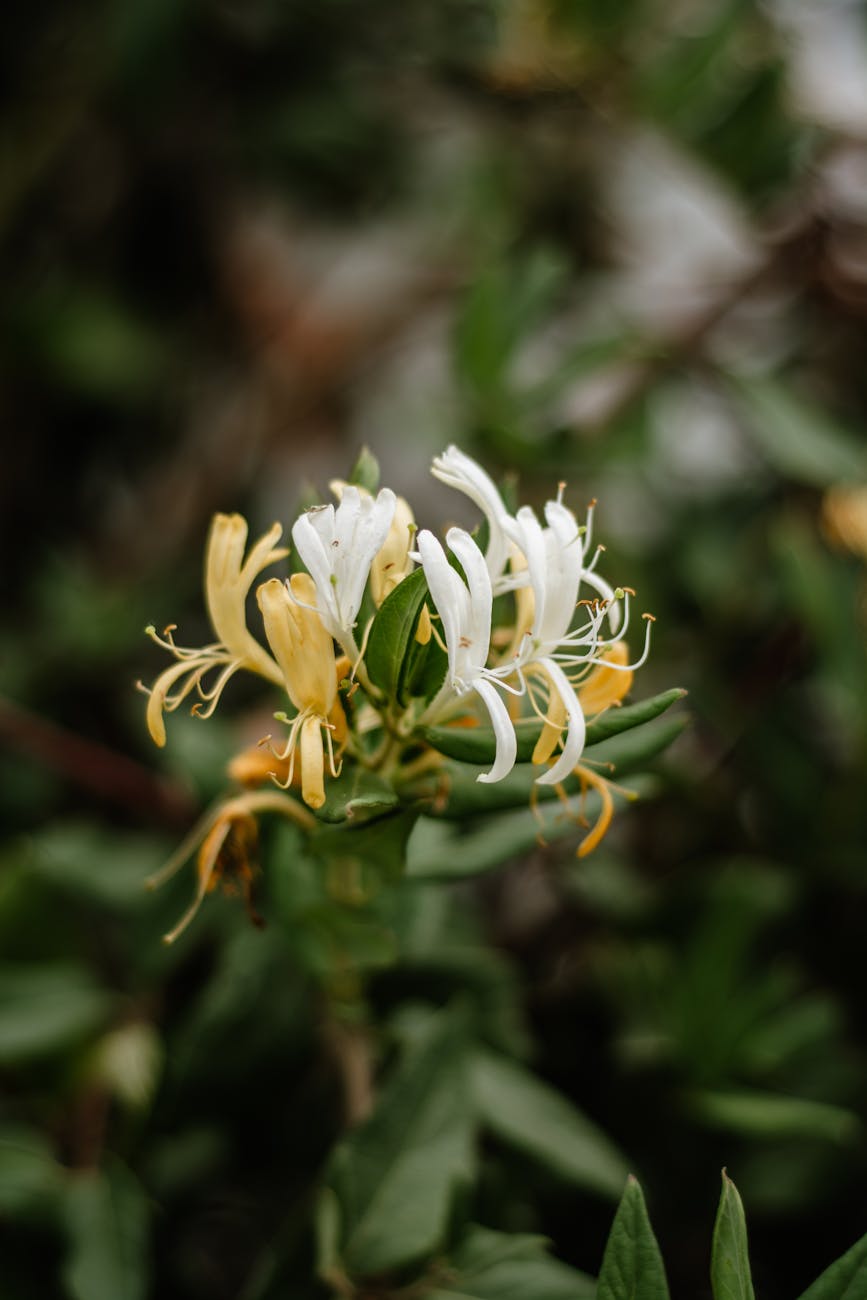
This time of year, certain blooms and fragrances evoke my childhood memories. I spent most of my childhood and all of my adolescence in southern New Jersey, along the Delaware Bay; the swampy coastal plains have now largely burgeoned into suburban housing developments, but in the late 1960s there were actual townships with old-fashioned suburbs–the kind with sidewalks–and many a privet hedge that bloomed in early June with small, white spires that gave off a faint scent. In overgrown areas of meadow and scrub, the sweet smell of Japanese honeysuckle perfumed muggy evenings. And while I don’t recall much scent from the mimosa trees in bloom on Harvey Avenue, once those fallen pink blossoms began to rot on the sidewalk, they added a distinct punk that meant summertime. The honeysuckle is blooming here now, making me wonder about the neuroscience behind the sense of smell. Gotta check out these books, perhaps: Kiser reviews four recent books on olfaction.

On a side note, none of these evocative plants are native to the Americas: Ligustrum vulgare, Lonicera japonica, Albizia julibrissin–and yet I associate them with South Jersey. It is almost like a refrain in my memory-mind.

To speak of associations reminds me of Alexis de Tocqueville. I’ll post a quote of his below, one that makes me think of language and poetry and science. But back to refrains:

Musical refrains also run through my brain, evoking memories and nostalgia, or just being irritating “earworms.” At any given time such tunes may include Tchaikovsky’s Serenade for Strings, strains from a late Haydn quartet, one of many Springsteen songs, Marvin Gaye’s version of “I Heard It Through the Grapevine,” or–most confounding of all–the Chock-full-o’Nuts jingle from the 1960s or some similar commercial sloganeering. Why such things wear a familiar groove in the gray matter I don’t know, though Oliver Sacks’ book on music (Musicophilia) and Daniel Levitin’s This Is Your Brain on Music offer some insights, and I’m thinking of reading this one by Samuel Markind when it comes out later this year.

Alas, I’m not gardening because once again the garden is awash in mud, so I entertain myself with endeavoring to discover how/why my brain works (and yours, and anyone else’s), since that’s one of my favorite lines of inquiry when I can’t work outside. I will take a sodden walk later and dwell on possibilities while enjoying the scent of the invasives; I’ll work on some poetry revisions; maybe I’ll listen to music…and freely associate with any and all possibilities. Here, as promised, Alexis de Tocqueville:

“When citizens can associate only in certain cases, they regard association as a rare and singular process, and they hardly think of it.

When you allow them to associate freely in everything, they end up seeing in association the universal and, so to speak, unique means that men can use to attain the various ends that they propose. Each new need immediately awakens the idea of association. The art of association then becomes, as I said above, the mother science; everyone studies it and applies it.”

Honeysuckle photo by Nadiye dabau015fu0131 on Pexels.com

Crabgrass

I have been at work in the vegetable garden during the past few dry, sunny, late-summer days–it has been rather droughty here–and pulling up weeds in an effort to get an early start on putting the patch to bed for autumn. I have decided not to do any late-season sowing this year, and therefore I can pretty much tear up everything if I feel like it. Today I was thinking about my mother-in-law, who died in 2017, but who was sometimes my partner in the garden, or I in hers, when we were younger. I learned a great deal about ornamentals from her.

At her property, crabgrass was a particular scourge. I remember us weeding flower beds together while she muttered, “Crabgrass! Always crabgrass, how I hate it!” It struck me odd at the time that she pronounced it “crebgrass,” with the first “a” like a short “e”, because she said the word “crab” and similar words with an open short “a.” It was almost as though she reserved that pronunciation to express her ire at this particular weed. She liked weeding at my house partly because I had so little crabgrass. Plenty of other weeds, but not much crabgrass.

Our weeding together took place over 15 years ago, when my gardens were on the new side, maybe a decade old. Today, however, I find my vegetable patch very much colonized by digitaria sanguinalis…one of the finger grasses, a very successful weed that can produce 150,000 seeds per plant. My garden now hosts both smooth and large crabgrass; the former is much easier to pull, though it can set seed even when it is mowed to under an inch in height! Large crabgrass, when it gets going, can grow over a foot tall and have a base rosette of 10″ with a star-like (or crab-like) set of leaves and quite tenacious roots, for an annual.

While I worked (too late, I really should have gotten to the weeds long before they began to set seed), I heard my mother-in-law in my mind: “Crebgrass! How I hate it.” Well, dearest Gene, I have finally encountered the Eurasian colonizer in my own gardens. And I miss having you around to sympathize with my plight.

 Maudib | Credit: Getty Images

There’s a metaphor here, I know there is. Maybe there’s a poem in this experience, too? For the time being, pulling weeds reminds me of someone I loved–and takes my mind off of another person I love, whose dwindling and decline (her “diminishing”) stay uneasily in the background of everything I do these days.

In the between-season time, with autumn almost upon us, I want to remind myself of the joys that come along with the crabgrass. Such as the brown crickets and the morning glories and the goldenrod…and memories of people for whom I have cared a great deal.

~

Pastoral call

When my father put on his collar and his well-shined shoes but it wasn’t a Sunday, we knew he had meetings to attend or visits to parishioners to make and that sometimes, on coming home, he might seem quiet, which was unusual and meant he was turning things over in his mind. I try imagining him as he must have been then, younger than my son is now, counseling people through their griefs and doubts, encouraging the ill, attempting to comfort, confronting so much inequity and pain. What did he know?

Trouble came. His father died young. My little sister was stricken with pneumonia, gasping, feverish, hospitalized. My pregnant mother in such pain she could not climb the stairs to tuck us in at night. And so, with no one near to take me for the day, I was his visitation sidekick, dressed as though for church, carrying paper and pencil and a book I couldn’t yet read. People welcomed us into their homes in formal rooms sun never seemed to reach, seated us on sofas with doilies on the armrests or crocheted throws along the backs, or sometimes in carved wooden armchairs with lion-paw feet. There were often candies in a glass dish on a side table. The women gave my dad coffee and sometimes I got a glass of milk. Once, I had tea in a translucent cup decorated with pastel-colored flowers, and I took two sugar cubes and stirred carefully so as not to spill or make any noise.

Sometimes the parishioner offered me the run of a playroom or nursery–those children now grown, maybe as old as my father–and I rummaged through the old toys and imagined my own stories. It was important to make as little sound as possible, to be a presence invisible to grownups while my father took someone’s hands in his, prayed beside them, or listened to quiet sobbing. Indirectly, I was learning that adults cry, too, and that they were not always invincible, or even in charge.

It seemed a privilege to be with him being with people when they most needed something, Maybe not something he could give or grant them, true. He started to realize that very early in his ministry.

~

In early childhood, once I abandoned the idea of growing up to be a princess, I liked the idea of being an artist or a scientist when I got to be an adult. That hasn’t quite worked out the way I guess I expected, but my ambitions (if that’s what they were) indicate that I had begun the lifelong process of wanting to understand–well, everything, almost! I found the following passage in Rebecca Elson’s book A Responsibility to Awe, and I feel as she does, though in her case she’s talking about observing and studying the Large Magellanic Cloud and its star structures:

There are times when the enterprise seems mechanical, when the constraint to pursue the truth seems to suffocate the imagination, and the mysteries of the Universe seem irrelevant to the lives we humans lead down here. But on the whole, understanding the Universe seems a fundamental step in understanding our origins, and in establishing a perspective with respect to space and time that I find comforting.

Rebecca Elson, “From Stones to Stars”

~

It took my father quite some time to find a perspective on life, faith, and human behavior that comforted him. I do not possess the same perspective, but I believe he would be okay with that.

Prose starts

In a recent post, I mentioned that one of the challenges of writing a speaker in lyric or lyric narrative poetry is that readers assume the voice, experience, or perspective of the speaker completely aligns with that of the poet. It’s especially confusing if the writer reveals that one poem does arise from or act as memoir/lived experience when other poems by the same author–that seem like memoir–are fictions.

I admit to being among said poets: my collection Barefoot Girls contains poems based on memories of my teen years in the 1970s, yet the stories therein are invented. Sometimes a poem starts as something that “really happened” but does not work well as a poem when I stick to the truth as I recall it. Journalism is not poetry (usually). Thus, in the revision process, the so-called truth gets reimagined…in order to craft lines that are better as poetry. I know that people who don’t write poems find this fact difficult to grasp.

I keep a journal–have done so for decades–and I tend to start poems one of two ways, either from image-based phrases I jot down or from prose entries. The latter approach, from prose, may indeed have a basis in lived experience. Here, I offer a concrete example.

The draft below started as prose but may evolve into a prose poem, may evolve into free verse, or may end up as metrical or formal, blank verse or pantoum. Or it may end up in the “Dead Poems” folder of forgotten drafts. Right now it consists mostly of lived experience, though I’ve already begun to fictionalize a few moments, blur a few lines about the ride in the car (there was another passenger), what he may really have said (heck, my memory’s not that accurate) and where my thought process went. I’ve also played around with line breaks and indents to help me visualize phrasing and rhythm. This is the way I often work.

I believe models and examples of creative working methods help to clarify what artists do. Yet some of it–especially among geniuses–is inspired, mysterious, and cannot be described. I wish I felt that inspiration more often. But I do not mind doing the work of rethinking, reimagining, revising.

~

My Son Drives Me from West LA to Pasadena
 
…talking the whole way about the job he loves,
new friends, old friends, how he spends
            his leisure time; where we can eat,
what he thinks about social movements and
government policies, whether it’s worth buying
            patio furniture, what we should do
next time I visit
 
and I’m listening, honest I am, but I’m also observing—
I can’t call it a landscape, really, as the view’s
            a swath of highway many lanes wide and
city blocks for untold acres dotted by walls of vivid
bougainvillea, beige buildings, tall palms under a sky
            perfectly cloudless, flat.
 
Then, a shift of geographic formation leads into
scrub brush, spotty suburbs, highway narrowing to
            a mere six lanes, and he says I’ll notice
real change once we get into the hills; the weather’s
usually predictable here, it’ll be a fine day. I’m listening,
 
but I’m also recalling times—many times—I sat
behind the wheel when he was far too young to drive,
            watching the road through the windshield
of the family car and listened to him tell me the thoughts
that flashed through his mind like a summer field of fireflies.
            Those trips I was privy to a newly-forming
perspective on the world, it was as though I listened to his
young mind crackling with ideas,
listened, and listening, with a joy I’ve never abandoned.
 
~


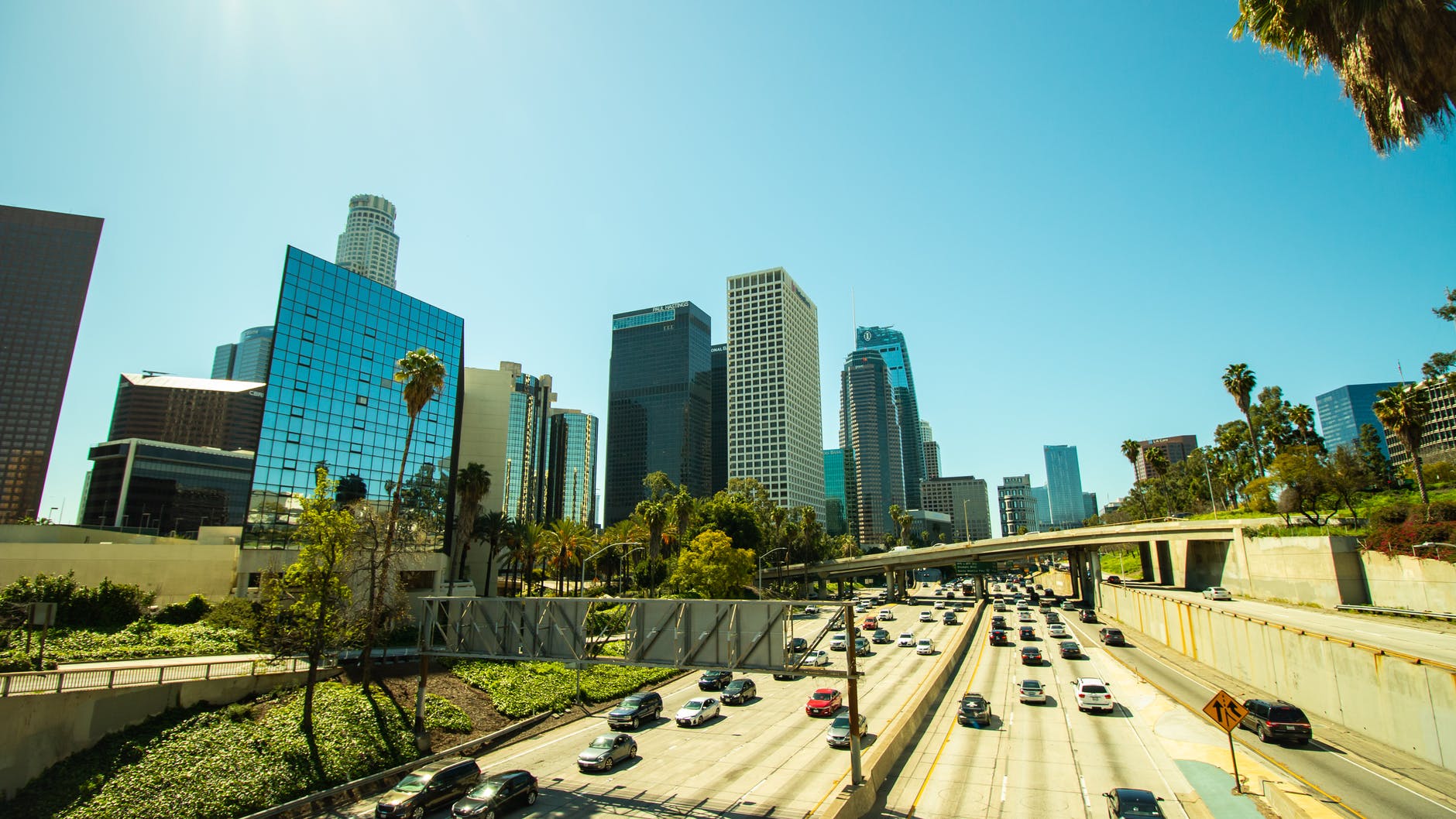
Photo by Anthony Celenie on Pexels.com

Expanding universe

I just finished reading Lisa Randall’s book about the Large Hadron Collider, which I read because…well, I knew it would be over my head as far as the applicable physics experiments go; but I was curious about what exactly the Higgs boson particle is and how it fits into the Standard Model of physics. And now I know. Sort of.

It is difficult not to feel a bit awed by the strides made in science as a result of rapid technological advances. On the sociological and personal level, I am not a big fan of rapid tech updates; they lead to planned or unplanned obsolescence and hence to constant capital expenditures and to waste (trash waste and time waste). The technology leads to experimental possibilities we would not have had otherwise, however.

At the close of the book, where the author wraps up the way engineering tech has dovetailed with abstract and speculative physics theories to show evidence for the Big Bang and the existence of quarks (among other things), there’s an illustration of the “ballooniverse,” an analogy physicists use to explain the expanding universe. I felt a rush of memory flooding me:

Freshman year in a seminar college. The class was Astronomical Physics and Cosmology. For context, Hubble had discovered red shift galaxies in 1929; cosmic microwave background was detected in 1964; Wilson and Penzias won the Nobel Prize–three years after my freshman year–for their work, which led to confirmation of an expanding universe. The term “black holes” was relatively new, coined during the mid-60s; and a theoretical explanation of them had not yet been determined. Oh, and because desk calculators were large and prohibitively expensive, my fellow students and I were using slide rules for calculations of stellar magnitudes.

Did I mention I had never taken a maths course beyond Algebra 2?

But our professor was enthusiastic and encouraging and loved using metaphors to help our teenaged brains decipher challenging concepts. I have forgotten most of his analogies, but the ballooniverse stayed with me. Everything in the universe is moving away from everything else. Our future is distance.

Physics classes in high school still use this 3-d visual analogy

So it seems at present. Each of us moving away from one another. Defoe’s narrator says the best method of avoiding plague was to run from it.

But oh, my Beloveds, how I wish to be close to you.

Opinion, argument

We have reached the part of my course in which I show my students what a fallacy is, how many forms of fallacies there are, and how a fallacy works–or, supposedly, doesn’t work–in an academic essay. This being an election year, and social media presenting so many examples of ideological opinions and shortcuts in thinking, there’s been no end of sources to demonstrate fallacies. Too many, in fact. My students have been so overwhelmed this year that I sheared my usual list-o-fallacies to four of the most common among freshman students. In doing so, I thought of my dad.

My father was well-instructed in formal argument at Wabash College in the early 1950s. His belief that people could disagree intellectually while maintaining friendly relationships probably stemmed from his experience there. His faith that people in groups could resolve conflict through careful listening and commitment to compromises came later. But what I want to mention here is how seldom it was that I heard my dad making an ad hominem attack, or any of the more frequent rational argument fallacies, until he was in his 60s or 70s and “the filter came off” a bit, post-retirement.

One time stands out in my memory. I was in my early teens and was telling my dad that I recalled being 6 years old and attending, with my parents and sister, an event at Dr. P’s house–a slide show of Dr. P’s trips to the Holy Lands. (Yes, in the 60s, that sort of event was a thing.) “Was he rich?” I asked, “Because I remember thinking his house was so big and so fancy compared to any other house I had been in.” And to my surprise, Dad gave a kind of derisive snort and said Dr. P was a “pretentious snob.” (A snob was one thing he couldn’t abide.)

Now, my dad had opinions, and expressed them bluntly; but he tended to frame his opposition to someone’s behavior or ideas, not to his (or her) person. He’d happily tell us that a friend was “just being a horse’s ass” (not that he is one), or say that someone was “talking through his butt” or that a politician’s proposals were “nothing but a load of horse manure”– “Oh, that fella, he talks like he gets his ideas from the back of a cereal box.” Or, “I don’t take him seriously when he yammers like a hypocrite.” Dad would say such things, but always qualified them with how a person spoke or acted–a subtle difference that I actually did pick up on. That’s why his ad hominem brush-off of the Dr. came as a surprise to me, I suppose. As my father neared 90, he got a bit more curmudgeonly, yet he genuinely believed that [most] people are inherently good.

I like to remember that about him.

~

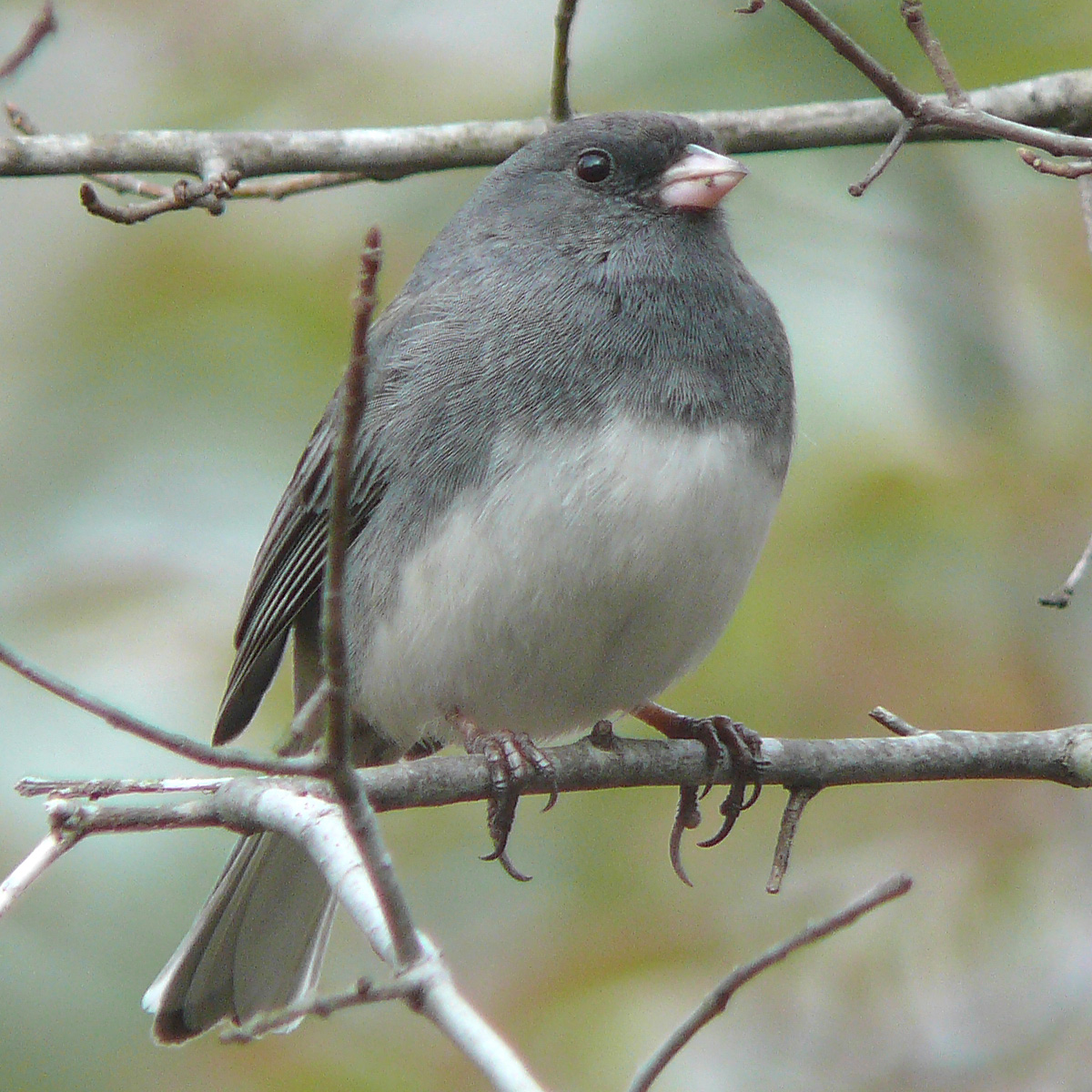
Dark-eyed junco .. now appearing at our birdfeeders.

Practicing

When I was 15 years old and learning to type on my dad’s old manual typewriter, I decided to write my memories; I was composing memoir before I knew what memoir was, under the influence of fiction (David Copperfield). I lost track long ago of where those pages are, but I do recall that I wrote page after page. What on earth would an adolescent who was raised in loving and non-traumatic circumstances in a middle-class New Jersey suburb have had to say that was worth recording?

I wrote about losing a toy bear, and learning to read; receiving second-hand books with joy, reading voraciously, wondering what it would be like to be an orphan, and feeling terrified of dying. I wrote about the attic of our old house and learning to ride a bicycle. There were other things, too, that I can’t remember now. Generally, mundane and typical 1960s-childhood events–and descriptions galore. It felt important to write down the small details.

Perhaps I should have gone into journalism.

These days I’ve no interest in writing memoir. I have kept a journal since I was ten years old, and that constitutes enough self-indulgent scribbling on its own. I treasure, however, the practice all that writing gave me: practice in constructing sentences, employing vocabulary words, creating metaphors, using punctuation in various ways, expressing abstract ideas and describing concrete objects. Writing, learning to write, critique, and revision have been immensely valuable to me.

I’m not sure who I would be if I hadn’t been constantly writing (and reading). Maybe I’d have been a contemplative.

~~

All of which is to report to my readers, who may be experiencing their own obstacles to their art, that –yes– the writing continues in the face of loss and grief, anxiety, and the work of the body in the world, in the mundane spaces of daily grind and in the wakeful hours, and in the containers of dreamwork and consciousness. Right now, the writing is not “good,” not crafted, aware of itself, ready to speak to others than the self. It is, at present, more akin to what the Buddhists call practice.

Photo by Donald Macauley on Flickr | https://tricy.cl/2DSmsmY

~

Keep working, keep practicing, keep breathing.