Small, refreshing

Another day. One that the calendar claims occurs in 2026, although at times I disregard the calendar–another human-made thing, and I find so many human-made things destructive and frustrating. It’s not as though a “new” year puts away what has happened the previous 365 days the way I can put away the holiday decor. Which I haven’t actually done as yet. Anyway, we’re still in the first week of January, and Twelfth Night has barely arrived, so if I do want to acknowledge the calendar I can excuse my lack of clearing-away. But I can’t clear away the losses of the past year, and I don’t want to. I want to remember my friends for as long as I can.

It’s true that wintry walks offer quiet splendor (sometimes) and a chance to reflect, but mostly winter affords the chance to stay inside, curled up with a book or browsing through garden catalogs. Theoretically, it’s a good time to revise and submit my work; often, however, I don’t get to that process because winter is also a low-energy time for me. I powered through a fibromyalgia flare two days after New Year’s Eve because loved ones were visiting, but there’s a bit of fallout as a result–worth it, though; and I’m chuffed about taking poetry workshops later in the month. Meanwhile, reading books! I got a Samuel Hazo collection from my local library, I’m reading Wendell Berry and Richard McCann, and Ada Limón’s You Are Here is on my to-read pile. I’ve also felt inspired by the start-of-a-new-year blog posts Dave Bonta has curated on his Poetry Blog Digest. Many writers and books there I want to check out, and many writers and poets feeling some of the same things I’ve been feeling about the past year and what to make of the years ahead.

So to recharge, as it were, I’ll do small, refreshing things this January: take photos, doodle with watercolors, read books, tromp about in boots, meet pals for morning coffee, draft poems, play with images, as per Johan Huizinga–“To call poetry, as Paul Valery has done, a playing with words and language is no metaphor: it is the precise and literal truth…What poetic language does with images is to play with them.”

Play’s the thing

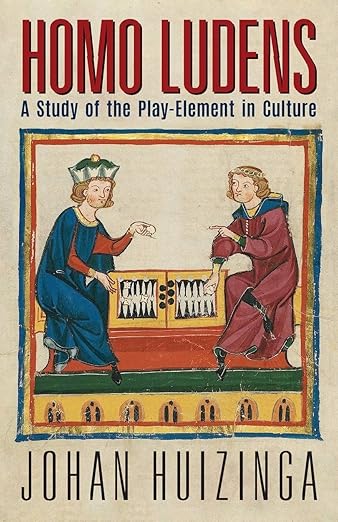
My freshman humanities professor, the brilliant, late Larry Fuchsberg, assigned Johan Huizinga‘s The Waning of the Middle Ages as one of the texts for our course…an unusual choice for American teens in 1975, as was another of our books, Burckhardt’s The Civilization of the Renaissance in Italy. At 17, I found Burckhardt rather slow going stylistically (it was published in 1860, after all); by comparison, Huizinga (circa 1919) was refreshingly clear. I really enjoyed it and learned a great deal. I kept meaning to read his 1938 book Homo Ludens, but for awhile it was difficult to find in libraries or bookstores. Also, I lacked the time to track it down or read it. The premise interested me, though–that we humans evolved our culture from the “pointless, imaginative” urge to play, and that play is fundamental to our learning and our social structures. Also, we are not mechanical beings–the messy frolicsome-ness of people is as necessary for our survival as food, water, and shelter.

“Animals play, so they must be more than merely mechanical things. We play and know that we play, so we must be more than merely rational beings, for play is irrational.” 

Finally, I’ve begun to read Homo Ludens, and it’s even on Amazon now; also I discovered that it exists online here thanks to Yale University. Fifty years after my initial encounter with the author, I find his thinking just as interesting as I did in college, and just as difficult. As in his other books, Huizinga uses etymology as one of his methods of examining the meaning and culture of play. He was writing for an audience that he assumed was well-educated in the classics, so there are passages in Greek, Latin, and French that neither he nor the English translator bothers to translate for less linguistically-adept readers like me. Fortunately, such passages are brief and are used as sources for his argument, and I’m not reading to find fault with his material. I’m interested in his argument and insights as a whole, and intrigued by his thinking. He apologizes for his lack of sources (ha! There are hundreds of them) because he was “working in haste.” He composed this book in the Netherlands as Germany began to be a serious threat to Europe, and he wanted to get his ideas in print before he was silenced. In fact, his last few years were difficult. He had used his standing as a well-known cultural historian to criticize the Nazis and was arrested in 1942, basically house arrest; he died in 1945 just before the war was over.

I’m only on Chapter 4 but am finding, in the etymological tracings of the words that intersect in meaning(s) for play–game, contest, gambol, gamble, dallying, tournament, match, riddle, performance, frolic, pretending, folly, fun, sport, etc.–fruitful stuff for poetry, for thinking about poems and about how poems work as craft, as poems, and as works of art and imagination. And also, what roles poems may play in culture today, and whether that differs at all from the role poetry played in ancient times. Huizinga writes:

“In the making of speech and language the spirit is continually ‘sparking’ between matter and mind, as it were, playing with this wondrous nominative faculty. Behind every abstract expression there lie the boldest of metaphors, and every metaphor is a play upon words. Thus in giving expression to life man creates second, poetic world alongside the world of nature.”

Language may not be necessary for play but can easily be incorporated into it, and language can become play. Or playful. I don’t know much about Wittgenstein, but I find myself thinking of his theory about words having “family resemblances” that often connect, overlap, shade meanings. So we get jokes, puns, flirting, mocking, and new “rules” for our language use that culture constantly shifts in all kinds of directions. Language is a game-changer, and poets make use of that.

I thank Larry Fuchsberg, musicologist, book-lover, and educator, for introducing me to Johan H. Teachers, you never know how much you may have influenced a student’s life, even decades later.

Walking

Numerous so-called health and fitness articles continually pop up on my screen, and many of them not only tout the benefits of walking but claim to know how many minutes or miles of walking (or rate of speed and such) are necessary to ward off dementia, keep your heart healthy, your bones in shape, your muscles well-conditioned, your circulatory system moving, your lungs going, or to extend your life. Oh, and relieve stress. And while you are at it you can get a device for your wrist or an app on your cellphone to monitor your pace, steps, heartbeat, etc.

But not everyone can walk. Too many of us forget that, take it for granted–especially “content” developers online angling for clicks. And, while I do like walking, I don’t particularly relish being told how I should go about it. I agree that it would probably be good for me to walk at a brisk pace for an hour every day, and some days I am inclined to do just that. There are other days I want to hike up a hill, or take a pokey amble around my meadow, or wander through a nearby park, or climb Nemrut Dağ just as dawn breaks. Or curl up on the sofa and read a book. I appreciate routine, but not invariable routine.

Autumn happens to be a time of year I like a slow stroll or hike; save the brisk walks for cooler, lousier weather. Now that most of the leaves have fallen, I can spy bird nests and paper-wasp nests (there’s one of those in our tamarack tree; last year, there was one in the Japanese maple). Milkweed puffs are swirling in somewhat chilly air, red berries decorate shrubs and trees. Red-tailed hawks and black buzzards wheel overhead. No reason to churn through the scenery at a rapid pace.

A. R. Ammons wrote an essay titled “A Poem Is a Walk,” in which he describes the physical act of taking a stroll “with” a poem, rhythm, breathing, the stride; he says both a walk and a poem are useless–though you might want to read the essay before agreeing or disagreeing on the uselessness, since his essay is almost a phenomenological argument (and we have to decide what is meant by “useless”). [Note: The essay is paywalled behind University of Arizona’s site, and–oddly–the one legible free version I found is here, from the Università degli Studi di Milano! Well worth reading, though, and in English.]

I think better when I walk slowly and steadily, with pauses to look around. That’s when images come to mind, metaphors, descriptions, sensations, ideas. Sometimes, it is a kind of haiku-walking, generally undirected. I don’t plan to reflect on anything or come up with prompts for poems. And I don’t do it to improve my life expectancy.

I just like to walk. And maybe, a walk is a poem.

Blue

At one of our local used book stores,* I found a copy of William Gass’ 1976 On Being Blue: A Philosophical Inquiry. Gass writes in a style one might term prolix; but if you are like me and sometimes appreciate lists, wordplay, allusions, lengthy sentences, and fine distinctions in your sentences–as well as humor–while exploring the limits and the stretches of words and language, this book-length essay on the word/concept/color/iconography/sexual innuendo/moody attitude and conflicting meanings of the word blue might appeal. I’ve been feeling a bit on the blue side lately, hence my attraction to the book (though I do like Gass as a writer, as long as I don’t have to read too much of him at one time). And guess? It cheered me! [I will caution the reader who avoids the use of “bad language” that Gass employs such words in this essay, for purely intellectual reasons…]

Granted, my feeling blue has a different tone from other uses of the word: blue postcards, sexual meanings of blue–I’m reminded of the movie “I Am Curious (Blue)” which was considered racy and given an X rating when I was a kid, though the blue in that title referred to the Swedish flag, apparently. My blue is the blue of songs like “Baby’s in Black” or Joni Mitchell’s “Blue” album. Or just that classic music form, the blues.

And I’ll get over feeling this way. That’s what moods are: feelings that come and go, transitory. It always seems as though low moods stay around longer than neutral or cheerful ones, but many scientific studies show that it is our perception and memory of the negatives that make us think we are sadder for longer. Even Wikipedia has an entry on negativity bias, with some sources if you want to check things out yourself. As I age, I realize that bad moods and sad events and past mistakes don’t need to stick around as much as I used to think. A bit of mediation, some practice and readings in Zen and in psychology, a lengthening perspective on life’s vicissitudes, some counseling and even some medicine; whatever it is that’s brought me here, I recognize that before long the depressive hours will lift. Also I know some methods of thinking that assist me to move to more neutral ground.

I will note there are many kinds and hues of blue, enough for Gass to write 112 pages on it and for the word to appear in 85 files of my own poetry during the past 12 years–I did a quick word search just to find out. That is in the files alone, and each file contains many poems. so I can only imagine how much I have over-used the word in my writing life! Certainly, not all of those blues are sad. Many are beautiful, sunny, the blues of blueberries and balloon flowers, the New Mexico sky, mountains and oceans; teal-blues and turquoise, the bright royal blue I like to wear, the pale color of robin’s eggs.

Blue. It has always been my favorite color.

~~

*The bookstore is Apport, in Emmaus, PA. Ben has an active Instagram feed and really cool catalogues of odd books, art, and ephemera.

*The first “blue” above is an encaustic painting by Deborah Barlow; the second is at Bandolier National Monument; the third is of the Blue Ridge Mountains; the last was taken at an inlet bay, maybe in Delaware–I’ve forgotten.

Blackberries

[note] *Hmmm. Somehow, I backposted this post. It was written June 23rd, post-solstice!

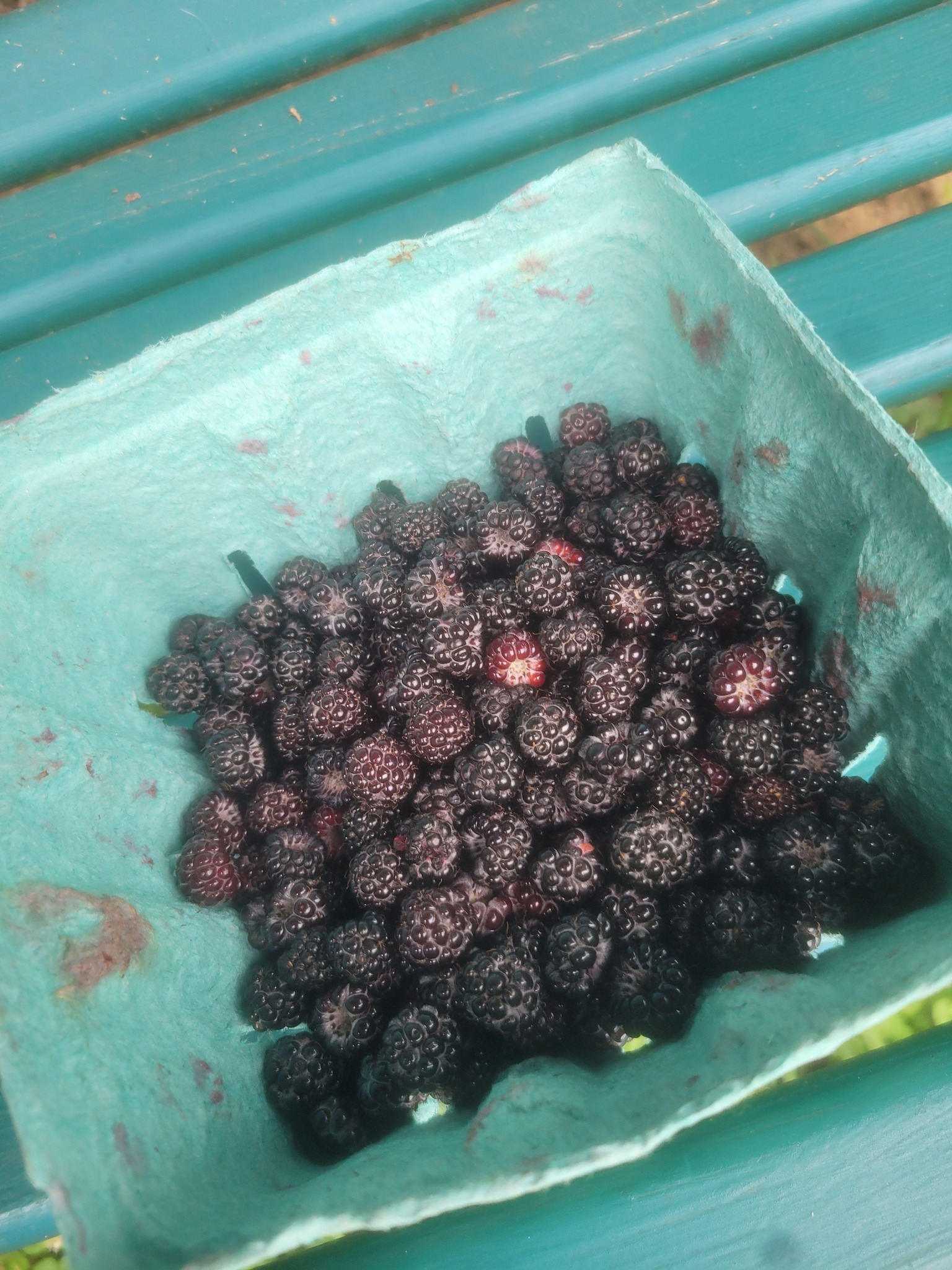
Actually, they’re wild black raspberries, someone informed me. They usually ripen around the end of June, and everything eats them–orioles, robins, catbirds, deer, possums, raccoons, possibly even foxes. Black bears, if they’re in the vicinity, though we haven’t seen one here.

Humans enjoy eating them, too. Usually I don’t get more than a few for yogurt or ice cream toppings, but this year–a bonanza. Maybe the canes liked all that rain. Harvesting them is quite a task, because the canes are in the hedgerow thicket and twined about with poison ivy and cat’s-claw and other spiky and rashy flora, not to mention the thorns of the berry canes themselves. And harvesting comes as the hot, humid weather descends on this valley, making the effort a sweaty and uncomfortable one. I always think of farm workers, almost all of them immigrants, who get hired to do this sort of work–the vital work no one else wants to do. They deserve better pay and considerably more compassion than they generally receive. Half a quart of blackberries cost me half an hour of sweat, many scratches, and a swath of dermatitis; but, like Flopsy, Mopsy, and Cottontail, I had bread and milk and blackberries, (for breakfast).

Current mood: harrowing. Aghast. These two poems, though I wrote them many years ago, seem apropos to the moment.

~

Like Thumbelina

Where there’s green foliage
so dense my eyes ache
I spend an hour in shade
snacking on blackberries
the birds haven’t found.
My head hurts from the agonies
of money. The cell phone rings.
Ferns and five-leaf vines
muffle street sounds,
a little colony of feathery mosses
sits under a tree-burl shelf.
I find a hole pressed snugly
against old roots and leaf-mulch.
Like Thumbelina,
I want to curl myself inside
a sassafras leaf, sleep
beneath a toadstool
undiscovered,
unmolested,
temporarily free.

~~
Thicket

Behold the thicket:
it is deep with brambles.
It is blackberries in July,
wineberries in August.
Move, and the thicket
impedes you, catches
your sleeve,
plucks you awake.
The bee is here. The spider.
The thicket is alive, and crawling.
Green with jewelweed to salve
rashes from the thicket’s
poison ivy. Green with prickly
horsenettle, coarse pokeberry,
the brilliant, twining nightshade:
thickets sweat poisons
as well as fruits.
I have brought you here to show
that you can never get through,
not unscathed, not without
brutality of some kind,
the saw, machete, knife.
This tangle no amount of patience
will ever undo—
it will overtake you,
grow into your hair,
invite warblers in to nest,
spiders to unfurl their orbs.
You must learn not to hate
before entering the thicket;
you must acknowledge all its ways
to understand its wild embrace.


Correspondences

Dear Beejay,

Remember how we used to correspond by email every week? Sometimes more often. You, the best correspondent ever, though we never wrote paper letters–in those pre-internet years, we’d lost touch, moved too often; no postal mail from you until, once we were connected again, you sent me a birthday card. And tomorrow is your birthday. So here’s your birthday email. You see? I didn’t forget.

It remains dry here. That spate of rainy days in early April? Over with and barely a half an inch since then. I’m watering my veg garden daily. Today I sowed another row of spinach. The first and third sowings are doing well, but the second sowing didn’t germinate–can’t figure out why not. The lettuces and other greens are looking good, and the strawberry plants are in bloom. I even took a chance and planted some zucchini seeds. The task of thinning lettuce and carrots is indeed tedious, but it is a lovely day and the air is mild; and frankly, thinning carrots is less tedious than sending poems out to literary journals, I know you’d agree.

I’ve been reading a lot of contemporary poetry. It comforts me somehow, even when the poems are sad or angry poems (that seems to reflect the times, which poetry can do). Your own writing, who has it? Does it exist on some hard drive somewhere? You always were excellent at organizing things. A talent I envy and do not possess.

Anyway, I did a bit of weeding to prep for the tomatoes and peppers when the seedlings are ready to transplant, but I got a late start on them and may not even move them to the garden until after my trip to New Mexico. Right now we’re getting pollen blow here. I expect your pollen blow was over two or three weeks ago, and that the azaleas are past their showy bloom time down there. I know how you love azalea season. And the beach–I guess you won’t get there this year.

I do find myself, at odd moments, wondering about your cats. When our lives were routine and there was nothing of interest to write about, we could always turn to cat anecdotes. Today, my Nessie joined me in the garden while I was working on the carrot patch. The catnip plant in the herb bed has leafed out quite early, and Nessie stretched his whole lean body over it and lolled himself into a snooze-fest, exposing his white belly. You would have laughed. You always called tuxedo cats “Holsteins.” I’m insulted on Nessie’s behalf.

When a person we love dies, I guess there’s an impulse–almost an instinct–to memorialize them, at least among those of us in “Western societies.” Or maybe it is a human impulse, I can’t say. I have written too many poems of elegy, and there will be more; but sometimes, it takes awhile before I feel I have the right perspective or frame of mind to write about them, or about my feelings of loss. Today, so much reminded me of you, Beejay, that I had to write something. If not a poem, then an epistle–the way I used to write to you, of ordinary things, the garden, cats, seasons, poetry.

Happy birthday, wherever you are.

Reading my contemporaries

The poetry collections I’ve been reading during much of the past year have largely been works of contemporary writers–books that were published during the past two decades, some during the past two years. My focus on such current work was not intentional. After all, there is still so much poetry from the past three or four thousand years that I haven’t yet explored! Grad school, however, was decades ago; that’s when I last studied both contemporary and classic/canonical/influential poems with a specific eye to learning from them. I continue to learn from the poems I read, though. I just don’t take as many notes or write any papers about them these days.

Three collections I read recently have got me thinking about the grittier sonic elements in poetry; the use of scientific, foreign, antiquated, and invented words; wordplay in general as a poetry component; and how sound can push both experiment and meaning in a poem. I’ve been mulling about the task of writing anything that feels “new,” to me or to my readers, and about the challenges more sonic wordplay would mean for me as a writer. I’m saying here I think it would be difficult to do, because it differs from my long-accustomed voice and style. I’m also saying I like a challenge in creative work, and that my style(s) go though changes always, so why not? In creative art of any kind, the passing of years makes a difference in many things. Content (because: experience). Situation (because: life happens). Methods (because: technology and materials). And influence–what I was reading in high school vs. grad school vs. today–though some favorites will always hold a place in my creative mind.

My poems tend to be plain-spoken, although I’ve never been shy about going beyond the standard vernacular to employ a geological term, a botanical name, or a somewhat archaic noun or adjective when it suits the feel and sound of the poem. Most of my poems don’t fall under the description of experimental or edgy. I’m not making waves with language, but some poets are. And my recent reading has me wanting to experiment more. It will mean failing a lot, because I’m working against my habitual methods of composition. I won’t be as good at it as these poets (below) are. What I’m hoping, though, is that the practice of trying more sonic wordplay in my work implants a tracery of that practice onto my poetic voice.

~

So which contemporaries do I mean? More than the three I’ll briefly mention here, for sure (and it is not as if the only poets playing with words and sound are my contemporaries–far from it). However, here’s a start with some examples that I particularly love.

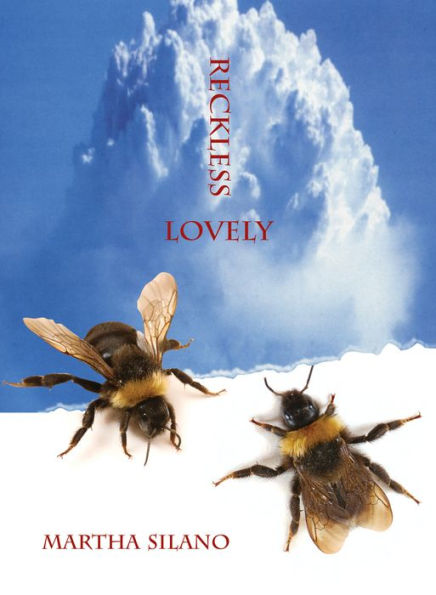
I mentioned Silano’s poetry in a recent post when I appreciated her scientific ideas that meld with an “everyday” life. Reckless Lovely contains many long-lined couplet verses that name objects such as a 64-ounce Big Gulp, Wells-Fargo, Italian Renaissance paintings, or the red spot on Jupiter as the poet observes and speculates on the cosmos that surrounds her. And she invents or alters words that suit her for rhythm, alliteration, sound: “the sfumato is sfumato-ing, the lute-r is lute-ing;” “when most of all that creep-eth/breath-eth buzz-eth/galump-eth sex-eth spar-eth/went AWOL/paving the avenue of asp/the boulevard of bee…” or the totally wild mashup Silano composes in “Summons and Petition for Name Change”:

Dim sum-my dilberry. Down there Daquiri.
Ear of Eden. Eminently Earthy. Empress Gensho.
Fandango-ing funnel. Fox foot. Flamingo.
Geranium in the Gate of the Gourd. Gentian's grin.

~

I find much to admire in Martha Silano’s work even though I often have to look up words (physics and geology nomenclature, usually).

Lesley Wheeler’s most recent book demonstrates her ability with form and sound in a different way, though in “Gran Torino Gigan” the alliteration is as snazzy as Silano’s abecedarian poem above: “Buzzes fade up front,/where beltless adults murmur and smoke//after unfurling musty sleeping bags…in rhizomatic zigzags, with a sharp zipper.” Contemporary technology gets into the poems and, with it, the sounds of our infrastructure, as in “I believe in utility poles, transformers,/lightning arrestors. Subtransmission lines/and static lines. The dead southern yellow pine…” and the theme of fungal connectivity means that we learn some useful and often beautiful mycology terms. Yet Wheeler often relies on shorter words when they suit the tone of the narrative. In a poem dealing with the aftermath of her mother’s death, she writes “No one’s grimmer inside/than me. My bully of a heart wears cheap/scuffed pumps and cusses like a mobster.” The repetition of the word “snow” in “Minus Time” establishes the poem’s pace. So many poems in the collection offer experiments in form!

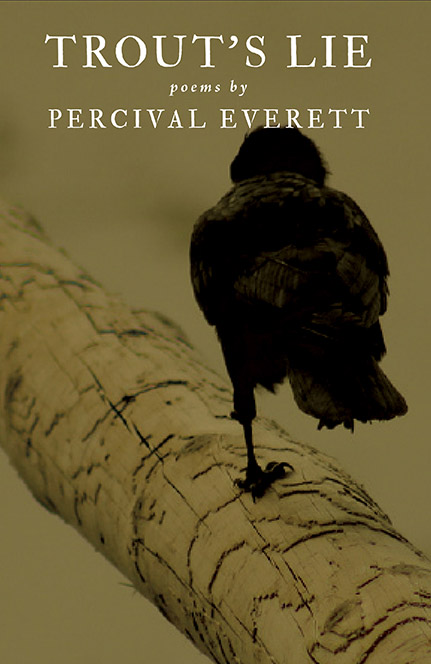
Percival Everett has gained an even stronger following thanks to his novel James, but he’s been writing poetry for years (Trout’s Lie is from 2015). This collection is deceptively simple in language and vernacular: there are surprises. Several poems make allusions to “great poetry of the past” by name or phrase; short lines build and build, twisting the lyric where we don’t think it would go. There are several examples I’d like to give, but this post is getting pretty long. I think I will close with an excerpt from Everett’s “Maybe Even Clouds,” the first section, which begins “Count the marines..”

They look like nice
Boys and bad boys,
From Vermont-and-Montana-
Following-orders-dumbshit-
Non-blinking-soon-
to-kill-soon-to-die boys,
Who might or might
Not, should or should
Not, but never would
Not and never can
not.
Not sure doesn't matter.
Doubt is a penniless
Customer, conscience
Waits for the weather
To change.


National Poetry Month may be almost over, but I’ll keep reading poems. And posting about them. And writing them. I encourage you to do the same, because there is no time in the history of the world when human beings haven’t benefited from poems.

Paper files

Frankly, I have never been much of a fan of organization. I don’t mind planning, in brief and purposeful bursts, but getting things in shape after the fact–once the mess exists–well. I know people who truly enjoy pitching in and re-organizing, but I am not one of them. Besides, I’m also facing similar tasks in my household, rooting through the kids’ rooms (they left years ago) and our attic and basement to cull, straighten up, and organize. The tasks are mutually distracting. And often tedious. I’m working on my attitude, though, trying to find some method of making these chores, er, “creative” in some way. (File under “Lying to Self”).

Call me old-fashioned, I’ll readily admit to it; but lately I have decided that the most efficient way for me to keep track of my own writing is by using a physical filing system. I have experimented with various spreadsheets (I have no patience with Excel, however and alas) and computer folders. I do use the latter for a year-by-year archive of my work, but I cannot easily extract what I am looking for that way. Now that I’ve retired from my 40-hour work week, I have wanted to manage my creative work better and keep track of what needs revision, what seems finished, what has been submitted, what’s been published. That strikes me as a necessary part of tending to myself as a writer. The past year has been a time of working through options, with accompanying irritation and tedium.

Photo by Anete Lusina on Pexels.com

After years of endeavoring to use electronic files, it came to me that there’s nothing wrong with old-fashioned paper systems, organized alphabetically by title, with the computer-file names and draft number at the bottom of each poem. This is how I think about the poems when I want to work on them or submit them, so it feels natural to me. Why operate against one’s own operating system?

I suspect one reason (oh, there are many, but let’s start with one) I am so angry about Elon Musk’s “DOGE” initiatives is that efficiency is never all it is cracked up to be and is also not the be-all and end-all of any society’s best organization. Of course those who push AI believe that algorithmic calculations can make the world run smoothly, but said people are egregiously uninformed about human nature and the myriad forms of individual thought processes. We are non-standard. Averages account for almost nothing, really. We do not think the same thinks. (And yes, I meant thinks not things, autocorrect). Diversity is what keeps evolution going. There is no change without it; and without change, we die.

So: I’m inefficient, to a degree, when it comes to keeping my creative work in order. However, the paper filing system, with a notebook and index cards and files on my hard drive, assisted by my still-useful memory (a human brain!!), have so far been working pretty well. It has taken me several weeks to put my stuff together, but now it’s far easier to fetch what I want to work on, send out, or collate, which I need to do to prepare for upcoming reading [I have two online readings coming up–one on Feb. 18 and one on May 2]. I’m also grateful that the task kept me busy while I was anxious and worried and grieving over recent not-so-terrific experiences in my (physical, real) life. Real life, which is not averaged. Seldom predictable. Inefficient. And something to celebrate for all its strangeness.

Chastened & learning

The temperature got wintry this past week, and now I feel inclined to make chili or giambatta, or savory stews with ingredients such as butternut squash, potatoes, beets, eggplant, cannellini beans. Or polenta, maybe–anything that takes awhile to cook, sending up steam and warming the kitchen so it feels toasty when I come in from a walk. I admit to being a wimp about walking in cold weather. I do it; I know walking in any weather is good for me and I bundle up, but my walks are decidedly shorter. Even on sunny days.

Today was not a sunny day.

And to my dismay, the downy woodpeckers are back again, hammering at the wood on our house. The one on the left banged into a window, but generally they cling to the boards. I wish they would drill at the many dead trees along our property line; they’d have more luck, too, if they’re seeking food. By the way, this photo is 10 years old. Now I would know not to handle a wild bird with bare hands because the oils on human skin are not good for feathers. (Three decades of educating myself about my own environment have chastened me–there’s so much I don’t know.)

I also don’t know which of my own poems are any good, or which ones to send to which journals, or whether I should care. It’s oddly heartening–and honestly, NOT schadenfreude! (because I get no pleasure from it, merely a sense of community)–to read in my colleagues’ social media posts that “rejection season” is here. I am not the only one whose poems have returned lately. Lesley Wheeler writes: “Magazine rejections have been trickling in, too, although mostly the please-try-us-again kind, and I know enough about editing now to really appreciate those.” I have had a number of those, too. And I’ve been an editor, so I get it, and I am appreciative. But I am mystified nonetheless–after 40 years, why am I so clueless at this sort of critical analysis? When I sit myself down to submit poems, I tend to find all my work lousy or, looking at the poems I think may be good, realize I lack any idea of where to send them–even though I am a frequent and avid reader of online and print literary journals. You’d think I’d have gleaned something about poetry the way I have learned about my geological region, its seasons, critters, viruses, predators, bloom times, pruning times, sowing/planting times and such.

Equally chastened by poetry’s landscape, I guess!

Practice makes poetry

I’ve been challenging myself to write 7-line poems lately. Half-sonnets? Not necessarily. Just an exercise in writing a poem in brief. I have used haiku and tanka as brevity/image exercises in the past, and that work has been helpful. While I seldom write poems that are longer than, say, 30-35 lines, practice with conciseness never hurts, especially when my inclination is to go narrative.

I’m not knocking narrative poetry: I love it. Love reading it, love writing it–especially the lyrical narrative. In addition, I’m a big fan of the discursive and tangential in poems and essays (looking at you, Ross Gay). But one does tend to fall into familiar territory, and it’s useful to push away at what’s easy. That means, every now and again, trying something unusual: persona poem, aphorism poem, Spencerian sonnet, cadralor, surrealism, slant rhyme, golden shovel, or an invention of one’s own…something to freshen up the craft.

Many writers I know rely on prompts for imagery, language use, theme, or topic. For some reason, that sort of prompt seldom gets me really working in a new vein, though I can get a poem draft or two that way. Using a form, trying something new with how the words land on the page, is much harder to do (for me)–and therefore, more useful. I honestly want to feel as though I am working at poetry, doing the good and rewarding sort of work during which I learn new techniques and rediscover how craft can deepen meaning.

Real work takes practice. And real practice doesn’t actually lead to perfection. It leads to new explorations and revelations. There’s my wisdom-for-the-day to poets who are just starting out.

practice doesn’t make perfect…