Correspondences

Dear Beejay,

Remember how we used to correspond by email every week? Sometimes more often. You, the best correspondent ever, though we never wrote paper letters–in those pre-internet years, we’d lost touch, moved too often; no postal mail from you until, once we were connected again, you sent me a birthday card. And tomorrow is your birthday. So here’s your birthday email. You see? I didn’t forget.

It remains dry here. That spate of rainy days in early April? Over with and barely a half an inch since then. I’m watering my veg garden daily. Today I sowed another row of spinach. The first and third sowings are doing well, but the second sowing didn’t germinate–can’t figure out why not. The lettuces and other greens are looking good, and the strawberry plants are in bloom. I even took a chance and planted some zucchini seeds. The task of thinning lettuce and carrots is indeed tedious, but it is a lovely day and the air is mild; and frankly, thinning carrots is less tedious than sending poems out to literary journals, I know you’d agree.

I’ve been reading a lot of contemporary poetry. It comforts me somehow, even when the poems are sad or angry poems (that seems to reflect the times, which poetry can do). Your own writing, who has it? Does it exist on some hard drive somewhere? You always were excellent at organizing things. A talent I envy and do not possess.

Anyway, I did a bit of weeding to prep for the tomatoes and peppers when the seedlings are ready to transplant, but I got a late start on them and may not even move them to the garden until after my trip to New Mexico. Right now we’re getting pollen blow here. I expect your pollen blow was over two or three weeks ago, and that the azaleas are past their showy bloom time down there. I know how you love azalea season. And the beach–I guess you won’t get there this year.

I do find myself, at odd moments, wondering about your cats. When our lives were routine and there was nothing of interest to write about, we could always turn to cat anecdotes. Today, my Nessie joined me in the garden while I was working on the carrot patch. The catnip plant in the herb bed has leafed out quite early, and Nessie stretched his whole lean body over it and lolled himself into a snooze-fest, exposing his white belly. You would have laughed. You always called tuxedo cats “Holsteins.” I’m insulted on Nessie’s behalf.

When a person we love dies, I guess there’s an impulse–almost an instinct–to memorialize them, at least among those of us in “Western societies.” Or maybe it is a human impulse, I can’t say. I have written too many poems of elegy, and there will be more; but sometimes, it takes awhile before I feel I have the right perspective or frame of mind to write about them, or about my feelings of loss. Today, so much reminded me of you, Beejay, that I had to write something. If not a poem, then an epistle–the way I used to write to you, of ordinary things, the garden, cats, seasons, poetry.

Happy birthday, wherever you are.

Reading my contemporaries

The poetry collections I’ve been reading during much of the past year have largely been works of contemporary writers–books that were published during the past two decades, some during the past two years. My focus on such current work was not intentional. After all, there is still so much poetry from the past three or four thousand years that I haven’t yet explored! Grad school, however, was decades ago; that’s when I last studied both contemporary and classic/canonical/influential poems with a specific eye to learning from them. I continue to learn from the poems I read, though. I just don’t take as many notes or write any papers about them these days.

Three collections I read recently have got me thinking about the grittier sonic elements in poetry; the use of scientific, foreign, antiquated, and invented words; wordplay in general as a poetry component; and how sound can push both experiment and meaning in a poem. I’ve been mulling about the task of writing anything that feels “new,” to me or to my readers, and about the challenges more sonic wordplay would mean for me as a writer. I’m saying here I think it would be difficult to do, because it differs from my long-accustomed voice and style. I’m also saying I like a challenge in creative work, and that my style(s) go though changes always, so why not? In creative art of any kind, the passing of years makes a difference in many things. Content (because: experience). Situation (because: life happens). Methods (because: technology and materials). And influence–what I was reading in high school vs. grad school vs. today–though some favorites will always hold a place in my creative mind.

My poems tend to be plain-spoken, although I’ve never been shy about going beyond the standard vernacular to employ a geological term, a botanical name, or a somewhat archaic noun or adjective when it suits the feel and sound of the poem. Most of my poems don’t fall under the description of experimental or edgy. I’m not making waves with language, but some poets are. And my recent reading has me wanting to experiment more. It will mean failing a lot, because I’m working against my habitual methods of composition. I won’t be as good at it as these poets (below) are. What I’m hoping, though, is that the practice of trying more sonic wordplay in my work implants a tracery of that practice onto my poetic voice.

~

So which contemporaries do I mean? More than the three I’ll briefly mention here, for sure (and it is not as if the only poets playing with words and sound are my contemporaries–far from it). However, here’s a start with some examples that I particularly love.

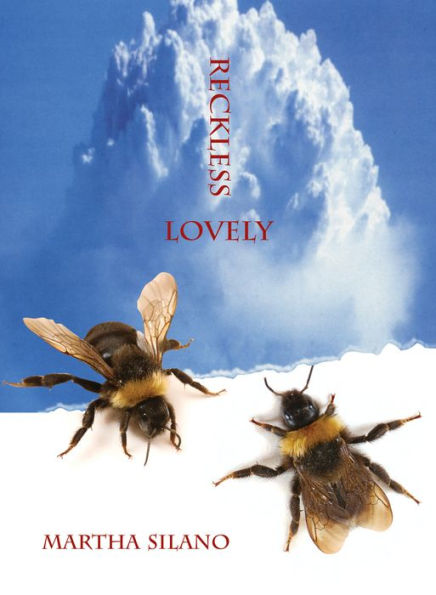
I mentioned Silano’s poetry in a recent post when I appreciated her scientific ideas that meld with an “everyday” life. Reckless Lovely contains many long-lined couplet verses that name objects such as a 64-ounce Big Gulp, Wells-Fargo, Italian Renaissance paintings, or the red spot on Jupiter as the poet observes and speculates on the cosmos that surrounds her. And she invents or alters words that suit her for rhythm, alliteration, sound: “the sfumato is sfumato-ing, the lute-r is lute-ing;” “when most of all that creep-eth/breath-eth buzz-eth/galump-eth sex-eth spar-eth/went AWOL/paving the avenue of asp/the boulevard of bee…” or the totally wild mashup Silano composes in “Summons and Petition for Name Change”:

Dim sum-my dilberry. Down there Daquiri.
Ear of Eden. Eminently Earthy. Empress Gensho.
Fandango-ing funnel. Fox foot. Flamingo.
Geranium in the Gate of the Gourd. Gentian's grin.

~

I find much to admire in Martha Silano’s work even though I often have to look up words (physics and geology nomenclature, usually).

Lesley Wheeler’s most recent book demonstrates her ability with form and sound in a different way, though in “Gran Torino Gigan” the alliteration is as snazzy as Silano’s abecedarian poem above: “Buzzes fade up front,/where beltless adults murmur and smoke//after unfurling musty sleeping bags…in rhizomatic zigzags, with a sharp zipper.” Contemporary technology gets into the poems and, with it, the sounds of our infrastructure, as in “I believe in utility poles, transformers,/lightning arrestors. Subtransmission lines/and static lines. The dead southern yellow pine…” and the theme of fungal connectivity means that we learn some useful and often beautiful mycology terms. Yet Wheeler often relies on shorter words when they suit the tone of the narrative. In a poem dealing with the aftermath of her mother’s death, she writes “No one’s grimmer inside/than me. My bully of a heart wears cheap/scuffed pumps and cusses like a mobster.” The repetition of the word “snow” in “Minus Time” establishes the poem’s pace. So many poems in the collection offer experiments in form!

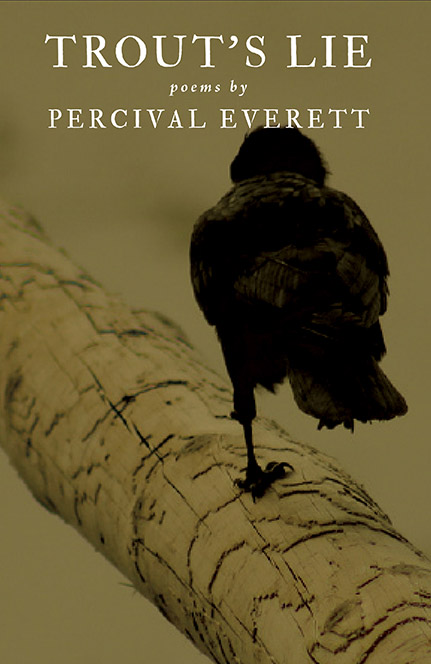
Percival Everett has gained an even stronger following thanks to his novel James, but he’s been writing poetry for years (Trout’s Lie is from 2015). This collection is deceptively simple in language and vernacular: there are surprises. Several poems make allusions to “great poetry of the past” by name or phrase; short lines build and build, twisting the lyric where we don’t think it would go. There are several examples I’d like to give, but this post is getting pretty long. I think I will close with an excerpt from Everett’s “Maybe Even Clouds,” the first section, which begins “Count the marines..”

They look like nice
Boys and bad boys,
From Vermont-and-Montana-
Following-orders-dumbshit-
Non-blinking-soon-
to-kill-soon-to-die boys,
Who might or might
Not, should or should
Not, but never would
Not and never can
not.
Not sure doesn't matter.
Doubt is a penniless
Customer, conscience
Waits for the weather
To change.


National Poetry Month may be almost over, but I’ll keep reading poems. And posting about them. And writing them. I encourage you to do the same, because there is no time in the history of the world when human beings haven’t benefited from poems.

Paper files

Frankly, I have never been much of a fan of organization. I don’t mind planning, in brief and purposeful bursts, but getting things in shape after the fact–once the mess exists–well. I know people who truly enjoy pitching in and re-organizing, but I am not one of them. Besides, I’m also facing similar tasks in my household, rooting through the kids’ rooms (they left years ago) and our attic and basement to cull, straighten up, and organize. The tasks are mutually distracting. And often tedious. I’m working on my attitude, though, trying to find some method of making these chores, er, “creative” in some way. (File under “Lying to Self”).

Call me old-fashioned, I’ll readily admit to it; but lately I have decided that the most efficient way for me to keep track of my own writing is by using a physical filing system. I have experimented with various spreadsheets (I have no patience with Excel, however and alas) and computer folders. I do use the latter for a year-by-year archive of my work, but I cannot easily extract what I am looking for that way. Now that I’ve retired from my 40-hour work week, I have wanted to manage my creative work better and keep track of what needs revision, what seems finished, what has been submitted, what’s been published. That strikes me as a necessary part of tending to myself as a writer. The past year has been a time of working through options, with accompanying irritation and tedium.

Photo by Anete Lusina on Pexels.com

After years of endeavoring to use electronic files, it came to me that there’s nothing wrong with old-fashioned paper systems, organized alphabetically by title, with the computer-file names and draft number at the bottom of each poem. This is how I think about the poems when I want to work on them or submit them, so it feels natural to me. Why operate against one’s own operating system?

I suspect one reason (oh, there are many, but let’s start with one) I am so angry about Elon Musk’s “DOGE” initiatives is that efficiency is never all it is cracked up to be and is also not the be-all and end-all of any society’s best organization. Of course those who push AI believe that algorithmic calculations can make the world run smoothly, but said people are egregiously uninformed about human nature and the myriad forms of individual thought processes. We are non-standard. Averages account for almost nothing, really. We do not think the same thinks. (And yes, I meant thinks not things, autocorrect). Diversity is what keeps evolution going. There is no change without it; and without change, we die.

So: I’m inefficient, to a degree, when it comes to keeping my creative work in order. However, the paper filing system, with a notebook and index cards and files on my hard drive, assisted by my still-useful memory (a human brain!!), have so far been working pretty well. It has taken me several weeks to put my stuff together, but now it’s far easier to fetch what I want to work on, send out, or collate, which I need to do to prepare for upcoming reading [I have two online readings coming up–one on Feb. 18 and one on May 2]. I’m also grateful that the task kept me busy while I was anxious and worried and grieving over recent not-so-terrific experiences in my (physical, real) life. Real life, which is not averaged. Seldom predictable. Inefficient. And something to celebrate for all its strangeness.

Chastened & learning

The temperature got wintry this past week, and now I feel inclined to make chili or giambatta, or savory stews with ingredients such as butternut squash, potatoes, beets, eggplant, cannellini beans. Or polenta, maybe–anything that takes awhile to cook, sending up steam and warming the kitchen so it feels toasty when I come in from a walk. I admit to being a wimp about walking in cold weather. I do it; I know walking in any weather is good for me and I bundle up, but my walks are decidedly shorter. Even on sunny days.

Today was not a sunny day.

And to my dismay, the downy woodpeckers are back again, hammering at the wood on our house. The one on the left banged into a window, but generally they cling to the boards. I wish they would drill at the many dead trees along our property line; they’d have more luck, too, if they’re seeking food. By the way, this photo is 10 years old. Now I would know not to handle a wild bird with bare hands because the oils on human skin are not good for feathers. (Three decades of educating myself about my own environment have chastened me–there’s so much I don’t know.)

I also don’t know which of my own poems are any good, or which ones to send to which journals, or whether I should care. It’s oddly heartening–and honestly, NOT schadenfreude! (because I get no pleasure from it, merely a sense of community)–to read in my colleagues’ social media posts that “rejection season” is here. I am not the only one whose poems have returned lately. Lesley Wheeler writes: “Magazine rejections have been trickling in, too, although mostly the please-try-us-again kind, and I know enough about editing now to really appreciate those.” I have had a number of those, too. And I’ve been an editor, so I get it, and I am appreciative. But I am mystified nonetheless–after 40 years, why am I so clueless at this sort of critical analysis? When I sit myself down to submit poems, I tend to find all my work lousy or, looking at the poems I think may be good, realize I lack any idea of where to send them–even though I am a frequent and avid reader of online and print literary journals. You’d think I’d have gleaned something about poetry the way I have learned about my geological region, its seasons, critters, viruses, predators, bloom times, pruning times, sowing/planting times and such.

Equally chastened by poetry’s landscape, I guess!

Practice makes poetry

I’ve been challenging myself to write 7-line poems lately. Half-sonnets? Not necessarily. Just an exercise in writing a poem in brief. I have used haiku and tanka as brevity/image exercises in the past, and that work has been helpful. While I seldom write poems that are longer than, say, 30-35 lines, practice with conciseness never hurts, especially when my inclination is to go narrative.

I’m not knocking narrative poetry: I love it. Love reading it, love writing it–especially the lyrical narrative. In addition, I’m a big fan of the discursive and tangential in poems and essays (looking at you, Ross Gay). But one does tend to fall into familiar territory, and it’s useful to push away at what’s easy. That means, every now and again, trying something unusual: persona poem, aphorism poem, Spencerian sonnet, cadralor, surrealism, slant rhyme, golden shovel, or an invention of one’s own…something to freshen up the craft.

Many writers I know rely on prompts for imagery, language use, theme, or topic. For some reason, that sort of prompt seldom gets me really working in a new vein, though I can get a poem draft or two that way. Using a form, trying something new with how the words land on the page, is much harder to do (for me)–and therefore, more useful. I honestly want to feel as though I am working at poetry, doing the good and rewarding sort of work during which I learn new techniques and rediscover how craft can deepen meaning.

Real work takes practice. And real practice doesn’t actually lead to perfection. It leads to new explorations and revelations. There’s my wisdom-for-the-day to poets who are just starting out.

practice doesn’t make perfect…

Many amazements

Subscribe to continue reading

Subscribe to get access to the rest of this post and other subscriber-only content.

Headlines

Headlines. They make us so worried, so anxious, so scared. That was true when I was a child, in 1968; it’s true today. The poem below, which appears in Abundance/Diminishment, is one I wrote eight years ago. It remains relevant. And it is an April poem.

~

At a Birdfeeder

Woodpecker works at sunflower seeds
intent on his hunger
deaf to blackbirds’ territorial ambitions,
wooing robins, chickadee’s agitated perch & dip
at feeder’s edge.
Woodpecker makes of his head
a bright gimlet, his claws anchored on an eyebolt.

I watch a redwing drift
on the last morning breeze of April,
a spider’s line trimming the porch rail.
Woodpecker revels in the easy meal
we’ve provided, doesn’t know
about the sack of seed in our garage,
the price of bulk feed, acres of sunflowers
blooming in Iowa, Kansas, Mexico
chaff at the processing plants
allusions to van Gogh, pollen-packed bees
in their yellow jodhpurs.

That’s human knowledge: mine,
yet I’d rather dwell on turkey calls
vibrating the nearby woods, the labor
of wild cherry petals landing on dew,
grass, and feeder where the woodpecker—
still famished—writes the morning news
in bold headlines amid hickories,
that being all the news that matters
in this moment.

~

Interview & discussion

This TV interview was interesting to participate in, and I loved chatting with Marilyn Klimcho! She put me at ease, which is hard to do in front of cameras. I have watched the whole 20 minutes without hating myself or feeling too embarrassed. (Hooray?)

Is the show entertaining? Well…you have to be interested in poetry and poets, I suppose. Feel free to check it out. The link above should take you to the YouTube video.

~

National Poetry Month does, it turns out, raise the public’s awareness of poetry at least a little. Recently, I was invited to be a guest at a weekly online discussion of poetry and spirituality. The participants had been reading and discussing my poem “Deity’s Diary” and asked me whether I’d be available to read the poem and then discuss it with the group members at one of their meetings. They even sent me recordings of previous meetings’ discussions. I find it fascinating to learn how readers interpret my poems, what they get out of the work; so of course I obliged.

The group members asked intriguing, intelligent questions–clearly, they are accustomed to talking about poetry. That was refreshing, and it kept me on my toes. I learned that my poem (which is in four parts, so maybe it is poems) is doing the work I hoped it would do, at least with this group of careful and reflective readers. “Deity’s Diary” is intentionally paradoxical and questions many of western culture’s received ideas about god. It’s also pretty presumptuous, since I chose to write it in the persona of a deity…but, like all poems, it is decidedly a work of the imagination. (No, I do not consider myself a god!)

The discussion ranged from philosophical, scientific, and theological concerns to the nuts and bolts of writing and revising a poem, where I get my ideas, what the major influences on my work have been, and lots of other topics. Seldom do we lesser-known writers get to hear back from readers, especially in such detail–so this event felt like a real treat to me.

One participant said that reading these poems was like walking through an unfamiliar forest, not on a straight path, with possibilities of obstacles and turns in the track and the surprise of wildflowers, mosses, or lovely birds along the way.

That made my day.

Au revoir, institution

It was not a huge surprise–the proverbial writing has been on the metaphorical wall for some time–but the college I attended for graduate studies has announced that it is folding.

In January 2001, shortly after I won a grant in poetry from the PA Council on the Arts, I rallied myself and my work, packed a bag, and took the family car by myself to Vermont for two weeks. In a burst of confidence and enthusiasm post-grant, I’d applied to creative writing graduate programs. There were none nearby enough to commute to, and Goddard’s low-residency model seemed my only choice. Well, I could have abandoned my husband and young children and moved to another area, but that seemed untenable and unkind.

But Goddard was perfect. I met new people and made (so far) lifelong friends-in-writing and friends-in-feeling. The work challenged me; the reading was intense! When I look at the bibliography at the back of my thesis, I admit I wonder how I managed. Hard work, intellectually demanding work, constant revision. Well, I needed less sleep in those days. Many times I read and annotated while waiting for my kids while they took piano lessons or riding lessons or whatever they were doing in middle school.

Sometimes my parents or spouse spent a Saturday or Sunday with the children so Mama could study and write. It is kind of a blur, but the community of fellow students seemed so supportive at the time. It’s not that I was without supportive people in my life–but the folks at Goddard, students and faculty, deeply understood my passion for writing. I found I could spend hours talking about things that matter to writers (which is kind of everything, but also, WRITING), which wasn’t easy to do in other areas of my middle-aged, middle-class, mom-life existence.

The iconic Goddard College Clocktower

Goddard often has been termed an “experimental” college. That term covers a whole host of meanings in the world of education. No point in trying to define it, since one thing that experimental institutions tend to do is change and evolve. The program I attended in 2000-2003 differed from the programs of 1985 or 2015. Which is as it should be–education should not be a static set of activities even when some exploration of canonical texts is necessary. One reason I chose to pursue my education at experimental colleges (The New School, Thomas Jefferson College, Goddard) is that I am a slightly odd bird, an autodidact who did well enough in standard subjects but who got the most benefit from deep study of things I felt passionate about–literature, history, botany, poems, dance, philosophy, feminism, visual art. Experimental colleges offered mentors who could guide me in self-directed learning, recommend books and authors, feed my often-changing interests, offer personal, one-to-one advising and critique. I am 100% sure I would not have excelled in universities that followed more standard educational subjects and protocols, and I’m glad I received good guidance (usually) and a well-rounded, if eclectic, education.

Many of the poems in my book Water-Rites are from my time at Goddard, since Water-Rites in an earlier form was part of my graduate thesis. And a fair number of the poems in The Red Queen Hypothesis were first drafted during my years there, when I was experimenting with forms. So, having just learned for certain that Goddard will cease to function as an offbeat, transformative, self-directed institution of higher education–thus joining my undergraduate school, Thomas Jefferson College of Michigan, as defunct institutions–I will post a poem that I know for certain I drafted just before I graduated. It’s a response to the events of 9/11 and was not quite ready, nor suited, for inclusion in my first collection; it appears in The Red Queen Hypothesis and Other Poems.

~

Shreds
for Judith

We ran, leaves before a bitter wind,
& some ran headlong & some in circles,
we did not know what to do with ourselves,

& watched, pressed to our windows & could
do nothing: streets erupted with people
like clustered beetles wakened from dormancy.

We walked, in all directions but mostly north,
& we were silent and our mouths were dry.
Things like shoes and hats made us human.

We wept and it was not sufficient,
& swept, then, for months & recalled
mostly paper, the ways we occupy ourselves,
the mild wind carrying what lingered. Scraps.


(after “Exhibit 13,” Blue Man Group, 2002)


~

Abundance!

In all my born days, I’ve never had a Poetry Month start off with such an abundance of publications–and, as it will probably never happen again, I’m going to post the links here.

Siren for Somebody Else” offers a mother’s perspective on waiting, unable to get to sleep, for a child who is out late on his own. It appears in RockPaperPoem.

Interpreting the Conversation from Another Room” shows up in Stick Figure Poetry #13. The poem originated during the years our son lived with us and played online multiplayer games in his room, but it morphed into something a little more sinister.

Fevered” came almost out of nowhere but resonated with some early readers who contend with mental and emotional challenges. It’s also a poem about love and compassion, I suppose. The journal Philadelphia Stories published it in the latest issue.

Gyroscope Review is a print journal that also offers a Kindle and a PDF version, the last of which is free to download, though the paper book is lovely and only $12 on Amazon. My poem “Bach and Birdsong” starts the issue off…a meditation on springtime.

Whew! This post goes with my “Gratitude” post of last week!

~ The poem below appears in my chapbook Small Things Rise & Go, FootHills Publishing:

Nap in a Treehouse

Alone in my children's treehouse,
I read 300 poems from the Chinese.

Sunlight slants over the cornfield,
flies buzz, the afternoon is warm.

This first day of autumn,
insomnia's caught up with me.

After so many sleepless nights,
I doze with Li Po and Tu Fu.
~