Not a dry spell

October arrived in a remarkably ordinary way, considering how inconsistent the weather in my valley has been during the past year. There were a few clear days of brilliant sky, some heavy breezes with leaves beginning to drift into the lawn, a couple of glorious autumn days–mild and crisp–followed by a spate of rain and humid air (and toadstools and mushrooms cropping up everywhere), a further yellowing and reddening of foliage, and then, chilly rain.
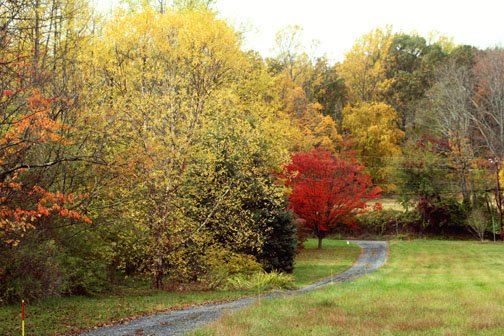
This is “normal” weather for our area in early- to mid-October. Although the heavy skies and damp chill are not always welcomed by residents, including me, the gardener in me feels relieved. We need the rain and the coming dormancy. The birds relish the late, large insects that frequent gutters and fields, ponds and puddles, providing proteins for a trip south or for winter ahead. Seeds need the watering-in and the cooling-down. Trees need reminders to store their nutrients deep inside when the cold air really sets in.

And pretty soon, I will have bulbs to plant. I want the soil to be moist enough to dig up and the ground temperature cool enough to keep the daffodils still and quiet for several months.

Some years, I write prolifically in autumn; it’s as though the change in season effects a kind of transition within me, and creativity abounds. Other years, not so much. I do notice that when I spend a good deal of time out in the garden, I write more. This fall has not been that kind of season. I have been busy with writing tasks that do not exercise the philosophical or metaphysical side of myself–though I have been writing, most of the work has been reviews, proposals, pedagogy.  I will be posting links to the reviews and essays on the sidebar to the right, adding to the list…

Should fortune–and the Muse–smile upon me, there may be a few new links to poems, as well, in the coming weeks. In November, I’ll be giving a few readings locally. In January, I’ll be teaching Introduction to Poetry again, and I’m eager to try new texts for my students.

Perhaps the post-equinox period will have a creative harvest after all.
Poetry, art, & a little bit more about libraries

After writing about some memorable libraries lately, I realize that I have been able to pursue my passions–indeed, discover my passions–largely through the help of these marvelous civic institutions. It is time I brought my posts back to those passions, however, particularly to my love of poetry.

My family introduced me to poetry through nursery rhymes and hymns and taught me to love narratives through story-telling of several kinds, so the foundation for my lifelong love of stories and poems existed before I ever set foot in a library; but books solidified and focused my various enthusiasms, and libraries offered more books than I could hope to read (though I tried!). Libraries led me not only to novels and poems but to books on visual art, art museums, artists, art history, and art criticism. If I couldn’t get to the Louvre or Rijksmuseum, to Venice or to Rome, I could borrow an art book from the library and be on my way via imagination.

When I got to college, I spent many hours in the library on campus borrowing books I couldn’t afford to buy. Few of those books were required for my academic studies; in fact, I don’t recall doing much research for term papers. I was reading up on and diversifying my own interests, often unrelated to coursework. A look back at my undergraduate transcripts reveals only two classes specifically devoted to poetry, but I recall reading many poetry collections in the campus library. As a junior, I had a work-study job in an office in the library basement. When my hours were up, I’d walk upstairs to the stacks.

I was finding my own way to what I loved.

~

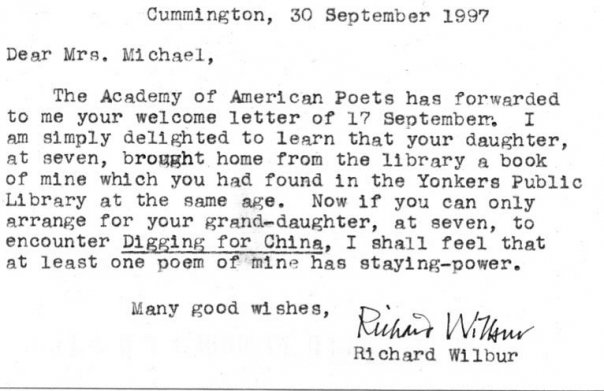
Needless to say, once I had children of my own, we visited the library often. Years ago, I wrote to the poet Richard Wilbur to tell him about my 2nd-grade daughter’s encounter with Digging for China and how, nearly 30 years earlier, I had been fascinated by the book too. He replied with this modest note. June 2009, I saw Wilbur at the West Chester Poetry Conference. What a talented writer, and what a sweet man.

~

Richard Wilbur

Short books and re-reading

~

clockWhen life gets busy and over-scheduled, even an inveterate reader may find she has to give up some of her precious book time to life’s other adventures and responsibilities. Philosophy and meditation require enough time for reflective, slow thinking; a hectic week precludes such activities. Creative thinking gets funneled into problem solving of a more mundane and practical variety. Creative writing? It may have to move, temporarily one hopes, to a back burner.

Last week was one of those over-scheduled periods when I take advantage of brief, unscheduled minutes to read short books. The beauty of reading short books is that the best short books reveal depths upon re-reading–one of the beauties of poetry as well. And if those short books happen to be books of poetry? “More’s the better,” as my great-aunt used to say.

During my crazy week, I managed to read three short collections of contemporary poetry, all by poets with whom I am personally (if marginally) acquainted. All three books are wonderful: layered, varied, well-crafted, interesting, moving, refreshing, surprising reflections on and of modern life with enough empathy and reach toward the “universal” to keep the poems valuable beyond today’s context. All three books are going on my re-read list so I can study and savor them again later, yet each collection is vivid and entertaining enough to read when crunched for time.

~

Will Greenway’s 1999 collection Simmer Dim was published by University of Akron Press and offers the reader a travelogue to many places in the world without as well as the more interior worlds of memory, relationships, and reflection. Greenway writes in both free verse and in rhyme, which he employs so well it seems natural even in the informal diction his work often takes.

April Lindner’s 2012 collection This Bed Our Bodies Shaped was published by Able Muse this summer. The poems offer the sense of a personal speaker, suggesting intimacy that is revealed subtly through well-crafted lines and images of flowers, scene-settings, and  allusions from the classic to the modern (rock n roll). Lindner presents the woman’s perspective as individual, surprising, and non-stereotypical; when she writes about jobs, a lover, motherhood, or menopause, her observations are often quirky but wonderfully observed.

Elaine Terranova’s 2012 collection Dames Rocket was published by Penstroke Press. I love Elaine’s work, steeped as it is in the natural world, plausible and tactile, yet positively ascendant in tone. Her memoir-type poems evoke the kind of childhood that is fast becoming historical, and her awareness of that fact–the fact of aging–gives these pieces poignancy and occasional irony.

~

All three books are also available on Amazon.com. Or ask your librarian to locate a copy for you.

Amazon…

The second week of August is always a busy one for me. There’s little time for reflection–or writing.

I do have some news to impart, however: Water-Rites is now available on Amazon.com at this link. In the best interests of my publisher, Brick Road Press, I’m going to request that you order from the press itself if you can.

Thanks!

Ambition & failure

Some of my non-writer friends are surprised to learn that I am in the process of trying to get a new book into print. After all, Water-Rites just came out! So shouldn’t I be concentrating on selling that book and resting on my laurels awhile? To be sure this collection is a “success” before continuing on?

Those who write poetry or literary fiction, however, recognize that by the time a book finally gets published, the work in it is “old.” We are already well into new projects, working on new ideas, using new styles to express ourselves, addressing different topics. If I were to wait to write new poetry until after my book got into print, I’d probably never write another collection. The economics of the poetry world are too close to what Lewis Hyde calls the “gift economy” to imagine we can stop writing, sell a book, live off of the income and then write another one. Even many best-selling authors cannot do that. Poets are lucky to sell 500 copies of a book. We write for other reasons. Need. Love. Ambitions of a non-monetary kind.

Like all artists, poets take risks. Sometimes the changes we make in our work are not well-received. Sometimes they aren’t any good. Failure, however, can be a most excellent instructor. Sometimes, to shake myself up when the writing seems stuck, I attempt a completely different activity. Gardening clears my mind, and gardening offers many chances to fail at what I do. I’ve also tried watercolor painting, sumi ink calligraphy, modeling clay, embroidery, dancing, piano, and many other endeavors. I cannot claim to be remotely good at any of them yet each of these pursuits has taught me much…often through my lousiness.

janis ian

Janis Ian, 2012. Photo by David Sloan.

Recently, Janis Ian–singer, songwriter, science fiction author, and philanthropist–offered the commencement address at Warren Wilson College in Asheville, NC. In her speech, Ian talked about being self-taught; being a self-taught success. And she had important things to say about failing, as well. She said, “We are rarely asked what success really represents to us, or why failure is so demeaning.” Then, she admitted that she herself had always avoided failure but that at a point in her life when she felt unhappy with everything she was producing, “I had to learn to fail before I could find my way again.”

Her approach was to take ballet lessons! At age 33. And she was awful at it, but she enjoyed doing it. Then she attempted other things at which she was terrible, and she learned to overcome some of her fear of failing.

An autodidact myself, even though I do have academic degrees, I found I could easily relate to Ian’s experiences. The part of her speech that spoke to me most was this section:

“You see, I am an artist. I believe that art saves. I believe it is often the only thing that stands between us and chaos. I have faith that while the world is crumbling, art survives. So to feel like my work was a mockery of what I could do, that I was not living up to my talent…well, it was killing me.”

Art requires us to do our best, to be ambitious and strong, to take risks and –occasionally– to fail. To fail spectacularly perhaps, or just to produce a bunch of small, humiliating, stupid failures…like dancing badly in your own room where no one can see you.

But dancing can feel so wonderful, so freeing, so different from writing! It’s worth doing badly. Sometimes when we have less at stake, we find new methods of expression and new ways to keep our fears, including the fear of failure, at bay.

~~

The full speech is available on Warren Wilson’s site here.

Flame and ash

I have often imagined what it feels like to lose everything in a fire. Particularly if you are a writer or painter, and you work with easily consumable tools–paper, for example. Maxine Hong Kingston has been articulate and interesting on this situation; perhaps it was her well-reported experience that first got me thinking about how terribly affecting such a loss would be. In 1999, a friend of ours whose business is woodworking lost his shop, tools, work, and wood in a workshop fire. The shock was the worst part–like Hong Kingston, our friends had been away from home and returned to find cinders where their livelihood had been.

Last week, Michael Czarnecki, publisher and sole proprietor of FootHills Publishing, was vacationing in Maine when he learned his house and business had burned to the ground. I have heard that phrase before–but it was literally the case: to the ground. With the loss of clothing, memorabilia, musical instruments, furniture, etc. came the loss of livelihood and the loss of FootHills’ archive of 20+ years of small-press publishing. Many, many books went up in flames, a life’s work.

Paul Martin's chapbook

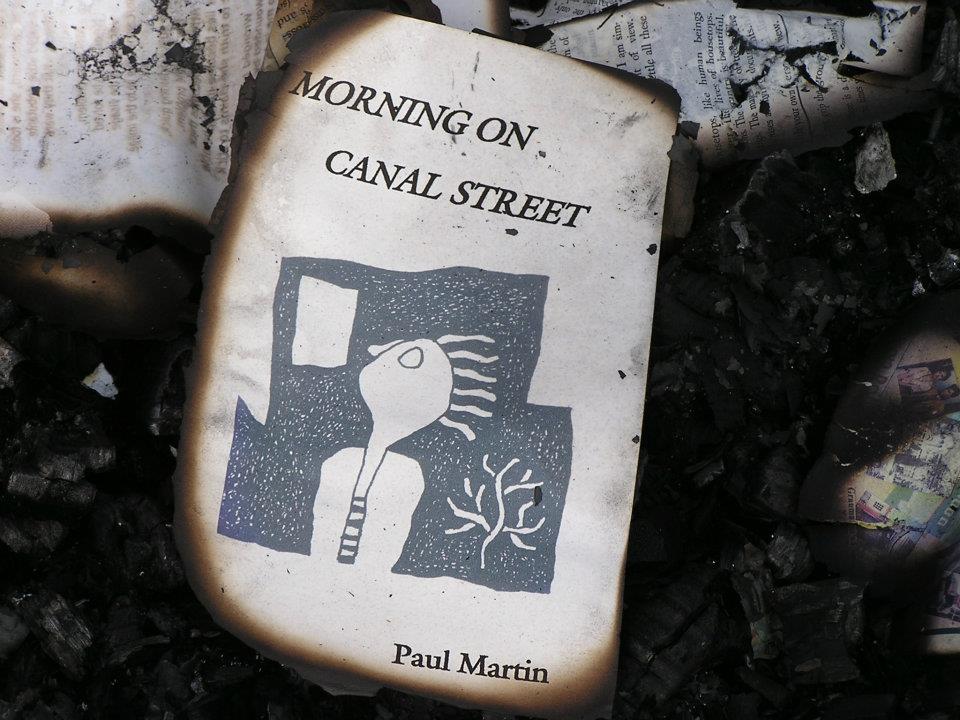
Paul Martin’s lovely chapbook Morning on Canal Street, FootHills Publishing.

Michael has been documenting the remains and posting images on his Facebook Page. Pictured here, what’s left of a copy of Paul Martin’s chapbook, one of the few that were still recognizable after the tragedy. Paul is a colleague of mine, and this photo makes me sad.

I am sure Michael has not yet done a full accounting of his destroyed inventory. The two books of mine he published are certainly among the casualties, and I feel a selfish pang over that. If he gets the press up and running again–and he plans to (he is an optimist and a hard worker)–he’ll probably try to reprint at least some of the 300 or so books FootHills has produced over the years. The more recent books will be easier to reprint, as he had his computer with him and it was not lost in the fire…pdf files of some of the books are intact. But the “history” of the press…its archival, early chapbooks, may be gone for good.

Once again, I reflect on ephemera. One of the most moving photos Michael took is one of his sons’ birth certificates, charred, the edges the same color as the tiny footprints that are still visible. We are so vulnerable.

And we endure, too. Our art helps us to manage these difficult passages. Love helps us navigate the ashes.

If you are interested in and financially able to help FootHills Publishing recover and rise, phoenix-like, from the ashes, you can go to the FootHills website and donate through PayPal or send a check to

FootHills Publishing
PO Box 68
Kanona, NY 14856

Thanks very much. As Michael Czarnecki says, “Never stop asking for poems.”

Poems that help us to endure

I’ve recently completed reading Eugenia Semyonovna Ginzburg’s memoir Journey into the Whirlwind. What has struck me about the memoir is, in particular, Ginzburg’s reliance on poetry as a means to enduring prison, deprivation, oppression.

In several selections, she reiterates how reciting or recalling poetry–Pushkin, Pasternak, Blok, Mandelstam, and lesser-known (to us Westerners) poets such as Tyutchev, Chorny & Nekrasov–gave her hope or encouraged her to keep on in the face of awful situations, or just to remind her that others have endured harsh and terrible conditions and found the means to express themselves despite it all.

I believe poems–and art of all varieties–help us to endure. Some poets who have helped me to endure include Anna Akhmatova, Mark Doty, Mary Oliver, Gregory Orr, John Donne, Yehudi Amichai, Stanley Kunitz, Donald Hall, Emily Dickinson, Adrienne Rich, Marie Ponsot, and others. Too many to name.

Who has helped you to endure? Whose art, whose poetry, whose stories, whose music?

When we reflect on these creations, perhaps we can learn more about ourselves.

Love is all you need?

My daughter made this collage when she was nine years old. This is a poorly PhotoShopped version (the original has faded pretty badly):

~

Love is all you need

I was listening to The Beatles recently, music that takes me pretty far back into my childhood. I’ve been thinking about musical cues to memory for another poetic project on which I am currently working, so the concept of music evoking imagery, subjects, memoir has been uppermost in my mind. More on that project perhaps later, when I have arranged my thoughts more cogently. Meanwhile, some thoughts on “All You Need is Love.” Or more correctly, some musings that begin with “All You Need Is Love.”

When I was an adolescent, that Beatles’ song seemed to signify on several levels. One level was the universal: Love as the root of human sharing, as the means to peace and understanding, as the solution to the Big Problems. Another level was the romantic: Love as the way to solve personal loneliness, finding the partner with whom I could mesh, forge a permanent and personal understanding.

Love as solution. I view that ‘philosophy’ as a non-philosophy now; it is simplistic and impossible. Love is not a solution; it is a verb, active and engaging. Love certainly does not fix things. Its necessity, however, I do not question. Not for those who wish to be fully human.

Wait, you’re going to object–love is a noun, too. In most dictionaries, love as a noun is the entry before love as a verb. Arbitrary on my part to assert precedence for the verb, but I am cautious of abstractions even though I relish philosophy. Love as noun is abstract.

Merriam-Webster: “strong affection for another arising out of kinship or personal ties.” My OED (compact, print edition) contains 9 columns defining Love as a noun and two defining Love in the verb sense.

When I say love is a verb, I mean that in definition 3b in the OED: “to entertain a strong affection; in the reciprocal sense” and 4c: “to take pleasure in the existence of (a virtue, a practice, a state of things) in oneself, in others, or in the world generally.” Love need not be reciprocal, though that feels best to us–hypersocial beings that we are (see my post on Brian Boyd). Love is the greater part of compassion, in which case love is something we do.

I know people who have chosen to take their own lives. A few felt the sense of despair that comes from feeling there is no love (and therefore, no hope). But that is not always the case; some who took their lives did feel love, knew love deeply, knew that others loved them and would miss their physical presence. Love was not all these people needed.

And love was not the solution.

I think we damage ourselves when we believe that love is the solution to our problems. We need other strategies, other fullness in our lives, the tools to overcome or bear with many obstacles; we need perspective and humor and grace. Love alone, in and of itself, doesn’t make peace break out. It does not solve all the issues in a truly profound and sharing relationship–not on its own. Love needs other actions, and other abstractions (trust, communication, compassion, patience, for example) to do its work. It does not solo well–that is not what love needs. Altruism cannot exist in a vacuum, nor can romance, nor compassion.

It takes some effort not to become sentimental here (but Bachelard defends a certain amount of sentiment…)

This is not my definitive post on the subject of love! I need to read more philosophers on love, and to consider love’s evolutionary role, and its spiritual role, in human existence. I’ve done reading on t his in the past, but it was all very long ago. Now might be a good time to begin anew (since “I was so much older then, I’m younger than that now”).

Berries

My region, like many others, has been sweltering through a heat wave lately. The mild winter pushed bloom times and fruiting times a bit earlier than usual; blackberries started ripening ten days ago, and now we have blueberries before July.

But not much before July. In celebration of blueberries and other joys of summertime, here’s a poem from my collection Small Things Rise & Go.

The Blue of July

We pick the first blueberries
while lilies gape at us,
peering over their green fans.
Birds’ tirades scatter over wind
and into our ears,
buffeting us with scold and caw and
something not melody but song:

a song of fruit, of seeds and
mealybugs and inchworms,
the wild clack of bamboo
or maple branches.

Summer’s like a mulberry,
a blueberry, dark and vivid.
It stains the day sweaty,
leaves bright pollen on our noses
as we inhale the sun

on lilies, as white clover gathers
like clouds upon the grass
and, sweet in our mouths,
the day explodes—blue.

~

A note to anyone who has ordered or wishes to order Water-Rites: The order has gone to the printer. Possibly 2-3 weeks before my book is in your hands. Many thanks.

Control

middle island ~

Human beings crave control. We want to be the masters of our own fate or to believe that there is a master of our fates who can be entreated or persuaded, propitiated or cajoled into helping us to gain control of our lives or the lives of others. We want to change the weather so that the rain falls when the soil needs rain, wetting the seeds we’ve sown, and so that the warmth comes when our plants need warmth. We want the sea to be calm and the fog to lift when we are ready to set sail. We want fine, sunny days when we visit the beach to swim or head out for a picnic. We want just enough snow so that school’s canceled, but not so much that our power goes out. We pray. We dance. We chant. We invent little private rituals and participate in community rituals.

We want to control our health. It does not seem to be an unreasonable aim. We want to control our relationships–just enough to keep ourselves happy. We want control over our careers and  our income–not so much to ask. We want to be able to make our own decisions. We want choices so that we feel we have control over our lives.

My gardens are my analogy today. I’m still endeavoring to exert some control over my vegetable garden, but I kept my purposes modest this year; I planted fewer beans, fewer tomatoes, fewer peppers, fewer potatoes, no onions, no peas, no edamame, no radishes…the walk-through rows are wider so it is easier to weed. Beginning with the dry warm winter and some assemblies of challenges that do not pertain to the garden, the season looked “iffy.” Then came lashings of showers in May. A challenging season, but not insurmountable. I have been gardening a long time, and I have methods of adapting to things I cannot control. It comes with the territory.

The ornamental beds have presented the most difficult struggle with my need to control the space I (somewhat ridiculously) consider my own. When the beds get overgrown–as they are now–I know that I can accept their exuberant rioting with the successful weeds. I can say, “This is what nature intends. There is beauty here.”

overgrown

I do know that. But the controlling mind–the monkey mind–says, “Too much penstemon; it’s gotten aggressive. Deadhead the peonies. Pull up the plantian, the wild asters, fleabane, wild garlic, crabgrass, bermuda grass, creeping charlie, five-leaf vine. Get the seedlings out of there (mulberry, redbud, oak). Mulch. Keep the rabbits off the hostas. Move the marybells. Get the weeds out of the alchemilla…”

My head clouds with fog. The seas get rough and I despair, because I cannot control things. Not even a small garden.

Instead, I could be meditating on green. On the amazing variety of leaf-shapes, on dappledness (like G. M. Hopkins):

Pied Beauty

Glory be to God for dappled things—
For skies of couple-colour as a brinded cow;
For rose-moles all in stipple upon trout that swim;
Fresh-firecoal chestnut-falls; finches’ wings;
Landscape plotted and pieced—fold, fallow, and plough;
And áll trades, their gear and tackle and trim.

All things counter, original, spáre, strange;
Whatever is fickle, frecklèd (who knows how?)
With swíft, slów; sweet, sóur; adázzle, dím;
He fathers-forth whose beauty is pást change:

Práise hím.

~

Here is one aspect of my ornamental garden. Overgrown, yes. Lush, diverse, lovely in its unrefined way. Until I have the wherewithal to tear through and divide and move and mulch, this is not a bad view, the definition of … lack of restraint, ornamentals gone wild. Freedom, I suppose.

A little too much of some good things.

As we grow, we learn to let go. So I am told. Garden, you have a chance to go wild!

And I guess I have the opportunity to learn to live with that.